- Forecast Value (2035): 7.2 Bn
- CAGR (2035): 18.4%
Medical AR Systems Market Outlook 2025 to 2035
The global medical AR Systems market is expected to reach USD 7.2 Billion by 2035, up from estimated value of USD 1.3 Billion in 2025. During the forecast period 2025 to 2035, the industry is projected to expand at a CAGR of 18.3%.
Medical AR systems market can be described as an area of increased demand due to the need to utilize precise surgeries, immersive medical training, as well as, improved patient care. The combination with AI and IoT, as well as imaging system, enhances the accuracy and efficiency of the procedures. The growing use of minimally invasive procedures and digitization of healthcare also drives the use of AR solutions in hospitals, surgical units, and training facilities worldwide rapidly.
Quick Stats for Medical AR Systems Market
- Industry Value (2025): USD 1.3 Billion
- Projected Value (2035): USD 7.2 Billion
- Forecast CAGR (2025 to 2035): 18.3%
- Leading Segment (2025): Hardware (40% Market Share)
- Fastest Growing Country (2025-2035): Japan (17.8% CAGR)
- Top Key Players: Augmedics, EchoPixel, Medivis, SentiAR, Medtronic, Siemens Healthineers, Philips, Zimmer Biomet, Lucid Reality Labs, and vStream Health.
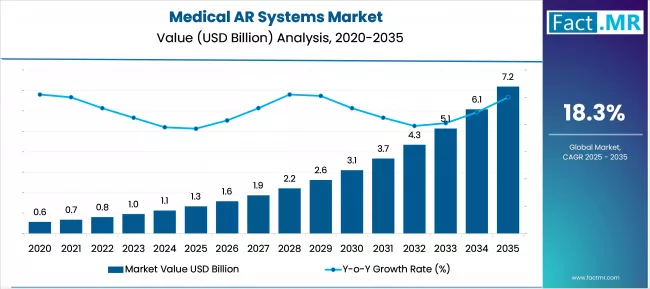
Medical Ar Systems Market Market Value Analysis | Source: Fact.MR
What are the key factors driving growth in the Medical AR Systems Market?
The major driving forces are the increased need to have more precise surgeries, medical training that is more immersive and the improvement of patient care. Combining AR and imaging technology and AI allows minimizing the number of mistakes in the procedure and accelerating the learning of new skills. The growing use of minimally invasive procedures and the need to transition to an electronic healthcare system continue to accelerate the use of AR systems worldwide.
What are the key trends driving growth in the Medical AR Systems market?
The fast-changing nature of AR hardware, software, and cloud-based systems is revolutionizing healthcare delivery. The trends are wearable AR headsets, AI-assisted visualization, real-time imaging overlay, remote surgery support, and interactive training simulations. Hospitals are moving toward scalable, modular and interoperable AR systems, whereas software providers aim at intuitive interfaces, multi-organ applications and compatibility with robotic and imaging systems.
What factors hinder the growth of the Medical AR Systems market?
The cost of implementation is high, the integration with current hospital infrastructure is complicated, and regulatory obstacles do not allow adoption. Issues relating to training of clinicians, precision of the device and its fit with the old systems could delay adoption. The privacy of data, the issues of cybersecurity and constant updates and maintenance may restrain extensive use, especially in smaller hospitals and new markets.
What are the key regional trends driving Medical AR Systems Market growth?
North America
The largest in the medical AR systems market is North America and this is attributed to the fact that the first in the market to adopt the AR system was in hospitals, surgical centers and training institutes. The intensive implementation and new applications in various clinical areas become possible with the help of strong research and development, advanced healthcare systems, and the ability of artificial intelligence, Internet of Things, and robotic solutions.
East Asia
Rapid growth of East Asia has been achieved through urbanization, higher expenditure on healthcare and government policies that promote adoption of digital medical infrastructure. AR is increasingly widespread in hospitals and research facilities, with or without international partnerships between local and international technology suppliers, in surgery and training, as well as patient care.
Western Europe
In the Western European region, the market is growing and hospitals and surgical centers are embracing AR as the solution to the precision-guided surgery and virtual medical training. It is helpful when regulatory assistance, developed engineering, and partnerships between technology companies and medical professionals can be applied in the context of high-performance and scalable AR systems to foster the adoption.
Country-wise Outlook
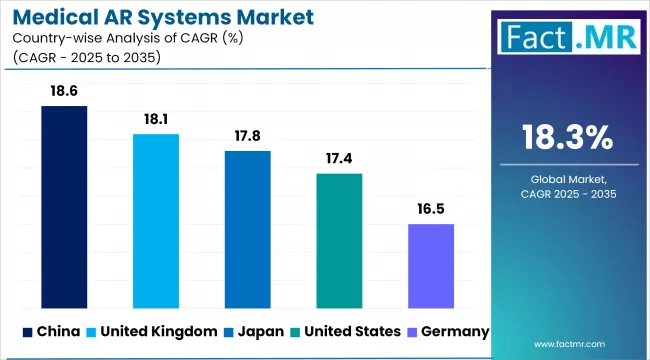
Medical Ar Systems Market Cagr Analysis By Country | Source: Fact.MR
Technological Innovation and Clinical Precision Drive the United States’ Medical AR Systems Market
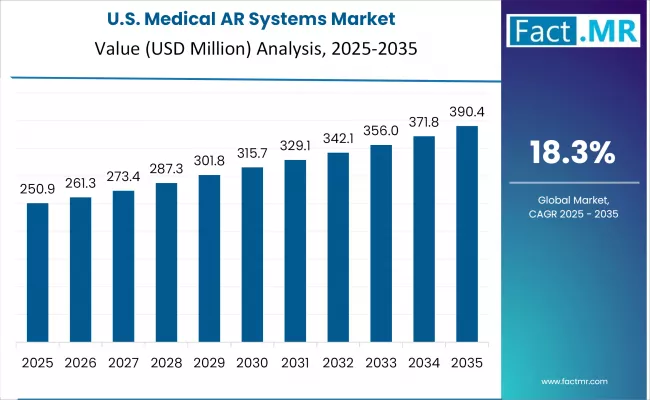
Medical Ar Systems Market Country Value Analysis | Source: Fact.MR
The American market of the AR systems used in medicine is booming as hospitals, surgical facilities, and training centers implement AR in an attempt to improve the accuracy of their procedures and provide a more realistic learning experience. The providers are incorporating enhanced headsets, glasses, and software platforms to enhance surgical navigation, patient care, and medical education. Innovation is supported by strong R&D, regulatory compliance, and the drive towards AI and IoT-enabled systems, and AR solutions are becoming more important to enhance the results, efficiency, and clinician skill development in healthcare facilities in the United States.
Engineering Excellence and Regulatory Support Propel Germany’s Medical AR Systems Market
The market of medical AR systems in Germany is flourishing where hospitals and surgical centers are deploying high-precision AR to carry out minimized invasive surgeries and conduct medical training. AR hardware is modular, IoT-enabled, and durable making it reliable when used extensively. A combination of local and international businesses works to provide scalable, energy-saving, and sophisticated solutions, and the high-quality regulatory frameworks and emphasis on clinical safety make Germany a center of AR use and innovation in European healthcare.
Technological Advancement and Healthcare Modernization Fuel Japan’s Medical AR Systems Market
The Japanese market of medical AR systems is developing at a high pace because of the rising necessity in accuracy of surgery, higher medical training, and optimization of patient care. AR is being incorporated in hospitals and research centers together with imaging and AI-based surgical planning and education systems. The partnership of local innovators and international techno bases will provide access to durable and high-performance AR technologies. The government efforts to modernize healthcare facilities and encourage the use of technologies also contribute to increasing the growth in the Japanese market.
Category-Wise Market Outlook
Hardware Segment Leads with Advanced AR Devices
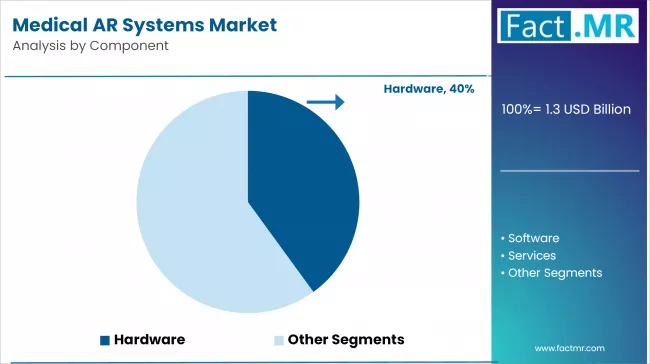
Medical Ar Systems Market Analysis By Component | Source: Fact.MR
Hardware sub segment is increasing at the most rapid rate by increasing need of high-precision AR headsets, glasses and wearable in surgical, rehabilitation and training areas. These machines make it possible to have real-time visualization, remote guidance, and interactive learning.
The main growth driver in the hardware area is the focus of healthcare providers on the purchase of durable, ergonomic, and sensor-rich AR hardware to enhance the precision of the procedure, patient safety, and efficiency of clinicians located in hospitals, surgical centers, and medical training facilities.
Surgical Navigation & Visualization Dominates Applications
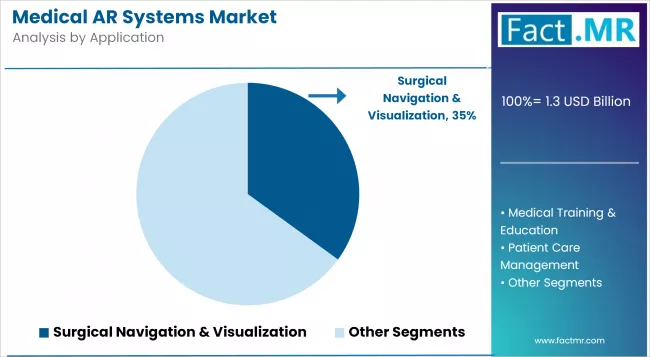
Medical Ar Systems Market Analysis By Application | Source: Fact.MR
Surgical navigation and visualization is the swiftly growing among the applications. AR systems give three-dimensional superimposition of patient anatomy, which improves accuracy in less invasive operations and complicated surgeries. Integration of imaging, AI, and real-time feedback minimizes errors, positively impacts the output, and accelerates the efficiency of the process, which leads to a solid uptake in hospitals and specialized surgical centers worldwide.
Hospitals & Surgical Centers Drive Market Uptake
The dominantly-growing segment is in the end users, i.e., hospitals and surgical centers. They implement the AR systems in order to improve accuracy of surgery, minimize risks in the operation and streamline the clinical processes. Combining AR solutions with robotic platforms, imaging systems, and telemedicine projects, AR solutions are essential in the advanced patient care, training of professionals, and the increase of operational efficiency, which contributes to the rising demand of AR solutions among medical professionals.
Competitive Analysis
Competitive Outlook: Medical AR Systems Market
The marketplace of medical AR systems is a very competitive one, as the large multinational corporations and niche developers are the forces behind its adoption by hospitals, surgical centers, and education. AR-based surgical navigation is the area of work of companies such as Augmedics, Medivis, and SentiAR, which provide real-time 3D visualization to improve patient safety and precision of the procedure.
EchoPixel and vStream Health offer immersive time-interactive AR systems to preoperative planning and medical education, allowing to make credible simulations and lessen the learning curves. In the meantime, the established healthcare giants, like Medtronic, Siemens Healthineers, or Philips, carry their extensive experience with imaging, diagnostics, and robotics and apply these concepts to AR to infuse them into the workflow and increase use in minimally invasive surgery, rehabilitation, and telemedicine.
AR solution providers specializing in orthopedics and procedures, such as Zimmer Biomet and Lucid Reality Labs, focus on orthopedic and procedure-specific AR solutions, such as easy integration, friendly interfaces, and AI-directed guidance. The competitive approaches in the market are aimed at cloud connectivity, AI and IoT integration, modular core hardware design, and scalability. With the rapidly growing trends of digitization in the healthcare sector around the world, such companies are putting money on new, sustainable, and intelligent AR systems to tap into new market opportunities and become market leaders.
Key players in the Medical AR Systems market are Augmedics, EchoPixel, Medivis, SentiAR, Medtronic, Siemens Healthineers, Philips, Zimmer Biomet, Lucid Reality Labs, vStream Health.
Recent Development
- In June 2024, Mediwave unveiled its AI and AR-powered Emergency Response Suite at EMS World 2024. This integrated solution combines AI and AR technologies to provide real-time guidance to emergency responders, improving decision-making and patient outcomes during critical situations. The suite aims to revolutionize emergency medical services by enhancing situational awareness and response efficiency.
- In April 2024, Fresenius Medical Care launched the Ready4 multiFiltratePRO AR application for ICU staff training.This augmented reality application combines digital learning elements with real-life training on the Continuous Kidney Replacement Therapy (CKRT) system, enhancing the training experience for healthcare professionals. The AR application aims to improve the proficiency and confidence of ICU staff in operating complex medical equipment.
Fact.MR has provided detailed information about the price points of key manufacturers of Medical AR Systems market positioned across regions, sales growth, production capacity, and speculative technological expansion, in the recently published report.
Methodology and Industry Tracking Approach
The Fact.MR survey research on the Medical AR Systems Market by 2025 consisted of more than 10,000 participants representing 30 countries, and each country has to include at least 250 participants. About two-thirds of the sample was of end-users, including hospitals, surgical centers, medical training institutions, and rehabilitation centers, and the last third was of industry experts, including equipment designers, regulatory experts, healthcare consultants, and technology advisors.
The study, which should be conducted between September 2024 and August 2025, was dedicated to the trends of adoption, the integration of technology, the changes in regulations, and the innovations that can contribute to the development of advanced storage, immersive, and sustainable medical solutions. Besides the primary research, more than 250 secondary sources, such as patents, product launch, policy frameworks, and sustainability reports, were examined with the help of sophisticated modeling and trend forecasting tools.
Since 2018, Fact.MR has been monitoring the healthcare solutions (Medical AR Systems) through the use of technology, regulatory change, and market maturity. With this wealth of knowledge, the report of 2025 is able to provide practical insights, strategic recommendations, and practical advice to the stakeholders who want to be informed in their investment, planning, and sustainable development in this volatile market.
Segmentation
Segmentation of Medical AR Systems Market Research
-
By Component :
- Hardware
- Software
- Services
-
By Application :
- Surgical Navigation & Visualization
- Medical Training & Education
- Patient Care Management
- Rehabilitation & Therapy
- Others
-
By End User :
- Hospitals & Surgical Centers
- Medical Training Institutes
- Research Organizations
- Rehabilitation Centers
- Others
-
By Technology :
- Head-Mounted Displays (HMDs)
- Handheld Devices
- AR Projection Systems
-
By Interaction Method :
- Marker-Based AR
- Markerless AR
- Location-Based AR
-
By Region :
- North America
- Latin America
- Western Europe
- Eastern Europe
- East Asia
- South Asia & Pacific
- Middle East & Africa
Frequently Asked Questions
What was the Global Medical AR Systems Market Size Reported by Fact.MR for 2025?
Who are the Major Players Operating in the Medical AR Systems Market?
What is the Estimated Valuation of the Medical AR Systems Market in 2035?
What Value CAGR did the Medical AR Systems Market Exhibit Over the Last Five Years?
Who worked on this report


Preview the report firsthand - request a free sample
Free SampleGet the brochure for pricing and purchase details
Download PDF