Medical Oxygen Systems Market Size, Share, Growth and Forecast (2026 - 2036)
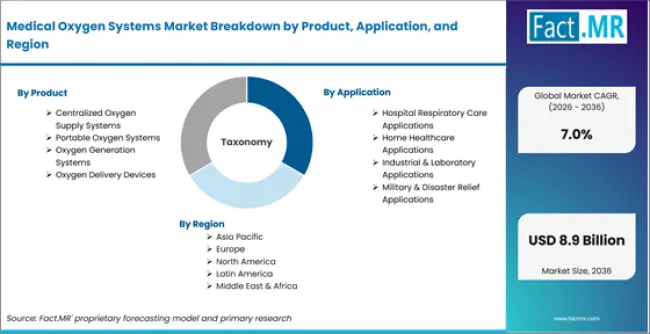
The Medical Oxygen Systems Market is analyzed by product, including centralized supply, portable, oxygen generation and delivery systems, along with application, end use, and region, forecast 2026 to 2036.
Medical Oxygen Systems Market Analysis and Forecast by Fact.MR
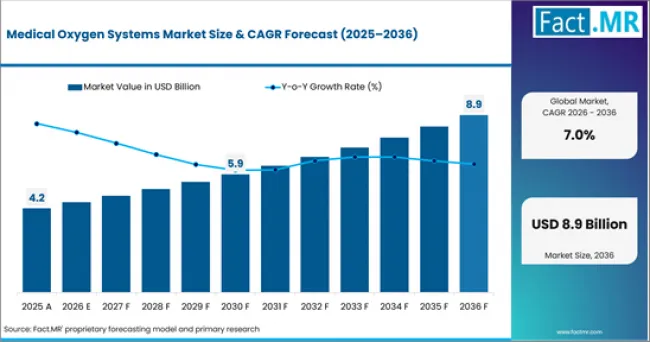
- The Medical Oxygen Systems Market is expected to grow from USD 4.5 billion in 2026 to USD 8.9 billion by 2036, at a 7.0% CAGR.
- The market is driven by expanding institutional demand, product technology advancement, and healthcare infrastructure development.
- Centralized Oxygen Supply Systems account for 78.4% product share, while Hospitals & Healthcare Facilities contribute 69.5% of end-use demand.
Summary of Medical Oxygen Systems Market
- Market Snapshot
- In 2025, the global Medical Oxygen Systems Market was valued at approximately USD 4.2 billion.
- The market is estimated to reach USD 4.5 billion in 2026 and is projected to attain USD 8.9 billion by 2036.
- The market is likely to expand at a CAGR of 7.0% during the forecast period.
- The market is anticipated to create an absolute dollar opportunity of USD 4.4 billion between 2026 and 2036.
- Centralized Oxygen Supply Systems accounts for 78.4% of product segment share in 2026.
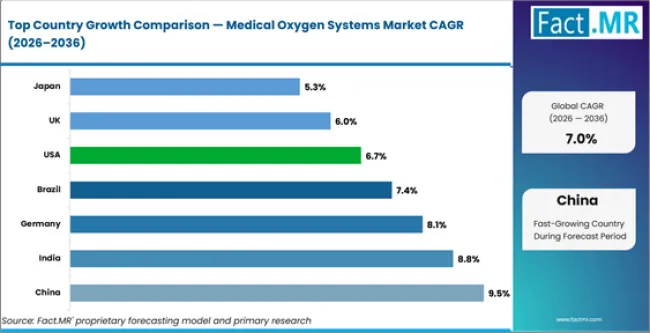
- China (9.5%) and India (8.8%) are the key growth markets.
- Demand and Growth Drivers
- Growing clinical and institutional demand creates sustained procurement for centralized oxygen supply systems and related product categories across primary healthcare and industrial settings.
- Healthcare infrastructure investment and facility modernization create capital procurement pipelines across established and emerging market institutional networks.
- Technology advancement improves product performance, expands application scope, and supports adoption across both premium and cost-sensitive market segments.
- Regulatory pathway development and reimbursement coverage expansion improve market access and financial viability for institutional procurement decisions.
- Product and Segment View
- Centralized Oxygen Supply Systems accounts for 78.4% of the product segment in 2026, reflecting established utilization and broad institutional or consumer adoption.
- Hospitals & Healthcare Facilities represent 69.5% of end use demand in 2026, reflecting procurement concentration among primary institutional buyers.
- Integrated Oxygen Infrastructure Systems leads the formulation segment with 57.9% share in 2026, supported by workflow integration and performance documentation.
- Key segmentation includes:
- Product Type: Centralized Oxygen Supply Systems, Portable Oxygen Systems, Oxygen Generation Systems, and Oxygen Delivery Devices
- End Use: Hospitals & Healthcare Facilities, Homecare Providers, Pharmaceutical & Biotechnology Companies, and Defense & Emergency Organizations
- Configuration: Integrated Oxygen Infrastructure Systems, Portable Oxygen Configurations, Modular Oxygen Configurations, and Emergency Oxygen Configurations
- These capabilities enable:
- Primary functional capability addressing core performance requirements across institutional and consumer applications.
- Workflow integration improving operational efficiency and resource utilization.
- Regulatory compliance and quality documentation supporting market access.
- Geography and Competitive Outlook
- North America maintains a significant share supported by established demand infrastructure and regulatory frameworks.
- Asia Pacific is the fastest-growing region, with China (9.5%) and India (8.8%) leading through infrastructure expansion.
- Europe maintains steady demand with Germany supported by EU regulatory compliance and institutional procurement.
- Key companies include Koninklijke Philips N.V., Inogen, Precision Medical, Luxfer Group among others.
- Analyst Opinion
- Shambhu Nath Jha, Principal Consultant at Fact.MR, says "The medical oxygen systems market reflects structural demand growth at the intersection of institutional expansion, technology advancement, and regulatory evolution. Established markets support demand through replacement cycles and specification upgrades. Emerging markets expand the addressable base through new facility construction and healthcare access programs. Companies positioning across both tiers with appropriate product portfolios and regulatory documentation will capture the broadest share of incremental opportunity."
Key Growth Drivers, Constraints, and Opportunities
Key Factors Driving Growth
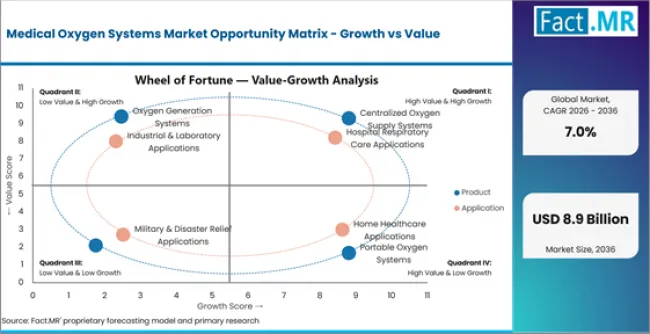
- Institutional demand growth creates sustained procurement across primary application settings.
- Infrastructure expansion and modernization create capital equipment procurement pipelines.
- Technology advancement improves performance and cost-competitiveness, supporting adoption.
Key Market Constraints
- Capital cost limits adoption in resource-constrained settings.
- Regulatory complexity increases compliance costs across multiple jurisdictions.
- Trained workforce requirements constrain adoption where specialized expertise is limited.
Key Opportunity Areas
- Emerging market infrastructure development creates incremental demand as capacity expands.
- Technology innovation at lower cost points expands the addressable market.
- Digital integration and connected platforms create new access and monitoring pathways.
Segment-wise Analysis of the Medical Oxygen Systems Market
- Centralized Oxygen Supply Systems holds 78.4% of the product segment in 2026.
- Hospitals & Healthcare Facilities accounts for 69.5% of end use demand in 2026.
- Emerging categories grow faster as technology and access expansion create new applications.
The market is segmented by product, application, end use, technology, configuration, distribution channel, and region. Lead segments maintain dominant positions, while emerging categories grow faster driven by technology and access expansion.
Which Product Segment Dominates the Medical Oxygen Systems Market?
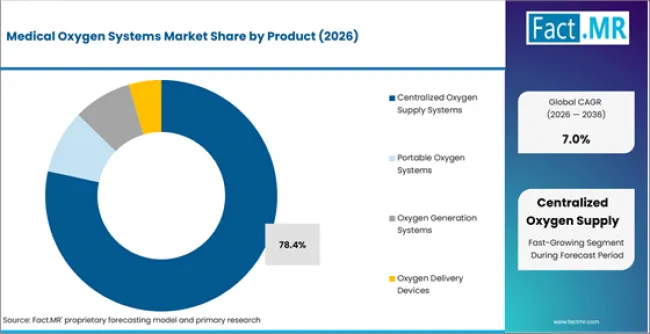
Centralized Oxygen Supply Systems accounts for 78.4% of the product segment in 2026 through established utilization, broad institutional adoption, and documented performance.
Supporting segments hold growing positions as technology advancement and regulatory evolution create specialized demand.
Which End-Use Segment Dominates the Medical Oxygen Systems Market?
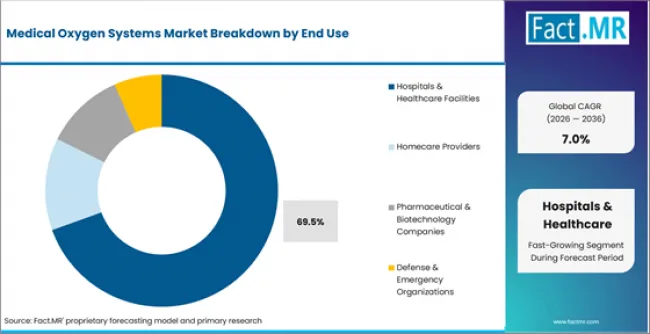
Hospitals & Healthcare Facilities is expected to lead the end use segment with a 69.5% share in 2026, reflecting primary institutional or consumer procurement concentration.
Secondary channels hold growing positions as distribution access and awareness expand.
Which Technology or Product Trend is Shaping the Next Phase of Growth in the Medical Oxygen Systems Market?
Technology advancement in centralized oxygen supply systems and integrated oxygen infrastructure systems is the most significant trend, with next-generation platforms delivering improved performance, enhanced connectivity, and better workflow integration that supports adoption across both premium and cost-sensitive settings.
The second dimension is access expansion through infrastructure development, coverage growth, and digital platforms in emerging markets, structurally expanding the addressable procurement base.
Regional Outlook Across Key Markets
- China leads growth at 9.5%, supported by infrastructure expansion and growing institutional demand.
- India follows at 8.8%, driven by healthcare development and private facility investment.
- North America and Europe maintain significant shares through established infrastructure and regulatory frameworks.
- Germany leads European growth at 8.1%, supported by EU compliance and institutional procurement.
.webp)
CAGR Table
| Country | CAGR (%) |
|---|---|
| China | 9.5% |
| India | 8.8% |
| Germany | 8.1% |
| Brazil | 7.4% |
| USA | 6.7% |
Source: Fact.MR analysis, based on proprietary forecasting model and primary research.
Medical Oxygen Systems Demand Trends in the United States
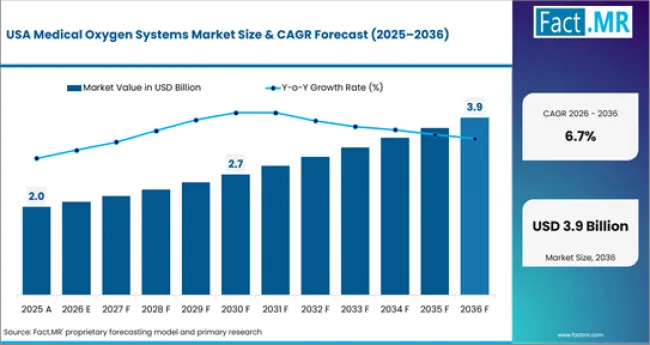
The USA market is projected to grow at a CAGR of 6.7% through 2036 as hospitals require reliable medical gas delivery for surgical, emergency, respiratory, and critical care departments. FDA regulatory requirements for medical oxygen system design and installation define procurement specifications. The growing home healthcare segment creates demand for portable oxygen concentrators and home oxygen therapy systems, supported by Medicare Part B coverage for home oxygen equipment prescribed for qualifying respiratory conditions including COPD and chronic respiratory failure.
- Medicare Part B home oxygen therapy coverage supports consumer access to portable oxygen concentrators and home delivery systems for qualifying respiratory conditions.
- Hospital infrastructure modernization and ASC expansion create capital procurement demand for centralized oxygen supply systems meeting current safety and capacity standards.
China Medical Oxygen Systems Growth Assessment
China is projected to grow at a CAGR of 9.4% through 2036 as hospital construction programs and ICU capacity expansion create strong demand for centralized oxygen supply systems. Domestic medical gas equipment manufacturers hold cost advantages through local production and established relationships with hospital construction contractors. The experience of respiratory disease surge capacity requirements during recent health emergencies reinforced institutional investment in oxygen system infrastructure resilience and capacity redundancy across Chinese hospital networks.
- Tier-2 and tier-3 hospital construction with new ICU and surgical capacity creates high-volume procurement for centralized oxygen supply system installation.
- Domestic manufacturers provide cost-competitive oxygen system equipment through local production and established hospital construction contractor partnerships.
India Medical Oxygen Systems Market Opportunity Outlook
India is projected to grow at a CAGR of 8.8% through 2036 as PM CARES Fund oxygen infrastructure and National Health Mission upgrades support procurement across district and sub-district hospitals. The 2021 oxygen crisis exposed infrastructure gaps that triggered multi-year hospital oxygen system installation and upgrade programs still underway. Private hospital expansion by Apollo, Fortis, and Max Healthcare creates additional procurement for integrated oxygen infrastructure systems meeting international safety and capacity standards in new facility construction.
- PM CARES Fund oxygen infrastructure investment and National Health Mission upgrades create multi-year procurement for centralized hospital oxygen supply systems.
- Private hospital construction by Apollo and Fortis creates procurement for integrated oxygen infrastructure meeting international capacity and safety specifications.
Germany Medical Oxygen Systems Demand Analysis
Germany is projected to grow at a CAGR of 8.1% through 2036 as EU MDR and DIN EN ISO 7396-1 requirements guide centralized oxygen system design, installation, and maintenance. GKV hospital funding through the DRG-based payment system shapes capital investment decisions for oxygen infrastructure modernization, with energy efficiency and system reliability as primary procurement criteria. Hospital consolidation concentrates oxygen system procurement among larger health systems where standardized equipment specifications and service contracts with Linde, Air Liquide govern institutional gas supply relationships.
- DIN EN ISO 7396-1 compliance defines centralized oxygen system design and installation specifications for German hospital infrastructure projects.
- Hospital consolidation creates concentrated oxygen system procurement through standardized service contracts with Linde and Air Liquide for medical gas supply.
Competitive Benchmarking and Company Positioning
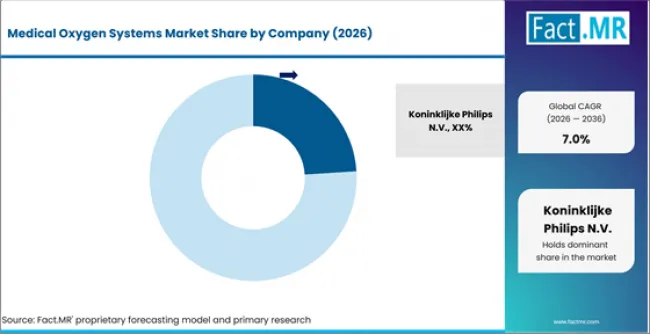
Medical Oxygen Systems Market Analysis By Company
- Leading companies hold strong positions through comprehensive portfolios and established institutional relationships.
- Mid-tier competitors differentiate through focused specialties and regional positioning.
- Regulatory certification and technology innovation capability are key competitive differentiators.
The competitive landscape combines multinational companies with regional specialists competing through portfolios, institutional relationships, and technology capability.
Strategic priorities include portfolio expansion, emerging market presence, and digital integration.
Key Companies in the Medical Oxygen Systems Market
- Koninklijke Philips N.V., Inogen are among the leading participants.
- Precision Medical, Luxfer Group, Cryofab hold established positions.
- Responsive Respiratory, GCE group compete through specialized offerings.
Recent Industry Developments
- BOC Kenya, Linde Company, Hospital Medical Gas Infrastructure Work
- BOC Kenya, a Linde company, reported work linked to medical gas pipeline systems, medical oxygen tanks, and hospital gas reticulation.
- Inogen, Rove 4 Portable Oxygen Concentrator Launch
- Inogen launched the Rove 4 portable oxygen concentrator in October 2024. The product has four flow settings, oxygen output of up to 840 ml/min, and battery operation of up to 5 hours and 45 minutes.
- Philips Respironics, Oxygen Concentrator Portfolio Discontinuation Update
- Philips Respironics should be included as a portfolio shift rather than a product launch. The company listed EverFlo, Millennium M10, SimplyGo, and SimplyGo Mini under global discontinuation dates in January 2024.
Leading Companies Shaping the Medical Oxygen Systems Market
- Koninklijke Philips N.V.
- Inogen
- Precision Medical
- Luxfer Group
- Cryofab
- Responsive Respiratory
- GCE group
- High Vacuum Maintenance (HVM) S.R.L.
Sources and Research References
- BOC Kenya PLC. (2025, April 22). Annual report and financial statements for the year ended 31 December 2024.
- Inogen, Inc. (2024, October 8). Inogen launches Rove 4 portable oxygen concentrator, delivering the highest oxygen output in the lightest weight 4-setting POC.
- Inogen, Inc. (2025). Annual report 2024.
- Linde India Limited. (2025). Business Responsibility and Sustainability Report FY 2024–25.
- Philips Respironics. (2024, February 6). Sleep & Respiratory product portfolio changes.
Key Questions This Report Addresses
- What is the current and future size of the Medical Oxygen Systems Market?
- How fast is the market expected to grow between 2026 and 2036?
- Which product type leads?
- Which end-use accounts for highest demand?
- What are the primary growth drivers?
- How is technology influencing the market?
- Which countries show fastest growth?
- Who are the key companies?
- How does Fact.MR validate the forecast?
Medical Oxygen Systems Market Definition
The Medical Oxygen Systems Market covers specialized products, devices, or equipment serving healthcare, pharmaceutical, and institutional applications.
Medical Oxygen Systems Market Inclusions
- The scope covers global and regional market size and forecasts for 2026 to 2036 across product type, end use, formulation, and region.
- It includes all major product categories for primary and secondary applications.
- The report covers technology, regulatory, and market trends alongside the competitive landscape.
Medical Oxygen Systems Market Exclusions
- The scope excludes general-purpose products not specific to this market.
- It excludes upstream component supply chains sold independently.
- The report excludes downstream consumer or patient outcome assessments.
Medical Oxygen Systems Market Research Methodology
- The methodology combines secondary research, primary interviews, and forecast modelling.
- It draws on 90+ secondary sources and benchmarks 45+ company portfolios.
- Market sizing covers 40+ countries through a demand-side model supported by top-down validation.
- Key inputs include institutional spending data, regulatory tracking, and technology adoption rates.
- Primary validation includes 25+ interviews across manufacturers, end users, and specialists.
Scope of Analysis

| Parameter | Details |
|---|---|
| Quantitative Units | USD 4.5 billion to USD 8.9 billion, at a CAGR of 7.0% |
| Market Definition | The Medical Oxygen Systems Market covers specialized products and equipment serving healthcare and institutional applications. |
| Regions Covered | North America, Latin America, Europe, East Asia, South Asia and Pacific, Middle East and Africa |
| Countries Covered | USA, Canada, UK, Germany, China, India, 40 plus countries |
| Key Companies | Koninklijke Philips N.V., Inogen, Precision Medical, Luxfer Group, Cryofab, Responsive Respiratory |
| Forecast Period | 2026 to 2036 |
| Approach | Hybrid demand-side methodology built on institutional data, regulatory tracking, and primary interviews. |
Medical Oxygen Systems Market Segmentation
-
Medical Oxygen Systems Market Segmented by Product:
- Centralized Oxygen Supply Systems
- Bulk Oxygen Storage Systems
- Cryogenic Liquid Oxygen Tanks
- Vacuum Insulated Storage Vessels
- Pipeline Distribution Systems
- Medical Gas Pipeline Networks
- Zone Valve Distribution Systems
- Bulk Oxygen Storage Systems
- Portable Oxygen Systems
- Portable Oxygen Concentrators
- Pulse Flow Oxygen Concentrators
- Continuous Flow Oxygen Concentrators
- Portable Cylinder Systems
- Aluminum Oxygen Cylinders
- Composite Oxygen Cylinders
- Portable Oxygen Concentrators
- Oxygen Generation Systems
- PSA Oxygen Generation Systems
- Modular PSA Oxygen Plants
- High Capacity PSA Units
- Membrane Oxygen Generation Systems
- Compact Membrane Generators
- Industrial Membrane Oxygen Units
- PSA Oxygen Generation Systems
- Oxygen Delivery Devices
- Patient Interface Devices
- Nasal Cannula Oxygen Devices
- Venturi Mask Oxygen Devices
- Critical Care Delivery Devices
- High Flow Oxygen Therapy Systems
- Mechanical Ventilation Interfaces
- Patient Interface Devices
- Centralized Oxygen Supply Systems
-
Medical Oxygen Systems Market Segmented by Application:
- Hospital Respiratory Care Applications
- Intensive Care Applications
- ICU Oxygen Delivery Systems
- Ventilator Oxygen Support Systems
- Emergency Care Applications
- Trauma Oxygen Therapy Systems
- Emergency Resuscitation Oxygen Systems
- Intensive Care Applications
- Home Healthcare Applications
- Chronic Respiratory Care
- COPD Oxygen Therapy Systems
- Sleep Apnea Oxygen Support Systems
- Elderly Care Applications
- Long Term Oxygen Therapy Systems
- Portable Home Oxygen Solutions
- Chronic Respiratory Care
- Industrial & Laboratory Applications
- Medical Research Applications
- Clinical Laboratory Oxygen Systems
- Biomedical Research Gas Systems
- Pharmaceutical Manufacturing Applications
- Sterile Production Oxygen Systems
- Cleanroom Oxygen Supply Systems
- Medical Research Applications
- Military & Disaster Relief Applications
- Field Medical Applications
- Mobile Medical Oxygen Systems
- Combat Casualty Oxygen Units
- Emergency Relief Applications
- Disaster Response Oxygen Stations
- Temporary Medical Camp Oxygen Systems
- Field Medical Applications
- Hospital Respiratory Care Applications
-
Medical Oxygen Systems Market Segmented by End Use:
- Hospitals & Healthcare Facilities
- Public Healthcare Facilities
- Government Multi Specialty Hospitals
- Regional Trauma Care Centers
- Private Healthcare Facilities
- Corporate Hospital Networks
- Advanced Specialty Clinics
- Public Healthcare Facilities
- Homecare Providers
- Home Oxygen Service Providers
- Portable Oxygen Rental Providers
- Residential Oxygen Therapy Providers
- Elderly Care Providers
- Assisted Living Healthcare Providers
- Long Term Care Facilities
- Home Oxygen Service Providers
- Pharmaceutical & Biotechnology Companies
- Drug Manufacturing Companies
- Sterile Injectable Manufacturers
- Biopharmaceutical Production Units
- Research Organizations
- Clinical Trial Research Facilities
- Biomedical Innovation Centers
- Drug Manufacturing Companies
- Defense & Emergency Organizations
- Military Medical Units
- Army Medical Support Facilities
- Naval Healthcare Systems
- Emergency Response Organizations
- Disaster Relief Medical Agencies
- Air Ambulance Emergency Services
- Military Medical Units
- Hospitals & Healthcare Facilities
-
Medical Oxygen Systems Market Segmented by Technology:
- Pressure Swing Adsorption Technology
- Dual Bed PSA Systems
- Continuous Flow PSA Units
- High Purity Oxygen PSA Systems
- Modular PSA Architectures
- Scalable PSA Oxygen Plants
- Containerized PSA Systems
- Dual Bed PSA Systems
- Cryogenic Separation Technology
- Low Temperature Distillation Systems
- Industrial Cryogenic Oxygen Units
- High Capacity Air Separation Plants
- Vacuum Insulated Storage Technology
- Cryogenic Liquid Transfer Systems
- Thermal Loss Prevention Systems
- Low Temperature Distillation Systems
- Membrane Separation Technology
- Polymeric Membrane Systems
- Compact Oxygen Membrane Units
- Portable Membrane Oxygen Systems
- Advanced Filtration Systems
- High Selectivity Membrane Modules
- Multi Stage Filtration Systems
- Polymeric Membrane Systems
- Smart Monitoring Technology
- Remote Monitoring Systems
- IoT Oxygen Monitoring Platforms
- Cloud Based Gas Monitoring Systems
- Predictive Maintenance Systems
- AI Based Equipment Diagnostics
- Automated Failure Detection Systems
- Remote Monitoring Systems
- Pressure Swing Adsorption Technology
-
Medical Oxygen Systems Market Segmented by Formulation:
- Integrated Oxygen Infrastructure Systems
- Centralized Distribution Configurations
- Hospital Wide Oxygen Networks
- Multi Ward Oxygen Distribution Systems
- Automated Supply Configurations
- Smart Oxygen Flow Control Systems
- Automated Pressure Regulation Systems
- Centralized Distribution Configurations
- Portable Oxygen Configurations
- Battery Powered Configurations
- Rechargeable Oxygen Concentrator Systems
- Extended Runtime Portable Units
- Compact Mobility Configurations
- Wearable Oxygen Delivery Systems
- Travel Friendly Oxygen Systems
- Battery Powered Configurations
- Modular Oxygen Configurations
- Expandable System Configurations
- Scalable Oxygen Plant Modules
- Customizable Supply Configurations
- Containerized Configurations
- Mobile Oxygen Plant Systems
- Rapid Deployment Oxygen Units
- Expandable System Configurations
- Emergency Oxygen Configurations
- Rapid Response Configurations
- Emergency Backup Oxygen Systems
- Disaster Relief Oxygen Platforms
- Critical Care Configurations
- ICU Dedicated Oxygen Systems
- High Demand Respiratory Support Units
- Rapid Response Configurations
- Integrated Oxygen Infrastructure Systems
-
Medical Oxygen Systems Market Segmented by Distribution Channel:
- Direct Institutional Supply
- Hospital Procurement Contracts
- Government Healthcare Supply Agreements
- Private Hospital Equipment Contracts
- Long Term Infrastructure Contracts
- Medical Gas Pipeline Installation Agreements
- Healthcare Facility Upgrade Contracts
- Hospital Procurement Contracts
- Medical Equipment Distributors
- Regional Equipment Suppliers
- Respiratory Equipment Distribution Networks
- Critical Care Equipment Suppliers
- Specialized Gas System Distributors
- Medical Gas Infrastructure Suppliers
- Oxygen Equipment Solution Providers
- Regional Equipment Suppliers
- Online Healthcare Platforms
- Digital Medical Procurement Platforms
- Hospital Equipment E Commerce Portals
- Cloud Based Procurement Systems
- Manufacturer Direct Platforms
- Direct Oxygen System Ordering Platforms
- Subscription Equipment Supply Systems
- Digital Medical Procurement Platforms
- Rental & Leasing Providers
- Short Term Rental Services
- Portable Oxygen Rental Programs
- Emergency Equipment Leasing Services
- Long Term Leasing Providers
- Healthcare Infrastructure Leasing Contracts
- Managed Oxygen Supply Service Programs
- Short Term Rental Services
- Direct Institutional Supply
-
Medical Oxygen Systems Market by Region:
- North America
- USA
- Canada
- Mexico
- Latin America
- Brazil
- Chile
- Rest of Latin America
- Western Europe
- Germany
- UK
- Italy
- Spain
- France
- Nordic
- BENELUX
- Rest of Western Europe
- Eastern Europe
- Russia
- Poland
- Hungary
- Balkan & Baltic
- Rest of Eastern Europe
- East Asia
- China
- Japan
- South Korea
- South Asia and Pacific
- India
- ASEAN
- Australia & New Zealand
- Rest of South Asia and Pacific
- Middle East & Africa
- Kingdom of Saudi Arabia
- Other GCC Countries
- Turkiye
- South Africa
- Other African Union
- Rest of Middle East & Africa
- North America
- Frequently Asked Questions -
How big is the medical oxygen systems market in 2026?
The global medical oxygen systems market is estimated to be valued at USD 4.5 billion in 2026.
What will be the size of the medical oxygen systems market in 2036?
The market size for the medical oxygen systems market is projected to reach USD 8.9 billion by 2036.
What CAGR is expected for the medical oxygen systems market between 2026 and 2036?
The medical oxygen systems market is expected to grow at a 7.0% CAGR between 2026 and 2036.
What are the key products in the medical oxygen systems market?
The key products in the medical oxygen systems market are Centralized Oxygen Supply Systems, Portable Oxygen Systems, Oxygen Generation Systems and Oxygen Delivery Devices.
Which application segment is expected to contribute the leading share in the medical oxygen systems market in 2026?
In terms of application, the Hospital Respiratory Care Applications segment is expected to command 34.7% share in the medical oxygen systems market in 2026.
Table of Content
- Key Takeaways
- Market Size and CAGR
- Top Growth Driver
- Fastest Growing Segment
- Leading Region
- Key Companies
- Emerging Opportunities
- Executive Summary
- Global Market Outlook
- Demand-side Trends
- Supply-side Trends
- Technology Roadmap Analysis
- Analysis and Recommendations
- Analyst Perspective (What is happening? Why now? What should investors know?)
- Key Questions Answered
- How large is the market?
- What is the CAGR?
- What are key trends?
- Which region dominates?
- Who are the leaders?
- Market Overview
- Market Coverage / Taxonomy
- Market Definition / Scope / Limitations
- Research Methodology
- Chapter Orientation
- Analytical Lens and Working Hypotheses
- Market Structure, Signals, and Trend Drivers
- Benchmarking and Cross-market Comparability
- Market Sizing, Forecasting, and Opportunity Mapping
- Research Design and Evidence Framework
- Desk Research Programme (Secondary Evidence)
- Expert Input and Fieldwork (Primary Evidence)
- Tooling, Models, and Reference Databases
- Data Engineering and Model Build
- Quality Assurance and Audit Trail
- Market Background
- Market Dynamics (Drivers, Restraints, Opportunity, Trends)
- Scenario Forecast (Optimistic, Likely, Conservative)
- Impact Analysis
- AI Impact
- Sustainability Impact
- Regulatory Impact
- Technology Impact
- Consumer / Buyer Analysis
- Purchase Drivers
- Adoption Barriers
- Buyer Journey
- Opportunity Map Analysis
- Product Life Cycle Analysis
- Supply Chain Analysis
- Investment Feasibility Matrix
- Value Chain Analysis
- PESTLE and Porter's Analysis
- Regulatory Landscape
- Regional Parent Market Outlook
- Production and Consumption Statistics
- Import and Export Statistics
- Global Market Analysis and Forecast, 2021 to 2036
- Historical Market Size Value (USD Million) Analysis, 2021 to 2025
- Current and Future Market Size Value (USD Million) Projections, 2026 to 2036
- Y-o-Y Growth Trend Analysis
- Absolute $ Opportunity Analysis
- Global Market Pricing Analysis, 2021 to 2036
- Global Market Analysis and Forecast, By Product, 2021 to 2036
- Introduction / Key Findings
- Historical Market Size Value (USD Million) Analysis By Product, 2021 to 2025
- Current and Future Market Size Value (USD Million) Analysis and Forecast By Product, 2026 to 2036
- Centralized Oxygen Supply Systems
- Bulk Oxygen Storage Systems
- Pipeline Distribution Systems
- Portable Oxygen Systems
- Portable Oxygen Concentrators
- Portable Cylinder Systems
- Oxygen Generation Systems
- PSA Oxygen Generation Systems
- Membrane Oxygen Generation Systems
- Oxygen Delivery Devices
- Patient Interface Devices
- Critical Care Delivery Devices
- Centralized Oxygen Supply Systems
- Y-o-Y Growth Trend Analysis By Product, 2021 to 2025
- Absolute $ Opportunity Analysis By Product, 2026 to 2036
- Global Market Analysis and Forecast, By Application, 2021 to 2036
- Introduction / Key Findings
- Historical Market Size Value (USD Million) Analysis By Application, 2021 to 2025
- Current and Future Market Size Value (USD Million) Analysis and Forecast By Application, 2026 to 2036
- Hospital Respiratory Care Applications
- Intensive Care Applications
- Emergency Care Applications
- Home Healthcare Applications
- Chronic Respiratory Care
- Elderly Care Applications
- Industrial & Laboratory Applications
- Medical Research Applications
- Pharmaceutical Manufacturing Applications
- Military & Disaster Relief Applications
- Field Medical Applications
- Emergency Relief Applications
- Hospital Respiratory Care Applications
- Y-o-Y Growth Trend Analysis By Application, 2021 to 2025
- Absolute $ Opportunity Analysis By Application, 2026 to 2036
- Global Market Analysis and Forecast, By End Use, 2021 to 2036
- Introduction / Key Findings
- Historical Market Size Value (USD Million) Analysis By End Use, 2021 to 2025
- Current and Future Market Size Value (USD Million) Analysis and Forecast By End Use, 2026 to 2036
- Hospitals & Healthcare Facilities
- Public Healthcare Facilities
- Private Healthcare Facilities
- Homecare Providers
- Home Oxygen Service Providers
- Elderly Care Providers
- Pharmaceutical & Biotechnology Companies
- Drug Manufacturing Companies
- Research Organizations
- Defense & Emergency Organizations
- Military Medical Value (USD Million)s
- Emergency Response Organizations
- Hospitals & Healthcare Facilities
- Y-o-Y Growth Trend Analysis By End Use, 2021 to 2025
- Absolute $ Opportunity Analysis By End Use, 2026 to 2036
- Global Market Analysis and Forecast, By Technology, 2021 to 2036
- Introduction / Key Findings
- Historical Market Size Value (USD Million) Analysis By Technology, 2021 to 2025
- Current and Future Market Size Value (USD Million) Analysis and Forecast By Technology, 2026 to 2036
- Pressure Swing Adsorption Technology
- Dual Bed PSA Systems
- Modular PSA Architectures
- Cryogenic Separation Technology
- Low Temperature Distillation Systems
- Vacuum Insulated Storage Technology
- Membrane Separation Technology
- Polymeric Membrane Systems
- Advanced Filtration Systems
- Smart Monitoring Technology
- Remote Monitoring Systems
- Predictive Maintenance Systems
- Pressure Swing Adsorption Technology
- Y-o-Y Growth Trend Analysis By Technology, 2021 to 2025
- Absolute $ Opportunity Analysis By Technology, 2026 to 2036
- Global Market Analysis and Forecast, By Formulation, 2021 to 2036
- Introduction / Key Findings
- Historical Market Size Value (USD Million) Analysis By Formulation, 2021 to 2025
- Current and Future Market Size Value (USD Million) Analysis and Forecast By Formulation, 2026 to 2036
- Integrated Oxygen Infrastructure Systems
- Centralized Distribution Configurations
- Automated Supply Configurations
- Portable Oxygen Configurations
- Battery Powered Configurations
- Compact Mobility Configurations
- Modular Oxygen Configurations
- Expandable System Configurations
- Containerized Configurations
- Emergency Oxygen Configurations
- Rapid Response Configurations
- Critical Care Configurations
- Integrated Oxygen Infrastructure Systems
- Y-o-Y Growth Trend Analysis By Formulation, 2021 to 2025
- Absolute $ Opportunity Analysis By Formulation, 2026 to 2036
- Global Market Analysis and Forecast, By Distribution Channel
- Introduction / Key Findings
- Historical Market Size Value (USD Million) Analysis By Distribution Channel, 2021 to 2025
- Current and Future Market Size Value (USD Million) Analysis and Forecast By Distribution Channel, 2026 to 2036
- Direct Institutional Supply
- Hospital Procurement Contracts
- Long Term Infrastructure Contracts
- Medical Equipment Distributors
- Regional Equipment Suppliers
- Specialized Gas System Distributors
- Online Healthcare Platforms
- Digital Medical Procurement Platforms
- Manufacturer Direct Platforms
- Rental & Leasing Providers
- Short Term Rental Services
- Long Term Leasing Providers
- Direct Institutional Supply
- Y-o-Y Growth Trend Analysis By Distribution Channel, 2021 to 2025
- Absolute $ Opportunity Analysis By Distribution Channel, 2026 to 2036
- Global Market Analysis and Forecast, By Region, 2021 to 2036
- Introduction
- Historical Market Size Value (USD Million) Analysis By Region, 2021 to 2025
- Current Market Size Value (USD Million) Analysis and Forecast By Region, 2026 to 2036
- North America
- Latin America
- Western Europe
- Eastern Europe
- East Asia
- South Asia and Pacific
- Middle East & Africa
- Market Attractiveness Analysis By Region
- North America Market Analysis and Forecast, By Country, 2021 to 2036
- Historical Market Size Value (USD Million) Trend Analysis By Market Taxonomy, 2021 to 2025
- Market Size Value (USD Million) Forecast By Market Taxonomy, 2026 to 2036
- By Country
- USA
- Canada
- Mexico
- By Product
- By Application
- By End Use
- By Technology
- By Formulation
- By Distribution Channel
- By Country
- Market Attractiveness Analysis
- By Country
- By Product
- By Application
- By End Use
- By Technology
- By Formulation
- By Distribution Channel
- Key Takeaways
- Latin America Market Analysis and Forecast, By Country
- Historical Market Size Value (USD Million) Trend Analysis By Market Taxonomy, 2021 to 2025
- Market Size Value (USD Million) Forecast By Market Taxonomy, 2026 to 2036
- By Country
- Brazil
- Chile
- Rest of Latin America
- By Product
- By Application
- By End Use
- By Technology
- By Formulation
- By Distribution Channel
- By Country
- Market Attractiveness Analysis
- By Country
- By Product
- By Application
- By End Use
- By Technology
- By Formulation
- By Distribution Channel
- Key Takeaways
- Western Europe Market Analysis and Forecast, By Country
- Historical Market Size Value (USD Million) Trend Analysis By Market Taxonomy, 2021 to 2025
- Market Size Value (USD Million) Forecast By Market Taxonomy, 2026 to 2036
- By Country
- Germany
- UK
- Italy
- Spain
- France
- Nordic
- BENELUX
- Rest of Western Europe
- By Product
- By Application
- By End Use
- By Technology
- By Formulation
- By Distribution Channel
- By Country
- Market Attractiveness Analysis
- By Country
- By Product
- By Application
- By End Use
- By Technology
- By Formulation
- By Distribution Channel
- Key Takeaways
- Eastern Europe Market Analysis and Forecast, By Country
- Historical Market Size Value (USD Million) Trend Analysis By Market Taxonomy, 2021 to 2025
- Market Size Value (USD Million) Forecast By Market Taxonomy, 2026 to 2036
- By Country
- Russia
- Poland
- Hungary
- Balkan & Baltic
- Rest of Eastern Europe
- By Product
- By Application
- By End Use
- By Technology
- By Formulation
- By Distribution Channel
- By Country
- Market Attractiveness Analysis
- By Country
- By Product
- By Application
- By End Use
- By Technology
- By Formulation
- By Distribution Channel
- Key Takeaways
- East Asia Market Analysis and Forecast, By Country
- Historical Market Size Value (USD Million) Trend Analysis By Market Taxonomy, 2021 to 2025
- Market Size Value (USD Million) Forecast By Market Taxonomy, 2026 to 2036
- By Country
- China
- Japan
- South Korea
- By Product
- By Application
- By End Use
- By Technology
- By Formulation
- By Distribution Channel
- By Country
- Market Attractiveness Analysis
- By Country
- By Product
- By Application
- By End Use
- By Technology
- By Formulation
- By Distribution Channel
- Key Takeaways
- South Asia and Pacific Market Analysis and Forecast, By Country
- Historical Market Size Value (USD Million) Trend Analysis By Market Taxonomy, 2021 to 2025
- Market Size Value (USD Million) Forecast By Market Taxonomy, 2026 to 2036
- By Country
- India
- ASEAN
- Australia & New Zealand
- Rest of South Asia and Pacific
- By Product
- By Application
- By End Use
- By Technology
- By Formulation
- By Distribution Channel
- By Country
- Market Attractiveness Analysis
- By Country
- By Product
- By Application
- By End Use
- By Technology
- By Formulation
- By Distribution Channel
- Key Takeaways
- Middle East & Africa Market Analysis and Forecast, By Country
- Historical Market Size Value (USD Million) Trend Analysis By Market Taxonomy, 2021 to 2025
- Market Size Value (USD Million) Forecast By Market Taxonomy, 2026 to 2036
- By Country
- Kingdom of Saudi Arabia
- Other GCC Countries
- Turkiye
- South Africa
- Other African Union
- Rest of Middle East & Africa
- By Product
- By Application
- By End Use
- By Technology
- By Formulation
- By Distribution Channel
- By Country
- Market Attractiveness Analysis
- By Country
- By Product
- By Application
- By End Use
- By Technology
- By Formulation
- By Distribution Channel
- Key Takeaways
- Key Countries Market Analysis
- USA
- Pricing Analysis
- Market Share Analysis, 2025
- By Product
- By Application
- By End Use
- By Technology
- By Formulation
- By Distribution Channel
- Canada
- Pricing Analysis
- Market Share Analysis, 2025
- By Product
- By Application
- By End Use
- By Technology
- By Formulation
- By Distribution Channel
- Mexico
- Pricing Analysis
- Market Share Analysis, 2025
- By Product
- By Application
- By End Use
- By Technology
- By Formulation
- By Distribution Channel
- Brazil
- Pricing Analysis
- Market Share Analysis, 2025
- By Product
- By Application
- By End Use
- By Technology
- By Formulation
- By Distribution Channel
- Chile
- Pricing Analysis
- Market Share Analysis, 2025
- By Product
- By Application
- By End Use
- By Technology
- By Formulation
- By Distribution Channel
- Germany
- Pricing Analysis
- Market Share Analysis, 2025
- By Product
- By Application
- By End Use
- By Technology
- By Formulation
- By Distribution Channel
- UK
- Pricing Analysis
- Market Share Analysis, 2025
- By Product
- By Application
- By End Use
- By Technology
- By Formulation
- By Distribution Channel
- Italy
- Pricing Analysis
- Market Share Analysis, 2025
- By Product
- By Application
- By End Use
- By Technology
- By Formulation
- By Distribution Channel
- Spain
- Pricing Analysis
- Market Share Analysis, 2025
- By Product
- By Application
- By End Use
- By Technology
- By Formulation
- By Distribution Channel
- France
- Pricing Analysis
- Market Share Analysis, 2025
- By Product
- By Application
- By End Use
- By Technology
- By Formulation
- By Distribution Channel
- India
- Pricing Analysis
- Market Share Analysis, 2025
- By Product
- By Application
- By End Use
- By Technology
- By Formulation
- By Distribution Channel
- ASEAN
- Pricing Analysis
- Market Share Analysis, 2025
- By Product
- By Application
- By End Use
- By Technology
- By Formulation
- By Distribution Channel
- Australia & New Zealand
- Pricing Analysis
- Market Share Analysis, 2025
- By Product
- By Application
- By End Use
- By Technology
- By Formulation
- By Distribution Channel
- China
- Pricing Analysis
- Market Share Analysis, 2025
- By Product
- By Application
- By End Use
- By Technology
- By Formulation
- By Distribution Channel
- Japan
- Pricing Analysis
- Market Share Analysis, 2025
- By Product
- By Application
- By End Use
- By Technology
- By Formulation
- By Distribution Channel
- South Korea
- Pricing Analysis
- Market Share Analysis, 2025
- By Product
- By Application
- By End Use
- By Technology
- By Formulation
- By Distribution Channel
- Russia
- Pricing Analysis
- Market Share Analysis, 2025
- By Product
- By Application
- By End Use
- By Technology
- By Formulation
- By Distribution Channel
- Poland
- Pricing Analysis
- Market Share Analysis, 2025
- By Product
- By Application
- By End Use
- By Technology
- By Formulation
- By Distribution Channel
- Hungary
- Pricing Analysis
- Market Share Analysis, 2025
- By Product
- By Application
- By End Use
- By Technology
- By Formulation
- By Distribution Channel
- Kingdom of Saudi Arabia
- Pricing Analysis
- Market Share Analysis, 2025
- By Product
- By Application
- By End Use
- By Technology
- By Formulation
- By Distribution Channel
- Turkiye
- Pricing Analysis
- Market Share Analysis, 2025
- By Product
- By Application
- By End Use
- By Technology
- By Formulation
- By Distribution Channel
- South Africa
- Pricing Analysis
- Market Share Analysis, 2025
- By Product
- By Application
- By End Use
- By Technology
- By Formulation
- By Distribution Channel
- USA
- Market Structure Analysis
- Competition Dashboard
- Competition Benchmarking
- Market Share Analysis of Top Players
- By Regional
- By Product
- By Application
- By End Use
- By Technology
- By Formulation
- By Distribution Channel
- Emerging Startups
- Innovation Benchmarking
- Competition Analysis
- Competition Deep Dive
- Koninklijke Philips N.V.
- Overview
- Product Portfolio
- Profitability by Market Segments (Product/Age /Sales Channel/Region)
- Sales Footprint
- Strategy Overview
- Marketing Strategy
- Product Strategy
- Channel Strategy
- Inogen
- Precision Medical
- Luxfer Group
- Cryofab
- Responsive Respiratory
- GCE group
- High Vacuum Maintenance (HVM) S.R.L.
- Koninklijke Philips N.V.
- Competition Deep Dive
- Case Studies
- Success Stories
- Recent Developments
- Assumptions & Acronyms Used
List Of Table
- Table 1: Global Market Value (USD Million) Forecast by Region, 2021 to 2036
- Table 2: Global Market Value (USD Million) Forecast by Product, 2021 to 2036
- Table 3: Global Market Value (USD Million) Forecast by Application, 2021 to 2036
- Table 4: Global Market Value (USD Million) Forecast by End Use, 2021 to 2036
- Table 5: Global Market Value (USD Million) Forecast by Technology, 2021 to 2036
- Table 6: Global Market Value (USD Million) Forecast by Formulation, 2021 to 2036
- Table 7: Global Market Value (USD Million) Forecast by Distribution Channel, 2021 to 2036
- Table 8: Global Market rma_anu Forecast by rma_anu, 2021 to 2036
- Table 9: North America Market Value (USD Million) Forecast by Country, 2021 to 2036
- Table 10: North America Market Value (USD Million) Forecast by Product, 2021 to 2036
- Table 11: North America Market Value (USD Million) Forecast by Application, 2021 to 2036
- Table 12: North America Market Value (USD Million) Forecast by End Use, 2021 to 2036
- Table 13: North America Market Value (USD Million) Forecast by Technology, 2021 to 2036
- Table 14: North America Market Value (USD Million) Forecast by Formulation, 2021 to 2036
- Table 15: North America Market Value (USD Million) Forecast by Distribution Channel, 2021 to 2036
- Table 16: Latin America Market Value (USD Million) Forecast by Country, 2021 to 2036
- Table 17: Latin America Market Value (USD Million) Forecast by Product, 2021 to 2036
- Table 18: Latin America Market Value (USD Million) Forecast by Application, 2021 to 2036
- Table 19: Latin America Market Value (USD Million) Forecast by End Use, 2021 to 2036
- Table 20: Latin America Market Value (USD Million) Forecast by Technology, 2021 to 2036
- Table 21: Latin America Market Value (USD Million) Forecast by Formulation, 2021 to 2036
- Table 22: Latin America Market Value (USD Million) Forecast by Distribution Channel, 2021 to 2036
- Table 23: Western Europe Market Value (USD Million) Forecast by Country, 2021 to 2036
- Table 24: Western Europe Market Value (USD Million) Forecast by Product, 2021 to 2036
- Table 25: Western Europe Market Value (USD Million) Forecast by Application, 2021 to 2036
- Table 26: Western Europe Market Value (USD Million) Forecast by End Use, 2021 to 2036
- Table 27: Western Europe Market Value (USD Million) Forecast by Technology, 2021 to 2036
- Table 28: Western Europe Market Value (USD Million) Forecast by Formulation, 2021 to 2036
- Table 29: Western Europe Market Value (USD Million) Forecast by Distribution Channel, 2021 to 2036
- Table 30: Eastern Europe Market Value (USD Million) Forecast by Country, 2021 to 2036
- Table 31: Eastern Europe Market Value (USD Million) Forecast by Product, 2021 to 2036
- Table 32: Eastern Europe Market Value (USD Million) Forecast by Application, 2021 to 2036
- Table 33: Eastern Europe Market Value (USD Million) Forecast by End Use, 2021 to 2036
- Table 34: Eastern Europe Market Value (USD Million) Forecast by Technology, 2021 to 2036
- Table 35: Eastern Europe Market Value (USD Million) Forecast by Formulation, 2021 to 2036
- Table 36: Eastern Europe Market Value (USD Million) Forecast by Distribution Channel, 2021 to 2036
- Table 37: East Asia Market Value (USD Million) Forecast by Country, 2021 to 2036
- Table 38: East Asia Market Value (USD Million) Forecast by Product, 2021 to 2036
- Table 39: East Asia Market Value (USD Million) Forecast by Application, 2021 to 2036
- Table 40: East Asia Market Value (USD Million) Forecast by End Use, 2021 to 2036
- Table 41: East Asia Market Value (USD Million) Forecast by Technology, 2021 to 2036
- Table 42: East Asia Market Value (USD Million) Forecast by Formulation, 2021 to 2036
- Table 43: East Asia Market Value (USD Million) Forecast by Distribution Channel, 2021 to 2036
- Table 44: South Asia and Pacific Market Value (USD Million) Forecast by Country, 2021 to 2036
- Table 45: South Asia and Pacific Market Value (USD Million) Forecast by Product, 2021 to 2036
- Table 46: South Asia and Pacific Market Value (USD Million) Forecast by Application, 2021 to 2036
- Table 47: South Asia and Pacific Market Value (USD Million) Forecast by End Use, 2021 to 2036
- Table 48: South Asia and Pacific Market Value (USD Million) Forecast by Technology, 2021 to 2036
- Table 49: South Asia and Pacific Market Value (USD Million) Forecast by Formulation, 2021 to 2036
- Table 50: South Asia and Pacific Market Value (USD Million) Forecast by Distribution Channel, 2021 to 2036
- Table 51: Middle East & Africa Market Value (USD Million) Forecast by Country, 2021 to 2036
- Table 52: Middle East & Africa Market Value (USD Million) Forecast by Product, 2021 to 2036
- Table 53: Middle East & Africa Market Value (USD Million) Forecast by Application, 2021 to 2036
- Table 54: Middle East & Africa Market Value (USD Million) Forecast by End Use, 2021 to 2036
- Table 55: Middle East & Africa Market Value (USD Million) Forecast by Technology, 2021 to 2036
- Table 56: Middle East & Africa Market Value (USD Million) Forecast by Formulation, 2021 to 2036
- Table 57: Middle East & Africa Market Value (USD Million) Forecast by Distribution Channel, 2021 to 2036
List Of Figures
- Figure 1: Global Market Pricing Analysis
- Figure 2: Global Market Value (USD Million) Forecast 2021 to 2036
- Figure 3: Global Market Value Share and BPS Analysis by Product, 2026 and 2036
- Figure 4: Global Market Y-o-Y Growth Comparison by Product, 2026 to 2036
- Figure 5: Global Market Attractiveness Analysis by Product
- Figure 6: Global Market Value Share and BPS Analysis by Application, 2026 and 2036
- Figure 7: Global Market Y-o-Y Growth Comparison by Application, 2026 to 2036
- Figure 8: Global Market Attractiveness Analysis by Application
- Figure 9: Global Market Value Share and BPS Analysis by End Use, 2026 and 2036
- Figure 10: Global Market Y-o-Y Growth Comparison by End Use, 2026 to 2036
- Figure 11: Global Market Attractiveness Analysis by End Use
- Figure 12: Global Market Value Share and BPS Analysis by Technology, 2026 and 2036
- Figure 13: Global Market Y-o-Y Growth Comparison by Technology, 2026 to 2036
- Figure 14: Global Market Attractiveness Analysis by Technology
- Figure 15: Global Market Value Share and BPS Analysis by Formulation, 2026 and 2036
- Figure 16: Global Market Y-o-Y Growth Comparison by Formulation, 2026 to 2036
- Figure 17: Global Market Attractiveness Analysis by Formulation
- Figure 18: Global Market Value Share and BPS Analysis by Distribution Channel, 2026 and 2036
- Figure 19: Global Market Y-o-Y Growth Comparison by Distribution Channel, 2026 to 2036
- Figure 20: Global Market Attractiveness Analysis by Distribution Channel
- Figure 21: Global Market Value (USD Million) Share and BPS Analysis by Region, 2026 and 2036
- Figure 22: Global Market Y-o-Y Growth Comparison by Region, 2026 to 2036
- Figure 23: Global Market Attractiveness Analysis by Region
- Figure 24: North America Market Incremental Dollar Opportunity, 2026 to 2036
- Figure 25: Latin America Market Incremental Dollar Opportunity, 2026 to 2036
- Figure 26: Western Europe Market Incremental Dollar Opportunity, 2026 to 2036
- Figure 27: Eastern Europe Market Incremental Dollar Opportunity, 2026 to 2036
- Figure 28: East Asia Market Incremental Dollar Opportunity, 2026 to 2036
- Figure 29: South Asia and Pacific Market Incremental Dollar Opportunity, 2026 to 2036
- Figure 30: Middle East & Africa Market Incremental Dollar Opportunity, 2026 to 2036
- Figure 31: North America Market Value Share and BPS Analysis by Country, 2026 and 2036
- Figure 32: North America Market Value Share and BPS Analysis by Product, 2026 and 2036
- Figure 33: North America Market Y-o-Y Growth Comparison by Product, 2026 to 2036
- Figure 34: North America Market Attractiveness Analysis by Product
- Figure 35: North America Market Value Share and BPS Analysis by Application, 2026 and 2036
- Figure 36: North America Market Y-o-Y Growth Comparison by Application, 2026 to 2036
- Figure 37: North America Market Attractiveness Analysis by Application
- Figure 38: North America Market Value Share and BPS Analysis by End Use, 2026 and 2036
- Figure 39: North America Market Y-o-Y Growth Comparison by End Use, 2026 to 2036
- Figure 40: North America Market Attractiveness Analysis by End Use
- Figure 41: North America Market Value Share and BPS Analysis by Technology, 2026 and 2036
- Figure 42: North America Market Y-o-Y Growth Comparison by Technology, 2026 to 2036
- Figure 43: North America Market Attractiveness Analysis by Technology
- Figure 44: North America Market Value Share and BPS Analysis by Formulation, 2026 and 2036
- Figure 45: North America Market Y-o-Y Growth Comparison by Formulation, 2026 to 2036
- Figure 46: North America Market Attractiveness Analysis by Formulation
- Figure 47: North America Market Value Share and BPS Analysis by Distribution Channel, 2026 and 2036
- Figure 48: North America Market Y-o-Y Growth Comparison by Distribution Channel, 2026 to 2036
- Figure 49: North America Market Attractiveness Analysis by Distribution Channel
- Figure 50: Latin America Market Value Share and BPS Analysis by Country, 2026 and 2036
- Figure 51: Latin America Market Value Share and BPS Analysis by Product, 2026 and 2036
- Figure 52: Latin America Market Y-o-Y Growth Comparison by Product, 2026 to 2036
- Figure 53: Latin America Market Attractiveness Analysis by Product
- Figure 54: Latin America Market Value Share and BPS Analysis by Application, 2026 and 2036
- Figure 55: Latin America Market Y-o-Y Growth Comparison by Application, 2026 to 2036
- Figure 56: Latin America Market Attractiveness Analysis by Application
- Figure 57: Latin America Market Value Share and BPS Analysis by End Use, 2026 and 2036
- Figure 58: Latin America Market Y-o-Y Growth Comparison by End Use, 2026 to 2036
- Figure 59: Latin America Market Attractiveness Analysis by End Use
- Figure 60: Latin America Market Value Share and BPS Analysis by Technology, 2026 and 2036
- Figure 61: Latin America Market Y-o-Y Growth Comparison by Technology, 2026 to 2036
- Figure 62: Latin America Market Attractiveness Analysis by Technology
- Figure 63: Latin America Market Value Share and BPS Analysis by Formulation, 2026 and 2036
- Figure 64: Latin America Market Y-o-Y Growth Comparison by Formulation, 2026 to 2036
- Figure 65: Latin America Market Attractiveness Analysis by Formulation
- Figure 66: Latin America Market Value Share and BPS Analysis by Distribution Channel, 2026 and 2036
- Figure 67: Latin America Market Y-o-Y Growth Comparison by Distribution Channel, 2026 to 2036
- Figure 68: Latin America Market Attractiveness Analysis by Distribution Channel
- Figure 69: Western Europe Market Value Share and BPS Analysis by Country, 2026 and 2036
- Figure 70: Western Europe Market Value Share and BPS Analysis by Product, 2026 and 2036
- Figure 71: Western Europe Market Y-o-Y Growth Comparison by Product, 2026 to 2036
- Figure 72: Western Europe Market Attractiveness Analysis by Product
- Figure 73: Western Europe Market Value Share and BPS Analysis by Application, 2026 and 2036
- Figure 74: Western Europe Market Y-o-Y Growth Comparison by Application, 2026 to 2036
- Figure 75: Western Europe Market Attractiveness Analysis by Application
- Figure 76: Western Europe Market Value Share and BPS Analysis by End Use, 2026 and 2036
- Figure 77: Western Europe Market Y-o-Y Growth Comparison by End Use, 2026 to 2036
- Figure 78: Western Europe Market Attractiveness Analysis by End Use
- Figure 79: Western Europe Market Value Share and BPS Analysis by Technology, 2026 and 2036
- Figure 80: Western Europe Market Y-o-Y Growth Comparison by Technology, 2026 to 2036
- Figure 81: Western Europe Market Attractiveness Analysis by Technology
- Figure 82: Western Europe Market Value Share and BPS Analysis by Formulation, 2026 and 2036
- Figure 83: Western Europe Market Y-o-Y Growth Comparison by Formulation, 2026 to 2036
- Figure 84: Western Europe Market Attractiveness Analysis by Formulation
- Figure 85: Western Europe Market Value Share and BPS Analysis by Distribution Channel, 2026 and 2036
- Figure 86: Western Europe Market Y-o-Y Growth Comparison by Distribution Channel, 2026 to 2036
- Figure 87: Western Europe Market Attractiveness Analysis by Distribution Channel
- Figure 88: Eastern Europe Market Value Share and BPS Analysis by Country, 2026 and 2036
- Figure 89: Eastern Europe Market Value Share and BPS Analysis by Product, 2026 and 2036
- Figure 90: Eastern Europe Market Y-o-Y Growth Comparison by Product, 2026 to 2036
- Figure 91: Eastern Europe Market Attractiveness Analysis by Product
- Figure 92: Eastern Europe Market Value Share and BPS Analysis by Application, 2026 and 2036
- Figure 93: Eastern Europe Market Y-o-Y Growth Comparison by Application, 2026 to 2036
- Figure 94: Eastern Europe Market Attractiveness Analysis by Application
- Figure 95: Eastern Europe Market Value Share and BPS Analysis by End Use, 2026 and 2036
- Figure 96: Eastern Europe Market Y-o-Y Growth Comparison by End Use, 2026 to 2036
- Figure 97: Eastern Europe Market Attractiveness Analysis by End Use
- Figure 98: Eastern Europe Market Value Share and BPS Analysis by Technology, 2026 and 2036
- Figure 99: Eastern Europe Market Y-o-Y Growth Comparison by Technology, 2026 to 2036
- Figure 100: Eastern Europe Market Attractiveness Analysis by Technology
- Figure 101: Eastern Europe Market Value Share and BPS Analysis by Formulation, 2026 and 2036
- Figure 102: Eastern Europe Market Y-o-Y Growth Comparison by Formulation, 2026 to 2036
- Figure 103: Eastern Europe Market Attractiveness Analysis by Formulation
- Figure 104: Eastern Europe Market Value Share and BPS Analysis by Distribution Channel, 2026 and 2036
- Figure 105: Eastern Europe Market Y-o-Y Growth Comparison by Distribution Channel, 2026 to 2036
- Figure 106: Eastern Europe Market Attractiveness Analysis by Distribution Channel
- Figure 107: East Asia Market Value Share and BPS Analysis by Country, 2026 and 2036
- Figure 108: East Asia Market Value Share and BPS Analysis by Product, 2026 and 2036
- Figure 109: East Asia Market Y-o-Y Growth Comparison by Product, 2026 to 2036
- Figure 110: East Asia Market Attractiveness Analysis by Product
- Figure 111: East Asia Market Value Share and BPS Analysis by Application, 2026 and 2036
- Figure 112: East Asia Market Y-o-Y Growth Comparison by Application, 2026 to 2036
- Figure 113: East Asia Market Attractiveness Analysis by Application
- Figure 114: East Asia Market Value Share and BPS Analysis by End Use, 2026 and 2036
- Figure 115: East Asia Market Y-o-Y Growth Comparison by End Use, 2026 to 2036
- Figure 116: East Asia Market Attractiveness Analysis by End Use
- Figure 117: East Asia Market Value Share and BPS Analysis by Technology, 2026 and 2036
- Figure 118: East Asia Market Y-o-Y Growth Comparison by Technology, 2026 to 2036
- Figure 119: East Asia Market Attractiveness Analysis by Technology
- Figure 120: East Asia Market Value Share and BPS Analysis by Formulation, 2026 and 2036
- Figure 121: East Asia Market Y-o-Y Growth Comparison by Formulation, 2026 to 2036
- Figure 122: East Asia Market Attractiveness Analysis by Formulation
- Figure 123: East Asia Market Value Share and BPS Analysis by Distribution Channel, 2026 and 2036
- Figure 124: East Asia Market Y-o-Y Growth Comparison by Distribution Channel, 2026 to 2036
- Figure 125: East Asia Market Attractiveness Analysis by Distribution Channel
- Figure 126: South Asia and Pacific Market Value Share and BPS Analysis by Country, 2026 and 2036
- Figure 127: South Asia and Pacific Market Value Share and BPS Analysis by Product, 2026 and 2036
- Figure 128: South Asia and Pacific Market Y-o-Y Growth Comparison by Product, 2026 to 2036
- Figure 129: South Asia and Pacific Market Attractiveness Analysis by Product
- Figure 130: South Asia and Pacific Market Value Share and BPS Analysis by Application, 2026 and 2036
- Figure 131: South Asia and Pacific Market Y-o-Y Growth Comparison by Application, 2026 to 2036
- Figure 132: South Asia and Pacific Market Attractiveness Analysis by Application
- Figure 133: South Asia and Pacific Market Value Share and BPS Analysis by End Use, 2026 and 2036
- Figure 134: South Asia and Pacific Market Y-o-Y Growth Comparison by End Use, 2026 to 2036
- Figure 135: South Asia and Pacific Market Attractiveness Analysis by End Use
- Figure 136: South Asia and Pacific Market Value Share and BPS Analysis by Technology, 2026 and 2036
- Figure 137: South Asia and Pacific Market Y-o-Y Growth Comparison by Technology, 2026 to 2036
- Figure 138: South Asia and Pacific Market Attractiveness Analysis by Technology
- Figure 139: South Asia and Pacific Market Value Share and BPS Analysis by Formulation, 2026 and 2036
- Figure 140: South Asia and Pacific Market Y-o-Y Growth Comparison by Formulation, 2026 to 2036
- Figure 141: South Asia and Pacific Market Attractiveness Analysis by Formulation
- Figure 142: South Asia and Pacific Market Value Share and BPS Analysis by Distribution Channel, 2026 and 2036
- Figure 143: South Asia and Pacific Market Y-o-Y Growth Comparison by Distribution Channel, 2026 to 2036
- Figure 144: South Asia and Pacific Market Attractiveness Analysis by Distribution Channel
- Figure 145: Middle East & Africa Market Value Share and BPS Analysis by Country, 2026 and 2036
- Figure 146: Middle East & Africa Market Value Share and BPS Analysis by Product, 2026 and 2036
- Figure 147: Middle East & Africa Market Y-o-Y Growth Comparison by Product, 2026 to 2036
- Figure 148: Middle East & Africa Market Attractiveness Analysis by Product
- Figure 149: Middle East & Africa Market Value Share and BPS Analysis by Application, 2026 and 2036
- Figure 150: Middle East & Africa Market Y-o-Y Growth Comparison by Application, 2026 to 2036
- Figure 151: Middle East & Africa Market Attractiveness Analysis by Application
- Figure 152: Middle East & Africa Market Value Share and BPS Analysis by End Use, 2026 and 2036
- Figure 153: Middle East & Africa Market Y-o-Y Growth Comparison by End Use, 2026 to 2036
- Figure 154: Middle East & Africa Market Attractiveness Analysis by End Use
- Figure 155: Middle East & Africa Market Value Share and BPS Analysis by Technology, 2026 and 2036
- Figure 156: Middle East & Africa Market Y-o-Y Growth Comparison by Technology, 2026 to 2036
- Figure 157: Middle East & Africa Market Attractiveness Analysis by Technology
- Figure 158: Middle East & Africa Market Value Share and BPS Analysis by Formulation, 2026 and 2036
- Figure 159: Middle East & Africa Market Y-o-Y Growth Comparison by Formulation, 2026 to 2036
- Figure 160: Middle East & Africa Market Attractiveness Analysis by Formulation
- Figure 161: Middle East & Africa Market Value Share and BPS Analysis by Distribution Channel, 2026 and 2036
- Figure 162: Middle East & Africa Market Y-o-Y Growth Comparison by Distribution Channel, 2026 to 2036
- Figure 163: Middle East & Africa Market Attractiveness Analysis by Distribution Channel
- Figure 164: Global Market - Tier Structure Analysis
- Figure 165: Global Market - Company Share Analysis