- Base Value(2025): 9.5 Bn
- Estimated Value(2026): 10.2 Bn
- Forecast Value (2036): 20.8 Bn
- CAGR (2026 - 2036): 7.4%
Medical Lighting Technologies Market Size, Market Forecast and Outlook by Fact.MR
- The medical lighting technologies market was valued at USD 9.5 billion in 2025.
- Demand is estimated to reach USD 10.2 billion in 2026 and is projected to rise to USD 20.8 billion by 2036.
- The market is forecast to record 7.4% CAGR from 2026 to 2036 as hospitals and surgical centers replace older halogen systems with LED lights.
- Medical lighting demand is rising as operating rooms need clearer visibility and less heat during long procedures.
- Surgeons prefer lights that reduce shadows and show tissue color clearly.
- Examination rooms need simple lighting systems for routine diagnosis.
- Replacement demand is growing as hospitals upgrade operating rooms and outpatient care spaces.
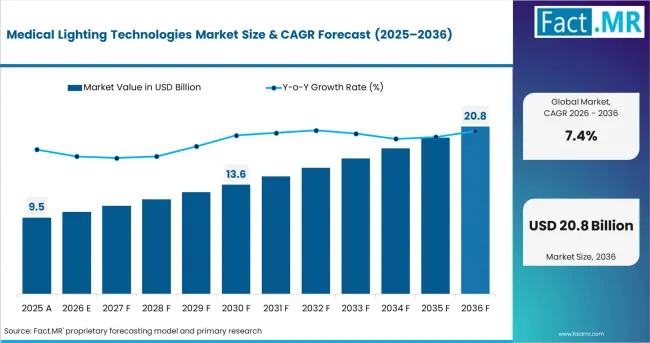
Medical Lighting Technologies Market Value Analysis | Source: Fact.MR
Summary of medical lighting technologies market
- Demand Drivers in the Market
- Operating Room Upgrades: Hospitals need surgical lights that improve visibility and reduce heat near the surgical field.
- LED Replacement: Facility managers are replacing halogen systems with LED lights to reduce maintenance burden.
- Outpatient Procedures: Ambulatory centers need compact medical lighting systems for procedure rooms.
- Key Segments Analyzed
- By Product: Surgical lighting systems are expected to hold 49.0% share in 2026, with operating rooms requiring high-intensity illumination and controlled shadowing.
- By Technology: LED is likely to account for 66.0% share in 2026, reflecting hospital preference for lower heat output and longer usable life.
- By Application: Operating rooms and surgical suites are projected to hold 57.0% share in 2026, driven by the need for clear surgical visibility.
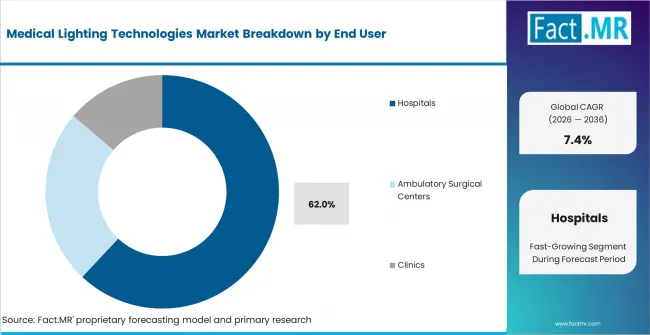
- By End User: Hospitals are anticipated to capture 62.0% share in 2026, supported by the concentration of major surgical infrastructure in hospital settings.
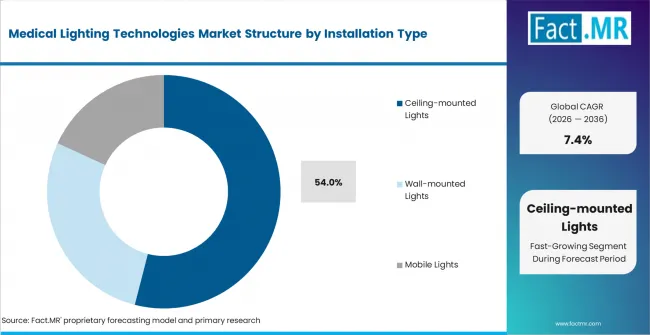
- By Installation Type: Ceiling-mounted lights are expected to hold 54.0% share in 2026, due to stable overhead positioning needs in operating rooms.
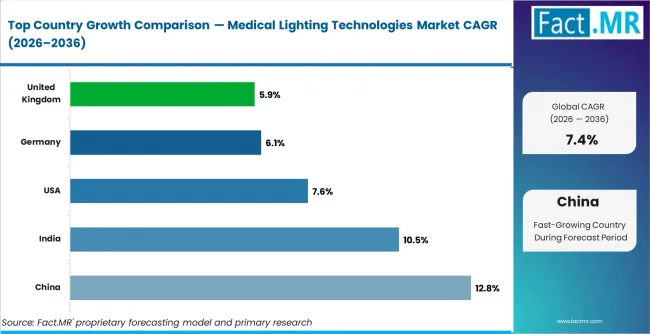
- By Geography: China is projected to record 12.8% CAGR through 2036, supported by hospital infrastructure expansion and LED medical lighting upgrades.
- Analyst Opinion at Fact.MR
- Shambhu Nath Jha, Senior Analyst at Fact.MR, states, “Medical lighting technologies demand is moving from basic lighting to procedure-specific visibility. Hospitals want light quality for tissue checks and lower staff fatigue. Suppliers with strong LED performance and room integration support will gain better access.”
- Strategic Implications
- LED Performance: Manufacturers need lights with accurate color and low heat output.
- Room Integration: Hospital planners should align lighting purchases with operating room layout and camera needs.
- Retrofit Access: Suppliers need replacement options that fit older surgical rooms without major structural changes.
| Metric | Details |
|---|---|
| Industry Size 2026 | USD 10.2 billion |
| Industry Value 2036 | USD 20.8 billion |
| CAGR 2026 to 2036 | 7.4% |
Source: Fact.MR analysis. Updated Jun 8, 2026
China is projected to record 12.8% CAGR through 2036 as hospital infrastructure expansion supports LED medical lighting demand. India is likely to post 10.5% CAGR as surgical capacity expands in public and private hospitals. The United States is expected to register 7.6% CAGR since ambulatory surgery centers upgrade lighting systems. Germany is poised to record 6.1% CAGR because hospitals modernize surgical rooms. The United Kingdom is set to grow at 5.9% CAGR by 2036 as surgical hubs support procedure capacity.
Segmental Analysis
Medical Lighting Technologies Market Analysis by Product
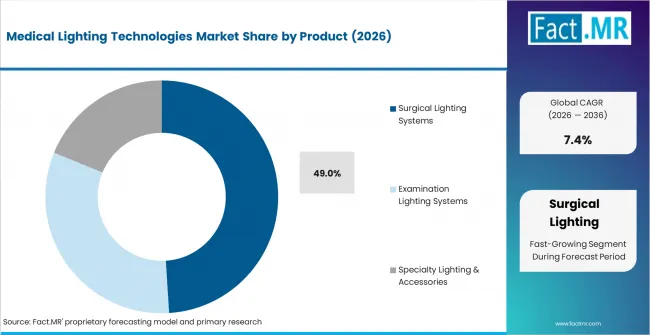
Medical Lighting Technologies Market Analysis By Product | Source: Fact.MR
Surgical lighting systems are expected to hold 49.0% share in 2026 as operating rooms need strong light and stable visibility. The segment leads because surgeons need clear views in deep areas and during position changes. STERIS states that surgical lights support visibility and safety during surgery, with design choices affecting operating room performance. [1] Examination lights serve outpatient and diagnostic settings. Specialty lighting and accessories support dental rooms and focused treatment areas. Surgical lights carry higher value because they need precise positioning and stronger performance control.
- Surgical Visibility: Surgical lights support clear visibility during complex procedures.
- Examination Use: Examination lights help clinicians check patients in routine care spaces.
- Specialty Needs: Specialty lights support dental suites and focused treatment areas.
Medical Lighting Technologies Market Analysis by Technology
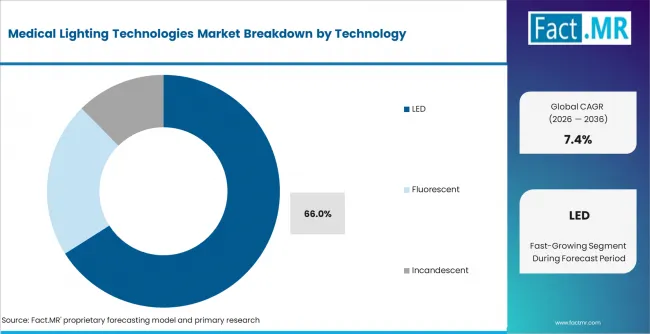
Medical Lighting Technologies Market Analysis By Technology | Source: Fact.MR
Hospitals are replacing older lighting systems because heat and maintenance needs affect operating room efficiency. LED systems reduce lamp replacement and improve visual control. LED is likely to account for 66.0% share in 2026 because hospitals prefer lower heat near the surgical field and steady light quality. Fluorescent and halogen systems continue in older facilities. Incandescent use is falling as clinical spaces move toward LED upgrades.
- Heat Control: LED lights reduce heat exposure near the surgical field.
- Performance Standards: Medical lighting must meet safety and essential performance requirements.
- Replacement Cycle: Older halogen systems create retrofit demand for LED suppliers.
Medical Lighting Technologies Market Analysis by Application
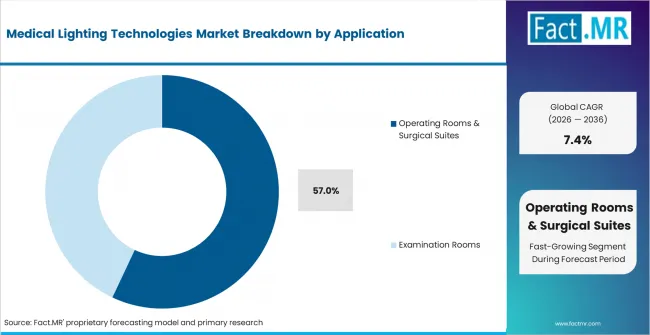
Medical Lighting Technologies Market Analysis By Application | Source: Fact.MR
Operating rooms and surgical suites are projected to hold 57.0% share in 2026 as surgical visibility remains the main purchase driver. Surgical suites require lights that stay clear during repositioning and staff movement. Examination rooms need reliable light for diagnosis and wound checks. ICU lighting requires patient-safe visibility for monitoring and bedside care. Getinge notes that IEC 60601-2-41:2021 sets requirements for surgical and diagnostic luminaires. [2] Application choice affects product needs because surgical rooms require higher intensity and more stable positioning than examination areas.
- Surgical Suites: Operating rooms need stable lighting for long and complex procedures.
- Examination Rooms: Examination lights support routine diagnosis and minor procedures.
- ICU Settings: ICU lights need controlled visibility without excess patient discomfort.
Medical Lighting Technologies Market Analysis by End User
Medical Lighting Technologies Market Analysis By End User | Source: Fact.MR
Hospitals carry the main demand because they operate major surgical suites and procedure rooms. Ambulatory surgical centers are gaining attention as outpatient surgery expands. Hospitals are anticipated to capture 62.0% share in 2026 because complex procedures and large operating room networks remain hospital-based. MedPAC’s 2025 ASC status report states that ambulatory surgical centers provide outpatient surgical procedures for patients who do not need overnight stays. [3] Clinics and dental facilities use lower-intensity systems for routine care. End-user selection depends on procedure mix and room use.
- Hospital Demand: Hospitals need higher-value systems for operating rooms and ICUs.
- ASC Expansion: Ambulatory centers need compact lights for outpatient procedure rooms.
- Clinic Use: Clinics rely on simpler examination lights for routine diagnosis.
Medical Lighting Technologies Market Analysis by Installation Type
Medical Lighting Technologies Market Analysis By Installation Type | Source: Fact.MR
Ceiling-mounted systems lead because surgical rooms need stable overhead positioning and wide field coverage. Mobile lights support outpatient care and flexible procedure rooms. Ceiling-mounted lights are expected to hold 54.0% share in 2026 as operating rooms need fixed positioning and reliable arm movement. Wall-mounted lights suit smaller examination rooms with limited floor space. Mobile systems help clinics and emergency units use rooms for different procedures.
- Ceiling Stability: Ceiling-mounted lights support fixed surgical field coverage.
- Mobile Flexibility: Mobile lights help clinics use rooms for multiple procedures.
- Wall Placement: Wall-mounted lights suit examination rooms with limited space.
Medical Lighting Technologies Market Drivers, Restraints, and Opportunities
Medical Lighting Technologies Market Opportunity Matrix Growth Vs Value | Source: Fact.MR
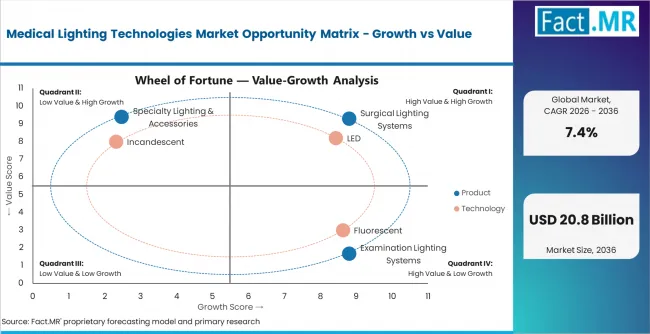
Operating room upgrades are the main driver for medical lighting technologies demand. Hospitals need lights that improve visual clarity and support longer procedures.
High installation cost can limit adoption in smaller facilities. Ceiling-mounted systems may need structural work and room planning. Some clinics delay replacement until older systems fail. This slows LED conversion outside major hospitals.
Opportunities in the Medical Lighting Technologies Market
- LED Retrofit: Suppliers can target hospitals that need lower heat output and longer lamp life.
- ASC Lighting: Ambulatory surgical centers need compact lights for outpatient procedure rooms.
- Camera Integration: Surgical light manufacturers can add imaging support for teaching and documentation.
Regional Analysis
Based on regional analysis, the medical lighting technologies market is segmented into North America, Latin America, Western Europe, Eastern Europe, East Asia, South Asia and Pacific, and Middle East and Africa.
.webp "Top Country Growth Comparison Medical Lighting Technologies Market Cagr (2026 2036)")
Top Country Growth Comparison Medical Lighting Technologies Market Cagr (2026 2036) | Source: Fact.MR
| Country | CAGR 2026 to 2036 |
|---|---|
| China | 12.8% |
| India | 10.5% |
| United States | 7.6% |
| Germany | 6.1% |
| United Kingdom | 5.9% |
Source: Fact.MR analysis. Updated Jun 8, 2026
Source: Fact.MR analysis, based on forecast approach and primary research.
Medical Lighting Technologies Market Cagr Analysis By Country | Source: Fact.MR
East Asia Medical Lighting Technologies Market Analysis
East Asia demand is supported by hospital expansion and LED replacement. China leads regional demand because hospitals and specialty facilities need modern surgical lighting.
- China: China is projected to record 12.8% CAGR through 2036 as hospital expansion supports LED medical lighting demand. Surgical lights will gain from new operating rooms and hospital upgrades. Domestic suppliers can serve cost-sensitive facilities. International manufacturers can compete in high-end surgical suites. Demand will favor systems with LED performance with service support.
South Asia and Pacific Medical Lighting Technologies Market Analysis
South Asia and Pacific demand is led by hospital buildout and private healthcare expansion. India supports regional demand as surgical capacity rises across large cities and tier-two locations. Medical lighting purchases are tied to new operating rooms and replacement cycles.
- India: India hospital expansion is raising demand for surgical and examination lighting. India is likely to post 10.5% CAGR through 2036 as public and private providers add procedure capacity. Hospitals need LED systems that reduce heat and maintenance work. Smaller facilities will prefer affordable examination lights and mobile systems. India’s Ministry of Health and Family Welfare stated in 2025 that PM-ABHIM focuses on building health system capacity across primary and tertiary care with an outlay of ₹64,180 crore for 2021-22 to 2025-26. [4] Private hospitals will drive premium surgical lighting purchases. Suppliers with local service networks will gain better access.
North America Medical Lighting Technologies Market Analysis
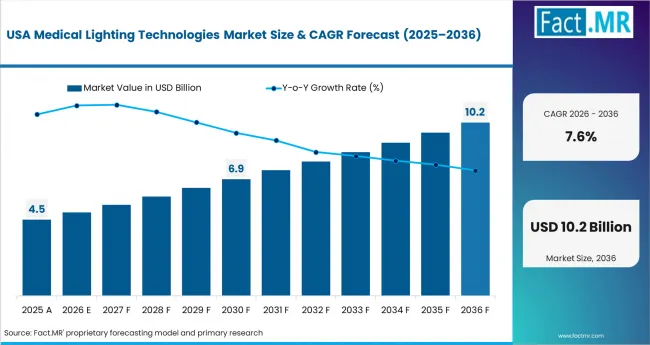
Medical Lighting Technologies Market Country Value Analysis | Source: Fact.MR
North America demand is led by the United States. Hospitals and ambulatory surgical centers need lighting systems for outpatient procedures and operating room upgrades. Replacement demand supports premium LED systems.
- United States: The United States is expected to register 7.6% CAGR through 2036 as ambulatory surgical centers and hospitals upgrade procedure rooms. This supports demand for compact surgical and procedure lights. Hospitals will continue replacing older systems with LED models. Camera-ready systems can gain in teaching and documentation rooms. Suppliers with reliable service support will be better placed in hospital networks.
Western Europe Medical Lighting Technologies Market Analysis
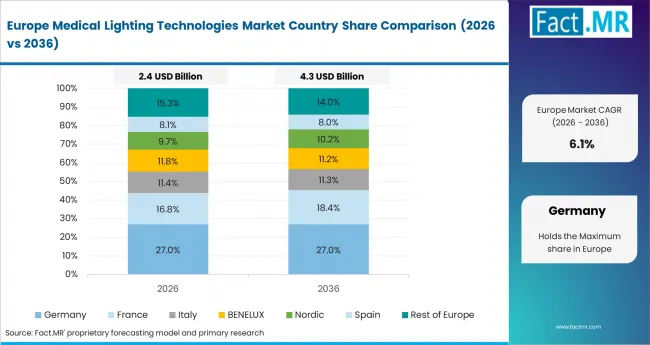
Medical Lighting Technologies Market Europe Country Market Share Analysis, 2026 & 2036 | Source: Fact.MR
Western Europe demand comes from hospital upgrades and surgical efficiency programs. Germany and the United Kingdom need replacement lighting systems across hospital and outpatient facilities. LED adoption is tied to room upgrades and clinical productivity.
- Germany: Germany is likely to record 6.1% CAGR from 2026 to 2036 as hospitals modernize operating rooms and surgical care areas. Hospital reform and quality-focused care planning support medtech replacement needs. Surgical lighting suppliers can gain from LED upgrades and integrated room design. German hospitals will prefer certified systems that match safety requirements. Ceiling-mounted lights will stay important in operating rooms. Equipment providers with reliable installation support will gain easier access.
- United Kingdom: Surgical hubs and elective recovery programs support medical lighting demand in the United Kingdom. The United Kingdom is set to grow at 5.9% CAGR through 2036 as planned care capacity needs modern procedure rooms. Lighting demand will come from surgical hubs and operating room upgrades. NHS England’s 2025 elective care reform plan stated that 17 new and expanded surgical hubs would be launched by June 2025 to provide quicker access to common surgical procedures. [5] Suppliers with retrofit-friendly systems can serve NHS facilities. Private hospitals will add demand for premium LED lights.
Competitive Aligners for Market Suppliers
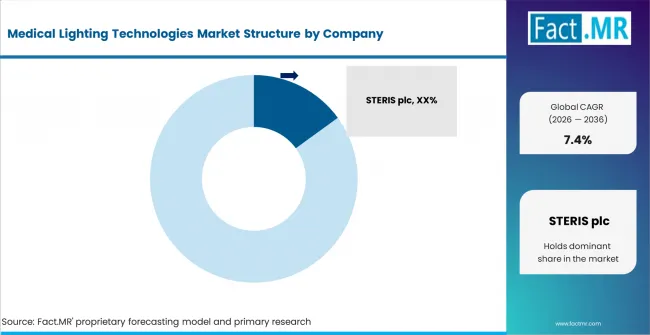
Medical Lighting Technologies Market Analysis By Company | Source: Fact.MR
The medical lighting technologies market includes surgical light manufacturers and integrated operating room equipment suppliers. STERIS plc drives demand through surgical lighting and sterile workflow systems. Getinge AB serves hospitals through operating room equipment and clinical infrastructure. Drägerwerk AG & Co. KGaA supports medical lighting through clinical equipment and hospital technology. Midmark Corporation provides examination room lighting and care space equipment. Stryker Corporation helps operating room demand through surgical equipment and integrated room solutions.
By 2036 suppliers with LED performance and integration support will gain stronger hospital access. Hospitals will prefer lighting systems that reduce fatigue and match existing surgical room layouts. Vendors without retrofit flexibility may lose replacement opportunities in established hospital markets.
Key Companies in Medical Lighting Technologies Market
- STERIS plc
- Getinge AB
- Drägerwerk AG & Co. KGaA
- Midmark Corporation
- Stryker Corporation
Bibliography
- [1] STERIS. (2024, August 23). The complete guide to surgical lights. STERIS Healthcare Knowledge Center.
- [2] Getinge. (2025). Surgical lights that meet IEC 60601-2-41 Ed. 3 Standard. Getinge.
- [3] Medicare Payment Advisory Commission. (2025, March). Ambulatory surgical center services: Status report. In Report to the Congress: Medicare payment policy (chap. 10).
- [4] Ministry of Health and Family Welfare. (2025, July 22). Update on Pradhan Mantri Ayushman Bharat Health Infrastructure Mission (PM-ABHIM). Press Information Bureau, Government of India.
- [5] NHS England. (2025, January 6). Reforming elective care for patients. NHS England.
This Report Addresses
- The report explains how large the medical lighting technologies market will be in 2026.
- Shows the 2036 value outlook and the expected CAGR.
- Identifies the leading product and explains why surgical lighting systems lead.
- The report explains why LED remains the leading technology.
- Reviews operating room and surgical suite demand.
- The report compares country-level outlook across China, India, the United States, Germany, and the United Kingdom.
- Explains how ambulatory surgical centers influence lighting demand.
- The report assesses competition among surgical light and examination light suppliers.
Medical Lighting Technologies Market Definition
The medical lighting technologies market covers lighting systems used in healthcare facilities for surgery and specialty treatment settings. The market includes fixed and mobile lights used in operating rooms and examination rooms. It is distinct from general facility lighting because medical lights need controlled intensity and safety performance.
Medical Lighting Technologies Market Inclusions
The scope includes surgical lighting systems and examination lighting systems. Specialty lighting and accessories are included when used in healthcare settings. LED and halogen technologies are covered. Ceiling-mounted and mobile light systems are included when they support medical procedures or clinical examination.
Medical Lighting Technologies Market Exclusions
The scope excludes general building lighting used in corridors and administrative spaces. It excludes non-medical studio lighting. Projector lamps are outside scope unless certified and sold for clinical use. Imaging equipment lights are excluded when sold as part of an imaging device.
Medical Lighting Technologies Market Research Methodology
- Primary Research
- Primary research includes interviews with hospital equipment planners and operating room managers. Biomedical engineering heads were reviewed separately.
- Desk Research
- Desk research reviews medical lighting standards and official healthcare facility guidance. Supplier product documents support technology validation.
- Market-Sizing and Forecasting
- Forecasting uses product demand and technology replacement patterns. Application demand and end-user adoption support the forecast approach.
- Data Validation and Update Cycle
- Forecasts are validated through hospital obtaining checks and supplier interviews. Regional assumptions are reviewed against healthcare infrastructure and surgical care expansion.
Segmentation
Scope of the Report
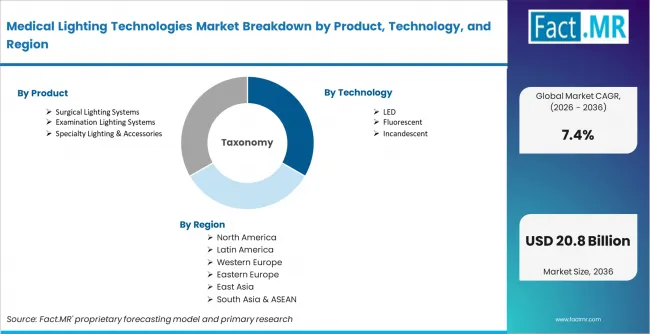
Medical Lighting Technologies Market Breakdown By Product, Technology, And Region | Source: Fact.MR
| Attribute | Details |
|---|---|
| Quantitative Units | USD 10.2 billion in 2026 to USD 20.8 billion by 2036 at 7.4% CAGR |
| Market Definition | Lighting systems used in healthcare facilities for surgery, examination, diagnosis, and specialty care |
| Product | Surgical Lighting Systems, Examination Lighting Systems, Specialty Lighting & Accessories |
| Technology | Fluorescent, LED, Incandescent, Halogen |
| Application | Operating Rooms & Surgical Suites, Examination Rooms, Intensive Care Units |
| End User | Hospitals, Ambulatory Surgical Centers, Clinics, Dental Facilities |
| Installation Type | Ceiling-mounted Lights, Wall-mounted Lights, Mobile Lights |
| Regions Covered | North America, Latin America, Western Europe, Eastern Europe, East Asia, South Asia and Pacific, Middle East and Africa |
| Countries Covered | China, India, United States, Germany, United Kingdom |
| Key Companies Profiled | STERIS plc, Getinge AB, Drägerwerk AG & Co. KGaA, Midmark Corporation, Stryker Corporation |
| Forecast Period | 2026 to 2036 |
| Approach | Hybrid top-down and bottom-up approach using product demand, technology adoption, application use, end-user demand, and regional validation |
Source: Fact.MR analysis. Updated Jun 8, 2026
Medical Lighting Technologies Market Analysis by Segments
-
By Product:
- Surgical Lighting Systems
- Examination Lighting Systems
- Specialty Lighting & Accessories
-
By Technology:
- Fluorescent
- LED
- Incandescent
- Halogen
-
By Application:
- Operating Rooms & Surgical Suites
- Examination Rooms
- Intensive Care Units
-
By End User:
- Hospitals
- Ambulatory Surgical Centers
- Clinics
- Dental Facilities
-
By Installation Type:
- Ceiling-mounted Lights
- Wall-mounted Lights
- Mobile Lights
-
Region:
- North America
- United States
- Canada
- Western Europe
- Germany
- United Kingdom
- France
- Italy
- Spain
- Eastern Europe
- Poland
- Russia
- Czech Republic
- East Asia
- China
- Japan
- South Korea
- South Asia and Pacific
- India
- ASEAN
- Australia and New Zealand
- Latin America
- Brazil
- Mexico
- Argentina
- Middle East and Africa
- GCC Countries
- South Africa
- Turkey
- North America
Frequently Asked Questions
How large is the global ligament stabilizers market in 2025?
What will the ligament stabilizers market size be in 2026?
What is the projected ligament stabilizers market size by 2036?
What is the expected CAGR for the ligament stabilizers market from 2026 to 2036?
Which product leads the ligament stabilizers market?
Which injury type leads the ligament stabilizers market?
Which country grows fastest in the ligament stabilizers market?
Who worked on this report


Preview the report firsthand - request a free sample
Free SampleGet the brochure for pricing and purchase details
Download PDF