Mesh Bag Market (2026 - 2036)
Mesh Bag Market Size and Share Forecast Outlook 2026 to 2036
Core Findings
Mesh Bag Market Forecast and Outlook 2026 to 2036
The mesh bag market starts the period at USD 4.2 billion in 2026 and moves to USD 6.8 billion by 2036, which reflects a 5.0% CAGR.
Mesh Bag Market Key Takeaways
- Mesh Bag Market Value (2026): USD 4.2 billion
- Mesh Bag Market Forecast Value (2036): USD 6.8 billion
- Mesh Bag Market Forecast CAGR 2026 to 2036: 5.0%
- Leading Material Type in Mesh Bag Market: Nylon
- Key Growth Regions in Mesh Bag Market: Asia Pacific, Europe, North America, Latin America, Middle East & Africa
- Top Players in Mesh Bag Market: Knack Packaging Private Limited, Karatzis S.A., Nutec Manufacturing Inc., Tex-Pro Inc., Agribag International Ltd., Tufbag Industrial Co. Ltd., Vedder Industrial Ltd., Flexipol Packaging Limited, Mega Plastic Industries, Sagar Polypack
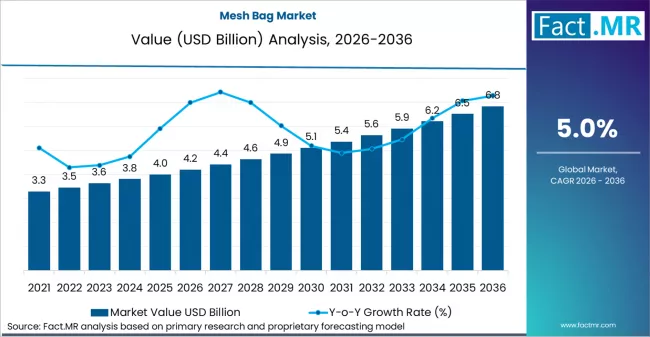
This segment serves agriculture, retail produce, and bulk handling where ventilation, visibility, and low material use matter more than rigid protection. Buyers choose formats based on load tolerance, knot or seal strength, and how the bag behaves on filling and weighing lines.
Many users standardize a small set of sizes to keep packing stations, labeling, and pallet patterns consistent. Reuse in some channels places attention on abrasion resistance and shape retention. Once a bag type is qualified for a crop or product group, it usually stays in place since changing sizes affects equipment settings and downstream handling. Volume growth follows higher produce throughput and wider use in organized retail rather than frequent changes in bag construction.
Mesh Bag Market
| Metric | Value |
|---|---|
| Market Value (2026) | USD 4.2 billion |
| Forecast Value (2036) | USD 6.8 billion |
| Forecast CAGR 2026 to 2036 | 5.0% |
Category
| Category | Segments |
|---|---|
| Material Type | Nylon; Polyethylene; Polypropylene; Cotton |
| Application | Agriculture and produce; Retail and consumer goods; Industrial and construction; Others |
| Region | North America; Europe; Asia Pacific; Latin America; Middle East & Africa |
Segmental Analysis
Why Does Nylon Set the Baseline for Most Mesh Bag Programs?
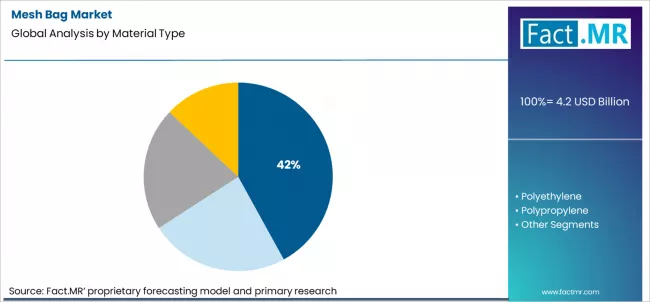
Nylon accounts for 42.0% of material type usage in the mesh bag market. This share reflects its balance of tensile strength, abrasion resistance, and stable knot retention during repeated loading and unloading. Packing operations value consistent mesh geometry that holds shape under compression and rebound cycles. Reuse programs and rental pools also favor materials that tolerate washing and drying without loss of structure. Color stability and print adhesion remain acceptable across long distribution chains. Procurement teams keep standardized deniers and weave patterns in stock to simplify replenishment. Polyethylene, polypropylene, and cotton serve defined niches. Most high-throughput users still specify nylon as the reference material when setting size ranges, load limits, and service life targets.
What Keeps Agriculture and Produce as The Largest Destination for Mesh Bags?
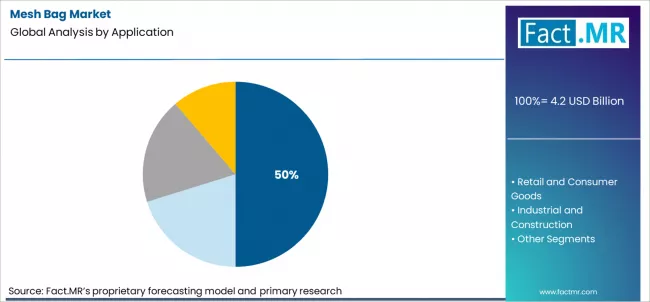
Agriculture and produce represent 50.00% of application volume in the mesh bag market. Harvest and packing stations move large counts of onions, potatoes, citrus, and similar items that require airflow and visual inspection during grading and retail display. Daily throughput creates continuous demand for bagging rather than project-based orders. Size grading and weight bands align well with standardized mesh formats used across regions. Handling steps involve stacking, tipping, and short-distance transport, which suits breathable containment. Cold storage and wash-down routines also fit mesh construction. Retail and industrial uses add volume. The scale and cadence of fresh produce movement keep this application as the primary driver of bag consumption.
What are the Drivers, Restraints, and Key Trends of the Mesh Bag Market?
- Drivers: Increasing use of mesh bags for produce and bulk goods packaging to support ventilation, reduce condensation, and enable efficient handling in retail and supply chain operations is shaping demand across fruit, vegetable, and multipack packaging segments.
- Restraint: Limitations in load strength and abrasion resistance compared with some alternative bag materials, coupled with cost sensitivities in price-driven markets, constrain broader use in heavier or irregular goods packaging.
- Trend 1: Development of stronger mesh constructions and reinforced closures to enhance load integrity while maintaining breathability.
- Trend 2: Expanded availability of mesh bags in a wider range of sizes and closure types designed to accommodate diverse product assortments and handling requirements.
Analysis of the Mesh Bag Market by Key Country
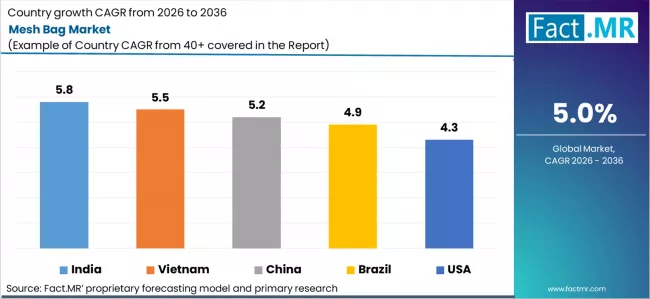
| Country | CAGR 2026 to 2036 |
|---|---|
| India | 5.8% |
| Vietnam | 5.5% |
| China | 5.2% |
| Brazil | 4.9% |
| USA | 4.3% |
The report covers an in-depth analysis of 40+ countries; top-performing countries are highlighted below.
How Are Produce Distribution and Retail Handling Practices Shaping Mesh Bag Use in India?
Fresh produce distribution in India relies heavily on lightweight, breathable packaging for transport and display. The market advances near 5.8% per year through 2036 as organized retail and wholesale markets expand. Mesh bags are used mainly for onions, potatoes, citrus, and similar categories. Buyers focus on load bearing capacity, knot strength, and consistent sizing. Procurement decisions emphasize availability and price stability. Volume growth follows expansion of formal trading channels and cold chain investments. Adoption increases in modern trade faster than in traditional markets. Market development remains tied to logistics efficiency and crop distribution scale rather than branding or material substitution trends.
Why Is Export-Oriented Agriculture Driving Mesh Bag Demand in Vietnam?
Agricultural export flows shape packaging requirements in Vietnam more than domestic retail standards. With growth near 5.5% per year through 2036, mesh bags are increasingly used for fruits and vegetables shipped to regional markets. Users focus on ventilation, weight tolerance, and handling convenience. Procurement decisions are closely linked to seasonal harvest cycles and exporter contracts. Volume growth tracks expansion of produce exports and consolidation of packing houses. Local manufacturers supply most demand, with limited import reliance. Adoption remains concentrated in export corridors. Market development depends more on crop volumes and trade routes than on changes in retail packaging formats or policy initiatives.
What Is Sustaining Steady Mesh Bag Usage Across Produce Supply Chains in China?
Large scale agricultural distribution networks define how mesh bags are used in China. The market grows near 5.2% per year through 2036 as wholesale markets and interprovincial transport remain central to food supply. Mesh bags are favored for bulk handling of vegetables and root crops. Buyers emphasize consistent size, strength, and stacking behavior. Procurement is often handled by produce traders and logistics operators rather than retailers. Volume growth follows movement of agricultural output and modernization of wholesale markets. Adoption is driven by practicality and cost control. Market development remains volume led rather than driven by packaging policy or retail presentation standards.
How Are Logistics Formalization and Crop Trading Patterns Influencing Mesh Bags in Brazil?
Produce trading and long distance transport shape packaging choices in Brazil. With growth near 4.9% per year through 2036, mesh bags remain common for potatoes, onions, and citrus. Users focus on durability, handling ease, and resistance to tearing. Procurement decisions emphasize supplier reach and stable pricing. Volume growth follows expansion of organized wholesale markets and improvement of transport links between farming regions and cities. Adoption in export channels grows faster than in domestic trade. Market development stays tied to agricultural throughput and distribution efficiency rather than retail packaging standards or branding considerations.
What Is Limiting but Sustaining Mesh Bag Demand in USA?
Produce handling practices in USA increasingly mix reusable containers and lightweight flexible packaging. The market advances near 4.3% per year through 2036, supported mainly by onions, citrus, and certain bulk vegetables. Buyers focus on compliance with handling standards, consistent sizing, and ease of stacking. Procurement decisions are influenced by distributor contracts and packing house specifications. Volume growth follows produce shipment volumes rather than retail expansion. Substitution by crates and bins limits faster adoption. Market development remains steady and tied to agricultural distribution needs rather than changes in consumer packaging preferences or store level merchandising strategies.
How Do Packing Line Efficiency and Produce Handling Standards Shape Competition in the Mesh Bag Market?
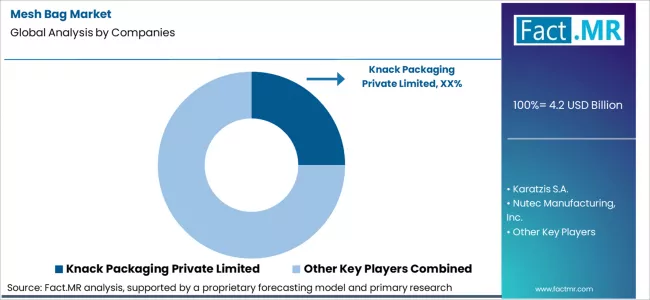
Access to produce packing programs is determined by line speed, bag geometry, and handling tolerance rather than by resin cost. Packhouses first define fill weights, ventilation needs, and sealing methods before any supplier is evaluated. Karatzis, Agribag International, Tufbag, Nutec, and Vedder often compete in high throughput operations where consistency of weave and knot strength matter for automated lines. Knack Packaging, Tex Pro, KB Poly, Flexipol, Mega Plastic, Sagar Polypack, and regional mesh bag specialists serve programs that require format variety, private labeling, or short lead times. Buyers compare suppliers using breakage rates, stitch uniformity, and pallet stacking behavior. Once a bag format is standardized, volumes follow crop cycles and packing schedules. Supplier changes usually occur after line upgrades or shifts in crop mix.
Key Players in Mesh Bag Market
- Knack Packaging Private Limited
- Karatzis S.A.
- Nutec Manufacturing, Inc.
- Tex-Pro Inc.
- Agribag International Ltd.
- Tufbag Industrial Co. Ltd.
- Leno Mesh Bags
- Mesh Bag Co.
- KB Poly Industries
- Vedder Industrial Ltd.
- Flexipol Packaging Limited
- Mega Plastic Industries
- Sagar Polypack
Scope of the Report
| Items | Values |
|---|---|
| Quantitative Units (2026) | USD billion |
| Material Type | Nylon, polyethylene, polypropylene, cotton |
| Application | Agriculture and produce, retail and consumer goods, industrial and construction, others |
| Regions Covered | Asia Pacific, Europe, North America, Latin America, Middle East & Africa |
| Countries Covered | United States, Canada, Mexico, Germany, United Kingdom, France, Italy, Spain, Nordics, BENELUX, China, Japan, South Korea, India, Australia & New Zealand, ASEAN, Brazil, Chile, Saudi Arabia, Turkey, South Africa, and other regional markets |
| Key Companies Profiled | Knack Packaging, Karatzis, Nutec Manufacturing, Tex-Pro, Agribag International, Tufbag Industrial, Vedder Industrial, KB Poly, Flexipol Packaging, Mega Plastic Industries, Sagar Polypack |
| Additional Attributes | Dollar value by material type and application; focus on load tolerance, knot strength, and packing line behavior; demand driven by produce throughput growth and expansion of organized retail |
Mesh Bag Market Segmentation
-
Material Type :
- Nylon
- Polyethylene
- Polypropylene
- Cotton
-
Application :
- Agriculture & Produce
- Retail & Consumer Goods
- Industrial & Construction
- Others
-
Region :
- Asia Pacific
- China
- Japan
- South Korea
- India
- Australia & New Zealand
- ASEAN
- Rest of Asia Pacific
- Europe
- Germany
- United Kingdom
- France
- Italy
- Spain
- Nordic
- BENELUX
- Rest of Europe
- North America
- United States
- Canada
- Mexico
- Latin America
- Brazil
- Chile
- Rest of Latin America
- Middle East & Africa
- Kingdom of Saudi Arabia
- Other GCC Countries
- Turkey
- South Africa
- Other African Union
- Rest of Middle East & Africa
- Asia Pacific
References
- Food and Agriculture Organization of the United Nations & World Health Organization. (2023). Code of practice for packaging and transport of fresh fruits and vegetables. FAO/WHO.
- U.S. Department of Agriculture. (2023). Perishable Agricultural Commodities Act (PACA) compliance and handling guidelines. U.S. Department of Agriculture.
- International Organization for Standardization. (2024). ISO 2233: Packaging - Complete, filled transport packages - Stacking tests using compression tester. ISO.
- International Organization for Standardization. (2023). ISO 287: Paper and board - Determination of moisture content. ISO.
Table of Content
- Executive Summary
- Global Market Outlook
- Demand to side Trends
- Supply to side Trends
- Technology Roadmap Analysis
- Analysis and Recommendations
- Market Overview
- Market Coverage / Taxonomy
- Market Definition / Scope / Limitations
- Market Background
- Market Dynamics
- Drivers
- Restraints
- Opportunity
- Trends
- Scenario Forecast
- Demand in Optimistic Scenario
- Demand in Likely Scenario
- Demand in Conservative Scenario
- Opportunity Map Analysis
- Product Life Cycle Analysis
- Supply Chain Analysis
- Investment Feasibility Matrix
- Value Chain Analysis
- PESTLE and Porter’s Analysis
- Regulatory Landscape
- Regional Parent Market Outlook
- Production and Consumption Statistics
- Import and Export Statistics
- Market Dynamics
- Global Market Analysis 2021 to 2025 and Forecast, 2026 to 2036
- Historical Market Size Value (USD Million) Analysis, 2021 to 2025
- Current and Future Market Size Value (USD Million) Projections, 2026 to 2036
- Y to o to Y Growth Trend Analysis
- Absolute $ Opportunity Analysis
- Global Market Pricing Analysis 2021 to 2025 and Forecast 2026 to 2036
- Global Market Analysis 2021 to 2025 and Forecast 2026 to 2036, By Material Type
- Introduction / Key Findings
- Historical Market Size Value (USD Million) Analysis By Material Type, 2021 to 2025
- Current and Future Market Size Value (USD Million) Analysis and Forecast By Material Type, 2026 to 2036
- Nylon
- Polyethylene
- Polypropylene
- Cotton
- Nylon
- Y to o to Y Growth Trend Analysis By Material Type, 2021 to 2025
- Absolute $ Opportunity Analysis By Material Type, 2026 to 2036
- Global Market Analysis 2021 to 2025 and Forecast 2026 to 2036, By Application
- Introduction / Key Findings
- Historical Market Size Value (USD Million) Analysis By Application, 2021 to 2025
- Current and Future Market Size Value (USD Million) Analysis and Forecast By Application, 2026 to 2036
- Agriculture and Produce
- Retail and Consumer Goods
- Industrial and Construction
- Others
- Agriculture and Produce
- Y to o to Y Growth Trend Analysis By Application, 2021 to 2025
- Absolute $ Opportunity Analysis By Application, 2026 to 2036
- Global Market Analysis 2021 to 2025 and Forecast 2026 to 2036, By Region
- Introduction
- Historical Market Size Value (USD Million) Analysis By Region, 2021 to 2025
- Current Market Size Value (USD Million) Analysis and Forecast By Region, 2026 to 2036
- North America
- Latin America
- Western Europe
- Eastern Europe
- East Asia
- South Asia and Pacific
- Middle East & Africa
- Market Attractiveness Analysis By Region
- North America Market Analysis 2021 to 2025 and Forecast 2026 to 2036, By Country
- Historical Market Size Value (USD Million) Trend Analysis By Market Taxonomy, 2021 to 2025
- Market Size Value (USD Million) Forecast By Market Taxonomy, 2026 to 2036
- By Country
- USA
- Canada
- Mexico
- By Material Type
- By Application
- By Country
- Market Attractiveness Analysis
- By Country
- By Material Type
- By Application
- Key Takeaways
- Latin America Market Analysis 2021 to 2025 and Forecast 2026 to 2036, By Country
- Historical Market Size Value (USD Million) Trend Analysis By Market Taxonomy, 2021 to 2025
- Market Size Value (USD Million) Forecast By Market Taxonomy, 2026 to 2036
- By Country
- Brazil
- Chile
- Rest of Latin America
- By Material Type
- By Application
- By Country
- Market Attractiveness Analysis
- By Country
- By Material Type
- By Application
- Key Takeaways
- Western Europe Market Analysis 2021 to 2025 and Forecast 2026 to 2036, By Country
- Historical Market Size Value (USD Million) Trend Analysis By Market Taxonomy, 2021 to 2025
- Market Size Value (USD Million) Forecast By Market Taxonomy, 2026 to 2036
- By Country
- Germany
- UK
- Italy
- Spain
- France
- Nordic
- BENELUX
- Rest of Western Europe
- By Material Type
- By Application
- By Country
- Market Attractiveness Analysis
- By Country
- By Material Type
- By Application
- Key Takeaways
- Eastern Europe Market Analysis 2021 to 2025 and Forecast 2026 to 2036, By Country
- Historical Market Size Value (USD Million) Trend Analysis By Market Taxonomy, 2021 to 2025
- Market Size Value (USD Million) Forecast By Market Taxonomy, 2026 to 2036
- By Country
- Russia
- Poland
- Hungary
- Balkan & Baltic
- Rest of Eastern Europe
- By Material Type
- By Application
- By Country
- Market Attractiveness Analysis
- By Country
- By Material Type
- By Application
- Key Takeaways
- East Asia Market Analysis 2021 to 2025 and Forecast 2026 to 2036, By Country
- Historical Market Size Value (USD Million) Trend Analysis By Market Taxonomy, 2021 to 2025
- Market Size Value (USD Million) Forecast By Market Taxonomy, 2026 to 2036
- By Country
- China
- Japan
- South Korea
- By Material Type
- By Application
- By Country
- Market Attractiveness Analysis
- By Country
- By Material Type
- By Application
- Key Takeaways
- South Asia and Pacific Market Analysis 2021 to 2025 and Forecast 2026 to 2036, By Country
- Historical Market Size Value (USD Million) Trend Analysis By Market Taxonomy, 2021 to 2025
- Market Size Value (USD Million) Forecast By Market Taxonomy, 2026 to 2036
- By Country
- India
- ASEAN
- Australia & New Zealand
- Rest of South Asia and Pacific
- By Material Type
- By Application
- By Country
- Market Attractiveness Analysis
- By Country
- By Material Type
- By Application
- Key Takeaways
- Middle East & Africa Market Analysis 2021 to 2025 and Forecast 2026 to 2036, By Country
- Historical Market Size Value (USD Million) Trend Analysis By Market Taxonomy, 2021 to 2025
- Market Size Value (USD Million) Forecast By Market Taxonomy, 2026 to 2036
- By Country
- Kingdom of Saudi Arabia
- Other GCC Countries
- Turkiye
- South Africa
- Other African Union
- Rest of Middle East & Africa
- By Material Type
- By Application
- By Country
- Market Attractiveness Analysis
- By Country
- By Material Type
- By Application
- Key Takeaways
- Key Countries Market Analysis
- USA
- Pricing Analysis
- Market Share Analysis, 2025
- By Material Type
- By Application
- Canada
- Pricing Analysis
- Market Share Analysis, 2025
- By Material Type
- By Application
- Mexico
- Pricing Analysis
- Market Share Analysis, 2025
- By Material Type
- By Application
- Brazil
- Pricing Analysis
- Market Share Analysis, 2025
- By Material Type
- By Application
- Chile
- Pricing Analysis
- Market Share Analysis, 2025
- By Material Type
- By Application
- Germany
- Pricing Analysis
- Market Share Analysis, 2025
- By Material Type
- By Application
- UK
- Pricing Analysis
- Market Share Analysis, 2025
- By Material Type
- By Application
- Italy
- Pricing Analysis
- Market Share Analysis, 2025
- By Material Type
- By Application
- Spain
- Pricing Analysis
- Market Share Analysis, 2025
- By Material Type
- By Application
- France
- Pricing Analysis
- Market Share Analysis, 2025
- By Material Type
- By Application
- India
- Pricing Analysis
- Market Share Analysis, 2025
- By Material Type
- By Application
- ASEAN
- Pricing Analysis
- Market Share Analysis, 2025
- By Material Type
- By Application
- Australia & New Zealand
- Pricing Analysis
- Market Share Analysis, 2025
- By Material Type
- By Application
- China
- Pricing Analysis
- Market Share Analysis, 2025
- By Material Type
- By Application
- Japan
- Pricing Analysis
- Market Share Analysis, 2025
- By Material Type
- By Application
- South Korea
- Pricing Analysis
- Market Share Analysis, 2025
- By Material Type
- By Application
- Russia
- Pricing Analysis
- Market Share Analysis, 2025
- By Material Type
- By Application
- Poland
- Pricing Analysis
- Market Share Analysis, 2025
- By Material Type
- By Application
- Hungary
- Pricing Analysis
- Market Share Analysis, 2025
- By Material Type
- By Application
- Kingdom of Saudi Arabia
- Pricing Analysis
- Market Share Analysis, 2025
- By Material Type
- By Application
- Turkiye
- Pricing Analysis
- Market Share Analysis, 2025
- By Material Type
- By Application
- South Africa
- Pricing Analysis
- Market Share Analysis, 2025
- By Material Type
- By Application
- USA
- Market Structure Analysis
- Competition Dashboard
- Competition Benchmarking
- Market Share Analysis of Top Players
- By Regional
- By Material Type
- By Application
- Competition Analysis
- Competition Deep Dive
- Knack Packaging Private Limited
- Overview
- Product Portfolio
- Profitability by Market Segments (Product/Age /Sales Channel/Region)
- Sales Footprint
- Strategy Overview
- Marketing Strategy
- Product Strategy
- Channel Strategy
- Karatzis S.A.
- Nutec Manufacturing, Inc.
- Tex-Pro Inc.
- Agribag International Ltd.
- Tufbag Industrial Co. Ltd.
- Leno Mesh Bags
- Mesh Bag Co.
- KB Poly Industries
- Vedder Industrial Ltd.
- Flexipol Packaging Limited
- Mega Plastic Industries
- Sagar Polypack
- Knack Packaging Private Limited
- Competition Deep Dive
- Assumptions & Acronyms Used
- Research Methodology
List Of Table
- Table 1: Global Market Value (USD Million) Forecast by Region, 2021 to 2036
- Table 2: Global Market Value (USD Million) Forecast by Material Type, 2021 to 2036
- Table 3: Global Market Value (USD Million) Forecast by Application, 2021 to 2036
- Table 4: North America Market Value (USD Million) Forecast by Country, 2021 to 2036
- Table 5: North America Market Value (USD Million) Forecast by Material Type, 2021 to 2036
- Table 6: North America Market Value (USD Million) Forecast by Application, 2021 to 2036
- Table 7: Latin America Market Value (USD Million) Forecast by Country, 2021 to 2036
- Table 8: Latin America Market Value (USD Million) Forecast by Material Type, 2021 to 2036
- Table 9: Latin America Market Value (USD Million) Forecast by Application, 2021 to 2036
- Table 10: Western Europe Market Value (USD Million) Forecast by Country, 2021 to 2036
- Table 11: Western Europe Market Value (USD Million) Forecast by Material Type, 2021 to 2036
- Table 12: Western Europe Market Value (USD Million) Forecast by Application, 2021 to 2036
- Table 13: Eastern Europe Market Value (USD Million) Forecast by Country, 2021 to 2036
- Table 14: Eastern Europe Market Value (USD Million) Forecast by Material Type, 2021 to 2036
- Table 15: Eastern Europe Market Value (USD Million) Forecast by Application, 2021 to 2036
- Table 16: East Asia Market Value (USD Million) Forecast by Country, 2021 to 2036
- Table 17: East Asia Market Value (USD Million) Forecast by Material Type, 2021 to 2036
- Table 18: East Asia Market Value (USD Million) Forecast by Application, 2021 to 2036
- Table 19: South Asia and Pacific Market Value (USD Million) Forecast by Country, 2021 to 2036
- Table 20: South Asia and Pacific Market Value (USD Million) Forecast by Material Type, 2021 to 2036
- Table 21: South Asia and Pacific Market Value (USD Million) Forecast by Application, 2021 to 2036
- Table 22: Middle East & Africa Market Value (USD Million) Forecast by Country, 2021 to 2036
- Table 23: Middle East & Africa Market Value (USD Million) Forecast by Material Type, 2021 to 2036
- Table 24: Middle East & Africa Market Value (USD Million) Forecast by Application, 2021 to 2036
List Of Figures
- Figure 1: Global Market Pricing Analysis
- Figure 2: Global Market Value (USD Million) Forecast 2021 to 2036
- Figure 3: Global Market Value Share and BPS Analysis by Material Type, 2026 and 2036
- Figure 4: Global Market Y to o to Y Growth Comparison by Material Type, 2026 to 2036
- Figure 5: Global Market Attractiveness Analysis by Material Type
- Figure 6: Global Market Value Share and BPS Analysis by Application, 2026 and 2036
- Figure 7: Global Market Y to o to Y Growth Comparison by Application, 2026 to 2036
- Figure 8: Global Market Attractiveness Analysis by Application
- Figure 9: Global Market Value (USD Million) Share and BPS Analysis by Region, 2026 and 2036
- Figure 10: Global Market Y to o to Y Growth Comparison by Region, 2026 to 2036
- Figure 11: Global Market Attractiveness Analysis by Region
- Figure 12: North America Market Incremental Dollar Opportunity, 2026 to 2036
- Figure 13: Latin America Market Incremental Dollar Opportunity, 2026 to 2036
- Figure 14: Western Europe Market Incremental Dollar Opportunity, 2026 to 2036
- Figure 15: Eastern Europe Market Incremental Dollar Opportunity, 2026 to 2036
- Figure 16: East Asia Market Incremental Dollar Opportunity, 2026 to 2036
- Figure 17: South Asia and Pacific Market Incremental Dollar Opportunity, 2026 to 2036
- Figure 18: Middle East & Africa Market Incremental Dollar Opportunity, 2026 to 2036
- Figure 19: North America Market Value Share and BPS Analysis by Country, 2026 and 2036
- Figure 20: North America Market Value Share and BPS Analysis by Material Type, 2026 and 2036
- Figure 21: North America Market Y to o to Y Growth Comparison by Material Type, 2026 to 2036
- Figure 22: North America Market Attractiveness Analysis by Material Type
- Figure 23: North America Market Value Share and BPS Analysis by Application, 2026 and 2036
- Figure 24: North America Market Y to o to Y Growth Comparison by Application, 2026 to 2036
- Figure 25: North America Market Attractiveness Analysis by Application
- Figure 26: Latin America Market Value Share and BPS Analysis by Country, 2026 and 2036
- Figure 27: Latin America Market Value Share and BPS Analysis by Material Type, 2026 and 2036
- Figure 28: Latin America Market Y to o to Y Growth Comparison by Material Type, 2026 to 2036
- Figure 29: Latin America Market Attractiveness Analysis by Material Type
- Figure 30: Latin America Market Value Share and BPS Analysis by Application, 2026 and 2036
- Figure 31: Latin America Market Y to o to Y Growth Comparison by Application, 2026 to 2036
- Figure 32: Latin America Market Attractiveness Analysis by Application
- Figure 33: Western Europe Market Value Share and BPS Analysis by Country, 2026 and 2036
- Figure 34: Western Europe Market Value Share and BPS Analysis by Material Type, 2026 and 2036
- Figure 35: Western Europe Market Y to o to Y Growth Comparison by Material Type, 2026 to 2036
- Figure 36: Western Europe Market Attractiveness Analysis by Material Type
- Figure 37: Western Europe Market Value Share and BPS Analysis by Application, 2026 and 2036
- Figure 38: Western Europe Market Y to o to Y Growth Comparison by Application, 2026 to 2036
- Figure 39: Western Europe Market Attractiveness Analysis by Application
- Figure 40: Eastern Europe Market Value Share and BPS Analysis by Country, 2026 and 2036
- Figure 41: Eastern Europe Market Value Share and BPS Analysis by Material Type, 2026 and 2036
- Figure 42: Eastern Europe Market Y to o to Y Growth Comparison by Material Type, 2026 to 2036
- Figure 43: Eastern Europe Market Attractiveness Analysis by Material Type
- Figure 44: Eastern Europe Market Value Share and BPS Analysis by Application, 2026 and 2036
- Figure 45: Eastern Europe Market Y to o to Y Growth Comparison by Application, 2026 to 2036
- Figure 46: Eastern Europe Market Attractiveness Analysis by Application
- Figure 47: East Asia Market Value Share and BPS Analysis by Country, 2026 and 2036
- Figure 48: East Asia Market Value Share and BPS Analysis by Material Type, 2026 and 2036
- Figure 49: East Asia Market Y to o to Y Growth Comparison by Material Type, 2026 to 2036
- Figure 50: East Asia Market Attractiveness Analysis by Material Type
- Figure 51: East Asia Market Value Share and BPS Analysis by Application, 2026 and 2036
- Figure 52: East Asia Market Y to o to Y Growth Comparison by Application, 2026 to 2036
- Figure 53: East Asia Market Attractiveness Analysis by Application
- Figure 54: South Asia and Pacific Market Value Share and BPS Analysis by Country, 2026 and 2036
- Figure 55: South Asia and Pacific Market Value Share and BPS Analysis by Material Type, 2026 and 2036
- Figure 56: South Asia and Pacific Market Y to o to Y Growth Comparison by Material Type, 2026 to 2036
- Figure 57: South Asia and Pacific Market Attractiveness Analysis by Material Type
- Figure 58: South Asia and Pacific Market Value Share and BPS Analysis by Application, 2026 and 2036
- Figure 59: South Asia and Pacific Market Y to o to Y Growth Comparison by Application, 2026 to 2036
- Figure 60: South Asia and Pacific Market Attractiveness Analysis by Application
- Figure 61: Middle East & Africa Market Value Share and BPS Analysis by Country, 2026 and 2036
- Figure 62: Middle East & Africa Market Value Share and BPS Analysis by Material Type, 2026 and 2036
- Figure 63: Middle East & Africa Market Y to o to Y Growth Comparison by Material Type, 2026 to 2036
- Figure 64: Middle East & Africa Market Attractiveness Analysis by Material Type
- Figure 65: Middle East & Africa Market Value Share and BPS Analysis by Application, 2026 and 2036
- Figure 66: Middle East & Africa Market Y to o to Y Growth Comparison by Application, 2026 to 2036
- Figure 67: Middle East & Africa Market Attractiveness Analysis by Application
- Figure 68: Global Market - Tier Structure Analysis
- Figure 69: Global Market - Company Share Analysis
- FAQs -
How big is the mesh bag market in 2026?
The global mesh bag market is estimated to be valued at USD 4.2 billion in 2026.
What will be the size of mesh bag market in 2036?
The market size for the mesh bag market is projected to reach USD 6.8 billion by 2036.
How much will be the mesh bag market growth between 2026 and 2036?
The mesh bag market is expected to grow at a 5.0% CAGR between 2026 and 2036.
What are the key product types in the mesh bag market?
The key product types in mesh bag market are nylon, polyethylene, polypropylene and cotton.
Which application segment to contribute significant share in the mesh bag market in 2026?
In terms of application, agriculture and produce segment to command 50.0% share in the mesh bag market in 2026.