- Base Value(2025): 147.2 Mn
- Estimated Value(2026): 151.2 Mn
- Forecast Value (2036): 226.1 Mn
- CAGR (2026 - 2036): 4.1%
Wine Bag Market Forecast and Outlook 2026 to 2036
In 2025, the wine bag market was valued at USD 147.2 million. Based on FACT.MR analysis, demand for wine bags is estimated to grow to USD 151.2 million in 2026 and USD 226.1 million by 2036. FACT.MR projects a CAGR of 4.1% during the forecast period.
The projected absolute growth of USD 74.9 million from 2026 to 2036 reflects steady rather than transformational expansion, driven by the sustained growth of wine retail and gifting channels globally and a consumer-level shift toward reusable fabric wine bags that generate higher per-unit revenue even as overall unit volumes in commodity disposable formats decline.
Malcolm Waugh, CEO of Frugalpac states, “What we've seen since the CBS feature is clear proof of pent-up demand. Retailers and brands are actively looking for credible, scalable alternatives to glass - and the Frugal Bottle is ready now.” Growth is moderated by the fragmented nature of packaging supply, the low switching cost that makes retailer sourcing decisions highly price-sensitive, and the absence of mandatory sustainability regulations specifically targeting wine bag formats in most jurisdictions.
Country level growth varies based on wine culture, gifting habits, and packaging regulations. China leads at 5.8% CAGR, supported by rising domestic wine consumption, strong premium gifting during festive seasons, and growth in branded e-commerce packaging. India follows at 5.6%, driven by expanding urban demand and modern retail adoption. The United States grows at 4.3%, supported by gifting occasions and direct to consumer winery shipments. The United Kingdom posts 4.2%, sustained by independent wine merchants and premium paper and fabric formats. Japan records 3.9%, with steady demand but limited growth due to traditional gift wrapping practices and lower domestic wine volumes.
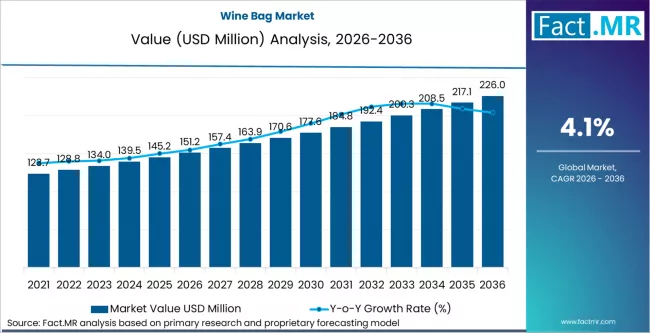
Wine Bag Market Market Value Analysis | Source: Fact.MR
Market Definition
The wine bag market encompasses paper, plastic, and fabric bags specifically designed to carry, protect, and present wine bottles in retail, gifting, and food service settings. These bags range from simple single-use paper or plastic totes used at point of sale to premium reusable jute, cotton, or non-woven fabric bags incorporating drawstring closures, padded insulation, and branded print decoration. They are purchased by wine retailers, supermarkets, wineries, restaurants, and gift packaging distributors who require functional and presentable packaging to facilitate single or multi-bottle wine purchase, transport, and gifting across both online and physical retail channels.
Market Inclusions
The report covers global and regional market sizing from 2026 to 2036, segmented by material type, product type, and capacity. It analyses pricing differentials between paper, plastic, and fabric formats, reusable versus disposable product type adoption trends by channel, single and multi-bottle capacity preference by end-use occasion, and the competitive positioning of leading wine bag manufacturers and distributors across North America, Europe, Asia-Pacific, Latin America, and Middle East and Africa.
Market Exclusions
The scope excludes rigid wine bottle boxes and wooden wine crates used for premium gifting that do not incorporate fabric or paper bag elements. It also omits wine shipping cartons and corrugated fiber cases used for logistics and bulk transport, wine bottle sleeves without carry handles, and general-purpose shopping bags not specifically designed or marketed for wine bottle carrying, focusing strictly on wine-specific bag formats sold through retail, wholesale, and direct-to-consumer gifting channels.
Research Methodology
- Primary Research: Primary research involved structured interviews with wine bag procurement managers at major supermarket chains and wine retailers, sourcing directors at wine gifting and corporate gift packaging distributors, and production managers at fabric bag manufacturers in China, India, and the United Kingdom.
- Desk Research: Desk research synthesized data from national wine retail trade association reports, Wine Intelligence global consumption trend publications, retail trade press covering packaging and gifting trends, and company-disclosed product portfolio and geographic expansion information from publicly available manufacturer websites and trade show publications.
- Market-Sizing and Forecasting: Market sizing employed a bottom-up approach, building from estimated annual wine bottle unit sales by country with attachment rate assumptions for bag usage by channel type, multiplied by average selling prices per bag format, validated against disclosed revenues from listed flexible packaging manufacturers with wine packaging segments.
- Data Validation and Update Cycle: Outputs were cross-validated against import and export trade data for non-woven fabric bags and paper bags from UN Comtrade databases, reconciled annually with new product launches at major packaging trade fairs including Interpack and Pack Expo, and updated with retailer sustainability policy announcements affecting bag format procurement decisions.
Summary
-
Market Definition
- The wine bag market covers paper, plastic, and fabric single-use and reusable carrying bags purpose-designed for wine bottle presentation and transport, sold to wine retailers, supermarkets, wineries, and gifting distributors across physical and e-commerce channels worldwide.
-
Demand Drivers
- Single-use plastic bag restrictions enacted across the European Union, United Kingdom, India, and China are compelling wine retailers and supermarkets to source alternative paper and fabric bag formats, creating mandatory product substitution demand that is structurally independent of wine consumption volume growth.
- The global expansion of wine gifting occasions including holidays, weddings, and corporate events is increasing the proportion of wine purchases made in premium reusable fabric bag formats, which carry three to five times the unit revenue of commodity paper bags and are driving average selling price growth even where total unit volumes grow modestly.
- Growth of direct-to-consumer winery shipping programmes in the United States and Australia, enabled by state-level wine shipping law relaxation, is generating demand for single-bottle wine bags suitable for inclusion in shipped packages as a gifting presentation layer that adds perceived value without significant freight weight addition.
-
Key Segments Analyzed
- By Material, Fabric Bags hold 50.2% share, reflecting their dominance in the premium gifting and reusable segments where jute, cotton, and non-woven polypropylene formats command the highest unit prices and generate the most retailer demand among sustainability-focused buying programmes.
- By Product Type, Reusable Wine Bags command 65% share, driven by retailer sustainability commitments, single-use plastic restrictions in major markets, and consumer preference for gifting formats that have functional value beyond the initial purchase occasion, reducing effective per-use cost below equivalent disposable formats.
- By Capacity, Single Bottle Wine Bags account for 64% share, reflecting the dominance of single-bottle wine gifting occasions and point-of-sale convenience purchasing where individual bottle carry bags are the standard format across supermarkets, wine merchants, and restaurant retail channels globally.
-
Analyst Opinion at FACT.MR
- Shambhu Nath Jha, Principal Consultant at Fact.MR, opines, 'CXOs will find this report valuable for understanding how single-use plastic regulations, wine gifting culture expansion in Asia-Pacific, and the premiumization of fabric reusable bag formats are simultaneously reshaping the wine bag market's revenue architecture, and which material and capacity segments offer the highest unit margin expansion opportunity through the forecast period.'
-
Strategic Implications / Executive Takeaways
- Wine bag manufacturers should accelerate development of certified organic cotton and recycled non-woven fabric bag ranges with verifiable sustainability credentials that meet retailer ESG procurement criteria, positioning premium reusable formats as a margin expansion opportunity rather than a compliance cost, particularly in European and North American markets where retailer sustainability auditing is most advanced.
- Distributors serving wine retail and gifting channels should build multi-format product catalogues that allow clients to select across paper, plastic-free fabric, and luxury rigid-insert bag formats from a single vendor relationship, reducing fragmentation in the wine bag supply chain and capturing a greater share of the gifting packaging budget that currently flows to multiple specialty suppliers.
- Manufacturers targeting Asia-Pacific growth should establish local production or sourcing partnerships in China and India to supply fabric wine bags at price points competitive with domestically produced commodity formats, avoiding the import cost premium that currently limits penetration of premium reusable bag formats in price-sensitive retail channels serving mid-market wine consumers.
-
Methodology
- Market sizing was built from bottom-up wine bottle retail unit volume estimates by country and channel type, multiplied by wine bag attachment rates and average selling prices by material and product type format, calibrated against UN Comtrade trade flow data for fabric and paper bag import and export volumes.
- Pricing benchmarks were validated against publicly listed product pricing on major B2B procurement platforms including Alibaba, GlobalSources, and industry-specific packaging distributor catalogues in the United States, United Kingdom, and Germany.
- Sustainability regulation impact modelling incorporated confirmed single-use plastic bag ban timelines from EU Directive 2019/904, India's Plastic Waste Management Amendment Rules 2022, and China's Updated Plastic Ban Regulations 2020, quantifying mandatory format substitution volumes by country.
Segmental Analysis
Wine Bag Market Analysis by Material
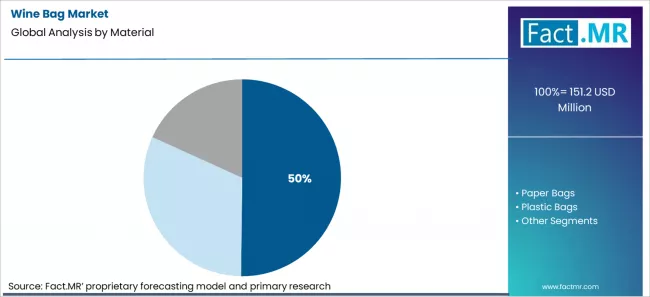
Wine Bag Market Analysis By Material | Source: Fact.MR
Fabric bags are projected to hold 50.2% share in 2026. They dominate premium and gifting segments due to durability, visual appeal, and alignment with retailer sustainability policies.
- Ampac Holdings Sustainable Expansion: Ampac expanded its sustainable non-woven reusable bag offerings to meet retailer demand for plastic alternatives. [1]
- Non-Woven Fabric Technology Development: NANGFA Manufacturing expanded laminated non-woven PP wine bag capacity with padded multi bottle formats for gifting and transport. [5]
- Paper Bag Retail Shift: After EU plastic restrictions, retailers such as Carrefour and Tesco transitioned wine bag stock to certified paper and fabric options. [6]
Wine Bag Market Analysis by Product Type
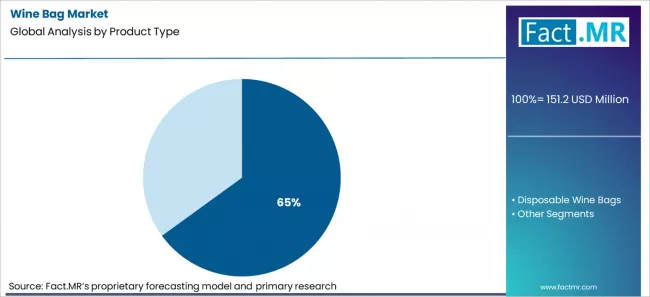
Wine Bag Market Analysis By Product Type | Source: Fact.MR
Reusable wine bags are expected to hold 65% share in 2026. Regulatory pressure, higher retailer margins, and consumer preference for reusable gifting formats are driving this dominance.
- Wine Box Company Reusable Launch: Wine Box Company expanded printed jute and cotton reusable ranges in 2024 to meet UK retailer demand. [7]
- Disposable Paper Bag Demand: Kraft paper wine bags remain relevant in high volume retail, with suppliers such as Smurfit Kappa reporting steady demand. [8]
Drivers, Restraints, and Opportunities
FACT.MR analysts note that the wine bag market has grown steadily alongside global bottled wine retail expansion. As wine sales shifted to supermarkets, specialty stores, and direct to consumer channels, individual bottle carry packaging became standard. The valuation in 2026 reflects a market that is mature in plastic and paper formats but rapidly evolving toward fabric and reusable options. This shift is driven by plastic restrictions and stronger consumer preference for premium gifting presentation.
Decline of single use plastic bags, which are increasingly restricted across Europe, the UK, India, and parts of China, versus rising demand for paper and fabric alternatives. Although reusable fabric bags cost more per unit, they generate higher revenue and margins. For manufacturers, however, this transition requires new sourcing for cotton and jute, upgraded production capabilities, and closer collaboration with retail chains.
- EU Single Use Plastics Directive: Directive 2019/904 bans single use plastic carry bags across EU retail channels, legally enforcing a shift toward paper, fabric, or compostable wine bag formats across major wine consuming markets. [2]
- India Plastic Waste Management Rules: India’s 2022 amendment banned thin plastic carry bags, accelerating demand for paper and fabric wine bags as wine retail expands in modern trade channels. [3]
- China Wine Consumption Growth: Rising wine gifting during major festivals and growth of e commerce platforms such as JD.com and Tmall have increased procurement of premium fabric wine bags at scale. [4]
Regional Analysis
The wine bag market is analyzed across North America, Europe, Asia-Pacific, Latin America, and Middle East and Africa. Regional demand is shaped by wine consumption culture, retail gifting tradition, single-use plastic regulation intensity, and the maturity of premium packaging procurement practices among wine retailers and distributors. The full report offers detailed market attractiveness analysis comparing regulatory environment, channel structure, and competitive intensity by region.
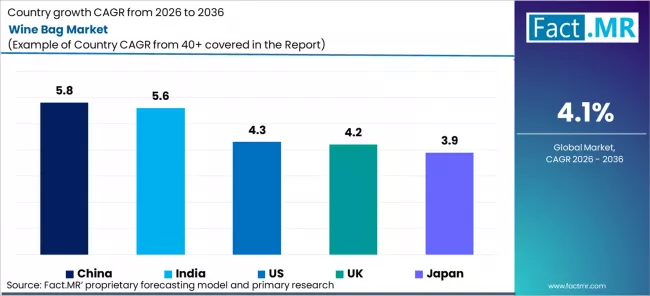
Wine Bag Market Cagr Analysis By Country | Source: Fact.MR
| Country | CAGR% |
|---|---|
| China | 5.8% |
| India | 5.6% |
| United States | 4.3% |
| United Kingdom | 4.2% |
| Japan | 3.9% |
Source: Fact.MR analysis. Updated Feb 24, 2026
Source: Fact.MR (FACT.MR) analysis, based on proprietary forecasting model and primary research
North America Wine Bag Market Analysis
North America remains a stable and mature wine bag market, supported by strong wine retail volumes and the growing shift toward reusable fabric programmes among major chains. Suppliers such as Ampac Holdings LLC and Acorn Paper Products Company maintain close relationships with wineries and specialty retailers, competing on customization and flexible order sizes.
- United States: The United States is projected to grow at 4.3% CAGR through 2036. As the world’s largest wine market by value, it provides a steady baseline for single bottle bag demand. Growth in direct to consumer winery shipping and sustainability commitments by retailers such as Target Corporation and Kroger Co. are increasing adoption of certified paper and reusable fabric wine bags.
Europe Wine Bag Market Analysis
Europe is the regulatory benchmark for sustainable wine bags. The EU ban on single use plastic carry bags has permanently shifted demand toward paper and fabric formats. Companies such as Wine Box Company Limited and Smurfit Kappa Group play strong roles in supplying grocery and specialist wine retailers.
- United Kingdom: The UK market is expected to grow at 4.2% CAGR through 2036. The extended plastic bag charge has made single use formats commercially unattractive, pushing retailers toward reusable fabric alternatives. With a large wine retail base and strong gifting culture, merchants such as Majestic Wine and Waitrose & Partners increasingly offer reusable wine bags as standard gifting packaging.
Asia Pacific Wine Bag Market Analysis
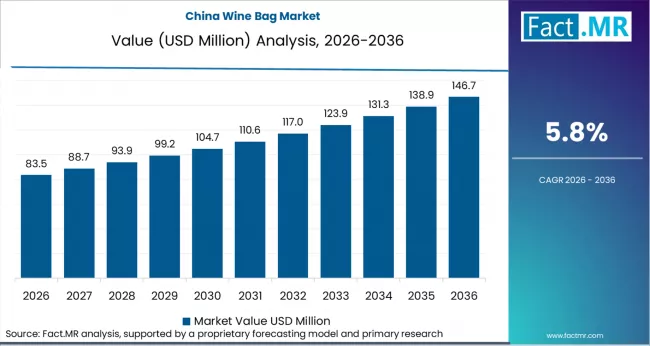
Wine Bag Market Country Value Analysis | Source: Fact.MR
Asia Pacific is the fastest growing region, supported by rising wine consumption and plastic restrictions. Manufacturers in China and India serve both export and domestic demand, supplying customizable fabric and paper wine bags to expanding retail and e-commerce channels.
- China: China is projected to grow at 5.8% CAGR through 2036. Progressive plastic restrictions and strong premium gifting culture during major festivals are driving demand for fabric wine bags. Large e-commerce platforms such as JD.com have standardized premium packaging options, creating large scale procurement demand for domestic fabric wine bag suppliers.
- India: India is forecast to grow at 5.6% CAGR through 2036. Plastic ban has accelerated the shift from plastic to paper and fabric wine bags across retail outlets. Rapid growth in organized wine retail and wine tourism in Nashik is creating structured demand for premium single bottle gifting bags through supermarkets and winery cellar door sales.
- Japan: Japan is expected to grow at 3.9% CAGR through 2036. Traditional gift wrapping methods limit rapid bag adoption, but younger consumers are embracing reusable wine totes for modern gifting. Following the Plastic Resource Circulation Act, major chains such as 7-Eleven Japan and FamilyMart are transitioning wine packaging from plastic to paper formats, supporting gradual market expansion.
Competitive Aligners for Market Players
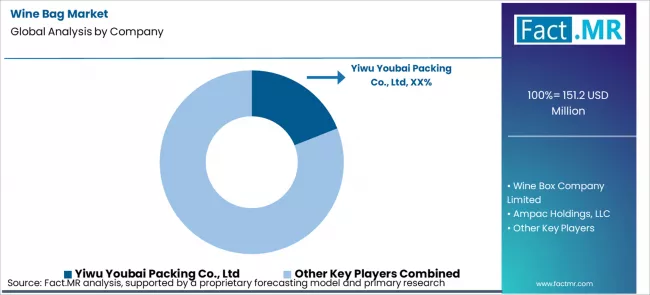
Wine Bag Market Analysis By Company | Source: Fact.MR
The wine bag market is highly fragmented, with no single company controlling more than five to seven percent of global revenue. Competition is split between China based export manufacturers such as Yiwu Youbai Packing, NANGFA Manufacturing Co. Ltd, Initi Bag Manufacturer, and Firstway (H.K.) Ltd, and Western suppliers including Ampac Holdings LLC, Acorn Paper Products Company, and Wine Box Company Limited. Asian manufacturers compete mainly on price, scale, and fast customization, supported by strong non-woven fabric supply chains. Western players focus more on certified materials, shorter lead times, and premium design.
In higher value segments, sustainability credentials such as GOTS, FSC, or recycled content certification are key differentiators. Retailers in Europe and North America increasingly demand traceable and auditable sourcing standards.
Large retail chains reduce risk through multi supplier strategies and annual tenders. Independent wine merchants often buy through distributors. Wineries engaged in direct to consumer sales tend to remain loyal to suppliers that manage their branded designs and seasonal customization efficiently.
Recent Development
- In 2025, SIG launched Australia’s first fully recycle-ready bag-in-box packaging for wine, developed with partners including Hill-Smith Family Estates and DeBortoli Wines.
- In 2025, Huizhou Union Packaging Co., Ltd unveiled a new collection of reusable wine bags made from recycled PET bottles, highlighting its focus on sustainable materials and the circular economy as part of broader eco-friendly packaging trends in the industry.
Key Players
- Yiwu Youbai Packing Co., Ltd
- Wine Box Company Limited
- Ampac Holdings, LLC
- Acorn Paper Products Company
- Richie Bags
- Initi Bag Manufacturer Co., Ltd
- DM Packaging Company
- Firstway (H.K.) Ltd
- NANGFA Manufacturing Co., Ltd
Bibliography
- [1] Ampac Holdings LLC / Mondi Group, Sustainable Packaging Product Portfolio and Reusable Bag Division Overview, January 2023.
- [2] European Commission, Directive (EU) 2019/904 of the European Parliament and of the Council on the reduction of the impact of certain plastic products on the environment (Single-Use Plastics Directive), Official Journal of the European Union, June 2019.
- [3] Ministry of Environment, Forest and Climate Change, Government of India, Plastic Waste Management Amendment Rules 2022, Gazette of India, February 2022.
- [4] International Organisation of Vine and Wine (OIV), World Wine Report 2023: Global Consumption and Trade Data, July 2023.
- [5] NANGFA Manufacturing Co. Ltd, Product Portfolio: Wine Bag and Non-Woven Fabric Bag Range 2023, Company Trade Profile, October 2023.
- [6] Carrefour Group, Sustainability Report 2022: Single-Use Plastic Elimination Progress, April 2023.
- [7] Wine Box Company Limited, Product Range 2023: Reusable Fabric Wine Bags and Sustainable Gifting Packaging, Company Website, 2023.
- [8] Smurfit Kappa Group, Packaging Market Commentary and Annual Report 2023, March 2024.
This Report Addresses
- Market intelligence for strategic planning with analysis of wine bag format migration from single-use plastic toward paper, certified fabric, and reusable formats driven by regulatory mandates and retailer sustainability procurement policies.
- Market size and forecast showing global valuation of USD 151.4 million in 2026 and projected USD 226.1 million by 2036 at 4.1% CAGR.
- Growth opportunity mapping across premium reusable fabric single-bottle gifting bags, insulated wine carry formats, and branded winery direct-to-consumer packaging programmes.
- Segment and regional forecasts covering all major countries with material type, product type, and capacity breakdowns.
- Competition strategy assessment of leading wine bag manufacturers and distributors including export manufacturer versus domestic specialist positioning, certification capability, and retailer relationship structures.
- Product and compliance tracking of EU Single-Use Plastics Directive implementation, India Plastic Waste Management Rules 2022, China plastic bag ban phase timeline, and UK Environment Act carrier bag charge provisions affecting wine bag format procurement.
- Channel analysis comparing supermarket, wine specialist retailer, winery direct-to-consumer, and e-commerce wine platform wine bag demand profiles and average order size by channel type.
- Report delivery in Excel, PowerPoint, and PDF formats with fully validated data, primary research evidence, and source documentation.
Segmentation
Scope of Report
| Items | Values |
|---|---|
| Quantitative Units | USD 151.4 million (2026) to USD 226.2 million (2036), at a CAGR of 4.1% |
| Market Definition | Aquaculture lighting and environmental control systems encompass LED and spectrum-tunable lighting, aeration and oxygenation equipment, water quality sensors, and automated feeding systems deployed in fish and shellfish farming facilities to precisely manage the biological environment and optimize production performance. |
| Material | Paper Bags, Plastic Bags, Fabric Bags |
| Product Type | Reusable Wine Bags, Disposable Wine Bags |
| Capacity | Single Bottle Wine Bags, Multi Bottle Wine Bags |
| Regions Covered | Asia Pacific, Europe, North America, Latin America, Middle East & Africa |
| Countries Covered | China, Japan, South Korea, Australia & New Zealand, India, ASEAN, Rest of Asia Pacific, Norway, Germany, United Kingdom, France, Spain, Netherlands, Nordics, Rest of Europe, United States, Canada, Mexico, Brazil, Chile, Ecuador, Rest of Latin America, Kingdom of Saudi Arabia, United Arab Emirates, South Africa, Turkey, Rest of Middle East & Africa |
| Key Companies Profiled | Yiwu Youbai Packing Co., Ltd, Wine Box Company Limited, Ampac Holdings, LLC, Acorn Paper Products Company, Richie Bags, Initi Bag Manufacturer Co., Ltd, DM Packaging Company, Firstway (H.K.) Ltd, and NANGFA Manufacturing Co., Ltd. |
| Forecast Period | 2026 to 2036 |
| Approach | Top down and bottom up market modeling validated through primary interviews with wine retailers, winery operators, packaging distributors, and fabric and paper bag manufacturers, supported by national wine consumption statistics, retail sales data, plastic regulation policy documents, trade association reports, and company disclosed revenue and production capacity information. |
Source: Fact.MR analysis. Updated Feb 24, 2026
Wine Bag Market by Segment
-
By Material :
- Paper Bags
- Plastic Bags
- Fabric Bags
-
By Product Type :
- Reusable Wine Bags
- Disposable Wine Bags
-
By Capacity :
- Single Bottle Wine Bags
- Multi Bottle Wine Bags
-
Region :
- Asia Pacific
- China
- Japan
- South Korea
- Australia & New Zealand
- India
- ASEAN
- Rest of Asia Pacific
- Europe
- Norway
- Germany
- United Kingdom
- France
- Spain
- Netherlands
- Nordics
- Rest of Europe
- North America
- United States
- Canada
- Mexico
- Latin America
- Brazil
- Chile
- Ecuador
- Rest of Latin America
- Middle East & Africa
- Kingdom of Saudi Arabia
- United Arab Emirates
- South Africa
- Turkey
- Rest of Middle East & Africa
- Asia Pacific
Who worked on this report


Preview the report firsthand - request a free sample
Free SampleGet the brochure for pricing and purchase details
Download PDF