- Base Value(2025): 1.3 Bn
- Estimated Value(2026): 1.4 Bn
- Forecast Value (2036): 3.3 Bn
- CAGR (2026 - 2036): 9.2%
Metal Modifiers Market Forecast and Outlook 2026 to 2036
In 2025, the metal modifiers market was valued at USD 1.3 billion. Based on Fact.MR analysis, demand for metal modifiers is estimated to grow to USD 1.4 billion in 2026 and USD 3.3 billion by 2036. Fact.MR projects a CAGR of 9.2% during the forecast period.
The market is expected to generate an absolute dollar opportunity of USD 1.9 billion between 2026 and 2036. This transformational gain reflects the compounding effect of simultaneous demand growth across automotive, aerospace, and electronics manufacturing, each of which is independently raising performance specifications for metallic surface and structural modifier chemistries.
Dr. Heinz Schimmelbusch, Chairman of the Management Board and CEO, said, “Our third quarter performance remained strong, driven by continued momentum in AMG Technologies with AMG Engineering’s order backlog, as well as high profitability in AMG Antimony.
Country growth reflects manufacturing intensity and regulatory shifts. China leads at 11.0% CAGR on automotive electronics scale plus China 6 standards. India follows at 10.5% via PLI incentives and Make in India expansion. The United States grows 8.8% on aerospace and ILSAC GF-7 adoption. Germany posts 8.5% under REACH and Euro 7 upgrades, while Brazil records 8.0% on aerospace and automotive localization.
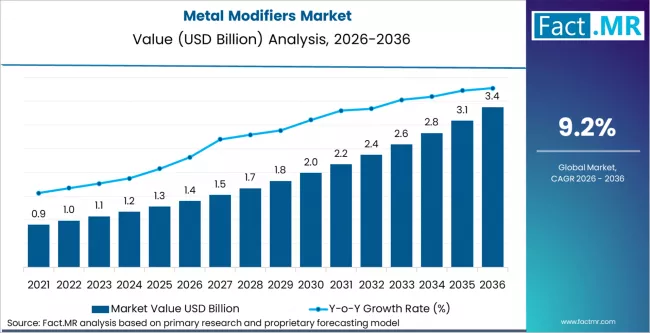
Metal Modifiers Market Market Value Analysis | Source: Fact.MR
Market Definition
The metal modifiers market includes chemical additives and functional materials that improve the surface, structural, and tribological performance of metal components. These include corrosion inhibitors, friction modifiers, anti-wear additives, extreme pressure agents, and surface hardeners used in lubricants, metalworking fluids, coatings, and treatments. They extend component life and enable high temperature and high load performance across automotive, aerospace, electronics, construction, and marine sectors.
Market Inclusions
The report covers global and regional revenues from 2026 to 2036, segmented by modifier type, application industry, formulation format, and end user. It assesses metallic and non-metallic chemistries across powder, liquid, and granular formats. Regulatory drivers including REACH, China 6, and ILSAC GF 7 are analyzed, with country forecasts for China, India, the United States, Germany, and Brazil.
Market Exclusions
The scope excludes bulk base oils, coolant fluids where modifiers are incidental, and standalone coatings not integrated into additive packages. Structural alloys, raw metals, semiconductor precursors, electroplating chemicals, and thermal spray coatings are not included. The focus is strictly on in situ metal modifier additives.
Research Methodology
- Primary Research: Interviews were conducted with formulation chemists, OEM procurement managers, aerospace engineers, and specialty chemical distributors across major regions.
- Desk Research: Sources included earnings reports from Lubrizol, BASF, Evonik, and Solvay, regulatory updates from EPA, ECHA, and China MEE, and product announcements from leading surface treatment suppliers.
- Market Sizing and Forecasting: A hybrid model combined sector production volumes with modifier loading rates and pricing data. Automotive, aerospace, and electronics output served as demand proxies, supported by primary interview insights.
- Data Validation and Update Cycle: Results were validated against specialty chemical revenues, OEM reformulation announcements, and regulatory timelines. Forecasts are updated annually to reflect specification and raw material shifts.
Summary
- Market Definition
- Metal modifiers are additive packages that enhance surface and tribological performance of metals in lubricants, fluids, and treatment formulations across industrial applications.
- Demand Drivers
- ILSAC GF 7 implementation in 2025 is driving reformulation of lubricant modifier packages globally.
- China 6 standards and manufacturing expansion are increasing demand for advanced modifier chemistries.
- REACH substance restrictions are accelerating replacement of legacy metallic formulations in Europe.
- Key Segments Analyzed
- By Type of Modifier: Metallic modifiers hold about 63% share due to superior performance in high load applications.
- By Application Industry: Automotive accounts for about 34% share driven by drivetrain and engine demand.
- By Formulation Type: Powder modifiers hold around 42% share for controlled dosing and surface coverage.
- By End User: Manufacturers represent roughly 46% share as primary industrial consumers.
- By Geography: Asia Pacific leads in volume, while Europe leads in premium revenue share.
- Analyst Opinion at FACT.MR
- Shambhu Nath Jha, Principal Consultant at Fact.MR, opines, "CXOs will find this report essential for understanding how simultaneous regulatory cycles in North America, Asia, and Europe are creating a global reformulation window that rewards suppliers with compliant next generation modifier portfolios."
- Strategic Implications
- Suppliers should accelerate GF 7 and ACEA C7 compliant package qualification to secure OEM specifications.
- Manufacturers in China and India should expand local technical teams to support OEM approval processes.
- Distributors in Brazil and Southeast Asia should align with global suppliers for compliant product portfolios.
- Methodology
- Market sizing combined production forecasts with loading rates and price benchmarks validated against major specialty chemical disclosures.
- Regulatory driven reformulation demand was mapped against implementation timelines and affected volume shares.
- Regional modelling incorporated automotive and aerospace output data along with government investment commitments.
Segmental Analysis
Metal Modifiers Market Analysis by Type of Modifier
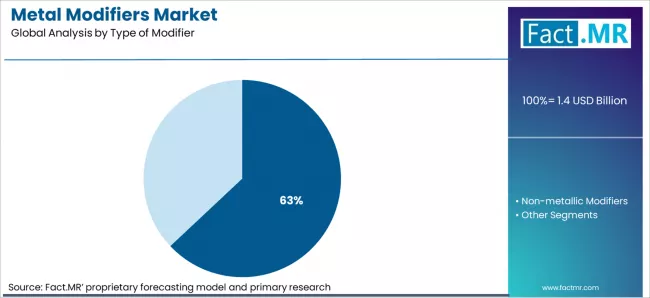
Metal Modifiers Market Analysis By Type Of Modifier | Source: Fact.MR
Metallic modifiers are projected to hold 63% share in 2026. Zinc, molybdenum, boron, and titanium based chemistries provide proven extreme pressure and anti wear performance. These formulations are deeply embedded in OEM standards, and switching requires 12 to 36 months of requalification, creating specification inertia.
- Lubrizol BASF Distribution Expansion: Lubrizol’s expanded 2024 distribution agreement with BASF for EMGARD and Plurasafe lines strengthens global industrial reach. The partnership highlights how established additive firms extend market access through distribution alliances while protecting qualified formulation portfolios. [1]
- Lubrizol MF9145V Diesel Modifier Launch: In Q2 2025, Lubrizol introduced MF9145V to support China 6b diesel compliance. The additive improves combustion and reduces particulate filter regeneration frequency. The launch demonstrates region specific regulatory targeting within metallic modifier development. [5]
- Non-metallic Modifier Growth via EV Thermal Fluids: Global EV stock surpassed 40 million units in 2025, expanding demand for copper compatible and dielectric stable non metallic modifiers. EV thermal and e axle fluids require chemistries that differ from traditional organometallic systems, creating new growth space for specialized suppliers.
Metal Modifiers Market Analysis by Application Industry
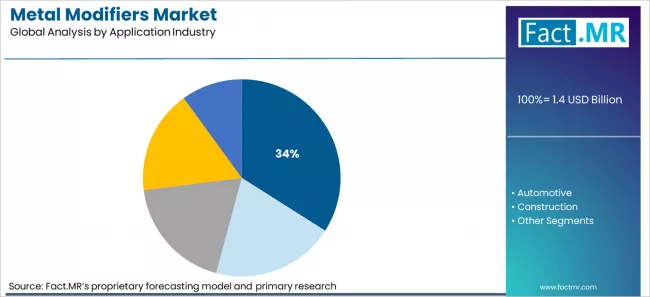
Metal Modifiers Market Analysis By Application Industry | Source: Fact.MR
Automotive is projected to hold 34% share in 2026. The sector drives the largest modifier volumes across engine oils, transmission fluids, and gear lubricants. Continuous OEM specification updates create recurring qualification cycles that favor established additive suppliers.
- ILSAC GF 7 Automotive Qualification: Chevron Oronite secured Volvo VDS 5 approval for OLOA 61530 in November 2024. The multi-year validation reflects the depth of OEM testing required in automotive modifier supply chains and reinforces incumbent supplier positioning. [6]
- Aerospace Grade Modifier Investment: BASF Chemetall received Airbus’s SQIP Award in 2024 for surface treatment supply performance. Aerospace applications demand consistent quality and long term reliability, supporting premium pricing for qualified modifier packages.
- Electronics Modifier Application Expansion: Growth in PCB and semiconductor manufacturing is increasing demand for precision surface modifier chemistries. India’s electronics expansion under PLI schemes has strengthened domestic consumption of advanced metallic treatment formulations. [7]
Drivers, Restraints, and Opportunities
Fact.MR estimates the metal modifiers market reached USD 1.3 billion in 2025. Demand is firmly embedded in automotive, aerospace, and industrial manufacturing where modifiers are essential formulation inputs, not optional additives. Growth typically follows vehicle production and industrial cycles, with regulatory reformulation deadlines creating periodic spikes in replacement demand.
A key tension exists between legacy metallic modifiers, which hold 63% share, and newer compliant technologies. REACH and similar regulations are pressuring traditional chemistries, while bio based and nano scale alternatives command 15 to 40% price premiums.
- ILSAC GF 7 Standard Implementation: The GF 7 standard effective March 2025 requires stronger anti-wear performance and tighter elemental limits in engine oils. This is forcing reformulation away from ZDDP heavy systems. Lubrizol introduced Solsperse W60 Hyper dispersant in February 2025 to support low SAPs engine oil formulations, reflecting active market transition. [2]
- China Manufacturing Modifier Demand: China produced about 31 million vehicles in 2024, reinforcing its role as the largest single automotive modifier market. Full enforcement of China 6 standards is driving second phase lubricant reformulation, sustaining demand for advanced metallic and non-metallic modifier chemistries. [3]
- REACH Restriction Reformulation Cycles: REACH continues to restrict chromate and certain organometallic substances, requiring reformulation in aerospace and construction supply chains. BASF Chemetall’s Oxsilan technology serves as a compliant alternative to chromate surface treatments across automotive and aerospace programmes. [4]
Regional Analysis
The metal modifiers market is analysed across North America, Europe, Asia Pacific, Latin America, and Middle East and Africa, with each region assessed by automotive production volume, aerospace manufacturing activity, electronics output, and regulatory reformulation pressure from REACH, ILSAC GF-7, and China 6 standards. Country-level coverage includes China, India, the United States, Germany, and Brazil. The full report provides market attractiveness analysis benchmarked against OEM qualification cycle intensity, regulatory restriction timelines, and manufacturing sector growth trajectories.
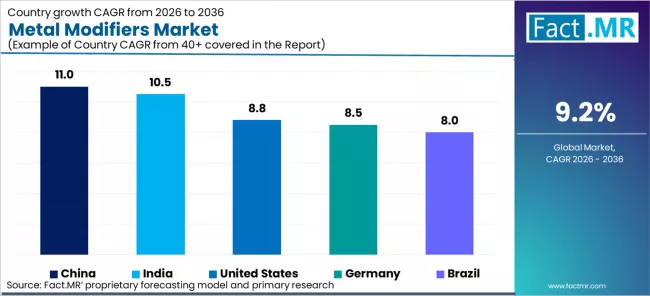
Metal Modifiers Market Cagr Analysis By Country | Source: Fact.MR
| Country | CAGR (2026-2036) |
|---|---|
| China | 11.0% |
| India | 10.5% |
| United States | 8.8% |
| Germany | 8.5% |
| Brazil | 8.0% |
Source: Fact.MR analysis. Updated Feb 25, 2026
Source: Fact.MR (FACT.MR) analysis, based on proprietary forecasting model and primary research
Asia Pacific Metal Modifiers Market Analysis
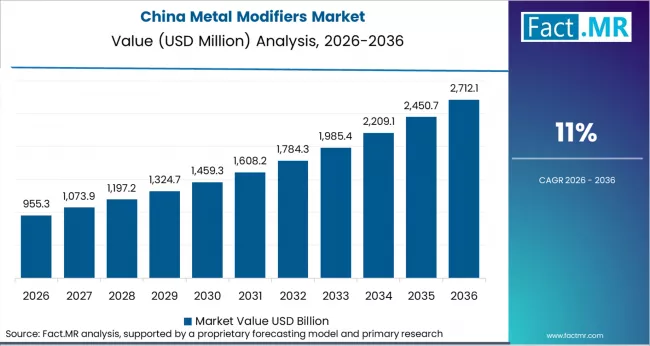
Metal Modifiers Market Country Value Analysis | Source: Fact.MR
Asia Pacific is the largest volume hub for metal modifiers, led by China’s automotive and electronics scale and India’s expanding chemical base. The region includes global Tier 1 suppliers such as BASF Chemetall and Lubrizol, alongside regional players competing in standard metallic tiers. Regulatory alignment with China 6 and Indian lubricant standards is pushing demand toward higher specification products.
- China: Demand for metal modifiers in China is projected to rise at 11.0% CAGR through 2036. China produced about 31 million vehicles in 2024, sustaining strong OEM lubricant and metalworking modifier demand. China 6b enforcement has triggered mandatory reformulation across passenger and commercial vehicle oils. Lubrizol’s 2025 MF9145V launch and BASF Chemetall’s Oxsilan platform reflect this regulatory driven transition.
- India: Demand for metal modifiers in India is projected to rise at 10.5% CAGR through 2036. Growth is policy supported through the Production Linked Incentive scheme for specialty chemicals, strengthening domestic capacity. Passenger vehicle output reached 5.8 million units in FY 2023 to 24. BIS IS 13656 standards create a formal qualification gateway for OEM lubricant additive approval.
FACT.MR's Asia Pacific analysis covers China, India, Japan, South Korea, Australia and New Zealand, ASEAN, and Rest of Asia Pacific. Readers can access China 6 timelines, PLI investment data, OEM qualification benchmarks, and regional production capacity trends.
Europe Metal Modifiers Market Analysis
Europe acts as the regulatory benchmark region where REACH restrictions drive systematic replacement of legacy chemistries. Automotive, aerospace, and construction sectors must adopt compliant alternatives. Germany’s BASF, Evonik, and France’s Arkema lead R and D in sustainable lubricant and surface treatment modifier systems.
- Germany: Demand for metal modifiers in Germany is projected to rise at 8.5% CAGR through 2036. Germany combines strong OEM vehicle production with advanced chemical R and D leadership. REACH Annex XIV deadlines have accelerated chromate free surface treatment adoption. BASF Chemetall’s Oxsilan system and Evonik’s 2025 Smart Materials restructuring confirm continued premium modifier focus.
FACT.MR's European analysis covers Germany, France, the United Kingdom, Norway, Spain, the Netherlands, Nordics, and Rest of Europe. Readers can find REACH timelines, ACEA C7 adoption data, OEM specification updates, and regional production benchmarks.
North America Metal Modifiers Market Analysis
North America is central to ILSAC driven lubricant specification change. The March 2025 GF 7 implementation has forced widespread reformulation of engine oil additive packages. Lubrizol, Infineum, and Afton Chemical lead regional supply. Growing EV production is creating additional demand for copper compatible and dielectric stable modifier chemistries.
- United States: Demand for metal modifiers in the United States is projected to rise at 8.8% CAGR through 2036. GF 7 enforcement is driving mandatory additive reformulation across factory fill and service markets. Lubrizol expanded Deer Park capacity to meet this shift. Aerospace and defence programmes add premium demand, while EV growth expands thermal fluid modifier applications.
FACT.MR's North American analysis covers the United States, Canada, and Mexico. Readers can review GF 7 adoption data, EPA Tier 3 requirements, EV thermal fluid projections, and OEM qualification timelines.
Competitive Aligners for Market Players
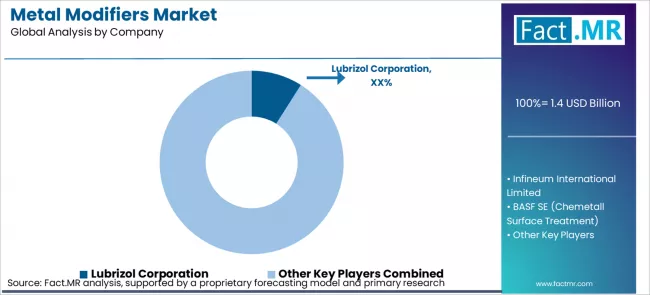
Metal Modifiers Market Analysis By Company | Source: Fact.MR
The global metal modifiers market is moderately concentrated in the premium and automotive qualified tier. Lubrizol, Infineum, BASF Chemetall, Evonik, and Solvay control a large share of OEM approved revenues across automotive, aerospace, and industrial uses. At the regional commodity level, competition is more fragmented, with Shandong Donglin New Materials, Dorf Ketal, and other Asian producers competing mainly on price. In the premium segment, competitive strength depends on OEM qualification breadth and the number of approved lubricant specifications held.
Companies gain structural advantage through deep integration into OEM qualification programmes. Once embedded in vehicle or aircraft platforms, modifier products remain specified for the life of that programme. Lubrizol benefits from its global lubricant additive leadership and broad OEM approvals. BASF Chemetall is entrenched in REACH compliant pretreatment systems across Airbus and major European automotive groups. Evonik secures long term inclusion through its viscosity modifier and dispersant chemistries in OEM preferred formulations.
Large industrial buyers typically dual source to maintain pricing leverage. However, automotive factory fill programmes often become effectively single source due to USD 1 to 3 million qualification costs. This reinforces pricing power for approved suppliers while commodity producers compete mainly in non-specified segments.
Recent Development
- In 2025, Perstorp introduced new synthetic ester products at the Interflam exhibition, positioned as base fluid and carrier chemistries for Environmentally Acceptable Lubricant modifier formulations, signalling continued industry investment in bio-compatible and biodegradable modifier carrier technologies for marine and environmentally sensitive application markets.
- In 2025, Lubrizol launched MF9145V, a diesel fuel modifier additive designed to reduce diesel particulate matter and optimise combustion in China 6-compliant diesel engine applications, directly targeting the Chinese automotive modifier reformulation market created by China 6b emission standard enforcement.
Key Players
- Lubrizol Corporation
- Infineum International Limited
- BASF SE (Chemetall Surface Treatment)
- Solvay SA
- Arkema SA
- Dorf Ketal Chemicals
- Shandong Donglin New Materials Co., Ltd.
- Evonik Industries AG
- Croda International Plc
- Cortec Corporation
- NOF America Corporation
- LORD Corporation (Parker Hannifin)
- Suzhou Kai-Fu Chemical Co., Ltd.
Bibliography
- [1] Lubrizol Corporation. (2024, February). Lubrizol and BASF Expand Distribution Agreement for EMGARD and Plurasafe Industrial Lubricant Additive Product Lines.
- [2] Lubrizol Corporation. (2025, February). Lubrizol Launches Solsperse W60 Hyperdispersant for Next-Generation Low-SAPs Engine Oil Formulations.
- [3] China Association of Automobile Manufacturers (CAAM). (2025, January). China Automobile Production and Sales Data 2024 Annual Report.
- [4] BASF SE / Chemetall. (2025). Chemetall Receives Airbus SQIP Award for Supplier Quality and Delivery Performance 2024.
- [5] Lubrizol Corporation. (2025, Q2). Lubrizol Launches MF9145V Diesel Fuel Additive for China 6 Compliance. Lubrizol Product Announcements.
- [6] Chevron Oronite Company LLC. (2024, November). Chevron Oronite Obtains Volvo VDS-5 Approval for OLOA 61530 Heavy-Duty Diesel Engine Oil Additive.
- [7] Society of Indian Automobile Manufacturers (SIAM). (2024). Annual Automobile Production Data FY 2023-24: Passenger Vehicles, Commercial Vehicles, and Two-Wheelers.
This Report Addresses
- Market intelligence for strategic planning across metal modifier product development, OEM qualification programme investment, REACH and ILSAC GF-7 regulatory reformulation response, and competitive positioning against both global Tier-1 additive suppliers and regional Asian commodity modifier producers.
- Market size and forecast: metal modifiers market valued at USD 1.4 billion in 2026, projected to reach USD 3.3 billion by 2036 at a CAGR of 9.2%, with segmentation by modifier type, application industry, formulation format, and end-user category.
- Growth opportunity mapping across ILSAC GF-7-compliant modifier package qualification, REACH-compliant surface treatment modifier adoption, EV powertrain thermal fluid modifier chemistries, and emerging market OEM lubricant specification programme development in China and India.
- Segment and regional forecasts: country-level CAGR analysis for China (11.0%), India (10.5%), United States (8.8%), Germany (8.5%), and Brazil (8.0%), with modifier type, formulation, and end-user category splits by region and application sector.
- Competition strategy assessment: positioning of Lubrizol, BASF Chemetall, Evonik, Solvay, and Infineum covering OEM qualification breadth, REACH-compliant chemistry investment, distribution network strategy, and competitive differentiation against regional Asian modifier producers in standard application segments.
- Product and technology tracking: ILSAC GF-7 and ACEA 2023 C7 standard adoption timelines, China 6 reformulation programme status, REACH Annex XIV sunset date enforcement for legacy metallic modifier substances, EV-specific modifier chemistry development, and bio-based liquid modifier carrier advancement.
- Regulatory impact analysis: REACH substance restriction waves from ECHA, ILSAC GF-7 enforcement from March 2025, China 6b emission standard implementation, and India BIS automotive lubricant additive specification requirements that collectively determine the mandatory reformulation calendar for metallic and non-metallic modifier chemistries.
- Report delivery in Excel data tables, PowerPoint executive summary, and detailed PDF with verified specialty chemical industry and regulatory sources for product strategy, OEM qualification planning, and investment decision teams.
Segmentation
Scope of Report
| Items | Values |
|---|---|
| Quantitative Units | USD 1.4 billion (2026) to USD 3.3 billion (2036), at a CAGR of 9.2% |
| Market Definition | The metal modifiers market includes chemical additives and functional materials that improve the surface, structural, and tribological performance of metal components. |
| Type of Modifier Segmentation | Metallic Modifiers, Non-metallic Modifiers |
| Application Industry Segmentation | Aerospace, Automotive, Construction, Electronics, Marine |
| Formulation Type Segmentation | Powder Modifiers, Liquid Modifiers, Granular Modifiers |
| End User Segmentation | Manufacturers, Research and Development Entities, Original Equipment Manufacturers (OEMs), Distributors and Suppliers |
| Application Coverage | Engine oil and transmission fluid modifier packages, metalworking fluid additive packages, surface treatment pretreatment modifier systems, aerospace structural bonding and corrosion protection applications, marine lubrication and antifouling modifier chemistries, EV thermal management fluid and e-axle modifier packages |
| Regions Covered | Asia Pacific, Europe, North America, Latin America, Middle East and Africa |
| Countries Covered | China, Japan, South Korea, Australia and New Zealand, India, ASEAN, Rest of Asia Pacific, Norway, Germany, United Kingdom, France, Spain, Netherlands, Nordics, Rest of Europe, United States, Canada, Mexico, Brazil, Chile, Ecuador, Rest of Latin America, Kingdom of Saudi Arabia, United Arab Emirates, South Africa, Turkey, Rest of Middle East and Africa |
| Key Companies Profiled | Lubrizol Corporation, Infineum International Limited, BASF SE (Chemetall), Solvay SA, Arkema SA, Dorf Ketal Chemicals, Shandong Donglin New Materials, Evonik Industries AG, Croda International Plc, Cortec Corporation, NOF America Corporation, LORD Corporation, Suzhou Kai-Fu Chemical |
| Forecast Period | 2026 to 2036 |
| Approach | A hybrid top-down and bottom-up modelling approach was applied. Top-down inputs incorporated global automotive production volumes, aerospace manufacturing output, and electronics industry growth rates as demand proxies. Bottom-up inputs included modifier loading rates per application, price per kilogram by chemistry type and formulation format, and OEM qualification cycle timelines. Outputs were validated against Lubrizol, BASF, and Evonik specialty chemical revenue disclosures and regulatory reformulation programme timelines. |
Source: Fact.MR analysis. Updated Feb 25, 2026
Metal Modifiers Market by Segment
-
By Type of Modifier
- Metallic Modifiers
- Non-metallic Modifiers
-
By Application Industry
- Aerospace
- Automotive
- Construction
- Electronics
- Marine
-
By Formulation Type
- Powder Modifiers Liquid Modifiers
- Granular Modifiers
-
By End User
- Manufacturers
- Research and Development Entities
- Original Equipment Manufacturers (OEMs)
- Distributors and Suppliers
-
By Region
- North America
- United States
- Canada
- Mexico
- Europe
- Germany
- United Kingdom
- France
- Norway
- Spain
- Netherlands
- Nordics
- Rest of Europe
- Asia Pacific
- China
- Japan
- South Korea
- India
- Australia and New Zealand
- ASEAN
- Rest of Asia Pacific
- Latin America
- Brazil
- Chile
- Ecuador
- Rest of Latin America
- Middle East and Africa
- Kingdom of Saudi Arabia
- United Arab Emirates
- South Africa
- Turkey
- Rest of Middle East and Africa
- North America
Frequently Asked Questions
How large is the metal modifiers market in 2025?
What will the market size be in 2026?
What is the projected market size by 2036?
What is the expected CAGR for the forecast period 2026 to 2036?
Which type of modifier is poised to lead the metal modifiers market?
Which application industry holds the largest share?
How significant is the powder modifiers segment?
Which country shows the fastest growth rate?
Who worked on this report


Preview the report firsthand - request a free sample
Free SampleGet the brochure for pricing and purchase details
Download PDF