- Market Value (2025): USD 2.53 Bn
- Estimated Value (2026): USD 3.6 Bn
- Forecast Value (2036): USD 121.9 Bn
- CAGR (2026-2036): 42.2%
What is the Micro-LED Market forecast to be worth by 2036?
USD 3.6 billion in 2026 to USD 121.9 billion by 2036 at a 42.2% CAGR.
- Fact.MR estimates the micro-LED market at USD 2.53 billion for 2025, a base built mostly on modular video walls, luxury televisions and early wearable screens.
- Value will grow from USD 3.6 billion in 2026 to USD 121.9 billion by 2036 as panel makers move micro-LED from large showpieces into watches, glasses and car interiors.
- A 42.2% CAGR reflects a young technology scaling from a small base, where each gain in transfer yield cuts the cost of every panel size at once.
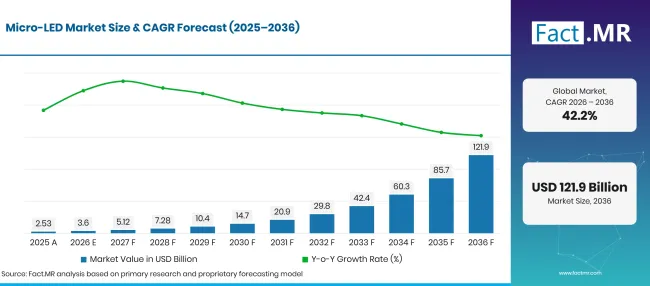
Micro Led Market Forecast Global | Source: Fact.MR
| Year | Basis | Market Value (USD billion) |
|---|---|---|
| 2025 | Actual | 2.53 |
| 2026 | Estimate | 3.6 |
| 2036 | Forecast | 121.9 |
| CAGR 2026 to 2036 | Forecast period | 42.2% |
Source: Fact.MR analysis. Updated Nov 5, 2026
What are the defining numbers behind Micro-LED Market growth?
The 2026 to 2036 period will add USD 118.3 billion in new value, led by display panels for consumer electronics.
- Demand Drivers in the Market
- Screen time keeps rising across connected devices. About 6 billion people were online in 2025, roughly three-quarters of the world’s population, according to the International Telecommunication Union [1]. Every phone, watch and television in that base is a candidate for a brighter, longer-lasting display.
- Vehicle makers are turning lighting and screens into communication surfaces. Ennostar unveiled a pixelated automotive lighting platform in March 2026 that uses its micro-LED technology to project full-color graphics onto the ground from side-mirror modules [2]. Cockpit displays and head-up systems draw on the same high-brightness chips.
- Public funding is widening the supply base beyond East Asia. In May 2026 India’s Cabinet approved a Crystal Matrix Limited facility in Dholera, Gujarat that will produce 72,000 square meters of Mini/Micro-LED display panels a year [3]. New regional capacity shortens supply chains for television, tablet and smartwatch makers.
- Progress in mass transfer, chip bonding and wafer-level inspection is lowering defect rates on each panel. Better yields shrink the repair step, which today adds cost to every unit shipped.
- Extended reality glasses need tiny and intensely bright emitters that still read clearly outdoors. Micro-LED microdisplays meet that need in a smaller power budget than most rival formats.
- Key Segments Analyzed
- By Product Type: Display will hold 68.4% share in 2026, since televisions, watches and video walls turn micro-LED chips into finished screens with a clear price premium.
- By Application: Consumer Electronics will account for 41.7% of 2026 demand, as premium television and wearable brands launch the format first to stand apart on brightness.
- By Panel Size: Small will capture 37.5% in 2026 because watch faces and glasses need high pixel density in a few square centimeters of glass.
- Analyst Opinion at Fact.MR
- Shambhu Nath Jha, Principal Consultant at Fact.MR, states, “Micro-LED has proven its picture quality, and the coming decade will be about yield, cost and supply depth. Small panels for watches and glasses will carry volume first, while large modular walls will keep the premium end active. Suppliers that can move millions of chips onto a backplane with almost no defects will set the cost curve for the whole industry.”
- Strategic Implications
- Panel makers should qualify small-format micro-LED lines first, where fewer chips per panel keep repair costs manageable while yields improve.
- Chip and epitaxy suppliers should invest in wafer uniformity and in-line inspection, since every defective emitter turns into a repair job further down the line.
- Device brands should secure at least two panel sources before committing a flagship watch or headset to micro-LED, given that capacity is still thin.
- Investors should weigh transfer yield data and signed customer programs above showroom demonstrations when comparing equipment and display developers.
Brazil heads the five-country view at 51.5%, growing from a small base as rising device ownership meets new electronics assembly. The United States follows at 50.1%, with federal microelectronics funding and early adoption of extended reality devices. Japan, at 48.6%, brings display know-how and fresh state backing for advanced chips. A wider gap opens to the United Kingdom at 42.1%, where strength lies in research and design more than in panel output. Germany, at 41.6%, closes the range just half a point lower. Its automotive demand is balanced by a larger existing display market.
How does the Micro-LED Market break down by segment?
Display will lead Product Type at 68.4%; Consumer Electronics will head Application at 41.7%; Small will lead Panel Size at 37.5% in 2026.
Which Product Type leads?
Display holds 68.4% of 2026 sales.
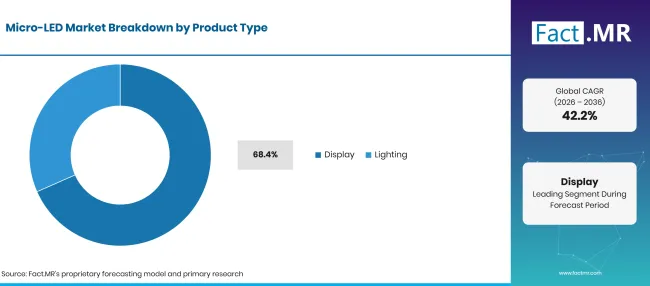
Micro Led Market Breakdown Product Type | Source: Fact.MR
| Product Type | Share (2026) |
|---|---|
| Display (Leading segment) | 68.4% |
| Other segments combined | 31.6%* |
| Total | 100.0% |
Source: Fact.MR analysis. Updated Nov 5, 2026
Television buyers, watch brands and corporate lobbies pay for finished screens, so most chip value is realized once it is mounted on a backplane and sold as a panel. Micro-LED screens deliver high peak brightness and per-pixel control without organic materials that age. Mobile networks now reach more people with richer video, as 5G covered an estimated 55% of the world’s population in 2025 [1]. Buyers comparing the format with OLED display panels look first at lifetime and outdoor readability. Lighting covers non-display uses such as adaptive vehicle lamps, projection modules and optical links. Ennostar showed a GaN-based micro-LED light source for short-reach data center interconnects in April 2026, rated for over 30,000 hours of operation [4]. Many lighting buyers also compare micro-LED with mini LED backlights, which cost less but give coarser control.
What supports Consumer Electronics within Application?
Consumer Electronics takes 41.7% of 2026 revenue.
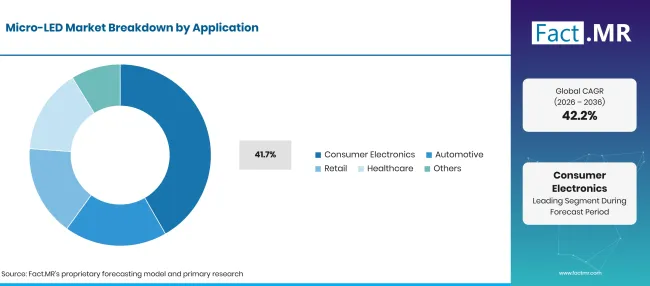
Micro Led Market Breakdown Application | Source: Fact.MR
| Application | Share (2026) |
|---|---|
| Consumer Electronics (Leading segment) | 41.7% |
| Other segments combined | 58.3%* |
| Total | 100.0% |
Source: Fact.MR analysis. Updated Nov 5, 2026
Television and wearable brands compete hard on picture quality, so a visible step in brightness or contrast can justify a higher shelf price. Premium televisions, smartwatches and headsets are where the first commercial volumes appear. Headset makers tracked in the virtual reality space want emitters small enough for glasses yet bright enough for daylight. Automotive is the next application in line. Vehicle makers use micro-LED in head-up displays, cockpit screens and exterior signal lamps covered in automotive lighting. Retail uses modular walls and signage. Healthcare is a small niche built around surgical displays and diagnostic screens.
What leads the Panel Size segment?
Small represents 37.5% of 2026 value.
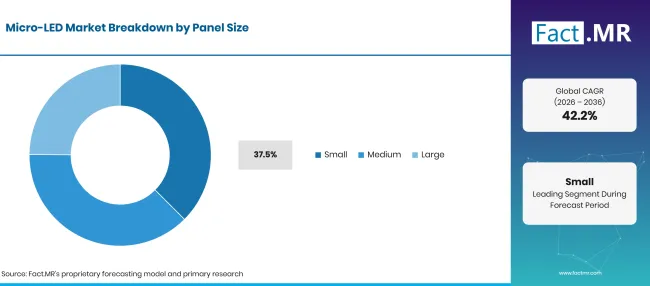
Micro Led Market Breakdown Panel Size | Source: Fact.MR
| Panel Size | Share (2026) |
|---|---|
| Small (Leading segment) | 37.5% |
| Other segments combined | 62.5%* |
| Total | 100.0% |
Source: Fact.MR analysis. Updated Nov 5, 2026
Watch faces and near-eye displays need thousands of pixels per inch, and micro-LED chips can be packed that densely while staying bright. A small panel also uses far fewer chips than a television, so a transfer defect is cheaper to fix. Growth in the wearable display category gives these panels their main volume outlet. Medium panels serve tablets, laptops and vehicle instrument clusters, where cost per square inch is still the main barrier. Large panels cover luxury televisions and modular video walls, which can be assembled from tiles. Better chip placement and faster repair will lift all three size classes.
What is accelerating Micro-LED Market adoption, and what is holding it back?
Premium device launches, automotive display programs and new chip plants are pulling micro-LED into commercial products. High chip cost, slow mass transfer and expensive pixel repair still keep prices well above OLED and LCD. Until yields rise, most volume will stay in small panels and high-margin video walls.
Drivers Impact Analysis
| DRIVER | (~) % IMPACT ON CAGR | GEOGRAPHIC RELEVANCE | IMPACT TIMELINE |
|---|---|---|---|
| Premium televisions and wearables adopting micro-LED screens | +2.4% | Global | Medium term (2-4 years) |
| Advances in mass transfer, bonding and inspection | +2.0% | East Asia, North America, Western Europe | Medium term (2-4 years) |
| Micro-LED displays and lamps in vehicle cockpits | +1.6% | Western Europe, Japan, North America | Long term (>=4 years) |
| Public funding for chip and display plants | +1.2% | South Asia & Pacific, North America, Latin America | Long term (>=4 years) |
| Modular walls for corporate and retail spaces | +0.9% | Global | Short term (<=2 years) |
Source: Fact.MR analysis. Updated Nov 5, 2026
Opportunity Impact Analysis
| OPPORTUNITY | (~) % IMPACT ON CAGR | GEOGRAPHIC RELEVANCE | IMPACT TIMELINE |
|---|---|---|---|
| Microdisplays for extended reality glasses | +1.3% | North America, East Asia, Western Europe | Medium term (2-4 years) |
| Low-cost transfer and repair equipment | +1.0% | East Asia, North America | Medium term (2-4 years) |
| Micro-LED optical links for data centers | +0.7% | North America, East Asia | Long term (>=4 years) |
| New regional panel capacity outside East Asia | +0.5% | South Asia & Pacific, Latin America | Long term (>=4 years) |
Source: Fact.MR analysis. Updated Nov 5, 2026
Restraints Impact Analysis
| RESTRAINT | (~) % IMPACT ON CAGR | GEOGRAPHIC RELEVANCE | IMPACT TIMELINE |
|---|---|---|---|
| High cost of chip fabrication and panel assembly | -1.2% | Global | Short term (<=2 years) |
| Low mass transfer yields on large panels | -0.9% | Global | Medium term (2-4 years) |
| Costly inspection and defective pixel repair | -0.6% | Global | Medium term (2-4 years) |
| Thin supply of mature volume production lines | -0.4% | Eastern Europe, Middle East & Africa | Long term (>=4 years) |
Source: Fact.MR analysis. Updated Nov 5, 2026
Which countries are scaling the Micro-LED Market through 2036?
| Country | CAGR (2026 to 2036) |
|---|---|
| Brazil | 51.5% |
| United States | 50.1% |
| Japan | 48.6% |
| United Kingdom | 42.1% |
| Germany | 41.6% |
Source: Fact.MR analysis. Updated Nov 5, 2026
How is Brazil developing demand?
51.5% CAGR, helped by near-universal phone ownership and growing local electronics assembly.
Brazil’s device base is large and still upgrading. The IBGE reported that 90.5% of people aged 10 or over used the internet in 2025, and about 167.4 million people owned a mobile phone for personal use [5]. Most premium screens are still imported, so local demand starts from a small value base. Local assembly of televisions and phones gives panel suppliers a route into the market as prices fall.
What is supporting United States adoption?
50.1% CAGR, driven by federal microelectronics programs and early headset demand.
NIST opened a CHIPS broad agency announcement in September 2025 for research proposals on advanced semiconductors, prototyping and commercialization [6]. In September 2026 the Department of Commerce finalized a CHIPS research award of up to USD 375 million with GlobalFoundries covering advanced packaging and heterogeneous integration [7]. These are the same bonding and integration skills that micro-LED backplanes need. Headset developers and watch brands based in the country are among the earliest buyers of microdisplays.
What supports Japan’s adoption?
48.6% CAGR, backed by deep display engineering and new state chip funding.
Japanese firms bring decades of panel, optics and precision equipment experience to micro-LED. METI announced in November 2025 that it would invest 100 billion yen from the fiscal 2025 budget in Rapidus through the Information-technology Promotion Agency [8]. State support of this scale strengthens domestic wafer, materials and tool suppliers. Display and camera makers are applying that base to automotive screens and near-eye displays.
How is the United Kingdom developing demand?
42.1% CAGR, reflecting a research-led compound semiconductor base.
The UK government counted 703 semiconductor companies in its 2026 sector study, and dedicated firms earned an estimated GBP 10.6 billion in 2025 [9]. The same study notes GaN micro-LED work at Strathclyde’s Institute of Photonics in Glasgow. Plessey develops micro-LED displays in Plymouth for augmented reality and wearables. On the demand side, 473,000 zero emission cars were registered for the first time in 2025 [10]. That figure equals 23% of new registrations and adds vehicle platforms for advanced cockpit displays.
How does Germany perform?
41.6% CAGR, as carmakers test micro-LED for cockpits and lamps.
The Federal Cabinet adopted a microelectronics strategy in October 2025, noting that Germany holds about 30% of European wafer capacity [11]. The strategy targets research transfer, skilled workers and new production sites. Vehicle demand is the main pull, with 545,142 new battery electric cars registered in 2025 for a 19.1% share [12]. Electric models tend to carry larger screens and digital lighting, both natural outlets for micro-LED.
Who leads the Micro-LED Market?
Three groups shape competition. Large panel makers Samsung Electronics, AUO and BOE Technology Group control backplanes, factory scale and brand access. They decide when micro-LED moves from walls into mass devices. Samsung sells its The Wall range for commercial spaces, while AUO put micro-LED at the front of its Touch Taiwan 2026 showcase, pointing to progress toward mass production [13].
Chip and epitaxy specialists Ennostar and PlayNitride supply the emitters and transfer know-how; Ennostar co-developed a micro-LED optical link with AUO and Tyntek in April 2026 [4] and introduced pixelated vehicle lighting days earlier [2]. Process and microdisplay developers Plessey Semiconductors and VueReal license printing, transfer and near-eye panel technology to device brands. Success will turn on who can push transfer yield high enough to price small and medium panels close to OLED, and who can sign device makers to multi-year supply programs.
Which companies are the key providers?
Key companies in the Micro-LED Market include Samsung Electronics, AUO, BOE Technology Group, Ennostar, PlayNitride, Plessey Semiconductors and VueReal.
- Samsung Electronics
- AUO
- BOE Technology Group
- Ennostar
- PlayNitride
- Plessey Semiconductors
- VueReal
Bibliography
- [1] International Telecommunication Union. (2025, November 17). Global number of Internet users increases, but disparities deepen key digital divides.
- [2] Ennostar Inc. (2026, March 26). Ennostar Unveils Pixelated Automotive LED Lighting Platform at Touch Taiwan 2026.
- [3] Prime Minister’s Office, Government of India. (2026, May 5). Cabinet approves two more semiconductor manufacturing units with cumulative investment of more than Rs. 3,900 crore.
- [4] Ennostar Inc. (2026, April 1). Ennostar Showcases Micro LED Optical Communication for High-Speed AI Data Center Interconnects with AUO and Tyntek.
- [5] Instituto Brasileiro de Geografia e Estatística. (2026, July 2). Proportion of Internet users in Brazil exceeded 90% of population aged 10 or over, in 2025.
- [6] National Institute of Standards and Technology. (2025, September 24). NIST Issues Broad Agency Announcement for Proposals to Advance Microelectronics Technologies.
- [7] National Institute of Standards and Technology. (2026, September 8). Department of Commerce Announces Finalization of CHIPS R&D Award with GlobalFoundries.
- [8] Ministry of Economy, Trade and Industry. (2025, November 21). Press Conference by Minister Akazawa (Excerpt).
- [9] Department for Business and Trade. (2026, June 8). Semiconductor sector study 2026.
- [10] Department for Transport. (2026, April 29). Vehicle licensing statistics, United Kingdom: 2025.
- [11] Federal Government of Germany. (2025, October 15). Federal Cabinet: Federal Government microelectronics strategy adopted.
- [12] Kraftfahrt-Bundesamt. (2026, January 6). Fahrzeugzulassungen im Dezember 2025: Jahresbilanz.
- [13] AUO Display Plus Corp. (2026, March 24). Reveal the World. Reveal the Future..
This Report Answers
- How is micro-LED revenue split between display panels and lighting modules?
- Why do consumer electronics brands adopt the format ahead of automotive and retail buyers?
- What makes small panels the first volume outlet for micro-LED chips?
- Which transfer, bonding and repair advances will lower panel cost?
- How far apart are growth rates in Brazil, the United States, Japan, the United Kingdom and Germany?
- Where do panel makers, chip specialists and process developers each compete?
What does the Micro-LED Market cover?
This study values products in which each pixel or light point is a microscopic inorganic LED chip, usually under 100 micrometers across. Finished display panels, display modules and lighting modules count when micro-LED chips form the light source.
Value is measured at the panel and module level across consumer, automotive, retail, healthcare and other uses. Phones, watches, vehicles and televisions are not valued in full, so the figures reflect only the micro-LED content.
What is included in the scope?
Micro-LED display panels and modules for televisions, watches, phones, glasses and video walls.
Micro-LED lighting modules for vehicle lamps, projection and optical links, including GaN semiconductor device emitters built for these uses.Micro-LED chips and epitaxial wafers sold for panel or module assembly.Country coverage for Brazil, the United States, Japan, the United Kingdom and Germany, with all seven regions.
What is excluded from the scope?
LCD, OLED and conventional LED displays with no micro-LED pixels, including mini LED backlit LCD panels.
The full value of televisions, phones, vehicles and headsets that carry micro-LED screens.General semiconductor fabrication tools and chips not used in micro-LED products.Display software, content creation and advertising services.
How Was the Analysis Built?
The analysis draws on 120+ sources, 35+ company portfolios, 25+ countries, and more than 20 industry interviews.
- Primary Research: Primary research includes discussions with manufacturers, service providers, technology developers, distributors, end users, and subject-matter experts. These conversations examine purchasing priorities, product adoption, operational challenges, approval requirements, competitive positioning, and the factors that influence wider market acceptance.
- Desk Research: Desk research covers government statistics, regulatory publications, company filings, trade data, technical studies, industry associations, standards, public policy, and other authoritative sources. Every source used in the analysis is documented in the bibliography.
- Market Sizing and Forecasting: Market estimates combine historical performance, demand indicators, pricing and volume trends, segment shares, company participation, country-level growth, adoption patterns, investment activity, and barriers to market expansion.
- Data Validation and Update Cycle: Findings are validated by comparing primary interviews with public data, company activity, regulatory changes, trade patterns, and industry developments. Regular updates review new product launches, capacity changes, partnerships, approvals, and shifts in commercial adoption.
Segmentation
What is the report’s scope and coverage?
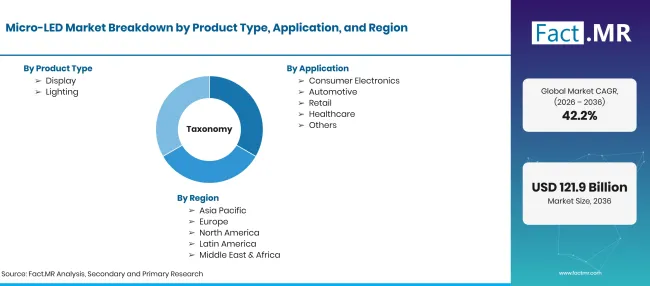
Micro Led Market Taxonomy | Source: Fact.MR
| Attribute | Details |
|---|---|
| Quantitative Units | USD billion |
| Market Definition | Displays, lighting modules and related components that use microscopic inorganic light-emitting diodes as individual pixels or light sources. |
| Product Type | Display; Lighting |
| Application | Consumer Electronics; Automotive; Retail; Healthcare; Others |
| Panel Size | Small; Medium; Large |
| Industry Vertical | Consumer; Commercial; Industrial |
| Regions Covered | North America; Latin America; Western Europe; Eastern Europe; East Asia; South Asia & Pacific; Middle East & Africa |
| Countries Covered | Brazil; United States; Japan; United Kingdom; Germany |
| Companies Profiled | Samsung Electronics; AUO; BOE Technology Group; Ennostar; PlayNitride; Plessey Semiconductors; VueReal |
| Forecast Period | 2026 to 2036 |
| Approach | Panel and chip capacity mapped against device launches by application and panel size, with transfer yield and pricing tracked by country. |
Source: Fact.MR analysis. Updated Nov 5, 2026
How is the market segmented?
-
By Product Type
- Display
- Lighting
-
By Application
- Consumer Electronics
- Automotive
- Retail
- Healthcare
- Others
-
By Panel Size
- Small
- Medium
- Large
-
By Industry Vertical
- Consumer
- Commercial
- Industrial
-
By Region
- North America
- Latin America
- Western Europe
- Eastern Europe
- East Asia
- South Asia & Pacific
- Middle East & Africa
Frequently Asked Questions
How large is the micro-LED market in 2026?
What growth rate will the micro-LED market record?
Which product type leads?
Which application leads?
Which panel size leads?
Which country will grow quickest?
Who are the main companies?
What holds the market back?
Who worked on this report


Preview the report firsthand - request a free sample
Free SampleGet the brochure for pricing and purchase details
Download PDF