- Market Value (2025): USD 63.4 Mn
- Estimated Value (2026): USD 79 Mn
- Forecast Value (2036): USD 720 Mn
- CAGR (2026-2036): 24.7%
What is the MicroLED Mass Repair Market forecast to be worth by 2036?
USD 79 million in 2026 to USD 720 million by 2036 at a 24.7% CAGR.
- The MicroLED Mass Repair Market reached USD 63.4 million in 2025.
- Demand is projected to increase from USD 79 million in 2026 to USD 720 million by 2036.
- The market is forecast to record 24.7% CAGR from 2026 to 2036 as display makers, panel OSATs and equipment OEMs qualify repair steps for production transfer lines.
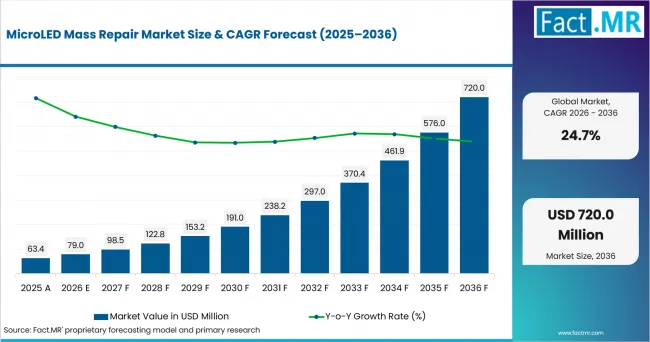
Microled Mass Repair Market Value Analysis | Source: Fact.MR
What are the defining numbers behind MicroLED Mass Repair Market growth?
USD 641 million absolute opportunity by 2036, led by laser removal and replace, fully automated repair and display makers.
- Demand Drivers in the Market
- Display makers need selective pixel correction because one dead emitter can reduce the value of a premium tiled display module.
- Process engineers need inspection coordinates linked to repair actions so final verification follows the same defect map.
- Tool integrators need laser processing equipment that can work near fragile emitters without damaging adjacent pixels or bonding layers.
- Panel OSATs need modular repair cells owing to early yield learning in AR, automotive and large-format display programs.
- Research institutes need lab-scale repair workflows that move into pilot lines once pixel pitch and substrate handling stabilize.
- Key Segments Analyzed
- By Repair Method: Laser removal & replace is expected to hold 41.0% share in 2026 because it directly corrects failed or misplaced emitters after inspection.
- By Defect Type: Dead pixels are projected to account for 38.0% share in 2026, reflecting the visible failure mode that panel makers prioritize during yield screening.
- By Display Type: Large-format displays are anticipated to capture 34.0% share in 2026 since tiled modules expose more pixels to inspection and post-transfer repair.
- By Automation Level: Fully automated systems are estimated to represent 52.0% share in 2026 owing to repeatability needs in high-pixel-count panel lines.
- By End User: Display makers are forecast to hold 47.0% share in 2026, supported by in-house yield control before modules move to downstream assembly.
- Analyst Opinion at Fact.MR
- Shambhu Nath Jha, Principal Consultant at Fact.MR, states, “MicroLED mass repair draws attention because defect correction is becoming part of yield economics, not only laboratory process learning. The market is expected to expand when inspection data, laser action and post-repair verification are linked in one production workflow. Suppliers should combine precise optics, reliable handling and repair software that gives engineers repeatable proof.”
- Strategic Implications
- Equipment vendors should prove repair yield at the panel level instead of showing only individual emitter placement accuracy.
- Laser suppliers should document pulse control and thermal limits so customers can protect nearby emitters during removal or trimming.
- Automation integrators should connect repair heads with robot vision systems and panel-handling modules to reduce manual review.
- Display makers should compare repair cost against rejected-panel value before approving fully automated tools for each display format.
Switzerland is projected to record 29.9% CAGR through 2036, supported by precision-equipment exports and photonics depth. Finland is expected to post 28.1% as microelectronics and photonics pilot work expands. Germany is forecast to advance at 26.0% owing to automation engineering and electronics orders. South Korea is anticipated to reach 23.9% because panel and semiconductor manufacturing remain concentrated. The USA is projected to hold 21.2% on the back of electronics investment and laser-tool capability. Japan is expected to register 18.3% with precision equipment and electronic components output. The UK is forecast to reach 17.5% where photonics and compound-semiconductor capability support early repair validation.
How does the MicroLED Mass Repair Market break down by segment?
Laser removal and replace leads at 41.0%; fully automated repair leads at 52.0%.
Which Repair Method dominates?
Laser removal & replace is expected to hold 41.0% share in 2026.
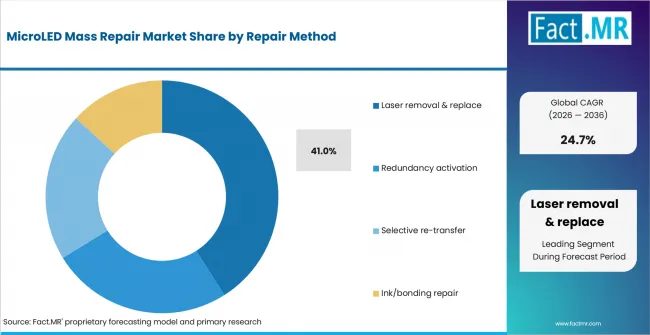
Microled Mass Repair Market Analysis By Repair Method | Source: Fact.MR
Laser removal and replace leads because it targets the defect after inspection instead of scrapping a larger panel area. The method is used when a dead or misplaced emitter must be removed and replaced without disturbing nearby pixels. ITRI reports dimensional accuracy of 5 μm or less for laser cutting and a blind-drilling hole diameter of 30 μm or less in its flexible MicroLED splicing process.
What leads the Defect Type segment?
Dead pixels are projected to account for 38.0% share in 2026.
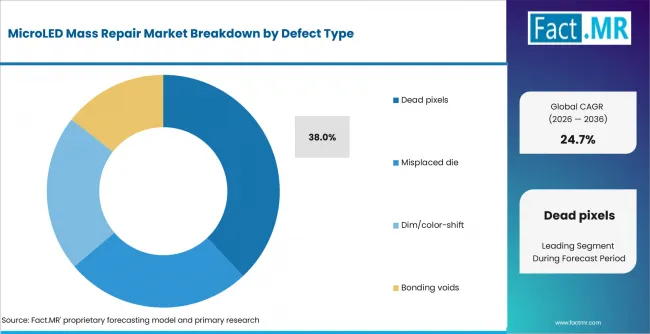
Microled Mass Repair Market Analysis By Defect Type | Source: Fact.MR
Dead pixels lead because they are easy for inspection systems to identify and hard for premium-display customers to accept. Repair workflows start with optical inspection and electrical testing before a tool selects removal, replacement or redundancy activation.
How does Display Type shape demand?
Large-format displays are anticipated to lead with 34.0% share in 2026.
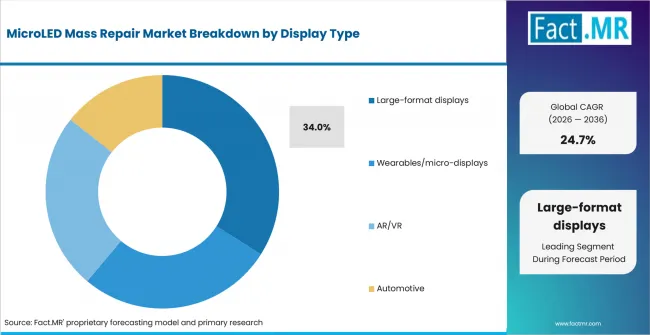
Microled Mass Repair Market Analysis By Display Type | Source: Fact.MR
Large-format displays lead because tiled panels contain many emitters and expose failures across a visible surface. A repair cell can protect module value when production moves beyond demonstration walls into displays. Adjacent demand for low-power next-generation displays and automotive smart displays is expected to keep repair accuracy visible across premium applications.
What supports Automation Level demand?
Fully automated systems are estimated to represent 52.0% share in 2026.
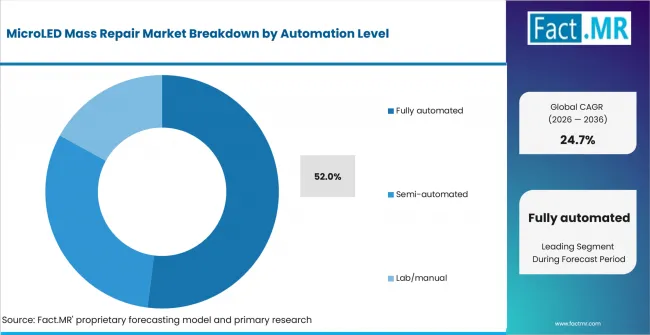
Microled Mass Repair Market Analysis By Automation Level | Source: Fact.MR
Fully automated systems lead because mass repair depends on repeatable alignment across many pixels. Manual review works in laboratories, yet production panels need software that passes defect coordinates to handling and laser modules. Automation is expected to reduce operator variation and shorten the time between inspection, repair and verification.
What supports Display makers within End User?
Display makers are forecast to hold 47.0% share in 2026.
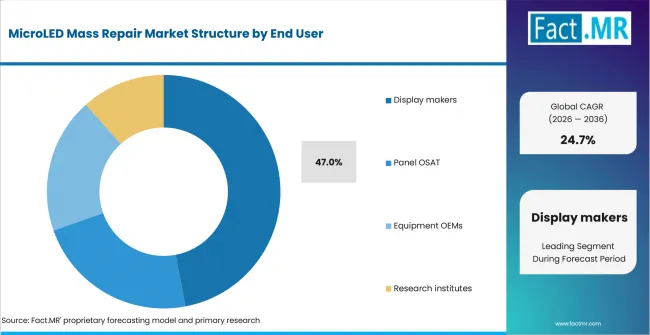
Microled Mass Repair Market Analysis By End User | Source: Fact.MR
Display makers lead because they carry the yield risk before finished modules move to device brands or system integrators. Internal repair capability lets them compare redundancy activation and replacement during process development. It also aligns with demand for display drivers and passenger-side interactive displays where high-resolution panels must pass stricter visual checks.
What is accelerating MicroLED Mass Repair Market adoption, and what is holding it back?
Demand is expected to rise through yield protection and automated inspection, while adoption is constrained by qualification cost and repair-cycle time.
Drivers Impact Analysis
| DRIVER | (~) % IMPACT ON CAGR | GEOGRAPHIC RELEVANCE | IMPACT TIMELINE |
|---|---|---|---|
| Defect correction for premium panels | +2.4% | East Asia, North America | Short term (<= 2 years) |
| Laser repair linked to inspection maps | +1.8% | Global | Medium term (2-4 years) |
| Automation for tiled display production | +1.3% | Europe, East Asia | Medium term (2-4 years) |
| AR and automotive display validation | +0.9% | USA, Japan, UK | Long term (>= 4 years) |
Source: Fact.MR analysis. Updated Aug 24, 2026
- Defect correction for premium panels: Repair demand is expected to rise when display makers compare the value of a salvaged module against the cost of scrapping it.
- Laser repair linked to inspection maps: Production tools are projected to gain approval where coordinates from AOI and electrical test can trigger reliable laser action.
- Automation for tiled display production: Fully automated systems are anticipated to reduce manual handling when large-format modules move from pilot lines into commercial output.
Opportunity Impact Analysis
| OPPORTUNITY | (~) % IMPACT ON CAGR | GEOGRAPHIC RELEVANCE | IMPACT TIMELINE |
|---|---|---|---|
| Integrated repair and verification cells | +1.5% | Global | Medium term (2-4 years) |
| Micro-displays for AR and wearables | +1.2% | USA, Japan, UK | Long term (>= 4 years) |
| Panel OSAT repair services | +0.8% | East Asia, Europe | Long term (>= 4 years) |
Source: Fact.MR analysis. Updated Aug 24, 2026
- Integrated repair and verification cells: Tool vendors can gain share by combining defect review, repair action and post-repair validation in one documented workflow.
- Micro-displays for AR and wearables: Wearable HUD tiles create a route for repair systems that handle small pixel pitch and tight placement limits.
- Panel OSAT repair services: Contract repair capacity is expected to emerge where display makers prefer service models before buying dedicated in-house tools.
Restraints Impact Analysis
| RESTRAINT | (~) % IMPACT ON CAGR | GEOGRAPHIC RELEVANCE | IMPACT TIMELINE |
|---|---|---|---|
| High qualification cost for each panel design | -0.8% | Global | Short term (<= 2 years) |
| Slow repair-cycle time at fine pitch | -0.6% | East Asia, Europe | Medium term (2-4 years) |
| Limited common process standards | -0.4% | Global | Long term (>= 4 years) |
Source: Fact.MR analysis. Updated Aug 24, 2026
- High qualification cost for each panel design: Tool approval is constrained when each pixel pitch, substrate and bonding method needs a separate process window.
- Slow repair-cycle time at fine pitch: Smaller emitters are expected to raise alignment burden and limit throughput gains unless repair action is tightly automated.
- Limited common process standards: Display makers may delay purchases until repair metrics are accepted across internal quality teams and end customers.
Which countries are scaling the MicroLED Mass Repair Market through 2036?
- The country comparison spans 12.4 percentage points between Switzerland and the UK.
- Switzerland remains 1.8 percentage points above Finland.
- Finland remains 2.1 percentage points above Germany.
- Germany remains 2.1 percentage points above South Korea.
- South Korea remains 2.7 percentage points above the USA.
- The USA remains 2.9 percentage points above Japan.
- Japan remains 0.8 percentage point above the UK.
Comparable CAGRs can create different entry conditions due to panel scale, qualification cycles, electronics exports and photonics depth. Full report coverage includes North America, Latin America, Western Europe, Eastern Europe, East Asia, South Asia & Pacific, Middle East & Africa.
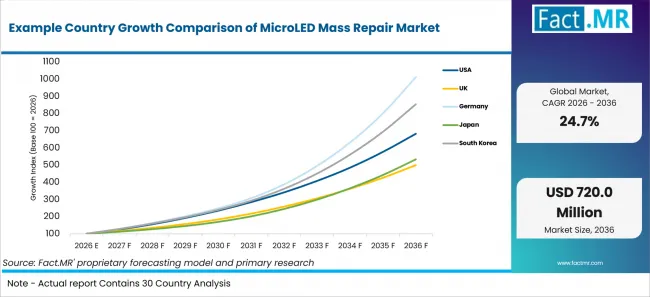
Example Country Growth Comparison Of Microled Mass Repair Market | Source: Fact.MR
| Country | CAGR (2026-2036) |
|---|---|
| Switzerland | 29.9% |
| Finland | 28.1% |
| Germany | 26.0% |
| South Korea | 23.9% |
| USA | 21.2% |
| Japan | 18.3% |
| UK | 17.5% |
Source: Fact.MR analysis. Updated Aug 24, 2026
What supports Switzerland adoption?
29.9% CAGR, supported by precision-equipment exports and photonics depth.
Switzerland’s growth is supported by its precision-engineering base and strong export orientation. FOCBS reported that Swiss exports increased 1.4% to CHF 287.0 billion in 2025, while SECO stated that the EU accounted for around 50% of Swiss machinery-industry exports. These conditions support demand for advanced laser and photonics equipment where accuracy, compact integration and export-grade manufacturing quality are important.
How is Finland scaling demand?
28.1% CAGR, driven by microelectronics and photonics pilot capability.
Finland’s growth reflects its microelectronics, photonics and advanced manufacturing capabilities. Statistics Finland reported that working-day-adjusted turnover in the electronic and electrical industry increased 21.9% year over year in June 2026. This expanding electronics activity can support demand for precision laser tools and photonics systems used in pilot production, device processing and specialized manufacturing where flexible equipment and close engineering support are important.
What supports Germany adoption?
26.0% CAGR, backed by electronics orders and automation engineering.
Germany’s growth is supported by improving electronics demand and a mature automation ecosystem. Destatis reported that new orders increased 5.7% month over month in computer, electronic and optical products and 9.8% in electrical equipment in December 2025. Germany’s manufacturing base provides a strong setting for precision laser equipment where process control, automated handling and repeatable engineering performance are required before wider production deployment.
How does South Korea perform?
23.9% CAGR, reinforced by display manufacturing and semiconductor exports.
South Korea’s growth reflects its large semiconductor and display manufacturing ecosystem. MOTIR and MSIT reported that ICT exports reached USD 264.3 billion in 2025, up 12.4% year over year, while semiconductor exports increased 22.1% and display exports declined 9.5%. High-volume electronics manufacturing supports demand for precision laser processing and photonics equipment where throughput, repeatability and integration with automated production lines are critical.
What supports USA adoption?
21.2% CAGR, supported by electronics investment and laser-tool capability.
The USA’s growth is supported by expanding electronics activity and established laser-tool development capability. The U.S. Census Bureau reported that new orders for computers and electronic products increased USD 0.9 billion, or 3.1%, to USD 31.1 billion in June 2026. This manufacturing base supports precision laser systems used in electronics processing, prototyping and production environments where equipment flexibility, process control and technical support influence purchasing decisions.
How does Japan perform?
18.3% CAGR, led by electronic components output and precision equipment know-how.
Japan’s growth reflects its established electronics manufacturing base and long-standing precision-equipment expertise. JEITA’s METI-sourced statistics reported electronic components and devices production of JPY 732,271 million in December 2025. Local manufacturers are well positioned to adopt precision laser and photonics systems where tightly controlled processing, compact equipment design and reliable engineering support are important for high-value electronic components and device production.
What supports UK growth?
17.5% CAGR, backed by compound-semiconductor and photonics capability.
The UK’s growth is supported by its compound-semiconductor, photonics and specialist electronics ecosystem. DSIT’s Semiconductor Sector Study 2026 reported that dedicated UK semiconductor companies directly employed approximately 16,350 people and generated an estimated GBP 7.5 billion in GVA in 2025. This specialist base supports demand for precision laser systems in research, pilot manufacturing and advanced device processing where flexible tooling and close technical collaboration are important.
Who leads the MicroLED Mass Repair Market?
Coherent has the clearest direct current commercial MicroLED repair evidence in the profiled set: its UVtransfer portfolio includes pixel repair/trimming and a UVtransfer R remove-and-refill system.
V Technology currently markets FPD inspection and repair equipment, while Kulicke and Soffa's LUMINEX is a laser-based mini/microLED transfer platform with precision-correction capability. ITRI is a research and technology-development organization with MicroLED laser-manufacturing processes.
Competition is expected to center on proof of yield recovery, laser-process repeatability and integration with inspection data. Supplier qualification is likely to favor companies that can show repaired-panel results across defect types and panel formats without adding excessive cycle time.
Which companies are the key providers?
Key companies include Coherent Corp., V Technology Co., Ltd., Kulicke & Soffa Industries, Inc. (LUMINEX), PlayNitride Inc.
- Coherent Corp.
- V Technology Co., Ltd.
- Kulicke & Soffa Industries, Inc. (LUMINEX)
- PlayNitride Inc.
Bibliography
- Coherent Corp. (2025, May 28). Coherent details growth strategy and long-term financial model at 2025 Analyst and Investor Day.
- Coherent Corp. (2026, January 20). Photonic innovation – An evening with Coherent [Investor presentation].
- Department for Science, Innovation and Technology. (2026, June 8). Semiconductor Sector Study 2026. GOV.UK.
- Federal Office for Customs and Border Security. (2026, January 29). 2025: Exports hit a new record, driven by chemicals and pharmaceuticals.
- Federal Statistical Office. (2026, February 5). New orders in manufacturing in December 2025: +7.8% on the previous month.
- Ministry of Trade, Industry and Resources, & Ministry of Science and ICT. (2026, January 15). ICT exports post record annual performance in 2025.
- State Secretariat for Economic Affairs. (2025, September 19). Maschinen: Erhalt des erleichterten Zugangs zum EU-Binnenmarkt.
- Statistics Finland. (2026, August 10). Turnover in industry grew by 13.5 per cent in June 2026.
- U.S. Census Bureau. (2026, July 27). Monthly advance report on durable goods manufacturers’ shipments, inventories and orders: June 2026.
This Report Answers
- The report explains where MicroLED mass repair is used across repair method and defect type. It also covers display type, automation level and end user.
- Segment analysis identifies the subsegments that shape tool qualification and repair workflow design.
- Country analysis examines the listed markets and the electronics or photonics mechanisms supporting adoption.
- Competitive analysis reviews current providers across laser repair, placement, inspection and MicroLED process development.
- Application analysis assesses how pixel defects, repair-cycle time and post-repair validation affect purchase decisions.
What does the MicroLED Mass Repair Market cover?
The MicroLED Mass Repair Market covers equipment and software used to correct defects in MicroLED panels after mass transfer or assembly. It includes repair tools that remove failed emitters, replace die, activate redundancy, repair bonding defects and verify corrected areas through inspection data. It sits adjacent to LED chip supply because repair economics depend on emitter quality and availability.LED chip supply
The assessment covers large-format displays, wearables and micro-displays, AR/VR devices and automotive displays.
What is included in the scope?
The scope includes laser repair tools, selective replacement systems, redundancy activation platforms, repair software and integrated inspection-to-repair workflows. It includes lab, pilot and production systems tied to MicroLED defect correction.
What is excluded from the scope?
The scope excludes general LED chip manufacturing equipment when it is not sold for MicroLED repair. It also excludes standard display inspection systems that only identify defects and do not support repair action or verification.
Finished MicroLED televisions, automotive displays, AR headsets and unrelated semiconductor processing tools are excluded. OLED, LCD and mini-LED repair tools are outside the scope unless they are adapted for MicroLED defect correction.
How Was the Analysis Built?
The analysis draws on 120+ sources, 35+ company portfolios, 25+ countries, and more than 20 industry interviews.
- Primary Research: Primary research includes discussions with manufacturers, service providers, technology developers, distributors, end users, procurement teams, and subject-matter experts. These conversations examine purchasing priorities, product adoption, operational challenges, approval requirements, competitive positioning, and the factors that influence wider market acceptance.
- Desk Research: Desk research covers government statistics, regulatory publications, company filings, trade data, technical studies, industry associations, standards, public policy, and other authoritative sources. Every source used in the analysis is documented in the bibliography.
- Market Sizing and Forecasting: Market estimates combine historical performance, demand indicators, pricing and volume trends, segment shares, company participation, country-level growth, adoption patterns, investment activity, and barriers to market expansion.
- Data Validation and Update Cycle: Findings are validated by comparing primary interviews with public data, company activity, regulatory changes, trade patterns, and industry developments. Regular updates review new product launches, capacity changes, partnerships, approvals, procurement trends, and shifts in commercial adoption.
Segmentation
What is the report’s scope and coverage?
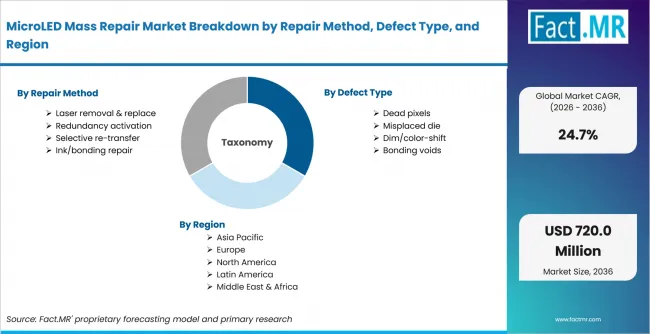
Microled Mass Repair Market Breakdown By Repair Method, Defect Type, And Region | Source: Fact.MR
| Attribute | Details |
|---|---|
| Quantitative Units | USD million |
| Market Definition | Tools, software and process modules used to identify, remove, replace, bypass or verify defective MicroLED emitters after mass transfer or assembly. |
| Repair Method | Laser removal & replace; Redundancy activation; Selective re-transfer; Ink/bonding repair |
| Defect Type | Dead pixels; Misplaced die; Dim/color-shift; Bonding voids |
| Display Type | Large-format displays; Wearables/micro-displays; AR/VR; Automotive |
| Automation Level | Fully automated; Semi-automated; Lab/manual |
| End User | Display makers; Panel OSAT; Equipment OEMs; Research institutes |
| Regions Covered | North America; Latin America; Western Europe; Eastern Europe; East Asia; South Asia & Pacific; Middle East & Africa |
| Countries Covered | United States; United Kingdom; Germany; Japan; South Korea; Finland; Switzerland |
| Key Companies Profiled | Coherent Corp., V Technology Co., Ltd., Kulicke & Soffa Industries, Inc. (LUMINEX), PlayNitride Inc. |
| Forecast Period | 2026 to 2036 |
| Approach | Hybrid top-down and bottom-up approach using display-tool demand, MicroLED process steps, repair method mix, country adoption and provider portfolio review. |
Source: Fact.MR analysis. Updated Aug 24, 2026
How is the market segmented?
-
By Repair Method:
- Laser removal & replace
- Redundancy activation
- Selective re-transfer
- Ink/bonding repair
-
By Defect Type:
- Dead pixels
- Misplaced die
- Dim/color-shift
- Bonding voids
-
By Display Type:
- Large-format displays
- Wearables/micro-displays
- AR/VR
- Automotive
-
By Automation Level:
- Fully automated
- Semi-automated
- Lab/manual
-
By End User:
- Display makers
- Panel OSAT
- Equipment OEMs
- Research institutes
-
By Region:
- North America
- Latin America
- Western Europe
- Eastern Europe
- East Asia
- South Asia & Pacific
- Middle East & Africa
Frequently Asked Questions
How big is the MicroLED mass repair market in 2026?
What is the CAGR of the MicroLED mass repair market from 2026 to 2036?
Which repair method leads the MicroLED mass repair market?
Which defect type leads the MicroLED mass repair market?
Who are the leading companies in the MicroLED mass repair market?
Who worked on this report


Preview the report firsthand - request a free sample
Free SampleGet the brochure for pricing and purchase details
Download PDF