Modular Flooring Market (2026 - 2036)

Modular Flooring Market is segmented by Product Type (Carpet Tile, Rigid LVT, Flexible LVT, Rubber Flooring, and Others), End Use (Non-Residential and Residential), and Region. Forecast for 2026 to 2036.

Core Findings

    Modular Flooring Market Forecast and Outlook 2026 to 2036

    In 2025, the modular flooring market was valued at approximately USD 47.2 billion. Based on Fact.MR analysis, demand for modular flooring systems is estimated to reach around USD 49.8 billion in 2026 and expand to nearly USD 82.4 billion by 2036, registering a CAGR of 5.2% during the forecast period. Design-led specification is becoming increasingly relevant in commercial interiors, where modular systems balance aesthetics, durability, and phased installation. Reflecting this shift, Mandy Leeming, Design Director UK at Interface, noted,“We have always been about great design, grounded in human experience and the natural world Since quality and sustainability are a given at Interface, they’re embodied within us when designing products,” [1] underscoring how design intent is now embedded into modular flooring procurement, not treated as an add-on.

    The market is projected to add approximately USD 33.0 billion in value over the forecast window, indicating steady compounding rather than abrupt expansion. Early-period growth is supported by carpet tile replacement in offices and institutional spaces. Mid-period momentum aligns with wider adoption of rigid and flexible LVT across retail, hospitality, and multi-family housing. In later years, value growth increasingly reflects demand for rubber and specialty modular flooring in healthcare and industrial facilities, where performance validation and maintenance efficiency influence specification.

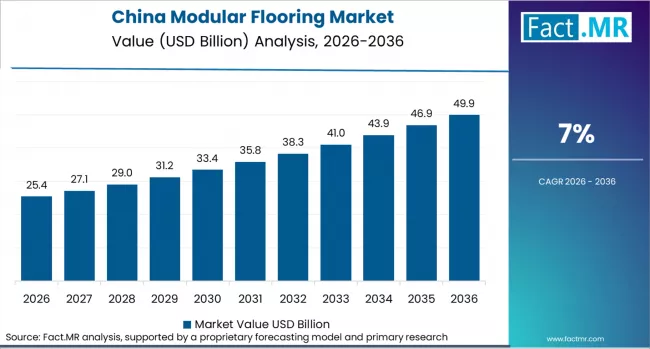
    China leads growth at 7.0% CAGR, supported by large-scale commercial construction and refurbishment. India follows at 6.5%, driven by expanding office and urban residential developments. Germany records 6.0%, reflecting renovation-led demand, while France posts 5.5% linked to public infrastructure upgrades. The United Kingdom grows at 4.9%, and the United States at 4.4%, both remaining replacement-driven markets with mature flooring penetration. Brazil, at 3.9%, reflects gradual uptake tied to commercial refurbishment activity.
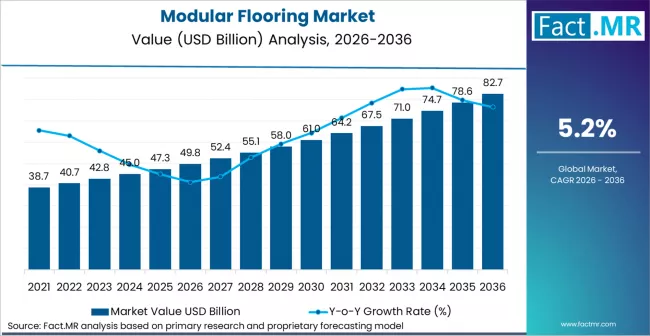
    Modular Flooring Market Market Value Analysis

    Modular Flooring Market

    Metric Value
    Market Value (2026) USD 49.8 billion
    Forecast Value (2036) USD 82.4 billion
    Forecast CAGR (2026-2036) 5.2%

    Summary of Modular Flooring Market

    • Market Definition
      • The modular flooring market comprises prefabricated floor tiles and planks designed for selective replacement, flexible installation, and lifecycle efficiency across residential and non-residential buildings.
    • Demand Drivers
      • Commercial building owners and facility managers specify modular flooring to reduce downtime during renovations, as individual tiles or planks can be replaced without disrupting entire floor areas.
      • Healthcare, education, and office spaces demand flooring systems that meet slip resistance, acoustic control, and indoor safety requirements while supporting phased refurbishment.
      • Urban residential projects increasingly adopt modular vinyl and LVT formats to balance durability, ease of installation, and cost control in high-occupancy housing.
    • Key Segments Analyzed
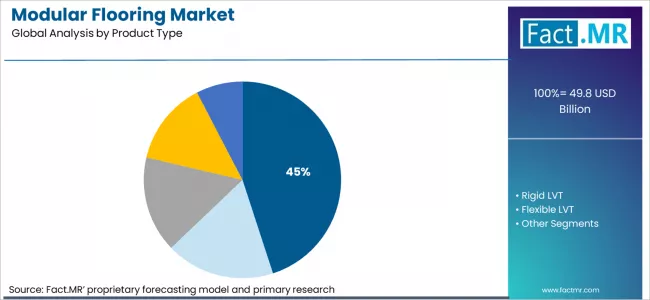
      • By product type, carpet tiles lead the market with an estimated 45% share, driven by acoustic performance and selective replacement advantages in offices and institutions.
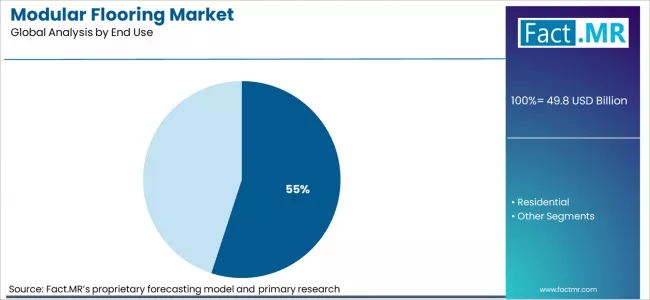
      • By end use, non-residential applications account for about 55% of demand, reflecting higher refurbishment frequency in commercial and public buildings.
      • By geography, Asia Pacific represents the fastest-growing region, supported by commercial construction and large-scale renovation activity in China and India.
    • Analyst Opinion at Fact.MR
      • Shambhu Nath Jha, Principal Consultant at Fact.MR, opines, ‘CXOs will find this report useful for understanding how specification-led refurbishment cycles, product modularity, and lifecycle cost considerations are reshaping procurement strategies in commercial and institutional flooring projects.’
    • Strategic Implications / Executive Takeaways
      • Flooring manufacturers should align product portfolios with refurbishment-driven demand rather than relying solely on new construction exposure.
      • Investment in installation efficiency and selective replacement features can strengthen positioning with facility managers and architects.
      • Regional strategies should prioritize Asia Pacific, where commercial fit-outs and urban development are expanding specification-led demand.
    • Methodology
      • Market estimates are derived from manufacturer interviews, contractor insights, and analysis of construction and renovation data.
      • Sizing uses bottom-up assessment of installed area, replacement cycles, and product mix, cross-validated with company disclosures.
      • Regulatory and safety assumptions reference to ensure compliance alignment.[2]

    Modular Flooring Market Definition

    The modular flooring market covers prefabricated floor covering units manufactured in standardized tiles or planks for installation in residential, commercial, and institutional buildings. These products are designed for interlocking or adhesive based installation and allow replacement of individual sections without removing the entire floor. Materials commonly used include vinyl, carpet tile, laminate, and engineered wood. Product safety, surface performance, and material emissions compliance are regulated under building product and indoor air quality standards enforced by the US Consumer Product Safety Commission and building codes adopted under federal guidance. [3]

    Modular Flooring Market Inclusions

    The report covers global and regional market size estimates in volume and value with a forecast from 2026 to 2036. Segmentation includes flooring type such as vinyl tiles, carpet tiles, laminate planks, and engineered wood modules, application across residential and commercial spaces, and end use by housing, offices, retail, and institutional buildings. Regional demand patterns, pricing trends, and trade flows for modular floor coverings are included.

    Modular Flooring Market Exclusions

    The scope excludes traditional roll based flooring products, ceramic tiles, stone slabs, and poured flooring systems. Subfloor preparation materials, adhesives sold separately, and installation tools are not included. Outdoor decking systems, sports flooring surfaces, and industrial epoxy coatings are excluded. Installation services, flooring maintenance contracts, prototype materials, and laboratory testing systems are also outside the scope.

    Modular Flooring Market Research Methodology

    • Primary Research: Interviews were conducted with flooring manufacturers, building contractors, architects, interior designers, and distribution channel partners.
    • Desk Research: Desk research used product safety and material compliance guidance issued by the US Consumer Product Safety Commission and housing and building health standards published by the US Department of Housing and Urban Development, along with company disclosures.
    • Market Sizing and Forecasting: Estimates were developed using construction activity data, renovation rates, flooring replacement cycles, and product mix trends across residential and commercial segments.
    • Data Validation and Update Cycle: Data was cross checked against trade statistics, building completion data, regulatory documentation, and manufacturer shipment disclosures before updates were finalized.

    Segmental Analysis

    Modular Flooring Market Analysis by Product Type
    Modular Flooring Market Analysis By Product Type

    Based on Fact.MR analysis, consumption of carpet tiles is estimated to hold 45% share of the global modular flooring market. Fact.MR analysts note carpet tiles lead due to ease of installation, selective replacement, and acoustic performance in commercial interiors. As per Fact.MR, this product type addresses facility manager requirements for reduced downtime during renovations, flexible design layouts, and maintenance efficiency, supporting adoption across offices, educational buildings, healthcare facilities, and retail spaces worldwide today where modularity and lifecycle cost control influence flooring decisions.

    • Workplace standards: Commercial flooring selection is influenced by occupational safety and indoor environment regulations.
    • Acoustic control: Fact.MR analysts note carpet tiles help manage noise in high-traffic interiors.
    • Maintenance benefit: Damaged tiles can be replaced individually without full floor removal.

    Modular Flooring Market Analysis by End Use
    Modular Flooring Market Analysis By End Use

    Based on Fact.MR analysis, consumption of modular flooring in non-residential applications is estimated to hold 55% share of the global market. Fact.MR analysts note non-residential demand leads due to frequent refurbishment cycles and high foot traffic across commercial buildings. As per Fact.MR, this end use addresses performance needs for durability, safety compliance, and design flexibility in offices, hospitals, schools, and hospitality facilities worldwide today, where flooring systems must support continuous operation and evolving space utilization requirements.

    • Building compliance: Commercial buildings must follow safety and material use regulations for interior finishes.
      Renovation cycles: Fact.MR analysts note offices and institutions undergo regular interior upgrades.
    • Traffic resistance: Non-residential spaces require flooring suited for sustained daily use.

    Drivers, Restraints, and Opportunities

    Fact.MR analysis indicates that the modular flooring market exists as a specialised construction materials segment used in commercial, residential, industrial, and institutional applications where ease of installation, design flexibility, and lifecycle maintenance are specified. As per Fact.MR assessment, modular flooring products including vinyl tiles, laminate panels, engineered wood, and interlocking systems are influenced by building performance and material safety expectations set out in regulatory frameworks such as the U.S. Occupational Safety and Health Administration (OSHA) walking-working surfaces and flooring standards, which establish hazard prevention criteria to reduce slips, trips, and falls in workplaces. Fact.MR analysts observe that the current market size is shaped by renovation and new construction activity where project specifications increasingly reference ease of dispatch, reduced installation downtime, and compliance with material safety guidelines to support occupant welfare.

    Fact.MR is of the opinion that current market dynamics reflect a transition from traditional sheet and glued flooring products toward modular systems that offer rapid installation, design modularity, and simplified maintenance. Based on Fact.MR assessment, conventional broadloom carpets and poured flooring options remain widely used due to legacy supply chains and cost familiarity, but demand for modular flooring grows where accelerated fit-out schedules and reversible interior design are specified by building programmes. Modular flooring systems generally carry a pricing premium related to precision manufacturing, dimensional tolerances, and engineered locking mechanisms, meaning realised market value can increase even where shipment volumes grow at a measured pace. Fact.MR analysis suggests this combination of design preference shifts and value capture will shape near-term market progression.

    • Workplace and surface safety expectations: Fact.MR analysts note that frameworks such as the OSHA walking-working surfaces and flooring standards influence how building owners, facility managers, and contractors select modular flooring products that meet hazard prevention criteria.[4]
    • Shift to rapid installation formats: Based on Fact.MR assessment, demand is rising for modular flooring systems that support accelerated construction fit-out, reduced labour costs, and reversible design options compared with traditional flooring materials.
    • Asia Pacific construction and renovation growth: Fact.MR opines that increasing commercial and residential infrastructure development in China, India, and Southeast Asia supports regional uptake of modular flooring solutions as part of overall building interior specification and renovation cycles.

    Regional Analysis

    Based on regional assessment, the modular flooring sector is analyzed across North America, Europe, East Asia, South Asia, and Latin America, spanning more than 40 countries. Regional performance varies according to commercial construction activity, renovation demand, preference for flexible flooring solutions, and adoption across non-residential and residential applications.
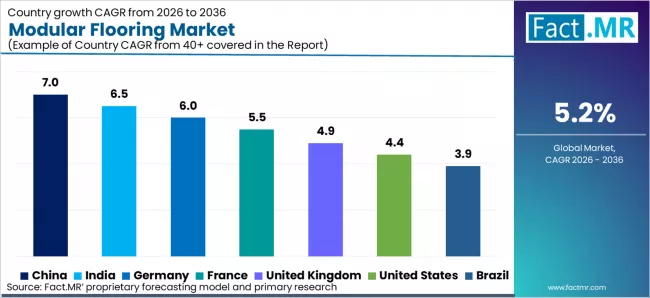
    Modular Flooring Market Cagr Analysis By Country

    Modular Flooring Market CAGR Analysis by Country (2026-2036)

    Country CAGR
    China 7.0%
    India 6.5%
    Germany 6.0%
    France 5.5%
    United Kingdom 4.9%
    United States 4.4%
    Brazil 3.9%

    Source: Fact.MR analysis, based on proprietary forecasting models and primary research.

    Outlook On Modular Flooring Demand in Asia Pacific
    Modular Flooring Market Country Value Analysis

    Asia Pacific reflects sustained demand for modular flooring supported by commercial construction activity office refurbishment and institutional building development. Demand is shaped by preference for easy installation replacement flexibility and lifecycle cost control. China and India anchor regional consumption through large scale commercial real estate healthcare and education projects. Sales growth reflects expansion of organized construction supply chains specification led procurement and rising use of carpet tiles and resilient modular formats across non-residential and mixed use developments regionwide.

    • China: Demand for modular flooring in China is projected to rise at 7.0% CAGR through 2036. Growth reflects commercial construction activity and adoption of modular flooring in offices healthcare and education buildings, as per Fact.MR.
    • India: Demand for modular flooring in India is projected to rise at 6.5% CAGR through 2036. Usage reflects increasing installation in commercial interiors and institutional projects, according to Fact.MR.

    Fact.MR’s analysis of the Modular Flooring Market in Asia Pacific consists of country-wise assessment that includes China and India. Readers can find commercial construction and specification trends.

    Analysis On Modular Flooring Sales in Europe

    Europe demonstrates steady modular flooring sales supported by refurbishment driven demand and mature commercial building stock. Adoption is shaped by replacement cycles sustainability requirements and standardized interior specifications. Germany France and the United Kingdom contribute through office renovation healthcare facilities and public buildings. Procurement emphasizes durability acoustic performance and ease of maintenance. Market growth reflects retrofit activity rather than new construction supported by structured tendering processes and established supplier relationships across Western European commercial interiors markets.

    • Germany: Demand for modular flooring in Germany is projected to rise at 6.0% CAGR through 2036. Sales reflect refurbishment of offices healthcare facilities and institutional buildings, as per Fact.MR.
    • France: Demand for modular flooring in France is projected to rise at 5.5% CAGR through 2036. Usage is driven by public and private sector renovation projects, according to Fact.MR.
    • United Kingdom: Demand for modular flooring in the United Kingdom is projected to rise at 4.9% CAGR through 2036. Adoption reflects commercial refurbishment and replacement demand, as per Fact.MR.

    Fact.MR’s analysis of the Modular Flooring Market in Europe consists of country-wise assessment that includes Germany France and the United Kingdom. Readers can find refurbishment and procurement insights.

    Demand for Modular Flooring in North America

    North America shows consistent demand for modular flooring supported by office renovation education facilities and healthcare construction. Sales are driven by preference for flexible flooring systems and ease of replacement. The United States anchors regional demand through corporate office fit outs and institutional projects. Procurement favors standardized specifications and long term supplier agreements. Market growth reflects steady refurbishment activity and moderate new construction across commercial real estate and public sector buildings nationwide.

    • United States: Demand for modular flooring in the United States is projected to rise at 4.4% CAGR through 2036. Usage reflects office renovation activity and installation across healthcare and education facilities, as per Fact.MR.

    Fact.MR’s analysis of the Modular Flooring Market in North America consists of country-wise assessment that includes the United States. Readers can find commercial construction demand references.

    Outlook On Modular Flooring Adoption in Latin America

    Latin America reflects moderate adoption of modular flooring driven by commercial construction and gradual modernization of office spaces. Demand is shaped by cost considerations and growing awareness of modular flooring benefits. Brazil anchors regional consumption through urban commercial projects. Market expansion remains incremental reflecting selective adoption in corporate and institutional interiors rather than widespread penetration across residential applications regionwide.

    • Brazil: Demand for modular flooring in Brazil is projected to rise at 3.9% CAGR through 2036. Adoption reflects growth in commercial interiors and office refurbishment projects, according to Fact.MR.

    Fact.MR’s analysis of the Modular Flooring Market in Latin America consists of country-wise assessment that includes Brazil. Readers can find regional construction activity insights.

    Competitive Landscape for Market Players
    Modular Flooring Market Analysis By Company

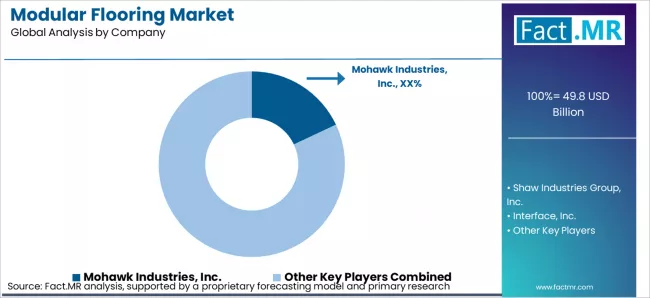
    As per Fact.MR analysis, the 2026 modular flooring market is defined by validated durability, installation efficiency, and multi-segment compliance, which determine competitive advantage. Mohawk Industries, Inc. and Shaw Industries Group, Inc. lead with high-performance carpet and resilient tiles tested for wear and fire resistance, which strengthens adoption in commercial and residential projects. Interface, Inc. and Tarkett S.A. focus on validated sustainability credentials and ease-of-installation solutions, which improve lifecycle efficiency and customer preference. AHF Products and Forbo Flooring Systems provide engineered vinyl and linoleum panels with verified dimensional stability, which enhances adoption in high-traffic applications. Milliken & Company and Gerflor Group emphasize anti-slip and acoustic performance with tested durability, which supports specification in healthcare, hospitality, and education sectors. Beaulieu International Group and LX Hausys deliver modular designs with multi-region compliance, which enables global distribution and regulatory acceptance. Across the market, validated product performance, installation efficiency, and regulatory adherence form enduring competitive moats, reducing reliance on pricing or isolated design claims.

    Recent Industry Developments

    • In March 2024, Mohawk Industries announced USD 65 million investment in LVT manufacturing capacity expansion at its Tennessee facility, adding 40 million square feet annual production [5].
    • In June 2024, Interface Inc. launched its CQuest Bio backing technology incorporating algae-based materials, achieving 95% bio-based content in carpet tile backing systems [6].

    Key Players in Modular Flooring Market

    • Mohawk Industries, Inc.
    • Shaw Industries Group, Inc.
    • Interface, Inc.
    • Tarkett S.A. (Tarkett Group)
    • AHF Products
    • Forbo Flooring Systems
    • Milliken & Company
    • Gerflor Group
    • Beaulieu International Group (B.I.G.)
    • LX Hausys

    Scope of the Report

    Metric Value
    Quantitative Units USD 49.8 billion (2026) to USD 82.4 billion (2036), CAGR 5.2%
    Market Definition The modular flooring market covers prefabricated floor covering units manufactured in standardized tiles or planks for installation in residential, commercial, and institutional buildings. Products include carpet tiles, rigid LVT, flexible LVT, rubber flooring, and other specialty modular formats. They enable phased installation, selective replacement, and lifecycle cost efficiency. Compliance includes indoor air quality and building safety standards regulated by the US CPSC and federal housing codes.
    Product Type Segmentation Carpet Tile, Rigid LVT, Flexible LVT, Rubber Flooring, Others
    End Use Segmentation Non-Residential, Residential
    Regions Covered Asia Pacific, Europe, North America, Latin America, Middle East & Africa
    Countries Covered India, China, Japan, South Korea, Indonesia, Australia & New Zealand, Germany, Italy, France, United Kingdom, Spain, Benelux, Nordics, Central & Eastern Europe, United States, Canada, Mexico, Brazil, Argentina, Chile, Kingdom of Saudi Arabia, United Arab Emirates, South Africa, Turkey
    Key Companies Profiled Mohawk Industries, Inc., Shaw Industries Group, Inc., Interface, Inc., Tarkett S.A. (Tarkett Group), AHF Products, Forbo Flooring Systems, Milliken & Company, Gerflor Group, Beaulieu International Group (B.I.G.), LX Hausys
    Forecast Period 2026 to 2036
    Approach Combination of top-down and bottom-up modeling validated through interviews with manufacturers, contractors, designers, and distributors. Cross-checked with building completion data, renovation cycles, and regulatory compliance records.

    Modular Flooring Market Analysis by Segments

    • Product Type :

      • Carpet Tile
      • Rigid LVT
      • Flexible LVT
      • Rubber Flooring
      • Others
    • End Use :

      • Non-Residential
      • Residential
    • Region :

      • Asia Pacific
        • India
        • China
        • Japan
        • South Korea
        • Indonesia
        • Australia & New Zealand
        • ASEAN
        • Rest of Asia Pacific
      • Europe
        • Germany
        • Italy
        • France
        • United Kingdom
        • Spain
        • Benelux
        • Nordics
        • Central & Eastern Europe
        • Rest of Europe
      • North America
        • United States
        • Canada
        • Mexico
      • Latin America
        • Brazil
        • Argentina
        • Chile
        • Rest of Latin America
      • Middle East & Africa
        • Kingdom of Saudi Arabia
        • United Arab Emirates
        • South Africa
        • Turkey
        • Rest of Middle East & Africa

    Bibliography

    • [1] Interface, Inc. (2023). Design, sustainability, and human-centered flooring innovation: Interview with Mandy Leeming, Design Director UK. Interface, Inc.
    • [2] U.S. Consumer Product Safety Commission. (2024). Regulations, laws, and standards for consumer products. U.S. Consumer Product Safety Commission; U.S. Department of Housing and Urban Development. (2024). Healthy homes and indoor environment standards. U.S. Department of Housing and Urban Development.
    • [3] U.S. Consumer Product Safety Commission. (2024). Product safety regulations and material compliance for building products. U.S. Consumer Product Safety Commission; U.S. Department of Housing and Urban Development. (2024). Indoor air quality and housing health guidance. U.S. Department of Housing and Urban Development.
    • [4] U.S. Occupational Safety and Health Administration. (2024). Walking-working surfaces and flooring standards (29 CFR 1910.22). U.S. Department of Labor.
    • [5] Mohawk Industries, Inc. (2024). Mohawk Industries announces expansion of LVT manufacturing capacity in Tennessee [Company press release]. Mohawk Industries, Inc.
    • [6] Interface, Inc. (2024). Interface launches CQuest™ Bio backing technology using algae-based materials [Product and sustainability announcement]. Interface, Inc.

    This Report Addresses

    • Market intelligence to enable specification-led strategic decision-making in the modular flooring industry, where ease of replacement, installation flexibility, and lifecycle cost efficiency influence demand more than new-build construction cycles
    • Global market size estimation and 10-year revenue forecasts from 2026 to 2036, built using construction activity data, refurbishment rates, and flooring replacement cycles across residential and non-residential buildings
    • Growth opportunity mapping across modular flooring product types, including carpet tiles, rigid LVT, flexible LVT, rubber flooring, and specialty formats, highlighting performance, durability, and maintenance-driven specification trends
    • End-use demand analysis across non-residential and residential segments, linking refurbishment intensity, foot-traffic requirements, and operational downtime considerations to product selection
    • Competitive landscape benchmarking of leading flooring manufacturers based on product durability, design flexibility, sustainability credentials, installation efficiency, and multi-region regulatory compliance
    • Technology and design roadmap assessment covering advancements in resilient flooring materials, acoustic performance, modular locking systems, and low-emission, sustainable backing technologies
    • Regulatory and standards impact review covering indoor air quality requirements, surface safety norms, and building material compliance frameworks influencing modular flooring adoption
    • Regional and country-level growth assessment across Asia Pacific, Europe, North America, Latin America, and Middle East & Africa, highlighting differentiated trajectories in China, India, Germany, France, the United Kingdom, and the United States
    • Strategic implications for manufacturers, architects, contractors, and facility managers focused on renovation-led demand, phased installation strategies, and long-term maintenance efficiency
    • Multi-format market report delivery in PDF, Excel datasets, PPT presentations, and interactive dashboards for executives, specification teams, contractors, distributors, and procurement stakeholders

    Table of Content

    1. Executive Summary
      • Global Market Outlook
      • Demand to side Trends
      • Supply to side Trends
      • Technology Roadmap Analysis
      • Analysis and Recommendations
    2. Market Overview
      • Market Coverage / Taxonomy
      • Market Definition / Scope / Limitations
    3. Research Methodology
      • Chapter Orientation
      • Analytical Lens and Working Hypotheses
        • Market Structure, Signals, and Trend Drivers
        • Benchmarking and Cross-market Comparability
        • Market Sizing, Forecasting, and Opportunity Mapping
      • Research Design and Evidence Framework
        • Desk Research Programme (Secondary Evidence)
          • Company Annual and Sustainability Reports
          • Peer-reviewed Journals and Academic Literature
          • Corporate Websites, Product Literature, and Technical Notes
          • Earnings Decks and Investor Briefings
          • Statutory Filings and Regulatory Disclosures
          • Technical White Papers and Standards Notes
          • Trade Journals, Industry Magazines, and Analyst Briefs
          • Conference Proceedings, Webinars, and Seminar Materials
          • Government Statistics Portals and Public Data Releases
          • Press Releases and Reputable Media Coverage
          • Specialist Newsletters and Curated Briefings
          • Sector Databases and Reference Repositories
          • FMR Internal Proprietary Databases and Historical Market Datasets
          • Subscription Datasets and Paid Sources
          • Social Channels, Communities, and Digital Listening Inputs
          • Additional Desk Sources
        • Expert Input and Fieldwork (Primary Evidence)
          • Primary Modes
            • Qualitative Interviews and Expert Elicitation
            • Quantitative Surveys and Structured Data Capture
            • Blended Approach
          • Why Primary Evidence is Used
          • Field Techniques
            • Interviews
            • Surveys
            • Focus Groups
            • Observational and In-context Research
            • Social and Community Interactions
          • Stakeholder Universe Engaged
            • C-suite Leaders
            • Board Members
            • Presidents and Vice Presidents
            • R&D and Innovation Heads
            • Technical Specialists
            • Domain Subject-matter Experts
            • Scientists
            • Physicians and Other Healthcare Professionals
          • Governance, Ethics, and Data Stewardship
            • Research Ethics
            • Data Integrity and Handling
        • Tooling, Models, and Reference Databases
      • Data Engineering and Model Build
        • Data Acquisition and Ingestion
        • Cleaning, Normalisation, and Verification
        • Synthesis, Triangulation, and Analysis
      • Quality Assurance and Audit Trail
    4. Market Background
      • Market Dynamics
        • Drivers
        • Restraints
        • Opportunity
        • Trends
      • Scenario Forecast
        • Demand in Optimistic Scenario
        • Demand in Likely Scenario
        • Demand in Conservative Scenario
      • Opportunity Map Analysis
      • Product Life Cycle Analysis
      • Supply Chain Analysis
      • Investment Feasibility Matrix
      • Value Chain Analysis
      • PESTLE and Porter’s Analysis
      • Regulatory Landscape
      • Regional Parent Market Outlook
      • Production and Consumption Statistics
      • Import and Export Statistics
    5. Global Market Analysis 2021 to 2025 and Forecast, 2026 to 2036
      • Historical Market Size Value (USD Million) Analysis, 2021 to 2025
      • Current and Future Market Size Value (USD Million) Projections, 2026 to 2036
        • Y to o to Y Growth Trend Analysis
        • Absolute $ Opportunity Analysis
    6. Global Market Pricing Analysis 2021 to 2025 and Forecast 2026 to 2036
    7. Global Market Analysis 2021 to 2025 and Forecast 2026 to 2036, By Product Type
      • Introduction / Key Findings
      • Historical Market Size Value (USD Million) Analysis By Product Type , 2021 to 2025
      • Current and Future Market Size Value (USD Million) Analysis and Forecast By Product Type , 2026 to 2036
        • Carpet Tile
        • Rigid LVT
        • Flexible LVT
        • Rubber Flooring
        • Others
      • Y to o to Y Growth Trend Analysis By Product Type , 2021 to 2025
      • Absolute $ Opportunity Analysis By Product Type , 2026 to 2036
    8. Global Market Analysis 2021 to 2025 and Forecast 2026 to 2036, By End Use
      • Introduction / Key Findings
      • Historical Market Size Value (USD Million) Analysis By End Use, 2021 to 2025
      • Current and Future Market Size Value (USD Million) Analysis and Forecast By End Use, 2026 to 2036
        • Non-Residential
        • Residential
      • Y to o to Y Growth Trend Analysis By End Use, 2021 to 2025
      • Absolute $ Opportunity Analysis By End Use, 2026 to 2036
    9. Global Market Analysis 2021 to 2025 and Forecast 2026 to 2036, By Region
      • Introduction
      • Historical Market Size Value (USD Million) Analysis By Region, 2021 to 2025
      • Current Market Size Value (USD Million) Analysis and Forecast By Region, 2026 to 2036
        • North America
        • Latin America
        • Western Europe
        • Eastern Europe
        • East Asia
        • South Asia and Pacific
        • Middle East & Africa
      • Market Attractiveness Analysis By Region
    10. North America Market Analysis 2021 to 2025 and Forecast 2026 to 2036, By Country
      • Historical Market Size Value (USD Million) Trend Analysis By Market Taxonomy, 2021 to 2025
      • Market Size Value (USD Million) Forecast By Market Taxonomy, 2026 to 2036
        • By Country
          • USA
          • Canada
          • Mexico
        • By Product Type
        • By End Use
      • Market Attractiveness Analysis
        • By Country
        • By Product Type
        • By End Use
      • Key Takeaways
    11. Latin America Market Analysis 2021 to 2025 and Forecast 2026 to 2036, By Country
      • Historical Market Size Value (USD Million) Trend Analysis By Market Taxonomy, 2021 to 2025
      • Market Size Value (USD Million) Forecast By Market Taxonomy, 2026 to 2036
        • By Country
          • Brazil
          • Chile
          • Rest of Latin America
        • By Product Type
        • By End Use
      • Market Attractiveness Analysis
        • By Country
        • By Product Type
        • By End Use
      • Key Takeaways
    12. Western Europe Market Analysis 2021 to 2025 and Forecast 2026 to 2036, By Country
      • Historical Market Size Value (USD Million) Trend Analysis By Market Taxonomy, 2021 to 2025
      • Market Size Value (USD Million) Forecast By Market Taxonomy, 2026 to 2036
        • By Country
          • Germany
          • UK
          • Italy
          • Spain
          • France
          • Nordic
          • BENELUX
          • Rest of Western Europe
        • By Product Type
        • By End Use
      • Market Attractiveness Analysis
        • By Country
        • By Product Type
        • By End Use
      • Key Takeaways
    13. Eastern Europe Market Analysis 2021 to 2025 and Forecast 2026 to 2036, By Country
      • Historical Market Size Value (USD Million) Trend Analysis By Market Taxonomy, 2021 to 2025
      • Market Size Value (USD Million) Forecast By Market Taxonomy, 2026 to 2036
        • By Country
          • Russia
          • Poland
          • Hungary
          • Balkan & Baltic
          • Rest of Eastern Europe
        • By Product Type
        • By End Use
      • Market Attractiveness Analysis
        • By Country
        • By Product Type
        • By End Use
      • Key Takeaways
    14. East Asia Market Analysis 2021 to 2025 and Forecast 2026 to 2036, By Country
      • Historical Market Size Value (USD Million) Trend Analysis By Market Taxonomy, 2021 to 2025
      • Market Size Value (USD Million) Forecast By Market Taxonomy, 2026 to 2036
        • By Country
          • China
          • Japan
          • South Korea
        • By Product Type
        • By End Use
      • Market Attractiveness Analysis
        • By Country
        • By Product Type
        • By End Use
      • Key Takeaways
    15. South Asia and Pacific Market Analysis 2021 to 2025 and Forecast 2026 to 2036, By Country
      • Historical Market Size Value (USD Million) Trend Analysis By Market Taxonomy, 2021 to 2025
      • Market Size Value (USD Million) Forecast By Market Taxonomy, 2026 to 2036
        • By Country
          • India
          • ASEAN
          • Australia & New Zealand
          • Rest of South Asia and Pacific
        • By Product Type
        • By End Use
      • Market Attractiveness Analysis
        • By Country
        • By Product Type
        • By End Use
      • Key Takeaways
    16. Middle East & Africa Market Analysis 2021 to 2025 and Forecast 2026 to 2036, By Country
      • Historical Market Size Value (USD Million) Trend Analysis By Market Taxonomy, 2021 to 2025
      • Market Size Value (USD Million) Forecast By Market Taxonomy, 2026 to 2036
        • By Country
          • Kingdom of Saudi Arabia
          • Other GCC Countries
          • Turkiye
          • South Africa
          • Other African Union
          • Rest of Middle East & Africa
        • By Product Type
        • By End Use
      • Market Attractiveness Analysis
        • By Country
        • By Product Type
        • By End Use
      • Key Takeaways
    17. Key Countries Market Analysis
      • USA
        • Pricing Analysis
        • Market Share Analysis, 2025
          • By Product Type
          • By End Use
      • Canada
        • Pricing Analysis
        • Market Share Analysis, 2025
          • By Product Type
          • By End Use
      • Mexico
        • Pricing Analysis
        • Market Share Analysis, 2025
          • By Product Type
          • By End Use
      • Brazil
        • Pricing Analysis
        • Market Share Analysis, 2025
          • By Product Type
          • By End Use
      • Chile
        • Pricing Analysis
        • Market Share Analysis, 2025
          • By Product Type
          • By End Use
      • Germany
        • Pricing Analysis
        • Market Share Analysis, 2025
          • By Product Type
          • By End Use
      • UK
        • Pricing Analysis
        • Market Share Analysis, 2025
          • By Product Type
          • By End Use
      • Italy
        • Pricing Analysis
        • Market Share Analysis, 2025
          • By Product Type
          • By End Use
      • Spain
        • Pricing Analysis
        • Market Share Analysis, 2025
          • By Product Type
          • By End Use
      • France
        • Pricing Analysis
        • Market Share Analysis, 2025
          • By Product Type
          • By End Use
      • India
        • Pricing Analysis
        • Market Share Analysis, 2025
          • By Product Type
          • By End Use
      • ASEAN
        • Pricing Analysis
        • Market Share Analysis, 2025
          • By Product Type
          • By End Use
      • Australia & New Zealand
        • Pricing Analysis
        • Market Share Analysis, 2025
          • By Product Type
          • By End Use
      • China
        • Pricing Analysis
        • Market Share Analysis, 2025
          • By Product Type
          • By End Use
      • Japan
        • Pricing Analysis
        • Market Share Analysis, 2025
          • By Product Type
          • By End Use
      • South Korea
        • Pricing Analysis
        • Market Share Analysis, 2025
          • By Product Type
          • By End Use
      • Russia
        • Pricing Analysis
        • Market Share Analysis, 2025
          • By Product Type
          • By End Use
      • Poland
        • Pricing Analysis
        • Market Share Analysis, 2025
          • By Product Type
          • By End Use
      • Hungary
        • Pricing Analysis
        • Market Share Analysis, 2025
          • By Product Type
          • By End Use
      • Kingdom of Saudi Arabia
        • Pricing Analysis
        • Market Share Analysis, 2025
          • By Product Type
          • By End Use
      • Turkiye
        • Pricing Analysis
        • Market Share Analysis, 2025
          • By Product Type
          • By End Use
      • South Africa
        • Pricing Analysis
        • Market Share Analysis, 2025
          • By Product Type
          • By End Use
    18. Market Structure Analysis
      • Competition Dashboard
      • Competition Benchmarking
      • Market Share Analysis of Top Players
        • By Regional
        • By Product Type
        • By End Use
    19. Competition Analysis
      • Competition Deep Dive
        • Mohawk Industries, Inc.
          • Overview
          • Product Portfolio
          • Profitability by Market Segments (Product/Age /Sales Channel/Region)
          • Sales Footprint
          • Strategy Overview
            • Marketing Strategy
            • Product Strategy
            • Channel Strategy
        • Shaw Industries Group, Inc.
        • Interface, Inc.
        • Tarkett S.A. (Tarkett Group)
        • AHF Products
        • Forbo Flooring Systems
        • Milliken & Company
        • Gerflor Group
        • Beaulieu International Group (B.I.G.)
        • LX Hausys
    20. Assumptions & Acronyms Used

    List Of Table

    • Table 1: Global Market Value (USD Million) Forecast by Region, 2026 and 2036
    • Table 2: Global Market Value (USD Million) Forecast by Product Type, 2026 and 2036
    • Table 3: Global Market Value (USD Million) Forecast by End Use, 2026 and 2036
    • Table 4: North America Market Value (USD Million) Forecast by Country, 2026 and 2036
    • Table 5: North America Market Value (USD Million) Forecast by Product Type, 2026 and 2036
    • Table 6: North America Market Value (USD Million) Forecast by End Use, 2026 and 2036
    • Table 7: Latin America Market Value (USD Million) Forecast by Country, 2026 and 2036
    • Table 8: Latin America Market Value (USD Million) Forecast by Product Type, 2026 and 2036
    • Table 9: Latin America Market Value (USD Million) Forecast by End Use, 2026 and 2036
    • Table 10: Western Europe Market Value (USD Million) Forecast by Country, 2026 and 2036
    • Table 11: Western Europe Market Value (USD Million) Forecast by Product Type, 2026 and 2036
    • Table 12: Western Europe Market Value (USD Million) Forecast by End Use, 2026 and 2036
    • Table 13: Eastern Europe Market Value (USD Million) Forecast by Country, 2026 and 2036
    • Table 14: Eastern Europe Market Value (USD Million) Forecast by Product Type, 2026 and 2036
    • Table 15: Eastern Europe Market Value (USD Million) Forecast by End Use, 2026 and 2036
    • Table 16: East Asia Market Value (USD Million) Forecast by Country, 2026 and 2036
    • Table 17: East Asia Market Value (USD Million) Forecast by Product Type, 2026 and 2036
    • Table 18: East Asia Market Value (USD Million) Forecast by End Use, 2026 and 2036
    • Table 19: South Asia and Pacific Market Value (USD Million) Forecast by Country, 2026 and 2036
    • Table 20: South Asia and Pacific Market Value (USD Million) Forecast by Product Type, 2026 and 2036
    • Table 21: South Asia and Pacific Market Value (USD Million) Forecast by End Use, 2026 and 2036
    • Table 22: Middle East & Africa Market Value (USD Million) Forecast by Country, 2026 and 2036
    • Table 23: Middle East & Africa Market Value (USD Million) Forecast by Product Type, 2026 and 2036
    • Table 24: Middle East & Africa Market Value (USD Million) Forecast by End Use, 2026 and 2036

    List Of Figures

    • Figure 1: Global Market Pricing Analysis
    • Figure 2: Global Market Value (USD Million) Forecast 2021 to 2036
    • Figure 3: Global Market Value Share and BPS Analysis by Product Type,2026 and 2036
    • Figure 4: Global Market Y to o to Y Growth Comparison by Product Type, 2026 to 2036
    • Figure 5: Global Market Attractiveness Analysis by Product Type
    • Figure 6: Global Market Value Share and BPS Analysis by End Use,2026 and 2036
    • Figure 7: Global Market Y to o to Y Growth Comparison by End Use, 2026 to 2036
    • Figure 8: Global Market Attractiveness Analysis by End Use
    • Figure 9: Global Market Value (USD Million) Share and BPS Analysis by Region,2026 and 2036
    • Figure 10: Global Market Y to o to Y Growth Comparison by Region, 2026 to 2036
    • Figure 11: Global Market Attractiveness Analysis by Region
    • Figure 12: North America Market Incremental Dollar Opportunity, 2026 to 2036
    • Figure 13: Latin America Market Incremental Dollar Opportunity, 2026 to 2036
    • Figure 14: Western Europe Market Incremental Dollar Opportunity, 2026 to 2036
    • Figure 15: Eastern Europe Market Incremental Dollar Opportunity, 2026 to 2036
    • Figure 16: East Asia Market Incremental Dollar Opportunity, 2026 to 2036
    • Figure 17: South Asia and Pacific Market Incremental Dollar Opportunity, 2026 to 2036
    • Figure 18: Middle East & Africa Market Incremental Dollar Opportunity, 2026 to 2036
    • Figure 19: North America Market Value Share and BPS Analysis by Country,2026 and 2036
    • Figure 20: North America Market Value Share and BPS Analysis by Product Type,2026 and 2036
    • Figure 21: North America Market Y to o to Y Growth Comparison by Product Type, 2026 to 2036
    • Figure 22: North America Market Attractiveness Analysis by Product Type
    • Figure 23: North America Market Value Share and BPS Analysis by End Use,2026 and 2036
    • Figure 24: North America Market Y to o to Y Growth Comparison by End Use, 2026 to 2036
    • Figure 25: North America Market Attractiveness Analysis by End Use
    • Figure 26: Latin America Market Value Share and BPS Analysis by Country,2026 and 2036
    • Figure 27: Latin America Market Value Share and BPS Analysis by Product Type,2026 and 2036
    • Figure 28: Latin America Market Y to o to Y Growth Comparison by Product Type, 2026 to 2036
    • Figure 29: Latin America Market Attractiveness Analysis by Product Type
    • Figure 30: Latin America Market Value Share and BPS Analysis by End Use,2026 and 2036
    • Figure 31: Latin America Market Y to o to Y Growth Comparison by End Use, 2026 to 2036
    • Figure 32: Latin America Market Attractiveness Analysis by End Use
    • Figure 33: Western Europe Market Value Share and BPS Analysis by Country,2026 and 2036
    • Figure 34: Western Europe Market Value Share and BPS Analysis by Product Type,2026 and 2036
    • Figure 35: Western Europe Market Y to o to Y Growth Comparison by Product Type, 2026 to 2036
    • Figure 36: Western Europe Market Attractiveness Analysis by Product Type
    • Figure 37: Western Europe Market Value Share and BPS Analysis by End Use,2026 and 2036
    • Figure 38: Western Europe Market Y to o to Y Growth Comparison by End Use, 2026 to 2036
    • Figure 39: Western Europe Market Attractiveness Analysis by End Use
    • Figure 40: Eastern Europe Market Value Share and BPS Analysis by Country,2026 and 2036
    • Figure 41: Eastern Europe Market Value Share and BPS Analysis by Product Type,2026 and 2036
    • Figure 42: Eastern Europe Market Y to o to Y Growth Comparison by Product Type, 2026 to 2036
    • Figure 43: Eastern Europe Market Attractiveness Analysis by Product Type
    • Figure 44: Eastern Europe Market Value Share and BPS Analysis by End Use,2026 and 2036
    • Figure 45: Eastern Europe Market Y to o to Y Growth Comparison by End Use, 2026 to 2036
    • Figure 46: Eastern Europe Market Attractiveness Analysis by End Use
    • Figure 47: East Asia Market Value Share and BPS Analysis by Country,2026 and 2036
    • Figure 48: East Asia Market Value Share and BPS Analysis by Product Type,2026 and 2036
    • Figure 49: East Asia Market Y to o to Y Growth Comparison by Product Type, 2026 to 2036
    • Figure 50: East Asia Market Attractiveness Analysis by Product Type
    • Figure 51: East Asia Market Value Share and BPS Analysis by End Use,2026 and 2036
    • Figure 52: East Asia Market Y to o to Y Growth Comparison by End Use, 2026 to 2036
    • Figure 53: East Asia Market Attractiveness Analysis by End Use
    • Figure 54: South Asia and Pacific Market Value Share and BPS Analysis by Country,2026 and 2036
    • Figure 55: South Asia and Pacific Market Value Share and BPS Analysis by Product Type,2026 and 2036
    • Figure 56: South Asia and Pacific Market Y to o to Y Growth Comparison by Product Type, 2026 to 2036
    • Figure 57: South Asia and Pacific Market Attractiveness Analysis by Product Type
    • Figure 58: South Asia and Pacific Market Value Share and BPS Analysis by End Use,2026 and 2036
    • Figure 59: South Asia and Pacific Market Y to o to Y Growth Comparison by End Use, 2026 to 2036
    • Figure 60: South Asia and Pacific Market Attractiveness Analysis by End Use
    • Figure 61: Middle East & Africa Market Value Share and BPS Analysis by Country,2026 and 2036
    • Figure 62: Middle East & Africa Market Value Share and BPS Analysis by Product Type,2026 and 2036
    • Figure 63: Middle East & Africa Market Y to o to Y Growth Comparison by Product Type, 2026 to 2036
    • Figure 64: Middle East & Africa Market Attractiveness Analysis by Product Type
    • Figure 65: Middle East & Africa Market Value Share and BPS Analysis by End Use,2026 and 2036
    • Figure 66: Middle East & Africa Market Y to o to Y Growth Comparison by End Use, 2026 to 2036
    • Figure 67: Middle East & Africa Market Attractiveness Analysis by End Use
    • Figure 68: Global Market - Tier Structure Analysis
    • Figure 69: Global Market - Company Share AnalysisFigure 1: Global Market Pricing Analysis
    • Figure 2: Global Market Value (USD Million) Forecast 2021 to 2036
    • Figure 3: Global Market Value Share and BPS Analysis by Product Type,2026 and 2036
    • Figure 4: Global Market Y to o to Y Growth Comparison by Product Type, 2026 to 2036
    • Figure 5: Global Market Attractiveness Analysis by Product Type
    • Figure 6: Global Market Value Share and BPS Analysis by End Use,2026 and 2036
    • Figure 7: Global Market Y to o to Y Growth Comparison by End Use, 2026 to 2036
    • Figure 8: Global Market Attractiveness Analysis by End Use
    • Figure 9: Global Market Value (USD Million) Share and BPS Analysis by Region,2026 and 2036
    • Figure 10: Global Market Y to o to Y Growth Comparison by Region, 2026 to 2036
    • Figure 11: Global Market Attractiveness Analysis by Region
    • Figure 12: North America Market Incremental Dollar Opportunity, 2026 to 2036
    • Figure 13: Latin America Market Incremental Dollar Opportunity, 2026 to 2036
    • Figure 14: Western Europe Market Incremental Dollar Opportunity, 2026 to 2036
    • Figure 15: Eastern Europe Market Incremental Dollar Opportunity, 2026 to 2036
    • Figure 16: East Asia Market Incremental Dollar Opportunity, 2026 to 2036
    • Figure 17: South Asia and Pacific Market Incremental Dollar Opportunity, 2026 to 2036
    • Figure 18: Middle East & Africa Market Incremental Dollar Opportunity, 2026 to 2036
    • Figure 19: North America Market Value Share and BPS Analysis by Country,2026 and 2036
    • Figure 20: North America Market Value Share and BPS Analysis by Product Type,2026 and 2036
    • Figure 21: North America Market Y to o to Y Growth Comparison by Product Type, 2026 to 2036
    • Figure 22: North America Market Attractiveness Analysis by Product Type
    • Figure 23: North America Market Value Share and BPS Analysis by End Use,2026 and 2036
    • Figure 24: North America Market Y to o to Y Growth Comparison by End Use, 2026 to 2036
    • Figure 25: North America Market Attractiveness Analysis by End Use
    • Figure 26: Latin America Market Value Share and BPS Analysis by Country,2026 and 2036
    • Figure 27: Latin America Market Value Share and BPS Analysis by Product Type,2026 and 2036
    • Figure 28: Latin America Market Y to o to Y Growth Comparison by Product Type, 2026 to 2036
    • Figure 29: Latin America Market Attractiveness Analysis by Product Type
    • Figure 30: Latin America Market Value Share and BPS Analysis by End Use,2026 and 2036
    • Figure 31: Latin America Market Y to o to Y Growth Comparison by End Use, 2026 to 2036
    • Figure 32: Latin America Market Attractiveness Analysis by End Use
    • Figure 33: Western Europe Market Value Share and BPS Analysis by Country,2026 and 2036
    • Figure 34: Western Europe Market Value Share and BPS Analysis by Product Type,2026 and 2036
    • Figure 35: Western Europe Market Y to o to Y Growth Comparison by Product Type, 2026 to 2036
    • Figure 36: Western Europe Market Attractiveness Analysis by Product Type
    • Figure 37: Western Europe Market Value Share and BPS Analysis by End Use,2026 and 2036
    • Figure 38: Western Europe Market Y to o to Y Growth Comparison by End Use, 2026 to 2036
    • Figure 39: Western Europe Market Attractiveness Analysis by End Use
    • Figure 40: Eastern Europe Market Value Share and BPS Analysis by Country,2026 and 2036
    • Figure 41: Eastern Europe Market Value Share and BPS Analysis by Product Type,2026 and 2036
    • Figure 42: Eastern Europe Market Y to o to Y Growth Comparison by Product Type, 2026 to 2036
    • Figure 43: Eastern Europe Market Attractiveness Analysis by Product Type
    • Figure 44: Eastern Europe Market Value Share and BPS Analysis by End Use,2026 and 2036
    • Figure 45: Eastern Europe Market Y to o to Y Growth Comparison by End Use, 2026 to 2036
    • Figure 46: Eastern Europe Market Attractiveness Analysis by End Use
    • Figure 47: East Asia Market Value Share and BPS Analysis by Country,2026 and 2036
    • Figure 48: East Asia Market Value Share and BPS Analysis by Product Type,2026 and 2036
    • Figure 49: East Asia Market Y to o to Y Growth Comparison by Product Type, 2026 to 2036
    • Figure 50: East Asia Market Attractiveness Analysis by Product Type
    • Figure 51: East Asia Market Value Share and BPS Analysis by End Use,2026 and 2036
    • Figure 52: East Asia Market Y to o to Y Growth Comparison by End Use, 2026 to 2036
    • Figure 53: East Asia Market Attractiveness Analysis by End Use
    • Figure 54: South Asia and Pacific Market Value Share and BPS Analysis by Country,2026 and 2036
    • Figure 55: South Asia and Pacific Market Value Share and BPS Analysis by Product Type,2026 and 2036
    • Figure 56: South Asia and Pacific Market Y to o to Y Growth Comparison by Product Type, 2026 to 2036
    • Figure 57: South Asia and Pacific Market Attractiveness Analysis by Product Type
    • Figure 58: South Asia and Pacific Market Value Share and BPS Analysis by End Use,2026 and 2036
    • Figure 59: South Asia and Pacific Market Y to o to Y Growth Comparison by End Use, 2026 to 2036
    • Figure 60: South Asia and Pacific Market Attractiveness Analysis by End Use
    • Figure 61: Middle East & Africa Market Value Share and BPS Analysis by Country,2026 and 2036
    • Figure 62: Middle East & Africa Market Value Share and BPS Analysis by Product Type,2026 and 2036
    • Figure 63: Middle East & Africa Market Y to o to Y Growth Comparison by Product Type, 2026 to 2036
    • Figure 64: Middle East & Africa Market Attractiveness Analysis by Product Type
    • Figure 65: Middle East & Africa Market Value Share and BPS Analysis by End Use,2026 and 2036
    • Figure 66: Middle East & Africa Market Y to o to Y Growth Comparison by End Use, 2026 to 2036
    • Figure 67: Middle East & Africa Market Attractiveness Analysis by End Use
    • Figure 68: Global Market - Tier Structure Analysis
    • Figure 69: Global Market - Company Share Analysis

    - FAQs -

    How large is the modular flooring market in 2026?

    The modular flooring market is valued at USD 49.8 billion in 2026, supported by replacement-driven demand across commercial interiors.

    What will the modular flooring market size be by 2036?

    By 2036, the market is projected to reach USD 82.4 billion, reflecting steady specification-led adoption.

    What is the expected CAGR for the modular flooring market during the forecast period?

    The market is expected to grow at a 5.2% CAGR from 2026 to 2036.

    How much incremental value will the modular flooring market add over the forecast window?

    The market is projected to add approximately USD 33.0 billion in value between 2026 and 2036.

    What factors are structurally driving demand in the modular flooring market?

    Demand is driven by ease of replacement, installation flexibility, and lifecycle cost efficiency, rather than new construction alone.

    Which product type is poised to lead the modular flooring market?

    Carpet tiles lead the market with an estimated 45% share, driven by selective replacement and acoustic performance benefits.

    Why do carpet tiles hold the largest share in modular flooring?

    They allow phased installation, reduce renovation downtime, and support flexible interior design in commercial spaces.

    Which end-use segment dominates the modular flooring market?

    The non-residential segment dominates with an estimated 55% share, driven by offices, healthcare facilities, and institutional buildings.

    Why does non-residential flooring demand outpace residential demand?

    Non-residential spaces undergo more frequent refurbishment cycles and require durable, easily replaceable flooring systems.

    What is supporting early-period growth in the modular flooring market?

    Early growth is supported by carpet tile replacement across offices and institutional environments.

    What drives mid-period momentum in the market?

    Mid-period growth aligns with increased adoption of rigid and flexible LVT in retail, hospitality, and multi-family housing.

    What shapes value growth in the later years of the forecast period?

    Later growth is driven by rubber and specialty modular flooring in healthcare and industrial facilities.

    Which country is expected to grow the fastest in the modular flooring market?

    China leads growth at 7.0% CAGR, supported by large-scale commercial construction and refurbishment activity.

    What is India’s growth outlook in the modular flooring market?

    India is projected to grow at 6.5% CAGR, driven by expanding office and urban residential developments.

    How fast is the modular flooring market expected to grow in Germany?

    Germany is forecast to expand at a 6.0% CAGR, reflecting renovation-led demand across commercial buildings.

    What is the growth outlook for France in modular flooring?

    France is projected to grow at 5.5% CAGR, supported by public infrastructure and refurbishment projects.

    How does the United Kingdom modular flooring market perform?

    The UK market is expected to grow at 4.9% CAGR, remaining largely replacement-driven with mature flooring penetration.

    What is the expected growth rate for the United States modular flooring market?

    The United States is projected to grow at 4.4% CAGR, supported by steady office, healthcare, and education refurbishment activity.

    How does Brazil compare to other markets in modular flooring growth?

    Brazil is projected to grow at 3.9% CAGR, reflecting gradual uptake tied to commercial refurbishment rather than large-scale expansion.

    What is the long-term outlook for the modular flooring market?

    The market outlook remains stable and positive, anchored in specification-led replacement demand, phased installations, and lifecycle cost optimization.

    Modular Flooring Market