Adjustable Spanner Market Size, Share, Growth and Forecast (2026 - 2036)

The Adjustable Spanner Market is segmented by Product Type, by Material Type, by Length Range, by Distribution Channel, and by End Use, and Region. Forecast for 2026 to 2036.

Adjustable Spanner Market Size, Market Forecast and Outlook by Fact.MR

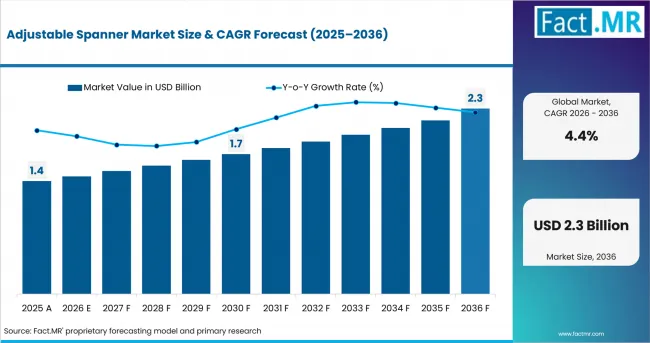
  • The adjustable spanner market surpassed a value of USD 1.4 billion in 2025.
  • Demand is expected to increase from USD 1.5 billion in 2026 to USD 2.3 billion by 2036.
  • The market is forecast to record 4.4% CAGR from 2026 to 2036 as repair workshops and industrial maintenance users replace basic wrench sets with more flexible hand tools.
Adjustable Spanner Market Value Analysis

Metric Details
Industry Size 2026 USD 1.5 billion
Industry Value 2036 USD 2.3 billion
CAGR 2026 to 2036 4.4%

Summary of the Adjustable Spanner Market

  • Demand Drivers in the Market
    • Automotive workshops need adjustable spanners for fastener work across repair tasks.
    • Industrial maintenance managers prefer tools that reduce kit size during routine service.
    • Hardware retailers stock adjustable spanners because the tool serves both professional and household repair needs.
  • Key Segments Analyzed
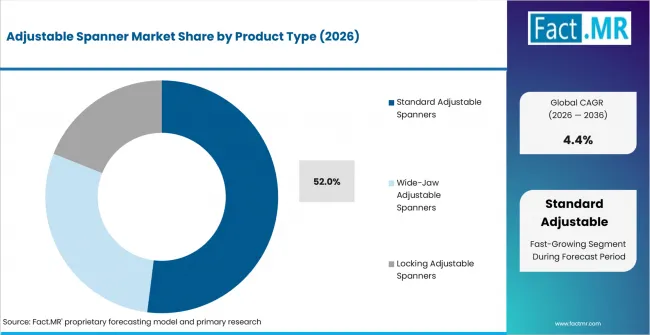
    • By Product Type: Standard adjustable spanners are expected to hold 52.0% share in 2026 because they serve everyday repair and maintenance needs.
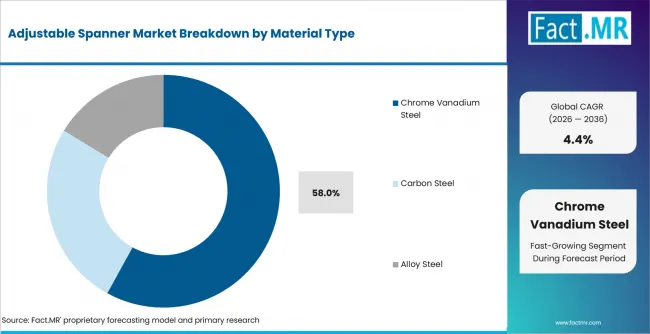
    • By Material Type: Chrome vanadium steel is likely to account for 58.0% share in 2026 as users prefer stronger tools with better wear resistance.
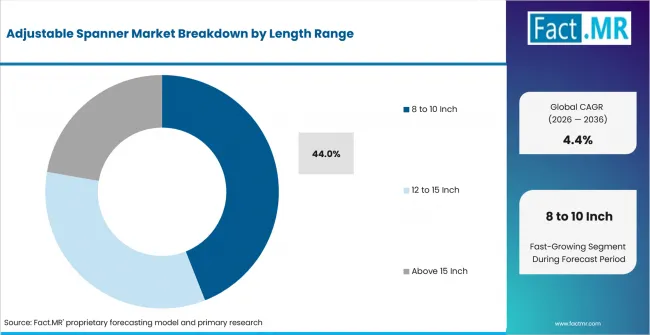
    • By Length Range: 8 to 10 inch spanners are projected to capture 44.0% share in 2026 since the size balances grip force and portability.
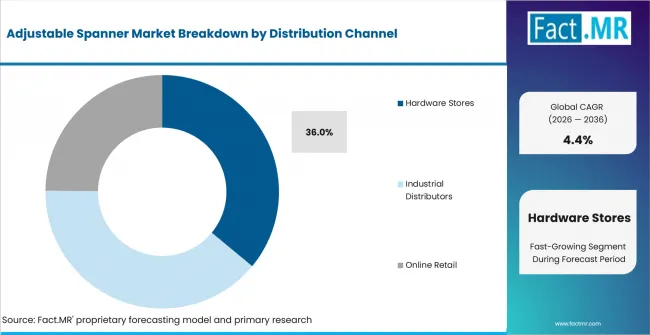
    • By Distribution Channel: Hardware stores are anticipated to hold 36.0% share in 2026 because tool buyers often need immediate replacement.
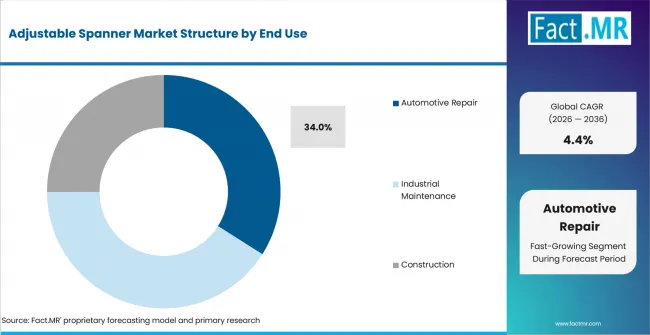
    • By End Use: Automotive repair is expected to account for 34.0% share in 2026 as garages use adjustable spanners across common service jobs.
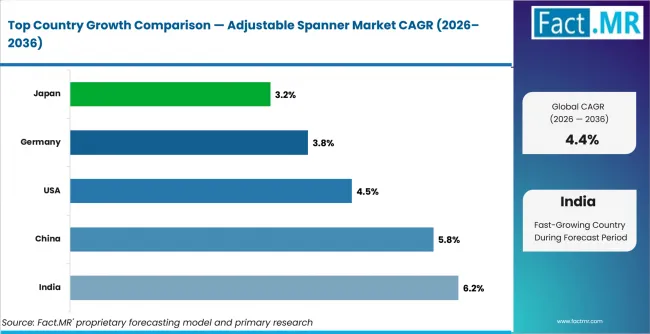
    • By Geography: India is projected to record 6.2% CAGR through 2036 as repair garages and construction activity increase tool demand.
  • Analyst Opinion at Fact.MR
    • Shambhu Nath Jha, Principal Consultant at Fact.MR, notes, “Adjustable spanners look simple, but product quality drives repeat purchase. Mechanics notice jaw wobble and finish after daily use. Suppliers that control jaw tolerance and offer dependable mid-size tools can build stronger channel confidence.”
  • Strategic Implications
    • Tool manufacturers need tighter jaw tolerance control to reduce slippage complaints.
    • Industrial distributors should stock mid-size spanners because service technicians replace them frequently.
    • Automotive tool retailers need clear grade separation between household and professional models.

Adjustable spanner demand is becoming more quality-led. Mechanics need tools with better jaw grip for difficult fastening work. Channellock’s 2026 product page for the 806SWLG adjustable wrench states that the tool has longer jaws that grip better, rugged chrome vanadium steel construction and a lightweight design up to 20% lighter than a standard wrench with similar capacity [1]. Industrial maintenance technicians need lighter spanners that reduce toolbox weight during daily service work.

India is projected to record 6.2% CAGR by 2036 as vehicle repair networks and construction maintenance lift demand for mid-size spanners. China is likely to post 5.8% CAGR through 2036 because manufacturing repair and hardware retail support steady tool consumption. The United States is expected to register 4.5% CAGR from 2026 to 2036 as professional mechanics and home improvement channels sustain replacement demand. Germany is forecast to advance at 3.8% CAGR by 2036 as industrial maintenance favors tested hand tools. Japan is set to record 3.2% CAGR by 2036 because tool demand is mature and precision-driven.

Segmental Analysis

Adjustable Spanner Market Analysis by Product Type
Adjustable Spanner Market Analysis By Product Type

Standard adjustable spanners lead product type demand with 52.0% share in 2026 because they serve daily fastening work across garages and homes. Wide-jaw spanners support plumbing and larger fitting work. Locking models serve difficult fasteners. Insulated spanners address controlled electrical maintenance needs.

  • Standard Use: Standard adjustable spanners suit common repair work across nut and bolt sizes.
  • Wide-Jaw Need: Wide-jaw models help plumbers and technicians handle larger fittings with fewer tools.
  • Locking Grip: Locking adjustable spanners help mechanics manage worn fasteners and rounded edges.

Adjustable Spanner Market Analysis by Material Type
Adjustable Spanner Market Analysis By Material Type

Chrome vanadium steel leads because it offers stronger wear resistance for repeated workshop use. The material type is likely to hold 58.0% share in 2026 as professional users prefer durable jaw surfaces. Carbon steel serves low-cost household tools. Stainless steel supports corrosion-sensitive work areas.

  • Durability Need: Chrome vanadium steel supports repeated fastening work with lower jaw wear.
  • Budget Demand: Carbon steel spanners serve household tool kits and basic repair needs.
  • Corrosion Control: Stainless steel spanners suit wet service areas and marine maintenance.

Adjustable Spanner Market Analysis by Length Range
Adjustable Spanner Market Analysis By Length Range

8 to 10 inch spanners lead because they suit most household and workshop tasks. Smaller spanners serve compact repairs and light-duty kits. The 8 to 10-inch length range is projected to capture 44.0% share in 2026 as it offers useful leverage without adding tool weight. Longer spanners serve industrial fittings.

  • Mid-Size Balance: 8 to 10 inch spanners give mechanics useful leverage and easier carrying.
  • Compact Repair: Up to 6 inch tools support tight spaces and light maintenance work.
  • Heavy Fastening: Above 15 inch spanners serve large fittings in industrial maintenance.

Adjustable Spanner Market Analysis by Distribution Channel
Adjustable Spanner Market Analysis By Distribution Channel

Hardware stores are anticipated to hold 36.0% share in 2026 as users often replace spanners during repair work. Home Depot’s 2025 Form 10-K states that professional customers include maintenance professionals and handymen who repair and maintain residential and commercial properties, and that store departments include Hardware [2]. Industrial distributors serve workshops and maintenance departments. Online retail supports branded tool comparison and bulk buying through price visibility and job-lot quantity access.

  • Immediate Purchase: Hardware stores serve urgent tool replacement and household repair demand.
  • Industrial Supply: Industrial distributors support maintenance departments with repeat orders and known brands.
  • Online Comparison: Online retail helps users compare length range and jaw capacity.

Adjustable Spanner Market Analysis by End Use
Adjustable Spanner Market Analysis By End Use

Automotive repair leads because mechanics use adjustable spanners across service and maintenance jobs. Industrial maintenance creates steady replacement demand. Construction users need adjustable tools for site repair and fitting work. Automotive repair is expected to account for 34.0% share in 2026 as garages need flexible tools for mixed fastener sizes.

  • Garage Use: Automotive repair shops use adjustable spanners for service tasks across mixed fasteners.
  • Plant Maintenance: Industrial maintenance users need durable tools for valves and equipment checks.
  • Site Repair: Construction workers use adjustable spanners for temporary fixes and fitting adjustments.

Adjustable Spanner Market Drivers, Restraints, and Opportunities
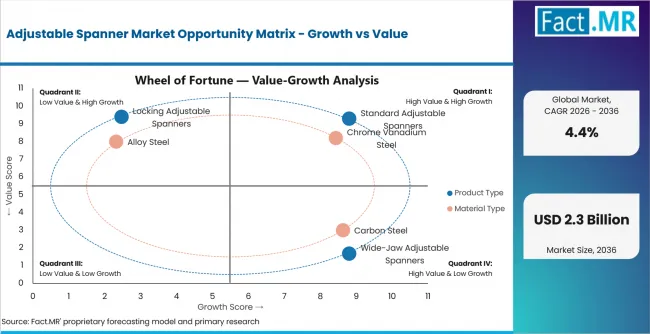
Adjustable Spanner Market Opportunity Matrix Growth Vs Value

Repair and maintenance activity is the main driver for adjustable spanners. A single adjustable jaw helps users manage different fastener sizes without carrying a full wrench set. Stanley Black & Decker’s 2024 filing states that its Tools & Outdoor segment includes hand tools and storage products under brands such as STANLEY and CRAFTSMAN. [3]

Low-cost imports and product failure can slow branded growth. Jaw looseness and poor finish reduce user confidence. Price-sensitive channels often compare tools by size rather than steel quality. Professional mechanics can reject lower-grade spanners after repeated slip or jaw damage.

Opportunities in the Adjustable Spanner Market

  • Professional Tool Kits: Suppliers can target garages with chrome vanadium mid-size spanners.
  • Insulated Tools: Electrical maintenance channels can support insulated models with safety documentation.
  • Online Retail: Branded suppliers can use product images and jaw-capacity details to reduce returns.

Regional Analysis

Based on regional analysis, the adjustable spanner market is segmented into North America, Latin America, Europe, East Asia, South Asia and Pacific, and Middle East and Africa.

Top Country Growth Comparison Adjustable Spanner Market Cagr (2026 2036)

Country CAGR 2026 to 2036
India 6.2%
China 5.8%
United States 4.5%
Germany 3.8%
Japan 3.2%

Adjustable Spanner Market Cagr Analysis By Country

South Asia and Pacific Adjustable Spanner Market Analysis

South Asia demand comes from vehicle repair and construction maintenance. India leads regional demand because garages and hardware stores rely on affordable hand tools. Local distribution depth is important because spanners are often bought as replacement tools.

  • India: India is projected to record 6.2% CAGR from 2026 to 2036 as vehicle repair networks and construction maintenance expand. Mid-size chrome vanadium spanners suits garages and site technicians. Suppliers with wide hardware store coverage can reach professional users and household buyers.

East Asia Adjustable Spanner Market Analysis
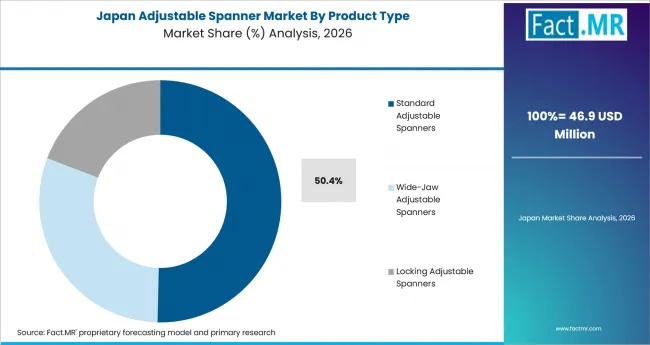
Adjustable Spanner Market Japan Market Share Analysis By Product Type

East Asia demand comes from manufacturing maintenance and mature tool retail. China supports faster uptake through industrial repair and hardware channel volume. Japan shows steadier demand as professional users already favor high-quality hand tools.

  • China: China has a large manufacturing base and a deep hardware retail network. The country is likely to post 5.8% CAGR over the forecast period because repair work and equipment maintenance support adjustable spanner use. Domestic suppliers can compete through price and broad channel access.
  • Japan: Japan is set to record 3.2% CAGR by 2036 as mature industrial maintenance supports replacement demand. Professional users value smooth jaw action and compact handling. Suppliers need precision finish and consistent sizing to protect repeat orders.

North America Adjustable Spanner Market Analysis

North America demand is supported by automotive repair and do-it-yourself home maintenance. The United States supports stable replacement demand through professional tool trucks and online retail. Brand trust plays a major role because users compare warranty and tool feel before purchase.

  • United States: The United States is expected to register 4.5% CAGR from 2026 to 2036 as professional mechanics and home improvement users replace worn tools. Snap-on’s 2024 annual report notes online catalog access for hand tools and repair equipment across major markets. [4] Channel reach supports replacement buying.

Europe Adjustable Spanner Market Analysis
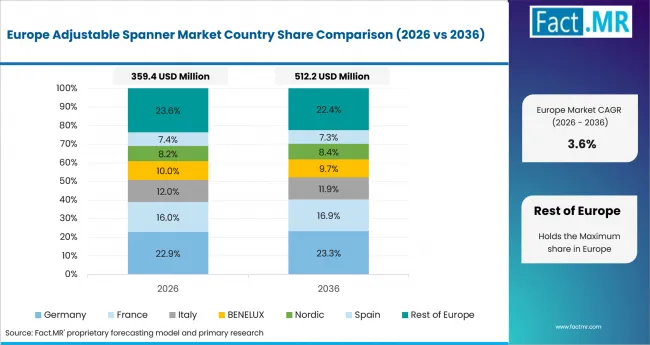
Adjustable Spanner Market Europe Country Market Share Analysis, 2026 & 2036

Europe demand comes from industrial maintenance and tool safety expectations. Germany leads regional demand because workshops and factories use durable hand tools for equipment service. Product quality and standard alignment carry more weight than low entry price.

  • Germany: Germany is forecast to advance at 3.8% CAGR by 2036 because industrial maintenance and automotive service require dependable hand tools. Workshop users prefer tools with stable jaw control and clear quality grading. Suppliers with recognized standards and distributor support can protect premium shelf space.

Competitive Aligners for Market Suppliers
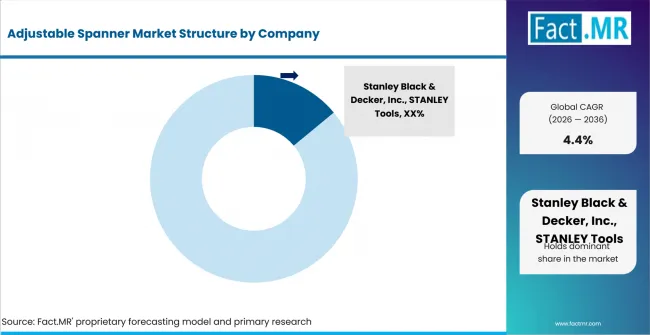
Adjustable Spanner Market Analysis By Company

The adjustable spanner market is led by hand tool brands that serve professional and household users. Stanley Black & Decker, Inc. / STANLEY Tools competes through broad tool availability and strong retail reach. Snap-on Incorporated serves professional users that need durable tools for regular workshop use. Apex Tool Group’s Crescent brand has a long position in adjustable wrenches and remains closely associated with the product.

Klein Tools, Inc. and Channellock, Inc. add competition through trade-focused hand tool portfolios. Product choice depends on jaw strength and smooth adjustment. Handle comfort matters because professionals use these tools repeatedly. Retailers look for brands that reduce returns and support steady replacement demand.

Competition will depend on tool finish and quality proof through 2036. Lower-cost models will continue to serve basic household use. Professional channels will favor better jaw control and longer working life. Brands that separate trade-grade tools from DIY products will be better placed.

Key Companies in Adjustable Spanner Market

  • Stanley Black & Decker, Inc. / STANLEY Tools
  • Snap-on Incorporated
  • Apex Tool Group, LLC / Crescent
  • Klein Tools, Inc.
  • Channellock, Inc.

Bibliography

  • [1] Channellock, Inc. (n.d.). 806SWLG 6-inch lightweight extra slim jaw WideAzz® adjustable wrench.
  • [2] The Home Depot, Inc. (2026, March 18). Fiscal 2025 Form 10-K. The Home Depot, Inc.
  • [3]. Stanley Black & Decker, Inc. (2025, February 18). 2024 Annual Report. Stanley Black & Decker, Inc.
  • [4]. Snap-on Incorporated. (2025). 2024 Annual Report. Snap-on Incorporated.

This Report Addresses

  • Strategic intelligence on adjustable spanner demand across product type and material type.
  • Forecast mapping from USD 1.5 billion in 2026 to USD 2.3 billion by 2036.
  • Segment analysis covering standard adjustable spanners, chrome vanadium steel, 8 to 10 inch length range, hardware stores and automotive repair.
  • Regional outlook covering India, China, the United States, Germany and Japan.
  • Competitive analysis of Stanley Black & Decker, Inc. / STANLEY Tools, Snap-on Incorporated, Apex Tool Group, LLC / Crescent, Klein Tools, Inc., Channellock, Inc.
  • Product assessment covering jaw tolerance, steel grade, handle comfort and channel availability.
  • Primary interviews, supplier checks, official source review and standards validation support the forecast.

Adjustable Spanner Market Definition

The adjustable spanner market covers hand tools with a movable jaw used to tighten or loosen nuts and fittings across different sizes. It includes standard and specialty adjustable wrench formats used in repair and installation work. The scope differs from fixed-size wrenches because one tool can cover several fastener sizes through jaw adjustment.

Adjustable Spanner Market Inclusions

The scope includes standard adjustable spanners and wide-jaw models. It covers locking adjustable spanners and insulated versions used in controlled electrical work. It includes spanners sold through hardware stores and online retail.

Adjustable Spanner Market Exclusions

The scope excludes fixed-size wrenches, socket wrenches, torque wrenches, pipe wrenches, pliers, and powered fastening tools. It also excludes tool storage products and repair services.

Adjustable Spanner Market Research Methodology

  • Primary Research
    • Primary research includes interviews with automotive workshop owners and industrial maintenance managers. It includes input from hardware distributors and tool retail managers. Construction contractors are reviewed to assess replacement and bulk buying behavior.
  • Desk Research
    • Desk research reviews hand tool standards and company annual reports. It covers tool brand portfolios and distributor catalog signals. Product specifications are reviewed to assess size range and jaw design.
  • Market-Sizing and Forecasting
    • Forecasting uses replacement demand across automotive repair and industrial maintenance as the baseline. It reviews demand by length range and distribution channel. Country-level vehicle service and construction repair activity help assess future market direction.
  • Data Validation and Update Cycle
    • Forecasts are validated through distributor checks and workshop feedback. Product pricing and channel availability are reviewed. Tool standards and company disclosures help confirm the final forecast path.

Scope of the Report

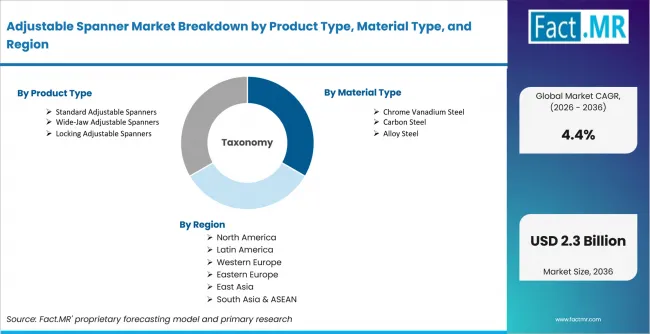
Adjustable Spanner Market Breakdown By Product Type, Material Type, And Region

Attribute Details
Quantitative Units USD 1.5 billion in 2026 to USD 2.3 billion by 2036 at 4.4% CAGR
Market Definition Adjustable hand tools with movable jaws used for tightening and loosening nuts, bolts and fittings
Product Type Standard Adjustable Spanners, Wide-Jaw Adjustable Spanners, Locking Adjustable Spanners, Insulated Adjustable Spanners
Material Type Chrome Vanadium Steel, Carbon Steel, Alloy Steel, Stainless Steel
Length Range Up to 6 Inch, 8 to 10 Inch, 12 to 15 Inch, Above 15 Inch
Distribution Channel Hardware Stores, Industrial Distributors, Online Retail, Automotive Tool Stores
End Use Automotive Repair, Industrial Maintenance, Construction, Household DIY, Electrical Maintenance
Regions Covered North America, Latin America, Europe, East Asia, South Asia and Pacific, Middle East and Africa
Countries Covered India, China, United States, Germany, Japan
Key Companies Profiled Stanley Black & Decker, Inc. / STANLEY Tools, Snap-on Incorporated, Apex Tool Group, LLC / Crescent, Klein Tools, Inc., Channellock, Inc.
Forecast Period 2026 to 2036
Approach Hybrid top-down and bottom-up approach using tool replacement demand, material type use, length range preference, channel sales and regional validation

Adjustable Spanner Market Analysis by Segments

  • By Product Type:

    • Standard Adjustable Spanners
    • Wide-Jaw Adjustable Spanners
    • Locking Adjustable Spanners
    • Insulated Adjustable Spanners
  • By Material Type:

    • Chrome Vanadium Steel
    • Carbon Steel
    • Alloy Steel
    • Stainless Steel
  • By Length Range:

    • Up to 6 Inch
    • 8 to 10 Inch
    • 12 to 15 Inch
    • Above 15 Inch
  • By Distribution Channel:

    • Hardware Stores
    • Industrial Distributors
    • Online Retail
    • Automotive Tool Stores
  • By End Use:

    • Automotive Repair
    • Industrial Maintenance
    • Construction
    • Household DIY
    • Electrical Maintenance
  • By Region:

    • North America
      • United States
      • Canada
    • Europe
      • Germany
      • United Kingdom
      • France
      • Italy
      • Spain
    • East Asia
      • China
      • Japan
      • South Korea
    • South Asia and Pacific
      • India
      • ASEAN
      • Australia and New Zealand
    • Latin America
      • Brazil
      • Mexico
    • Middle East and Africa
      • GCC Countries
      • South Africa

- Frequently Asked Questions -

What is the Adjustable Spanner Market size in 2026?

The adjustable spanner market is estimated to reach USD 1.5 billion in 2026 as repair and maintenance demand supports hand tool replacement.

What will the Adjustable Spanner Market be worth by 2036?

The adjustable spanner market is projected to reach USD 2.3 billion by 2036.

What CAGR is projected for the Adjustable Spanner Market?

The adjustable spanner market is forecast to record 4.4% CAGR from 2026 to 2036 through workshop and maintenance tool replace ment.

Which product type leads the Adjustable Spanner Market?

Standard adjustable spanners lead with 52.0% share in 2026 because they serve everyday repair and maintenance needs.

Which material type leads the Adjustable Spanner Market?

Chrome vanadium steel leads with 58.0% share in 2026 because professional users prefer stronger tools with better wear resistance.

Which length range leads the Adjustable Spanner Market?

8 to 10 inch spanners lead with 44.0% share in 2026 because they balance leverage and portability.

Which distribution channel leads thne Adjustable Spanner Market?

Hardware stores lead with 36.0% share in 2026 because users often need immediate tool replacement.

Which end use leads the Adjustable Spanner Market?

Automotive repair leads with 34.0% share in 2026 because garages use adjustable spanners across common service jobs.

Which country expands fastest in the Adjustable Spanner Market?

India is projected to record 6.2% CAGR through 2036 as vehicle repair networks and construction maintenance expand.

How does China perform in the Adjustable Spanner Market?

China is likely to post 5.8% CAGR through 2036 as manufacturing repair and hardware retail support tool consumption.

How does the United States perform in the Adjustable Spanner Market?

The United States is expected to register 4.5% CAGR from 2026 to 2036 as professional mechanics and home improvement users replace worn tools.

What is the main driver in the Adjustable Spanner Market?

The main driver is repair and maintenance demand because one adjustable tool can handle multiple fastener sizes.

What is the main restraint in the Adjustable Spanner Market?

The main restraint is low-cost product quality because loose jaws and weak finish reduce repeat purchases.

Why do standard adjustable spanners lead demand?

Standard adjustable spanners lead because they cover everyday nut and bolt work at a practical price.

Why does chrome vanadium steel lead material demand?

Chrome vanadium steel leads because it supports stronger jaw life during repeated fastening work.

Why are 8 to 10 inch spanners important?

8 to 10 inch spanners are important because they provide useful leverage without adding too much tool weight.

Why are hardware stores important in this market?

Hardware stores are important because repair users often buy replacement spanners during active maintenance work.

Table of Content

  1. Executive Summary
    • Global Market Outlook
    • Demand to side Trends
    • Supply to side Trends
    • Technology Roadmap Analysis
    • Analysis and Recommendations
  2. Market Overview
    • Market Coverage / Taxonomy
    • Market Definition / Scope / Limitations
  3. Research Methodology
    • Chapter Orientation
    • Analytical Lens and Working Hypotheses
      • Market Structure, Signals, and Trend Drivers
      • Benchmarking and Cross-market Comparability
      • Market Sizing, Forecasting, and Opportunity Mapping
    • Research Design and Evidence Framework
      • Desk Research Programme (Secondary Evidence)
        • Company Annual and Sustainability Reports
        • Peer-reviewed Journals and Academic Literature
        • Corporate Websites, Product Literature, and Technical Notes
        • Earnings Decks and Investor Briefings
        • Statutory Filings and Regulatory Disclosures
        • Technical White Papers and Standards Notes
        • Trade Journals, Industry Magazines, and Analyst Briefs
        • Conference Proceedings, Webinars, and Seminar Materials
        • Government Statistics Portals and Public Data Releases
        • Press Releases and Reputable Media Coverage
        • Specialist Newsletters and Curated Briefings
        • Sector Databases and Reference Repositories
        • Fact.MR Internal Proprietary Databases and Historical Market Datasets
        • Subscription Datasets and Paid Sources
        • Social Channels, Communities, and Digital Listening Inputs
        • Additional Desk Sources
      • Expert Input and Fieldwork (Primary Evidence)
        • Primary Modes
          • Qualitative Interviews and Expert Elicitation
          • Quantitative Surveys and Structured Data Capture
          • Blended Approach
        • Why Primary Evidence is Used
        • Field Techniques
          • Interviews
          • Surveys
          • Focus Groups
          • Observational and In-context Research
          • Social and Community Interactions
        • Stakeholder Universe Engaged
          • C-suite Leaders
          • Board Members
          • Presidents and Vice Presidents
          • R&D and Innovation Heads
          • Technical Specialists
          • Domain Subject-matter Experts
          • Scientists
          • Physicians and Other Healthcare Professionals
        • Governance, Ethics, and Data Stewardship
          • Research Ethics
          • Data Integrity and Handling
      • Tooling, Models, and Reference Databases
    • Data Engineering and Model Build
      • Data Acquisition and Ingestion
      • Cleaning, Normalisation, and Verification
      • Synthesis, Triangulation, and Analysis
    • Quality Assurance and Audit Trail
  4. Market Background
    • Market Dynamics
      • Drivers
      • Restraints
      • Opportunity
      • Trends
    • Scenario Forecast
      • Demand in Optimistic Scenario
      • Demand in Likely Scenario
      • Demand in Conservative Scenario
    • Opportunity Map Analysis
    • Product Life Cycle Analysis
    • Supply Chain Analysis
    • Investment Feasibility Matrix
    • Value Chain Analysis
    • PESTLE and Porter’s Analysis
    • Regulatory Landscape
    • Regional Parent Market Outlook
    • Production and Consumption Statistics
    • Import and Export Statistics
  5. Global Market Analysis 2021 to 2025 and Forecast, 2026 to 2036
    • Historical Market Size Value (USD Million) Analysis, 2021 to 2025
    • Current and Future Market Size Value (USD Million) Projections, 2026 to 2036
      • Y to o to Y Growth Trend Analysis
      • Absolute $ Opportunity Analysis
  6. Global Market Pricing Analysis 2021 to 2025 and Forecast 2026 to 2036
  7. Global Market Analysis 2021 to 2025 and Forecast 2026 to 2036, By Type
    • Introduction / Key Findings
    • Historical Market Size Value (USD Million) Analysis By Type , 2021 to 2025
    • Current and Future Market Size Value (USD Million) Analysis and Forecast By Type , 2026 to 2036
      • Vibrators
      • Rubber Penis
      • Others
    • Y to o to Y Growth Trend Analysis By Type , 2021 to 2025
    • Absolute $ Opportunity Analysis By Type , 2026 to 2036
  8. Global Market Analysis 2021 to 2025 and Forecast 2026 to 2036, By Distribution Channel
    • Introduction / Key Findings
    • Historical Market Size Value (USD Million) Analysis By Distribution Channel, 2021 to 2025
    • Current and Future Market Size Value (USD Million) Analysis and Forecast By Distribution Channel, 2026 to 2036
      • Online Retail
      • Specialty Stores
      • Hypermarkets & Supermarkets
      • Pharmacies & Drug Stores
      • Others
    • Y to o to Y Growth Trend Analysis By Distribution Channel, 2021 to 2025
    • Absolute $ Opportunity Analysis By Distribution Channel, 2026 to 2036
  9. Global Market Analysis 2021 to 2025 and Forecast 2026 to 2036, By End User
    • Introduction / Key Findings
    • Historical Market Size Value (USD Million) Analysis By End User, 2021 to 2025
    • Current and Future Market Size Value (USD Million) Analysis and Forecast By End User, 2026 to 2036
      • Women
      • Men
      • Couples
    • Y to o to Y Growth Trend Analysis By End User, 2021 to 2025
    • Absolute $ Opportunity Analysis By End User, 2026 to 2036
  10. Global Market Analysis 2021 to 2025 and Forecast 2026 to 2036, By Material
    • Introduction / Key Findings
    • Historical Market Size Value (USD Million) Analysis By Material, 2021 to 2025
    • Current and Future Market Size Value (USD Million) Analysis and Forecast By Material, 2026 to 2036
      • Silicone
      • Rubber
      • Plastic
      • Metal
      • Others
    • Y to o to Y Growth Trend Analysis By Material, 2021 to 2025
    • Absolute $ Opportunity Analysis By Material, 2026 to 2036
  11. Global Market Analysis 2021 to 2025 and Forecast 2026 to 2036, By Price Range
    • Introduction / Key Findings
    • Historical Market Size Value (USD Million) Analysis By Price Range, 2021 to 2025
    • Current and Future Market Size Value (USD Million) Analysis and Forecast By Price Range, 2026 to 2036
      • Mid-Range
      • Premium
      • Luxury
      • Economy
    • Y to o to Y Growth Trend Analysis By Price Range, 2021 to 2025
    • Absolute $ Opportunity Analysis By Price Range, 2026 to 2036
  12. Global Market Analysis 2021 to 2025 and Forecast 2026 to 2036, By Region
    • Introduction
    • Historical Market Size Value (USD Million) Analysis By Region, 2021 to 2025
    • Current Market Size Value (USD Million) Analysis and Forecast By Region, 2026 to 2036
      • North America
      • Latin America
      • Western Europe
      • Eastern Europe
      • East Asia
      • South Asia and Pacific
      • Middle East & Africa
    • Market Attractiveness Analysis By Region
  13. North America Market Analysis 2021 to 2025 and Forecast 2026 to 2036, By Country
    • Historical Market Size Value (USD Million) Trend Analysis By Market Taxonomy, 2021 to 2025
    • Market Size Value (USD Million) Forecast By Market Taxonomy, 2026 to 2036
      • By Country
        • USA
        • Canada
        • Mexico
      • By Type
      • By Distribution Channel
      • By End User
      • By Material
      • By Price Range
    • Market Attractiveness Analysis
      • By Country
      • By Type
      • By Distribution Channel
      • By End User
      • By Material
      • By Price Range
    • Key Takeaways
  14. Latin America Market Analysis 2021 to 2025 and Forecast 2026 to 2036, By Country
    • Historical Market Size Value (USD Million) Trend Analysis By Market Taxonomy, 2021 to 2025
    • Market Size Value (USD Million) Forecast By Market Taxonomy, 2026 to 2036
      • By Country
        • Brazil
        • Chile
        • Rest of Latin America
      • By Type
      • By Distribution Channel
      • By End User
      • By Material
      • By Price Range
    • Market Attractiveness Analysis
      • By Country
      • By Type
      • By Distribution Channel
      • By End User
      • By Material
      • By Price Range
    • Key Takeaways
  15. Western Europe Market Analysis 2021 to 2025 and Forecast 2026 to 2036, By Country
    • Historical Market Size Value (USD Million) Trend Analysis By Market Taxonomy, 2021 to 2025
    • Market Size Value (USD Million) Forecast By Market Taxonomy, 2026 to 2036
      • By Country
        • Germany
        • UK
        • Italy
        • Spain
        • France
        • Nordic
        • BENELUX
        • Rest of Western Europe
      • By Type
      • By Distribution Channel
      • By End User
      • By Material
      • By Price Range
    • Market Attractiveness Analysis
      • By Country
      • By Type
      • By Distribution Channel
      • By End User
      • By Material
      • By Price Range
    • Key Takeaways
  16. Eastern Europe Market Analysis 2021 to 2025 and Forecast 2026 to 2036, By Country
    • Historical Market Size Value (USD Million) Trend Analysis By Market Taxonomy, 2021 to 2025
    • Market Size Value (USD Million) Forecast By Market Taxonomy, 2026 to 2036
      • By Country
        • Russia
        • Poland
        • Hungary
        • Balkan & Baltic
        • Rest of Eastern Europe
      • By Type
      • By Distribution Channel
      • By End User
      • By Material
      • By Price Range
    • Market Attractiveness Analysis
      • By Country
      • By Type
      • By Distribution Channel
      • By End User
      • By Material
      • By Price Range
    • Key Takeaways
  17. East Asia Market Analysis 2021 to 2025 and Forecast 2026 to 2036, By Country
    • Historical Market Size Value (USD Million) Trend Analysis By Market Taxonomy, 2021 to 2025
    • Market Size Value (USD Million) Forecast By Market Taxonomy, 2026 to 2036
      • By Country
        • China
        • Japan
        • South Korea
      • By Type
      • By Distribution Channel
      • By End User
      • By Material
      • By Price Range
    • Market Attractiveness Analysis
      • By Country
      • By Type
      • By Distribution Channel
      • By End User
      • By Material
      • By Price Range
    • Key Takeaways
  18. South Asia and Pacific Market Analysis 2021 to 2025 and Forecast 2026 to 2036, By Country
    • Historical Market Size Value (USD Million) Trend Analysis By Market Taxonomy, 2021 to 2025
    • Market Size Value (USD Million) Forecast By Market Taxonomy, 2026 to 2036
      • By Country
        • India
        • ASEAN
        • Australia & New Zealand
        • Rest of South Asia and Pacific
      • By Type
      • By Distribution Channel
      • By End User
      • By Material
      • By Price Range
    • Market Attractiveness Analysis
      • By Country
      • By Type
      • By Distribution Channel
      • By End User
      • By Material
      • By Price Range
    • Key Takeaways
  19. Middle East & Africa Market Analysis 2021 to 2025 and Forecast 2026 to 2036, By Country
    • Historical Market Size Value (USD Million) Trend Analysis By Market Taxonomy, 2021 to 2025
    • Market Size Value (USD Million) Forecast By Market Taxonomy, 2026 to 2036
      • By Country
        • Kingdom of Saudi Arabia
        • Other GCC Countries
        • Turkiye
        • South Africa
        • Other African Union
        • Rest of Middle East & Africa
      • By Type
      • By Distribution Channel
      • By End User
      • By Material
      • By Price Range
    • Market Attractiveness Analysis
      • By Country
      • By Type
      • By Distribution Channel
      • By End User
      • By Material
      • By Price Range
    • Key Takeaways
  20. Key Countries Market Analysis
    • USA
      • Pricing Analysis
      • Market Share Analysis, 2025
        • By Type
        • By Distribution Channel
        • By End User
        • By Material
        • By Price Range
    • Canada
      • Pricing Analysis
      • Market Share Analysis, 2025
        • By Type
        • By Distribution Channel
        • By End User
        • By Material
        • By Price Range
    • Mexico
      • Pricing Analysis
      • Market Share Analysis, 2025
        • By Type
        • By Distribution Channel
        • By End User
        • By Material
        • By Price Range
    • Brazil
      • Pricing Analysis
      • Market Share Analysis, 2025
        • By Type
        • By Distribution Channel
        • By End User
        • By Material
        • By Price Range
    • Chile
      • Pricing Analysis
      • Market Share Analysis, 2025
        • By Type
        • By Distribution Channel
        • By End User
        • By Material
        • By Price Range
    • Germany
      • Pricing Analysis
      • Market Share Analysis, 2025
        • By Type
        • By Distribution Channel
        • By End User
        • By Material
        • By Price Range
    • UK
      • Pricing Analysis
      • Market Share Analysis, 2025
        • By Type
        • By Distribution Channel
        • By End User
        • By Material
        • By Price Range
    • Italy
      • Pricing Analysis
      • Market Share Analysis, 2025
        • By Type
        • By Distribution Channel
        • By End User
        • By Material
        • By Price Range
    • Spain
      • Pricing Analysis
      • Market Share Analysis, 2025
        • By Type
        • By Distribution Channel
        • By End User
        • By Material
        • By Price Range
    • France
      • Pricing Analysis
      • Market Share Analysis, 2025
        • By Type
        • By Distribution Channel
        • By End User
        • By Material
        • By Price Range
    • India
      • Pricing Analysis
      • Market Share Analysis, 2025
        • By Type
        • By Distribution Channel
        • By End User
        • By Material
        • By Price Range
    • ASEAN
      • Pricing Analysis
      • Market Share Analysis, 2025
        • By Type
        • By Distribution Channel
        • By End User
        • By Material
        • By Price Range
    • Australia & New Zealand
      • Pricing Analysis
      • Market Share Analysis, 2025
        • By Type
        • By Distribution Channel
        • By End User
        • By Material
        • By Price Range
    • China
      • Pricing Analysis
      • Market Share Analysis, 2025
        • By Type
        • By Distribution Channel
        • By End User
        • By Material
        • By Price Range
    • Japan
      • Pricing Analysis
      • Market Share Analysis, 2025
        • By Type
        • By Distribution Channel
        • By End User
        • By Material
        • By Price Range
    • South Korea
      • Pricing Analysis
      • Market Share Analysis, 2025
        • By Type
        • By Distribution Channel
        • By End User
        • By Material
        • By Price Range
    • Russia
      • Pricing Analysis
      • Market Share Analysis, 2025
        • By Type
        • By Distribution Channel
        • By End User
        • By Material
        • By Price Range
    • Poland
      • Pricing Analysis
      • Market Share Analysis, 2025
        • By Type
        • By Distribution Channel
        • By End User
        • By Material
        • By Price Range
    • Hungary
      • Pricing Analysis
      • Market Share Analysis, 2025
        • By Type
        • By Distribution Channel
        • By End User
        • By Material
        • By Price Range
    • Kingdom of Saudi Arabia
      • Pricing Analysis
      • Market Share Analysis, 2025
        • By Type
        • By Distribution Channel
        • By End User
        • By Material
        • By Price Range
    • Turkiye
      • Pricing Analysis
      • Market Share Analysis, 2025
        • By Type
        • By Distribution Channel
        • By End User
        • By Material
        • By Price Range
    • South Africa
      • Pricing Analysis
      • Market Share Analysis, 2025
        • By Type
        • By Distribution Channel
        • By End User
        • By Material
        • By Price Range
  21. Market Structure Analysis
    • Competition Dashboard
    • Competition Benchmarking
    • Market Share Analysis of Top Players
      • By Regional
      • By Type
      • By Distribution Channel
      • By End User
      • By Material
      • By Price Range
  22. Competition Analysis
    • Competition Deep Dive
      • Doc Johnson
        • Overview
        • Product Portfolio
        • Profitability by Market Segments (Product/Age /Sales Channel/Region)
        • Sales Footprint
        • Strategy Overview
          • Marketing Strategy
          • Product Strategy
          • Channel Strategy
      • Durex
      • FUN FACTORY
      • LELO
      • Lovense
  23. Assumptions & Acronyms Used

List Of Table

  • Table 1: Global Market Value (USD Million) Forecast by Region, 2021 to 2036
  • Table 2: Global Market Value (USD Million) Forecast by Type, 2021 to 2036
  • Table 3: Global Market Value (USD Million) Forecast by Distribution Channel, 2021 to 2036
  • Table 4: Global Market Value (USD Million) Forecast by End User, 2021 to 2036
  • Table 5: Global Market Value (USD Million) Forecast by Material, 2021 to 2036
  • Table 6: Global Market Value (USD Million) Forecast by Price Range, 2021 to 2036
  • Table 7: North America Market Value (USD Million) Forecast by Country, 2021 to 2036
  • Table 8: North America Market Value (USD Million) Forecast by Type, 2021 to 2036
  • Table 9: North America Market Value (USD Million) Forecast by Distribution Channel, 2021 to 2036
  • Table 10: North America Market Value (USD Million) Forecast by End User, 2021 to 2036
  • Table 11: North America Market Value (USD Million) Forecast by Material, 2021 to 2036
  • Table 12: North America Market Value (USD Million) Forecast by Price Range, 2021 to 2036
  • Table 13: Latin America Market Value (USD Million) Forecast by Country, 2021 to 2036
  • Table 14: Latin America Market Value (USD Million) Forecast by Type, 2021 to 2036
  • Table 15: Latin America Market Value (USD Million) Forecast by Distribution Channel, 2021 to 2036
  • Table 16: Latin America Market Value (USD Million) Forecast by End User, 2021 to 2036
  • Table 17: Latin America Market Value (USD Million) Forecast by Material, 2021 to 2036
  • Table 18: Latin America Market Value (USD Million) Forecast by Price Range, 2021 to 2036
  • Table 19: Western Europe Market Value (USD Million) Forecast by Country, 2021 to 2036
  • Table 20: Western Europe Market Value (USD Million) Forecast by Type, 2021 to 2036
  • Table 21: Western Europe Market Value (USD Million) Forecast by Distribution Channel, 2021 to 2036
  • Table 22: Western Europe Market Value (USD Million) Forecast by End User, 2021 to 2036
  • Table 23: Western Europe Market Value (USD Million) Forecast by Material, 2021 to 2036
  • Table 24: Western Europe Market Value (USD Million) Forecast by Price Range, 2021 to 2036
  • Table 25: Eastern Europe Market Value (USD Million) Forecast by Country, 2021 to 2036
  • Table 26: Eastern Europe Market Value (USD Million) Forecast by Type, 2021 to 2036
  • Table 27: Eastern Europe Market Value (USD Million) Forecast by Distribution Channel, 2021 to 2036
  • Table 28: Eastern Europe Market Value (USD Million) Forecast by End User, 2021 to 2036
  • Table 29: Eastern Europe Market Value (USD Million) Forecast by Material, 2021 to 2036
  • Table 30: Eastern Europe Market Value (USD Million) Forecast by Price Range, 2021 to 2036
  • Table 31: East Asia Market Value (USD Million) Forecast by Country, 2021 to 2036
  • Table 32: East Asia Market Value (USD Million) Forecast by Type, 2021 to 2036
  • Table 33: East Asia Market Value (USD Million) Forecast by Distribution Channel, 2021 to 2036
  • Table 34: East Asia Market Value (USD Million) Forecast by End User, 2021 to 2036
  • Table 35: East Asia Market Value (USD Million) Forecast by Material, 2021 to 2036
  • Table 36: East Asia Market Value (USD Million) Forecast by Price Range, 2021 to 2036
  • Table 37: South Asia and Pacific Market Value (USD Million) Forecast by Country, 2021 to 2036
  • Table 38: South Asia and Pacific Market Value (USD Million) Forecast by Type, 2021 to 2036
  • Table 39: South Asia and Pacific Market Value (USD Million) Forecast by Distribution Channel, 2021 to 2036
  • Table 40: South Asia and Pacific Market Value (USD Million) Forecast by End User, 2021 to 2036
  • Table 41: South Asia and Pacific Market Value (USD Million) Forecast by Material, 2021 to 2036
  • Table 42: South Asia and Pacific Market Value (USD Million) Forecast by Price Range, 2021 to 2036
  • Table 43: Middle East & Africa Market Value (USD Million) Forecast by Country, 2021 to 2036
  • Table 44: Middle East & Africa Market Value (USD Million) Forecast by Type, 2021 to 2036
  • Table 45: Middle East & Africa Market Value (USD Million) Forecast by Distribution Channel, 2021 to 2036
  • Table 46: Middle East & Africa Market Value (USD Million) Forecast by End User, 2021 to 2036
  • Table 47: Middle East & Africa Market Value (USD Million) Forecast by Material, 2021 to 2036
  • Table 48: Middle East & Africa Market Value (USD Million) Forecast by Price Range, 2021 to 2036

List Of Figures

  • Figure 1: Global Market Pricing Analysis
  • Figure 2: Global Market Value (USD Million) Forecast 2021-2036
  • Figure 3: Global Market Value Share and BPS Analysis by Type, 2026 and 2036
  • Figure 4: Global Market Y-o-Y Growth Comparison by Type, 2026 to 2036
  • Figure 5: Global Market Attractiveness Analysis by Type
  • Figure 6: Global Market Value Share and BPS Analysis by Distribution Channel, 2026 and 2036
  • Figure 7: Global Market Y-o-Y Growth Comparison by Distribution Channel, 2026 to 2036
  • Figure 8: Global Market Attractiveness Analysis by Distribution Channel
  • Figure 9: Global Market Value Share and BPS Analysis by End User, 2026 and 2036
  • Figure 10: Global Market Y-o-Y Growth Comparison by End User, 2026 to 2036
  • Figure 11: Global Market Attractiveness Analysis by End User
  • Figure 12: Global Market Value Share and BPS Analysis by Material, 2026 and 2036
  • Figure 13: Global Market Y-o-Y Growth Comparison by Material, 2026 to 2036
  • Figure 14: Global Market Attractiveness Analysis by Material
  • Figure 15: Global Market Value Share and BPS Analysis by Price Range, 2026 and 2036
  • Figure 16: Global Market Y-o-Y Growth Comparison by Price Range, 2026 to 2036
  • Figure 17: Global Market Attractiveness Analysis by Price Range
  • Figure 18: Global Market Value (USD Million) Share and BPS Analysis by Region, 2026 and 2036
  • Figure 19: Global Market Y-o-Y Growth Comparison by Region, 2026 to 2036
  • Figure 20: Global Market Attractiveness Analysis by Region
  • Figure 21: North America Market Incremental Dollar Opportunity, 2026 to 2036
  • Figure 22: Latin America Market Incremental Dollar Opportunity, 2026 to 2036
  • Figure 23: Western Europe Market Incremental Dollar Opportunity, 2026 to 2036
  • Figure 24: Eastern Europe Market Incremental Dollar Opportunity, 2026 to 2036
  • Figure 25: East Asia Market Incremental Dollar Opportunity, 2026 to 2036
  • Figure 26: South Asia and Pacific Market Incremental Dollar Opportunity, 2026 to 2036
  • Figure 27: Middle East & Africa Market Incremental Dollar Opportunity, 2026 to 2036
  • Figure 28: North America Market Value Share and BPS Analysis by Country, 2026 and 2036
  • Figure 29: North America Market Value Share and BPS Analysis by Type, 2026 and 2036
  • Figure 30: North America Market Y-o-Y Growth Comparison by Type, 2026 to 2036
  • Figure 31: North America Market Attractiveness Analysis by Type
  • Figure 32: North America Market Value Share and BPS Analysis by Distribution Channel, 2026 and 2036
  • Figure 33: North America Market Y-o-Y Growth Comparison by Distribution Channel, 2026 to 2036
  • Figure 34: North America Market Attractiveness Analysis by Distribution Channel
  • Figure 35: North America Market Value Share and BPS Analysis by End User, 2026 and 2036
  • Figure 36: North America Market Y-o-Y Growth Comparison by End User, 2026 to 2036
  • Figure 37: North America Market Attractiveness Analysis by End User
  • Figure 38: North America Market Value Share and BPS Analysis by Material, 2026 and 2036
  • Figure 39: North America Market Y-o-Y Growth Comparison by Material, 2026 to 2036
  • Figure 40: North America Market Attractiveness Analysis by Material
  • Figure 41: North America Market Value Share and BPS Analysis by Price Range, 2026 and 2036
  • Figure 42: North America Market Y-o-Y Growth Comparison by Price Range, 2026 to 2036
  • Figure 43: North America Market Attractiveness Analysis by Price Range
  • Figure 44: Latin America Market Value Share and BPS Analysis by Country, 2026 and 2036
  • Figure 45: Latin America Market Value Share and BPS Analysis by Type, 2026 and 2036
  • Figure 46: Latin America Market Y-o-Y Growth Comparison by Type, 2026 to 2036
  • Figure 47: Latin America Market Attractiveness Analysis by Type
  • Figure 48: Latin America Market Value Share and BPS Analysis by Distribution Channel, 2026 and 2036
  • Figure 49: Latin America Market Y-o-Y Growth Comparison by Distribution Channel, 2026 to 2036
  • Figure 50: Latin America Market Attractiveness Analysis by Distribution Channel
  • Figure 51: Latin America Market Value Share and BPS Analysis by End User, 2026 and 2036
  • Figure 52: Latin America Market Y-o-Y Growth Comparison by End User, 2026 to 2036
  • Figure 53: Latin America Market Attractiveness Analysis by End User
  • Figure 54: Latin America Market Value Share and BPS Analysis by Material, 2026 and 2036
  • Figure 55: Latin America Market Y-o-Y Growth Comparison by Material, 2026 to 2036
  • Figure 56: Latin America Market Attractiveness Analysis by Material
  • Figure 57: Latin America Market Value Share and BPS Analysis by Price Range, 2026 and 2036
  • Figure 58: Latin America Market Y-o-Y Growth Comparison by Price Range, 2026 to 2036
  • Figure 59: Latin America Market Attractiveness Analysis by Price Range
  • Figure 60: Western Europe Market Value Share and BPS Analysis by Country, 2026 and 2036
  • Figure 61: Western Europe Market Value Share and BPS Analysis by Type, 2026 and 2036
  • Figure 62: Western Europe Market Y-o-Y Growth Comparison by Type, 2026 to 2036
  • Figure 63: Western Europe Market Attractiveness Analysis by Type
  • Figure 64: Western Europe Market Value Share and BPS Analysis by Distribution Channel, 2026 and 2036
  • Figure 65: Western Europe Market Y-o-Y Growth Comparison by Distribution Channel, 2026 to 2036
  • Figure 66: Western Europe Market Attractiveness Analysis by Distribution Channel
  • Figure 67: Western Europe Market Value Share and BPS Analysis by End User, 2026 and 2036
  • Figure 68: Western Europe Market Y-o-Y Growth Comparison by End User, 2026 to 2036
  • Figure 69: Western Europe Market Attractiveness Analysis by End User
  • Figure 70: Western Europe Market Value Share and BPS Analysis by Material, 2026 and 2036
  • Figure 71: Western Europe Market Y-o-Y Growth Comparison by Material, 2026 to 2036
  • Figure 72: Western Europe Market Attractiveness Analysis by Material
  • Figure 73: Western Europe Market Value Share and BPS Analysis by Price Range, 2026 and 2036
  • Figure 74: Western Europe Market Y-o-Y Growth Comparison by Price Range, 2026 to 2036
  • Figure 75: Western Europe Market Attractiveness Analysis by Price Range
  • Figure 76: Eastern Europe Market Value Share and BPS Analysis by Country, 2026 and 2036
  • Figure 77: Eastern Europe Market Value Share and BPS Analysis by Type, 2026 and 2036
  • Figure 78: Eastern Europe Market Y-o-Y Growth Comparison by Type, 2026 to 2036
  • Figure 79: Eastern Europe Market Attractiveness Analysis by Type
  • Figure 80: Eastern Europe Market Value Share and BPS Analysis by Distribution Channel, 2026 and 2036
  • Figure 81: Eastern Europe Market Y-o-Y Growth Comparison by Distribution Channel, 2026 to 2036
  • Figure 82: Eastern Europe Market Attractiveness Analysis by Distribution Channel
  • Figure 83: Eastern Europe Market Value Share and BPS Analysis by End User, 2026 and 2036
  • Figure 84: Eastern Europe Market Y-o-Y Growth Comparison by End User, 2026 to 2036
  • Figure 85: Eastern Europe Market Attractiveness Analysis by End User
  • Figure 86: Eastern Europe Market Value Share and BPS Analysis by Material, 2026 and 2036
  • Figure 87: Eastern Europe Market Y-o-Y Growth Comparison by Material, 2026 to 2036
  • Figure 88: Eastern Europe Market Attractiveness Analysis by Material
  • Figure 89: Eastern Europe Market Value Share and BPS Analysis by Price Range, 2026 and 2036
  • Figure 90: Eastern Europe Market Y-o-Y Growth Comparison by Price Range, 2026 to 2036
  • Figure 91: Eastern Europe Market Attractiveness Analysis by Price Range
  • Figure 92: East Asia Market Value Share and BPS Analysis by Country, 2026 and 2036
  • Figure 93: East Asia Market Value Share and BPS Analysis by Type, 2026 and 2036
  • Figure 94: East Asia Market Y-o-Y Growth Comparison by Type, 2026 to 2036
  • Figure 95: East Asia Market Attractiveness Analysis by Type
  • Figure 96: East Asia Market Value Share and BPS Analysis by Distribution Channel, 2026 and 2036
  • Figure 97: East Asia Market Y-o-Y Growth Comparison by Distribution Channel, 2026 to 2036
  • Figure 98: East Asia Market Attractiveness Analysis by Distribution Channel
  • Figure 99: East Asia Market Value Share and BPS Analysis by End User, 2026 and 2036
  • Figure 100: East Asia Market Y-o-Y Growth Comparison by End User, 2026 to 2036
  • Figure 101: East Asia Market Attractiveness Analysis by End User
  • Figure 102: East Asia Market Value Share and BPS Analysis by Material, 2026 and 2036
  • Figure 103: East Asia Market Y-o-Y Growth Comparison by Material, 2026 to 2036
  • Figure 104: East Asia Market Attractiveness Analysis by Material
  • Figure 105: East Asia Market Value Share and BPS Analysis by Price Range, 2026 and 2036
  • Figure 106: East Asia Market Y-o-Y Growth Comparison by Price Range, 2026 to 2036
  • Figure 107: East Asia Market Attractiveness Analysis by Price Range
  • Figure 108: South Asia and Pacific Market Value Share and BPS Analysis by Country, 2026 and 2036
  • Figure 109: South Asia and Pacific Market Value Share and BPS Analysis by Type, 2026 and 2036
  • Figure 110: South Asia and Pacific Market Y-o-Y Growth Comparison by Type, 2026 to 2036
  • Figure 111: South Asia and Pacific Market Attractiveness Analysis by Type
  • Figure 112: South Asia and Pacific Market Value Share and BPS Analysis by Distribution Channel, 2026 and 2036
  • Figure 113: South Asia and Pacific Market Y-o-Y Growth Comparison by Distribution Channel, 2026 to 2036
  • Figure 114: South Asia and Pacific Market Attractiveness Analysis by Distribution Channel
  • Figure 115: South Asia and Pacific Market Value Share and BPS Analysis by End User, 2026 and 2036
  • Figure 116: South Asia and Pacific Market Y-o-Y Growth Comparison by End User, 2026 to 2036
  • Figure 117: South Asia and Pacific Market Attractiveness Analysis by End User
  • Figure 118: South Asia and Pacific Market Value Share and BPS Analysis by Material, 2026 and 2036
  • Figure 119: South Asia and Pacific Market Y-o-Y Growth Comparison by Material, 2026 to 2036
  • Figure 120: South Asia and Pacific Market Attractiveness Analysis by Material
  • Figure 121: South Asia and Pacific Market Value Share and BPS Analysis by Price Range, 2026 and 2036
  • Figure 122: South Asia and Pacific Market Y-o-Y Growth Comparison by Price Range, 2026 to 2036
  • Figure 123: South Asia and Pacific Market Attractiveness Analysis by Price Range
  • Figure 124: Middle East & Africa Market Value Share and BPS Analysis by Country, 2026 and 2036
  • Figure 125: Middle East & Africa Market Value Share and BPS Analysis by Type, 2026 and 2036
  • Figure 126: Middle East & Africa Market Y-o-Y Growth Comparison by Type, 2026 to 2036
  • Figure 127: Middle East & Africa Market Attractiveness Analysis by Type
  • Figure 128: Middle East & Africa Market Value Share and BPS Analysis by Distribution Channel, 2026 and 2036
  • Figure 129: Middle East & Africa Market Y-o-Y Growth Comparison by Distribution Channel, 2026 to 2036
  • Figure 130: Middle East & Africa Market Attractiveness Analysis by Distribution Channel
  • Figure 131: Middle East & Africa Market Value Share and BPS Analysis by End User, 2026 and 2036
  • Figure 132: Middle East & Africa Market Y-o-Y Growth Comparison by End User, 2026 to 2036
  • Figure 133: Middle East & Africa Market Attractiveness Analysis by End User
  • Figure 134: Middle East & Africa Market Value Share and BPS Analysis by Material, 2026 and 2036
  • Figure 135: Middle East & Africa Market Y-o-Y Growth Comparison by Material, 2026 to 2036
  • Figure 136: Middle East & Africa Market Attractiveness Analysis by Material
  • Figure 137: Middle East & Africa Market Value Share and BPS Analysis by Price Range, 2026 and 2036
  • Figure 138: Middle East & Africa Market Y-o-Y Growth Comparison by Price Range, 2026 to 2036
  • Figure 139: Middle East & Africa Market Attractiveness Analysis by Price Range
  • Figure 140: Global Market - Tier Structure Analysis
  • Figure 141: Global Market - Company Share Analysis

Adjustable Spanner Market