- Base Value(2025): 22.1 Bn
- Estimated Value(2026): 26.7 Bn
- Forecast Value (2036): 180.0 Bn
- CAGR (2026 - 2036): 21.0%
Additive Manufacturing Equipment Market Forecast and Outlook by Fact.MR
- The additive manufacturing equipment market was valued at USD 22.1 billion in 2025.
- Based on Fact.MR analysis, demand for additive manufacturing equipment is estimated to grow to USD 26.7 billion in 2026 and USD 180.0 billion by 2036.
- Fact.MR projects a CAGR of 21.0% during the forecast period.
- The market is projected to generate approximately USD 153.3 billion in additional revenue between 2026 and 2036.
- Expansion reflects rising use of additive manufacturing in production applications.
- Demand is supported by manufacturing digitalization and lightweight component needs.
- High equipment costs and qualification requirements in regulated industries may slow adoption.
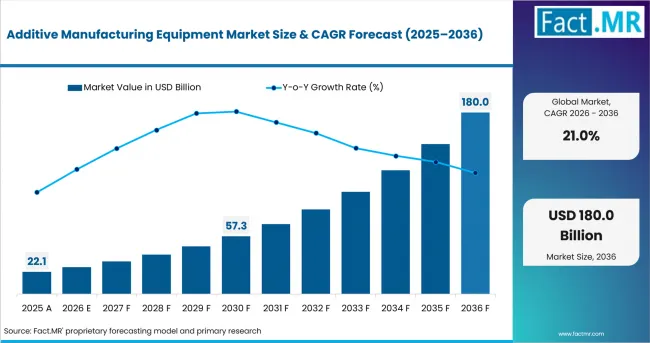
Additive Manufacturing Equipment Market Value Analysis | Source: Fact.MR
Summary of Additive Manufacturing Equipment Market
- Demand Drivers
- Manufacturing firms are adding more additive production capacity. Equipment demand is rising across industrial facilities.
- Aerospace manufacturers need lightweight components. Advanced printing systems support component optimization.
- Digital manufacturing strategies are increasing investment in production technologies. Equipment deployment supports factory modernization.
- Key Segments Analyzed
- By Technology: Fused Deposition Modeling accounts for 35% share in 2026 due to wide industrial adoption.
- By Material: Plastics contribute 45% share in 2026 supported by material affordability and compatibility.
- By Application: Production generates 75% share in 2026 due to increasing use of end-use printed parts.
- By End Use: Aerospace and Defense contributes 28% share in 2026 supported by lightweight component demand.
- By Component: Hardware captures 65% share in 2026 due to investment in industrial printing systems.
- By Printer Type: Industrial 3D Printers account for 60% share in 2026 supported by factory deployment.
- By Geography: China is projected to record 23.4% CAGR through 2036 supported by manufacturing investment.
- Analyst Opinion at Fact.MR
- Shambhu Nath Jha, Principal Consultant at Fact.MR, opines, “Production-scale manufacturing is changing additive equipment demand. Companies with industrial-grade platforms and strong application expertise can build a stronger market presence.”
- Strategic Implications
- Equipment manufacturers should expand industrial printer portfolios. Production demand is creating new revenue opportunities.
- Technology suppliers should build stronger manufacturing partnerships. Application validation supports equipment adoption.
- Industrial manufacturers should plan additive production faster. Equipment investment supports operational flexibility.
China is projected to expand at 23.4% CAGR from 2026 to 2036 supported by manufacturing modernization investment. India is expected to grow at 22.8% CAGR by 2036 driven by industrial digitization programs. South Korea is forecast to witness 21.9% CAGR through 2036 due to advanced manufacturing deployment. The United States is anticipated to register 20.7% CAGR from 2026 to 2036 supported by aerospace demand. Germany is projected to advance at 19.8% CAGR through 2036 due to industrial engineering investment. Japan is estimated to grow at 18.9% CAGR by 2036 supported by precision manufacturing activity.
Segmental Analysis
Additive Manufacturing Equipment Market Analysis by Technology
Fused Deposition Modeling (FDM) is estimated to hold 35% share in 2026. The technology has lower equipment costs and supports many industrial uses. Manufacturing facilities use FDM systems for prototyping and production work. Stratasys had secured more than 30 orders for its F3300 industrial 3D printer shortly after launch. Customers included organizations such as BAE, Sikorsky, the U.S. Department of Defense, and the U.S. Department of Energy. The F3300 is a production-focused additive manufacturing system designed to increase throughput, improve accuracy, and reduce manufacturing costs. [2]
- Industrial Adoption: FDM platforms are widely used across engineering and manufacturing facilities. Equipment accessibility supports wider deployment.
- Cost Efficiency: System costs are lower than metal printing technologies. Lower capital needs support broader installation.
- Application Range: Manufacturers use FDM for tooling and component development. Operational flexibility supports technology demand.
Additive Manufacturing Equipment Market Analysis by Material
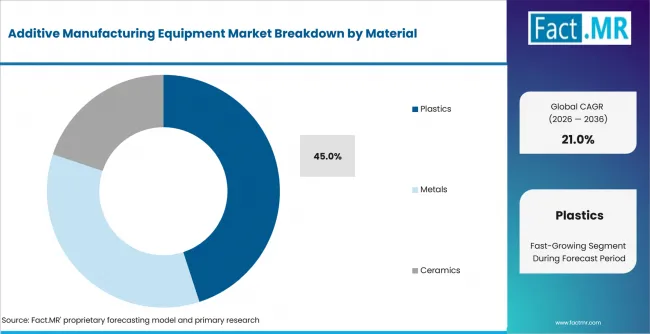
Additive Manufacturing Equipment Market Analysis By Material | Source: Fact.MR
Plastics are estimated to account for 45% share in 2026. Material affordability and broad printer compatibility support segment concentration. Production facilities use plastic feedstocks for prototyping and end-use manufacturing. EOS introduced the EOS P3 NEXT, a new industrial polymer SLS (Selective Laser Sintering) 3D printer at Formnext 2024. The company stated that the system delivers up to 50% higher productivity, up to 90% machine availability, and lower total cost of ownership compared with previous-generation platforms. The printer became commercially available in December 2024. [3]
- Material Availability: Plastic materials are available across global supply chains. Availability supports commercial utilization.
- Processing Speed: Production facilities prioritize materials that improve workflow efficiency. Plastic feedstocks support manufacturing objectives.
- Industrial Usage: Engineering use plastic components for testing and production. Application diversity supports demand concentration.
Additive Manufacturing Equipment Market Analysis by Application
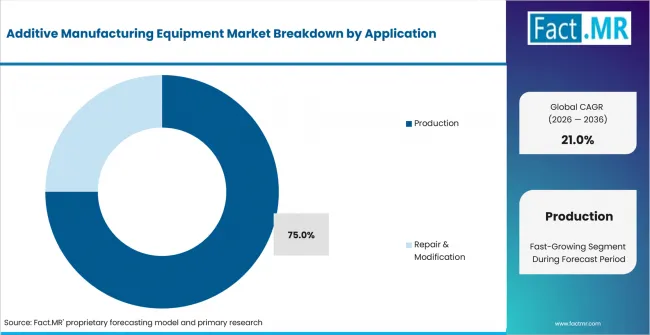
Additive Manufacturing Equipment Market Analysis By Application | Source: Fact.MR
Production is projected to generate 75% share in 2026. Manufacturers are using additive equipment more often for end-use component production. Equipment investment reflects movement beyond prototype development. 3D Systems launched the PSLA 270, a high-speed projection stereolithography printer designed for industrial and healthcare applications. The system expanded the company's additive manufacturing equipment portfolio. [1]
- Manufacturing Shift: Production facilities are expanding additive manufacturing capacity. Operational requirements support equipment deployment.
- Part Consolidation: Manufacturers reduce assembly complexity through printed components. Production efficiency supports adoption.
- Supply Flexibility: Manufacturers seek shorter development cycles. Additive systems support faster production response.
Additive Manufacturing Equipment Market Analysis by End Use
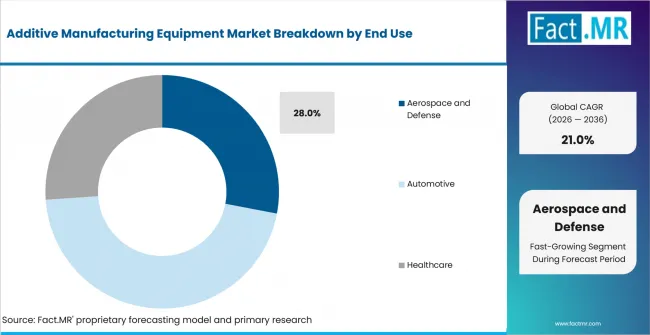
Additive Manufacturing Equipment Market Analysis By End Use | Source: Fact.MR
Aerospace and Defense is estimated to contribute 28% share in 2026. Lightweight component needs support equipment demand across aircraft and defense applications. Qualification activity is increasing across production programs.
- Weight Reduction: Aircraft manufacturers need lighter components to improve operating efficiency. Additive manufacturing supports design optimization.
- Component Complexity: Production programs need advanced geometries. Equipment capability supports application growth.
- Program Investment: Aerospace companies are expanding additive manufacturing programs. Capital investment supports equipment demand.
Additive Manufacturing Equipment Market Analysis by Component
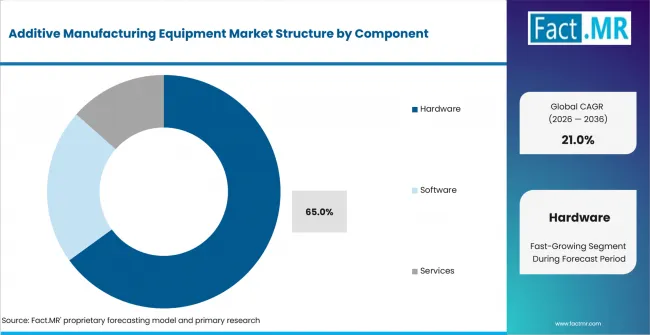
Additive Manufacturing Equipment Market Analysis By Component | Source: Fact.MR
Hardware is projected to capture 65% share in 2026. Revenue is concentrated in industrial printer installations and production systems. Manufacturing investment continues to focus on equipment acquisition.
- Capital Spending: Production facilities invest in manufacturing equipment. Hardware demand reflects installation activity.
- Capacity Expansion: Industrial operators are increasing additive manufacturing capability. Equipment purchases support expansion plans.
- Technology Upgrades: New printer platforms improve production performance. Hardware replacement supports revenue growth.
Additive Manufacturing Equipment Market Analysis by Printer Type
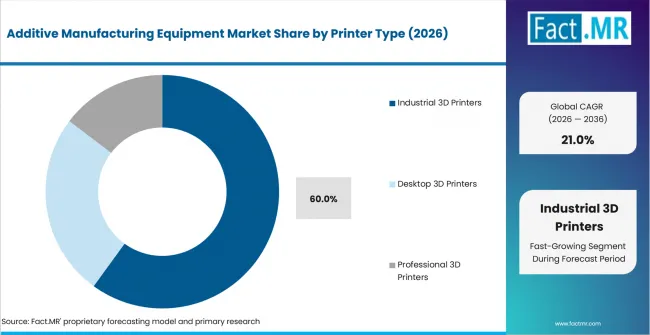
Additive Manufacturing Equipment Market Analysis By Printer Type | Source: Fact.MR
Industrial 3D Printers are estimated to account for 60% share in 2026. Manufacturing facilities need systems that support continuous production. Equipment performance and throughput support segment leadership.
- Production Capacity: Industrial systems support larger build volumes. Manufacturing requirements strengthen demand.
- Operational Reliability: Production environments need consistent equipment performance. Industrial printers address these requirements.
- Manufacturing Integration: Facilities incorporate are adding additive equipment to existing workflows. Integration supports installation growth.
Drivers, Restraints, and Opportunities
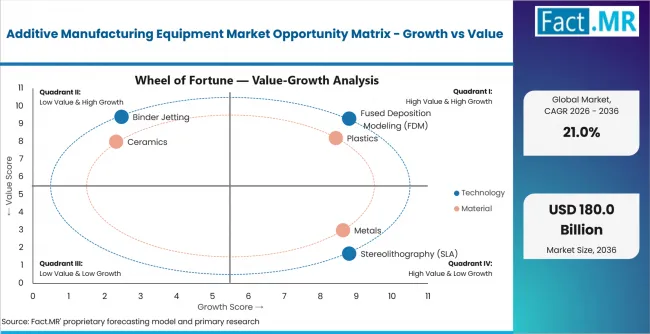
Additive Manufacturing Equipment Market Opportunity Matrix Growth Vs Value | Source: Fact.MR
The additive manufacturing equipment market is moving through a manufacturing transformation phase. Equipment demand is now more connected to production use than prototype development. Industrial investment remains the primary force supporting market expansion. HP introduced the HP Multi Jet Fusion (MJF) 1200 3D Printer Solution at RAPID + TCT 2026. The new system is a compact industrial-grade MJF platform designed to make HP's powder-bed fusion technology accessible to smaller engineering groups and manufacturers. HP stated that the printer includes automated material handling and workflow features and serves as an entry point into its industrial additive manufacturing ecosystem. [5]
Manufacturing organizations are expanding additive technology use across aerospace and healthcare applications. Production-scale equipment is receiving more investment due to productivity gains and design flexibility. Qualification needs and equipment costs influence purchasing decisions across regulated industries.
- Production Expansion: Manufacturing companies are increasing additive production programs across industrial facilities. Growth is supported by demand for customized components and shorter development timelines.
- Qualification Requirements: Certification processes across aerospace and healthcare sectors can limit adoption. Validation timelines can delay equipment deployment.
- Digital Manufacturing: Factory modernization strategies are increasing investment in additive manufacturing technologies. Equipment demand is supported by production flexibility and workflow optimization.
Regional Analysis
The additive manufacturing equipment market is assessed across North America, Europe, Asia Pacific, Latin America, and the Middle East & Africa. The study evaluates manufacturing investment, industrial digitization activity, production capacity expansion, and adoption of advanced manufacturing technologies across major economies.
.webp "Top Country Growth Comparison Additive Manufacturing Equipment Market Cagr (2026 2036)")
Top Country Growth Comparison Additive Manufacturing Equipment Market Cagr (2026 2036) | Source: Fact.MR
| Country | CAGR (2026 to 2036) |
|---|---|
| China | 23.4% |
| India | 22.8% |
| South Korea | 21.9% |
| United States | 20.7% |
| Germany | 19.8% |
| Japan | 18.9% |
Source: Fact.MR analysis. Updated Jun 11, 2026
Source: Fact.MR analysis, based on proprietary forecasting model and primary research.
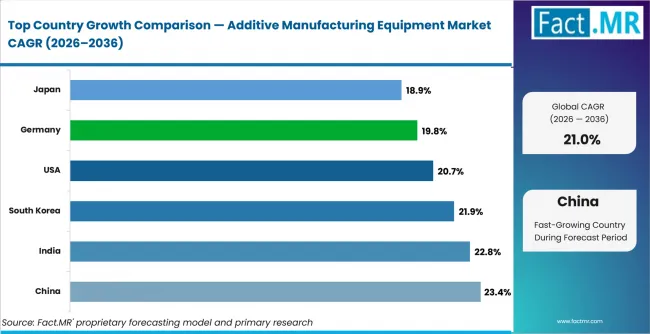
Additive Manufacturing Equipment Market Cagr Analysis By Country | Source: Fact.MR
Asia Pacific Additive Manufacturing Equipment Market Analysis
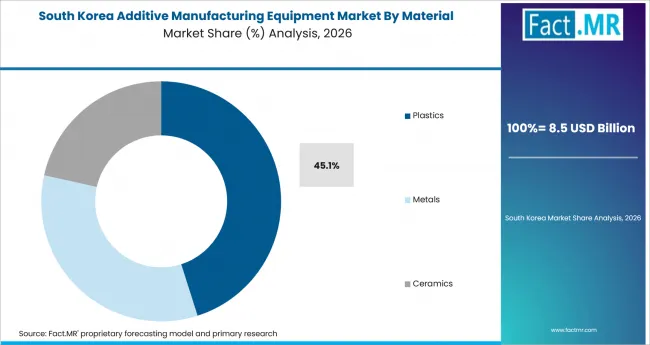
Additive Manufacturing Equipment Market South Korea Market Share Analysis By Material | Source: Fact.MR
Asia Pacific is the main growth center for additive manufacturing equipment demand. Industrial modernization programs are speeding up equipment deployment. Manufacturing expansion supports long-term market opportunities.
- China: Demand for additive manufacturing equipment in China is projected to rise at 23.4% CAGR through 2036. Industrial manufacturers are using advanced production technologies across automotive and aerospace facilities. Growth is attributable to domestic equipment development and government-backed manufacturing modernization initiatives.
- India: India is expected to expand at 22.8% CAGR from 2026 to 2036 driven by rising investment in digital manufacturing infrastructure. Production facilities are using more additive technologies for engineering and industrial applications. Growth reflects manufacturing expansion and greater technology accessibility.
- South Korea: Supported by advanced electronics and industrial production activity, South Korea is forecast to register 21.9% CAGR by 2036. Manufacturers are using additive technologies for precision component development. Market expansion reflects investment in advanced production systems.
- Japan: Japan is projected to witness 18.9% CAGR during the forecast period. Precision engineering needs support industrial additive manufacturing equipment. Demand is supported by advanced manufacturing activity and equipment modernization programs.
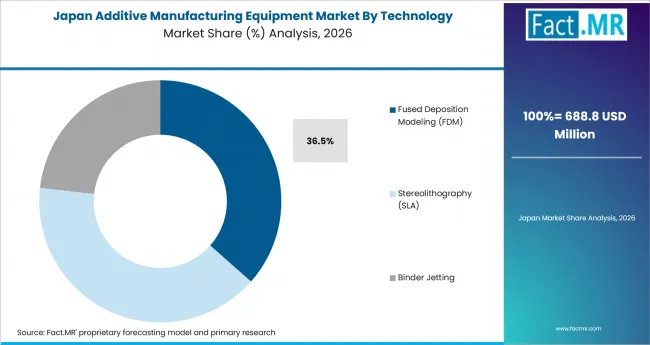
Additive Manufacturing Equipment Market Japan Market Share Analysis By Technology | Source: Fact.MR
North America Additive Manufacturing Equipment Market Analysis
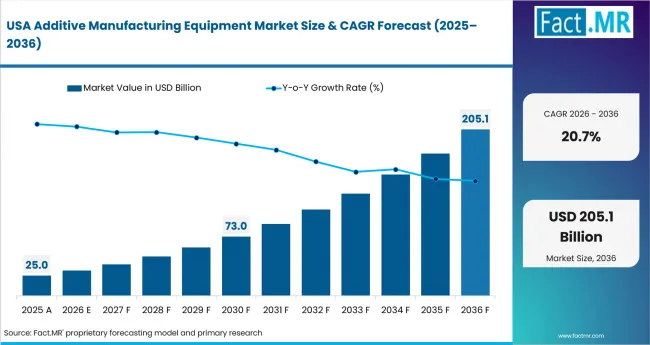
Additive Manufacturing Equipment Market Country Value Analysis | Source: Fact.MR
North America benefits from established aerospace and healthcare manufacturing capabilities. Industrial facilities are investing more in digital production technologies. Equipment deployment supports production flexibility. Nikon SLM Solutions AG announced that it had begun U.S. production of its NXG XII 600 metal additive manufacturing system at a facility in South Carolina. The move was intended to support growing demand from aerospace, defense, automotive, and energy customers while reducing lead times and increasing local support. [4]
- United States: The United States is anticipated to grow at 20.7% CAGR by 2036 as aerospace manufacturers use more additive production systems. Healthcare and industrial applications are creating additional equipment demand. Expansion is supported by technology innovation and production optimization strategies.
Europe Additive Manufacturing Equipment Market Analysis
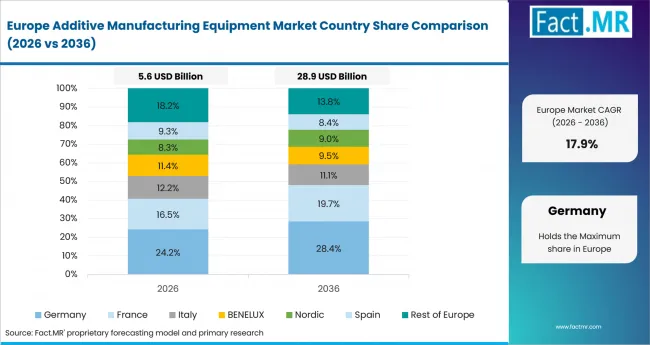
Additive Manufacturing Equipment Market Europe Country Market Share Analysis, 2026 & 2036 | Source: Fact.MR
Europe benefits from advanced industrial engineering and strong manufacturing infrastructure. Production facilities continue to invest in next-generation manufacturing technologies. Equipment modernization supports demand.
- Germany: Germany is estimated to advance at 19.8% CAGR through 2036, supported by industrial engineering expertise and manufacturing automation investment. Production facilities are using additive manufacturing for complex component production. Growth reflects industrial innovation and technology deployment activity.
Competitive Aligners for Market Players
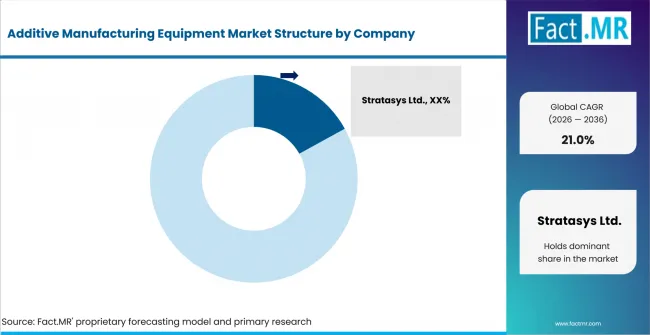
Additive Manufacturing Equipment Market Analysis By Company | Source: Fact.MR
The additive manufacturing equipment market includes industrial printer manufacturers and advanced manufacturing technology suppliers. Equipment performance influences purchasing decisions across production facilities. Companies with established industrial portfolios hold stronger commercial positions across manufacturing sectors.
Organizations with strong research capabilities benefit from faster product development. Technology leadership improves market access across aerospace and healthcare applications. Distribution strength supports commercial expansion across industrial markets. Manufacturing companies evaluate suppliers based on equipment reliability and production performance. Integration capability influences equipment selection. Long qualification cycles create barriers for new entrants and support established manufacturers.
Commercial success is increasingly connected to production-scale printing capability and material compatibility. Demand is moving toward suppliers that support industrial manufacturing needs. Equipment innovation remains a major source of competitive differentiation.
Key Players
- Stratasys Ltd.
- 3D Systems Corporation
- HP Inc.
- Nikon SLM Solutions AG
Bibliography
- 3D Systems, Inc. (2024, October 9). PSLA 270. 3D Systems, Inc.
- Stratasys Ltd. (2024, September 10). Momentum of Stratasys’ F3300 printer indicates global manufacturers are turning to AM to solve their toughest production challenges. Stratasys Ltd.
- EOS GmbH. (2024, November 19). EOS introduces EOS P3 NEXT for increased productivity in polymer AM. EOS GmbH.
- Nikon SLM Solutions AG. (2024, June 25). Nikon SLM Solutions to begin production of NXG XII 600 in the USA. Nikon SLM Solutions AG.
- HP Inc. (2026, April 14). HP marks a decade of additive manufacturing innovation by introducing the new HP MJF 1200 3D Printer at RAPID+TCT. HP Inc.
This Report Addresses
- Analysis of additive manufacturing equipment demand across production and industrial manufacturing applications.
- Opportunity assessment across industrial printing systems and production-scale manufacturing technologies.
- Segment forecasts covering technology, material, application, end use, component, and printer type demand.
- Competitive assessment of additive manufacturing equipment suppliers and industrial technology providers.
- Evaluation of manufacturing digitization and advanced production investment trends.
- Country-level analysis across China, India, South Korea, the United States, Germany, and Japan.
- Report delivery through PDF and Excel formats supported by primary interviews and manufacturing industry analysis.
Additive Manufacturing Equipment Market Definition
The additive manufacturing equipment market covers machines used to produce three-dimensional components through layer-by-layer material deposition. These systems process plastics, metals, ceramics, and composite materials to manufacture prototypes and finished parts. Equipment is utilized across aerospace, automotive, healthcare, electronics, and industrial manufacturing operations. The market includes hardware platforms designed for production, repair, and component customization applications.
Additive Manufacturing Equipment Market Inclusions
The study covers global and regional forecasts from 2026 to 2036 by technology, material, application, end use, component, and printer type. It includes industrial and professional additive manufacturing equipment deployed across manufacturing industries. The report evaluates equipment demand, installation activity, technology adoption, and manufacturing investment trends.
Additive Manufacturing Equipment Market Exclusions
The study excludes additive manufacturing materials, standalone design software, aftermarket maintenance services, and contract printing services. Revenue associated with finished printed components is excluded unless directly attributable to equipment sales. Consumer hobby printers are excluded from commercial market estimates.
Additive Manufacturing Equipment Market Research Methodology
- Primary Research
- Interviews were conducted with additive manufacturing equipment suppliers, manufacturing engineers, production managers, technology integrators, and industry consultants.
- Desk Research
- Analysis included company disclosures, manufacturing publications, technology announcements, industrial production reports, and equipment deployment updates released during 2024 and 2025.
- Market-Sizing and Forecasting
- Hybrid top-down and bottom-up model using equipment installations, manufacturing investment activity, production demand trends, and technology adoption assessments.
- Data Validation and Update Cycle
- Forecast was validated through manufacturer interviews, distributor feedback, equipment utilization analysis, and industrial investment assessments.
Segmentation
Scope of Report
| Attribute | Details |
|---|---|
| Quantitative Units | USD billion (2026) to USD billion (2036) at a CAGR |
| Market Definition | Covers equipment used for layer-by-layer manufacturing of industrial components. |
| Technology Segmentation | Fused Deposition Modeling, Stereolithography, Selective Laser Sintering, Binder Jetting, Digital Light Processing, Metal 3D Printing |
| Material Segmentation | Plastics, Metals, Ceramics, Composites |
| Application Segmentation | Production, Repair & Modification |
| End Use Segmentation | Automotive, Aerospace and Defense, Electrical and Electronics, Healthcare, Others |
| Component Segmentation | Hardware, Software, Services |
| Printer Type Segmentation | Industrial 3D Printers, Desktop 3D Printers, Professional 3D Printers |
| Regions Covered | North America, Europe, Asia Pacific, Latin America, Middle East & Africa |
| Countries Covered | China, India, South Korea, United States, Germany, Japan |
| Key Companies Profiled | Stratasys Ltd., 3D Systems Corporation, HP Inc., Nikon SLM Solutions AG |
| Forecast Period | 2026 to 2036 |
| Approach | Hybrid top-down and bottom-up model using equipment demand and manufacturing investment analysis |
Source: Fact.MR analysis. Updated Jun 11, 2026
Additive Manufacturing Equipment Market by Segment
-
By Technology
- Fused Deposition Modeling (FDM)
- Stereolithography (SLA)
- Selective Laser Sintering (SLS)
- Binder Jetting
- Digital Light Processing (DLP)
- Metal 3D Printing
-
By Material
- Plastics
- Metals
- Ceramics
- Composites
-
By Application
- Production
- Repair & Modification
-
By End Use
- Automotive
- Aerospace and Defense
- Electrical and Electronics
- Healthcare
- Others
-
By Component
- Hardware
- Software
- Services
-
By Printer Type
- Industrial 3D Printers
- Desktop 3D Printers
- Professional 3D Printers
-
By Region
- North America
- United States
- Canada
- Mexico
- Latin America
- Brazil
- Argentina
- Rest of Latin America
- Europe
- Germany
- United Kingdom
- France
- Italy
- Rest of Europe
- Asia Pacific
- China
- India
- Japan
- South Korea
- ASEAN
- Middle East & Africa
- UAE
- Saudi Arabia
- South Africa
- Rest of Middle East & Africa
- North America
Frequently Asked Questions
Which technology segment is expected to contribute prominent demand in 2026?
Which application segment generates substantial market demand?
Which country records stronger growth through 2036?
What is the expected growth rate of the Additive Manufacturing Equipment Market in Japan?
Who worked on this report


Preview the report firsthand - request a free sample
Free SampleGet the brochure for pricing and purchase details
Download PDF