- Market Value (2025): USD 3.7 Bn
- Estimated Value (2026): USD 4.1 Bn
- Forecast Value (2036): USD 9.3 Bn
- CAGR (2026-2036): 8.6%
What is the Modular Food Processing Lines Market forecast to be worth by 2036?
The Modular Food Processing Lines Market is projected to reach USD 4.1 Billion by 2036, from USD 9.3 Billion in 2026, at an 8.6% CAGR.
- The market stood at USD 3.7 Billion in 2025.
- Demand is valued at USD 4.1 Billion in 2026 and is forecast to reach USD 9.3 Billion by 2036.
- Growth is projected at 8.6% CAGR from 2026 to 2036. Staged capacity additions and product diversification support purchases of process modules with reusable engineering and defined interfaces.
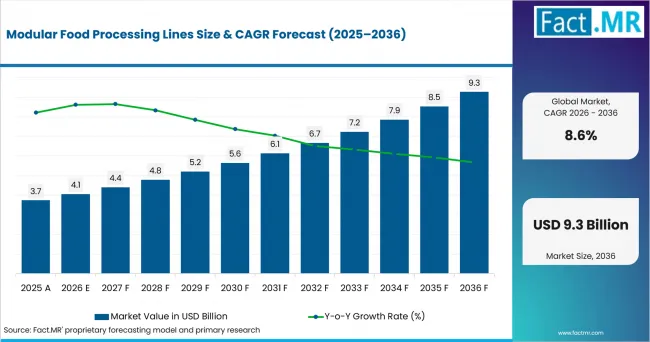
Modular Food Processing Lines Value Analysis | Source: Fact.MR
What are the defining numbers behind Modular Food Processing Lines Market growth?
The absolute opportunity between 2026 and 2036 is USD 5,204.5 million.
- Demand Drivers in the Market
- Manufacturers introducing a new product can install the required mixing or thermal capability before committing to a broader factory expansion. This creates demand for modules sized to an initial commercial production requirement.
- Existing plants often need to remove a particular bottleneck rather than replace every process stage. A defined module can support that upgrade when its connections and operating limits are compatible with surrounding food equipment.
- Product trials help buyers identify the operations needed for commercial production. Tetra Pak's development-centre offering includes equipment evaluation and scale-up work, illustrating the link between process development and subsequent capital decisions.
- Manufacturers repeating a process at another site can reuse engineering and training from a qualified module. Demand expands when the receiving plant can provide the necessary utilities, hygiene arrangements and control interfaces.
- Key Segments Analyzed
- Within Module, the Mixing / prep segment holds a 23.0% share in 2026. Ingredient preparation establishes the conditions that subsequent forming, heating and filling stages must handle.
- The Skid-mounted segment leads Architecture with 34.0% of 2026 revenue. Preassembly provides a defined equipment arrangement for testing and connection at the plant.
- For Industry, 23.0% of 2026 revenue comes from the Dairy segment. Dairy production combines several separable process duties that must operate within a controlled hygienic system.
- The leading Scale segment is Mid-scale, accounting for 31.0% in 2026. Commercial-scale buyers can add meaningful capacity while preserving the option to expand in stages.
- Analyst Opinion at Fact.MR
- Shambhu Nath Jha, Senior Consultant, Fact.MR
- “Modularity is valuable only if the next connection has been considered. A skid that runs well by itself can still leave a plant short of cleaning capacity, cooling or control coordination. Suppliers that define those limits early make phased expansion credible and reduce the risk of buying the same engineering work twice.”
- Strategic Implications
- Line suppliers should define mechanical, utility, control and cleaning interfaces with each module so the buyer can assess both the first installation and the planned expansion.
- Food manufacturers should reserve the space and utility capacity needed by the next phase, while avoiding unused process equipment whose purchase depends on unproven demand.
- Integrators should test how modules start, stop, clean and recover together through virtual commissioning and plant acceptance procedures appropriate to the process.
How does the Modular Food Processing Lines Market break down by segment?
The market is segmented by Module, Architecture, Industry, and Scale.
Why does the Mixing / prep segment lead Module?
The Mixing / prep segment holds a 23.0% share of the Module category in 2026.
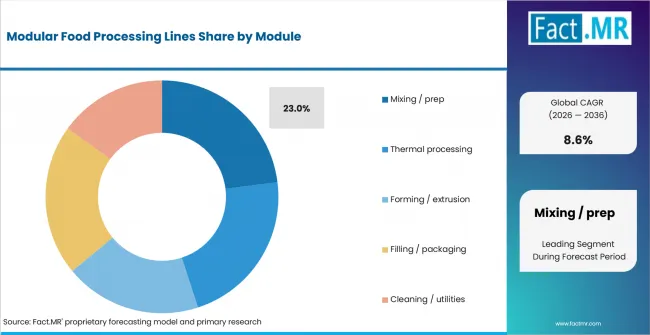
Modular Food Processing Lines Analysis By Module | Source: Fact.MR
Mixing and preparation determine how ingredients enter the process, influencing consistency, temperature and the condition of material passed downstream. A change in formulation may therefore require an upstream module before it requires replacement of the thermal or packaging stages. That creates a practical route for incremental equipment purchases.
Tetra Pak's processing portfolio separates duties such as blending, mixing, buffering and heat treatment, illustrating the different functions that a coordinated food process must perform. Buyers selecting a preparation module need to establish how its output matches the next operation, including product behaviour during waiting or transfer.
Why does the Skid-mounted segment lead Architecture?
The Skid-mounted segment holds a 34.0% share of the Architecture category in 2026.
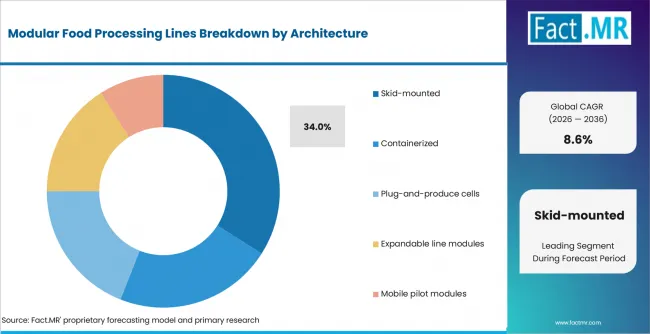
Modular Food Processing Lines Analysis By Architecture | Source: Fact.MR
A skid provides a defined arrangement of process equipment, pipework and instruments that can be assembled before arrival at the factory. This can shift part of the installation work into the supplier's workshop and allow testing of the package before it occupies production space. The buyer gains a clearer boundary for delivery and acceptance.
Connections beyond the skid remain material. Drainage, maintenance access, floor loading and utility quality can determine whether the package is practical at the site. A compact assembly is not automatically mobile or interchangeable, and a second supplier's skid may require additional engineering to join the same line.
Why does the Dairy segment lead Industry?
The Dairy segment holds a 23.0% share of the Industry category in 2026.
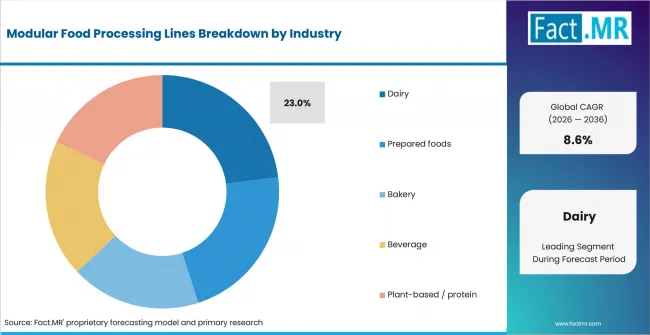
Modular Food Processing Lines Analysis By Industry | Source: Fact.MR
Dairy processes combine preparation, separation or standardisation, heat treatment, buffering and filling in different configurations. This creates opportunities for identifiable process packages, provided that their combination maintains the required product and hygiene conditions. Tetra Pak's dairy and processing offerings illustrate this breadth of equipment duties.
Adding a module can also change cleaning demand, holding time or the balance between upstream and downstream capacity. For EU operations, food-hygiene requirements continue to apply to the assembled production system. The commercial advantage of modular equipment therefore depends on preserving process control through each change in configuration.
Why does the Mid-scale segment lead Scale?
The Mid-scale segment holds a 31.0% share of the Scale category in 2026.
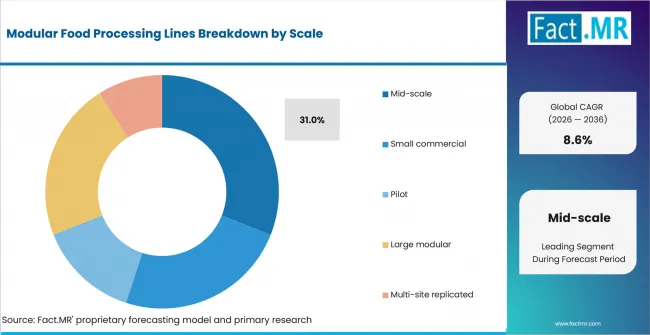
Modular Food Processing Lines Analysis By Scale | Source: Fact.MR
A mid-scale installation can provide commercial output while allowing investment to follow the development of the product or customer base. Buyers may add a preparation stage, expand thermal duty or install a filling module as the need becomes established. The appeal lies in a credible sequence of investments rather than a promise that every module will scale indefinitely.
The next increment must be planned against the capacity of shared utilities and common process stages. Expanding one module can move the bottleneck to cooling, cleaning or packaging. Procurement should therefore establish which future additions fit within the original design and which would require another phase of plant engineering.
What is accelerating Modular Food Processing Lines Market adoption, and what is holding it back?
Adoption is supported by repeatable engineering, advance testing and clearer package responsibilities. When automation controls describe each module's operating state and limits consistently, the line integrator can coordinate product transfer and avoid conflicting sequences. That coordination becomes more valuable as the number of suppliers and process stages increases.
Constraints arise at the connections: a module can meet its own specification while the line lacks adequate cooling, cleaning capacity or material buffering. Food-contact design also has to remain suitable after assembly. FDA equipment requirements address sanitary construction and maintenance of manufacturing systems, making the completed installation the relevant operating environment.
Drivers Impact Analysis
| Factor | (~) % Impact on CAGR | Geographic Relevance | Impact Timeline |
|---|---|---|---|
| Staged investment in new food products | +0.7% | UK, USA, Germany | 2026 to 2034 |
| Targeted replacement of process bottlenecks | +0.6% | Global | 2026 to 2036 |
| Reuse of engineering across plant installations | +0.5% | USA, Italy, France | 2027 to 2036 |
Opportunity Impact Analysis
| Factor | (~) % Impact on CAGR | Geographic Relevance | Impact Timeline |
|---|---|---|---|
| Commercial expansion after pilot qualification | +0.6% | Global | 2027 to 2036 |
| Modular cleaning and utility upgrades | +0.5% | Germany, France, UK | 2027 to 2035 |
| Coordinated controls for multi-vendor modules | +0.4% | USA, Germany, Italy | 2028 to 2036 |
Restraints Impact Analysis
| Factor | (~) % Impact on CAGR | Geographic Relevance | Impact Timeline |
|---|---|---|---|
| Unresolved utility and process interfaces | -0.6% | Global | 2026 to 2036 |
| Requalification after changes in configuration | -0.5% | Global | 2026 to 2034 |
| Limited space for later expansion | -0.4% | UK, Italy, France | 2026 to 2033 |
Which countries are scaling the Modular Food Processing Lines Market through 2036?
- UK: Phased factory upgrades can accommodate new products when installation access, maintenance and operator procedures are planned with the modules.
- USA: Targeted capacity additions support demand for process packages that connect to existing sanitary manufacturing systems.
- Germany: Coordinated engineering of process and utility interfaces supports replacement or expansion of individual production stages.
- Italy: Product variety creates opportunities to link flexible preparation and forming modules with the required filling or packaging capacity.
- France: Renewal of hygienic processing and shared cleaning systems can support modular investment across dairy and prepared-food operations.
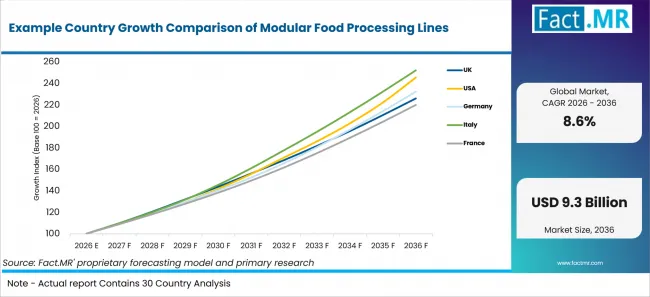
Example Country Growth Comparison Of Modular Food Processing Lines | Source: Fact.MR
Country CAGR (2026-2036)
| Country | CAGR (2026-2036) |
|---|---|
| UK | 8.5% |
| USA | 9.4% |
| Germany | 8.8% |
| Italy | 9.7% |
| France | 8.2% |
What is driving UK's growth through 2036?
UK is forecast to grow at 8.5% CAGR.
HSE's PUWER guidance ties work equipment to suitability, maintenance, inspection and user competence. For a manufacturer adding modules over time, those requirements make access and operating procedures relevant at every stage of expansion rather than only at initial delivery.
The purchasing opportunity is to complete a defined upgrade within a manageable production window. A buyer may favour a package that can be tested before installation and connected with limited interruption. Clear responsibility for commissioning the combined line can influence supplier selection when new equipment is introduced alongside an existing process.
What is driving USA's growth through 2036?
USA demand is projected to expand at 9.4% CAGR.
FDA's equipment provisions apply to sanitary manufacturing systems, including automated and enclosed arrangements. That supports a focus on the installed process when a preassembled module is connected to existing pipework, conveying or product-contact equipment.
Modular expansion can serve plants that need a particular preparation or thermal duty to launch an additional product. The buyer must establish that the existing utilities and downstream equipment can accept its output. A defined process package is commercially useful when it adds saleable capacity without introducing a new constraint elsewhere in the factory.
What is driving Germany's growth through 2036?
Germany is projected to record 8.8% CAGR.
The EU food-hygiene framework applies across food operations and continues to govern a line assembled from separately purchased modules. For German manufacturers, this makes the management of product-contact interfaces and cleaning arrangements a central part of process integration.
The growth mechanism is selective replacement and expansion of process stages whose surrounding plant remains serviceable. Suppliers can differentiate through clear operating-state descriptions, utility specifications and coordinated cleaning sequences. Those capabilities help the purchaser assess the implications of a new module before approving the next investment.
What is driving Italy's growth through 2036?
Italy is forecast to advance at 9.7% CAGR.
European food-information requirements make the intended product formulation and consumer information relevant to production decisions. For Italian producers managing several recipes, modular preparation and forming arrangements can support product changes while keeping the process aligned with its intended output.
Expansion also needs to reach the end of the line. A flexible processing module can deliver little additional commercial capacity if its output exceeds the available filling or packaging automation. Suppliers able to define the handover between these duties can improve the practicality of phased investments in plants with varied products.
What is driving France's growth through 2036?
France is projected to grow at 8.2% CAGR.
The EU hygiene framework establishes the continuing requirements within which French dairy and prepared-food operations must change their equipment. Modular purchasing can support renewal, but the combined line still needs suitable cleaning and product-handling arrangements.
The investment opportunity includes shared cleaning and utility modules that enable several production stages to operate reliably. Their value can be missed when expansion is assessed only through the capacity of the product-processing skid. Monitoring cleaning demand and process interruptions through a smart factory can help identify which shared duty requires the next upgrade.
Who Leads the Modular Food Processing Lines Market?
Key players in the Modular Food Processing Lines Market include GEA, Tetra Pak, Alfa Laval, Bühler, JBT Marel, and SPX FLOW (now within ITT Flow Technologies).
Competition depends on application knowledge, process integration, repeatable package engineering and support over the equipment life. JBT Marel presents both stand-alone machines and integrated food-processing lines within its current offering. SPX FLOW's process-technology brands have transitioned into ITT Flow Technologies following ITT's acquisition, which is relevant when buyers identify the organisation supporting an installed package.
Which companies are the key providers?
The key providers are GEA, Tetra Pak, Alfa Laval, Bühler, JBT Marel, and SPX FLOW (now within ITT Flow Technologies).
- GEA
- Tetra Pak
- Alfa Laval
- Bühler
- JBT Marel
- SPX FLOW (now within ITT Flow Technologies)
Bibliography
- Tetra Pak. (n.d.). Product Development Centres. Tetra Pak International.
- Tetra Pak. (n.d.). Processing equipment. Tetra Pak International.
- European Commission. (n.d.). Food hygiene. European Commission.
- U.S. Food and Drug Administration. (n.d.). 21 CFR 117.40: Equipment and utensils. Electronic Code of Federal Regulations.
- Health and Safety Executive. (n.d.). Provision and Use of Work Equipment Regulations 1998: Overview. HSE.
- European Commission. (n.d.). Food information to consumers: Legislation. European Commission.
- JBT Marel. (n.d.). Equipment, software and service solutions for food processing. JBT Marel.
- ITT Flow Technologies. (n.d.). Built on Trusted Brands. Decades of Flow Expertise. ITT Flow Technologies
This Report Answers
- What market value and growth are projected for modular food processing lines?
- Why do mixing and preparation, skid-mounted architecture, dairy and mid-scale installations lead their categories?
- Which interfaces determine whether staged expansion is practical?
- How do UK, USA, Germany, Italy and France differ in their demand mechanisms?
- What distinguishes a supplier's modular package from a complete integrated process?
What does the Modular Food Processing Lines Market cover?
The market covers commercial process modules and coordinated modular lines used to manufacture food and beverages. Revenue is analysed by module duty, physical architecture, consuming industry and production scale. Buyers include dairy processors, prepared-food manufacturers, bakeries, beverage producers and plant-based or protein-processing businesses.
What is included in the scope?
Mixing and preparation, thermal processing, forming or extrusion, filling or packaging, and cleaning or utility modules are included when part of a modular food-processing installation. Skid-mounted, containerized, plug-and-produce, expandable and mobile pilot arrangements are represented.
The analysis includes pilot, small commercial, mid-scale, large modular and replicated multi-site installations. Integrated package value includes its dedicated controls and connections. The same equipment is counted once within the module or line sale, rather than added again as a stand-alone component.
What is excluded from the scope?
Conventional fixed food plants without a modular equipment configuration are excluded. General construction, buildings, land, ingredients, packaging consumables and unrelated utility infrastructure are outside the revenue boundary.
Stand-alone laboratory instruments and individual machines without a defined role in a modular line are excluded. Filling and packaging revenue is included only for its modular process installation; the total value of a separate packaging factory is not attributed to the processing modules.
How Was the Analysis Built?
- Primary Research: Relevant respondent groups include food-plant project engineers, module suppliers, process integrators, dairy and prepared-food production managers, and commissioning specialists. The research framework examines phased investment decisions, utility constraints, package testing and the work required to connect subsequent modules.
- Desk Research: The assessment draws on food-hygiene and sanitary equipment requirements, work-equipment guidance and first-party descriptions of processing and development capabilities. Corporate information establishes the current organisation behind equipment brands and integrated offerings.
- Market Sizing and Forecasting: Sizing considers new modular installations, process-stage additions, replacement demand, package value and the proportion of a project attributable to modular equipment. Architecture and scale influence revenue, while shared equipment and complete-line contracts are reconciled to avoid counting their components twice.
- Data Validation and Update Cycle: Validation examines module assignment, interface assumptions, phased-project timing and country consistency. Updates track commercial expansion after trials, installed-line changes, supplier organisation and the utility or hygiene requirements affecting planned additions.
What is the report's scope and coverage?
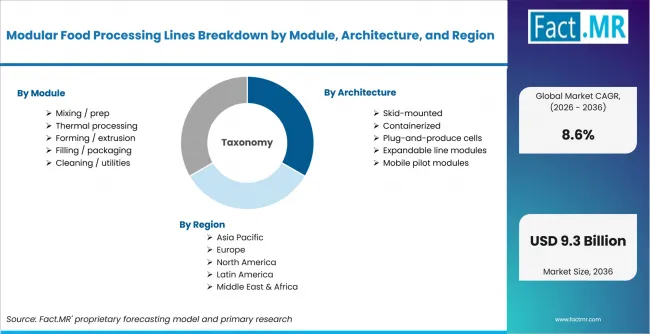
Modular Food Processing Lines Breakdown By Module, Architecture, And Region | Source: Fact.MR
| Attribute | Details |
|---|---|
| Quantitative Units | USD million |
| Market Definition | Preassembled process modules and coordinated modular lines for food and beverage manufacturing, including dedicated filling, cleaning and utility duties. |
| Segments Covered | Module; Architecture; Industry; Scale |
| Regions Covered | Global |
| Countries Covered | UK; USA; Germany; Italy; France |
| Key Companies | GEA, Tetra Pak, Alfa Laval, Bühler, JBT Marel, and SPX FLOW (now within ITT Flow Technologies) |
| Historical Period | 2021 to 2025 |
| Base Year | 2025 |
| Forecast Period | 2026 to 2036 |
| Market Value, 2026 | USD 4,060.0 million |
| Market Value, 2036 | USD 9,264.5 million |
| CAGR, 2026-2036 | 8.6% |
| Absolute Opportunity | USD 5,204.5 million |
| Approach | Modular project and expansion analysis combining process duties, architecture, production scale and equipment-contract revenue. |
How is the market segmented?
-
By Module
- Mixing / prep
- Thermal processing
- Forming / extrusion
- Filling / packaging
- Cleaning / utilities
-
By Architecture
- Skid-mounted
- Containerized
- Plug-and-produce cells
- Expandable line modules
- Mobile pilot modules
-
By Industry
- Dairy
- Prepared foods
- Bakery
- Beverage
- Plant-based / protein
-
By Scale
- Mid-scale
- Small commercial
- Pilot
- Large modular
- Multi-site replicated
-
By Region
- North America
- Latin America
- Western Europe
- Eastern Europe
- East Asia
- South Asia and Pacific
- Middle East & Africa