- Base Value(2025): 1.4 Bn
- Estimated Value(2026): 1.6 Bn
- Forecast Value (2036): 5.5 Bn
- CAGR (2026 - 2036): 13.3%
Virtual Commissioning Market Analysis and Forecast by Fact.MR
- The global market for virtual commissioning is estimated at US$ 1.59 billion in 2026 and is forecast to expand at a CAGR of 13.3% to reach US$ 5.53 billion by 2036.
- Virtual commissioning covers simulation software, industrial automation tools, digital twin platforms, commissioning management systems, and control system emulation used across manufacturing plants, energy systems, oil and gas, and building infrastructure projects.
- Digital twin technology leads the technology segment, supported by advances in physics based simulation, real time data integration, and cloud computing infrastructure.
- Growth is shaped by the need to reduce physical commissioning time, minimize production startup risks, validate automation logic before deployment, and optimize capital project execution across increasingly complex manufacturing and infrastructure systems.
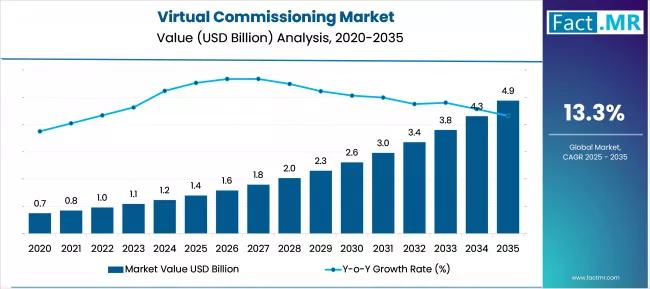
Virtual Commissioning Market Market Value Analysis | Source: Fact.MR
Summary of Virtual Commissioning Market
- Market Snapshot
- In 2025, the global Virtual Commissioning Market was valued at approximately USD 1.4 billion.
- The market is estimated to reach USD 1.59 billion in 2026 and is projected to attain USD 5.53 billion by 2036.
- The virtual commissioning market is likely to expand at a CAGR of 13.3% during the forecast period.
- The market is anticipated to create an absolute dollar opportunity of USD 3.94 billion between 2026 and 2036.
- Virtual Commissioning Software accounts for 52% of product share in 2026.
- India (18.4%) and China (17.2%) are the key growth markets during the forecast period.
- Demand and Growth Drivers
- Growing complexity of manufacturing automation systems is driving demand for virtual validation that reduces physical commissioning time and startup risk.
- Digital twin technology maturation is enabling more accurate simulation of production line behavior, making virtual commissioning commercially viable for a broader range of applications.
- Capital project cost pressure and compressed delivery timelines are creating economic justification for upfront investment in virtual commissioning to avoid costly physical rework.
- Expansion of distribution channels and direct to customer platforms is improving market access and product penetration across geographies.
- Growing investment in research and product development is supporting the introduction of higher specification and differentiated products.
- Product and Segment View
- Virtual commissioning software holds 52% of the product type segment in 2026, supported by its core role as the primary simulation and validation platform for automation systems before physical deployment.
- Manufacturing plants represent 58% of the application segment in 2026, with automotive production lines, food and beverage manufacturing, and pharmaceutical packaging acting as the primary demand channels.
- Digital twin platforms are growing faster in percentage terms, as real time bidirectional data exchange between physical and virtual systems enables continuous commissioning and optimization beyond initial startup.
- Key segmentation includes:
- Product: Virtual Commissioning Software, Industrial Automation Simulation Tools, Digital Twin Platforms, Commissioning Management Systems, Control System Emulation Tools
- Application: Manufacturing Plants, Energy & Power Systems, Oil & Gas Industry, Building & Infrastructure, Infrastructure Projects
- End Use: OEMs, Engineering Service Providers, Manufacturing Companies, Energy Sector Operators, Software Providers
- Technology: Digital Twin Technology, Industrial Automation Integration, Cloud & Edge Computing, AI & Analytics Technology
- Formulation: Software Based Systems, Hardware Assisted Systems, Integrated Systems, Service Based Systems
- Distribution Channel: Direct Sales, Channel Partners, Online Distribution, Aftermarket Services
- Geography and Competitive Outlook
- India leads growth at 18.4%, supported by expanding domestic demand, industry investment, and favorable policy conditions.
- North America shows mixed growth patterns, with the United States representing a mature market and other countries showing stronger growth driven by emerging applications.
- Europe demonstrates steady demand, with Germany and other key markets supported by regulatory frameworks and established industrial infrastructure.
- Key players in this market include Siemens AG, Dassault Systèmes SE, Rockwell Automation Inc., ABB Ltd., Emerson Electric Co..
- Analyst Opinion
- Shambhu Nath Jha, Principal Consultant at Fact.MR, says 'Virtual commissioning is transitioning from a nice to have engineering tool to a standard practice in capital project execution as the cost of physical commissioning delays, startup failures, and production ramp up inefficiencies becomes unacceptable in competitive manufacturing environments. The technology pays for itself by reducing physical commissioning time by 50 to 75 percent in many applications, while simultaneously improving automation code quality and reducing startup risk. Companies that combine strong simulation engines with seamless PLC and robot controller connectivity are capturing the largest share of adoption, particularly in automotive, pharmaceutical, and food and beverage manufacturing where production line complexity justifies the investment. India and China represent the highest growth markets as manufacturing automation accelerates.'
Key Growth Drivers, Constraints, and Opportunities
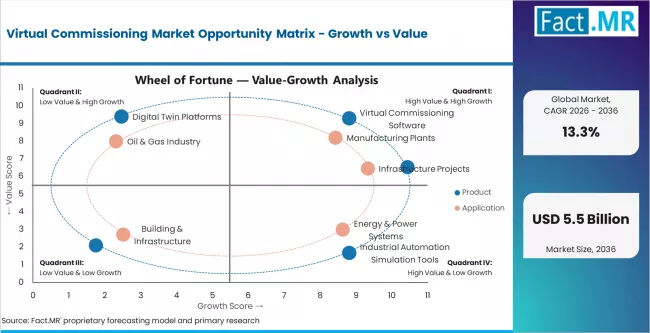
Virtual Commissioning Market Opportunity Matrix Growth Vs Value | Source: Fact.MR
Key Factors Driving Growth
- Growing complexity of manufacturing automation systems is driving demand for virtual validation that reduces physical commissioning time and startup risk.
- Digital twin technology maturation is enabling more accurate simulation of production line behavior, making virtual commissioning commercially viable for a broader range of applications.
- Capital project cost pressure and compressed delivery timelines are creating economic justification for upfront investment in virtual commissioning to avoid costly physical rework.
Key Market Constraints
- High upfront investment in software licensing, model development, and integration engineering limits adoption among smaller manufacturers and system integrators.
- Shortage of engineers with combined automation and simulation expertise constrains the speed of adoption across manufacturing sectors.
- Model accuracy limitations in capturing all physical system behaviors can reduce confidence in virtual commissioning results for novel or highly complex applications.
Key Opportunity Areas
- Expansion of virtual commissioning from automotive and discrete manufacturing into process industries, pharmaceuticals, and logistics creates new addressable market verticals.
- Cloud based virtual commissioning platforms that reduce upfront infrastructure cost and enable distributed engineering collaboration are lowering adoption barriers for mid sized manufacturers.
- Integration of AI and machine learning with virtual commissioning for automated optimization of automation logic and production parameters creates higher value platform offerings.
Segment-wise Analysis of the Virtual Commissioning Market
- Virtual commissioning software holds 52% of the product type segment in 2026, supported by its core role as the primary simulation and validation platform for automation systems before physical deployment.
- Manufacturing plants represent 58% of the application segment in 2026, with automotive production lines, food and beverage manufacturing, and pharmaceutical packaging acting as the primary demand channels.
- Digital twin platforms are growing faster in percentage terms, as real time bidirectional data exchange between physical and virtual systems enables continuous commissioning and optimization beyond initial startup.
The virtual commissioning market is segmented by product type, application, end use, technology, formulation, and distribution channel. By product type, the market covers commissioning software, simulation tools, digital twin platforms, management systems, and emulation tools. By application, coverage includes manufacturing, energy, oil and gas, and building infrastructure. Software platforms lead by value.
Which Product Type Segment Dominates the Virtual Commissioning Market?
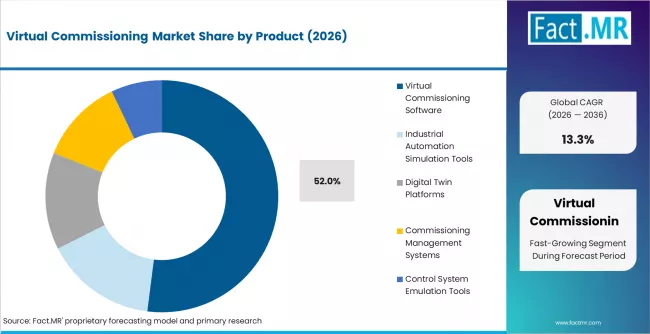
Virtual Commissioning Market Analysis By Product | Source: Fact.MR
Virtual commissioning software accounts for approximately 52% of the total market value in 2026. Its leadership is supported by broad applicability across manufacturing sectors, strong integration with major PLC and robot controller platforms, and the growing library of simulation models and component templates that reduce project setup time.
Software platforms dominate because they represent the foundational technology investment that all virtual commissioning implementations require. Digital twin platforms are gaining share as the technology matures, but standalone commissioning software remains the entry point for most adopters.
Which Application Segment Dominates the Virtual Commissioning Market?
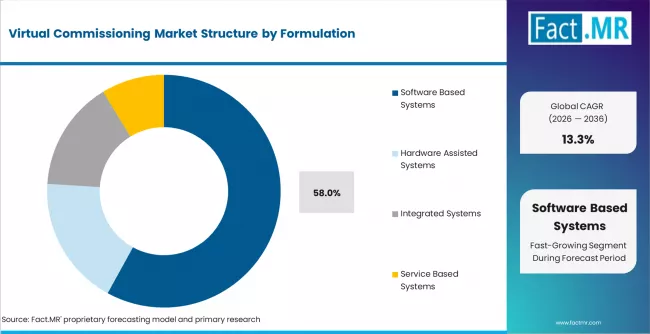
Virtual Commissioning Market Analysis By Formulation | Source: Fact.MR
Manufacturing plants are expected to lead the application segment with 58% of global market value in 2026. Demand is shaped by the complexity of modern production lines, the cost of commissioning delays, and the economic benefit of validating automation logic in simulation before physical deployment.
Energy and infrastructure applications are growing, but manufacturing retains dominance because production line commissioning involves the highest frequency of automation changes, shortest acceptable downtime windows, and clearest return on investment from virtual validation.
Which Product Trend is Shaping the Next Phase of Growth in the Virtual Commissioning Market?
Cloud based virtual commissioning platforms are emerging as the fastest growing product configuration in the market. These platforms eliminate the need for local high performance computing infrastructure, enable distributed engineering collaboration across multiple sites and time zones, and reduce the upfront investment required to adopt virtual commissioning.
The shift toward cloud delivery reflects the broader enterprise software trend and addresses one of the primary adoption barriers: the capital cost and IT complexity of on premise simulation infrastructure. Cloud platforms also enable more frequent use of virtual commissioning for smaller production changes and line modifications, expanding the technology from major capital projects into continuous production optimization.
Regional Outlook Across Key Markets
.webp "Top Country Growth Comparison Virtual Commissioning Market Cagr (2026 2036)")
Top Country Growth Comparison Virtual Commissioning Market Cagr (2026 2036) | Source: Fact.MR
- India leads growth at 18.4%, supported by expanding domestic demand and favorable industry conditions.
- North America shows varied growth, with the U.S. at 13.6% and China at 17.2%.
- European demand remains steady, supported by established industrial infrastructure and regulatory frameworks.
CAGR Table
| Country | CAGR (%) |
|---|---|
| India | 18.4% |
| China | 17.2% |
| South Korea | 16.8% |
| Japan | 15.9% |
| Germany | 14.7% |
| Brazil | 14.1% |
| USA | 13.6% |
Source: Fact.MR analysis. Updated May 19, 2026
Source: Fact MR (FMR) analysis, based on proprietary forecasting model and primary research.
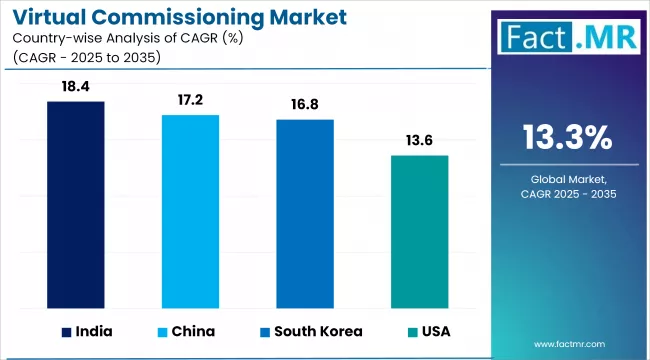
Virtual Commissioning Market Cagr Analysis By Country | Source: Fact.MR
Market Outlook for Virtual Commissioning in India
The India virtual commissioning market is projected to grow at a CAGR of 18.4% through 2036. Demand is shaped by rapid manufacturing automation expansion, automotive production line complexity, and growing adoption of digital engineering practices across organized manufacturing.
- Manufacturing automation expansion creates simulation demand.
- Automotive production complexity drives virtual validation adoption.
- Digital engineering practices are gaining traction.
Demand Trends for Virtual Commissioning in China
The China virtual commissioning market is projected to grow at a CAGR of 17.2% through 2036. Demand is supported by large scale smart manufacturing programs, automotive and electronics production automation, and government support for Industry 4.0 technologies.
- Smart manufacturing programs drive simulation adoption.
- Automotive and electronics automation creates demand.
- Government Industry 4.0 support accelerates investment.
Growth Assessment for Virtual Commissioning in South Korea
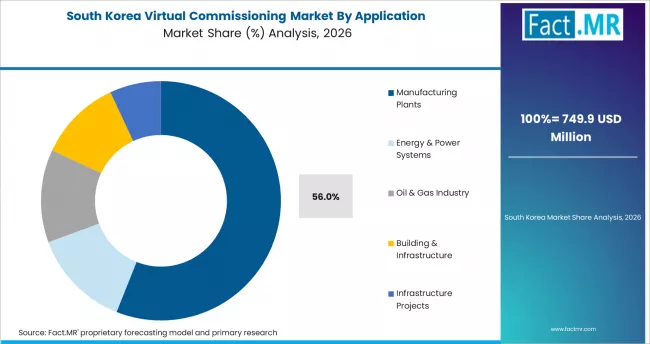
Virtual Commissioning Market South Korea Market Share Analysis By Application | Source: Fact.MR
The South Korea virtual commissioning market is projected to grow at a CAGR of 16.8% through 2036. Demand is supported by high manufacturing automation density, semiconductor and electronics production complexity, and strong digital infrastructure.
- High automation density supports advanced simulation.
- Semiconductor production creates complex commissioning needs.
- Digital infrastructure enables cloud platform adoption.
Market Demand Analysis for Virtual Commissioning in Japan
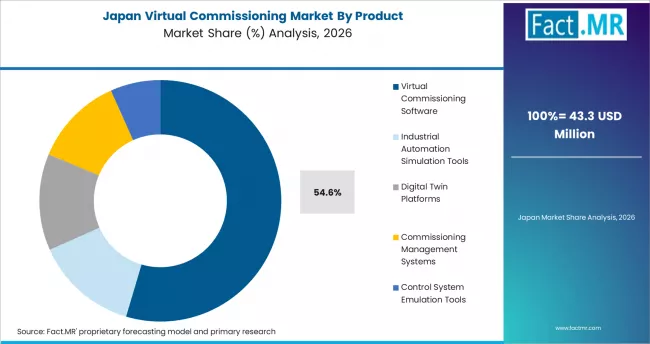
Virtual Commissioning Market Japan Market Share Analysis By Product | Source: Fact.MR
The Japan virtual commissioning market is projected to grow at a CAGR of 15.9% through 2036. Demand is supported by automotive manufacturing leadership, robotics integration complexity, and strong industrial automation culture.
- Automotive manufacturing drives commissioning demand.
- Robotics complexity requires virtual validation.
- Industrial automation culture supports adoption.
Growth Outlook for Virtual Commissioning in Germany
The Germany virtual commissioning market is projected to grow at a CAGR of 14.7% through 2036. Demand is supported by Industry 4.0 leadership, automotive and machinery manufacturing, and strong digital twin technology development.
- Industry 4.0 leadership drives adoption.
- Automotive manufacturing creates complex commissioning needs.
- Digital twin development supports platform growth.
Market Opportunity Outlook for Virtual Commissioning in Brazil
The Brazil virtual commissioning market is projected to grow at a CAGR of 14.1% through 2036. Demand is supported by automotive manufacturing modernization, growing industrial automation investment, and increasing awareness of virtual engineering benefits.
- Automotive modernization drives commissioning demand.
- Industrial automation investment supports adoption.
- Virtual engineering awareness is increasing.
Demand Patterns for Virtual Commissioning in the United States
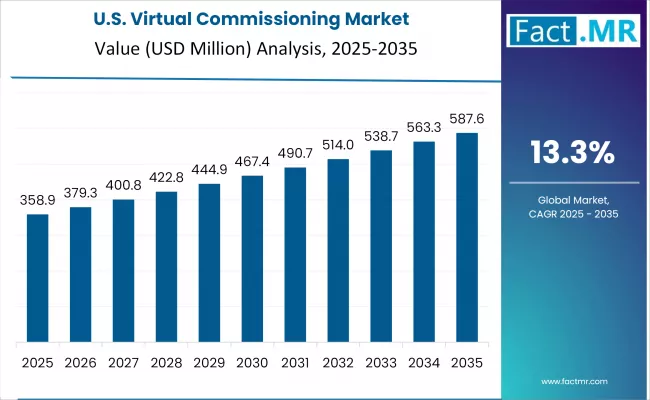
Virtual Commissioning Market Country Value Analysis | Source: Fact.MR
The U.S. virtual commissioning market is projected to grow at a CAGR of 13.6% through 2036. Demand is supported by advanced manufacturing investment, automotive and pharmaceutical production complexity, and strong adoption of digital twin and simulation technologies.
- Advanced manufacturing investment drives demand.
- Production complexity creates commissioning needs.
- Digital twin adoption supports platform growth.
Competitive Benchmarking and Company Positioning
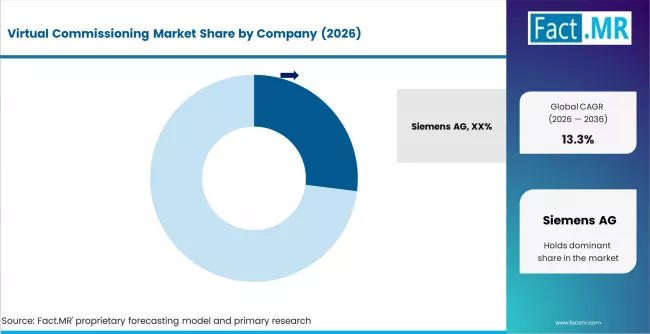
Virtual Commissioning Market Analysis By Company | Source: Fact.MR
Virtual Commissioning Market Analysis By Company
- Siemens AG, Dassault Systèmes SE, Rockwell Automation Inc., ABB Ltd. hold strong positions in the global virtual commissioning market through broad product portfolios, established customer relationships, and growing capabilities in their respective technology areas.
- Emerson Electric Co., Schneider Electric SE, Aveva Group plc, PTC Inc. participate meaningfully across specific price tiers, user segments, and regional channels.
- Technology integration and service capabilities create important differentiation factors.
The competitive landscape is moderately fragmented. Siemens AG, Dassault Systèmes SE, Rockwell Automation Inc. compete through product breadth, technology capabilities, and customer service infrastructure.
Competition is shaped by differences in product specification, geographic coverage, and service capability. Companies with integrated offerings are positioned to retain market share and improve margins over time.
Key Companies in the Virtual Commissioning Market
Siemens AG, Dassault Systèmes SE, Rockwell Automation Inc., ABB Ltd. are among the leading players in the virtual commissioning market globally.
Emerson Electric Co., Schneider Electric SE, Aveva Group plc, PTC Inc. hold established positions across specific customer groups and application areas.
Bentley Systems Inc., Honeywell International Inc. continue to compete through focused product offerings and niche strength.
Recent Industry Developments
- Siemens AG Platform Update / Digital Twin Integration (2025)
- Siemens released an updated Tecnomatix virtual commissioning platform with enhanced digital twin connectivity, real time data synchronization, and expanded PLC controller emulation coverage for automotive and consumer goods manufacturing lines.
- Rockwell Automation Inc. Technology Launch / Cloud Commissioning Platform (2026)
- Rockwell Automation launched a cloud based virtual commissioning environment integrated with its FactoryTalk ecosystem, enabling distributed engineering teams to collaboratively validate automation logic without local high performance computing infrastructure.
- Dassault Systemes SE Market Expansion / Manufacturing Simulation (2025)
- Dassault Systemes expanded its 3DEXPERIENCE virtual commissioning capabilities with enhanced robot simulation, conveyor modeling, and safety system validation features targeting pharmaceutical and food manufacturing automation projects.
Leading Companies Shaping the Virtual Commissioning Market
- Siemens AG
- Dassault Systèmes SE
- Rockwell Automation Inc.
- ABB Ltd.
- Emerson Electric Co.
- Schneider Electric SE
- Aveva Group plc
- PTC Inc.
- Bentley Systems Inc.
- Honeywell International Inc.
Sources and Research References
- Siemens AG. Product portfolio, corporate announcements, and market disclosures.
- Dassault Systèmes SE. Product portfolio, corporate announcements, and market disclosures.
- Rockwell Automation Inc.. Product portfolio, corporate announcements, and market disclosures.
- Industry association statistics, government agency publications, trade data, customs databases, and company product catalogs.
- Primary interviews with manufacturers, distributors, end users, and industry specialists.
This bibliography is provided for reader reference and is not exhaustive. The full report contains the complete reference list and detailed citations.
Key Questions This Report Addresses
- What is the current and future size of the Virtual Commissioning Market?
- How fast is the Virtual Commissioning Market expected to grow between 2026 and 2036?
- Which product type is likely to lead the market by 2026?
- Which application segment is expected to account for the highest demand by 2026?
- What factors are driving demand for virtual commissioning globally?
- Which countries are projected to show the fastest growth through 2036?
- What is driving market expansion in India and China?
- Who are the key companies active in the Virtual Commissioning Market?
- How does Fact.MR estimate and validate the market forecast?
- What are the key constraints and opportunity areas in this market?
Virtual Commissioning Market Definition
The virtual commissioning market covers software platforms, simulation tools, digital twin environments, and control system emulation technologies used to test, validate, and optimize automated manufacturing systems, production lines, and infrastructure control logic in a virtual environment before physical installation, reducing commissioning time, startup risk, and production ramp up inefficiencies across manufacturing, energy, oil and gas, and building infrastructure applications.
Virtual Commissioning Market Inclusions
- The scope covers global and regional market size and forecasts for 2026 to 2036 across product type, application, end use, technology, formulation, and distribution channel.
- It includes regional demand analysis based on manufacturing automation investment, capital project activity, digital transformation spending, and Industry 4.0 adoption.
- The report includes pricing and cost analysis across software licensing models, integration services, and platform tiers.
- It covers technology trends, market drivers and constraints, and competitive landscape including platform capabilities, integration partnerships, and geographic reach.
Virtual Commissioning Market Exclusions
- The scope excludes general purpose CAD/CAM software, ERP systems, and manufacturing execution systems not specifically designed for virtual commissioning simulation.
- It excludes physical commissioning services, field engineering, and on site startup support sold without virtual commissioning software.
- The report excludes standalone IoT platforms, SCADA systems, and process historians not integrated with virtual commissioning workflows.
- It also excludes academic simulation tools without commercial deployment and internal corporate tools without external licensing.
Virtual Commissioning Market Research Methodology
- The methodology combines secondary research, primary interviews, and forecast modelling.
- It draws on 100+ secondary sources and benchmarks 50+ company product portfolios.
- Market sizing covers 30+ countries through a demand side model, supported by top down validation.
- Key inputs include industry production data, trade statistics, pricing benchmarks, regulatory frameworks, and end use demand patterns.
- The model cross checks demand with shipments, pricing trends, channel mix, and product launches.
- Primary validation includes 20+ interviews across manufacturers, distributors, end users, and industry specialists.
- Final estimates go through trade flow checks, sales pattern review, and sensitivity testing.
Segmentation
Scope of Analysis
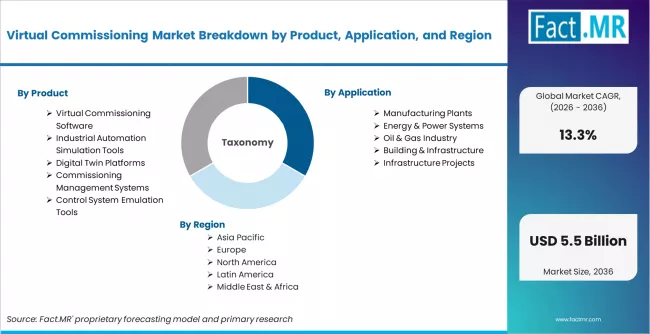
Virtual Commissioning Market Breakdown By Product, Application, And Region | Source: Fact.MR
| Parameter | Details |
|---|---|
| Quantitative Units | USD 1.59 billion to USD 5.53 billion, at a CAGR of 13.3% |
| Market Definition | The virtual commissioning market covers software platforms, simulation tools, digital twin environments, and control system emulation technologies used to test, validate, and optimize automated manufacturing systems, production lines, and infrastructure control logic in a virtual environment before physical installation, reducing commissioning time, startup risk, and production ramp up inefficiencies across manufacturing, energy, oil and gas, and building infrastructure applications. |
| Regions Covered | North America, Latin America, Europe, East Asia, South Asia and Pacific, Middle East and Africa |
| Countries Covered | India, China, South Korea, Japan, Germany, Brazil, USA, 30 plus countries |
| Key Companies | Siemens AG, Dassault Systèmes SE, Rockwell Automation Inc., ABB Ltd., Emerson Electric Co., Schneider Electric SE, Aveva Group plc, PTC Inc., Bentley Systems Inc., Honeywell International Inc. |
| Forecast Period | 2026 to 2036 |
| Approach | Hybrid demand side and top down methodology built on country level demand analysis, product benchmarking, pricing analysis, shipment validation, and primary interviews across manufacturers, distributors, and end users |
Source: Fact.MR analysis. Updated May 19, 2026
Virtual Commissioning Market Segmentation
-
Virtual Commissioning market Segmented by Product:
- Virtual Commissioning Software
- Digital Twin Commissioning Platforms
- 3D Simulation Based Platforms
- Real Time Process Twin Systems
- Cloud Based Commissioning Software
- SaaS Commissioning Platforms
- Remote Commissioning Suites
- Digital Twin Commissioning Platforms
- Industrial Automation Simulation Tools
- PLC Simulation Software
- Virtual PLC Testing Tools
- Controller Emulation Platforms
- SCADA Simulation Systems
- HMI Simulation Tools
- Control Room Virtual Systems
- PLC Simulation Software
- Digital Twin Platforms
- Asset Digital Twins
- Machine Level Twins
- Line Level Twins
- Process Digital Twins
- Production Line Simulation
- System Level Optimization Twins
- Asset Digital Twins
- Commissioning Management Systems
- Workflow Commissioning Tools
- Task Sequencing Systems
- Project Commissioning Dashboards
- Documentation Systems
- Digital Commissioning Reports
- Compliance Tracking Tools
- Workflow Commissioning Tools
- Control System Emulation Tools
- SCADA Emulators
- HMI Simulation Systems
- Control Panel Emulation Tools
- Automation Testing Platforms
- Industrial Network Simulators
- Control Logic Validation Systems
- SCADA Emulators
- Virtual Commissioning Software
-
Virtual Commissioning market Segmented by Application:
- Manufacturing Plants
- Discrete Manufacturing
- Automotive Production Lines
- Electronics Assembly Lines
- Process Manufacturing
- Chemical Plants
- Pharmaceutical Plants
- Discrete Manufacturing
- Energy & Power Systems
- Power Generation Plants
- Thermal Power Plants
- Renewable Energy Plants
- Energy Distribution Systems
- Smart Grid Systems
- Substation Automation Systems
- Power Generation Plants
- Oil & Gas Industry
- Upstream Operations
- Drilling Systems
- Offshore Platforms
- Downstream Operations
- Refinery Operations
- Pipeline Systems
- Upstream Operations
- Building & Infrastructure
- Smart Buildings
- HVAC Systems
- Building Automation Systems
- Infrastructure Projects
- Metro Rail Systems
- Airport Systems
- Smart Buildings
- Infrastructure Projects
- Manufacturing Plants
-
Virtual Commissioning market Segmented by End Use:
- OEMs
- Machine Manufacturers
- Industrial Equipment OEMs
- Automation Equipment OEMs
- System Integrators
- Factory Automation Integrators
- Control System Integrators
- Machine Manufacturers
- Engineering Service Providers
- Plant Engineering Firms
- EPC Contractors
- Design Engineering Companies
- Consulting Firms
- Industrial Simulation Consultants
- Digital Engineering Consultants
- Plant Engineering Firms
- Manufacturing Companies
- Large Manufacturers
- Automotive OEM Plants
- Electronics Manufacturers
- Mid Scale Manufacturers
- Component Manufacturing Units
- Assembly Plants
- Large Manufacturers
- Energy Sector Operators
- Power Utilities
- Generation Companies
- Grid Operators
- Oil and Gas Operators
- Refinery Operators
- Upstream Operators
- Power Utilities
- Software Providers
- OEMs
-
Virtual Commissioning market Segmented by Technology:
- Digital Twin Technology
- Real Time Simulation Technology
- Physics Based Simulation Engines
- Data Driven Simulation Models
- Model Based Systems Engineering
- System Architecture Modeling
- Lifecycle Modeling Systems
- Real Time Simulation Technology
- Industrial Automation Integration
- PLC Integration Technology
- Virtual PLC Emulation
- Controller Simulation Layers
- SCADA Integration Systems
- Virtual Control Rooms
- HMI Simulation Layers
- PLC Integration Technology
- Cloud & Edge Computing
- Cloud Simulation Platforms
- Scalable Simulation Engines
- Multi Tenant Commissioning Systems
- Edge Simulation Systems
- On Premise Edge Twins
- Hybrid Edge Cloud Systems
- Cloud Simulation Platforms
- AI & Analytics Technology
- Predictive Commissioning AI
- Fault Prediction Models
- Optimization Algorithms
- Process Analytics Systems
- Performance Benchmarking Tools
- Real Time Diagnostics Systems
- Predictive Commissioning AI
- Digital Twin Technology
-
Virtual Commissioning market Segmented by Formulation:
- Software Based Systems
- Simulation Software Platforms
- Standalone Simulation Tools
- Integrated Simulation Suites
- Cloud Software Platforms
- SaaS Commissioning Systems
- Hybrid Cloud Platforms
- Simulation Software Platforms
- Hardware Assisted Systems
- Edge Computing Hardware
- Industrial Edge Devices
- Embedded Controllers
- Test Bench Systems
- Virtual Test Environments
- Hardware in Loop Systems
- Edge Computing Hardware
- Integrated Systems
- Digital Twin Integrated Suites
- End to End Commissioning Platforms
- Lifecycle Management Systems
- Automation Integrated Systems
- PLC SCADA Combined Systems
- Multi System Integration Platforms
- Digital Twin Integrated Suites
- Service Based Systems
- Consulting Services
- Virtual Commissioning Consulting
- System Validation Services
- Support Services
- Maintenance Simulation Support
- Upgrade Simulation Services
- Consulting Services
- Software Based Systems
-
Virtual Commissioning market Segmented by Distribution Channel:
- Direct Sales
- OEM Partnerships
- Automation OEM Vendors
- Software OEM Providers
- Enterprise Sales
- Large Industrial Contracts
- Government Projects
- OEM Partnerships
- Channel Partners
- System Integrators
- Industrial Automation Integrators
- Engineering Consultants
- Industrial Distributors
- Software Resellers
- Automation Solution Dealers
- System Integrators
- Online Distribution
- Cloud Marketplaces
- Industrial SaaS Platforms
- Software Subscription Platforms
- Direct Online Sales
- Vendor Portals
- Cloud Marketplaces
- Aftermarket Services
- Support Contracts
- Annual Maintenance Contracts
- Technical Support Services
- Upgrade Services
- Software Upgrade Packages
- System Enhancement Services
- Support Contracts
- Direct Sales
-
Virtual Commissioning market by Region:
- North America
- USA
- Canada
- Mexico
- Latin America
- Brazil
- Chile
- Rest of Latin America
- Western Europe
- Germany
- UK
- Italy
- Spain
- France
- Nordic
- BENELUX
- Rest of Western Europe
- Eastern Europe
- Russia
- Poland
- Hungary
- Balkan & Baltic
- Rest of Eastern Europe
- East Asia
- China
- Japan
- South Korea
- South Asia and Pacific
- India
- ASEAN
- Australia & New Zealand
- Rest of South Asia and Pacific
- Middle East & Africa
- Kingdom of Saudi Arabia
- Other GCC Countries
- Turkiye
- South Africa
- Other African Union
- Rest of Middle East & Africa
- North America
Frequently Asked Questions
How big is the virtual commissioning market in 2025?
What will be the size of the virtual commissioning market in 2036?
How much will the virtual commissioning market grow between 2026 and 2036?
What are the key product types in the virtual commissioning market?
Which segment will contribute significant share in the virtual commissioning market in 2026?
Which are the fastest growing countries in the virtual commissioning market?
Who worked on this report


Preview the report firsthand - request a free sample
Free SampleGet the brochure for pricing and purchase details
Download PDF