- Market Value (2025): USD 4.1 Bn
- Estimated Value (2026): USD 4.3 Bn
- Forecast Value (2036): USD 7.9 Bn
- CAGR (2026-2036): 6.1%
What is the Monobloc Aerosol Non-BPA Coatings Market forecast to be worth by 2036?
USD 4.3 billion in 2026 to USD 7.9 billion by 2036 at a 6.1% CAGR.
- As per Fact.MR analysis, the Monobloc Aerosol Non-BPA Coatings Market was valued at USD 4.1 billion in 2025.
- Demand is expected to increase from USD 4.3 billion in 2026 to USD 7.9 billion by 2036.
- As per Fact.MR analysis, the market is forecast to record a 6.1% CAGR from 2026 to 2036.
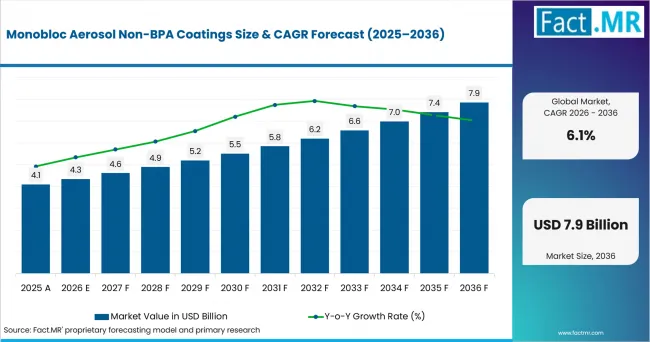
Monobloc Aerosol Non Bpa Coatings Value Analysis | Source: Fact.MR
What are the defining numbers behind Monobloc Aerosol Non-BPA Coatings Market growth?
An absolute opportunity of USD 3.5108 billion is expected between 2026 and 2036.
- Demand Drivers in the Market
- Monobloc aerosol manufacturers need inner coatings that prevent corrosion and reduce contact between the product and the metal.
- Beverage and food can producers need coatings that work during filling and storage and meet food safety rules. European Commission guidance published in December 2025 set 20 July 2026 as the transition date for many single-use food-contact products, including coated metal cans [1].
- Personal care and medicine tube makers need flexible BPA-free coatings that stay in place when aluminum tubes are shaped and handled. In February 2025, PPG launched PPG Hoba Pro 2848 for aluminum bottles as part of its BPA-free Hoba coating range. PPG states that Hoba coatings are used for monobloc aerosols, collapsible tubes, and aluminum bottles.
- Packaging companies need coatings that work on existing production lines and cure properly. Changes to production lines can increase costs and approval time.
- Key Segments Analyzed
- By Coating Chemistry: Polyester is expected to hold a 34.0% share in 2026 because it sticks well to metal, stays flexible, and helps prevent corrosion.
- By Package Type: Beverage cans are projected to account 31.0% share in 2026 because they are made in large numbers and need inner coatings to protect the metal from the drink.
- By Coating Position: Internal lining is anticipated to hold a 36.0% share in 2026 because it keeps the packed product from touching the metal during storage.
- By Results: Corrosion resistance is expected to represent 29.0% share in 2026 because cans and tubes need protection from products containing water, acids, salts, or active ingredients.
- Analyst Opinion at Fact.MR
- Shambhu Nath Jha, Principal Consultant at Fact.MR, states, “Packaging companies need coatings that protect the metal, stay strong during shaping, and work on existing production lines. Suppliers that provide clear test results, safety records, and production support are expected to see higher demand.”
- Strategic Implications
- Coating suppliers should provide clear test results for corrosion, flexibility, and chemical movement into the product. This helps packaging companies choose the right coating. In May 2025, AkzoNobel reported that Accelshield 300 had a 27% lower carbon footprint than early epoxy-based coatings.
- Can makers should check drying needs and production settings before changing inner coatings. A new coating can change oven settings and production speed. In May 2025, AkzoNobel stated that its €32 million Vilafranca plant for bisphenol-free metal packaging coatings was planned to be fully operational by mid-2025.
- Tube makers should test coatings on areas that are bent or shaped. The coating needs to stay in place during repeated use.
- Brand owners should check the product, packaging, and shelf-life needs before choosing a coating.
The USA is expected to grow at 7.1% CAGR through 2036, followed by China at 6.9% and Japan at 5.8%. France is expected to grow at 5.4%, while Germany records 5.2%. Demand differs by packaging type, coating approval rules, and local safety requirements.
How does the Monobloc Aerosol Non-BPA Coatings Market break down by segment?
Polyester leads Coating Chemistry at 34.0%; Internal lining leads Coating Position at 36.0%.
Which Coating Chemistry dominates?
Polyester is expected to hold 34.0% share in 2026.
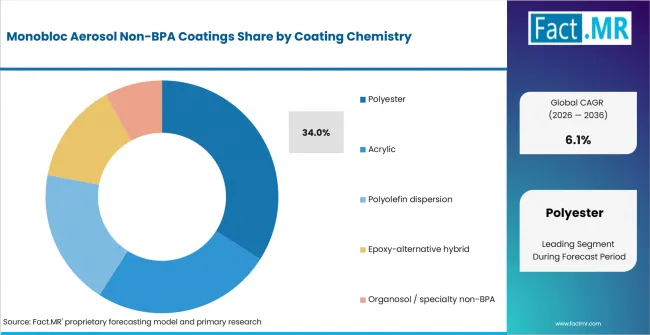
Monobloc Aerosol Non Bpa Coatings Analysis By Coating Chemistry | Source: Fact.MR
Polyester is expected to lead in 2026 because it sticks well to metal, stays flexible, and protects against corrosion without using BPA-based epoxy. Acrylic and polyolefin coatings are used when products need different drying or coating conditions. In February 2025, PPG launched Hoba Pro 2848 for aluminum beverage bottles. PPG also offers Hoba coatings for monobloc aerosols, collapsible tubes, and aluminum bottles.
What leads the Package Type segment?
Beverage cans are expected to account for 31.0% share in 2026.
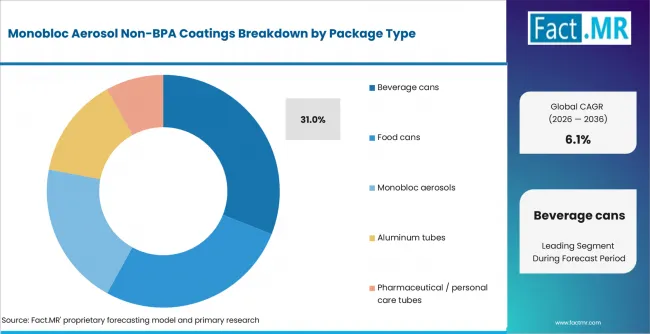
Monobloc Aerosol Non Bpa Coatings Analysis By Package Type | Source: Fact.MR
Beverage cans are expected to lead in 2026 because they need inner coatings that prevent drinks from touching the metal. Food cans need strong coatings that can handle heat and longer storage. Monobloc aerosols and aluminum tubes need coatings that stay in place after shaping. In July 2025, PPG expanded its BPA-NI coating range and stated that one low-film-weight system could reduce carbon emissions by 20%.
How does Coating Position shape demand?
Internal lining is estimated to capture 36.0% share in 2026.
Internal lining is expected to lead in 2026 because it stops the product from touching the metal. Some packages also need coatings on the ends for the same protection. Aluminum tubes need inner coatings that stay in place after shaping. Aerosol cans need an even coating inside, while closures and ends need protection on smaller areas.
What supports Corrosion Resistance within Performance?
Corrosion resistance is forecast to represent 29.0% share in 2026.
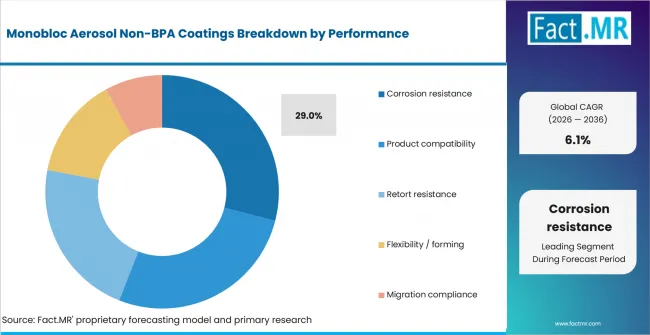
Monobloc Aerosol Non Bpa Coatings Analysis By Performance | Source: Fact.MR
Corrosion resistance is expected to lead in 2026 because the coating protects the metal from the product during storage. The coating must also work well with the product inside. Food cans need coatings that can handle high heat. Cans and tubes also need flexible coatings that stay in place when the package is shaped or squeezed.
What is accelerating Monobloc Aerosol Non-BPA Coatings Market adoption, and what is holding it back?
BPA-free coatings increase demand, while long approval processes can slow their use.
Drivers Impact Analysis
| DRIVER | (~) % IMPACT ON CAGR | GEOGRAPHIC RELEVANCE | IMPACT TIMELINE |
|---|---|---|---|
| Replacement of BPA-based internal coatings | +1.4% | North America, Europe, East Asia | Short term (<= 2 years) |
| Higher corrosion and product-compatibility needs | +1.1% | Global | Medium term (2-4 years) |
| Growth in aerosol and metal-pack applications | +0.9% | North America, East Asia | Medium term (2-4 years) |
| Line-compatible coating qualification | +0.7% | Global | Long term (>= 4 years) |
Opportunity Impact Analysis
| OPPORTUNITY | (~) % IMPACT ON CAGR | GEOGRAPHIC RELEVANCE | IMPACT TIMELINE |
|---|---|---|---|
| Polyester systems for high-volume cans | +1.0% | North America, Europe, East Asia | Medium term (2-4 years) |
| Flexible coatings for monobloc aerosols and tubes | +0.8% | Europe, East Asia | Long term (>= 4 years) |
| Migration-focused product qualification | +0.6% | Europe, North America | Short term (<= 2 years) |
Restraints Impact Analysis
| RESTRAINT | (~) % IMPACT ON CAGR | GEOGRAPHIC RELEVANCE | IMPACT TIMELINE |
|---|---|---|---|
| Long qualification cycles for replacement coatings | -0.8% | Global | Short term (<= 2 years) |
| Performance trade-offs across packed products | -0.6% | Global | Medium term (2-4 years) |
| Curing and line-conversion constraints | -0.4% | North America, Europe, East Asia | Medium term (2-4 years) |
Which countries are scaling the Monobloc Aerosol Non-BPA Coatings Market through 2036?
- The country comparison spans 1.9 percentage points across the five profiled markets.
- The USA is expected at 7.1% CAGR as metal packaging and aerosol uses support non-BPA coating approval.
- China is forecast at 6.9% CAGR as large-scale can and buyer packaging production widens addressable coating demand.
- Japan is expected at 5.8% CAGR as quality-focused packaging needs favor stable internal protection systems.
- France is estimated at 5.4% CAGR as EU food-contact and packaging rules shape input selection.
- Germany is expected at 5.2% CAGR as pack makers balance compliance needs with line results.
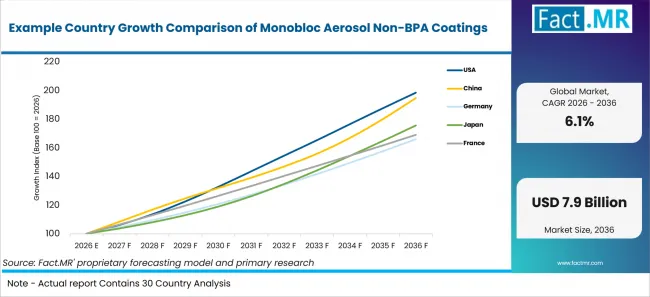
Example Country Growth Comparison Of Monobloc Aerosol Non Bpa Coatings | Source: Fact.MR
| Country | CAGR (2026-2036) |
|---|---|
| USA | 7.1% |
| China | 6.9% |
| Japan | 5.8% |
| France | 5.4% |
| Germany | 5.2% |
What supports USA adoption?
7.1% CAGR, supported by broad aerosol and metal-packaging use.
The USA has a large market for aerosol, beverage, food, and personal care packaging that needs inner coatings. These coatings must work with different products and existing production lines. Suppliers test how well the coatings stick, dry, and prevent corrosion. These tests help packaging companies choose the right BPA-free coating.
How is China scaling demand?
6.9% CAGR, shaped by high-volume buyer packaging production.
China has a large beverage and personal care industry, which increases demand for inner coatings in metal packaging. In January 2026, the National Bureau of Statistics reported that cosmetics retail sales grew by 5.1% in 2025 [2]. Suppliers need coatings that work well on fast production lines and cover the inside of the package evenly.
What supports Japan adoption?
5.8% CAGR, supported by quality-focused aerosol and metal-packaging needs.
Japan’s aerosol and specialty packaging companies need inner coatings that give even coverage and work well with the product. In September 2025, the European Aerosol Federation reported that Japan produced 504 million aerosol units in 2024. This increases demand for flexible inner coatings used in personal care, household, and specialty products.
What supports France adoption?
5.4% CAGR, influenced by aerosol production and EU food-contact needs.
France has a large aerosol, personal care, and household product industry. In September 2025, the European Aerosol Federation reported that France produced 723 million aerosol units in 2024. EU rules on bisphenols are increasing the use of new inner coatings for food and drink cans.
What supports Germany adoption?
5.2% CAGR, supported by a large aerosol production base and coating conversion work.
Germany has a large aerosol, food, beverage, and metal packaging industry. In 2026, Industrie-Gemeinschaft Aerosole reported that Germany produced 934 million aerosol units in 2025. Personal care products made up a large share of this production, increasing demand for inner coatings in metal packaging.
Who leads the Monobloc Aerosol Non-BPA Coatings Market?
PPG Industries supplies BPA-free coatings for aluminum bottles, monobloc aerosols, and collapsible tubes through its HOBA range. It also provides BPA-NI coatings for beverage can ends.
AkzoNobel supplies bisphenol-free coatings for cans and other metal packaging. These coatings help prevent corrosion and work on existing production lines. Sherwin-Williams and ACTEGA also provide coatings for cans, aerosols, tubes, and other metal packaging.
Buyers compare corrosion protection, flexibility, product safety, and ease of use. Suppliers also provide test results and technical support to help companies choose the right coating.
Which companies are the key providers?
Key companies include PPG Industries; AkzoNobel; Sherwin-Williams; and ACTEGA.
- PPG Industries
- AkzoNobel
- Sherwin-Williams
- ACTEGA
What is the report’s scope and coverage?
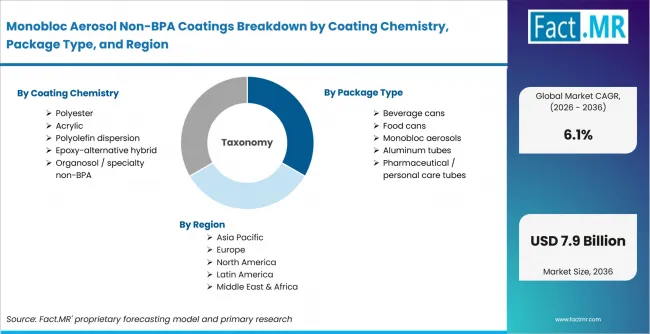
Monobloc Aerosol Non Bpa Coatings Breakdown By Coating Chemistry, Package Type, And Region | Source: Fact.MR
| Attribute | Details |
|---|---|
| Quantitative Units | USD billion in 2026 to USD billion by 2036 at a CAGR |
| Market Definition | Non-BPA internal and functional coating systems used on monobloc aerosols, metal cans, aluminum tubes and related metal packaging to provide corrosion protection, product compatibility and migration control without BPA-based coating chemistry. |
| Coating Chemistry | Polyester; Acrylic; Polyolefin dispersion; Epoxy-alternative hybrid; Organosol / specialty non-BPA |
| Package Type | Beverage cans; Food cans; Monobloc aerosols; Aluminum tubes; Pharmaceutical / personal care tubes |
| Coating Position | Internal lining; Internal + end coating; Tube shoulder / body lining; Aerosol interior; Closure / end lining |
| Performance | Corrosion resistance; Product compatibility; Retort resistance; Flexibility / forming; Migration compliance |
| Regions Covered | North America; Latin America; Western Europe; Eastern Europe; East Asia; South Asia & Pacific; Middle East & Africa |
| Countries Covered | USA; China; Germany; Japan; France |
| Key Companies Profiled | PPG Industries; AkzoNobel; Sherwin-Williams; ACTEGA |
| Forecast Period | 2026 to 2036 |
| Approach | Hybrid top-down and bottom-up review using package demand, coating-use patterns, segment shares, country growth, supplier portfolios and regulatory requirements. |
Bibliography
- [1] European Commission. (2025, December 17). Note for Guidance on the implementation of Commission Regulation (EU) 2024/3190 on the use of bisphenol A (BPA) and other bisphenols and bisphenol derivatives with harmonised classification for specific hazardous properties in certain materials and articles intended to come into contact with food.
- [2] National Bureau of Statistics of China. (2026, January 20). Total retail sales of consumer goods in December 2025.
- [3] PPG. (2025, February 3). PPG launches non-BPA PPG HOBA coatings for aluminum bottles at Paris Packaging Week.
- [4] PPG. (2025, July 21). PPG adds BPA-NI beverage can end coatings to PPG INNOVEL and PPG iSENSE series.
- [5] Bradford, C. (2025, May 1). Looking ahead. AkzoNobel Packaging Coatings.
- [6] European Aerosol Federation. (2025, September 23). FEA Annual Report 2025.
This Report Answers
- The report explains where non-BPA coating systems are used across metal package types and coating positions, together with the main chemistry and results choices.
- Segment review identifies the leading subsegments and explains the operating reasons behind their 2026 shares.
- Country review compares the USA, China, Japan, France and Germany using the 2026 to 2036 CAGR figures and market-specific adoption logic.
- Competitive review reviews active coating suppliers and the practical factors that influence pack maker approval.
- use review reviews how corrosion protection, forming behavior, product fit and migration needs shape coating selection.
What does the Monobloc Aerosol Non-BPA Coatings Market cover?
The Monobloc Aerosol Non-BPA Coatings Market covers non-BPA coating systems used on metal cans, aerosols and tubes. The scope focuses on internal and functional layers that protect metal from product contact, support corrosion resistance and address migration needs across the listed package formats.
What is included in the scope?
The scope includes liquid or dispersion coatings applied to metal packaging before filling.
It covers internal linings, combined internal and end systems, tube shoulder and body linings, aerosol interior coatings, and closure or end linings where non-BPA chemistry provides product-contact protection.
What is excluded from the scope?
The scope excludes decorative exterior paints that do not provide an internal or functional product-contact barrier.
It also excludes BPA-based epoxy coatings and general industrial metal coatings sold without a clear packaging use. Raw resins sold without a formulated coating system are outside the market boundary. Printing inks, labels and adhesives are excluded unless they are part of a coating product specifically designed for the internal barrier functions covered here.
How Was the Analysis Built?
The analysis draws on 120+ sources, 35+ company portfolios, 25+ countries, and more than 20 industry interviews.
- Primary Research: Primary research includes discussions with manufacturers, service providers, technology developers, distributors, end users, and subject-matter experts. These conversations examine purchasing priorities, product adoption, operational challenges, approval requirements, competitive positioning, and the factors that influence wider market acceptance.
- Desk Research: Desk research covers government statistics, regulatory publications, company filings, trade data, technical studies, industry associations, standards, public policy, and other authoritative sources. Every source used in the analysis is documented in the bibliography.
- Market Sizing and Forecasting: Market estimates combine historical performance, demand indicators, pricing and volume trends, segment shares, company participation, country-level growth, adoption patterns, investment activity, and barriers to market expansion.
- Data Validation and Update Cycle: Findings are validated by comparing primary interviews with public data, company activity, regulatory changes, trade patterns, and industry developments. Regular updates review new product launches, capacity changes, partnerships, approvals, and shifts in commercial adoption.
How is the market segmented?
-
By Coating Chemistry
- Polyester
- Acrylic
- Polyolefin dispersion
- Epoxy-alternative hybrid
- Organosol / specialty non-BPA
-
By Package Type
- Beverage cans
- Food cans
- Monobloc aerosols
- Aluminum tubes
- Pharmaceutical / personal care tubes
-
By Coating Position
- Internal lining
- Internal + end coating
- Tube shoulder / body lining
- Aerosol interior
- Closure / end lining
-
By Performance
- Corrosion resistance
- Product compatibility
- Retort resistance
- Flexibility / forming
- Migration compliance
-
By Region
- North America
- Latin America
- Western Europe
- Eastern Europe
- East Asia
- South Asia & Pacific
- Middle East & Africa