Aerosol Refrigerants Market Size, Share, Growth and Forecast (2026 - 2036)

The Aerosol Refrigerants Market is segmented by Type, End Use, Application, Aerosol Propellant, Distribution Channel, and Region. Forecast for 2026 to 2036.

Aerosol Refrigerants Market Forecast and Outlook by Fact.MR

  • In 2025, the aerosol refrigerants market was valued at USD 1.6 billion.
  • Based on Fact.MR analysis, demand for aerosol refrigerants is estimated to grow to USD 1.7 billion in 2026 and USD 3.2 billion by 2036.
  • Fact.MR projects a CAGR of 6.5% during the forecast period.
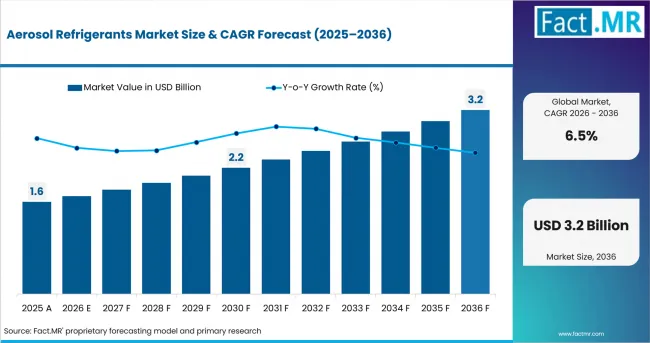
Aerosol Refrigerants Market Value Analysis

Metric Value
Estimated Value in 2026 USD 1.7 Billion
Forecast Value in 2036 USD 3.2 Billion
Forecast CAGR (2026 to 2036) 6.5%

Summary of the Aerosol Refrigerants Market

  • Demand Drivers
    • Cold chain expansion increases servicing demand across food storage and refrigerated transport assets.
    • Refrigerant transition regulations accelerate replacement demand for compliant refrigerant products.
    • Commercial refrigeration installations support recurring service consumption across retail and food processing facilities.
  • Key Segments Analyzed
    • By Type: Hydrofluorocarbons contribute 40.0% share in 2026 due to their extensive installed base across commercial refrigeration and automotive cooling systems.
    • By End Use: Food and Beverage accounts for 31.0% share supported by refrigeration demand across cold storage facilities and temperature-controlled logistics networks.
    • By Application: Commercial Refrigeration generates 35.0% share due to widespread deployment across supermarkets, convenience stores, food service outlets, and cold storage facilities.
    • By Aerosol Propellant: Hydrocarbon Propellants represent 45.0% share in 2026 supported by favorable environmental characteristics and cost competitiveness.
    • By Distribution Channel: Direct Sales contribute 60.0% share due to long-term supply agreements between refrigerant manufacturers and refrigeration service operators.
    • By Geography: India is projected to register 8.4% CAGR through 2036 supported by cold chain infrastructure expansion and rising refrigeration equipment deployment.
  • Analyst Opinion at Fact.MR
    • Shambhu Nath Jha, Principal Consultant at Fact.MR opines, "Refrigerant transition timing and servicing intensity will shape revenue opportunities across aerosol refrigerant suppliers. Suppliers with compliant product portfolios and strong service channel access are expected to strengthen their competitive position during the forecast period."
  • Strategic Implications
    • Portfolio Expansion: Suppliers should expand low emission refrigerant portfolios to align with changing environmental regulations. A broader compliant product range can improve market access and customer retention.
    • Distribution Strengthening: Distribution partnerships can improve product availability across refrigeration service networks. Strong channel coverage supports faster response to replacement demand.
    • Technical Support Investment: Investment in technical support can improve product adoption across servicing applications. Training and application guidance help increase conversion of replacement opportunities.

The market is projected to add USD 1.5 billion in new value between 2026 and 2036. Growth is supported by cold storage expansion and refrigerant replacement activity. Adoption is constrained by compliance costs linked to refrigerant transition regulations.

Country level growth varies across industrial and cold chain investment cycles. India is projected to expand at 8.4% CAGR due to cold chain capacity additions. China is projected to grow at 7.8% CAGR supported by commercial refrigeration installations. Brazil is expected to record 7.2% CAGR due to food export infrastructure investment. Mexico is forecast at 6.9% CAGR supported by manufacturing activity linked to North American supply chains. The United States is projected to expand at 5.8% CAGR due to refrigerant replacement demand. Germany is forecast at 5.4% CAGR as efficiency upgrades support steady equipment servicing demand.

Segmental Analysis

Aerosol Refrigerants Market Analysis by Type
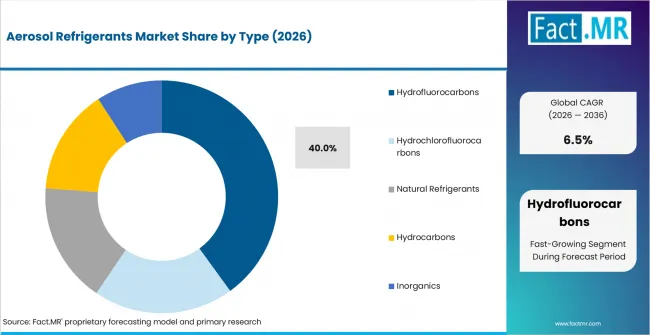
Aerosol Refrigerants Market Analysis By Type

Hydrofluorocarbons contribute 40.0% share in 2026. This segment benefits from a large installed refrigeration base across commercial facilities and automotive cooling systems. Service technicians continue using compatible refrigerants across existing equipment fleets. Chemours announced it would discontinue U.S. sales of legacy Freon™ R-404A and R-507 refrigerants as part of the transition toward lower-GWP alternatives under evolving HFC regulations. The move accelerates demand for next-generation refrigerants used across HVAC system and refrigeration servicing markets. [1]

  • Installed Base: Commercial refrigeration fleets across North America maintain substantial HFC demand due to equipment compatibility requirements.
  • Service Demand: Refrigeration contractors prioritize proven refrigerants for maintenance activity across retail and food storage assets.
  • Transition Pressure: Environmental regulations are encouraging gradual movement toward natural refrigerants and hydrofluoroolefin alternatives.

Aerosol Refrigerants Market Analysis by End Use
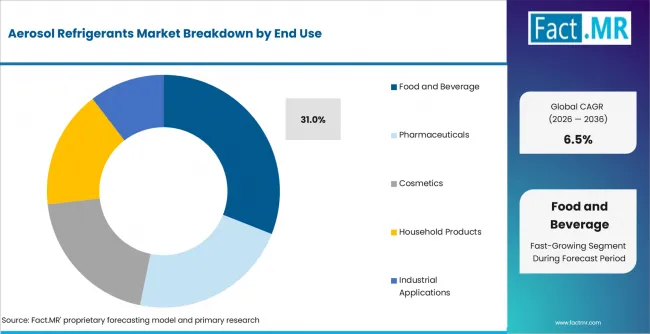
Aerosol Refrigerants Market Analysis By End Use

Food and Beverage is projected to hold 31.0% share in 2026. Refrigeration intensity across food storage and transport operations supports consistent servicing requirements. Cold chain expansion increases refrigerant consumption across distribution infrastructure. U.S. fedral court upheld EPA regulations implementing the AIM Act HFC phasedown program. The ruling supports long-term adoption of lower-GWP refrigerants and reshapes refrigerant product demand across the industry. [2]

  • Storage Expansion: Cold warehouse investments support refrigerant demand across food preservation facilities.
  • Distribution Networks: Refrigerated transportation fleets require regular maintenance and refrigerant replacement.
  • Export Activity: Food export growth supports additional cold storage capacity across emerging economies.

Aerosol Refrigerants Market Analysis by Application
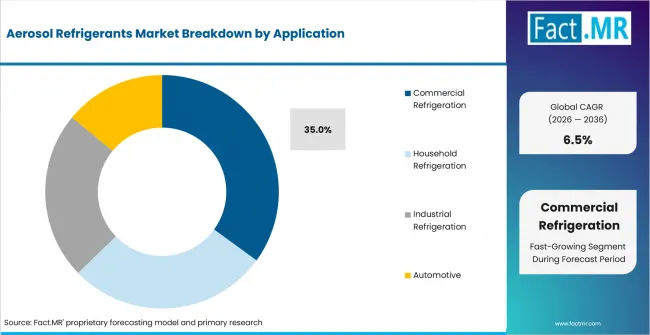
Aerosol Refrigerants Market Analysis By Application

Commercial Refrigeration is estimated to account for 35.0% share in 2026. Supermarkets and convenience stores operate extensive cooling equipment fleets. Frequent servicing cycles support recurring aerosol refrigerant consumption. Daikin announced the introduction of a new VRV range using R-744 (CO₂) refrigerant for European markets, with commercial launch planned for April 2025. The development expands the adoption of natural refrigerants and supports the transition away from high-GWP refrigerants. [3]

  • Retail Expansion: New grocery outlets increase refrigeration equipment deployment.
  • Maintenance Cycles: Refrigeration systems require periodic servicing throughout operational life.
  • Cold Storage Demand: Warehousing facilities support stable refrigerant replacement activity.

Aerosol Refrigerants Market Analysis by Aerosol Propellant
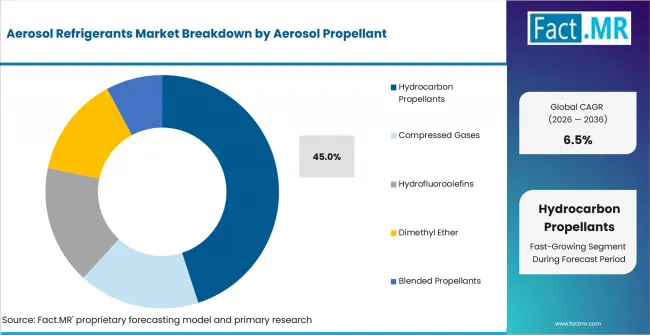
Aerosol Refrigerants Market Analysis By Aerosol Propellant

Hydrocarbon Propellants represent 45.0% share in 2026. Their adoption reflects cost competitiveness and lower environmental impact compared with traditional alternatives. Regulatory preference supports wider acceptance across multiple regions. Chemours introduced a new retrofit approach enabling vehicles using R-134a refrigerant to transition to Opteon™ YF (R-1234yf). This development supports the growing automotive refrigerant recharge and aftermarket service sector. [4]

  • Cost Position: Hydrocarbon propellants offer attractive operating economics.
  • Environmental Profile: Lower emission characteristics support adoption across regulated markets.
  • Product Availability: Supplier investment supports wider commercial availability.

Aerosol Refrigerants Market Analysis by Distribution Channel
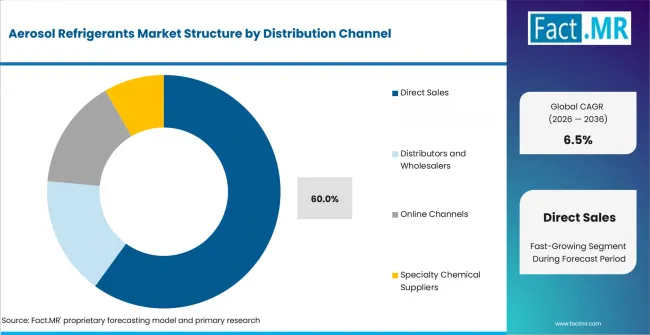
Aerosol Refrigerants Market Analysis By Distribution Channel

Direct Sales contribute 60.0% share in 2026. Refrigeration contractors and industrial operators prefer direct sourcing relationships. Contract supply arrangements support consistent product availability. Daikin announced that it would showcase HVAC solutions using multiple low-GWP refrigerants, including R-290, R-454C, R-32, and CO₂, at ISH 2025. The company also confirmed the upcoming debut of its new CO₂ VRV system, highlighting the industry's transition toward alternative refrigerants and lower-emission cooling technologies. [5]

  • Supply Assurance: Direct agreements improve inventory planning for industrial operators.
  • Technical Support: Manufacturers provide product guidance through direct engagement.
  • Volume Contracts: Large refrigeration fleets source products through negotiated supply agreements.

Drivers, Restraints, and Opportunities
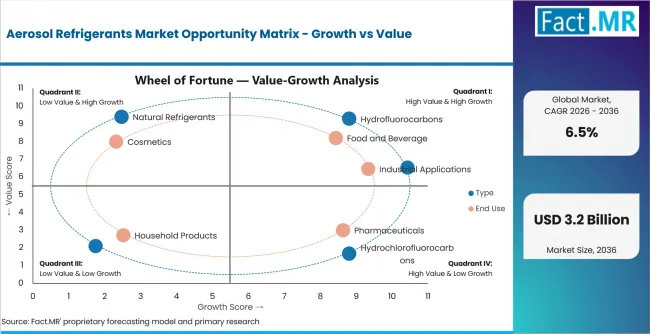
Aerosol Refrigerants Market Opportunity Matrix Growth Vs Value

Aerosol refrigerant demand is linked to refrigeration servicing activity and installed equipment volume. Market value reflects replacement demand across commercial refrigeration equipment and automotive cooling systems. Regulatory transition programs influence refrigerant selection across developed economies.

The market is shifting toward lower global warming potential refrigerants. Legacy refrigerants face regulatory pressure across North America and Europe. New refrigerant formulations command higher pricing which supports value growth despite gradual volume transition.

  • Cold Chain Expansion: Food producers and logistics operators are increasing investment in refrigerated storage and transportation infrastructure. Higher refrigeration capacity supports recurring demand for aerosol refrigerants and servicing products.
  • Refrigerant Transition Programs: Environmental regulations are accelerating adoption of lower emission refrigerant technologies. Replacement of legacy refrigerants supports demand for compliant aerosol refrigerant solutions.
  • Compliance and Cost Pressure: Adoption is constrained by regulatory requirements and refrigerant transition costs. Product qualification standards and equipment compatibility considerations influence replacement timelines.

Regional Analysis

The aerosol refrigerants market is assessed across North America, Europe, East Asia, South Asia & Oceania, Latin America, and the Middle East & Africa. The study evaluates refrigeration infrastructure expansion, refrigerant transition activity, cold chain investment, servicing demand, environmental compliance requirements, and commercial refrigeration deployment across major countries.

Top Country Growth Comparison Aerosol Refrigerants Market Cagr (2026 2036)

Country CAGR
India 8.4%
China 7.8%
Brazil 7.2%
Mexico 6.9%
United States 5.8%
Germany 5.4%

Source: Fact.MR analysis based on refrigeration equipment deployment, refrigerant transition programs, trade activity, and industry interviews.
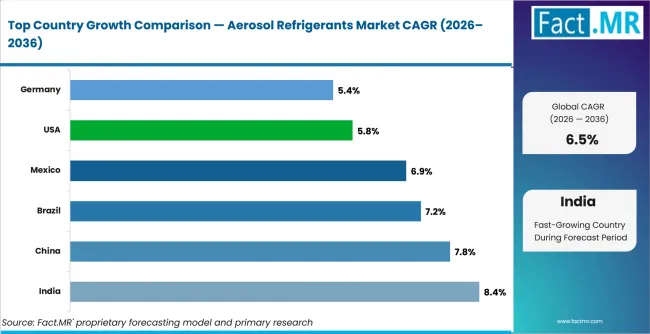
Aerosol Refrigerants Market Cagr Analysis By Country

Sales Analysis of Aerosol Refrigerants Market in India

India is projected to expand at 8.4% CAGR due to rising cold chain investment and refrigerated food distribution capacity. Government backed cold storage expansion is supporting refrigeration equipment installations across food logistics networks. Commercial refrigeration deployment is increasing across organized retail facilities. Demand is attributable to food preservation requirements and refrigeration servicing activity.

  • Cold chain expansion supports refrigerant consumption.
  • Organized retail growth increases refrigeration equipment deployment.
  • Servicing demand strengthens replacement refrigerant sales.

Demand Outlook for Aerosol Refrigerants Market in China

Supported by commercial refrigeration expansion programs, China is expected to witness 7.8% CAGR through 2036. Refrigeration equipment manufacturing activity supports widespread refrigerant usage across retail and industrial facilities. Food distribution modernization is increasing demand for cooling infrastructure. Growth reflects refrigeration system expansion and aftermarket servicing requirements.

  • Commercial refrigeration installations support refrigerant demand.
  • Domestic manufacturing capacity improves product availability.
  • Food logistics investment strengthens consumption growth.

Opportunity Analysis of Aerosol Refrigerants Market in Brazil

Brazil is forecast to grow at 7.2% CAGR by 2036 as food export activity increases refrigerated storage requirements. Agricultural processing facilities are investing in cold storage infrastructure to maintain product quality. Refrigeration servicing demand is expanding across logistics operations. Growth is supported by export driven refrigeration capacity additions.

  • Food export activity supports cold storage investment.
  • Refrigerated logistics networks increase servicing demand.
  • Agricultural processing expansion strengthens consumption.

Demand Assessment of Aerosol Refrigerants Market in Mexico

Mexico is projected to expand at 6.9% CAGR supported by industrial manufacturing growth and food distribution investment. Refrigeration equipment deployment is increasing across production facilities and logistics centers. Supply chain integration with North America supports cooling infrastructure demand. Growth reflects industrial expansion and refrigeration servicing requirements.

  • Manufacturing investment supports cooling system deployment.
  • Distribution networks increase refrigerant usage.
  • Equipment servicing creates recurring replacement demand.

In-depth Analysis of Aerosol Refrigerants Market in United States
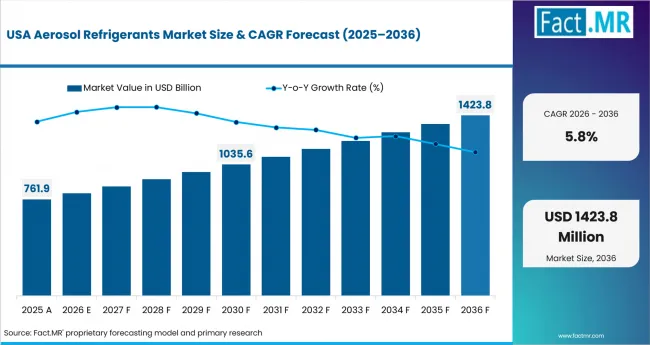
Aerosol Refrigerants Market Country Value Analysis

The United States is projected to register 5.8% CAGR through 2036 supported by refrigerant replacement activity and regulatory transition programs. Commercial refrigeration operators are upgrading systems to comply with environmental requirements. The installed refrigeration base supports recurring maintenance demand. Growth reflects replacement cycles and compliance driven refrigerant adoption.

  • Refrigerant transition programs support product replacement.
  • Commercial refrigeration upgrades increase servicing activity.
  • Environmental compliance supports newer refrigerant adoption.

Demand Outlook for Aerosol Refrigerants Market in Germany

Germany reflects steady demand and is expected to expand at 5.4% CAGR by 2036. Industrial refrigeration operators are investing in energy efficient cooling systems. Equipment modernization programs support refrigerant replacement activity. Growth is attributable to refrigeration upgrades and compliance requirements.

  • Industrial refrigeration modernization supports demand.
  • Energy efficiency targets influence refrigerant selection.
  • Replacement cycles sustain market expansion.

Competitive Aligners for Market Players
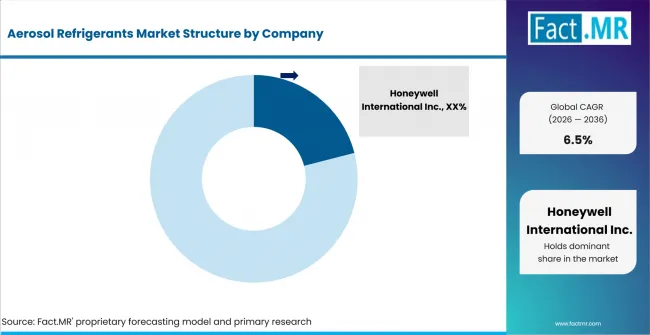
Aerosol Refrigerants Market Analysis By Company

The aerosol refrigerants market reflects a moderately consolidated structure. Global refrigerant manufacturers account for a substantial share of industry revenue. Product availability, regulatory compliance, and distribution reach influence competitive positioning across major regions. Suppliers with established refrigerant portfolios benefit from long standing relationships with refrigeration contractors and industrial service networks.

Large manufacturers benefit from refrigerant development capabilities and established distribution infrastructure. Technical support services and product certification strengthen supplier engagement with refrigeration service firms. Geographic manufacturing presence improves supply reliability and reduces delivery risk across regional markets. Investment in lower global warming potential refrigerants is strengthening competitive differentiation among leading suppliers. Competition is increasingly influenced by regulatory transition requirements. Refrigerant producers are expanding compliant product portfolios to align with evolving environmental standards across North America and Europe. Companies with proven replacement solutions and application support capabilities are improving access to commercial refrigeration and automotive servicing channels. Product compatibility remains an important factor in supplier selection.

Commercial refrigeration operators prioritize product consistency and regulatory compliance. Long term supply arrangements influence sourcing decisions and inventory planning. Service contractors prefer suppliers with stable product availability and technical guidance. Pricing discipline remains linked to refrigerant raw material exposure and environmental compliance requirements. Suppliers that combine regulatory expertise with dependable distribution networks are positioned to strengthen market presence through the forecast period.

Key Players

  • Solstice Advanced Materials
  • The Chemours Company
  • Arkema S.A.
  • Daikin Industries Ltd.
  • A-Gas International Ltd.

Bibliography

  • [1] The Chemours Company. (2024, May 2). Chemours discontinues U.S. sales of legacy Freon™ refrigerants 404A and 507.
  • [2] Garry, M. (2025, August 9). U.S. federal court upholds HFC reduction under AIM Act. Natural Refrigerants.
  • [3] Daikin Europe N.V. (2024, November 28). Daikin’s strategic vision in the VRF market: Introducing CO2 VRV in Europe.
  • [4] The Chemours Company. (2024, September 9). Chemours announces development of a low GWP retrofit approach for vehicles using the legacy R-134a mobile air conditioning refrigerant.
  • [5] Daikin Europe N.V. (2024, October 28). ISH 2025: Daikin to present heat pump innovations and HVAC solutions for a sustainable future.

This Report Addresses

  • Assessment of aerosol refrigerants market size and forecast from 2026 to 2036.
  • Analysis of revenue opportunities across type, end use, application, propellant, and distribution segments.
  • Country level demand assessment across major refrigeration markets.
  • Evaluation of refrigerant transition regulations and their commercial impact.
  • Competitive benchmarking of leading refrigerant manufacturers and suppliers.
  • Analysis of cold chain expansion and refrigeration servicing demand trends.
  • Review of product positioning across established and emerging refrigerant technologies.
  • Market intelligence delivered through segment forecasts and regional assessments.

Aerosol Refrigerants Market Definition

Aerosol refrigerants are pressurized refrigerant products supplied in portable containers for cooling system servicing and maintenance activities. These products help restore refrigeration performance and support leak replacement requirements. Demand is concentrated in commercial refrigeration equipment and automotive air conditioning systems. Product consumption is linked to equipment servicing cycles and refrigerant transition requirements. Industrial refrigeration facilities and cold chain operators account for an important share of consumption across developed and developing economies.

Aerosol Refrigerants Market Inclusions

The report covers global aerosol refrigerants market valuation and forecast assessment from 2026 to 2036. Analysis includes type, end use, application, aerosol propellant, distribution channel, and regional demand. The study evaluates pricing trends, refrigerant transition activity, trade movement, and competitive positioning. Country level forecasts and segment level revenue estimates are included.

Aerosol Refrigerants Market Exclusions

The study excludes refrigeration compressors, cooling equipment manufacturing, and standalone air conditioning systems. Finished refrigeration equipment sales are outside the scope of assessment. The report excludes refrigerant recovery equipment and unrelated industrial gases. Analysis focuses on aerosol refrigerants and immediate service applications associated with refrigeration system maintenance.

Aerosol Refrigerants Market Research Methodology

  • Primary Research
    • Interviews with refrigerant suppliers, refrigeration service firms, distributors, and industry consultants. Inputs were collected from commercial refrigeration operators and automotive service networks.
  • Desk Research
    • Public company reports, government publications, trade association data, and refrigerant regulatory documents were reviewed. Industry announcements from 2024 through January 2026 were evaluated.
  • Market Sizing and Forecasting
    • A hybrid forecasting model was applied. Revenue estimates were developed through demand assessment and supplier benchmarking across major countries.
  • Data Validation and Update Cycle
    • Results were triangulated with primary interviews. Forecast was validated through distributor interviews and company disclosures across major markets.

Scope of Report

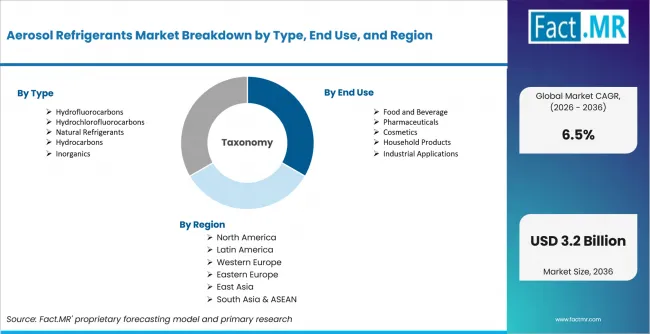
Aerosol Refrigerants Market Breakdown By Type, End Use, And Region

Attribute Details
Quantitative Units USD 1.7 Billion (2026) to USD 3.2 Billion (2036) at a CAGR of 6.5%
Market Definition Covers aerosol refrigerants used for refrigeration and cooling system servicing applications.
Type Segmentation Hydrofluorocarbons, Hydrochlorofluorocarbons, Natural Refrigerants, Hydrocarbons, Inorganics
End Use Segmentation Food and Beverage, Pharmaceuticals, Cosmetics, Household Products, Industrial Applications
Application Segmentation Automotive, Commercial Refrigeration, Household Refrigeration, Industrial Refrigeration
Aerosol Propellant Segmentation Hydrocarbon Propellants, Compressed Gases, Hydrofluoroolefins, Dimethyl Ether, Blended Propellants
Distribution Channel Segmentation Direct Sales, Distributors and Wholesalers, Online Channels, Specialty Chemical Suppliers
Regions Covered North America, Europe, East Asia, South Asia & Oceania, Latin America, Middle East & Africa
Countries Covered India, China, Brazil, Mexico, United States, Germany
Key Companies Profiled Solstice Advanced Materials, The Chemours Company, Arkema S.A., Daikin Industries Ltd., A-Gas International Ltd.
Forecast Period 2026 to 2036
Approach Hybrid top-down and bottom-up model using refrigerant demand and refrigeration servicing analysis.

Aerosol Refrigerants Market Segmentation

  • By Type

    • Hydrofluorocarbons
    • Hydrochlorofluorocarbons
    • Natural Refrigerants
    • Hydrocarbons
    • Inorganics
  • By End Use

    • Food and Beverage
    • Pharmaceuticals
    • Cosmetics
    • Household Products
    • Industrial Applications
  • By Application

    • Automotive
    • Commercial Refrigeration
    • Household Refrigeration
    • Industrial Refrigeration
  • By Aerosol Propellant

    • Hydrocarbon Propellants
    • Compressed Gases
    • Hydrofluoroolefins
    • Dimethyl Ether
    • Blended Propellants
  • By Distribution Channel

    • Direct Sales
    • Distributors and Wholesalers
    • Online Channels
    • Specialty Chemical Suppliers
  • By Region

    • North America
      • United States
      • Canada
      • Mexico
    • Latin America
      • Brazil
      • Argentina
      • Rest of Latin America
    • Europe
      • Germany
      • United Kingdom
      • France
      • Italy
      • Spain
      • Rest of Europe
    • Asia Pacific
      • China
      • India
      • Japan
      • South Korea
      • ASEAN
    • Middle East & Africa
      • GCC Countries
      • South Africa
      • UAE
      • Rest of Middle East & Africa

- Frequently Asked Questions -

How large is the aerosol refrigerants market in 2026?

The aerosol refrigerants market is estimated at USD 1.7 billion in 2026. Demand growth is supported by refrigeration servicing activity and cold chain infrastructure expansion.

What will be the aerosol refrigerants market size by 2036?

The aerosol refrigerants market is projected to reach USD 3.2 billion by 2036. Growth reflects refrigerant replacement demand and commercial refrigeration expansion.

What is the expected CAGR of the aerosol refrigerants market?

Fact.MR projects the aerosol refrigerants market to expand at a CAGR of 6.5% from 2026 to 2036. Growth is supported by refrigeration modernization activity.

Which type segment is projected to lead the aerosol refrigerants market?

Hydrofluorocarbons are projected to lead the market with an estimated 40.0% share in 2026. The segment benefits from a substantial installed equipment base.

Which end use segment contributes the leading revenue share?

Food and Beverage is expected to account for 31.0% share in 2026. Refrigerated storage and food logistics infrastructure support segment demand.

Which application segment is expected to generate strong demand?

Commercial Refrigeration is projected to represent 35.0% share in 2026. Extensive deployment across retail and cold storage facilities supports consumption.

Table of Content

  1. Executive Summary
    • Global Market Outlook
    • Demand to side Trends
    • Supply to side Trends
    • Technology Roadmap Analysis
    • Analysis and Recommendations
  2. Market Overview
    • Market Coverage / Taxonomy
    • Market Definition / Scope / Limitations
  3. Research Methodology
    • Chapter Orientation
    • Analytical Lens and Working Hypotheses
      • Market Structure, Signals, and Trend Drivers
      • Benchmarking and Cross-market Comparability
      • Market Sizing, Forecasting, and Opportunity Mapping
    • Research Design and Evidence Framework
      • Desk Research Programme (Secondary Evidence)
        • Company Annual and Sustainability Reports
        • Peer-reviewed Journals and Academic Literature
        • Corporate Websites, Product Literature, and Technical Notes
        • Earnings Decks and Investor Briefings
        • Statutory Filings and Regulatory Disclosures
        • Technical White Papers and Standards Notes
        • Trade Journals, Industry Magazines, and Analyst Briefs
        • Conference Proceedings, Webinars, and Seminar Materials
        • Government Statistics Portals and Public Data Releases
        • Press Releases and Reputable Media Coverage
        • Specialist Newsletters and Curated Briefings
        • Sector Databases and Reference Repositories
        • Fact.MR Internal Proprietary Databases and Historical Market Datasets
        • Subscription Datasets and Paid Sources
        • Social Channels, Communities, and Digital Listening Inputs
        • Additional Desk Sources
      • Expert Input and Fieldwork (Primary Evidence)
        • Primary Modes
          • Qualitative Interviews and Expert Elicitation
          • Quantitative Surveys and Structured Data Capture
          • Blended Approach
        • Why Primary Evidence is Used
        • Field Techniques
          • Interviews
          • Surveys
          • Focus Groups
          • Observational and In-context Research
          • Social and Community Interactions
        • Stakeholder Universe Engaged
          • C-suite Leaders
          • Board Members
          • Presidents and Vice Presidents
          • R&D and Innovation Heads
          • Technical Specialists
          • Domain Subject-matter Experts
          • Scientists
          • Physicians and Other Healthcare Professionals
        • Governance, Ethics, and Data Stewardship
          • Research Ethics
          • Data Integrity and Handling
      • Tooling, Models, and Reference Databases
    • Data Engineering and Model Build
      • Data Acquisition and Ingestion
      • Cleaning, Normalisation, and Verification
      • Synthesis, Triangulation, and Analysis
    • Quality Assurance and Audit Trail
  4. Market Background
    • Market Dynamics
      • Drivers
      • Restraints
      • Opportunity
      • Trends
    • Scenario Forecast
      • Demand in Optimistic Scenario
      • Demand in Likely Scenario
      • Demand in Conservative Scenario
    • Opportunity Map Analysis
    • Product Life Cycle Analysis
    • Supply Chain Analysis
    • Investment Feasibility Matrix
    • Value Chain Analysis
    • PESTLE and Porter’s Analysis
    • Regulatory Landscape
    • Regional Parent Market Outlook
    • Production and Consumption Statistics
    • Import and Export Statistics
  5. Global Market Analysis 2021 to 2025 and Forecast, 2026 to 2036
    • Historical Market Size Value (USD Million) Analysis, 2021 to 2025
    • Current and Future Market Size Value (USD Million) Projections, 2026 to 2036
      • Y to o to Y Growth Trend Analysis
      • Absolute $ Opportunity Analysis
  6. Global Market Pricing Analysis 2021 to 2025 and Forecast 2026 to 2036
  7. Global Market Analysis 2021 to 2025 and Forecast 2026 to 2036, By Type
    • Introduction / Key Findings
    • Historical Market Size Value (USD Million) Analysis By Type , 2021 to 2025
    • Current and Future Market Size Value (USD Million) Analysis and Forecast By Type , 2026 to 2036
      • Hydrofluorocarbons
      • Hydrochlorofluorocarbons
      • Natural Refrigerants
      • Hydrocarbons
      • Inorganics
    • Y to o to Y Growth Trend Analysis By Type , 2021 to 2025
    • Absolute $ Opportunity Analysis By Type , 2026 to 2036
  8. Global Market Analysis 2021 to 2025 and Forecast 2026 to 2036, By End Use
    • Introduction / Key Findings
    • Historical Market Size Value (USD Million) Analysis By End Use, 2021 to 2025
    • Current and Future Market Size Value (USD Million) Analysis and Forecast By End Use, 2026 to 2036
      • Food and Beverage
      • Pharmaceuticals
      • Cosmetics
      • Household Products
      • Industrial Applications
    • Y to o to Y Growth Trend Analysis By End Use, 2021 to 2025
    • Absolute $ Opportunity Analysis By End Use, 2026 to 2036
  9. Global Market Analysis 2021 to 2025 and Forecast 2026 to 2036, By Application
    • Introduction / Key Findings
    • Historical Market Size Value (USD Million) Analysis By Application, 2021 to 2025
    • Current and Future Market Size Value (USD Million) Analysis and Forecast By Application, 2026 to 2036
      • Commercial Refrigeration
      • Household Refrigeration
      • Industrial Refrigeration
      • Automotive
    • Y to o to Y Growth Trend Analysis By Application, 2021 to 2025
    • Absolute $ Opportunity Analysis By Application, 2026 to 2036
  10. Global Market Analysis 2021 to 2025 and Forecast 2026 to 2036, By Aerosol Propellant
    • Introduction / Key Findings
    • Historical Market Size Value (USD Million) Analysis By Aerosol Propellant, 2021 to 2025
    • Current and Future Market Size Value (USD Million) Analysis and Forecast By Aerosol Propellant, 2026 to 2036
      • Hydrocarbon Propellants
      • Compressed Gases
      • Hydrofluoroolefins
      • Dimethyl Ether
      • Blended Propellants
    • Y to o to Y Growth Trend Analysis By Aerosol Propellant, 2021 to 2025
    • Absolute $ Opportunity Analysis By Aerosol Propellant, 2026 to 2036
  11. Global Market Analysis 2021 to 2025 and Forecast 2026 to 2036, By Distribution Channel
    • Introduction / Key Findings
    • Historical Market Size Value (USD Million) Analysis By Distribution Channel, 2021 to 2025
    • Current and Future Market Size Value (USD Million) Analysis and Forecast By Distribution Channel, 2026 to 2036
      • Direct Sales
      • Distributors and Wholesalers
      • Online Channels
      • Specialty Chemical Suppliers
    • Y to o to Y Growth Trend Analysis By Distribution Channel, 2021 to 2025
    • Absolute $ Opportunity Analysis By Distribution Channel, 2026 to 2036
  12. Global Market Analysis 2021 to 2025 and Forecast 2026 to 2036, By Region
    • Introduction
    • Historical Market Size Value (USD Million) Analysis By Region, 2021 to 2025
    • Current Market Size Value (USD Million) Analysis and Forecast By Region, 2026 to 2036
      • North America
      • Latin America
      • Western Europe
      • Eastern Europe
      • East Asia
      • South Asia and Pacific
      • Middle East & Africa
    • Market Attractiveness Analysis By Region
  13. North America Market Analysis 2021 to 2025 and Forecast 2026 to 2036, By Country
    • Historical Market Size Value (USD Million) Trend Analysis By Market Taxonomy, 2021 to 2025
    • Market Size Value (USD Million) Forecast By Market Taxonomy, 2026 to 2036
      • By Country
        • USA
        • Canada
        • Mexico
      • By Type
      • By End Use
      • By Application
      • By Aerosol Propellant
      • By Distribution Channel
    • Market Attractiveness Analysis
      • By Country
      • By Type
      • By End Use
      • By Application
      • By Aerosol Propellant
      • By Distribution Channel
    • Key Takeaways
  14. Latin America Market Analysis 2021 to 2025 and Forecast 2026 to 2036, By Country
    • Historical Market Size Value (USD Million) Trend Analysis By Market Taxonomy, 2021 to 2025
    • Market Size Value (USD Million) Forecast By Market Taxonomy, 2026 to 2036
      • By Country
        • Brazil
        • Chile
        • Rest of Latin America
      • By Type
      • By End Use
      • By Application
      • By Aerosol Propellant
      • By Distribution Channel
    • Market Attractiveness Analysis
      • By Country
      • By Type
      • By End Use
      • By Application
      • By Aerosol Propellant
      • By Distribution Channel
    • Key Takeaways
  15. Western Europe Market Analysis 2021 to 2025 and Forecast 2026 to 2036, By Country
    • Historical Market Size Value (USD Million) Trend Analysis By Market Taxonomy, 2021 to 2025
    • Market Size Value (USD Million) Forecast By Market Taxonomy, 2026 to 2036
      • By Country
        • Germany
        • UK
        • Italy
        • Spain
        • France
        • Nordic
        • BENELUX
        • Rest of Western Europe
      • By Type
      • By End Use
      • By Application
      • By Aerosol Propellant
      • By Distribution Channel
    • Market Attractiveness Analysis
      • By Country
      • By Type
      • By End Use
      • By Application
      • By Aerosol Propellant
      • By Distribution Channel
    • Key Takeaways
  16. Eastern Europe Market Analysis 2021 to 2025 and Forecast 2026 to 2036, By Country
    • Historical Market Size Value (USD Million) Trend Analysis By Market Taxonomy, 2021 to 2025
    • Market Size Value (USD Million) Forecast By Market Taxonomy, 2026 to 2036
      • By Country
        • Russia
        • Poland
        • Hungary
        • Balkan & Baltic
        • Rest of Eastern Europe
      • By Type
      • By End Use
      • By Application
      • By Aerosol Propellant
      • By Distribution Channel
    • Market Attractiveness Analysis
      • By Country
      • By Type
      • By End Use
      • By Application
      • By Aerosol Propellant
      • By Distribution Channel
    • Key Takeaways
  17. East Asia Market Analysis 2021 to 2025 and Forecast 2026 to 2036, By Country
    • Historical Market Size Value (USD Million) Trend Analysis By Market Taxonomy, 2021 to 2025
    • Market Size Value (USD Million) Forecast By Market Taxonomy, 2026 to 2036
      • By Country
        • China
        • Japan
        • South Korea
      • By Type
      • By End Use
      • By Application
      • By Aerosol Propellant
      • By Distribution Channel
    • Market Attractiveness Analysis
      • By Country
      • By Type
      • By End Use
      • By Application
      • By Aerosol Propellant
      • By Distribution Channel
    • Key Takeaways
  18. South Asia and Pacific Market Analysis 2021 to 2025 and Forecast 2026 to 2036, By Country
    • Historical Market Size Value (USD Million) Trend Analysis By Market Taxonomy, 2021 to 2025
    • Market Size Value (USD Million) Forecast By Market Taxonomy, 2026 to 2036
      • By Country
        • India
        • ASEAN
        • Australia & New Zealand
        • Rest of South Asia and Pacific
      • By Type
      • By End Use
      • By Application
      • By Aerosol Propellant
      • By Distribution Channel
    • Market Attractiveness Analysis
      • By Country
      • By Type
      • By End Use
      • By Application
      • By Aerosol Propellant
      • By Distribution Channel
    • Key Takeaways
  19. Middle East & Africa Market Analysis 2021 to 2025 and Forecast 2026 to 2036, By Country
    • Historical Market Size Value (USD Million) Trend Analysis By Market Taxonomy, 2021 to 2025
    • Market Size Value (USD Million) Forecast By Market Taxonomy, 2026 to 2036
      • By Country
        • Kingdom of Saudi Arabia
        • Other GCC Countries
        • Turkiye
        • South Africa
        • Other African Union
        • Rest of Middle East & Africa
      • By Type
      • By End Use
      • By Application
      • By Aerosol Propellant
      • By Distribution Channel
    • Market Attractiveness Analysis
      • By Country
      • By Type
      • By End Use
      • By Application
      • By Aerosol Propellant
      • By Distribution Channel
    • Key Takeaways
  20. Key Countries Market Analysis
    • USA
      • Pricing Analysis
      • Market Share Analysis, 2025
        • By Type
        • By End Use
        • By Application
        • By Aerosol Propellant
        • By Distribution Channel
    • Canada
      • Pricing Analysis
      • Market Share Analysis, 2025
        • By Type
        • By End Use
        • By Application
        • By Aerosol Propellant
        • By Distribution Channel
    • Mexico
      • Pricing Analysis
      • Market Share Analysis, 2025
        • By Type
        • By End Use
        • By Application
        • By Aerosol Propellant
        • By Distribution Channel
    • Brazil
      • Pricing Analysis
      • Market Share Analysis, 2025
        • By Type
        • By End Use
        • By Application
        • By Aerosol Propellant
        • By Distribution Channel
    • Chile
      • Pricing Analysis
      • Market Share Analysis, 2025
        • By Type
        • By End Use
        • By Application
        • By Aerosol Propellant
        • By Distribution Channel
    • Germany
      • Pricing Analysis
      • Market Share Analysis, 2025
        • By Type
        • By End Use
        • By Application
        • By Aerosol Propellant
        • By Distribution Channel
    • UK
      • Pricing Analysis
      • Market Share Analysis, 2025
        • By Type
        • By End Use
        • By Application
        • By Aerosol Propellant
        • By Distribution Channel
    • Italy
      • Pricing Analysis
      • Market Share Analysis, 2025
        • By Type
        • By End Use
        • By Application
        • By Aerosol Propellant
        • By Distribution Channel
    • Spain
      • Pricing Analysis
      • Market Share Analysis, 2025
        • By Type
        • By End Use
        • By Application
        • By Aerosol Propellant
        • By Distribution Channel
    • France
      • Pricing Analysis
      • Market Share Analysis, 2025
        • By Type
        • By End Use
        • By Application
        • By Aerosol Propellant
        • By Distribution Channel
    • India
      • Pricing Analysis
      • Market Share Analysis, 2025
        • By Type
        • By End Use
        • By Application
        • By Aerosol Propellant
        • By Distribution Channel
    • ASEAN
      • Pricing Analysis
      • Market Share Analysis, 2025
        • By Type
        • By End Use
        • By Application
        • By Aerosol Propellant
        • By Distribution Channel
    • Australia & New Zealand
      • Pricing Analysis
      • Market Share Analysis, 2025
        • By Type
        • By End Use
        • By Application
        • By Aerosol Propellant
        • By Distribution Channel
    • China
      • Pricing Analysis
      • Market Share Analysis, 2025
        • By Type
        • By End Use
        • By Application
        • By Aerosol Propellant
        • By Distribution Channel
    • Japan
      • Pricing Analysis
      • Market Share Analysis, 2025
        • By Type
        • By End Use
        • By Application
        • By Aerosol Propellant
        • By Distribution Channel
    • South Korea
      • Pricing Analysis
      • Market Share Analysis, 2025
        • By Type
        • By End Use
        • By Application
        • By Aerosol Propellant
        • By Distribution Channel
    • Russia
      • Pricing Analysis
      • Market Share Analysis, 2025
        • By Type
        • By End Use
        • By Application
        • By Aerosol Propellant
        • By Distribution Channel
    • Poland
      • Pricing Analysis
      • Market Share Analysis, 2025
        • By Type
        • By End Use
        • By Application
        • By Aerosol Propellant
        • By Distribution Channel
    • Hungary
      • Pricing Analysis
      • Market Share Analysis, 2025
        • By Type
        • By End Use
        • By Application
        • By Aerosol Propellant
        • By Distribution Channel
    • Kingdom of Saudi Arabia
      • Pricing Analysis
      • Market Share Analysis, 2025
        • By Type
        • By End Use
        • By Application
        • By Aerosol Propellant
        • By Distribution Channel
    • Turkiye
      • Pricing Analysis
      • Market Share Analysis, 2025
        • By Type
        • By End Use
        • By Application
        • By Aerosol Propellant
        • By Distribution Channel
    • South Africa
      • Pricing Analysis
      • Market Share Analysis, 2025
        • By Type
        • By End Use
        • By Application
        • By Aerosol Propellant
        • By Distribution Channel
  21. Market Structure Analysis
    • Competition Dashboard
    • Competition Benchmarking
    • Market Share Analysis of Top Players
      • By Regional
      • By Type
      • By End Use
      • By Application
      • By Aerosol Propellant
      • By Distribution Channel
  22. Competition Analysis
    • Competition Deep Dive
      • Solstice Advanced Materials
        • Overview
        • Product Portfolio
        • Profitability by Market Segments (Product/Age /Sales Channel/Region)
        • Sales Footprint
        • Strategy Overview
          • Marketing Strategy
          • Product Strategy
          • Channel Strategy
      • The Chemours Company
      • Arkema S.A.
      • Daikin Industries Ltd.
      • A-Gas International Ltd.
  23. Assumptions & Acronyms Used

List Of Table

  • Table 1: Global Market Value (USD Million) Forecast by Region, 2021 to 2036
  • Table 2: Global Market Value (USD Million) Forecast by Type, 2021 to 2036
  • Table 3: Global Market Value (USD Million) Forecast by End Use, 2021 to 2036
  • Table 4: Global Market Value (USD Million) Forecast by Application, 2021 to 2036
  • Table 5: Global Market Value (USD Million) Forecast by Aerosol Propellant, 2021 to 2036
  • Table 6: Global Market Value (USD Million) Forecast by Distribution Channel, 2021 to 2036
  • Table 7: North America Market Value (USD Million) Forecast by Country, 2021 to 2036
  • Table 8: North America Market Value (USD Million) Forecast by Type, 2021 to 2036
  • Table 9: North America Market Value (USD Million) Forecast by End Use, 2021 to 2036
  • Table 10: North America Market Value (USD Million) Forecast by Application, 2021 to 2036
  • Table 11: North America Market Value (USD Million) Forecast by Aerosol Propellant, 2021 to 2036
  • Table 12: North America Market Value (USD Million) Forecast by Distribution Channel, 2021 to 2036
  • Table 13: Latin America Market Value (USD Million) Forecast by Country, 2021 to 2036
  • Table 14: Latin America Market Value (USD Million) Forecast by Type, 2021 to 2036
  • Table 15: Latin America Market Value (USD Million) Forecast by End Use, 2021 to 2036
  • Table 16: Latin America Market Value (USD Million) Forecast by Application, 2021 to 2036
  • Table 17: Latin America Market Value (USD Million) Forecast by Aerosol Propellant, 2021 to 2036
  • Table 18: Latin America Market Value (USD Million) Forecast by Distribution Channel, 2021 to 2036
  • Table 19: Western Europe Market Value (USD Million) Forecast by Country, 2021 to 2036
  • Table 20: Western Europe Market Value (USD Million) Forecast by Type, 2021 to 2036
  • Table 21: Western Europe Market Value (USD Million) Forecast by End Use, 2021 to 2036
  • Table 22: Western Europe Market Value (USD Million) Forecast by Application, 2021 to 2036
  • Table 23: Western Europe Market Value (USD Million) Forecast by Aerosol Propellant, 2021 to 2036
  • Table 24: Western Europe Market Value (USD Million) Forecast by Distribution Channel, 2021 to 2036
  • Table 25: Eastern Europe Market Value (USD Million) Forecast by Country, 2021 to 2036
  • Table 26: Eastern Europe Market Value (USD Million) Forecast by Type, 2021 to 2036
  • Table 27: Eastern Europe Market Value (USD Million) Forecast by End Use, 2021 to 2036
  • Table 28: Eastern Europe Market Value (USD Million) Forecast by Application, 2021 to 2036
  • Table 29: Eastern Europe Market Value (USD Million) Forecast by Aerosol Propellant, 2021 to 2036
  • Table 30: Eastern Europe Market Value (USD Million) Forecast by Distribution Channel, 2021 to 2036
  • Table 31: East Asia Market Value (USD Million) Forecast by Country, 2021 to 2036
  • Table 32: East Asia Market Value (USD Million) Forecast by Type, 2021 to 2036
  • Table 33: East Asia Market Value (USD Million) Forecast by End Use, 2021 to 2036
  • Table 34: East Asia Market Value (USD Million) Forecast by Application, 2021 to 2036
  • Table 35: East Asia Market Value (USD Million) Forecast by Aerosol Propellant, 2021 to 2036
  • Table 36: East Asia Market Value (USD Million) Forecast by Distribution Channel, 2021 to 2036
  • Table 37: South Asia and Pacific Market Value (USD Million) Forecast by Country, 2021 to 2036
  • Table 38: South Asia and Pacific Market Value (USD Million) Forecast by Type, 2021 to 2036
  • Table 39: South Asia and Pacific Market Value (USD Million) Forecast by End Use, 2021 to 2036
  • Table 40: South Asia and Pacific Market Value (USD Million) Forecast by Application, 2021 to 2036
  • Table 41: South Asia and Pacific Market Value (USD Million) Forecast by Aerosol Propellant, 2021 to 2036
  • Table 42: South Asia and Pacific Market Value (USD Million) Forecast by Distribution Channel, 2021 to 2036
  • Table 43: Middle East & Africa Market Value (USD Million) Forecast by Country, 2021 to 2036
  • Table 44: Middle East & Africa Market Value (USD Million) Forecast by Type, 2021 to 2036
  • Table 45: Middle East & Africa Market Value (USD Million) Forecast by End Use, 2021 to 2036
  • Table 46: Middle East & Africa Market Value (USD Million) Forecast by Application, 2021 to 2036
  • Table 47: Middle East & Africa Market Value (USD Million) Forecast by Aerosol Propellant, 2021 to 2036
  • Table 48: Middle East & Africa Market Value (USD Million) Forecast by Distribution Channel, 2021 to 2036

List Of Figures

  • Figure 1: Global Market Pricing Analysis
  • Figure 2: Global Market Value (USD Million) Forecast 2021-2036
  • Figure 3: Global Market Value Share and BPS Analysis by Type, 2026 and 2036
  • Figure 4: Global Market Y-o-Y Growth Comparison by Type, 2026 to 2036
  • Figure 5: Global Market Attractiveness Analysis by Type
  • Figure 6: Global Market Value Share and BPS Analysis by End Use, 2026 and 2036
  • Figure 7: Global Market Y-o-Y Growth Comparison by End Use, 2026 to 2036
  • Figure 8: Global Market Attractiveness Analysis by End Use
  • Figure 9: Global Market Value Share and BPS Analysis by Application, 2026 and 2036
  • Figure 10: Global Market Y-o-Y Growth Comparison by Application, 2026 to 2036
  • Figure 11: Global Market Attractiveness Analysis by Application
  • Figure 12: Global Market Value Share and BPS Analysis by Aerosol Propellant, 2026 and 2036
  • Figure 13: Global Market Y-o-Y Growth Comparison by Aerosol Propellant, 2026 to 2036
  • Figure 14: Global Market Attractiveness Analysis by Aerosol Propellant
  • Figure 15: Global Market Value Share and BPS Analysis by Distribution Channel, 2026 and 2036
  • Figure 16: Global Market Y-o-Y Growth Comparison by Distribution Channel, 2026 to 2036
  • Figure 17: Global Market Attractiveness Analysis by Distribution Channel
  • Figure 18: Global Market Value (USD Million) Share and BPS Analysis by Region, 2026 and 2036
  • Figure 19: Global Market Y-o-Y Growth Comparison by Region, 2026 to 2036
  • Figure 20: Global Market Attractiveness Analysis by Region
  • Figure 21: North America Market Incremental Dollar Opportunity, 2026 to 2036
  • Figure 22: Latin America Market Incremental Dollar Opportunity, 2026 to 2036
  • Figure 23: Western Europe Market Incremental Dollar Opportunity, 2026 to 2036
  • Figure 24: Eastern Europe Market Incremental Dollar Opportunity, 2026 to 2036
  • Figure 25: East Asia Market Incremental Dollar Opportunity, 2026 to 2036
  • Figure 26: South Asia and Pacific Market Incremental Dollar Opportunity, 2026 to 2036
  • Figure 27: Middle East & Africa Market Incremental Dollar Opportunity, 2026 to 2036
  • Figure 28: North America Market Value Share and BPS Analysis by Country, 2026 and 2036
  • Figure 29: North America Market Value Share and BPS Analysis by Type, 2026 and 2036
  • Figure 30: North America Market Y-o-Y Growth Comparison by Type, 2026 to 2036
  • Figure 31: North America Market Attractiveness Analysis by Type
  • Figure 32: North America Market Value Share and BPS Analysis by End Use, 2026 and 2036
  • Figure 33: North America Market Y-o-Y Growth Comparison by End Use, 2026 to 2036
  • Figure 34: North America Market Attractiveness Analysis by End Use
  • Figure 35: North America Market Value Share and BPS Analysis by Application, 2026 and 2036
  • Figure 36: North America Market Y-o-Y Growth Comparison by Application, 2026 to 2036
  • Figure 37: North America Market Attractiveness Analysis by Application
  • Figure 38: North America Market Value Share and BPS Analysis by Aerosol Propellant, 2026 and 2036
  • Figure 39: North America Market Y-o-Y Growth Comparison by Aerosol Propellant, 2026 to 2036
  • Figure 40: North America Market Attractiveness Analysis by Aerosol Propellant
  • Figure 41: North America Market Value Share and BPS Analysis by Distribution Channel, 2026 and 2036
  • Figure 42: North America Market Y-o-Y Growth Comparison by Distribution Channel, 2026 to 2036
  • Figure 43: North America Market Attractiveness Analysis by Distribution Channel
  • Figure 44: Latin America Market Value Share and BPS Analysis by Country, 2026 and 2036
  • Figure 45: Latin America Market Value Share and BPS Analysis by Type, 2026 and 2036
  • Figure 46: Latin America Market Y-o-Y Growth Comparison by Type, 2026 to 2036
  • Figure 47: Latin America Market Attractiveness Analysis by Type
  • Figure 48: Latin America Market Value Share and BPS Analysis by End Use, 2026 and 2036
  • Figure 49: Latin America Market Y-o-Y Growth Comparison by End Use, 2026 to 2036
  • Figure 50: Latin America Market Attractiveness Analysis by End Use
  • Figure 51: Latin America Market Value Share and BPS Analysis by Application, 2026 and 2036
  • Figure 52: Latin America Market Y-o-Y Growth Comparison by Application, 2026 to 2036
  • Figure 53: Latin America Market Attractiveness Analysis by Application
  • Figure 54: Latin America Market Value Share and BPS Analysis by Aerosol Propellant, 2026 and 2036
  • Figure 55: Latin America Market Y-o-Y Growth Comparison by Aerosol Propellant, 2026 to 2036
  • Figure 56: Latin America Market Attractiveness Analysis by Aerosol Propellant
  • Figure 57: Latin America Market Value Share and BPS Analysis by Distribution Channel, 2026 and 2036
  • Figure 58: Latin America Market Y-o-Y Growth Comparison by Distribution Channel, 2026 to 2036
  • Figure 59: Latin America Market Attractiveness Analysis by Distribution Channel
  • Figure 60: Western Europe Market Value Share and BPS Analysis by Country, 2026 and 2036
  • Figure 61: Western Europe Market Value Share and BPS Analysis by Type, 2026 and 2036
  • Figure 62: Western Europe Market Y-o-Y Growth Comparison by Type, 2026 to 2036
  • Figure 63: Western Europe Market Attractiveness Analysis by Type
  • Figure 64: Western Europe Market Value Share and BPS Analysis by End Use, 2026 and 2036
  • Figure 65: Western Europe Market Y-o-Y Growth Comparison by End Use, 2026 to 2036
  • Figure 66: Western Europe Market Attractiveness Analysis by End Use
  • Figure 67: Western Europe Market Value Share and BPS Analysis by Application, 2026 and 2036
  • Figure 68: Western Europe Market Y-o-Y Growth Comparison by Application, 2026 to 2036
  • Figure 69: Western Europe Market Attractiveness Analysis by Application
  • Figure 70: Western Europe Market Value Share and BPS Analysis by Aerosol Propellant, 2026 and 2036
  • Figure 71: Western Europe Market Y-o-Y Growth Comparison by Aerosol Propellant, 2026 to 2036
  • Figure 72: Western Europe Market Attractiveness Analysis by Aerosol Propellant
  • Figure 73: Western Europe Market Value Share and BPS Analysis by Distribution Channel, 2026 and 2036
  • Figure 74: Western Europe Market Y-o-Y Growth Comparison by Distribution Channel, 2026 to 2036
  • Figure 75: Western Europe Market Attractiveness Analysis by Distribution Channel
  • Figure 76: Eastern Europe Market Value Share and BPS Analysis by Country, 2026 and 2036
  • Figure 77: Eastern Europe Market Value Share and BPS Analysis by Type, 2026 and 2036
  • Figure 78: Eastern Europe Market Y-o-Y Growth Comparison by Type, 2026 to 2036
  • Figure 79: Eastern Europe Market Attractiveness Analysis by Type
  • Figure 80: Eastern Europe Market Value Share and BPS Analysis by End Use, 2026 and 2036
  • Figure 81: Eastern Europe Market Y-o-Y Growth Comparison by End Use, 2026 to 2036
  • Figure 82: Eastern Europe Market Attractiveness Analysis by End Use
  • Figure 83: Eastern Europe Market Value Share and BPS Analysis by Application, 2026 and 2036
  • Figure 84: Eastern Europe Market Y-o-Y Growth Comparison by Application, 2026 to 2036
  • Figure 85: Eastern Europe Market Attractiveness Analysis by Application
  • Figure 86: Eastern Europe Market Value Share and BPS Analysis by Aerosol Propellant, 2026 and 2036
  • Figure 87: Eastern Europe Market Y-o-Y Growth Comparison by Aerosol Propellant, 2026 to 2036
  • Figure 88: Eastern Europe Market Attractiveness Analysis by Aerosol Propellant
  • Figure 89: Eastern Europe Market Value Share and BPS Analysis by Distribution Channel, 2026 and 2036
  • Figure 90: Eastern Europe Market Y-o-Y Growth Comparison by Distribution Channel, 2026 to 2036
  • Figure 91: Eastern Europe Market Attractiveness Analysis by Distribution Channel
  • Figure 92: East Asia Market Value Share and BPS Analysis by Country, 2026 and 2036
  • Figure 93: East Asia Market Value Share and BPS Analysis by Type, 2026 and 2036
  • Figure 94: East Asia Market Y-o-Y Growth Comparison by Type, 2026 to 2036
  • Figure 95: East Asia Market Attractiveness Analysis by Type
  • Figure 96: East Asia Market Value Share and BPS Analysis by End Use, 2026 and 2036
  • Figure 97: East Asia Market Y-o-Y Growth Comparison by End Use, 2026 to 2036
  • Figure 98: East Asia Market Attractiveness Analysis by End Use
  • Figure 99: East Asia Market Value Share and BPS Analysis by Application, 2026 and 2036
  • Figure 100: East Asia Market Y-o-Y Growth Comparison by Application, 2026 to 2036
  • Figure 101: East Asia Market Attractiveness Analysis by Application
  • Figure 102: East Asia Market Value Share and BPS Analysis by Aerosol Propellant, 2026 and 2036
  • Figure 103: East Asia Market Y-o-Y Growth Comparison by Aerosol Propellant, 2026 to 2036
  • Figure 104: East Asia Market Attractiveness Analysis by Aerosol Propellant
  • Figure 105: East Asia Market Value Share and BPS Analysis by Distribution Channel, 2026 and 2036
  • Figure 106: East Asia Market Y-o-Y Growth Comparison by Distribution Channel, 2026 to 2036
  • Figure 107: East Asia Market Attractiveness Analysis by Distribution Channel
  • Figure 108: South Asia and Pacific Market Value Share and BPS Analysis by Country, 2026 and 2036
  • Figure 109: South Asia and Pacific Market Value Share and BPS Analysis by Type, 2026 and 2036
  • Figure 110: South Asia and Pacific Market Y-o-Y Growth Comparison by Type, 2026 to 2036
  • Figure 111: South Asia and Pacific Market Attractiveness Analysis by Type
  • Figure 112: South Asia and Pacific Market Value Share and BPS Analysis by End Use, 2026 and 2036
  • Figure 113: South Asia and Pacific Market Y-o-Y Growth Comparison by End Use, 2026 to 2036
  • Figure 114: South Asia and Pacific Market Attractiveness Analysis by End Use
  • Figure 115: South Asia and Pacific Market Value Share and BPS Analysis by Application, 2026 and 2036
  • Figure 116: South Asia and Pacific Market Y-o-Y Growth Comparison by Application, 2026 to 2036
  • Figure 117: South Asia and Pacific Market Attractiveness Analysis by Application
  • Figure 118: South Asia and Pacific Market Value Share and BPS Analysis by Aerosol Propellant, 2026 and 2036
  • Figure 119: South Asia and Pacific Market Y-o-Y Growth Comparison by Aerosol Propellant, 2026 to 2036
  • Figure 120: South Asia and Pacific Market Attractiveness Analysis by Aerosol Propellant
  • Figure 121: South Asia and Pacific Market Value Share and BPS Analysis by Distribution Channel, 2026 and 2036
  • Figure 122: South Asia and Pacific Market Y-o-Y Growth Comparison by Distribution Channel, 2026 to 2036
  • Figure 123: South Asia and Pacific Market Attractiveness Analysis by Distribution Channel
  • Figure 124: Middle East & Africa Market Value Share and BPS Analysis by Country, 2026 and 2036
  • Figure 125: Middle East & Africa Market Value Share and BPS Analysis by Type, 2026 and 2036
  • Figure 126: Middle East & Africa Market Y-o-Y Growth Comparison by Type, 2026 to 2036
  • Figure 127: Middle East & Africa Market Attractiveness Analysis by Type
  • Figure 128: Middle East & Africa Market Value Share and BPS Analysis by End Use, 2026 and 2036
  • Figure 129: Middle East & Africa Market Y-o-Y Growth Comparison by End Use, 2026 to 2036
  • Figure 130: Middle East & Africa Market Attractiveness Analysis by End Use
  • Figure 131: Middle East & Africa Market Value Share and BPS Analysis by Application, 2026 and 2036
  • Figure 132: Middle East & Africa Market Y-o-Y Growth Comparison by Application, 2026 to 2036
  • Figure 133: Middle East & Africa Market Attractiveness Analysis by Application
  • Figure 134: Middle East & Africa Market Value Share and BPS Analysis by Aerosol Propellant, 2026 and 2036
  • Figure 135: Middle East & Africa Market Y-o-Y Growth Comparison by Aerosol Propellant, 2026 to 2036
  • Figure 136: Middle East & Africa Market Attractiveness Analysis by Aerosol Propellant
  • Figure 137: Middle East & Africa Market Value Share and BPS Analysis by Distribution Channel, 2026 and 2036
  • Figure 138: Middle East & Africa Market Y-o-Y Growth Comparison by Distribution Channel, 2026 to 2036
  • Figure 139: Middle East & Africa Market Attractiveness Analysis by Distribution Channel
  • Figure 140: Global Market - Tier Structure Analysis
  • Figure 141: Global Market - Company Share Analysis

Aerosol Refrigerants Market

Buy Report Now