- Market Value (2025): USD 2.35 Bn
- Estimated Value (2026): USD 2.77 Bn
- Forecast Value (2036): USD 14.5 Bn
- CAGR (2026-2036): 18.0%
Multimedia Robots Market Forecast and Outlook 2026 to 2036
Fact.MR studies, the multimedia robots market was valued at USD 2.35 billion in 2025 and is projected to grow from USD 2.77 billion in 2026 to USD 14.5 billion by 2036. Demand for multimedia robots is likely to grow at a CAGR of 18.0% over the forecast period.
Demand for multimedia robots is rising as schools, hospitals, retailers and homes use robots with screens, speech and cameras to guide, teach and entertain people. Suppliers of multimedia robots are adding generative AI voice interfaces so robots can answer open questions rather than scripted prompts. For example, at CES 2025, Samsung presented its Ballie home robot with a built-in projector and AI assistant. Similar consumer launches are projected to drive sales of multimedia robots through 2036.
Key Takeaways from the Multimedia Robots Market
- Multimedia Robots Market Value (2025): USD 2.35 billion
- Multimedia Robots Market Value (2026): USD 2.77 billion
- Multimedia Robots Market Forecast Value (2036): USD 14.5 billion
- Multimedia Robots Market Forecast CAGR (2026-2036): 18.0%
- Leading Component: Hardware (42.5%)
- Key Market Participants: SoftBank Robotics Corp., iRobot Corporation, ABB Ltd., FANUC Corporation, Yaskawa Electric Corporation, KUKA AG
- Key Growth Regions: Brazil, Germany, United Kingdom, Japan, United States
Large language models released since 2023 allow service robots to hold natural, multilingual conversations, removing a long-standing barrier to adoption in reception and guidance roles. Demand for multimedia robots is growing as hotels, banks and hospitals test robots that can explain services in several languages. Suppliers of multimedia robots are integrating cloud AI services into existing platforms. Similar AI progress is projected to drive sales of multimedia robots across education, healthcare and retail.
Multimedia Robots Market
| Metric | Value |
|---|---|
| Estimated Value in (2026) | USD 2.77 billion |
| Forecast Value in (2036) | USD 14.5 billion |
| Forecast CAGR (2026 to 2036) | 18.0% |
Source: Fact.MR analysis. Updated Nov 18, 2026
Source: Fact.MR analysis.
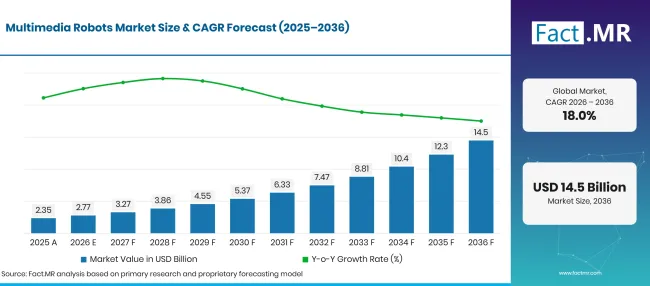
Multimedia Robots Market Forecast Global | Source: Fact.MR
Category
| Category | Segments |
|---|---|
| Component | Hardware, Software, Services |
| Application | Education, Healthcare, Entertainment, Retail, Others |
| Mobility | Stationary, Mobile |
| End-User | Commercial, Residential, Industrial, Others |
| Region | Brazil; Germany; United Kingdom; Japan; United States |
Source: Fact.MR analysis. Updated Nov 18, 2026
Source: Fact.MR analysis.
Segmental Analysis
What is driving hardware demand in the Multimedia Robots Market?
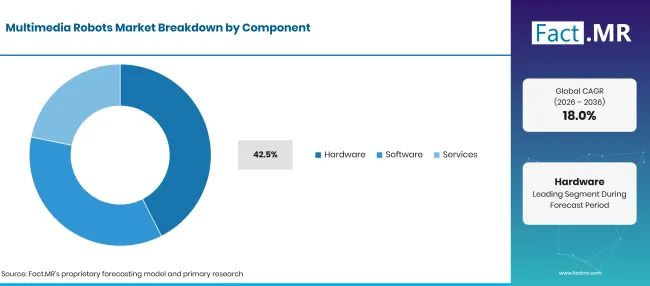
Multimedia Robots Market Breakdown Component | Source: Fact.MR
Demand for hardware accounts for 42.5% of multimedia robot revenue in 2026, about USD 1.2 billion. Demand is supported by the need for integrated cameras, microphones, displays, motors, processors and connectivity modules in each robot. Component availability and manufacturing costs directly influence suppliers’ pricing and sales volumes. India’s Electronics Components Manufacturing Scheme had approved 106 projects across 15 states by August 2026, involving ₹69,548 crore in investment, while 38 approved plants had begun production. This expansion of the electronics supply chain supports component sourcing and production capacity for hardware-intensive devices, including multimedia robots.
Which factors are supporting education demand in the Multimedia Robots Market?
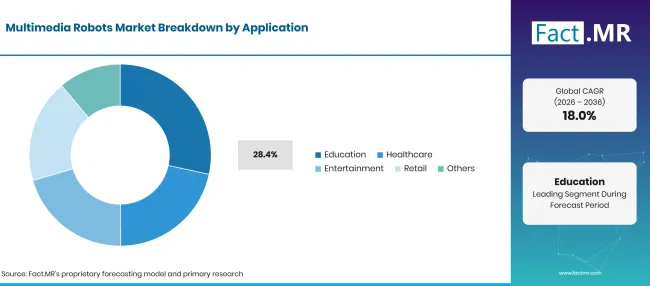
Multimedia Robots Market Breakdown Application | Source: Fact.MR
Education represents 28.4% of multimedia robot application revenue in 2026, about USD 785 million. Schools are purchasing interactive robots for coding, language learning, STEM activities and classroom engagement. Robots can also provide structured communication support for children who need additional learning assistance. India’s UDISE+ 2025–26 report covers 24.72 crore students across 14.67 lakh schools. The share of schools with computer access increased to 69.9% in 2025–26, from 64.7% in the previous year. The Ministry of Education also highlighted AI and computational thinking as areas for greater classroom emphasis in August 2026. These developments strengthen the digital-learning environment in which educational robot suppliers can expand sales.
How are stationary robots maintaining their lead in mobility demand?
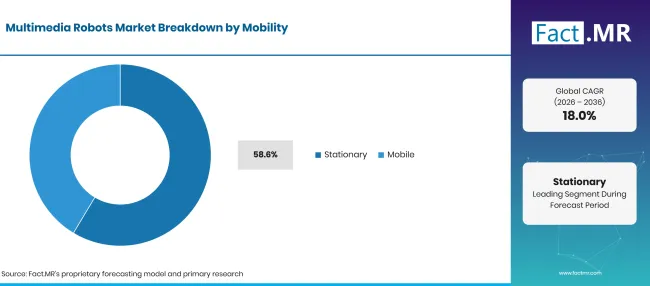
Multimedia Robots Market Breakdown Mobility | Source: Fact.MR
Sales of stationary robots leads with 58.6% of multimedia robot revenue in 2026, about USD 1.6 billion. Their sales benefit from relatively straightforward installation and lower navigation requirements, making them suitable for reception desks, classrooms, information kiosks and customer-service counters. Schools with established computer infrastructure can integrate stationary educational robots without requiring complex movement systems. India’s UDISE+ 2025–26 data show that 69.9% of schools had computer access, providing a useful indicator of the expanding technology infrastructure available to educational deployments. Although mobile robots can serve larger spaces such as hospitals and shopping centres, stationary models remain practical for fixed-location interaction and information delivery.
What is expanding commercial-user demand in the Multimedia Robots Market?
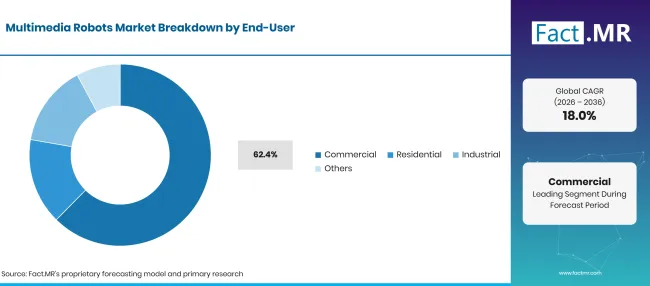
Multimedia Robots Market Breakdown End User | Source: Fact.MR
Commercial users account for 62.4% of multimedia robot revenue in 2026, about USD 1.7 billion. Retailers, hotels, banks, museums and hospitals are adopting interactive robots for visitor guidance, information delivery, promotion and customer engagement. India's Index of Services Production recorded 18.0% year-on-year growth in retail trade and 10.2% growth in accommodation and food services in June 2026. Separately, the government reported 38,466 public and private hospitals empanelled under Ayushman Bharat PM-JAY as of August 2026. These figures indicate the scale of commercial and service environments in which multimedia robots can be deployed. For suppliers, multi-unit sales and remote fleet-management contracts offer opportunities beyond individual robot purchases.
Multimedia Robots Market-Drivers, Restraints & Trends
Drivers: Rising Demand for Robots Amid Care Workforce Shortages
Demand for multimedia robots is increasing as labor shortages encourage businesses and care providers to automate reception, visitor guidance, communication and routine monitoring tasks. Japan's Ministry of Health, Labour and Welfare estimates that the country will require approximately 2.4 million care workers in FY2026, compared with around 2.15 million in FY2022. The requirement is projected to reach 2.72 million by FY2040. This growing workforce requirement is encouraging care providers to explore robotic systems that can support staff with reminders, communication and basic monitoring. Suppliers of multimedia robots are developing interactive platforms for healthcare, hospitality and public-service environments. Continued pressure on service-sector staffing is expected to support demand for robots that can perform repetitive communication and assistance functions.
Restraints: High Acquisition Costs and Uncertain Return on Investment
High acquisition costs, integration expenses and uncertain commercial returns continue to restrict multimedia robot adoption, particularly among small businesses and price-sensitive consumers. Buyers must consider not only the initial purchase price but also software subscriptions, maintenance, connectivity and ongoing technical support. The UK's 2026 AI Adoption Survey found that 65% of businesses that had not adopted AI cited the absence of a clear business case or proven return on investment as a barrier. In addition, 64% of businesses using AI reported no immediate operating-cost impact. Although these figures relate to AI adoption rather than multimedia robots specifically, they illustrate the wider challenge of proving measurable financial benefits from emerging technologies. Robot suppliers must demonstrate improvements in service efficiency, customer engagement and operating costs to encourage wider purchasing.
Opportunity: Generative AI-Powered Companions
Generative AI is creating opportunities for multimedia robots that can hold more natural conversations, respond to questions and personalize interactions. Advances in large language models, speech recognition and conversational interfaces are allowing robot developers to move beyond scripted responses toward more adaptive communication. The UK's 2026 AI Adoption Survey found that 32% of businesses used at least one AI technology, compared with 16% in 2025. Among businesses using or planning to use AI, 77% reported using large language model-based approaches. This wider adoption of conversational AI technologies creates opportunities for robot manufacturers to integrate language models into reception, education, hospitality and companion applications. Suppliers that combine reliable speech interaction, privacy controls and context-aware responses can expand the commercial uses of multimedia robots.
Trend: Growing Use of Robots in Elder Care
Multimedia robots are increasingly being explored for elder-care applications such as companionship, activity engagement, medication reminders and communication support. Japan's ageing population is strengthening the need for technologies that can help care facilities manage routine interactions while allowing human caregivers to focus on more complex needs. Japan's Statistics Bureau reported that people aged 65 and above represented 29.5% of the population in June 2026, while those aged 75 and above accounted for approximately 17.4%. The Ministry of Health, Labour and Welfare also projects that care-worker requirements will increase to approximately 2.72 million by FY2040. These demographic and workforce pressures are encouraging care providers to evaluate robotic assistance and monitoring solutions. Wider adoption will depend on user acceptance, safety, reliability and the ability of robots to complement rather than replace human care.
Multimedia Robots Market by Analysis by Key Country
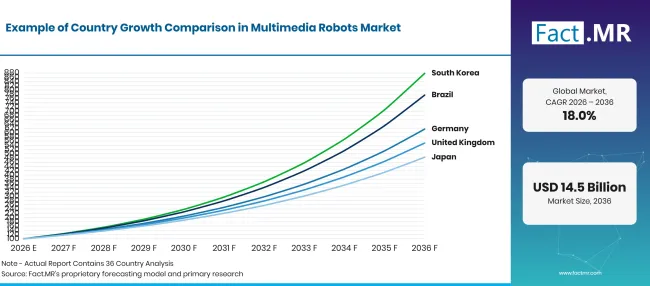
Multimedia Robots Market Growth Index | Source: Fact.MR
| Country | CAGR (2026-2036) |
|---|---|
| Brazil | 22.7% |
| Germany | 19.9% |
| United Kingdom | 18.6% |
| Japan | 17.1% |
| United States | 16.3% |
Source: Fact.MR analysis. Updated Nov 18, 2026
Source: Fact.MR analysis. Updated 16 Nov 2026
Why is Brazil the fastest-growing market for multimedia robots?
Sales of multimedia robots in Brazil are projected to grow at a 22.7% CAGR, supported by public investment in industrial modernization and digital technology.
In October 2026, Brazil’s Ministry of Development, Industry, Trade and Services reported that financing under the Nova Indústria Brasil program had reached BRL 713.3 billion, with BRL 653.15 billion disbursed across 428,000 projects by December 2025. The program includes a dedicated digital-transformation mission, which had received BRL 84.6 billion in allocations reported by the government in February 2026.
What is driving multimedia robot demand in Germany?
Demand for multimedia robots in Germany is estimated to register a 19.9% CAGR as care providers face persistent staffing constraints and seek technology to support communication, engagement and routine assistance.
Germany’s Federal Employment Agency reported in 2026 that only 57 unemployed nursing professionals were available for every 100 advertised nursing vacancies. It also recorded approximately 353,000 foreign-national employees in the care sector, representing around one-fifth of the workforce. These figures underline the recruitment challenges facing care facilities and create potential opportunities for social and companion robots in supported-care environments.
What is shaping multimedia robot demand in the United Kingdom?
Demand for multimedia robots in the United Kingdom is projected to hold 18.6% CAGR as public-sector investment encourages the adoption of AI-enabled interactive technologies.
The UK government’s 2026 Budget allocated £15 million to an AI Challenge Prize focused initially on NHS-related public-service problems, with a top award of up to £2.5 million. The same Budget reported that the government’s Ask HMRC AI assistant handled 6.3 million customer interactions during 2025–26. While these initiatives demonstrate growing institutional familiarity with AI-enabled communication and service interfaces, which can support the adoption of conversational robots in public services, education and healthcare.
What is supporting multimedia robot demand in Japan?
Demand for multimedia robots in Japan is estimated to record a 17.1% CAGR as an aging population increases the need for interactive assistance, companionship and communication technologies.
Japan’s Statistics Bureau reported in September 2026 that the population aged 65 and older reached 36.24 million, accounting for 29.6% of the total population and representing the highest proportion on record. This demographic concentration supports opportunities for companion robots, reception assistants and communication platforms in elder-care facilities and hospitality settings. Sony’s aibo and SoftBank’s Pepper have also helped establish consumer awareness of interactive robots in Japan.
Why is multimedia robot growth slower in the United States?
Sales of multimedia robots in the United States are projected to represent 16.3% CAGR, the slowest among the five key countries, despite a substantial consumer technology market.
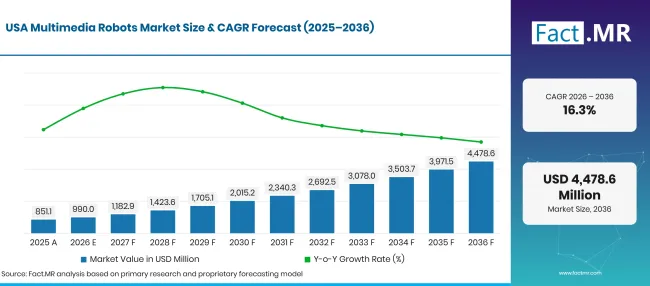
Multimedia Robots Market Forecast Usa | Source: Fact.MR
The U.S. Census Bureau estimated that retail e-commerce sales reached USD 340.2 billion in the second quarter of 2026, up 12.2% year over year and representing 17.1% of total retail sales. This demonstrates the scale of the digital consumer market. The Bureau of Labor Statistics also projected 18% employment growth for home health and personal care aides between 2025 and 2035, highlighting opportunities for assistive technologies. However, high device prices, privacy concerns and the need to demonstrate reliable everyday utility can constrain broader household adoption.
Competitive Landscape for Multimedia Robots Market
Competition in the multimedia robots market is divided between social robotics developers, interactive entertainment companies and humanoid robotics manufacturers. No Isolation AS and Intuition Robotics focus on socially assistive robots designed to reduce loneliness and support engagement among older adults and other users. Sphero competes through programmable educational robots that combine interactive content, coding and entertainment. Hanson Robotics and UBTECH Robotics develop humanoid robots with facial expressions, conversational capabilities and human-like interaction, while Furhat Robotics specializes in social robots with expressive faces, conversational AI and customizable personalities. Sony Group Corporation brings consumer electronics, entertainment and robotics expertise to interactive robotic experiences. Buyers evaluate these companies on speech recognition, emotional responsiveness, content flexibility, accessibility, reliability, customization and total ownership cost.
From 2024 onward, competition increasingly shifted toward generative AI, conversational intelligence, humanoid interaction and personalized user experiences. Robotics developers are integrating advanced language models and multimodal AI to improve how robots interpret speech, respond to questions and engage with people. Intuition Robotics has continued developing its ElliQ companion platform for older adults, while Furhat Robotics has expanded its conversational AI capabilities through its social robotics platform. Hanson Robotics continues to position Sophia around human-robot interaction, and UBTECH is advancing humanoid robotics for education, commercial services and industrial applications. No Isolation's AV1 telepresence robot and Sphero's programmable learning products address more focused education and social-inclusion applications. Sony contributes through its broader entertainment and interactive technology capabilities. Companies combining accessible hardware, natural conversation, adaptable content and dependable deployment support are better positioned to strengthen their presence in the multimedia robots market.
Recent Developments
- In January 2025, Samsung showcased its Ballie home robot at CES 2025.
- In March 2025, iRobot raised doubt about its ability to continue as a going concern.
- In January 2024, Amazon and iRobot terminated their proposed merger.
- On April 23, 2026, Sphero introduced Blueprint Robotics, a modular robotics ecosystem that enables students to build and program interactive robots for classroom learning and competitions. The launch supports the development of educational and interactive multimedia robotics.
Key Players in Multimedia Robots Market
Key companies operating in the market include No Isolation AS, Sphero Inc., Intuition Robotics Ltd., Hanson Robotics Ltd., Sony Group Corporation, Furhat Robotics AB, and UBTECH Robotics Corp. Ltd.
- No Isolation AS
- Sphero Inc.
- Intuition Robotics Ltd.
- Hanson Robotics Ltd.
- Sony Group Corporation
- Furhat Robotics AB
- UBTECH Robotics Corp. Ltd.
Bibliography
- Department for Science, Innovation and Technology. (2025). AI opportunities action plan.
- Department for Science, Innovation and Technology. (2026). AI adoption survey report 2026: Executive summary.
- Destatis. (2024). Nursing staff projection to 2049. Federal Statistical Office of Germany.
- Federal Employment Agency. (2026). Day of care: One in five care workers is a foreign national.
- Government of Brazil. (2024). Nova Indústria Brasil. Ministry of Development, Industry, Trade and Services.
- HM Treasury. (2026). Budget 2026. GOV.UK.
- iRobot Corporation. (2025). Annual report on Form 10-K for fiscal 2024.
- Ministry of Development, Industry, Trade and Services. (2026). Financing under Nova Indústria Brasil reaches 428,000 projects, with 61% in the North, Northeast and Central-West regions. Government of Brazil.
- Ministry of Health, Labour and Welfare. (2024). Projected demand for care workers under the 9th long-term care insurance plan.
- Ministry of Health, Labour and Welfare. (2026, March). Welfare and long-term care workforce securing measures.
- Press Information Bureau. (2026, July 7). UDISE+ 2025–26 school education report. Government of India.
- Press Information Bureau. (2026, August 12). Affordable and accessible healthcare for all. Government of India.
- Press Information Bureau. (2026, August 17). ECMS progress: 106 projects approved, ₹69,548 crore investment and 38 plants operational. Government of India.
- Press Information Bureau. (2026, August 31). Index of services production for June 2026. Government of India.
- Sphero. (2026). Introducing Blueprint Robotics.
- Statistics Bureau of Japan. (2026, June 19). Population estimates: June 2026. Ministry of Internal Affairs and Communications.
- UK Government. (2026). Chancellor unveils Britain’s ambitious plan for AI. GOV.UK.
- UDISE+. (2026). Official school statistics portal for 2025–26.
- U.S. Bureau of Labor Statistics. (2026). Home health and personal care aides: Employment outlook, 2025–2035.
- U.S. Census Bureau. (2026). Quarterly retail e-commerce sales: Second quarter 2026.
- U.S. Census Bureau. (2026, September 10). Robotic equipment for the Annual Integrated Economic Survey.
Segmentation
Scope of Report
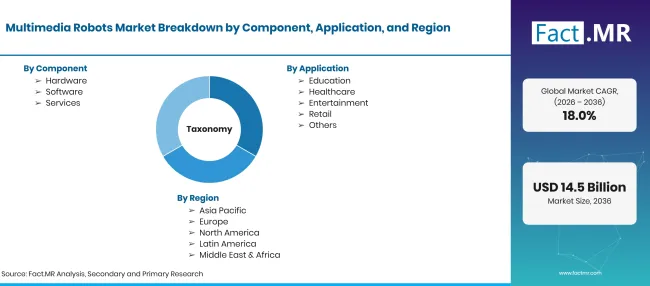
Multimedia Robots Market Taxonomy | Source: Fact.MR
| Items | Values |
|---|---|
| Quantitative Units (2026) | USD 2.8 Billion |
| Component | Hardware, Software, Services |
| Application | Education, Healthcare, Entertainment, Retail, Others |
| Mobility | Stationary, Mobile |
| End-User | Commercial, Residential, Industrial, Others |
| Regions Covered | North America, Latin America, Europe, East Asia, South Asia and Pacific, Middle East & Africa |
| Countries Covered | United States, Germany, Japan, United Kingdom, Brazil, and other countries |
| Key Companies Profiled | No Isolation AS; Sphero Inc.; Intuition Robotics Ltd.; Hanson Robotics Ltd.; Sony Group Corporation; Furhat Robotics AB; UBTECH Robotics Corp. Ltd. |
| Additional Attributes | Dollar revenue in the Multimedia Robots Market is segmented by component (hardware, software, services); application (education, healthcare, entertainment, retail); mobility (stationary, mobile); end-user (commercial, residential, industrial) and region. |
Source: Fact.MR analysis. Updated Nov 18, 2026
Multimedia Robots Market by Segments
-
Component
- Hardware
- Software
- Services
-
Application
- Education
- Healthcare
- Entertainment
- Retail
- Others
-
Mobility
- Stationary
- Mobile
-
End-User
- Commercial
- Residential
- Industrial
- Others
-
Region:
- North America
- United States
- Canada
- Mexico
- Europe
- Germany
- United Kingdom
- France
- Italy
- Spain
- Rest of Europe
- Asia Pacific
- China
- India
- Japan
- South Korea
- Australia
- Rest of Asia Pacific
- Latin America
- Brazil
- Mexico
- Argentina
- Rest of Latin America
- Middle East & Africa
- GCC Countries
- South Africa
- Rest of Middle East & Africa
- North America
Frequently Asked Questions
How big is the global Multimedia Robots Market in 2026?
What will be the size of the Multimedia Robots Market by 2036?
How fast will the Multimedia Robots Market grow during the forecast period?
Which component segment holds the largest share of the Multimedia Robots Market?
Who worked on this report


Preview the report firsthand - request a free sample
Free SampleGet the brochure for pricing and purchase details
Download PDF