- Market Value (2025): USD 489.7 Mn
- Estimated Value (2026): USD 516.3 Mn
- Forecast Value (2036): USD 877.0 Mn
- CAGR (2026-2036): 5.4%
Mobile Fluid System Market Forecast and Outlook 2026 to 2036
According to the Fact.MR analysis, the mobile fluid systems market was valued at USD 489.7 million in 2025 and is projected to grow from USD 516.3 million in 2026 to USD 877.0 million by 2036. Demand for mobile fluid systems is likely to grow at a CAGR of 5.4% over the forecast period.
Demand for mobile fluid systems is rising as construction, agricultural and material-handling machines need compact hydraulic pumps, valves and filtration that deliver more power with less fuel. Suppliers of mobile fluid systems are adding electro-hydraulic controls and components for electric machines. For example, Bosch Rexroth acquired HydraForce in 2023 to add cartridge valves and manifolds for mobile machines. Similar portfolio moves are projected to drive sales of mobile fluid systems through 2036.
Key Takeaways from the Mobile Fluid System Market
- Mobile Fluid System Market Value (2025): USD 489.7 million
- Mobile Fluid System Market Value (2026): USD 516.3 million
- Mobile Fluid System Market Forecast Value (2036): USD 877.0 million
- Mobile Fluid System Market Forecast CAGR (2026-2036): 5.4%
- Leading Component: Pumps (28.5%)
- Key Market Participants: Parker Hannifin Corporation, Eaton Corporation, Bosch Rexroth AG, Danfoss A/S, Continental AG, HYDAC International GmbH
- Key Growth Regions: Germany, Brazil, United States, United Kingdom, Japan
Bauma 2025 in Munich in April 2025 featured many battery-electric excavators, loaders and cranes that use electrified hydraulics. Demand for mobile fluid systems is growing as machine builders redesign hydraulic circuits around electric drives. Suppliers of mobile fluid systems are offering variable-speed pumps and electronic valves. Similar electrification is projected to drive sales of mobile fluid systems across Europe, North America and Asia.
Mobile Fluid System Market
| Metric | Value |
|---|---|
| Estimated Value in (2026) | USD 516.3 million |
| Forecast Value in (2036) | USD 877.0 million |
| Forecast CAGR (2026 to 2036) | 5.4% |
Source: Fact.MR analysis. Updated Nov 18, 2026
Source: Fact.MR analysis.
Category
| Category | Segments |
|---|---|
| Component | Pumps, Valves, Filters, Accumulators, Others |
| Application | Construction, Agriculture, Automotive, Aerospace, Others |
| End-User | OEMs, Aftermarket |
| Fluid Type | Hydraulic Fluids, Coolants, Lubricants, Others |
| Region | Germany; Brazil; United States; United Kingdom; Japan |
Source: Fact.MR analysis. Updated Nov 18, 2026
Source: Fact.MR analysis.
Segmental Analysis
Why do pumps lead component demand in the Mobile Fluid System Market?
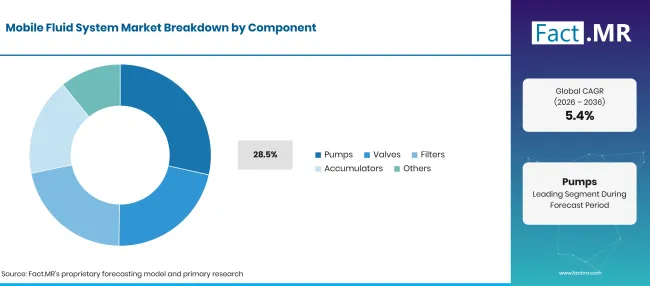
Mobile Fluid System Market Breakdown Component | Source: Fact.MR
Demand for pumps represent 28.5% of mobile fluid system revenue in 2026, about USD 145 million, because they generate the hydraulic flow required to operate steering, lifting, digging and transmission functions in mobile machinery. Demand is supported by equipment manufacturers seeking efficient variable-displacement pumps that adjust output to operating requirements and reduce energy losses. India's Ministry of Statistics and Programme Implementation reported that the manufacture of machinery and equipment increased 12.1% year on year in July 2026, with pumps of various types, including hydraulic pumps, among the major positive contributors. This indicates stronger production activity in a relevant equipment category and supports demand for hydraulic pumping components. Continued investment in agricultural and construction machinery is expected to sustain pump sales.
Why does construction lead application demand in the Mobile Fluid System Market?
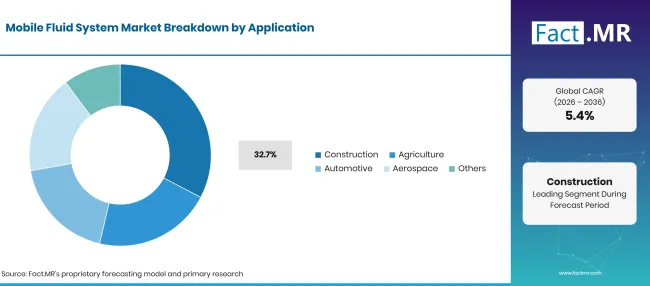
Mobile Fluid System Market Breakdown Application | Source: Fact.MR
Adoption of construction generates 32.7% of application revenue in 2026, about USD 170 million, as excavators, loaders, cranes and road-building equipment depend on hydraulic systems for high-force digging, lifting and material handling. Demand for mobile fluid systems is closely linked to construction equipment utilization and infrastructure investment. India's Ministry of Statistics and Programme Implementation reported that infrastructure and construction goods production increased 6.9% year on year in July 2026. In the United States, construction spending reached an annualized rate of USD 2,186.1 billion in September 2026, although it declined 2.7% from September 2025. These indicators show continued construction activity alongside regional spending weakness. Equipment manufacturers and construction fleet operators therefore remain important customers for hydraulic pumps, valves, cylinders and fluid-control assemblies.
Why do OEMs dominate end-user demand in the Mobile Fluid System Market?
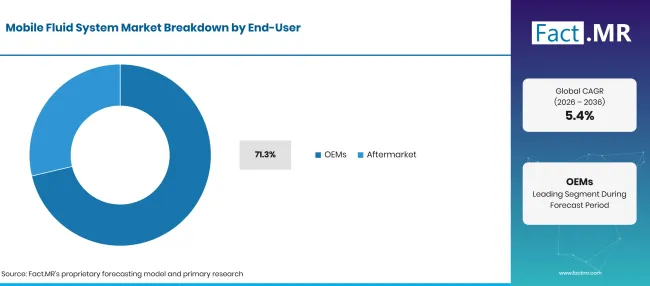
Mobile Fluid System Market Breakdown End User | Source: Fact.MR
OEMs represent 71.3% of mobile fluid system revenue in 2026, about USD 370 million, because hydraulic circuits are integrated during machine design and production. Equipment manufacturers purchase pumps, valves, cylinders, hoses and filtration assemblies as part of complete hydraulic systems, creating recurring component demand across new machinery production. India's Department of Economic Affairs reported that domestic tractor sales reached 1.0 lakh units in April 2026, registering 25% year-on-year growth. MoSPI also recorded 19.0% growth in motor vehicle manufacturing in September 2026. These increases indicate stronger demand across important machinery and vehicle manufacturing channels. As equipment producers expand output and introduce new machine platforms, OEM procurement and long-term component supply relationships are expected to sustain demand for mobile fluid systems.
Why do hydraulic fluids lead fluid-type demand in the Mobile Fluid System Market?
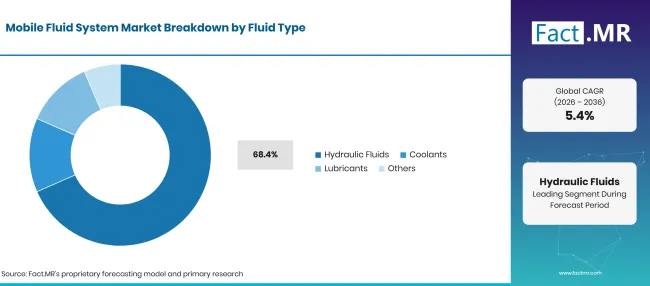
Mobile Fluid System Market Breakdown Fluid Type | Source: Fact.MR
Sales of Hydraulic fluids hold 68.4% of fluid-type revenue in 2026, about USD 355 million, because hydraulic power transmission remains central to the operation of mobile equipment. These fluids transfer power, lubricate moving components, dissipate heat and protect systems against wear and corrosion. Their consumption is linked to machinery operating hours, fluid replacement intervals and maintenance requirements across agricultural and construction fleets. India's Ministry of Statistics and Programme Implementation reported 7.6% year-on-year manufacturing growth in September 2026, while capital goods production increased 10.4%. This broader industrial expansion supports the operating base for fluid-dependent equipment. Electrification is also encouraging the development of specialized thermal-management fluids. Continued equipment use and scheduled fluid replacement are expected to preserve hydraulic fluids' leading position.
Mobile Fluid System Market-Drivers, Restraints & Trends
Drivers: Rising Agricultural and Construction Equipment Demand
Demand for mobile fluid systems is increasing as agricultural and construction machinery becomes larger, more powerful and increasingly automated. Tractors, harvesters, excavators and loaders require reliable hydraulic circuits for lifting, steering, transmission and implement control. India's Department of Economic Affairs reported that domestic tractor sales reached 1.0 lakh units in April 2026, increasing 25% year on year. Brazil's National Supply Company (Conab) estimated that grain production would reach a record 361.7 million tonnes in the 2025/26 season, up 2.6% from the previous cycle. Higher machinery utilization and expanding agricultural output support demand for hydraulic pumps, valves, cylinders, hoses and filtration systems. Suppliers serving agricultural and construction equipment OEMs are positioned to benefit as machinery requirements increase.
Restraints: Cyclical Machinery Investment
Demand for mobile fluid systems remains exposed to fluctuations in agricultural and construction equipment purchases. High borrowing costs, uncertain commodity prices and delayed infrastructure projects can encourage equipment owners to postpone fleet replacement and capital investment. The U.S. Census Bureau reported that construction spending during the first nine months of 2026 was 2.9% lower than in the corresponding period of 2025, while September spending declined 2.7% year on year. Such weakness can reduce orders for hydraulic components used in excavators, loaders and other construction machinery. Manufacturers must therefore manage production capacity, inventory and supplier commitments to limit exposure to changes in equipment demand.
Opportunity: Electro-Hydraulic Systems for Electrified Machines
Electro-hydraulic systems are gaining attention as equipment manufacturers adopt electric drives, electronic controls and automated operating functions. These systems combine electric motors, electronically controlled pumps, sensors and hydraulic actuators to improve power management and control precision. Suppliers such as Danfoss are developing integrated mobile hydraulic and electronic control solutions for off-highway equipment. India's Ministry of Statistics and Programme Implementation reported that capital goods production increased 10.4% year on year in September 2026, while manufacturing of electrical equipment rose 33.9%. Continued equipment electrification is expected to encourage demand for electronically controlled fluid systems.
Trend: Condition Monitoring and Predictive Maintenance
Equipment owners are increasingly adopting condition-monitoring technologies to identify hydraulic-system problems before they cause unplanned downtime. Sensors that track pressure, temperature, fluid contamination and filter condition help operators assess system performance and schedule maintenance more efficiently. Suppliers such as HYDAC and Parker offer filtration, sensing and monitoring solutions that support equipment diagnostics and fluid-system reliability. As agricultural and construction machinery becomes more connected and operates under demanding conditions, demand for real-time monitoring and predictive maintenance capabilities is expected to increase.
Mobile Fluid System Market by Analysis by Key Country
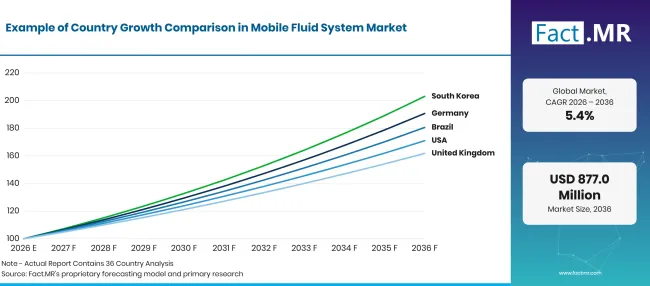
Mobile Fluid System Market Growth Index | Source: Fact.MR
| Country | CAGR (2026-2036) |
|---|---|
| Germany | 6.7% |
| Brazil | 6.1% |
| United States | 5.5% |
| United Kingdom | 4.9% |
| Japan | 4.4% |
Source: Fact.MR analysis. Updated Nov 18, 2026
Source: Fact.MR analysis.
Why is Germany the fastest-growing market for mobile fluid systems?
Demand for mobile fluid systems in Germany is estimated to grow at a 6.7% CAGR, supported by investment in construction equipment and the development of advanced machinery.
Germany’s Federal Statistical Office (Destatis) reported that real construction orders rose 23.0% month over month in August 2026 and 17.3% year over year. Orders in civil engineering increased 31.6% year over year, indicating stronger activity in projects that require excavators, loaders and other hydraulically operated machinery. The development of electric and automated equipment showcased at Bauma 2025 also creates opportunities for integrated hydraulic and fluid-management solutions. Bosch Rexroth and HYDAC are established German suppliers serving mobile machinery manufacturers.
What is driving mobile fluid system demand in Brazil?
Sales of mobile fluid systems in Brazil are projected to record a 6.1% CAGR as expanding agricultural production supports demand for tractors, harvesters and other farm machinery.
Brazil’s National Supply Company (Conab) estimated that grain production would reach 361.7 million tonnes in the 2025/26 crop season, an increase of 2.6% over the previous season, with cultivated area reaching 83.5 million hectares. Its November 2026 estimate for the 2026/27 season projected production of 366.1 million tonnes and a further increase in planted area to 85.3 million hectares. Higher crop volumes and expanding cultivation create opportunities for mobile fluid systems used in steering, lifting, braking and implement-control applications.
How is infrastructure spending supporting mobile fluid system sales in the United States?
Demand for mobile fluid systems in the United States are estimated to hold 5.5% CAGR as federal infrastructure funding supports road, bridge and construction projects.
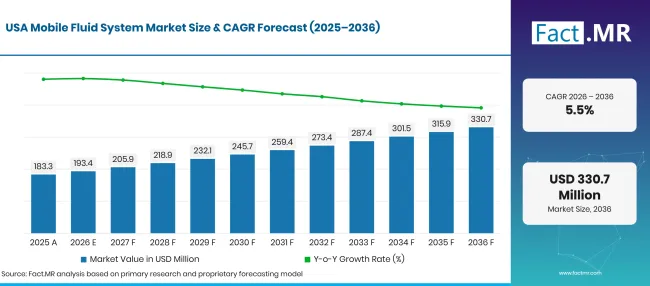
Mobile Fluid System Market Forecast Usa | Source: Fact.MR
The Federal Highway Administration allocated USD 5.5 billion for the Bridge Formula Program in fiscal 2026 under the Bipartisan Infrastructure Law, with approximately USD 5.31 billion available for distribution to states after specified deductions. These funds support bridge replacement, rehabilitation, preservation and construction activities. Continued project execution can sustain demand for excavators, cranes, loaders and other mobile equipment fitted with hydraulic pumps, cylinders and fluid-control components. Parker Hannifin and Eaton supply fluid-power and motion-control technologies to equipment manufacturers and industrial customers.
What is shaping mobile fluid system demand in the United Kingdom?
Sales of mobile fluid systems in the United Kingdom is projected to grow at a 4.9% CAGR as infrastructure and construction projects sustain the need for mobile equipment.
The Office for National Statistics reported that infrastructure construction output increased 3.3% in September 2026, contributing to a 0.8% monthly rise in total construction output. Construction new orders also increased 1.2% in the third quarter of 2026, equivalent to £107 million. These projects support equipment requirements across earthmoving, material handling and site operations. Manufacturers such as JCB are also developing electric and hydrogen-powered machines, encouraging demand for fluid systems suited to changing powertrain and equipment designs.
Why is mobile fluid system growth slower in Japan?
Demand for mobile fluid systems in Japan is estimated to record a 4.4% CAGR, the slowest among the five key countries, as an established construction equipment market limits the scope for rapid expansion.
Japan’s Ministry of Land, Infrastructure, Transport and Tourism forecast total construction investment of approximately JPY 81.47 trillion for fiscal 2026, representing a 2.9% increase over the previous year. Civil engineering investment was projected at JPY 28.52 trillion, up 1.8%, while public works investment was expected to rise by only 0.6%. These figures indicate continued demand for construction machinery but relatively moderate growth in major infrastructure-related spending. Komatsu and Kubota can continue to support domestic and export equipment markets, although the mature domestic construction base may restrain incremental demand for mobile fluid systems.
Competitive Landscape for Mobile Fluid System Market
Competition in the mobile fluid system market is shaped by diversified hydraulic technology manufacturers and specialists in fluid power components. Parker Hannifin, Bosch Rexroth and Danfoss compete through hydraulic pumps, motors, valves, control systems and integrated mobile machinery solutions. HYDAC International focuses on filtration, accumulators, sensors and hydraulic control components, while Gates Corporation and Yokohama Rubber compete in hydraulic hoses and fluid-conveyance systems. Trelleborg differentiates itself through engineered seals, hoses and polymer-based fluid-handling components. Buyers assess suppliers on pressure performance, durability, leakage prevention, energy efficiency, system integration and global aftermarket support.
From 2024 onward, competition has increasingly focused on mobile equipment electrification, electrohydraulic integration, energy efficiency and higher-performance fluid-conveyance components. Danfoss introduced its Editron Low Voltage eDrive in July 2024 and launched the EM-PMI180 motor in November 2025 to power hydraulic functions in compact electric machinery. Bosch Rexroth expanded its eLION electrification portfolio and introduced the RM Global load-sensing valve platform in 2025, while its 2026 Power and Motion Control portfolio further integrates electric drives, pumps and electronic controls. Parker Hannifin expanded its mobile hydraulics and electrification offering through its eSeries pumps and second-generation Global Vehicle Inverter.
Recent Developments
- In April 2025, Bauma in Munich showcased electric construction machines using electrified hydraulics.
- In September 2025, Parker launched the VA130 load-sensing directional control valve, completing its VA Series portfolio. Its modular configuration, electrohydraulic actuation options and precision flow control support mobile machinery requiring customized hydraulic functions and improved energy efficiency.
- In December 2025, Parker introduced a high-voltage extension to its NX8M mobile motor family for electrified off-road and mobile applications. This is relevant to electrohydraulic systems in electric mobile equipment.
- In February 2025, Bosch Rexroth introduced the RM Global load-sensing valve platform for medium-weight off-highway machinery. Its modular design saves installation space, while optimized flow channels and electronic pump control improve energy efficiency. The company reported up to 20% less internal leakage than its predecessor M4 valve.
- In November 2025, Danfoss launched a 48-volt synchronous reluctance-assisted permanent magnet motor designed to drive hydraulic gear pumps in compact electric machinery. It supports electrification of hydraulic functions in mobile equipment.
- In March 2026, HYDAC introduced this system-level engineering approach for compact, electrified and automated machinery. It focuses on fluid cleanliness, deaeration, tank sizing, filtration, cooling and predictive maintenance. This is a new engineering approach rather than an individual component launch.
Key Players in Mobile Fluid System Market
Key companies operating in the market include Parker Hannifin Corporation, Bosch Rexroth AG, Danfoss A/S, HYDAC International GmbH, Gates Corporation, Yokohama Rubber Co. Ltd., and Trelleborg AB.
- Parker Hannifin Corporation
- Bosch Rexroth AG
- Danfoss A/S
- HYDAC International GmbH
- Gates Corporation
- Yokohama Rubber Co. Ltd.
- Trelleborg AB
Bibliography
- Companhia Nacional de Abastecimento. (2025). Acompanhamento da safra brasileira de grãos: Safra 2024/25 (12º levantamento).
- Companhia Nacional de Abastecimento. (2025, September 11). Produção de grãos atinge novo recorde com 350,2 milhões de toneladas colhidas na safra 2024/25.
- Companhia Nacional de Abastecimento. (2026, September 15). Conab estimates grain production of 361.7 million tonnes in the 2025/26 harvest.
- Companhia Nacional de Abastecimento. (2026, November 13). Nova estimativa da Conab para safra de grãos 2026/27 é de 366,1 milhões de toneladas.
- Department of Economic Affairs, Ministry of Finance, Government of India. (2026, May). Monthly economic review: May 2026.
- Federal Highway Administration. (2025, October 1). Apportionment of fiscal year 2026 highway infrastructure program funds for the Bridge Formula Program pursuant to the Infrastructure Investment and Jobs Act. U.S. Department of Transportation.
- Messe München. (2025, April 13). Bauma 2025 provides impetus and creates a spirit of optimism: Final report.
- Ministry of Land, Infrastructure, Transport and Tourism, Government of Japan. (2026, August 31). 令和8年度(2026年度)建設投資見通し [Fiscal year 2026 construction investment outlook].
- Ministry of Statistics and Programme Implementation, Government of India. (2026, August 28). Quick estimates of Index of Industrial Production and use-based index for the month of July 2026. Press Information Bureau.
- Ministry of Statistics and Programme Implementation, Government of India. (2026, October 28). Quick estimates of Index of Industrial Production and use-based index for September 2026.
- Office for National Statistics. (2026, November 12). Construction output in Great Britain: September 2026, new orders and Construction Output Price Indices, July to September 2026.
- Statistisches Bundesamt (Destatis). (2026, October 23). Auftragseingang im Bauhauptgewerbe im August 2026: +23,0 % zum Vormonat [Orders received in main construction industry in August 2026: +23.0% month over month].
- U.S. Census Bureau. (2026, November 2). Monthly construction spending, September 2026.
Segmentation
Scope of Report
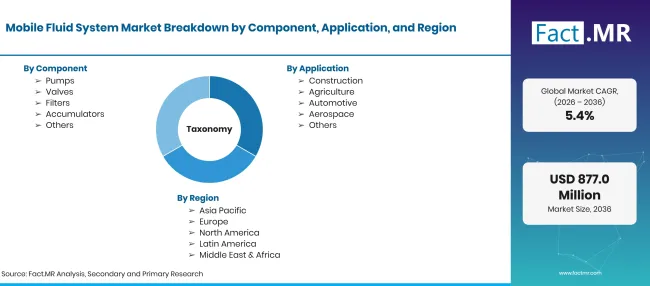
Mobile Fluid System Market Taxonomy | Source: Fact.MR
| Items | Values |
|---|---|
| Quantitative Units (2026) | USD 516.3 Million |
| Component | Pumps, Valves, Filters, Accumulators, Others |
| Application | Construction, Agriculture, Automotive, Aerospace, Others |
| End-User | OEMs, Aftermarket |
| Fluid Type | Hydraulic Fluids, Coolants, Lubricants, Others |
| Regions Covered | North America, Latin America, Europe, East Asia, South Asia and Pacific, Middle East & Africa |
| Countries Covered | United States, Germany, Japan, United Kingdom, Brazil, and other countries |
| Key Companies Profiled | Parker Hannifin Corporation; Bosch Rexroth AG; Danfoss A/S; HYDAC International GmbH; Gates Corporation; Yokohama Rubber Co. Ltd.; Trelleborg AB |
| Additional Attributes | Dollar revenue in the Mobile Fluid System Market is segmented by component (pumps, valves, filters, accumulators); application (construction, agriculture, automotive, aerospace); end-user (OEMs, aftermarket); fluid type (hydraulic fluids, coolants, lubricants) and region. |
Source: Fact.MR analysis. Updated Nov 18, 2026
Source: Fact.MR analysis.
Mobile Fluid System Market by Segments
-
Component
- Pumps
- Valves
- Filters
- Accumulators
- Others
-
Application
- Construction
- Agriculture
- Automotive
- Aerospace
- Others
-
End-User
- OEMs
- Aftermarket
-
Fluid Type
- Hydraulic Fluids
- Coolants
- Lubricants
- Others
-
Region:
- North America
- United States
- Canada
- Mexico
- Europe
- Germany
- United Kingdom
- France
- Italy
- Spain
- Rest of Europea
- Asia Pacific
- China
- India
- Japan
- South Korea
- Australia
- Rest of Asia Pacific
- Latin America
- Brazil
- Mexico
- Argentina
- Rest of Latin America
- Middle East & Africa
- GCC Countries
- South Africa
- Rest of Middle East & Africa
- North America
Frequently Asked Questions
How big is the global Mobile Fluid System Market in 2026?
What will be the size of the Mobile Fluid System Market by 2036?
How fast will the Mobile Fluid System Market grow during the forecast period?
Which component segment holds the largest share of the Mobile Fluid System Market?
Who worked on this report


Preview the report firsthand - request a free sample
Free SampleGet the brochure for pricing and purchase details
Download PDF