- Market Value (2025): USD 0.95 Bn
- Estimated Value (2026): USD 1.04 Bn
- Forecast Value (2036): USD 2.56 Bn
- CAGR (2026-2036): 9.4%
Peripheral Nerve Repair Devices Market Forecast and Outlook 2026 to 2036
According to the Fact.MR analysis, the peripheral nerve repair devices market was valued at USD 0.95 billion and is projected to grow from USD 1.04 billion in 2026 to USD 2.56 billion by 2036. Demand for peripheral nerve repair devices is likely to grow at a CAGR of 9.4% over the forecast period.
Demand for peripheral nerve repair devices is rising as surgeons repair nerve injuries from road accidents, workplace trauma and surgery with conduits, wraps and grafts rather than leaving gaps untreated. Suppliers are offering collagen, synthetic and processed allograft options. For example, the World Health Organization reported about 1.19 million road traffic deaths in 2021, with many more injuries that damage limb nerves. Similar trauma burden is projected to drive sales of peripheral nerve repair devices through 2036.
Key Takeaways from the Peripheral Nerve Repair Devices Market
- Peripheral Nerve Repair Devices Market Value (2025): USD 0.95 billion
- Peripheral Nerve Repair Devices Market Value (2026): USD 1.04 billion
- Peripheral Nerve Repair Devices Market Forecast Value (2036): USD 2.56 billion
- Peripheral Nerve Repair Devices Market Forecast CAGR (2026-2036): 9.4%
- Leading Product Type: Nerve Conduits (38.2%)
- Key Market Participants: Axogen Inc., Integra LifeSciences, Stryker Corporation, Polyganics B.V., Collagen Matrix Inc., Checkpoint Surgical
- Key Growth Regions: Brazil, Japan, United States, United Kingdom, Germany
In 2025, the US FDA accepted Axogen's Biologics License Application for the Avance Nerve Graft for review, moving processed nerve allograft toward biologic licensure. Demand for peripheral nerve repair devices is growing as surgeons gain more evidence for graft and conduit outcomes. Suppliers are funding surgeon education and clinical registries. Similar regulatory progress is projected to drive sales of peripheral nerve repair devices worldwide.
Peripheral Nerve Repair Devices Market
| Metric | Value |
|---|---|
| Estimated Value in (2026) | USD 1.04 billion |
| Forecast Value in (2036) | USD 2.56 billion |
| Forecast CAGR (2026 to 2036) | 9.4% |
Source: Fact.MR analysis. Updated Nov 18, 2026
Source: Fact.MR analysis.
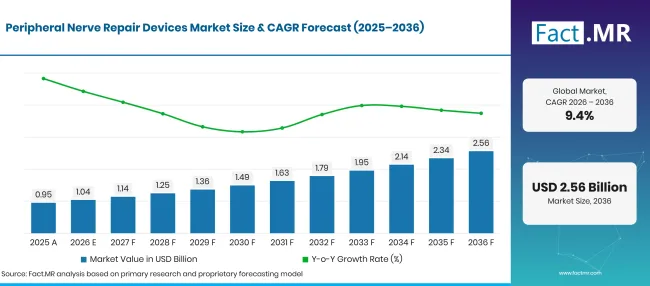
Peripheral Nerve Repair Devices Market Forecast Global | Source: Fact.MR
Category
| Category | Segments |
|---|---|
| Product Type | Nerve Conduits, Nerve Protectors, Nerve Wraps, Nerve Connectors |
| Application | Neurorrhaphy, Nerve Grafting, Stem Cell Therapy |
| End-User | Hospitals, Ambulatory Surgical Centers, Specialty Clinics |
| Region | Brazil; Japan; United States; United Kingdom; Germany |
Source: Fact.MR analysis. Updated Nov 18, 2026
Source: Fact.MR analysis.
Segmental Analysis
Which Factors supports nerve conduits lead product demand in the Peripheral Nerve Repair Devices Market?
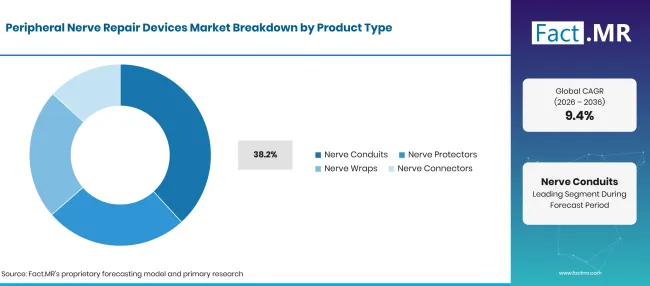
Peripheral Nerve Repair Devices Market Breakdown Product Type | Source: Fact.MR
Demand for nerve conduits are estimated to represent 38.2% of Peripheral Nerve Repair Devices Market revenue in 2026, about USD 395 million. These devices bridge short nerve gaps using collagen or resorbable polymer tubes, offering an alternative to donor-nerve harvesting in suitable cases. Products such as Integra’s NeuraGen, Polyganics’ Neurolac and Toyobo’s Nerbridge support the commercial availability of this approach. The U.S. Food and Drug Administration’s product documentation describes collagen nerve cuffs designed to protect injured nerves and provide a conduit-like structure where gap closure is possible through limb positioning. This established role in selected short-gap repairs supports continued demand for conduit-based products. A CDC/NIOSH study published in February 2026 estimated that work-related injuries treated in U.S. emergency departments between 2012 and 2023 included approximately 520,000 cases of nerve damage. The same study recorded an estimated 5.37 million laceration or puncture injuries.
What makes neurorrhaphy lead application demand in the Peripheral Nerve Repair Devices Market?
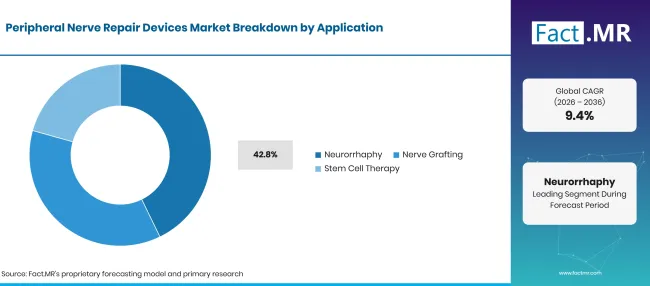
Peripheral Nerve Repair Devices Market Breakdown Application | Source: Fact.MR
Neurorrhaphy accounts for 42.8% of revenue in 2026, about USD 445 million, as direct suture repair is the standard for clean lacerations, often supported by wraps or connectors to reduce tension. Grafting is used for larger gaps. Suppliers are offering protectors that shield direct repairs. Similar clinical practice is projected to keep neurorrhaphy the leading application. The CDC/NIOSH 2026 publication estimated 5.37 million work-related laceration or puncture injuries treated in U.S. emergency departments over 2012–2023. It also reported approximately 6.51 million injuries involving the hand or fingers. The high clinical relevance of direct repair in appropriate injuries supports the leading position of neurorrhaphy in the application mix.
Why do hospitals lead end-user demand in the Peripheral Nerve Repair Devices Market?
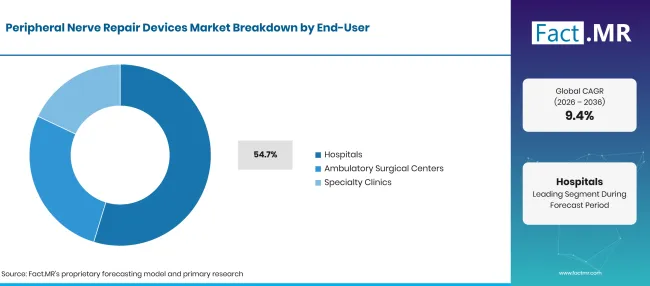
Peripheral Nerve Repair Devices Market Breakdown End User | Source: Fact.MR
Adoption of the peripheral nerve repair devices Hospitals account for 54.7% of revenue in 2026, about USD 570 million, as trauma, hand surgery and oncology cases are treated in hospital operating rooms. Ambulatory surgical centers are growing for elective repairs and carpal tunnel revisions. Suppliers are serving hospital trauma networks. Ambulatory surgical centers are also relevant for selected procedures that can be performed without overnight admission. However, complex injuries and repairs requiring broader hospital support continue to favor hospital-based treatment. The U.S. Medicare Payment Advisory Commission’s March 2026 report recorded approximately 6,400 ambulatory surgical centers treating 3.4 million fee-for-service Medicare beneficiaries in 2024. It also reported that the number of ASCs grew by more than 2% annually between 2019 and 2024. Separately, CMS’s 2026 payment update covers approximately 4,000 hospitals and 6,000 ASCs. These figures show the scale of both care settings and the expansion of outpatient surgery.
Peripheral Nerve Repair Devices Market-Drivers, Restraints & Trends
Drivers:
Demand for peripheral nerve repair devices is increasing as hand, trauma and reconstructive surgeons incorporate nerve repair into more surgical procedures. According to a 2026 CDC-published study, approximately 520,000 work-related nerve damage injuries were treated in U.S. emergency departments between 2012 and 2023. Hand and finger injuries accounted for another 6.51 million cases across the same period, creating a substantial pool of potential nerve injury patients. Axogen also reported approximately USD 187 million in revenue in 2024, reflecting commercial demand for nerve repair solutions. Growing surgical awareness and wider availability of specialized grafts are projected to support market expansion.
Restraints:
Sales of peripheral nerve repair devices are constrained by inconsistent reimbursement, differences in hospital purchasing budgets and limited surgeon familiarity with advanced nerve reconstruction techniques. Although the U.S. Centers for Medicare & Medicaid Services (CMS) maintains payment information for more than 10,000 medical services through its Physician Fee Schedule, reimbursement varies by procedure code, geographic locality and applicable payment policy. These differences can make dedicated nerve grafts and conduits less accessible in smaller hospitals. Suppliers need to strengthen surgeon education and publish long-term functional outcome data to improve adoption.
Opportunity:
Biologic Nerve Allografts Demand for processed human nerve allografts is increasing as surgeons seek alternatives to autologous nerve harvesting for repairing peripheral nerve gaps. A significant regulatory development occurred on December 3, 2025, when the U.S. FDA approved Axogen's Biologics License Application for AVANCE, an acellular nerve allograft indicated for peripheral nerve functional deficits. The FDA lists AVANCE under BLA 125816, establishing a licensed biologic pathway for the product. Commercial availability under the new regulatory framework was expected in the second quarter of 2026. This development creates opportunities for suppliers developing advanced biologic grafts and regenerative nerve repair solutions.
Trend:
Nerve Repair in Breast Reconstruction Demand for sensory nerve repair during breast reconstruction is gaining attention as plastic surgeons increasingly focus on restoring postoperative sensation alongside breast appearance. According to the U.S. National Cancer Institute's SEER estimates for 2026, approximately 321,910 new cases of female breast cancer are expected in the United States, sustaining the need for mastectomy and subsequent reconstructive care among eligible patients. Surgical approaches incorporating nerve preservation and sensory nerve reconstruction are creating opportunities for specialized nerve grafts and conduits. Growing awareness of functional outcomes is projected to support the use of peripheral nerve repair devices in reconstructive surgery.
Peripheral Nerve Repair Devices Market by Analysis by Key Country
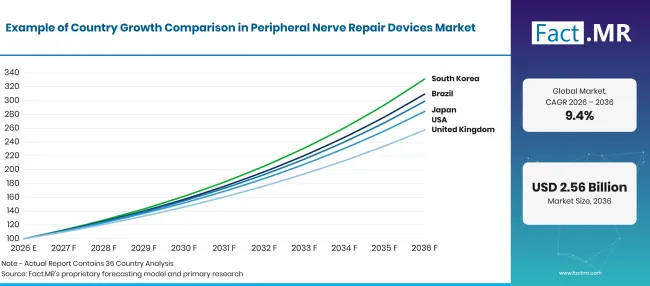
Peripheral Nerve Repair Devices Market Growth Index | Source: Fact.MR
| Country | CAGR (2026-2036) |
|---|---|
| Brazil | 12.0% |
| Japan | 11.6% |
| United States | 11.0% |
| United Kingdom | 9.9% |
| Germany | 8.2% |
Source: Fact.MR analysis. Updated Nov 18, 2026
Source: Fact.MR analysis.
Why is Brazil the fastest-growing market for peripheral nerve repair devices?
Sales of peripheral nerve repair devices in Brazil are projected to grow at a 12.0% CAGR, the fastest among the five key countries, as increasing motorcycle-related road injuries create demand for complex trauma and reconstructive surgeries.
According to Brazil's 2026 Atlas da Violência, motorcycle accidents accounted for 15,459 deaths in 2024, representing 41.6% of all road fatalities. Private hospitals are expanding specialized surgical capabilities, while overseas suppliers are pursuing ANVISA registration to improve market access. Growing trauma-care requirements are projected to support sales in Brazil.
What is driving peripheral nerve repair demand in Japan?
Demand for peripheral nerve repair devices in Japan is estimated to hold 11.6% CAGR as surgeons increasingly use established nerve regeneration technologies, including Toyobo's Nerbridge, approved by Japan's Ministry of Health, Labour and Welfare in March 2013.
According to the National Police Agency, Japan recorded 27,563 serious road-traffic injuries in 2025, an increase of 1.0% from the previous year. The availability of domestically approved nerve conduits and established clinical experience supports adoption. Continued acceptance of specialized nerve reconstruction techniques is projected to drive sales in Japan.
How is surgeon adoption supporting sales in the United States?
Sales of peripheral nerve repair devices in the United States are projected to represent an 11.0% CAGR as Axogen, Integra and Stryker strengthen surgeon education and expand access to specialized nerve reconstruction products.
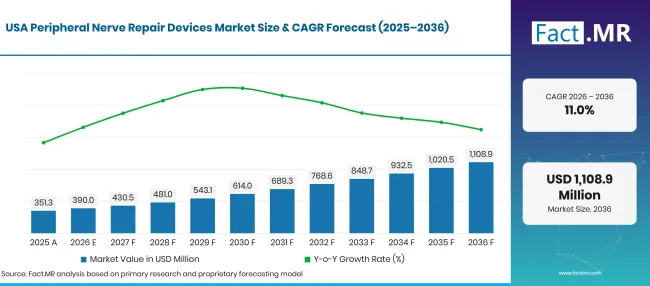
Peripheral Nerve Repair Devices Market Forecast Usa | Source: Fact.MR
According to the National Highway Traffic Safety Administration, 86,887 motorcyclists sustained injuries in 2024, creating demand for advanced trauma and nerve reconstruction procedures. Additionally, the National Cancer Institute projects 321,910 new female breast cancer cases in 2026, supporting the underlying patient population for reconstructive surgery. Greater clinical awareness and adoption of nerve repair techniques are projected to drive sales in the United States.
What is shaping peripheral nerve repair demand in the United Kingdom?
Demand for peripheral nerve repair devices in the United Kingdom is estimated to record at a 9.9% CAGR as NHS major trauma centers manage complex limb injuries requiring specialized reconstructive surgery.
NHS England's National Major Trauma Registry holds records covering more than 1 million injured patients and supports standardized trauma-care monitoring across the country and neighboring regions. Procurement through NHS Supply Chain also influences hospital purchasing decisions. Suppliers are emphasizing clinical outcomes and cost-effectiveness to strengthen adoption. Continued investment in coordinated trauma services is projected to support market growth in the United Kingdom.
Why is peripheral nerve repair growth slower in Germany?
Sales of peripheral nerve repair devices in Germany is estimated to capture 8.2% CAGR,
the slowest among the five key countries, as established surgical approaches, including direct nerve suturing and autologous nerve grafting, remain important treatment options. According to Germany's Federal Statistical Office, approximately 49,200 people sustained serious road-traffic injuries in 2025, indicating an ongoing need for specialized trauma and reconstructive care. Medovent offers chitosan-based nerve conduits, providing an alternative to conventional repair techniques. Wider clinical adoption and improved reimbursement evidence are expected to support gradual market expansion.
Competitive Landscape for Peripheral Nerve Repair Devices Market
Competition in the peripheral nerve repair devices market is divided between nerve specialists and broad medtech groups. Axogen, Polyganics, Collagen Matrix, Checkpoint Surgical, Toyobo and Medovent compete on dedicated nerve products, while Integra LifeSciences and Stryker compete on surgical portfolio breadth. Buyers select products on gap length, evidence, handling and price.
From 2024 onward, competition shifted toward biologic grafts and clinical evidence. Axogen's licensing process raised the evidence bar for allografts. Suppliers with outcome data and surgeon education programs are best placed to grow.
Recent Developments
- On October 1, 2026, Axogen completed its acquisition of BioCircuit Technologies, Inc. for approximately USD 200 million. The acquisition added NerveTape, an FDA-cleared device for sutureless peripheral nerve repair, to Axogen’s product portfolio. NerveTape is designed to align, connect and protect transected nerves without relying on microsutures. The acquisition expands Axogen’s peripheral nerve repair portfolio and provides access to an alternative nerve coaptation technology.
- On August 20, 2026, Checkpoint Surgical introduced the CHECKPOINT AxioCor Flexible Nerve Conduit, expanding its peripheral nerve repair and regeneration portfolio. The device combines a flexible corrugated design with a resorbable Type I collagen matrix. Its structure is designed to maintain an open lumen during natural tissue movement and support axonal regeneration across nerve discontinuities where gap closure can be achieved through flexion of the extremity. The launch strengthens the company's offering in flexible collagen-based nerve conduit solutions.
Key Players in Peripheral Nerve Repair Devices Market
Key companies operating in the market include Axogen Inc., Integra LifeSciences, Stryker Corporation, Polyganics B.V., Collagen Matrix Inc., and Checkpoint Surgical.
- Axogen Inc.
- Integra LifeSciences
- Stryker Corporation
- Polyganics B.V.
- Collagen Matrix Inc.
- Checkpoint Surgical
Bibliography
- Agência Nacional de Vigilância Sanitária. (n.d.). Medical devices: Regulatory requirements.
- Axogen, Inc. (2026, October 1). Axogen completes acquisition of BioCircuit Technologies, adding NerveTape™, the first FDA-cleared device for sutureless peripheral nerve repair.
- Centers for Disease Control and Prevention, National Institute for Occupational Safety and Health. (2026, February). Nonfatal work-related injuries treated in hospital emergency departments in the U.S., 2012–2023. Journal of Safety Research.
- Centers for Medicare & Medicaid Services. (2025). Calendar year 2026 hospital outpatient prospective payment system (OPPS) and ambulatory surgical center final rule.
- Checkpoint Surgical, Inc. (2026, August 20). Checkpoint Surgical expands peripheral nerve portfolio with new flexible nerve conduit.
- Destatis. (2026, July). Road traffic accident statistics 2025.
- Instituto de Pesquisa Econômica Aplicada. (2026, May). Atlas da violência: Brasil registrou 42.590 homicídios em 2024, menor resultado da série histórica, mas subnotificação preocupa. Ministério do Planejamento e Orçamento, Governo Federal do Brasil.
- Integra LifeSciences. (2025). Annual report 2024.
- Medicare Payment Advisory Commission. (2026, March). Report to the Congress: Medicare payment policy, Chapter 11—Ambulatory surgical center services.
- National Cancer Institute. (n.d.). Female breast cancer—Cancer stat facts. Surveillance, Epidemiology, and End Results Program.
- National Highway Traffic Safety Administration. (2025). Motorcycles: 2024 data (Traffic Safety Facts, Report No. DOT HS 813 824). U.S. Department of Transportation.
- National Health Service England. (n.d.). National Major Trauma Registry.
- National Police Agency. (2026). 2025 traffic accident statistics. Government of Japan.
- Pharmaceuticals and Medical Devices Agency. (2013). Nerbridge: Approval assessment report. Government of Japan.
- Toyobo Co., Ltd. (2024). Integrated report 2024.
Segmentation
Scope of Report
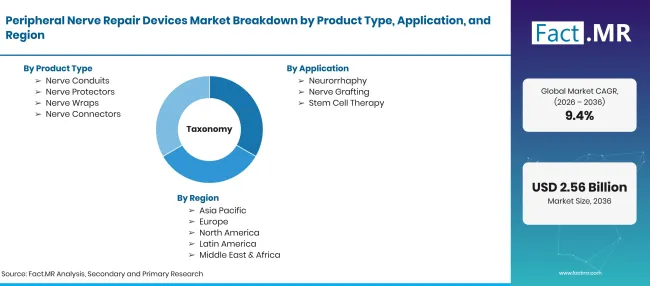
Peripheral Nerve Repair Devices Market Taxonomy 1 | Source: Fact.MR
| Items | Values |
|---|---|
| Quantitative Units (2026) | USD 1.0 Billion |
| Product Type | Nerve Conduits, Nerve Protectors, Nerve Wraps, Nerve Connectors |
| Application | Neurorrhaphy, Nerve Grafting, Stem Cell Therapy |
| End-User | Hospitals, Ambulatory Surgical Centers, Specialty Clinics |
| Regions Covered | North America, Latin America, Europe, East Asia, South Asia and Pacific, Middle East & Africa |
| Countries Covered | United States, Germany, Japan, United Kingdom, Brazil, and other countries |
| Key Companies Profiled | Axogen Inc.; Integra LifeSciences; Stryker Corporation; Polyganics B.V.; Collagen Matrix Inc. and Checkpoint Surgical |
| Additional Attributes | Dollar revenue in the Peripheral Nerve Repair Devices Market is segmented by product type (nerve conduits, nerve protectors, nerve wraps, nerve connectors); application (neurorrhaphy, nerve grafting, stem cell therapy); end-user (hospitals, ambulatory surgical centers, specialty clinics) and region. |
Source: Fact.MR analysis. Updated Nov 18, 2026
Source: Fact.MR analysis.
Peripheral Nerve Repair Devices Market by Segments
-
Product Type
- Nerve Conduits
- Nerve Protectors
- Nerve Wraps
- Nerve Connectors
-
Application
- Neurorrhaphy
- Nerve Grafting
- Stem Cell Therapy
-
End-User
- Hospitals
- Ambulatory Surgical Centers
- Specialty Clinics
-
Region:
- North America
- United States
- Canada
- Mexico
- Europe
- Germany
- United Kingdom
- France
- Italy
- Spain
- Rest of Europe
- Asia Pacific
- China
- India
- Japan
- South Korea
- Australia
- Rest of Asia Pacific
- Latin America
- Brazil
- Mexico
- Argentina
- Rest of Latin America
- Middle East & Africa
- GCC Countries
- South Africa
- Rest of Middle East & Africa
- North America
Frequently Asked Questions
How big is the global Peripheral Nerve Repair Devices Market in 2026?
What will be the size of the Peripheral Nerve Repair Devices Market by 2036?
How fast will the Peripheral Nerve Repair Devices Market grow during the forecast period?
Which product type segment holds the largest share of the Peripheral Nerve Repair Devices Market?
Who worked on this report


Preview the report firsthand - request a free sample
Free SampleGet the brochure for pricing and purchase details
Download PDF