- Market Value (2025): USD 586.7 Mn
- Estimated Value (2026): USD 670.0 Mn
- Forecast Value (2036): USD 2,527.8 Mn
- CAGR (2026-2036): 14.2%
What is the Mycoprotein Fibrous Ingredients Market forecast to be worth by 2036?
USD 670.0 million in 2026 to USD 2,527.8 million by 2036 at a 14.2% CAGR.
- The Mycoprotein Fibrous Ingredients Market surpassed a value of USD 586.7 million in 2025.
- Demand is projected to increase from USD 670.0 million in 2026 to USD 2,527.8 million by 2036.
- The market is forecast to record 14.2% CAGR from 2026 to 2036 as brands and contract manufacturers use fungal biomass to improve texture in meat-free foods.
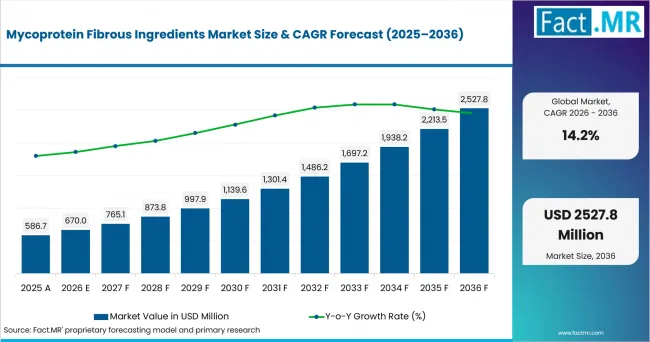
Mycoprotein Fibrous Ingredients Market Value Analysis | Source: Fact.MR
What are the defining numbers behind Mycoprotein Fibrous Ingredients Market growth?
An absolute opportunity of USD 1,857.8 million is expected between 2026 and 2036.
- Demand Drivers in the Market
- Alternative-meat brands need fibres that create a bite closer to cooked muscle, so native filament alignment is gaining value in premium formats.
- Foodservice developers need short cook times. USDA ERS reported in June 2026 that inflation-adjusted U.S. food-away-from-home spending reached USD 1.41 trillion in 2025.
- Regulatory teams need clearer dossier routes. FSA and FSS published four pieces of novel-food guidance in July 2026 for businesses developing cell-cultivated products and other novel foods.
- Ingredient manufacturers need scalable fermentation routes. The Government Chemist reported in June 2025 that its review of sustainable novel-food production covered precision-fermented biomass, including fungal and bacterial sources.
- Key Segments Analyzed
- By Fungal Platform: Fusarium-based mycoprotein is expected to hold 45.0% share in 2026 due to established strain familiarity and long commercial use in meat-free foods.
- By Ingredient Format: Wet fibrous biomass is projected to account for 36.0% share in 2026 since it preserves filament structure for chunks and whole-cut prototypes.
- By Texture Route: Native filament alignment is anticipated to capture 41.0% share in 2026 owing to its role in forming visible fibre without heavy extrusion.
- By End Product: Whole-cut meat alternatives are estimated to represent 31.0% share in 2026 supported by brand demand for chicken-style fillets and steak-like formats.
- Analyst Opinion at Fact.MR
- Shambhu Nath Jha, Principal Consultant at Fact.MR, states, "Fibrous mycoprotein is drawing attention because the organism already builds the texture that meat-alternative brands try to engineer. Demand is expected to move toward suppliers that can repeat fibre length and moisture behaviour at commercial scale. The better positioned companies combine strain control, post-processing know-how and evidence that a product cooks consistently in real kitchens."
- Strategic Implications
- Ingredient companies should document fibre length, water retention and cooked bite in application trials for mince, chunks and whole-cut formats.
- Food manufacturers should test wet biomass close to production sites because frozen transport and thawing can affect texture performance.
- Regulatory teams should map strain identity and fermentation controls before commercial sampling in the United Kingdom, European Union, United States and Singapore.
- Foodservice partners should use pilot menus to measure repeat purchase, cooking loss and plate appearance before widening distribution.
The UK is forecast to record 16.0% CAGR through 2036 supported by long-running mycoprotein know-how and novel-food guidance. The USA is projected to reach 15.2% CAGR due to GRAS pathways and foodservice scale. The Netherlands is anticipated to post 14.2% CAGR owing to fermentation policy support and ABUNDA capacity. Germany is estimated to advance at 13.5% CAGR linked to meat-substitute manufacturing. Singapore is forecast to reach 12.8% CAGR with food-security policy and novel-food review.
How does the Mycoprotein Fibrous Ingredients Market break down by segment?
Fusarium-based mycoprotein leads Fungal Platform at 45.0%; Native filament alignment leads Texture Route at 41.0%.
Which Fungal Platform dominates?
Fusarium-based mycoprotein is expected to hold 45.0% share in 2026.
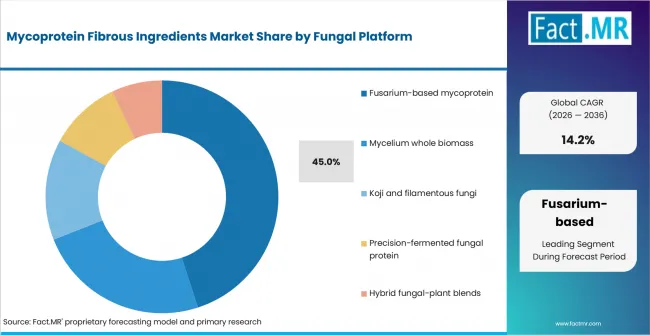
Mycoprotein Fibrous Ingredients Market Analysis By Fungal Platform | Source: Fact.MR
Fusarium-based mycoprotein is projected to lead due to established process learning and wider consumer recognition from meat-free meals. Mycelium whole biomass is gaining attention where brands want whole-food positioning and less ingredient complexity. Koji and other filamentous fungi support Asian-style formats and savoury applications. Precision-fermented fungal protein fits high-function formulations where targeted nutrition or flavour performance is needed. The segment sits close to mycelium meat fibers where fibre formation is central to product design.
What leads the Ingredient Format segment?
Wet fibrous biomass is projected to account for 36.0% share in 2026.
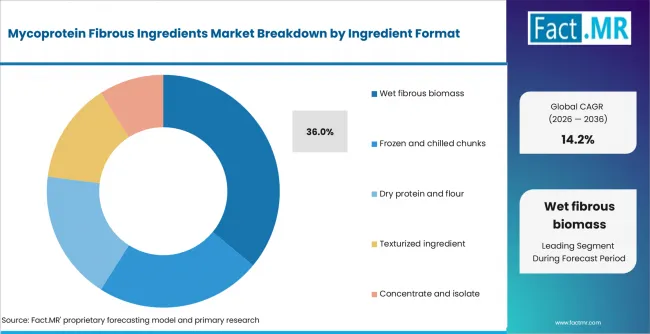
Mycoprotein Fibrous Ingredients Market Analysis By Ingredient Format | Source: Fact.MR
Wet fibrous biomass leads because moisture-rich filaments move directly into formed pieces with less texture rebuilding. Frozen and chilled chunks serve brands that want lower handling complexity and longer shelf life. Dry protein and flour work better in blends, coatings and nutrition systems. Texturized ingredients suit manufacturers that need a more standardized input across recipes. Protein ingredients coverage reinforces how form choice changes functionality across food applications.
How does Texture Route shape demand?
Native filament alignment is anticipated to lead with 41.0% share in 2026.
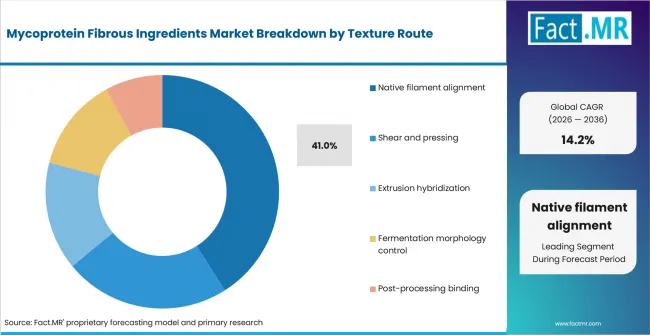
Mycoprotein Fibrous Ingredients Market Analysis By Texture Route | Source: Fact.MR
Native filament alignment is anticipated to lead since fungal growth already forms thread-like structures that support fibrous bite. Shear and pressing help convert biomass into layered textures for slices and chunks. Extrusion hybridization gives plant-fungal blends stronger shape control for burgers and strips. Fermentation morphology control is becoming useful when companies want fewer post-processing steps. The route aligns with fermented ingredients where process control determines ingredient behaviour.
What supports demand for Whole-cut meat alternatives within End Product?
Whole-cut meat alternatives are estimated to represent 31.0% share in 2026.
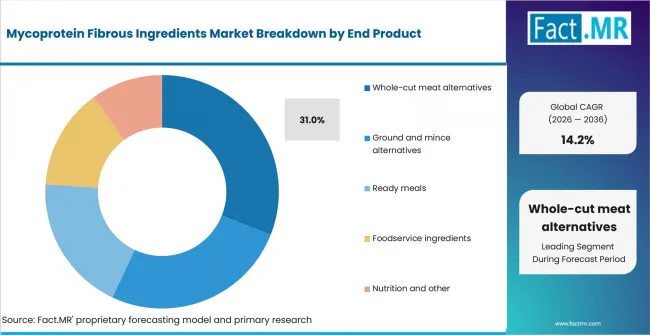
Mycoprotein Fibrous Ingredients Market Analysis By End Product | Source: Fact.MR
Whole-cut meat alternatives are estimated to lead because brands need visible fibres for fillets, strips and steak-style meals. Ground and mince alternatives remain practical for mainstream retail due to easier forming. Ready meals use fibrous mycoprotein to improve bite after reheating. Foodservice ingredients favour formats that tolerate hot holding and fast cooking. Wider meat substitutes development keeps texture proof central to supplier selection.
What is accelerating Mycoprotein Fibrous Ingredients Market adoption, and what is holding it back?
Texture realism drives it; approval work restrains it.
Drivers Impact Analysis
| DRIVER | (~) % IMPACT ON CAGR | GEOGRAPHIC RELEVANCE | IMPACT TIMELINE |
|---|---|---|---|
| Whole-cut texture requirements in meat alternatives | +2.4% | UK, USA, Netherlands | Short term (<= 2 years) |
| Foodservice trials for fibrous meat-free meals | +1.7% | USA, UK, Singapore | Medium term (2-4 years) |
| Biomass fermentation scale-up | +1.4% | Netherlands, Germany | Medium term (2-4 years) |
| Novel-food guidance and GRAS review pathways | +1.0% | USA, UK, EU, Singapore | Long term (>= 4 years) |
- Whole-cut texture requirements: Whole-cut products need visible fibres and a clean bite after cooking. Native fungal filaments can reduce the amount of mechanical structuring required in some applications, supporting development of meat-alternative formats with more natural fibrous texture.
- Foodservice trials: Restaurants and contract caterers can provide a practical testing route for fibrous fungal-protein formats before wider retail expansion. Foodservice trials allow ingredient developers to evaluate preparation, texture, cooking performance, and consumer acceptance under real operating conditions.
- Biomass fermentation scale-up: Larger fermentation assets help narrow the gap between laboratory development and commercial supply. Expanded production capacity supports more consistent availability of fungal biomass for chilled, frozen, and other structured food applications.
- Novel-food guidance and GRAS review pathways: Clear regulatory pathways can reduce uncertainty around strain identity, intended use, production controls, and safety assessment. Greater regulatory clarity supports confidence among food manufacturers evaluating fungal biomass and mycelial protein ingredients for commercial food applications.
Opportunity Impact Analysis
| OPPORTUNITY | (~) % IMPACT ON CAGR | GEOGRAPHIC RELEVANCE | IMPACT TIMELINE |
|---|---|---|---|
| Wet biomass for chilled whole-cut products | +1.5% | UK, Netherlands, USA | Medium term (2-4 years) |
| Foodservice ingredient systems | +1.2% | USA, Singapore, UK | Short term (<= 2 years) |
| Fungal nutrition and clean-label positioning | +0.9% | Global | Medium term (2-4 years) |
- Wet biomass for chilled products: Wet biomass can fit chilled formats where moisture retention, fibre visibility, and fresh texture matter. Established mycoprotein products show how fungal ingredients can support simpler formulations while maintaining the structural qualities expected in chilled meat-alternative applications.
- Foodservice ingredient systems: Foodservice provides an early route for fibrous fungal-protein formats that benefit from chef feedback and cooking validation. Integrated R&D, fermentation, and manufacturing capabilities can help suppliers move ingredients from trial kitchens into repeatable menu applications more efficiently.
- Fungal nutrition and clean-label positioning: Mycoprotein can support formulations that combine protein, fibre, and lower saturated-fat positioning within one ingredient system. Shorter ingredient lists strengthen its relevance where brands want texture, nutrition, and cleaner label communication to work together.
Restraints Impact Analysis
| RESTRAINT | (~) % IMPACT ON CAGR | GEOGRAPHIC RELEVANCE | IMPACT TIMELINE |
|---|---|---|---|
| Regulatory evidence requirements for novel fungal strains | -0.8% | UK, EU, Singapore | Short term (<= 2 years) |
| Cold-chain cost for wet fibrous biomass | -0.6% | Global | Medium term (2-4 years) |
| Consumer price pressure in meat-free meals | -0.5% | USA, UK, Germany | Short term (<= 2 years) |
- Regulatory evidence requirements: Fungal strains with limited food history require clear identity, safety, production, and use-level evidence before commercial launch. Pre-market approval frameworks can provide a defined entry route, but they also increase documentation and review requirements for ingredient developers.
- Cold-chain cost for wet biomass: Wet fibrous biomass can preserve texture and filament structure, but chilled or frozen handling increases storage and transport complexity. Dry formats reduce logistics burden, although they may require additional structuring or hydration during final product manufacturing.
- Consumer price pressure: Meat-free meals compete with animal proteins and lower-cost plant-based alternatives. Higher ingredient or menu costs can slow foodservice trials, particularly where operators need to protect margins while maintaining acceptable texture, nutrition, and consumer value.
Which countries are scaling the Mycoprotein Fibrous Ingredients Market through 2036?
- The country comparison spans 3.27 percentage points across the forecast period.
- The UK remains 0.86 percentage point above the USA through established mycoprotein production and novel-food guidance.
- The USA remains 0.99 percentage point above the Netherlands through GRAS pathways and foodservice spending depth.
- The Netherlands remains 0.71 percentage point above Germany through fermentation policy support and alternative-protein equipment incentives.
- Germany remains 0.71 percentage point above Singapore through a larger meat-substitute manufacturing base.
- Singapore closes the displayed range through food-security policy and pre-market review for novel foods.
Comparable CAGRs create different entry conditions due to food regulation, ingredient-scale capacity, consumer price pressure and local meat-alternative manufacturing. Full report coverage includes North America, Latin America, Western Europe, Eastern Europe, East Asia, South Asia & Pacific, Middle East & Africa.
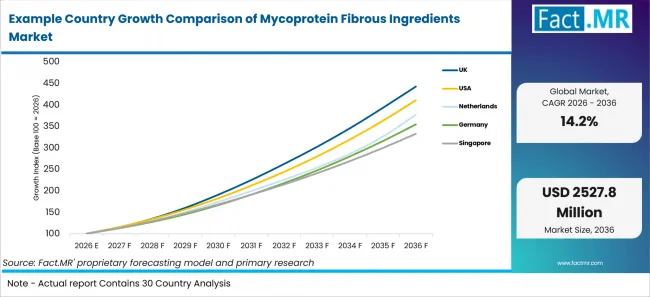
Example Country Growth Comparison Of Mycoprotein Fibrous Ingredients Market | Source: Fact.MR
| Country | CAGR (2026-2036) |
|---|---|
| United Kingdom | 16.0% |
| United States | 15.2% |
| Netherlands | 14.2% |
| Germany | 13.5% |
| Singapore | 12.8% |
What supports the United Kingdom’s growth?
16.0% CAGR, supported by established mycoprotein production and novel-food guidance.
Marlow Ingredients gives the UK a recognized mycoprotein base from the Quorn system. The market is projected to record 16.0% CAGR through 2036. DEFRA reported in 2026 that UK food, feed and drink exports reached GBP 25.7 billion in 2025, giving ingredient suppliers a broad food-manufacturing and export context.
How is the United States scaling demand?
15.2% CAGR, driven by GRAS pathways and foodservice spending depth.
U.S. formulators benefit from defined GRAS review routes for fungal protein ingredients. The market is expected to post 15.2% CAGR through 2036. USDA ERS reported in June 2026 that inflation-adjusted total U.S. food spending reached USD 2.51 trillion in 2025, creating a large channel base for meat-free formats.
What underpins the Netherlands outlook?
14.2% CAGR, led by fermentation expertise and alternative-protein policy support.
The Netherlands links fermentation capacity with public policy support for biotechnology. The market is anticipated to advance at 14.2% CAGR through 2036. RVO’s 2026 Environmental List makes qualifying production equipment eligible under code G 2700 when, among other conditions, plant-based meat and fish alternatives contain at least 5.0 g of protein per 100 g of product, supporting equipment investment tied to protein-rich alternatives.
What supports Germany’s adoption?
13.5% CAGR, supported by meat-substitute manufacturing and EU safety review.
Germany offers a sizable application base for meat-alternative ingredient testing. The market is estimated to record 13.5% CAGR through 2036. Destatis reported in May 2026 that Germany produced 124,900 tonnes of meat substitute products in 2025, giving fungal ingredient developers a direct manufacturing context.
How does Singapore perform?
12.8% CAGR, shaped by food-security policy and novel-food review.
Singapore uses food-security policy to support future protein routes. The market is forecast to post 12.8% CAGR through 2036. SFA reported in May 2026 that Singapore imported more than 90% of its food from over 180 countries and regions in 2025, keeping resilient protein supply in focus.
Who leads the Mycoprotein Fibrous Ingredients Market?
Marlow Ingredients supplies mycoprotein through the Marlow Foods system used across Quorn products, giving it a long-established commercial base in Fusarium-based meat-free foods.
ENOUGH is a scaled provider through ABUNDA mycoprotein and Sas van Gent manufacturing. BMC Ingredients is active through Rhiza mycelium. The Fynder Group is relevant through Fynder Ingredients and its central R&D, fermentation, and scaled-manufacturing platform.
Which companies are the key providers?
Key companies include Marlow Ingredients, ENOUGH, BMC Ingredients, and Fynder Ingredients (The Fynder Group).
- Marlow Ingredients
- ENOUGH
- BMC Ingredients
- Fynder Ingredients (The Fynder Group)
Bibliography
- U.S. Bureau of Labor Statistics. (2026, August 12). Consumer Price Index—July 2026.
- Department for Environment, Food & Rural Affairs. (2026, April 30). UK trade in Food, Feed and Drink, 2025 provisional.
- EFSA Panel on Nutrition, Novel Foods and Food Allergens (NDA). (2025). Safety of Rhizomucor pusillus biomass powder as a novel food pursuant to Regulation (EU) 2015/2283. EFSA Journal, 23(12), e9707.
- Food Standards Agency. (2026, July 10). New guidance for cell-cultivated and novel food businesses.
- Government Chemist. (2025, June 16). Quantitative review of sustainable novel food production.
- Government of the Netherlands. (2025, April 11). Dutch vision on biotechnology 2025–2040.
- Quorn. (2025, August 26). Quorn makes major change for ingredient-conscious fans.
- Meati Foods. (2025, November 11). Meati Holdings announces strategic revival and market expansion.
- MycoTechnology, Inc. (2026, March 3). MycoTechnology’s Honey Truffle Sweet Protein achieves regulatory milestone, enters U.S. market at commercial scale.
- Quorn. (2026, April 30). Back by popular demand, Quorn family favourite, Chilled Mince – now with no artificial ingredients!
- Rijksdienst voor Ondernemend Nederland. (2025, December 16). Productieapparatuur voor vlees-, vis- en zuivelvervangers.
- Singapore Food Agency. (2026, May 8). Singapore Food Statistics 2025.
- Singapore Food Agency. (2026, August 27). Overview of pre-market approval framework for novel food.
- Statistisches Bundesamt (Destatis). (2026, May 18). Nach jahrelangem Anstieg: Fleischersatz-Produktion sinkt 2025 um 1,2 % gegenüber dem Vorjahr.
- Zeballos, E., & Sinclair, W. (2026, June 11). Total U.S. food spending reached $2.51 trillion in 2025. U.S. Department of Agriculture, Economic Research Service.
- U.S. Department of Agriculture, Economic Research Service. (2026, July 8). Food Service Industry – Market Segments.
- U.S. Food and Drug Administration. (2025, November 18). GRN No. 1255: Mycelial biomass of Fusarium compactum CGMCC 41312 (fungal protein) [GRAS notice].
This Report Answers
- The report explains how fibrous fungal ingredients are used across platform, format, texture route and end product. It also covers regional and country demand.
- Segment analysis identifies why wet biomass and filament alignment are central to supplier selection for single cell protein extracts and related fungal ingredient systems.
- Country analysis reviews regulatory routes, food manufacturing depth and alternative-protein policy signals across the five listed countries.
- Competitive analysis examines current providers across Fusarium-based mycoprotein, whole mycelium biomass, foodservice formats and fungal fermentation ingredients.
- Application analysis links whole-cut products, mince alternatives and ready meals with adjacent gelatin substitutes where texture functionality also shapes formulation choices.
What does the Mycoprotein Fibrous Ingredients Market cover?
The Mycoprotein Fibrous Ingredients Market covers food ingredients derived from filamentous fungi and fungal biomass where fibrous structure is a core selling point. It includes ingredients used in whole-cut meat alternatives, ground meat-free formats, ready meals and foodservice systems that require chew and moisture control.
Coverage includes wet biomass, frozen chunks, dry protein, texturized ingredients, concentrates and isolates. It also connects to fermented yeast proteins where microbial production supports protein and functionality in food systems.
What is included in the scope?
The scope includes Fusarium-based mycoprotein, mycelium whole biomass, koji-derived systems and precision-fermented fungal protein when the ingredient is sold for fibrous structure or protein functionality. Hybrid fungal-plant blends are included when fungal material is used to improve texture.
The scope includes commercial ingredients sold to brands, contract manufacturers and foodservice developers. It also covers adjacent applications linked to precision fermentation dairy alternatives and precision fermentation CDMO services where fungal platforms share fermentation infrastructure.
What is excluded from the scope?
The scope excludes mushroom fruiting bodies sold as produce, culinary mushrooms without ingredient processing and fermentation hardware sold without food-grade fungal ingredient output. It also excludes animal-cell cultivated meat and general plant-protein isolates when fungal biomass is absent.
Finished consumer meals are covered only when they indicate ingredient demand. Conventional texturizers, hydrocolloids and starch systems are excluded unless they are part of a fungal ingredient blend; related benchmarking can be found in fermented ingredients.
How Was the Analysis Built?
The analysis draws on 120+ sources, 35+ company portfolios, 25+ countries, and more than 20 industry interviews.
- Primary Research: Primary research includes discussions with manufacturers, service providers, technology developers, distributors, end users, and subject-matter experts. These conversations examine purchasing priorities, product adoption, operational challenges, approval requirements, competitive positioning, and the factors that influence wider market acceptance.
- Desk Research: Desk research covers government statistics, regulatory publications, company filings, trade data, technical studies, industry associations, standards, public policy, and other authoritative sources. Every source used in the analysis is documented in the bibliography.
- Market Sizing and Forecasting: Market estimates combine historical performance, demand indicators, pricing and volume trends, segment shares, company participation, country-level growth, adoption patterns, investment activity, and barriers to market expansion.
- Data Validation and Update Cycle: Findings are validated by comparing primary interviews with public data, company activity, regulatory changes, trade patterns, and industry developments. Regular updates review new product launches, capacity changes, partnerships, approvals, and shifts in commercial adoption.
What is the report’s scope and coverage?
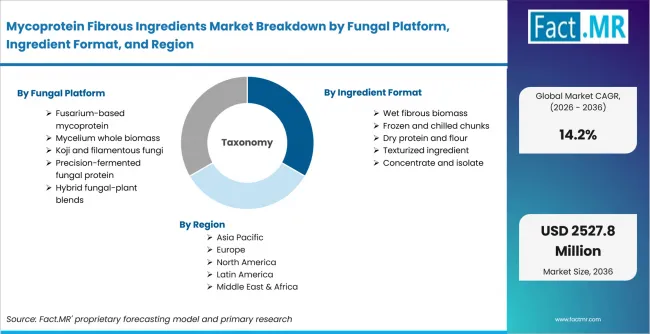
Mycoprotein Fibrous Ingredients Market Breakdown By Fungal Platform, Ingredient Format, And Region | Source: Fact.MR
| Attribute | Details |
|---|---|
| Quantitative Units | USD million |
| Market Definition | Food-grade fungal biomass and derived ingredient systems designed to provide fibrous bite, chew, structure and protein in meat alternatives, hybrid products, ready meals and foodservice preparations. |
| Fungal Platform | Fusarium-based mycoprotein; Mycelium whole biomass; Koji and filamentous fungi; Precision-fermented fungal protein; Hybrid fungal-plant blends |
| Ingredient Format | Wet fibrous biomass; Frozen and chilled chunks; Dry protein and flour; Texturized ingredient; Concentrate and isolate |
| Texture Route | Native filament alignment; Shear and pressing; Extrusion hybridization; Fermentation morphology control; Post-processing binding |
| End Product | Whole-cut meat alternatives; Ground and mince alternatives; Ready meals; Foodservice ingredients; Nutrition and other |
| Regions Covered | North America; Latin America; Western Europe; Eastern Europe; East Asia; South Asia & Pacific; Middle East & Africa |
| Countries Covered | United Kingdom; United States; Netherlands; Germany; Singapore |
| Key Companies Profiled | Marlow Ingredients; ENOUGH; BMC Ingredients; Fynder Ingredients (The Fynder Group) |
| Forecast Period | 2026 to 2036 |
| Approach | Hybrid top-down and bottom-up approach using fungal ingredient formats, meat-alternative applications, country demand, regulatory review and provider portfolio checks. |
How is the market segmented?
-
By Fungal Platform
- Fusarium-based mycoprotein
- Mycelium whole biomass
- Koji and filamentous fungi
- Precision-fermented fungal protein
- Hybrid fungal-plant blends
-
By Ingredient Format
- Wet fibrous biomass
- Frozen and chilled chunks
- Dry protein and flour
- Texturized ingredient
- Concentrate and isolate
-
By Texture Route
- Native filament alignment
- Shear and pressing
- Extrusion hybridization
- Fermentation morphology control
- Post-processing binding
-
By End Product
- Whole-cut meat alternatives
- Ground and mince alternatives
- Ready meals
- Foodservice ingredients
- Nutrition and other
-
By Region
- North America
- Latin America
- Western Europe
- Eastern Europe
- East Asia
- South Asia & Pacific
- Middle East & Africa