Precision Fermentation CDMO Services Market Size, Share, Growth and Forecast (2026 - 2036)
The Precision Fermentation CDMO Services Market is segmented by Service Type, by Ingredient Type, by Customer Type, by Delivery Model, by End Use, and Region. Forecast for 2026 to 2036.
What is the precision fermentation CDMO services market forecast to be worth by 2036?
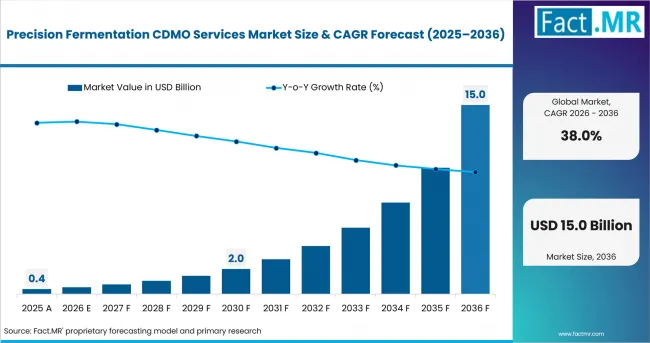
USD 0.6 billion in 2026 to USD 15.0 billion by 2036, at 38.0% CAGR.
- The precision fermentation CDMO services market was valued at USD 0.4 billion in 2025.
- Demand is expected to increase from USD 0.6 billion in 2026 to USD 15.0 billion by 2036.
- The market is forecast to record 38.0% CAGR during 2026 to 2036 as fermentation-based food ingredient brands outsource scale-up and downstream processing.
What are the defining numbers behind precision fermentation CDMO services growth?
USD 14.4 billion absolute opportunity by 2036, led by the United States and Denmark.
- Demand Drivers in the Market
- Fermentation ingredient brands need food-grade capacity before products can leave pilot stage.
- Food majors need outsourced production partners before testing animal-free dairy and functional proteins.
- Startups need downstream processing support because purification often decides ingredient cost.
- CDMOs need quality systems that meet food and regulatory expectations.
- Key Segments Analyzed
- By Service Type: Food-Grade Contract Manufacturing is expected to hold 36.0% share in 2026 as commercial bioreactor access is the main bottleneck.
- By Ingredient Type: Dairy Proteins lead because whey and beta-lactoglobulin are early precision-fermentation targets. The share is projected at 41.0% in 2026.
- By Customer Type: Fermentation-Based Food and Ingredient Brands lead because most lack owned manufacturing assets. This customer type is likely to account for 46.0% share in 2026.
- By Delivery Model: Capacity Reservation and Toll Manufacturing lead as brands need secured slots before launch. The model is projected to hold 39.0% share in 2026.
- By End Use: Animal-Free Dairy Ingredients are expected to hold 37.0% share in 2026 since dairy proteins have high functionality and clear food applications.
- By Geography: The United States is projected to record 42.2% CAGR through 2036 as commercial-scale food fermentation capacity comes online.
- Analyst Opinion at Fact.MR
- Shambhu Nath Jha, Senior Analyst at Fact.MR, states, “Precision fermentation is entering a capacity-constrained phase. We see ingredient brands asking who can move them from pilot batches to reliable commercial production. Providers that combine food-grade fermentation and launch support will gain stronger access to the next generation of food ingredients.”
- Strategic Implications
- Ingredient startups should secure manufacturing slots before commercial launch timelines are announced.
- Food brands need CDMO partners that can support quality and regulatory documentation.
- CDMOs should build downstream processing depth because purification drives final ingredient economics.
- Capacity providers need flexible contracts that support both pilot batches and commercial volumes.
The market covers contract development and manufacturing services that help brands scale precision-fermented food ingredients such as dairy proteins and collagen without building their own bioreactors. Liberation Bioindustries says its Richmond, Indiana facility has 600,000 liters of precision fermentation capacity and a dedicated downstream process line. [1] This gives food and ingredient companies a commercial-scale service base.
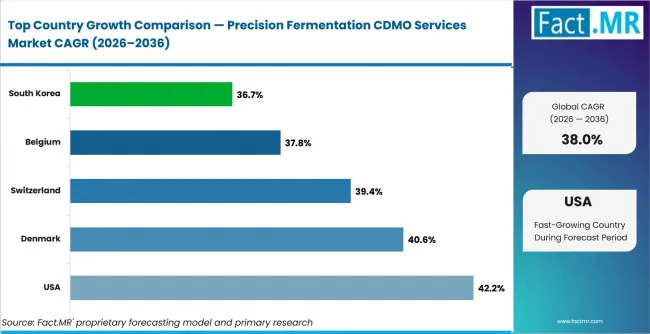
The United States is projected to record 42.2% CAGR from 2026 to 2036 as Liberation Bioindustries brings commercial-scale capacity online. Denmark will gain from pilot-scale and strain-to-scale expertise. The country is expected to post 40.6% CAGR through 2036. Switzerland is likely to record 39.4% CAGR by 2036 as Planetary-style fermentation platforms support European ingredient brands. Belgium is forecast to advance at 37.8% CAGR as BioBrew uses AB InBev fermentation and downstream processing expertise. South Korea is set to record 36.7% CAGR as CJ CheilJedang’s fermentation base supports food and nutrition ingredient scale-up.
How does the precision fermentation CDMO services market break down by segment?
Food-Grade Contract Manufacturing leads at 36.0%; Dairy Proteins lead at 41.0%.
Which service type dominates?
Food-Grade Contract Manufacturing holds 36.0% share in 2026.
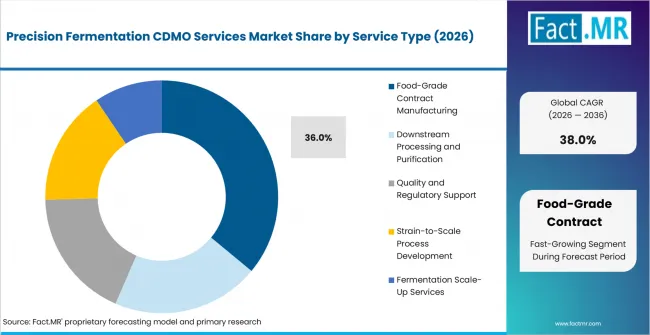
Food-Grade Contract Manufacturing is expected to hold 36.0% share in 2026 because commercial bioreactor access is the main bottleneck. The service covers production batches and quality documentation. Manufacturing leads because brands cannot commercialize ingredients without dependable capacity.
Which ingredient type dominates?
Dairy Proteins lead because they are early precision-fermentation targets.
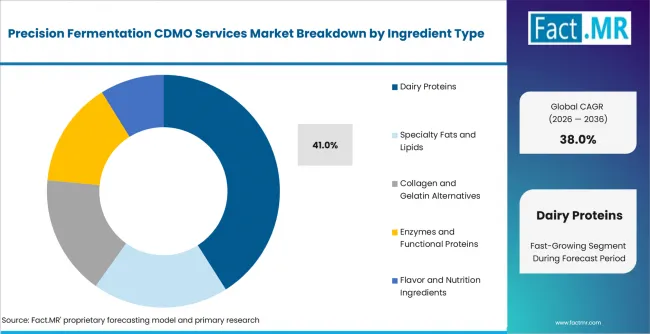
Dairy Proteins lead because whey and beta-lactoglobulin can improve taste and nutrition in animal-free dairy products. These ingredients need consistent purity and regulatory support before brand adoption. The ingredient type is projected to capture 41.0% share in 2026. 21st.BIO states that its programs include dairy proteins such as beta-lactoglobulin and caseins. [2]
Which customer type dominates?
Fermentation-Based Food and Ingredient Brands lead because most lack owned manufacturing assets.
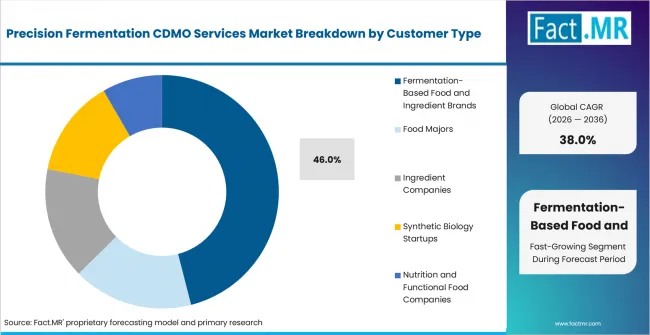
Fermentation-Based Food and Ingredient Brands lead because many companies own strains, IP and formulations but not production-scale bioreactors. Liberation Bioindustries announced in 2025 that it would produce Vivici’s Vivitein™ BLG at commercial scale from its Richmond, Indiana precision fermentation facility, which has 600,000 liters of capacity and a dedicated downstream process [3]. They need CDMOs to reduce capital burden and shorten launch timelines. This customer type is likely to account for 46.0% share in 2026.
Which delivery model dominates?
Capacity Reservation and Toll Manufacturing lead because brands need secured production slots.
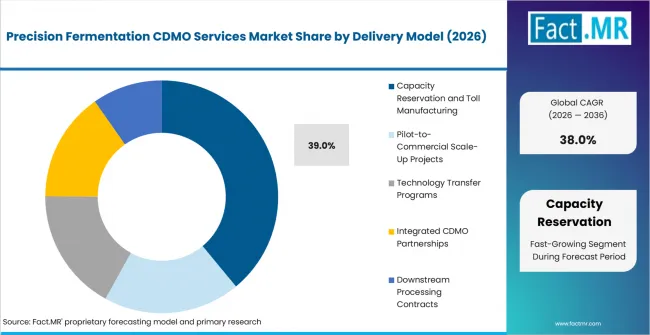
Capacity Reservation and Toll Manufacturing lead because ingredient brands must guarantee scale-up capacity before signing commercial supply or food brand agreements. The model is projected to hold 39.0% share in 2026. This model leads because production availability is now a strategic launch risk.
Which end use dominates?
Animal-Free Dairy Ingredients hold 37.0% share in 2026.
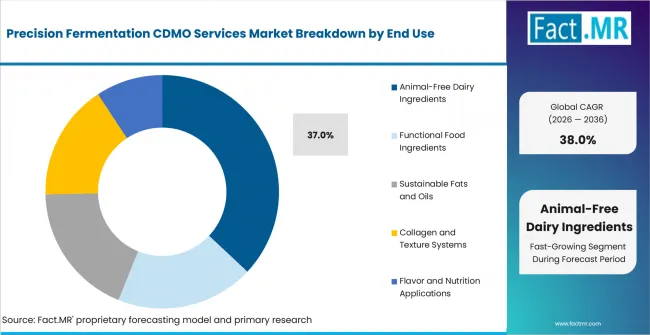
Animal-Free Dairy Ingredients lead because dairy proteins create clear use cases in cheese and nutritional products. DairyX stated in 2024 that its precision-fermented casein proteins can self-assemble into micelles, which are primary building blocks of dairy products such as cheese and yogurt [4]. The end use is expected to hold 37.0% share in 2026. Dairy ingredient applications lead because functionality can be demonstrated directly in familiar foods.
What is accelerating precision fermentation CDMO services demand, and what is holding it back?
Capacity shortage and downstream processing complexity drive demand; high capital intensity restrains adoption.
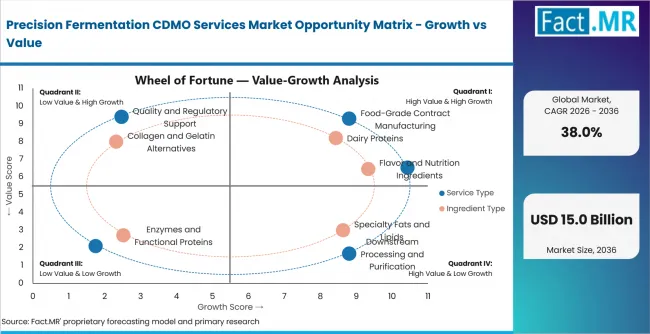
Capacity shortage is the main driver of demand for precision fermentation CDMO services. Liberation Bioindustries stated in 2025 that well over 50% of nameplate capacity at its Richmond plant was under contract or in late-stage agreements, showing strong customer demand for available commercial fermentation capacity [5]. This shows that food and ingredient companies are looking for available fermentation capacity before building their own production assets.
The main restraint is capital intensity. Commercial precision fermentation facilities require expensive bioreactors and food-grade quality systems. Many CDMOs also need customer commitments before building capacity. Service providers must balance flexible access with plant utilization before the business model can scale profitably.
Where do the biggest precision fermentation CDMO service opportunities sit?
Commercial manufacturing and dairy-protein scale-up.
- Commercial Manufacturing: CDMOs can sell food-grade production access to brands without bioreactors.
- Downstream Processing: Providers can reduce cost through purification and formulation support.
- Dairy-Protein Scale-Up: Service firms can support beta-lactoglobulin, casein and other animal-free dairy ingredients.
Which countries are scaling precision fermentation CDMO services fastest?
United States 42.2%, Denmark 40.6%, Switzerland 39.4%, Belgium 37.8%, South Korea 36.7%.
Based on regional analysis, the precision fermentation CDMO services market is segmented into North America, Western Europe, East Asia, Asia Pacific, Latin America, and Middle East and Africa.
.webp)
| Country | CAGR |
|---|---|
| United States | 42.2% |
| Denmark | 40.6% |
| Switzerland | 39.4% |
| Belgium | 37.8% |
| South Korea | 36.7% |

What is powering the United States lead?
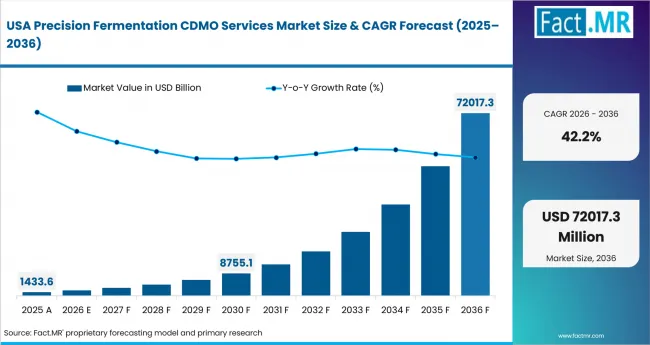
The United States is projected to record 42.2% CAGR through 2036 as commercial-scale food fermentation capacity comes online. The country has a strong base of fermentation startups and food brands seeking domestic capacity. CDMO demand will focus on pilot-to-commercial transfer and downstream processing. Service providers with available capacity will gain stronger access to dairy protein and specialty ingredient programs.
How is Denmark scaling precision fermentation CDMO demand?
Denmark benefits from industrial fermentation know-how and 21st.BIO’s strain-to-scale model. The country is expected to post 40.6% CAGR through 2036. 21st. Danish demand will focus on process development and technology transfer. Providers that connect strain engineering with industrial production design will be better placed.
What underpins Switzerland’s growth?
Switzerland is likely to record 39.4% CAGR through 2036 as Planetary-style fermentation platforms support European ingredient brands. Swiss demand will focus on full-stack platform services and cost optimization. Food ingredient firms need partners that can scale fermentation without owning factories. Growth will favor providers that combine process optimization and sustainability-focused production planning.
What supports Belgium’s outlook?
Belgium is forecast to advance at 37.8% CAGR through 2036 as BioBrew uses AB InBev fermentation and downstream processing expertise. Belgium’s brewing and biotech ecosystem supports food-grade fermentation services. Demand will favor providers that can convert beverage fermentation know-how into protein and ingredient production.
How is South Korea scaling precision fermentation CDMO services?
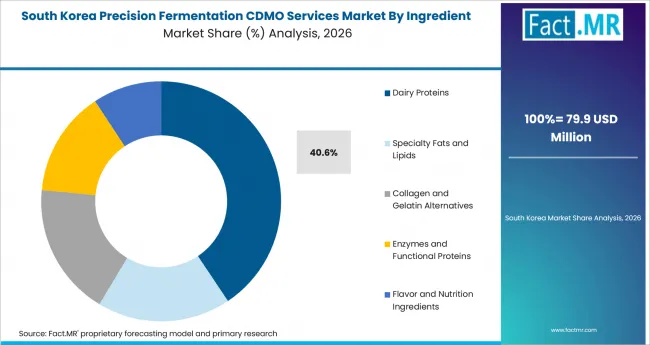
South Korea is set to record 36.7% CAGR through 2036 as CJ CheilJedang’s fermentation base supports food and nutrition ingredient scale-up. South Korean demand will focus on food additives and fermentation-derived functional components. Ingredient brands will need partners with quality systems and high-volume manufacturing capability. Service growth will favor companies with proven fermentation operations and global food customer access.
Who leads the precision fermentation CDMO services landscape?
Liberation Bioindustries and Planetary lead through commercial capacity and full-stack fermentation platforms.
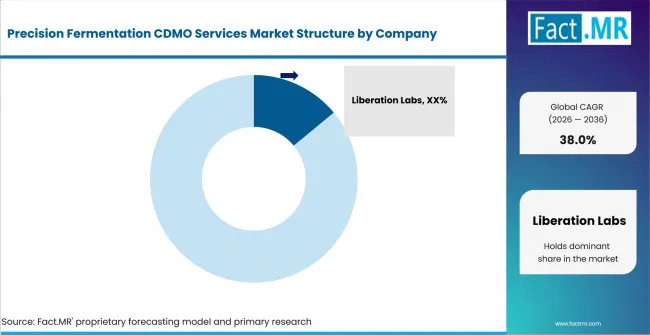
Precision fermentation CDMO services are used by food ingredient brands and biotechnology companies that need outsourced manufacturing. Liberation Bioindustries, formerly Liberation Labs, is building commercial-scale precision fermentation capacity through its Richmond facility. 21st.BIO supports strain development and regulatory services.
Planetary provides a full-stack fermentation platform for production at scale. BioBrew applies AB InBev’s scaled fermentation and downstream processing expertise to precision fermentation. CJ CheilJedang supports fermentation-derived food and nutrition ingredients through its CJ BIO platform. Competition through 2036 will depend on available capacity and production economics.
Providers that combine scale-up with downstream processing will be better placed. Pilot-stage specialists can win early development programs. Commercial CDMOs can win capacity-reservation contracts. Large fermentation incumbents can gain by converting existing know-how into food-grade precision fermentation services.
Which companies are the key players?
Liberation Bioindustries, 21st.BIO, Planetary, BioBrew and CJ BIO / CJ CheilJedang.
- Liberation Bioindustries
- 21st.BIO
- Planetary
- BioBrew (AB InBev)
- CJ BIO / CJ CheilJedang
Bibliography
- [1] Liberation Bioindustries. (2025, December 18). Liberation Bioindustries named one of “26 Food-Techs to Watch in 2026” by Protein Production Technology International.
- [2] Pinon, M. (2024, May 6). 21st.BIO unveils a new pilot plant facility to accelerate impact of biotech innovations globally. 21st.BIO.
- [3] Vivici. (2025, May 8). Powering active lifestyles: Vivici and Liberation Bioindustries bring the new standard of protein to the U.S.
- [4] Robinson, N. (2024, September 25). Cow-less casein protein “first” creates full cheese spectrum. FoodNavigator.
This Report Addresses
- Strategic intelligence on precision fermentation CDMO services across service type, ingredient type and customer type.
- Segment analysis covering Food-Grade Contract Manufacturing, Dairy Proteins, Fermentation-Based Food and Ingredient Brands, Capacity Reservation and Animal-Free Dairy Ingredients.
- Regional outlook covering the United States, Denmark, Switzerland, Belgium and South Korea.
- Competitive analysis of Liberation Bioindustries, 21st.BIO, Planetary, BioBrew and CJ BIO / CJ CheilJedang.
- Service assessment covering scale-up, contract manufacturing, downstream processing and quality support.
- Ingredient assessment covering dairy proteins, specialty fats, collagen alternatives, enzymes and nutrition ingredients.
- Primary interviews, provider checks, official source review and CDMO capacity validation support the forecast.
What does the precision fermentation CDMO services market cover?
Contract development and manufacturing services for precision-fermented food ingredients.
The precision fermentation CDMO services market covers outsourced services that help food and ingredient companies develop and manufacture precision-fermented proteins and functional ingredients. It includes strain-to-scale process support and quality documentation. The market differs from precision fermentation ingredient markets because the focus is outsourced production services.
What is included in the scope?
Scale-up and quality support.
The scope includes process development and technology transfer. It covers food-grade contract manufacturing and formulation support. It includes quality systems and ingredient launch readiness. It also includes commercial production partnerships for brands that do not own fermentation facilities.
What is excluded from the scope?
Ingredient sales without outsourced development or manufacturing services.
The scope excludes branded precision-fermented ingredients sold directly by producers unless CDMO services are offered. It excludes pharmaceutical biologics CDMO services with no food ingredient application. It excludes fermentation equipment sales without contract manufacturing or process services. It also excludes standard brewery operations unless precision fermentation food or ingredient production is supported.
How was the analysis built?
100+ sources, 40+ company portfolios, 25+ countries, 20+ interviews.
- Primary Research:
- Primary research includes interviews with fermentation ingredient startups and scale-up engineers. It includes input from CDMO operators and downstream processing specialists.
- Desk Research:
- Desk research reviews official CDMO service pages and commercial fermentation announcements. It covers food-grade capacity and biomanufacturing service models.
- Market-Sizing and Forecasting:
- Forecasting uses fermentation-based food company counts and production-stage conversion. Capacity expansion and downstream processing intensity support the market assessment.
- Data Validation and Update Cycle:
- Forecasts are validated through provider checks and ingredient company feedback. Facility start-up timelines and capacity disclosures help confirm market direction.
What is the report’s scope and coverage?
| Attribute | Details |
|---|---|
| Quantitative Units | USD Billion in services in 2026 to USD Billion by 2036 |
| Market Definition | Contract development and manufacturing services that scale precision-fermented food ingredients for brands without their own bioreactors |
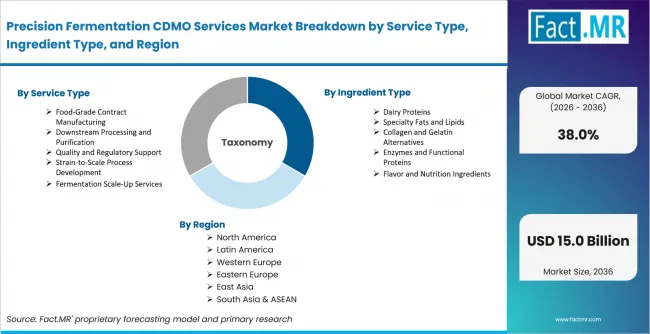
| Service Type | Strain-to-Scale Process Development, Fermentation Scale-Up Services, Food-Grade Contract Manufacturing, Downstream Processing and Purification, Quality and Regulatory Support |
| Ingredient Type | Dairy Proteins, Specialty Fats and Lipids, Collagen and Gelatin Alternatives, Enzymes and Functional Proteins, Flavor and Nutrition Ingredients |
| Customer Type | Fermentation-Based Food and Ingredient Brands, Food Majors, Ingredient Companies, Synthetic Biology Startups, Nutrition and Functional Food Companies |
| Delivery Model | Capacity Reservation and Toll Manufacturing, Pilot-to-Commercial Scale-Up Projects, Technology Transfer Programs, Integrated CDMO Partnerships, Downstream Processing Contracts |
| End Use | Animal-Free Dairy Ingredients, Functional Food Ingredients, Sustainable Fats and Oils, Collagen and Texture Systems, Flavor and Nutrition Applications |
| Regions Covered | North America, Western Europe, East Asia, Asia Pacific, Latin America, Middle East and Africa |
| Countries Covered | United States, Denmark, Switzerland, Belgium, South Korea |
| Key Companies Profiled | Liberation Bioindustries, 21st.BIO, Planetary, BioBrew and CJ BIO / CJ CheilJedang |
| Forecast Period | 2026 to 2036 |
| Approach | Hybrid top-down and bottom-up approach using fermentation brand counts, outsourced capacity demand, scale-up conversion, CDMO project intensity and provider validation |
How is the market segmented?
-
By Service Type:
- Strain-to-Scale Process Development
- Fermentation Scale-Up Services
- Food-Grade Contract Manufacturing
- Downstream Processing and Purification
- Quality and Regulatory Support
-
By Ingredient Type:
- Dairy Proteins
- Specialty Fats and Lipids
- Collagen and Gelatin Alternatives
- Enzymes and Functional Proteins
- Flavor and Nutrition Ingredients
-
By Customer Type:
- Fermentation-Based Food and Ingredient Brands
- Food Majors
- Ingredient Companies
- Synthetic Biology Startups
- Nutrition and Functional Food Companies
-
By Delivery Model:
- Capacity Reservation and Toll Manufacturing
- Pilot-to-Commercial Scale-Up Projects
- Technology Transfer Programs
- Integrated CDMO Partnerships
- Downstream Processing Contracts
-
By End Use:
- Animal-Free Dairy Ingredients
- Functional Food Ingredients
- Sustainable Fats and Oils
- Collagen and Texture Systems
- Flavor and Nutrition Applications
-
By Region:
- North America
- United States
- Canada
- Europe
- Denmark
- Switzerland
- Belgium
- Germany
- Netherlands
- Asia Pacific
- South Korea
- Japan
- Singapore
- Australia
- China
- Latin America
- Brazil
- Mexico
- Chile
- Middle East & Africa
- Saudi Arabia
- GCC Countries
- South Africa
- Israel
- North America
- Frequently Asked Questions -
How does Switzerland perform in the Precision Fermentation CDMO Services Market?
Switzerland is likely to record 39.4% CAGR through 2036 as full-stack fermentation platforms support European ingredient brands.
How does Belgium perform in the Precision Fermentation CDMO Services Market?
Belgium is forecast to advance at 37.8% CAGR through 2036 as scaled fermentation expertise moves into precision-fermented ingredients.
How does South Korea perform in the Precision Fermentation CDMO Services Market?
South Korea is set to record 36.7% CAGR through 2036 as fermentation-derived food and nutrition ingredient capacity expands.
What is the primary driver in the Precision Fermentation CDMO Services Market?
The primary driver is the lack of food-grade commercial fermentation capacity for startups and ingredient brands.
What is the main restraint in the Precision Fermentation CDMO Services Market?
The main restraint is capital intensity because facilities need expensive bioreactors, downstream lines and food-grade systems.
Why are dairy proteins important in this market?
Dairy proteins are important because they are early precision-fermentation targets with strong use cases in animal-free dairy products.
Table of Content
- Executive Summary
- Global Market Outlook
- Demand to side Trends
- Supply to side Trends
- Technology Roadmap Analysis
- Analysis and Recommendations
- Market Overview
- Market Coverage / Taxonomy
- Market Definition / Scope / Limitations
- Research Methodology
- Chapter Orientation
- Analytical Lens and Working Hypotheses
- Market Structure, Signals, and Trend Drivers
- Benchmarking and Cross-market Comparability
- Desk Research Programme (Secondary Evidence)
- Company Annual and Sustainability Reports
- Peer-reviewed Journals and Academic Literature
- Corporate Websites, Product Literature, and Technical Notes
- Earnings Decks and Investor Briefings
- Statutory Filings and Regulatory Disclosures
- Technical White Papers and Standards Notes
- Trade Journals, Industry Magazines, and Analyst Briefs
- Conference Proceedings, Webinars, and Seminar Materials
- Government Statistics Portals and Public Data Releases
- Press Releases and Reputable Media Coverage
- Specialist Newsletters and Curated Briefings
- Sector Databases and Reference Repositories
- Fact.MR Internal Proprietary Databases and Historical Market Datasets
- Subscription Datasets and Paid Sources
- Social Channels, Communities, and Digital Listening Inputs
- Additional Desk Sources
- Expert Input and Fieldwork (Primary Evidence)
- Primary Modes
- Qualitative Interviews and Expert Elicitation
- Quantitative Surveys and Structured Data Capture
- Blended Approach
- Why Primary Evidence is Used
- Field Techniques
- Interviews
- Surveys
- Physicians and Other Healthcare Professionals
- Governance, Ethics, and Data Stewardship
- Research Ethics
- Data Integrity and Handling
- Primary Modes
- Tooling, Models, and Reference Databases
- Data Engineering and Model Build
- Data Acquisition and Ingestion
- Cleaning, Normalisation, and Verification
- Synthesis, Triangulation, and Analysis
- Quality Assurance and Audit Trail
- Market Background
- Market Dynamics
- Drivers
- Restraints
- Opportunity
- Trends
- Scenario Forecast
- Demand in Optimistic Scenario
- Demand in Likely Scenario
- Demand in Conservative Scenario
- Opportunity Map Analysis
- Product Life Cycle Analysis
- Supply Chain Analysis
- Investment Feasibility Matrix
- Value Chain Analysis
- PESTLE and Porter’s Analysis
- Regulatory Landscape
- Regional Parent Market Outlook
- Production and Consumption Statistics
- Import and Export Statistics
- Market Dynamics
- Global Market Analysis 2021 to 2025 and Forecast, 2026 to 2036
- Historical Market Size Value (USD Million) Analysis, 2021 to 2025
- Current and Future Market Size Value (USD Million) Projections, 2026 to 2036
- Y to o to Y Growth Trend Analysis
- Absolute $ Opportunity Analysis
- Global Market Pricing Analysis 2021 to 2025 and Forecast 2026 to 2036
- Global Market Analysis 2021 to 2025 and Forecast 2026 to 2036, By Service Type
- Introduction / Key Findings
- Historical Market Size Value (USD Million) Analysis By Service Type , 2021 to 2025
- Current and Future Market Size Value (USD Million) Analysis and Forecast By Service Type , 2026 to 2036
- Food-Grade Contract Manufacturing
- Downstream Processing and Purification
- Quality and Regulatory Support
- Strain-to-Scale Process Development
- Fermentation Scale-Up Services
- Food-Grade Contract Manufacturing
- Y to o to Y Growth Trend Analysis By Service Type , 2021 to 2025
- Absolute $ Opportunity Analysis By Service Type , 2026 to 2036
- Global Market Analysis 2021 to 2025 and Forecast 2026 to 2036, By Ingredient Type
- Introduction / Key Findings
- Historical Market Size Value (USD Million) Analysis By Ingredient Type, 2021 to 2025
- Current and Future Market Size Value (USD Million) Analysis and Forecast By Ingredient Type, 2026 to 2036
- Dairy Proteins
- Specialty Fats and Lipids
- Collagen and Gelatin Alternatives
- Enzymes and Functional Proteins
- Flavor and Nutrition Ingredients
- Dairy Proteins
- Y to o to Y Growth Trend Analysis By Ingredient Type, 2021 to 2025
- Absolute $ Opportunity Analysis By Ingredient Type, 2026 to 2036
- Global Market Analysis 2021 to 2025 and Forecast 2026 to 2036, By Customer Type
- Introduction / Key Findings
- Historical Market Size Value (USD Million) Analysis By Customer Type, 2021 to 2025
- Current and Future Market Size Value (USD Million) Analysis and Forecast By Customer Type, 2026 to 2036
- Fermentation-Based Food and Ingredient Brands
- Food Majors
- Ingredient Companies
- Synthetic Biology Startups
- Nutrition and Functional Food Companies
- Fermentation-Based Food and Ingredient Brands
- Y to o to Y Growth Trend Analysis By Customer Type, 2021 to 2025
- Absolute $ Opportunity Analysis By Customer Type, 2026 to 2036
- Global Market Analysis 2021 to 2025 and Forecast 2026 to 2036, By End Use
- Introduction / Key Findings
- Historical Market Size Value (USD Million) Analysis By End Use, 2021 to 2025
- Current and Future Market Size Value (USD Million) Analysis and Forecast By End Use, 2026 to 2036
- Animal-Free Dairy Ingredients
- Functional Food Ingredients
- Sustainable Fats and Oils
- Collagen and Texture Systems
- Flavor and Nutrition Applications
- Animal-Free Dairy Ingredients
- Y to o to Y Growth Trend Analysis By End Use, 2021 to 2025
- Absolute $ Opportunity Analysis By End Use, 2026 to 2036
- Global Market Analysis 2021 to 2025 and Forecast 2026 to 2036, By Region
- Introduction
- Historical Market Size Value (USD Million) Analysis By Region, 2021 to 2025
- Current Market Size Value (USD Million) Analysis and Forecast By Region, 2026 to 2036
- North America
- Latin America
- Western Europe
- Eastern Europe
- East Asia
- South Asia and Pacific
- Middle East & Africa
- Market Attractiveness Analysis By Region
- North America Market Analysis 2021 to 2025 and Forecast 2026 to 2036, By Country
- Historical Market Size Value (USD Million) Trend Analysis By Market Taxonomy, 2021 to 2025
- Market Size Value (USD Million) Forecast By Market Taxonomy, 2026 to 2036
- By Country
- USA
- Canada
- Mexico
- By Service Type
- By Ingredient Type
- By Customer Type
- By End Use
- By Country
- Market Attractiveness Analysis
- By Country
- By Service Type
- By Ingredient Type
- By Customer Type
- By End Use
- Key Takeaways
- Latin America Market Analysis 2021 to 2025 and Forecast 2026 to 2036, By Country
- Historical Market Size Value (USD Million) Trend Analysis By Market Taxonomy, 2021 to 2025
- Market Size Value (USD Million) Forecast By Market Taxonomy, 2026 to 2036
- By Country
- Brazil
- Chile
- Rest of Latin America
- By Service Type
- By Ingredient Type
- By Customer Type
- By End Use
- By Country
- Market Attractiveness Analysis
- By Country
- By Service Type
- By Ingredient Type
- By Customer Type
- By End Use
- Key Takeaways
- Western Europe Market Analysis 2021 to 2025 and Forecast 2026 to 2036, By Country
- Historical Market Size Value (USD Million) Trend Analysis By Market Taxonomy, 2021 to 2025
- Market Size Value (USD Million) Forecast By Market Taxonomy, 2026 to 2036
- By Country
- Germany
- UK
- Italy
- Spain
- France
- Nordic
- BENELUX
- Rest of Western Europe
- By Service Type
- By Ingredient Type
- By Customer Type
- By End Use
- By Country
- Market Attractiveness Analysis
- By Country
- By Service Type
- By Ingredient Type
- By Customer Type
- By End Use
- Key Takeaways
- Eastern Europe Market Analysis 2021 to 2025 and Forecast 2026 to 2036, By Country
- Historical Market Size Value (USD Million) Trend Analysis By Market Taxonomy, 2021 to 2025
- Market Size Value (USD Million) Forecast By Market Taxonomy, 2026 to 2036
- By Country
- Russia
- Poland
- Hungary
- Balkan & Baltic
- Rest of Eastern Europe
- By Service Type
- By Ingredient Type
- By Customer Type
- By End Use
- By Country
- Market Attractiveness Analysis
- By Country
- By Service Type
- By Ingredient Type
- By Customer Type
- By End Use
- Key Takeaways
- East Asia Market Analysis 2021 to 2025 and Forecast 2026 to 2036, By Country
- Historical Market Size Value (USD Million) Trend Analysis By Market Taxonomy, 2021 to 2025
- Market Size Value (USD Million) Forecast By Market Taxonomy, 2026 to 2036
- By Country
- China
- Japan
- South Korea
- By Service Type
- By Ingredient Type
- By Customer Type
- By End Use
- By Country
- Market Attractiveness Analysis
- By Country
- By Service Type
- By Ingredient Type
- By Customer Type
- By End Use
- Key Takeaways
- South Asia and Pacific Market Analysis 2021 to 2025 and Forecast 2026 to 2036, By Country
- Historical Market Size Value (USD Million) Trend Analysis By Market Taxonomy, 2021 to 2025
- Market Size Value (USD Million) Forecast By Market Taxonomy, 2026 to 2036
- By Country
- India
- ASEAN
- Australia & New Zealand
- Rest of South Asia and Pacific
- By Service Type
- By Ingredient Type
- By Customer Type
- By End Use
- By Country
- Market Attractiveness Analysis
- By Country
- By Service Type
- By Ingredient Type
- By Customer Type
- By End Use
- Key Takeaways
- Middle East & Africa Market Analysis 2021 to 2025 and Forecast 2026 to 2036, By Country
- Historical Market Size Value (USD Million) Trend Analysis By Market Taxonomy, 2021 to 2025
- Market Size Value (USD Million) Forecast By Market Taxonomy, 2026 to 2036
- By Country
- Kingdom of Saudi Arabia
- Other GCC Countries
- Turkiye
- South Africa
- Other African Union
- Rest of Middle East & Africa
- By Service Type
- By Ingredient Type
- By Customer Type
- By End Use
- By Country
- Market Attractiveness Analysis
- By Country
- By Service Type
- By Ingredient Type
- By Customer Type
- By End Use
- Key Takeaways
- Key Countries Market Analysis
- USA
- Pricing Analysis
- Market Share Analysis, 2025
- By Service Type
- By Ingredient Type
- By Customer Type
- By End Use
- Canada
- Pricing Analysis
- Market Share Analysis, 2025
- By Service Type
- By Ingredient Type
- By Customer Type
- By End Use
- Mexico
- Pricing Analysis
- Market Share Analysis, 2025
- By Service Type
- By Ingredient Type
- By Customer Type
- By End Use
- Brazil
- Pricing Analysis
- Market Share Analysis, 2025
- By Service Type
- By Ingredient Type
- By Customer Type
- By End Use
- Chile
- Pricing Analysis
- Market Share Analysis, 2025
- By Service Type
- By Ingredient Type
- By Customer Type
- By End Use
- Germany
- Pricing Analysis
- Market Share Analysis, 2025
- By Service Type
- By Ingredient Type
- By Customer Type
- By End Use
- UK
- Pricing Analysis
- Market Share Analysis, 2025
- By Service Type
- By Ingredient Type
- By Customer Type
- By End Use
- Italy
- Pricing Analysis
- Market Share Analysis, 2025
- By Service Type
- By Ingredient Type
- By Customer Type
- By End Use
- Spain
- Pricing Analysis
- Market Share Analysis, 2025
- By Service Type
- By Ingredient Type
- By Customer Type
- By End Use
- France
- Pricing Analysis
- Market Share Analysis, 2025
- By Service Type
- By Ingredient Type
- By Customer Type
- By End Use
- India
- Pricing Analysis
- Market Share Analysis, 2025
- By Service Type
- By Ingredient Type
- By Customer Type
- By End Use
- ASEAN
- Pricing Analysis
- Market Share Analysis, 2025
- By Service Type
- By Ingredient Type
- By Customer Type
- By End Use
- Australia & New Zealand
- Pricing Analysis
- Market Share Analysis, 2025
- By Service Type
- By Ingredient Type
- By Customer Type
- By End Use
- China
- Pricing Analysis
- Market Share Analysis, 2025
- By Service Type
- By Ingredient Type
- By Customer Type
- By End Use
- Japan
- Pricing Analysis
- Market Share Analysis, 2025
- By Service Type
- By Ingredient Type
- By Customer Type
- By End Use
- South Korea
- Pricing Analysis
- Market Share Analysis, 2025
- By Service Type
- By Ingredient Type
- By Customer Type
- By End Use
- Russia
- Pricing Analysis
- Market Share Analysis, 2025
- By Service Type
- By Ingredient Type
- By Customer Type
- By End Use
- Poland
- Pricing Analysis
- Market Share Analysis, 2025
- By Service Type
- By Ingredient Type
- By Customer Type
- By End Use
- Hungary
- Pricing Analysis
- Market Share Analysis, 2025
- By Service Type
- By Ingredient Type
- By Customer Type
- By End Use
- Kingdom of Saudi Arabia
- Pricing Analysis
- Market Share Analysis, 2025
- By Service Type
- By Ingredient Type
- By Customer Type
- By End Use
- Turkiye
- Pricing Analysis
- Market Share Analysis, 2025
- By Service Type
- By Ingredient Type
- By Customer Type
- By End Use
- South Africa
- Pricing Analysis
- Market Share Analysis, 2025
- By Service Type
- By Ingredient Type
- By Customer Type
- By End Use
- USA
- Market Structure Analysis
- Competition Dashboard
- Competition Benchmarking
- Market Share Analysis of Top Players
- By Regional
- By Service Type
- By Ingredient Type
- By Customer Type
- By End Use
- Competition Analysis
- Competition Deep Dive
- Liberation Bioindustries
- Overview
- Product Portfolio
- Profitability by Market Segments (Product/Age /Sales Channel/Region)
- Sales Footprint
- Strategy Overview
- Marketing Strategy
- Product Strategy
- Channel Strategy
- 21st.BIO
- Planetary
- BioBrew (AB InBev)
- CJ BIO / CJ CheilJedang
- Liberation Bioindustries
- Competition Deep Dive
- Assumptions & Acronyms Used
List Of Table
- Table 1: Global Market Value (USD Million) Forecast by Region, 2021 to 2036
- Table 2: Global Market Value (USD Million) Forecast by Service Type , 2021 to 2036
- Table 3: Global Market Value (USD Million) Forecast by Ingredient Type, 2021 to 2036
- Table 4: Global Market Value (USD Million) Forecast by Customer Type, 2021 to 2036
- Table 5: Global Market Value (USD Million) Forecast by End Use, 2021 to 2036
- Table 6: North America Market Value (USD Million) Forecast by Country, 2021 to 2036
- Table 7: North America Market Value (USD Million) Forecast by Service Type , 2021 to 2036
- Table 8: North America Market Value (USD Million) Forecast by Ingredient Type, 2021 to 2036
- Table 9: North America Market Value (USD Million) Forecast by Customer Type, 2021 to 2036
- Table 10: North America Market Value (USD Million) Forecast by End Use, 2021 to 2036
- Table 11: Latin America Market Value (USD Million) Forecast by Country, 2021 to 2036
- Table 12: Latin America Market Value (USD Million) Forecast by Service Type , 2021 to 2036
- Table 13: Latin America Market Value (USD Million) Forecast by Ingredient Type, 2021 to 2036
- Table 14: Latin America Market Value (USD Million) Forecast by Customer Type, 2021 to 2036
- Table 15: Latin America Market Value (USD Million) Forecast by End Use, 2021 to 2036
- Table 16: Western Europe Market Value (USD Million) Forecast by Country, 2021 to 2036
- Table 17: Western Europe Market Value (USD Million) Forecast by Service Type , 2021 to 2036
- Table 18: Western Europe Market Value (USD Million) Forecast by Ingredient Type, 2021 to 2036
- Table 19: Western Europe Market Value (USD Million) Forecast by Customer Type, 2021 to 2036
- Table 20: Western Europe Market Value (USD Million) Forecast by End Use, 2021 to 2036
- Table 21: Eastern Europe Market Value (USD Million) Forecast by Country, 2021 to 2036
- Table 22: Eastern Europe Market Value (USD Million) Forecast by Service Type , 2021 to 2036
- Table 23: Eastern Europe Market Value (USD Million) Forecast by Ingredient Type, 2021 to 2036
- Table 24: Eastern Europe Market Value (USD Million) Forecast by Customer Type, 2021 to 2036
- Table 25: Eastern Europe Market Value (USD Million) Forecast by End Use, 2021 to 2036
- Table 26: East Asia Market Value (USD Million) Forecast by Country, 2021 to 2036
- Table 27: East Asia Market Value (USD Million) Forecast by Service Type , 2021 to 2036
- Table 28: East Asia Market Value (USD Million) Forecast by Ingredient Type, 2021 to 2036
- Table 29: East Asia Market Value (USD Million) Forecast by Customer Type, 2021 to 2036
- Table 30: East Asia Market Value (USD Million) Forecast by End Use, 2021 to 2036
- Table 31: South Asia and Pacific Market Value (USD Million) Forecast by Country, 2021 to 2036
- Table 32: South Asia and Pacific Market Value (USD Million) Forecast by Service Type , 2021 to 2036
- Table 33: South Asia and Pacific Market Value (USD Million) Forecast by Ingredient Type, 2021 to 2036
- Table 34: South Asia and Pacific Market Value (USD Million) Forecast by Customer Type, 2021 to 2036
- Table 35: South Asia and Pacific Market Value (USD Million) Forecast by End Use, 2021 to 2036
- Table 36: Middle East & Africa Market Value (USD Million) Forecast by Country, 2021 to 2036
- Table 37: Middle East & Africa Market Value (USD Million) Forecast by Service Type , 2021 to 2036
- Table 38: Middle East & Africa Market Value (USD Million) Forecast by Ingredient Type, 2021 to 2036
- Table 39: Middle East & Africa Market Value (USD Million) Forecast by Customer Type, 2021 to 2036
- Table 40: Middle East & Africa Market Value (USD Million) Forecast by End Use, 2021 to 2036
List Of Figures
- Figure 1: Global Market Pricing Analysis
- Figure 2: Global Market Value (USD Million) Forecast 2021-2036
- Figure 3: Global Market Value Share and BPS Analysis by Service Type,2026 and 2036
- Figure 4: Global Market Y-o-Y Growth Comparison by Service Type,2026 to 2036
- Figure 5: Global Market Attractiveness Analysis by Service Type
- Figure 6: Global Market Value Share and BPS Analysis by Ingredient Type,2026 and 2036
- Figure 7: Global Market Y-o-Y Growth Comparison by Ingredient Type,2026 to 2036
- Figure 8: Global Market Attractiveness Analysis by Ingredient Type
- Figure 9: Global Market Value Share and BPS Analysis by Customer Type,2026 and 2036
- Figure 10: Global Market Y-o-Y Growth Comparison by Customer Type,2026 to 2036
- Figure 11: Global Market Attractiveness Analysis by Customer Type
- Figure 12: Global Market Value Share and BPS Analysis by End Use,2026 and 2036
- Figure 13: Global Market Y-o-Y Growth Comparison by End Use,2026 to 2036
- Figure 14: Global Market Attractiveness Analysis by End Use
- Figure 15: Global Market Value (USD Million) Share and BPS Analysis by Region,2026 and 2036
- Figure 16: Global Market Y-o-Y Growth Comparison by Region,2026 to 2036
- Figure 17: Global Market Attractiveness Analysis by Region
- Figure 18: North America Market Incremental Dollar Opportunity,2026 to 2036
- Figure 19: Latin America Market Incremental Dollar Opportunity,2026 to 2036
- Figure 20: Western Europe Market Incremental Dollar Opportunity,2026 to 2036
- Figure 21: Eastern Europe Market Incremental Dollar Opportunity,2026 to 2036
- Figure 22: East Asia Market Incremental Dollar Opportunity,2026 to 2036
- Figure 23: South Asia and Pacific Market Incremental Dollar Opportunity,2026 to 2036
- Figure 24: Middle East & Africa Market Incremental Dollar Opportunity,2026 to 2036
- Figure 25: North America Market Value Share and BPS Analysis by Country,2026 and 2036
- Figure 26: North America Market Value Share and BPS Analysis by Service Type,2026 and 2036
- Figure 27: North America Market Y-o-Y Growth Comparison by Service Type,2026 to 2036
- Figure 28: North America Market Attractiveness Analysis by Service Type
- Figure 29: North America Market Value Share and BPS Analysis by Ingredient Type,2026 and 2036
- Figure 30: North America Market Y-o-Y Growth Comparison by Ingredient Type,2026 to 2036
- Figure 31: North America Market Attractiveness Analysis by Ingredient Type
- Figure 32: North America Market Value Share and BPS Analysis by Customer Type,2026 and 2036
- Figure 33: North America Market Y-o-Y Growth Comparison by Customer Type,2026 to 2036
- Figure 34: North America Market Attractiveness Analysis by Customer Type
- Figure 35: North America Market Value Share and BPS Analysis by End Use,2026 and 2036
- Figure 36: North America Market Y-o-Y Growth Comparison by End Use,2026 to 2036
- Figure 37: North America Market Attractiveness Analysis by End Use
- Figure 38: Latin America Market Value Share and BPS Analysis by Country,2026 and 2036
- Figure 39: Latin America Market Value Share and BPS Analysis by Service Type,2026 and 2036
- Figure 40: Latin America Market Y-o-Y Growth Comparison by Service Type,2026 to 2036
- Figure 41: Latin America Market Attractiveness Analysis by Service Type
- Figure 42: Latin America Market Value Share and BPS Analysis by Ingredient Type,2026 and 2036
- Figure 43: Latin America Market Y-o-Y Growth Comparison by Ingredient Type,2026 to 2036
- Figure 44: Latin America Market Attractiveness Analysis by Ingredient Type
- Figure 45: Latin America Market Value Share and BPS Analysis by Customer Type,2026 and 2036
- Figure 46: Latin America Market Y-o-Y Growth Comparison by Customer Type,2026 to 2036
- Figure 47: Latin America Market Attractiveness Analysis by Customer Type
- Figure 48: Latin America Market Value Share and BPS Analysis by End Use,2026 and 2036
- Figure 49: Latin America Market Y-o-Y Growth Comparison by End Use,2026 to 2036
- Figure 50: Latin America Market Attractiveness Analysis by End Use
- Figure 51: Western Europe Market Value Share and BPS Analysis by Country,2026 and 2036
- Figure 52: Western Europe Market Value Share and BPS Analysis by Service Type,2026 and 2036
- Figure 53: Western Europe Market Y-o-Y Growth Comparison by Service Type,2026 to 2036
- Figure 54: Western Europe Market Attractiveness Analysis by Service Type
- Figure 55: Western Europe Market Value Share and BPS Analysis by Ingredient Type,2026 and 2036
- Figure 56: Western Europe Market Y-o-Y Growth Comparison by Ingredient Type,2026 to 2036
- Figure 57: Western Europe Market Attractiveness Analysis by Ingredient Type
- Figure 58: Western Europe Market Value Share and BPS Analysis by Customer Type,2026 and 2036
- Figure 59: Western Europe Market Y-o-Y Growth Comparison by Customer Type,2026 to 2036
- Figure 60: Western Europe Market Attractiveness Analysis by Customer Type
- Figure 61: Western Europe Market Value Share and BPS Analysis by End Use,2026 and 2036
- Figure 62: Western Europe Market Y-o-Y Growth Comparison by End Use,2026 to 2036
- Figure 63: Western Europe Market Attractiveness Analysis by End Use
- Figure 64: Eastern Europe Market Value Share and BPS Analysis by Country,2026 and 2036
- Figure 65: Eastern Europe Market Value Share and BPS Analysis by Service Type,2026 and 2036
- Figure 66: Eastern Europe Market Y-o-Y Growth Comparison by Service Type,2026 to 2036
- Figure 67: Eastern Europe Market Attractiveness Analysis by Service Type
- Figure 68: Eastern Europe Market Value Share and BPS Analysis by Ingredient Type,2026 and 2036
- Figure 69: Eastern Europe Market Y-o-Y Growth Comparison by Ingredient Type,2026 to 2036
- Figure 70: Eastern Europe Market Attractiveness Analysis by Ingredient Type
- Figure 71: Eastern Europe Market Value Share and BPS Analysis by Customer Type,2026 and 2036
- Figure 72: Eastern Europe Market Y-o-Y Growth Comparison by Customer Type,2026 to 2036
- Figure 73: Eastern Europe Market Attractiveness Analysis by Customer Type
- Figure 74: Eastern Europe Market Value Share and BPS Analysis by End Use,2026 and 2036
- Figure 75: Eastern Europe Market Y-o-Y Growth Comparison by End Use,2026 to 2036
- Figure 76: Eastern Europe Market Attractiveness Analysis by End Use
- Figure 77: East Asia Market Value Share and BPS Analysis by Country,2026 and 2036
- Figure 78: East Asia Market Value Share and BPS Analysis by Service Type,2026 and 2036
- Figure 79: East Asia Market Y-o-Y Growth Comparison by Service Type,2026 to 2036
- Figure 80: East Asia Market Attractiveness Analysis by Service Type
- Figure 81: East Asia Market Value Share and BPS Analysis by Ingredient Type,2026 and 2036
- Figure 82: East Asia Market Y-o-Y Growth Comparison by Ingredient Type,2026 to 2036
- Figure 83: East Asia Market Attractiveness Analysis by Ingredient Type
- Figure 84: East Asia Market Value Share and BPS Analysis by Customer Type,2026 and 2036
- Figure 85: East Asia Market Y-o-Y Growth Comparison by Customer Type,2026 to 2036
- Figure 86: East Asia Market Attractiveness Analysis by Customer Type
- Figure 87: East Asia Market Value Share and BPS Analysis by End Use,2026 and 2036
- Figure 88: East Asia Market Y-o-Y Growth Comparison by End Use,2026 to 2036
- Figure 89: East Asia Market Attractiveness Analysis by End Use
- Figure 90: South Asia and Pacific Market Value Share and BPS Analysis by Country,2026 and 2036
- Figure 91: South Asia and Pacific Market Value Share and BPS Analysis by Service Type,2026 and 2036
- Figure 92: South Asia and Pacific Market Y-o-Y Growth Comparison by Service Type,2026 to 2036
- Figure 93: South Asia and Pacific Market Attractiveness Analysis by Service Type
- Figure 94: South Asia and Pacific Market Value Share and BPS Analysis by Ingredient Type,2026 and 2036
- Figure 95: South Asia and Pacific Market Y-o-Y Growth Comparison by Ingredient Type,2026 to 2036
- Figure 96: South Asia and Pacific Market Attractiveness Analysis by Ingredient Type
- Figure 97: South Asia and Pacific Market Value Share and BPS Analysis by Customer Type,2026 and 2036
- Figure 98: South Asia and Pacific Market Y-o-Y Growth Comparison by Customer Type,2026 to 2036
- Figure 99: South Asia and Pacific Market Attractiveness Analysis by Customer Type
- Figure 100: South Asia and Pacific Market Value Share and BPS Analysis by End Use,2026 and 2036
- Figure 101: South Asia and Pacific Market Y-o-Y Growth Comparison by End Use,2026 to 2036
- Figure 102: South Asia and Pacific Market Attractiveness Analysis by End Use
- Figure 103: Middle East & Africa Market Value Share and BPS Analysis by Country,2026 and 2036
- Figure 104: Middle East & Africa Market Value Share and BPS Analysis by Service Type,2026 and 2036
- Figure 105: Middle East & Africa Market Y-o-Y Growth Comparison by Service Type,2026 to 2036
- Figure 106: Middle East & Africa Market Attractiveness Analysis by Service Type
- Figure 107: Middle East & Africa Market Value Share and BPS Analysis by Ingredient Type,2026 and 2036
- Figure 108: Middle East & Africa Market Y-o-Y Growth Comparison by Ingredient Type,2026 to 2036
- Figure 109: Middle East & Africa Market Attractiveness Analysis by Ingredient Type
- Figure 110: Middle East & Africa Market Value Share and BPS Analysis by Customer Type,2026 and 2036
- Figure 111: Middle East & Africa Market Y-o-Y Growth Comparison by Customer Type,2026 to 2036
- Figure 112: Middle East & Africa Market Attractiveness Analysis by Customer Type
- Figure 113: Middle East & Africa Market Value Share and BPS Analysis by End Use,2026 and 2036
- Figure 114: Middle East & Africa Market Y-o-Y Growth Comparison by End Use,2026 to 2036
- Figure 115: Middle East & Africa Market Attractiveness Analysis by End Use
- Figure 116: Global Market - Tier Structure Analysis
- Figure 117: Global Market - Company Share Analysis