- Base Value(2025): 403.5 Mn
- Estimated Value(2026): 436.2 Mn
- Forecast Value (2036): 950.5 Mn
- CAGR (2026 - 2036): 8.1%
Nasopharyngoscopes Market Analysis and Forecast by Fact.MR
According to Fact.MR estimates, the global nasopharyngoscopes market market was valued at USD 403.5 million in 2025. The market is projected to reach USD 436.2 million in 2026 and is expected to grow to USD 950.5 million by 2036, expanding at a CAGR of 8.1%. Flexible Nasopharyngoscopes is anticipated to account for 48.0% of the product segment in 2026, while ENT Examination is expected to remain the leading application with around 44.0% share.
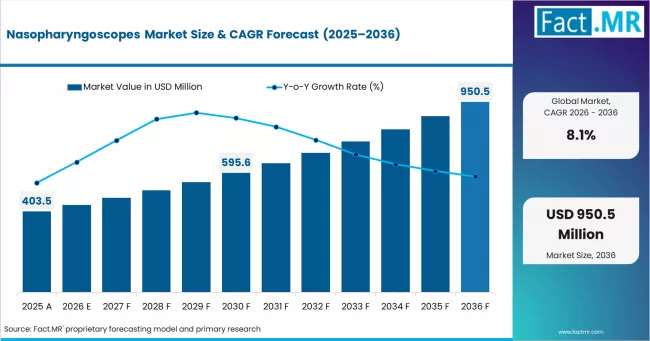
Nasopharyngoscopes Market Market Value Analysis | Source: Fact.MR
Summary of Nasopharyngoscopes Market
- Market Snapshot
- The nasopharyngoscopes market was valued at USD 403.50 million in 2025.
- By 2036, the Nasopharyngoscopes Market is expected to be worth USD 950.45 million.
- From 2026 to 2036, the market is projected to expand at a CAGR of 8.1%.
- The market is projected to create an incremental opportunity of USD 514.26 million between 2026 and 2036.
- In 2026, flexible nasopharyngoscopes are expected to account for 48% of the product segment, driven by broad ENT examination and diagnostic procedure demand.
- China (10.94%) and India (10.12%) are two of the fastest growing markets in the world.
- Demand and Growth Drivers
- Demand is shaped by rising ENT disorder prevalence globally, including chronic sinusitis, voice disorders, and sleep-related breathing conditions that require nasopharyngoscopic examination.
- Growth reflects expanding outpatient ENT clinic networks and ambulatory surgical center growth, both of which require flexible and rigid nasopharyngoscope deployment.
- Adoption is increasing due to growing preference for single-use nasopharyngoscopes in infection control protocols and expanding video and 4K imaging technology adoption.
- Product and Segment View
- Flexible nasopharyngoscopes lead the product segment with a 48% share in 2026, supported by broad ENT examination demand and diagnostic procedure use.
- ENT examination holds 44% of the application segment, anchored by nasal cavity and laryngeal examination workflows.
- Hospitals account for 41% of end-use demand, while specialty ENT clinics, ambulatory surgical centers, and diagnostic centers form secondary channels.
- Geography and Competitive Outlook
- North America remains the largest regional market, supported by mature ENT clinic infrastructure, broad outpatient procedure volumes, and advanced video endoscopy adoption.
- Asia Pacific is the fastest-growing region, led by China where expanding ENT specialty capacity, rising sleep medicine awareness, and growing video endoscopy adoption are all supporting demand.
- The competitive field is led by Karl Storz SE & Co. KG with an estimated 25% share, followed by Medtronic plc, Stryker Corporation, Olympus Corporation, and Ambu A/S.
- Analyst Opinion
- Nasopharyngoscopes sit at the intersection of ENT specialty examination workflows and emerging infection control priorities, and the commercial economics reflect a category undergoing structural shift. The category is structurally attractive because the 8.1 percent CAGR is supported by both baseline ENT procedure volume growth and a compositional shift toward single-use disposable endoscopes that deliver premium per-unit economics. The commercial lever that matters most is dual portfolio capability across reusable video endoscopy platforms and single-use disposable scopes because ENT departments increasingly prefer vendors that can serve both preferences. Players that combine reusable platform imaging quality with single-use infection control positioning will capture premium positioning, while single-format competitors face pressure as hospitals and clinics make category-wide vendor consolidation decisions.
Why is Nasopharyngoscopes Market Growing?
- Growth reflects rising ENT disorder prevalence globally and expanding diagnostic examination demand.
- Demand is shaped by expanding outpatient ENT clinic networks and ambulatory surgical center growth.
- Adoption is increasing due to growing preference for single-use nasopharyngoscopes and expanding video and 4K imaging technology adoption.
The demand base rests on rising ENT disorder prevalence globally, including chronic sinusitis, voice disorders, laryngeal lesions, and sleep-related breathing conditions. Chronic sinusitis affects an estimated 11 to 12 percent of adults in developed markets and drives consistent demand for diagnostic examination. Voice disorders, vocal cord lesions, and laryngeal conditions also drive specialty ENT examination volumes, while the growth of sleep medicine programs has expanded nasopharyngoscope use for obstructive sleep apnea evaluation.
The second structural driver is outpatient ENT clinic network and ambulatory surgical center growth. ENT procedures have increasingly shifted from hospital-based settings to outpatient clinics and ambulatory surgical centers, which require nasopharyngoscope deployment across multiple procedure rooms. This site-of-service shift also increases the number of clinics and ASCs requiring nasopharyngoscope procurement, which expands the installed base beyond traditional hospital-centric demand.
The third driver is single-use endoscope adoption and video technology evolution. Single-use disposable nasopharyngoscopes eliminate reprocessing requirements, reduce infection transmission risk, and improve workflow predictability, which supports sustained adoption particularly in ambulatory settings. Video nasopharyngoscopes with 4K imaging capability also provide superior visualization relative to traditional fiberoptic systems, which drives replacement demand in hospital and specialty ENT clinic settings.
Segment-wise Analysis of Nasopharyngoscopes Market
- Flexible nasopharyngoscopes lead the product segment with 48% share in 2026, anchored by broad ENT examination demand and diagnostic procedure use.
- Disposable single-use nasopharyngoscopes represent the fastest-growing sub-segment, driven by infection control preferences and workflow simplification.
- ENT examination holds 44% of the application segment, followed by laryngeal examination and airway management as secondary use cases.
The segmentation view shows a category with durable reusable platform demand and accelerating single-use disposable growth. Competitive advantage rests on imaging quality for reusable platforms, cost-per-procedure economics for single-use devices, and broad ENT channel distribution relationships. Growth over the forecast period is expected to tilt toward single-use disposable nasopharyngoscopes and video systems with 4K imaging capabilities.
Why Do Flexible Nasopharyngoscopes Lead the Product Segment?
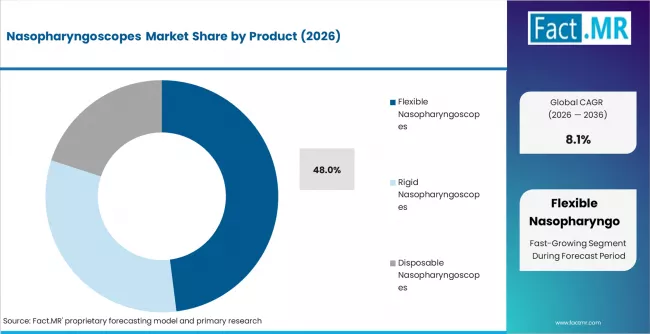
Nasopharyngoscopes Market Analysis By Product | Source: Fact.MR
Flexible nasopharyngoscopes lead the product segment because they serve the largest volume of ENT examination procedures. Flexible scopes navigate the nasal cavity and nasopharynx with minimal patient discomfort, which makes them the preferred option for outpatient examination, sleep medicine evaluation, voice disorder assessment, and other routine diagnostic workflows. Rigid scopes are used primarily for specialized surgical visualization rather than routine examination.
The segment leadership is reinforced by the transition from fiberoptic to video platforms. Video nasopharyngoscopes provide superior imaging quality, support digital documentation, and enable teaching through image sharing, which makes them preferred for modern ENT practice. High definition video scopes with 4K imaging capability represent the premium end of the flexible scope segment and are driving replacement demand in major hospital and academic ENT departments.
Why are Disposable Single-Use Nasopharyngoscopes the Fastest-Growing Sub-Segment?
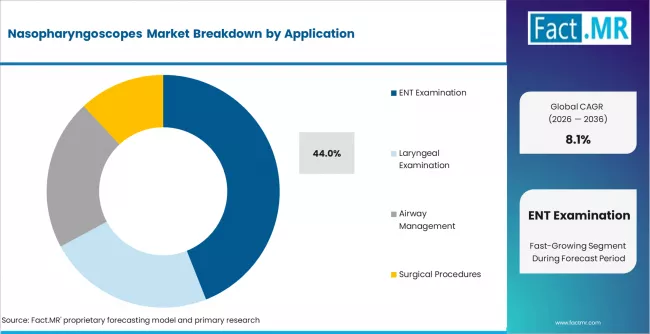
Nasopharyngoscopes Market Analysis By Application | Source: Fact.MR
Disposable single-use nasopharyngoscopes are the fastest-growing sub-segment because they eliminate reprocessing requirements while delivering imaging quality sufficient for most routine examination workflows. Reusable endoscopes require complex reprocessing protocols including high-level disinfection or sterilization, which creates meaningful operational burden and infection transmission risk if protocols are not followed correctly. Single-use scopes eliminate this burden entirely while supporting workflow predictability.
Growth within single-use scopes is being lifted by continued imaging quality improvements and cost reductions. Ambu A/S and other specialist manufacturers have driven imaging quality improvements that now approach reusable platform performance for routine examination use cases. Cost-per-procedure economics for single-use scopes remain higher than reusable alternatives at high procedure volumes but are competitive at lower volumes, particularly when reprocessing overhead is fully loaded into reusable scope costs.
Key Growth Drivers, Constraints, and Market Scope
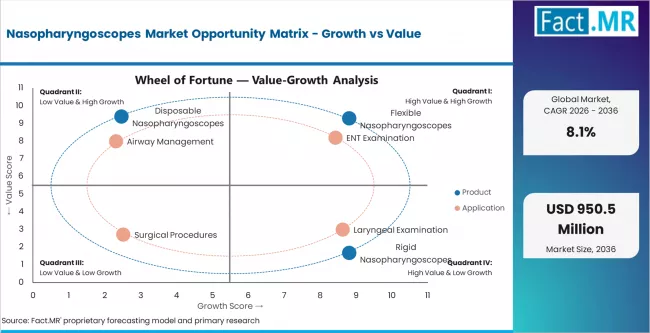
Nasopharyngoscopes Market Opportunity Matrix Growth Vs Value | Source: Fact.MR
- Rising ENT disorder prevalence and outpatient procedure site-of-service shift are the structural demand foundations.
- Single-use disposable scope adoption and 4K video imaging evolution are the key compositional shifts driving premium growth.
- Reprocessing burden on reusable scopes, per-procedure cost economics, and imaging quality tradeoffs remain the leading constraints.
The market scope is shaped by the combination of steady reusable platform demand growth and accelerating single-use disposable scope adoption. Competitive advantage sits in imaging quality for reusable platforms, per-procedure cost economics for single-use devices, and broad ENT channel distribution relationships.
Growth Drivers
The primary driver is rising ENT disorder prevalence globally, which drives consistent diagnostic examination and procedure demand. A second driver is the shift of ENT procedures to outpatient clinics and ambulatory surgical centers, which expands the installed base requiring nasopharyngoscope procurement. A third driver is single-use endoscope adoption and video technology evolution, which supports category growth through both infection control preferences and imaging quality differentiation. These three forces combine to deliver a strong high single-digit growth trajectory with premium uplift from single-use and 4K video segments.
Constraints
The leading constraint is reprocessing burden on reusable nasopharyngoscopes. Infection control protocols require complex reprocessing including high-level disinfection, which creates operational overhead and regulatory compliance burden. A second constraint is per-procedure cost economics for single-use scopes at high procedure volumes, where reusable platforms can deliver lower per-procedure costs if reprocessing is managed efficiently. A third constraint is imaging quality tradeoffs in single-use scopes relative to premium reusable video platforms, particularly for specialized surgical visualization applications that require superior image quality.
Opportunities
The strongest opportunity lies in single-use disposable scope portfolio expansion, where improved imaging quality and cost reductions can expand addressable procedure segments. A second opportunity is 4K video platform expansion in premium reusable scope segments targeting academic medical centers and specialty ENT clinics. A third opportunity is emerging market penetration, particularly in China and India, where expanding ENT specialty capacity, rising sleep medicine awareness, and growing video endoscopy adoption all support category growth.
Regional Outlook Across Key Markets
.webp "Top Country Growth Comparison Nasopharyngoscopes Market Cagr (2026 2036)")
Top Country Growth Comparison Nasopharyngoscopes Market Cagr (2026 2036) | Source: Fact.MR
- China leads country-level growth at 10.94% CAGR, supported by expanding ENT specialty capacity, rising sleep medicine awareness, and growing video endoscopy adoption.
- India follows at 10.12%, driven by private hospital ENT department expansion, rising sleep medicine program development, and growing single-use scope adoption.
- North America remains the largest regional pool by absolute value, with the USA at 7.70% supported by mature ENT clinic infrastructure and advanced video endoscopy adoption.
- European demand is led by Germany at 9.31% and the UK at 6.88%, with both countries showing strong ENT specialty infrastructure and infection control protocol adoption.
Country CAGR Table
| Country | CAGR (%) |
|---|---|
| China | 10.94% |
| India | 10.12% |
| Germany | 9.31% |
| Brazil | 8.51% |
| USA | 7.70% |
| UK | 6.88% |
| Japan | 6.08% |
Source: Fact.MR analysis. Updated Apr 27, 2026
Source: Fact.MR analysis, based on proprietary forecasting model and primary research.
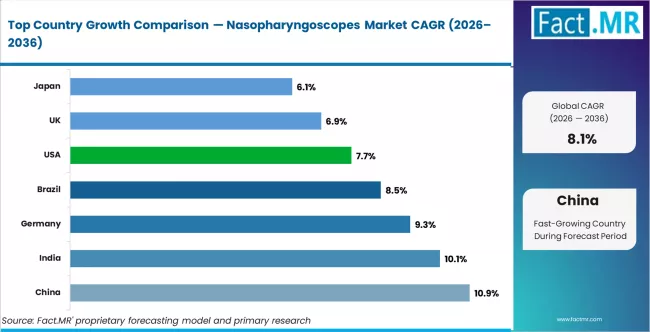
Nasopharyngoscopes Market Cagr Analysis By Country | Source: Fact.MR
Regional dynamics split into three profiles. Asia Pacific leads on growth rate, pulled by ENT specialty capacity expansion and rising sleep medicine awareness. Europe grows at high single-digit rates driven by strong ENT specialty infrastructure and strict infection control protocols that support single-use scope adoption. North America remains the largest dollar market, anchored by mature ENT clinic infrastructure, broad outpatient procedure volumes, and advanced video endoscopy adoption.
United States
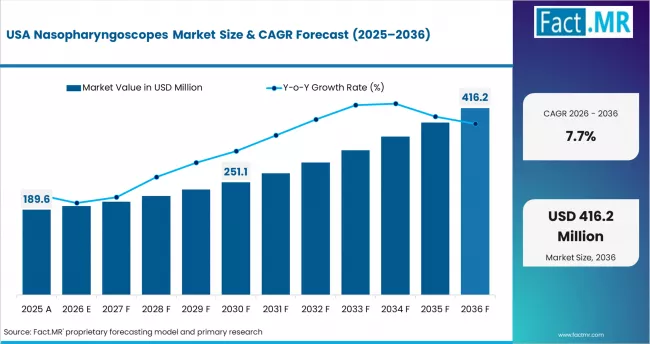
Nasopharyngoscopes Market Country Value Analysis | Source: Fact.MR
The United States anchors global demand through its mature ENT clinic infrastructure, broad outpatient procedure volumes, and advanced video endoscopy adoption. Karl Storz SE & Co. KG, Medtronic plc, Stryker Corporation, and Olympus Corporation lead the reusable video endoscopy segment, while Ambu A/S and other specialists lead single-use disposable scope adoption. Academic medical centers and large ENT specialty practices drive premium video platform demand, while ambulatory surgical centers drive single-use scope adoption.
- Mature ENT clinic infrastructure supports broad nasopharyngoscope adoption.
- Academic medical centers drive premium video and 4K platform placements.
- Ambulatory surgical centers drive single-use disposable scope adoption.
Canada
Canada represents a steady growth market shaped by provincial health system coverage for ENT procedures, hospital and community ENT clinic networks, and cross-border distribution relationships with US manufacturers. Provincial health systems cover ENT procedures, which supports sustained procedure volumes. Academic medical centers in Toronto, Montreal, and Vancouver drive premium video platform demand.
- Provincial health system coverage supports ENT procedure volumes.
- Academic medical centers drive premium video platform adoption.
- Cross-border distribution supports device availability across Canadian markets.
United Kingdom
The United Kingdom market is shaped by NHS England's ENT service networks, infection control standards that support single-use scope adoption, and the mix of NHS and private ENT service channels. NHS trusts deploy nasopharyngoscopes across ENT departments, while private healthcare providers and specialty ENT clinics support additional demand. UK infection control protocols have historically supported strong single-use scope adoption.
- NHS ENT service networks support nasopharyngoscope deployment.
- Infection control protocols support single-use scope adoption.
- Private ENT clinics drive additional procedure volumes beyond NHS channels.
Germany
Germany leads European growth on the strength of mature ENT specialty infrastructure, statutory insurance coverage for ENT procedures, and strong domestic manufacturing presence. Karl Storz SE & Co. KG has home-country operations anchoring German market positioning. German ENT clinics and hospitals drive consistent reusable video platform demand, while single-use scope adoption continues expanding supported by infection control considerations.
- Mature ENT specialty infrastructure supports broad nasopharyngoscope adoption.
- Karl Storz's home-country operations anchor German market positioning.
- Statutory insurance coverage supports sustained ENT procedure volumes.
China
China is the fastest-growing country in the forecast, driven by expanding ENT specialty capacity, rising sleep medicine awareness, and growing video endoscopy adoption. Tier-1 hospital ENT departments in Beijing, Shanghai, Guangzhou, and other major cities are adopting modern video nasopharyngoscope platforms, while sleep medicine program expansion drives additional examination volume growth. Chinese domestic manufacturers are also building value-tier competition against imported premium brands.
- Tier-1 hospital ENT adoption drives premium video platform placements.
- Rising sleep medicine awareness supports examination volume growth.
- Domestic manufacturing capability creates value-tier competition in mid-market segments.
India
India represents a strong growth market driven by private hospital ENT department expansion, rising sleep medicine program development, and growing single-use scope adoption. Apollo Hospitals, Fortis Healthcare, and other corporate hospital chains are expanding ENT specialty services across metropolitan markets. Sleep medicine programs have grown rapidly in Indian tier-1 cities, which supports nasopharyngoscope examination volume growth.
- Corporate hospital ENT department expansion drives nasopharyngoscope demand.
- Rising sleep medicine program development supports examination volumes.
- Growing single-use scope adoption supports premium segment growth.
Competitive Benchmarking and Company Positioning
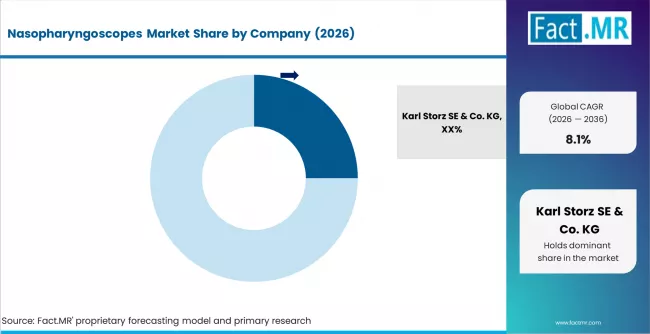
Nasopharyngoscopes Market Analysis By Company | Source: Fact.MR
- Karl Storz SE & Co. KG leads with an estimated 25% share, supported by its broad video endoscopy portfolio and strong ENT specialty channel relationships.
- Medtronic plc, Stryker Corporation, Olympus Corporation, and Ambu A/S compete through differentiated reusable and single-use scope portfolios.
- Specialty players such as Richard Wolf GmbH, Fujifilm Holdings Corporation, Boston Scientific Corporation, Cook Medical Incorporated, and Smith & Nephew plc hold focused positions in specific segments.
The competitive field is moderately concentrated, with Karl Storz SE & Co. KG commanding a strong share position through its broad video endoscopy portfolio and established ENT specialty channel relationships. Karl Storz's scale reach, portfolio breadth across flexible and rigid scopes, and strong image quality reputation create meaningful competitive advantages that reinforce its position across academic medical centers and specialty ENT clinics.
Medtronic plc competes through its ENT portfolio acquired through the Medtronic ENT franchise. Stryker Corporation competes through its Entellus Medical acquisition that extended its ENT surgical portfolio into nasopharyngoscope platforms. Olympus Corporation holds strong positions particularly in flexible video scope segments. Ambu A/S leads the single-use disposable scope segment through its aScope product family. Richard Wolf GmbH, Fujifilm Holdings Corporation, Boston Scientific Corporation, and Cook Medical Incorporated hold specialty positions across specific segments and geographies.
Strategic priorities across the field include expanding single-use disposable scope portfolios, deepening video and 4K imaging platform capabilities, and strengthening ambulatory surgical center channel relationships. Scaled manufacturers with dual portfolios spanning reusable video platforms and single-use scopes will capture the bulk of forecast period growth, while single-format competitors must differentiate through targeted innovation or specialty channel focus.
Competitive Analysis
Competitive positioning rests on three dimensions: reusable video platform imaging quality, single-use scope portfolio depth, and broad ENT specialty channel relationships. Karl Storz SE & Co. KG leads on video platform imaging quality and ENT channel depth. Olympus Corporation competes through flexible video scope heritage. Ambu A/S leads single-use scope positioning. Stryker Corporation and Medtronic plc competitive broadly across both reusable and single-use segments through portfolio breadth.
Second-tier competitors maintain relevance through specialized product designs, focused application strategies, or regional channel concentration. Chinese domestic manufacturers are building positions in value-tier reusable scope segments. The gap between dual-portfolio platform manufacturers and single-format specialty producers continues to widen as hospitals and clinics make vendor consolidation decisions that favor broader portfolio capability.
Benchmarking Table
| Company | Scale Reach | Reusable Portfolio | Single-Use Portfolio | ENT Channel |
|---|---|---|---|---|
| Karl Storz SE & Co. KG | Global | Strong | Medium | Strong |
| Medtronic plc | Global | Medium-Broad | Medium | Strong |
| Stryker Corporation | Global | Medium-Broad | Medium | Strong |
| Olympus Corporation | Global | Strong | Medium | Medium-Strong |
| Ambu A/S | Global | Low | Strong | Medium-Strong |
| Richard Wolf GmbH | Regional | Medium | Low | Medium |
| Fujifilm Holdings Corporation | Global | Medium | Low | Medium |
Source: Fact.MR analysis. Updated Apr 27, 2026
Recent Developments
- In 2025, Karl Storz SE & Co. KG continued expanding its video endoscopy portfolio through 4K imaging platform updates targeting ENT specialty channels.
- In 2025, Ambu A/S advanced its aScope nasopharyngoscope single-use scope platform through product line extensions and imaging quality improvements.
- In 2026, Olympus Corporation strengthened its video nasopharyngoscope platform through portfolio updates supporting both reusable and single-use workflow integration.
Leading Companies Shaping Nasopharyngoscopes Market
-
Major Players
- Karl Storz SE & Co. KG
- Medtronic plc
- Stryker Corporation
- Olympus Corporation
- Ambu A/S
- Richard Wolf GmbH
- Fujifilm Holdings Corporation
- Boston Scientific Corporation
-
Emerging Players
- Cook Medical Incorporated
- Entellus Medical
- Smith & Nephew plc
- Conmed Corporation
- Happersberger otopront GmbH
- EndoMed Systems GmbH
- PENTAX Medical
- HOYA Corporation
Sources and Research References
- United States Food and Drug Administration (FDA) - 510(k) Database for Nasopharyngoscope Devices
- American Academy of Otolaryngology-Head and Neck Surgery (AAO-HNS) - Clinical Practice Guidelines
- World Health Organization (WHO) - Global ENT Disorder Prevalence Publications
- Association for Professionals in Infection Control and Epidemiology (APIC) - Endoscope Reprocessing Guidelines
- Karl Storz SE & Co. KG - Video Endoscopy Platform Portfolio Updates
- Ambu A/S - Single-Use Endoscope Clinical Evidence Publications
- Primary interviews with otolaryngologists, ENT clinic managers, ambulatory surgical center directors, and endoscope manufacturers
This bibliography is provided for reader reference and is not exhaustive. The full report contains the complete reference list and detailed citations.
Key Questions This Report Addresses
- What is the current and future size of the nasopharyngoscopes market?
- How fast is the market expected to grow between 2026 and 2036?
- Which product segment is likely to lead the market by 2026?
- Which application segment will account for the highest demand by 2026?
- How is single-use disposable scope adoption reshaping demand patterns?
- Why are China and India emerging as the fastest-growing markets?
- Which countries are projected to show the fastest growth through 2036?
- Who are the key companies active in the nasopharyngoscopes market?
- How is 4K video imaging technology changing the competitive dynamics?
Nasopharyngoscopes Market Definition
The nasopharyngoscopes market covers endoscopic devices designed for examination of the nasal cavity, nasopharynx, larynx, and upper airway structures. This includes flexible nasopharyngoscopes including fiberoptic and video variants, rigid nasopharyngoscopes for diagnostic and surgical use, and disposable single-use nasopharyngoscopes. The market spans hospitals, public hospitals, tertiary care hospitals, general hospitals, specialty clinics, ENT clinics, private ENT centers, diagnostic ENT clinics, ambulatory surgical centers, outpatient surgical facilities, day care surgical units, and diagnostic centers across primary use cases including ENT examination, laryngeal examination, airway management, and surgical procedures.
Nasopharyngoscopes Market Inclusions
The scope includes flexible nasopharyngoscopes across fiberoptic nasopharyngoscopes and video nasopharyngoscopes including reusable fiberoptic scopes, portable fiberoptic scopes, high definition video scopes, and integrated camera scopes, rigid nasopharyngoscopes including diagnostic rigid scopes and high precision rigid scopes, and disposable nasopharyngoscopes including single use flexible scopes and sterile prepackaged scopes. It covers applications across ENT examination, nasal cavity examination, routine diagnostic procedures, post surgical evaluation, laryngeal examination, vocal cord assessment, voice disorder diagnosis, tumor detection, airway management, intubation assistance, emergency airway procedures, anesthesia support, surgical procedures, minimally invasive procedures, and biopsy procedures. Coverage spans hospitals, public hospitals, tertiary care hospitals, general hospitals, specialty clinics, ENT clinics, private ENT centers, diagnostic ENT clinics, ambulatory surgical centers, outpatient surgical facilities, day care surgical units, diagnostic centers, imaging and diagnostic labs, and preventive health centers from 2026 to 2036.
Nasopharyngoscopes Market Exclusions
The scope excludes general endoscopy devices used for gastrointestinal, urological, or gynecological applications, which are separate endoscopy category segments. It also excludes fiberoptic bronchoscopes used primarily for lower airway examination, video laryngoscopes designed specifically for intubation rather than ENT examination, and ENT surgical equipment such as microdebriders, shavers, and drills. Imaging displays, processing units, and video documentation systems sold as standalone equipment are outside the scope unless integrated directly into nasopharyngoscope platforms.
Nasopharyngoscopes Market Research Methodology
- Primary Research: Interviews with otolaryngologists, ENT clinic managers, ambulatory surgical center directors, endoscope manufacturers, and distribution partners to validate procedure volumes and adoption patterns.
- Desk Research: Review of FDA 510(k) clearances, CE mark filings, ENT society clinical guidelines, infection control publications on reusable endoscope reprocessing, and published clinical studies on video and 4K endoscopy outcomes.
- Market Sizing: Demand-side model built on ENT procedure volumes, clinic and hospital counts, per-unit pricing across reusable and single-use formats, replacement cycles, and single-use adoption rates, triangulated with top-down shipment disclosures.
- Data Validation: Cross-validation across primary interviews, regulatory filings, ENT society publications, and infection control society data on endoscope reprocessing, with sensitivity analysis on single-use endoscope adoption rates.
Segmentation
Scope of Analysis
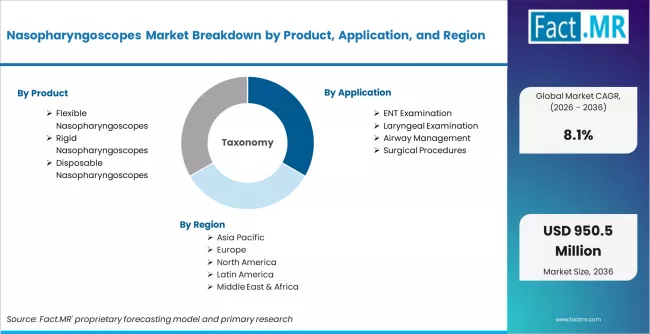
Nasopharyngoscopes Market Breakdown By Product, Application, And Region | Source: Fact.MR
| Parameter | Details |
|---|---|
| Quantitative Units | USD 436.19 million to USD 950.45 million, at a CAGR of 8.1% |
| Market Definition | The nasopharyngoscopes market covers endoscopic devices designed for examination of the nasal cavity, nasopharynx, larynx, and upper airway structures, spanning flexible and rigid nasopharyngoscopes in reusable and single-use disposable formats. |
| Regions Covered | North America, Latin America, Europe, East Asia, South Asia and Pacific, Middle East and Africa |
| Countries Covered | USA, Canada, UK, Germany, China, India, Brazil, Japan, 30 plus countries |
| Key Companies | Karl Storz SE & Co. KG, Medtronic plc, Stryker Corporation, Olympus Corporation, Ambu A/S, Richard Wolf GmbH, Fujifilm Holdings Corporation, Boston Scientific Corporation |
| Forecast Period | 2026 to 2036 |
| Approach | Hybrid demand-side and top-down methodology built on ENT procedure volumes, clinic and hospital counts, per-unit pricing across reusable and single-use formats, replacement cycles, single-use adoption rates, and primary interviews across otolaryngologists, ENT clinic managers, ambulatory surgical center directors, and endoscope manufacturers |
Source: Fact.MR analysis. Updated Apr 27, 2026
Market Segmentation Analysis
-
Nasopharyngoscopes Market Market Segmented by Product:
- Flexible Nasopharyngoscopes
- Fiberoptic Nasopharyngoscopes
- Reusable Fiberoptic Scopes
- Portable Fiberoptic Scopes
- Video Nasopharyngoscopes
- High Definition Video Scopes
- Integrated Camera Scopes
- Fiberoptic Nasopharyngoscopes
- Rigid Nasopharyngoscopes
- Diagnostic Rigid Scopes
- Standard Visualization Scopes
- High Precision Rigid Scopes
- Diagnostic Rigid Scopes
- Disposable Nasopharyngoscopes
- Single Use Flexible Scopes
- Sterile Prepackaged Scopes
- Infection Control Scopes
- Single Use Flexible Scopes
- Flexible Nasopharyngoscopes
-
Nasopharyngoscopes Market Market Segmented by Application:
- ENT Examination
- Nasal Cavity Examination
- Routine Diagnostic Procedures
- Post Surgical Evaluation
- Nasal Cavity Examination
- Laryngeal Examination
- Vocal Cord Assessment
- Voice Disorder Diagnosis
- Tumor Detection
- Vocal Cord Assessment
- Airway Management
- Intubation Assistance
- Emergency Airway Procedures
- Anesthesia Support
- Intubation Assistance
- Surgical Procedures
- Minimally Invasive Procedures
- Biopsy Procedures
- Foreign Body Removal
- Minimally Invasive Procedures
- ENT Examination
-
Nasopharyngoscopes Market Market Segmented by End Use:
- Hospitals
- Public Hospitals
- Tertiary Care Hospitals
- General Hospitals
- Public Hospitals
- Specialty Clinics
- ENT Clinics
- Private ENT Centers
- Diagnostic ENT Clinics
- ENT Clinics
- Ambulatory Surgical Centers
- Outpatient Surgical Facilities
- Day Care Surgical Units
- Outpatient Surgical Facilities
- Diagnostic Centers
- Imaging and Diagnostic Labs
- Preventive Health Centers
- Imaging and Diagnostic Labs
- Hospitals
-
Nasopharyngoscopes Market Market Segmented by Technology:
- Video Endoscopy Technology
- Digital Imaging Systems
- High Definition Imaging
- 4K Imaging Systems
- Digital Imaging Systems
- Fiberoptic Technology
- Optical Fiber Imaging
- Standard Fiberoptic Systems
- Enhanced Illumination Systems
- Optical Fiber Imaging
- Chip on Tip Technology
- CMOS Sensor Integration
- High Resolution Sensors
- Miniaturized Camera Systems
- CMOS Sensor Integration
- Illumination Technology
- LED Light Sources
- Cold Light Illumination
- High Intensity LED Systems
- LED Light Sources
- Video Endoscopy Technology
-
Nasopharyngoscopes Market Market Segmented by Usage:
- Reusable Nasopharyngoscopes
- Long Term Clinical Use
- Multi Patient Usage
- Sterilizable Devices
- Long Term Clinical Use
- Single Use Nasopharyngoscopes
- Infection Control Use
- Disposable Clinical Devices
- Outpatient Procedure Devices
- Infection Control Use
- Reusable Nasopharyngoscopes
-
Nasopharyngoscopes Market Market Segmented by Distribution Channel:
- Direct Sales
- Hospital Procurement
- Bulk Equipment Purchase
- Long Term Supply Contracts
- Hospital Procurement
- Distributors
- Medical Device Distributors
- Regional Distribution Networks
- Specialized ENT Equipment Supply
- Medical Device Distributors
- Online Sales
- E Commerce Platforms
- Direct Manufacturer Platforms
- Third Party Marketplaces
- E Commerce Platforms
- Direct Sales
-
Nasopharyngoscopes Market Market by Region:
- North America
- USA
- Canada
- Mexico
- Latin America
- Brazil
- Chile
- Rest of Latin America
- Western Europe
- Germany
- UK
- Italy
- Spain
- France
- Nordic
- BENELUX
- Rest of Western Europe
- Eastern Europe
- Russia
- Poland
- Hungary
- Balkan & Baltic
- Rest of Eastern Europe
- East Asia
- China
- Japan
- South Korea
- South Asia and Pacific
- India
- ASEAN
- Australia & New Zealand
- Rest of South Asia and Pacific
- Middle East & Africa
- Kingdom of Saudi Arabia
- Other GCC Countries
- Turkiye
- South Africa
- Other African Union
- Rest of Middle East & Africa
- North America
Frequently Asked Questions
How big is the nasopharyngoscopes market in 2026?
What will be the size of the nasopharyngoscopes market in 2036?
How much will the nasopharyngoscopes market grow between 2026 and 2036?
Which product segment is expected to lead the market in 2026?
Which country is the fastest-growing market?
Why is India a key growth market?
What does the nasopharyngoscopes market cover?
How is the market forecast estimated and validated?
Who worked on this report


Preview the report firsthand - request a free sample
Free SampleGet the brochure for pricing and purchase details
Download PDF