- Base Value(2025): 2.3 Bn
- Estimated Value(2026): 2.5 Bn
- Forecast Value (2036): 5.3 Bn
- CAGR (2026 - 2036): 7.8%
NdFeB Magnets Market Forecast and Outlook By Fact.MR
- The NdFeB magnets market crossed a valuation of USD 2.3 billion in 2025.
- Based on Fact.MR analysis, demand is estimated to grow to USD 2.5 billion in 2026.
- It is projected to reach USD 5.3 billion by 2036 at a CAGR of 7.8% during the forecast period.
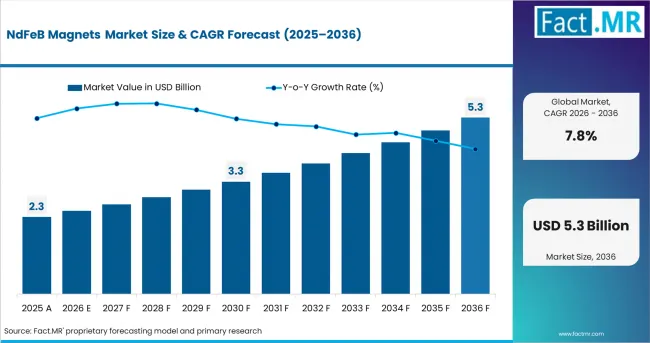
Ndfeb Magnets Market Value Analysis | Source: Fact.MR
| Metric | Value |
|---|---|
| Estimated Value in 2026 | USD 2.5 billion |
| Forecast Value in 2036 | USD 5.3 billion |
| Forecast CAGR (2026 to 2036) | 7.8% |
Source: Fact.MR analysis. Updated Jun 4, 2026
Summary of NdFeB Magnets Market
- Demand Drivers
- • EV motor production is increasing demand for high-flux magnets that help reduce motor size and weight.
- • Consumer electronics keep steady magnet use as compact devices need small motion and audio parts.
- • Wind generators and industrial servo motors support demand for higher-grade sintered materials.
- • Recycling interest is rising as users try to reduce exposure to neodymium and dysprosium price changes.
- Key Segments Analyzed
- By Type: Sintered NIB magnets are projected to account for 58.1% share in 2026 as high magnetic output supports motors and precision devices.
- By End Use: Consumer electronics are forecast to hold 23.6% share in 2026 because small motors and speakers use compact magnet designs.
- By Form: Blocks are expected to capture 32.5% share in 2026 since rectangular parts suit motor assemblies and industrial fixtures.
- By Grade: N45 to N52 grades are estimated to represent 39.4% share in 2026 as higher output supports smaller motor packages.
- By Coating: Nickel coated magnets are forecast at 46.8% share in 2026 because corrosion protection suits electronics and motor users.
- By Sales Channel: Direct sales are projected to hold 54.2% share in 2026 as large accounts require order traceability and drawings.
- Analyst Opinion at Fact.MR
- Shambhu Nath Jha, Principal Consultant at Fact.MR, opines, “CXOs will see NdFeB magnet demand moving toward motor-grade supply and better rare earth planning. Automotive and electronics users need stable coating quality. Industrial motion users now expect faster approval. Suppliers with powder access and in-house machining will have an advantage during price changes.”
- Strategic Implications
- • Manufacturers should expand sintered NIB capacity for EV traction motors and compact electronics with tighter size control.
- • Companies should build nickel and epoxy coating lines near motor assembly hubs to reduce rework and transport damage.
- • Suppliers should improve direct technical support for large accounts as drawings and magnetic grade approval shape repeat orders.
The market is set to generate an incremental revenue opportunity of USD 2.8 billion between 2026 and 2036. Market growth is steady as EV motors and compact electronics need high-flux magnets. Industrial servo motors also support demand for higher-grade sintered materials. Rare earth price pressure may slow adoption in low-spec devices. Recycling and technical support create opportunities for suppliers serving automotive and electronics customers.
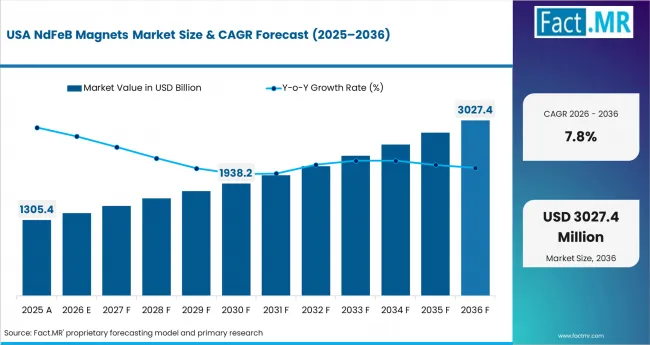
China is projected to record 8.2% CAGR through 2036 as EV output and magnet manufacturing support local supply. South Korea is expected to grow at 8.1% CAGR, backed by electric vehicle exports and electronics production. India records 8.0% CAGR through 2036 as electric two-wheeler volumes and motor assembly increase. Japan advances at 7.9% CAGR as hybrid vehicle motors keep rare earth magnet use steady. The United States grows at 7.8% CAGR as EV platforms and defense electronics raise magnet qualification work. Germany expands at 7.6% CAGR as premium vehicle production and automation equipment sustain demand for motor-grade magnets. The United Kingdom grows at 7.4% CAGR as fleet electrification and motor import demand support magnet use.
Segmental Analysis
NdFeB Magnets Market Analysis by Type
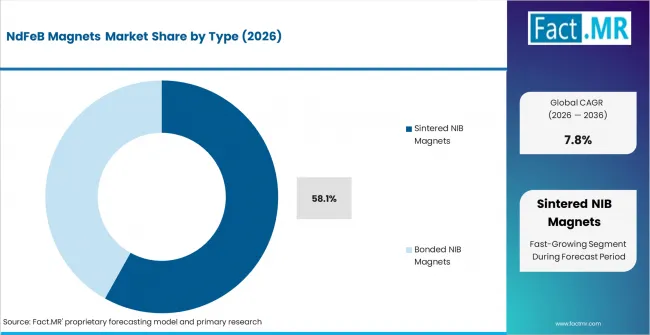
Ndfeb Magnets Market Analysis By Type | Source: Fact.MR
Sintered NIB magnets are projected to account for 58.1% share in 2026 because their higher magnetic strength supports compact motor designs. Users in magnetic materials supply chains prefer sintered grades for traction motors and speakers. Precision sensors create a smaller order base. Bonded magnets are used in lower-force parts that need flexible shapes and easier forming.
- Sintered NIB Demand: Motor and electronics manufacturers use sintered magnets to get higher output from smaller parts.
- Bonded NIB Use: Bonded magnets serve low-force sensors and molded parts that need easier forming over maximum magnetic power.
NdFeB Magnets Market Analysis by End Use
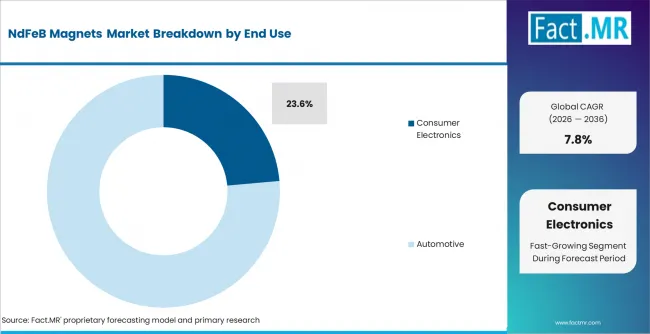
Ndfeb Magnets Market Analysis By End Use | Source: Fact.MR
Consumer electronics are forecast to hold 23.6% share in 2026 as phones and headphones use small permanent magnets. Compact motors create steady demand. Short product cycles and high unit shipments support the segment. Automotive demand is rising faster, but motor platform approval takes more time.
- Electronics Demand Base: Device makers use tiny magnets in speakers and haptic motors, which keeps replacement demand steady.
- Automotive Pull: Electric powertrain designs increase use of electric motors for electric vehicle that need stable magnet grade supply.
NdFeB Magnets Market Analysis by Form
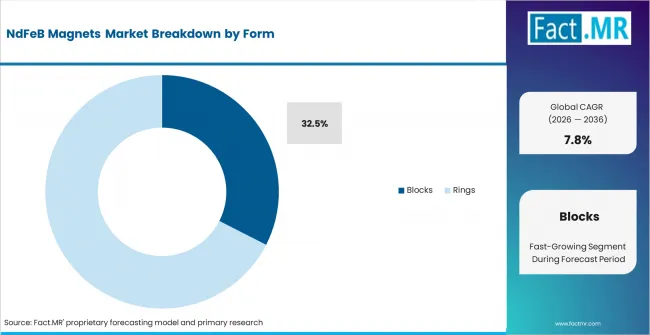
Ndfeb Magnets Market Analysis By Form | Source: Fact.MR
Blocks are expected to capture 32.5% share in 2026 as motor assemblies and fixtures use rectangular magnet pieces. Blocks are easy to machine and stack. Rotor assembly lines can place them with less rework. Rings and discs keep steady use in speakers and sensors because they suit circular motion paths.
- Block Format Strength: Motor builders prefer block magnets because the shape supports repeatable placement and controlled magnetic direction.
- Circular Format Demand: Rings and discs serve speakers and small pumps that need balanced rotation around a fixed axis.
NdFeB Magnets Market Analysis by Grade
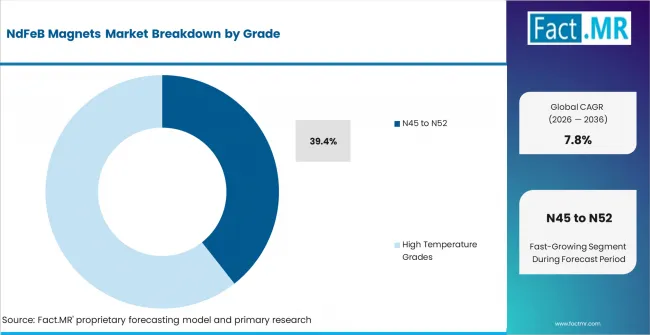
Ndfeb Magnets Market Analysis By Grade | Source: Fact.MR
N45 to N52 grades are estimated to represent 39.4% share in 2026 because users balance magnetic power and material cost. These grades support compact motors that need more force with fewer magnet pieces. Lower grades serve price-sensitive fixtures and toys.
Grade Selection: N45 to N52 grades support miniaturized motors as users seek higher force from fewer magnet pieces.
Heat Grade Use: High-temperature grades serve EV and aerospace parts that face heat during duty cycles.
NdFeB Magnets Market Analysis by Coating
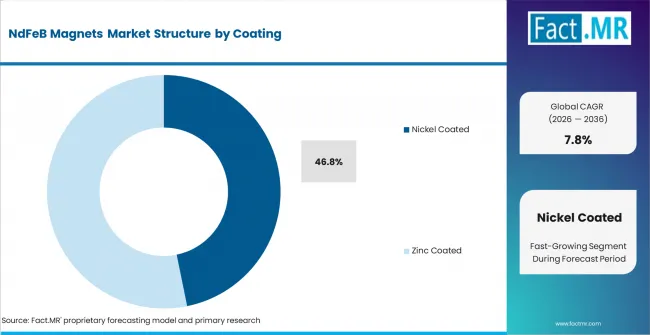
Ndfeb Magnets Market Analysis By Coating | Source: Fact.MR
Nickel coated magnets are forecast at 46.8% share in 2026 as the coating protects magnet surfaces during handling and use. Nickel plating works well for electronics and industrial fixtures. Epoxy coatings gain use in humid or chemically exposed assemblies.
Nickel Coating Demand: Electronics and motor producers prefer nickel coating for surface protection and stable appearance during assembly.
Epoxy Coating Use: Epoxy coated magnets suit humid or outdoor equipment that needs better corrosion protection.
NdFeB Magnets Market Analysis by Sales Channel
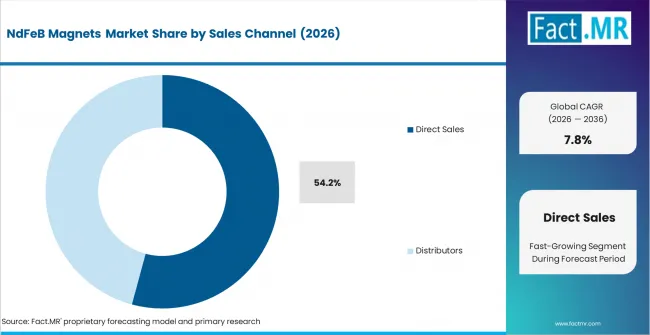
Ndfeb Magnets Market Analysis By Sales Channel | Source: Fact.MR
Direct sales are projected to hold 54.2% share in 2026 because large motor and electronics accounts need grade control. Direct supply helps manage drawings, sample approval and batch traceability. Distributors serve smaller users that need quick access to standard blocks and discs.
- Direct Sales Advantage: Large accounts prefer direct supply because producers can manage engineering changes, inspection records and delivery schedules.
- Distributor Role: Distributors serve small workshops and repair users that need ready stock of bonded magnets and standard sintered shapes.
Drivers Restraints and Opportunities
The NdFeB magnets market grows as electrified vehicles and compact devices need smaller high-power motion parts. The International Energy Agency reported 6% to 8% growth for rare earth demand and similar energy minerals in 2024 [1]. This connects magnet demand with upstream material planning.
Supply risk is the main restraint as neodymium, praseodymium and dysprosium processing is concentrated in a limited group of countries. Users can reduce risk through long-term supply contracts and alternate coating sources. The main opportunity is for suppliers that offer grade advice and steady delivery for rare earth elements users.
- EV Motor Pull: Traction motors need high-flux magnets that reduce rotor weight and improve power density.
- Material Cost Pressure: Rare earth price shifts can change quotes and reduce margins on long programs.
- Recycling Opportunity: Magnet scrap recovery can improve feedstock security for suppliers serving automotive and electronics accounts.
Regional Analysis
The NdFeB magnets market is assessed across North America and Europe. East Asia, South Asia and Pacific and the Middle East and Africa are also covered. Country analysis covers magnet type and end use. Coating and channel behavior are reviewed across 40 plus countries.
| Country | CAGR (2026 to 2036) |
|---|---|
| China | 8.2% |
| South Korea | 8.1% |
| India | 8.0% |
| Japan | 7.9% |
| United States | 7.8% |
| Germany | 7.6% |
| United Kingdom | 7.4% |
Source: Fact.MR analysis. Updated Jun 4, 2026
Source: Fact.MR analysis, based on proprietary forecasting model and primary research
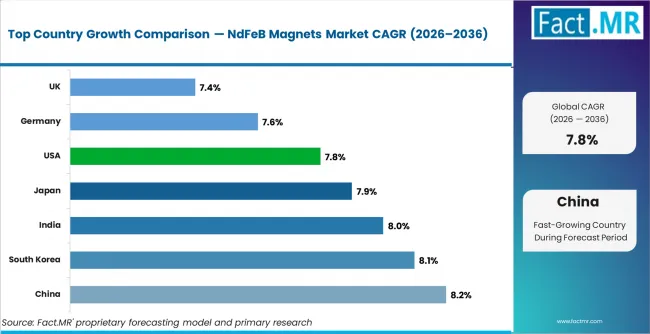
Ndfeb Magnets Market Cagr Analysis By Country | Source: Fact.MR
East Asia NdFeB Magnets Market Analysis
East Asia is the main production and use base for NdFeB magnets. EV output and electronics manufacturing raise demand for high-grade magnets across the region. Rare earth separation capacity and magnet machining support local sourcing.
- China: China is projected to record 8.2% CAGR through 2036. EV output and magnet-making capacity support local supply. China registered 5.62 million new energy vehicles in the first half of 2025 [2]. This scale supports magnet orders for motors and pumps.
- South Korea: South Korea is expected to expand at 8.1% CAGR by 2036. Export-focused vehicle production and electronics assembly raise demand for high-grade magnets. South Korea recorded USD 70.8 billion in automobile exports in 2024 [8]. This export base supports magnet uses in electric vehicles and precision devices.
- Japan: Japan is forecast to grow at 7.9% CAGR from 2026 to 2036. Hybrid vehicle production keeps magnet demand steady in drive systems and auxiliary motors. Japan sold 2.04 million hybrid vehicles in 2024 [7]. This level supports magnet uses in traction assist systems and small motor assemblies.
South Asia and Pacific NdFeB Magnets Market Analysis
South Asia and Pacific is gaining demand as electric two-wheelers and local motor assembly increase magnet use. Charging equipment and domestic sourcing interest support regional orders. Faster technical support is important for users that want lower import exposure.
- India: India is expected to advance at 8.0% CAGR through 2036. Electric two-wheeler adoption and local motor assembly expand magnet use. India reported 1.15 million electric two-wheeler sales in FY 2024 to 2025 [3]. This demand supports small traction motors and hub motors.
North America NdFeB Magnets Market Analysis
Ndfeb Magnets Market Country Value Analysis | Source: Fact.MR
North America shows steady demand for NdFeB magnets across EV platforms and defense electronics. Industrial motors are increasing magnet qualification work. Local rare earth projects may reduce sourcing risk over time.
- United States: The United States is projected to rise at 7.8% CAGR by 2036. EV platforms and defense electronics raise demand for qualified magnet supply. The U.S. electric vehicle market reached 1.56 million sales in 2024 [4]. This volume supports magnet demand in traction motors and thermal management systems.
Europe NdFeB Magnets Market Analysis
Europe is supported by premium vehicle production and automation equipment demand. Motor-grade magnets and magnetized assemblies are important across EV and industrial uses. Traceability and coating performance affect supplier selection across the region.
- Germany: Germany is forecast to grow at 7.6% CAGR from 2026 to 2036. Premium vehicle production and automation equipment keep magnet demand above basic industrial use. Germany registered 380,609 battery electric vehicles in 2024 [5]. This volume supports orders for motor-grade magnets and magnetized assemblies.
- United Kingdom: The United Kingdom is expected to post 7.4% CAGR through 2036. Fleet electrification and motor import demand support magnet use. The United Kingdom recorded 381,970 battery electric vehicle registrations in 2024 [6]. Local users rely on imports for most magnet pieces.
Competitive Aligners for Market Players
NdFeB magnet suppliers compete on rare earth access, sintering control, magnetizing accuracy and coating quality. Producers with mining or separation access have better protection against feedstock price changes. Independent magnet makers compete through tight tolerances and custom shapes. Faster sample approval helps suppliers win device and motor accounts.
Replacement demand and long-term programs keep established suppliers in a better position. Automotive users need consistent batch quality across long model cycles. Electronics users move faster and may shift orders to suppliers that can provide blocks, rings and custom parts without long tooling delays.
China and Japan continue to shape regional supply. South Korea adds technical strength through electronics and vehicle exports. North American firms are investing in domestic rare earth processing and magnet production to reduce import dependence. Companies that combine powder access with machining can serve permanent magnet motor users with fewer approval steps. Coating and magnet testing add another supplier advantage.
Key Players
- Arnold Magnetic Technologies
- Electron Energy Corporation
- Daido Steel Co., Ltd.
- Proterial, Ltd.
- Shin-Etsu Chemical Co., Ltd.
- MP Materials Corp.
- USA Rare Earth, LLC
Bibliography
- [1] International Energy Agency. (2025, May 21). Global critical minerals outlook 2025: Executive summary.
- [2] State Council of the People’s Republic of China. (2025, July 14). China’s new energy vehicle registrations hit record 5.62 mln in H1 2025.
- [3] Ministry of Heavy Industries. (2025, April 1). The Ministry of Heavy Industries has successfully achieved sales of more than one million of EVs in this financial year 2024–25. Press Information Bureau, Government of India.
- [4] Isenstadt, A., & Slowik, P. (2025, April 28). U.S. passenger electric vehicle sales and model availability through 2024. International Council on Clean Transportation.
- [5] European Alternative Fuels Observatory. (2025, January). Germany: BEV market share at 13.5%. European Commission.
- [6] European Alternative Fuels Observatory. (2025, January 15). United Kingdom becomes largest BEV market in Europe with 19.6% market share in 2024. European Commission.
- [7] International Trade Administration. (2025, November 20). Japan: Automotive. U.S. Department of Commerce.
- [8] Invest Korea. (2026, January 20). S. Korea’s auto exports hit record USD 72 bn in 2025. Korea Trade-Investment Promotion Agency.
This Report Addresses
- Strategic demand analysis for NdFeB magnets in consumer electronics and automotive motors. The scope also covers medical devices and industrial motion systems.
- Market forecast from USD 2.5 billion in 2026 to USD 5.3 billion by 2036 at 7.8% CAGR.
- Segment analysis by type and end use. The scope also covers form and grade plus coating and sales channel with 2026 share views.
- Opportunity mapping covers China and South Korea. It also covers India, Japan and selected Western markets.
- Competitive review covers Arnold Magnetic Technologies and Lynas Rare Earths. It also reviews other active suppliers named in the Key Players section.
- Supply risk review covers rare earth inputs and magnet machining. Coating quality and direct account support are reviewed separately.
- Report delivery in DOCX format with source-backed statistics and embedded Fact.MR interlinks.
NdFeB Magnets Market Definition
The NdFeB magnets market covers neodymium iron boron permanent magnets used to convert electric current into motion or hold parts in place. Products include sintered magnets and bonded magnets. They are supplied as blocks and rings. Disc, cylinder and custom shapes are also included. The scope covers magnet pieces sold to electronics and vehicle motor users. It also covers medical and industrial motor users. Ferrite magnets and samarium cobalt magnets are excluded. Complete motor assemblies are also outside scope.
NdFeB Magnets Market Inclusions
Covers global and regional forecasts from 2026 to 2036 by type and end use. It also covers form and grade. Coating, sales channel and country coverage are included.
NdFeB Magnets Market Exclusions
Excludes ferrite magnets and samarium cobalt magnets. Alnico magnets, finished motors and battery packs are outside scope. Rare earth mining revenue is excluded unless it directly covers magnet powder or magnet supply.
NdFeB Magnets Market Research Methodology
- Primary Research
- Interviews covered magnet producers and motor makers. They also covered electronics component users and distributors in China. The review included Japan and South Korea. India, Germany and the United States were also covered. Input checks focused on order size and price movement. Coating choice and lead time pressure were reviewed separately.
- Desk Research
- Desk research reviewed public trade data and automotive electrification data. It also reviewed rare earth supply releases and company product information. The review mapped permanent magnets demand against electric motors and speakers. Sensor and medical equipment use was also checked.
- Market-Sizing and Forecasting
- The model combined top-down permanent magnet use with bottom-up volume estimates by magnet type and end use. Pricing assumptions were tested against rare earth feedstock movements and supplier quotations.
- Data Validation and Update Cycle
- Forecasts were checked against EV output and consumer device production. Magnet supplier capacity signals were reviewed as a separate check. Updates are completed each year after annual vehicle data and rare earth supply indicators are released.
Segmentation
Scope of the Report
Ndfeb Magnets Market Breakdown By Type, End Use, And Region | Source: Fact.MR
| Attribute | Details |
|---|---|
| Quantitative Units | USD 2.5 billion to USD 5.3 billion, at a CAGR of 7.8% |
| Market Definition | Neodymium iron boron permanent magnets used in motors, sensors, speakers, medical equipment and industrial holding systems. |
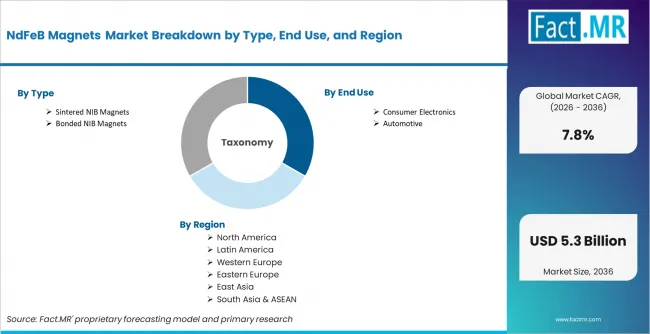
| Type Segmentation | Sintered NIB Magnets, Bonded NIB Magnets |
| End Use Segmentation | Consumer Electronics, Automotive, Oil and Gas, Aerospace and Defense, Medical Devices, Other End Uses |
| Form Segmentation | Blocks, Rings, Discs, Cylinders, Custom Shapes |
| Grade Segmentation | N35 to N42, N45 to N52, High Temperature Grades, Low Grade |
| Coating Segmentation | Nickel Coated, Zinc Coated, Epoxy Coated, Gold Coated, Uncoated |
| Sales Channel Segmentation | Direct Sales, Distributors, Online Sales |
| Regions Covered | North America, Latin America, Europe, East Asia, South Asia and Pacific, Middle East and Africa |
| Countries Covered | China, South Korea, India, Japan, United States, Germany, United Kingdom, 40 plus countries |
| Key Companies Profiled | Arnold Magnetic Technologies, Electron Energy Corporation, Daido Steel Co., Ltd., Proterial, Ltd., Shin-Etsu Chemical Co., Ltd., MP Materials Corp., USA Rare Earth, LLC |
| Forecast Period | 2026 to 2036 |
| Approach | Hybrid top-down and bottom-up model using EV output, electronics demand, supplier portfolios and primary interviews with magnet users. |
Source: Fact.MR analysis. Updated Jun 4, 2026
NdFeB Magnets Market by Segment
-
NdFeB Magnets Market Segmented by Type:
- Sintered NIB Magnets
- Bonded NIB Magnets
-
NdFeB Magnets Market Segmented by End Use:
- Consumer Electronics
- Automotive
- Oil and Gas
- Aerospace and Defense
- Medical Devices
- Other End Uses
-
NdFeB Magnets Market Segmented by Form:
- Blocks
- Rings
- Discs
- Cylinders
- Custom Shapes
-
NdFeB Magnets Market Segmented by Grade:
- N35 to N42
- N45 to N52
- High Temperature Grades
- Low Grade
-
NdFeB Magnets Market Segmented by Coating:
- Nickel Coated
- Zinc Coated
- Epoxy Coated
- Gold Coated
- Uncoated
-
NdFeB Magnets Market Segmented by Sales Channel:
- Direct Sales
- Distributors
- Online Sales
-
NdFeB Magnets Market by Region:
- North America
- United States
- Canada
- Mexico
- Latin America
- Brazil
- Chile
- Rest of Latin America
- Western Europe
- Germany
- United Kingdom
- France
- Italy
- Spain
- Nordic
- BENELUX
- Rest of Western Europe
- Eastern Europe
- Poland
- Hungary
- Balkan and Baltic
- Rest of Eastern Europe
- East Asia
- China
- Japan
- South Korea
- South Asia and Pacific
- India
- ASEAN
- Australia and New Zealand
- Rest of South Asia and Pacific
- Middle East and Africa
- Kingdom of Saudi Arabia
- Other GCC Countries
- Turkiye
- South Africa
- Rest of Middle East and Africa
- North America
Frequently Asked Questions
How large is the global NdFeB magnets market in 2025?
Based on Fact.MR analysis, demand for NdFeB magnets is estimated to grow to USD 2.5 billion in 2026.
The market is projected to reach USD 5.3 billion by 2036, generating USD 2.8 billion in absolute dollar opportunity.
What is the expected CAGR for the NdFeB magnets market from 2026 to 2036?
Which type segment leads the NdFeB magnets market?
Which end use holds a notable share in the NdFeB magnets market?
Which country shows the fastest growth in the NdFeB magnets market?
What does the NdFeB magnets market include?
Who worked on this report


Preview the report firsthand - request a free sample
Free SampleGet the brochure for pricing and purchase details
Download PDF