Neglected Tropical Disease Treatment Market
Neglected Tropical Disease Treatment Market Size and Share Forecast Outlook 2026 to 2036
Neglected tropical disease treatment market is projected to grow from USD 4.1 billion in 2026 to USD 6.4 billion by 2036, at a CAGR of 4.6%. Dengue will dominate with a 11.4% market share, while drugs will lead the product segment with a 69.1% share.
Neglected Tropical Disease Treatment Market Forecast and Outlook 2026 to 2036
The global neglected tropical disease treatment market is projected to reach USD 6.4 billion by 2036. The market is valued at USD 4.1 billion in 2026 and is set to rise at a CAGR of 4.6% during the assessment period.
Quick Stats for Neglected Tropical Disease Treatment Market
- Neglected Tropical Disease Treatment Market Value (2026): USD 4.1 billion
- Neglected Tropical Disease Treatment Market Forecast Value (2036): USD 6.4 billion
- Neglected Tropical Disease Treatment Market Forecast CAGR: 4.6%
- Leading Disease in Neglected Tropical Disease Treatment Market: Dengue (11.4%)
- Key Growth Regions in Neglected Tropical Disease Treatment Market: Asia Pacific, Latin America, and Africa
- Top Players in Neglected Tropical Disease Treatment Market: GlaxoSmithKline (GSK), Merck & Co., Novartis, Sanofi, Bayer, Pfizer, Takeda, Johnson & Johnson, Eisai, AstraZeneca
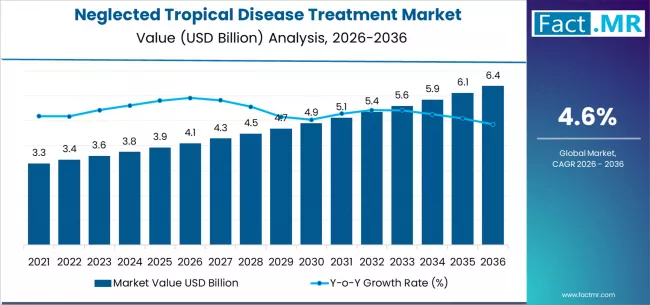
The scope for treating neglected tropical diseases is expected to grow by 1.6 times during the same period, supported by increasing demand from mass drug administration programs and expanding applications in vector-borne disease prevention across both developed and emerging endemic markets. Growing application diversity in vaccine development initiatives, diagnostic tool innovations, and specialized antiparasitic formulations creates expanding opportunities for NTD treatment innovations and specialized therapeutic developments.
Rising disease surveillance in tropical and subtropical regions, coupled with expanding healthcare infrastructure through WHO-supported elimination programs and modern distribution networks, further accelerate market penetration across diverse disease segments. The growing global commitment to disease elimination targets, particularly for lymphatic filariasis, onchocerciasis, and trachoma, generates sustained requirements for effective treatment medications and preventive intervention programs.
Technical advancements in drug delivery systems demonstrating measurable improvements in patient compliance, reduced treatment duration, and enhanced therapeutic efficacy reinforce public health confidence in NTD treatment economics, while vaccine development trends toward dengue prevention and leishmaniasis control expand addressable market opportunities beyond traditional drug-based interventions into comprehensive disease prevention strategies.
Neglected Tropical Disease Treatment Market Key Takeaways
| Metric | Value |
|---|---|
| Market Value (2026) | USD 4.1 billion |
| Market Forecast Value (2036) | USD 6.4 billion |
| Forecast CAGR (2026-2036) | 4.6% |
Category
| Category | Segments |
|---|---|
| Disease | Dengue; Rabies; Trachoma; Buruli Ulcer; Yaws; Leprosy; Chagas Disease; Human African Trypanosomiasis (Sleeping Sickness); Leishmaniases; Soil-transmitted Helminthiases; Others |
| Product | Drugs (Anti-Parasite; Antifungal; Antibiotics; Others); Vaccines |
| Region | Asia Pacific; Latin America; Africa; North America; Europe |
Segmental Analysis
Which Neglected Tropical Disease Treatment has the Highest Scope?

Dengue represents the dominant force in the neglected tropical disease treatment market, capturing 11.4% of the total market share in 2026. This established disease category encompasses solutions featuring critical therapeutic functionality for acute febrile illness management, severe dengue complications, and preventive vaccination programs, including supportive care protocols and vaccine administration that enable disease burden reduction, outbreak response capacity, and prevention strategy implementation across all endemic tropical regions.
Dengue treatment scope is increasing amid rising initiatives towards vector-borne disease control, with interventions capable of meeting diverse public health requirements while addressing substantial disease burden affecting millions of people annually across all tropical and subtropical environments.
Which Product Category Leads in the Neglected Tropical Disease Treatment Market?
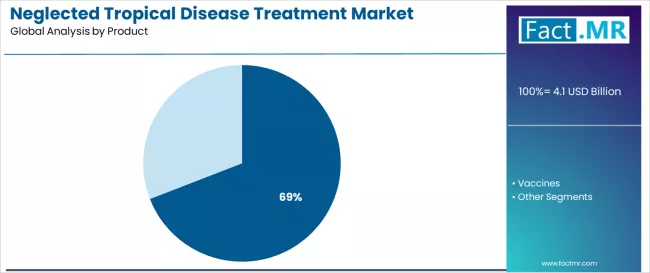
The drugs segment represents the dominant product category in the neglected tropical disease treatment market, capturing approximately 69.1% of total market share in 2026. This leading product category encompasses antiparasitic medications, antibiotics for bacterial NTDs, and antifungal treatments providing curative therapy for diverse neglected tropical diseases across different pathogen categories.
Drug-based treatment is preferred amid its established therapeutic role, with pharmaceutical treatments providing essential disease control tools for mass drug administration programs and clinical case management across diverse NTD portfolios.
What are the Drivers, Restraints, and Key Trends of the Neglected Tropical Disease Treatment Market?
The neglected tropical disease treatment market is driven by strong global commitment to disease elimination under WHO roadmaps and national public health programs. Expansion of mass drug administration and school-based deworming initiatives is increasing treatment volumes across endemic regions. Advances in vaccine development and improved multi-drug therapy protocols are further enhancing disease control effectiveness and accelerating elimination timelines.
Market restraints include limited healthcare budgets in endemic countries and volatility in donor funding, which affect procurement continuity and program sustainability. Concerns around emerging drug resistance and the need for ongoing safety monitoring add complexity and cost to treatment programs. Inadequate cold-chain infrastructure and logistical challenges in remote areas also constrain vaccine deployment and last-mile delivery.
Key trends include closer integration of NTD interventions with primary healthcare systems, particularly in Africa and Asia Pacific, to improve coverage and sustainability. Growing use of digital health tools, including mobile treatment tracking, disease surveillance platforms, and community health worker training applications, is improving program efficiency, adherence, and population-level disease monitoring.
Analysis of the Neglected Tropical Disease Treatment Market by Key Countries
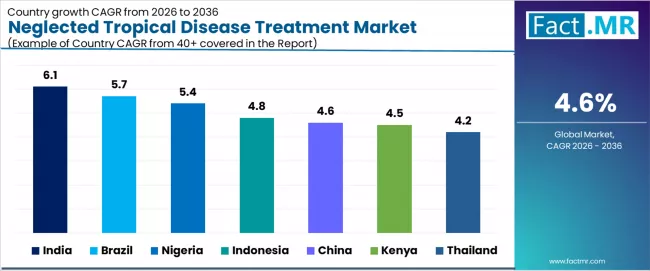
| Country | CAGR (2026-2036) |
|---|---|
| India | 6.1% |
| Brazil | 5.7% |
| Nigeria | 5.4% |
| China | 4.6% |
| Indonesia | 4.8% |
| Kenya | 4.5% |
| Thailand | 4.2% |
Why is India Driving the Fastest Expansion in NTD Treatment Programs?

India is leading global growth in neglected tropical disease treatments, expanding at a 6.1% CAGR through 2036, largely because the disease burden remains both high and geographically concentrated. States such as Uttar Pradesh, Bihar, Odisha, and Jharkhand continue to require sustained intervention for lymphatic filariasis and kala-azar, anchoring long-term treatment demand.
What sets India apart is not just prevalence, but scale. National mass drug administration programs and a deeply embedded primary healthcare network allow treatments to reach rural and hard-to-access populations with relative consistency.
How is Brazil Consolidating Its Position as Latin America’s NTD Leader?
Brazil’s NTD treatment market is growing at a 5.7% CAGR, shaped by persistent Chagas disease and leishmaniasis prevalence across the Northeast, Amazon basin, and Central-West regions. The country benefits from a unified public health system that converts epidemiological need directly into structured procurement and treatment delivery.
Growth is less about expansion into new diseases and more about improving coverage, treatment continuity, and integration with vector control programs across diverse ecological zones.
What makes Nigeria Central to Global Elimination Efforts?
Nigeria is expanding at a 5.4% CAGR, driven by its pivotal role in lymphatic filariasis and onchocerciasis elimination. Large-scale mass drug administration campaigns, supported by WHO frameworks and international donors, continue to define market demand.
Treatment volumes remain high as programs move from broad coverage toward elimination verification, requiring sustained procurement and increasingly precise targeting in endemic local government areas.
How is China Shifting from Treatment to Surveillance-Led Control?
China’s market is growing at a more measured 4.6% CAGR, reflecting its transition from active treatment to elimination maintenance. Most growth now comes from diagnostics, surveillance, and treatment readiness in residual endemic pockets, particularly in western provinces. Government investment under Healthy China initiatives emphasizes early detection and prevention of reintroduction, keeping demand steady even as disease prevalence declines.
Why does Dengue Prevention Dominate Indonesia’s Market Trajectory?
Indonesia is recording a 4.8% CAGR, driven almost entirely by dengue prevention and treatment needs across Java, Sumatra, and Sulawesi. High incidence rates and frequent outbreaks have accelerated vaccine rollout and strengthened treatment protocols within primary care systems. Unlike helminth-focused markets, Indonesia’s demand is shaped by urban transmission dynamics and the logistical challenge of delivering consistent coverage across an archipelagic geography.
Howi Kenya Combining Innovation with Community-Based Delivery?
Kenya’s NTD treatment market is expanding at a 4.5% CAGR, supported by community-directed delivery models and strong integration between research and implementation. Programs targeting lymphatic filariasis and soil-transmitted helminths rely heavily on community health workers, allowing high coverage even in remote counties. Growth reflects operational innovation rather than scale alone, with Kenya often serving as a pilot ground for improved delivery and monitoring approaches.
Why is Thailand Prioritising Dengue Control to Protect Public Health and Tourism?
Thailand is growing at a 4.2% CAGR, with dengue vaccination increasingly embedded into national immunization strategies. Tourist hubs and urban centres drive much of the demand, as public health protection is closely tied to economic stability.
Universal health coverage enables rapid program rollout, while strong surveillance systems ensure vaccination and treatment efforts remain targeted and responsive during outbreak cycles.
Competitive Landscape of the Neglected Tropical Disease Treatment Market

The neglected tropical disease (NTD) treatment market is moderately concentrated, with roughly 30–40 active participants engaged across pharmaceutical development, access programs, and public health partnerships. Competition is shaped less by commercial pricing and more by therapeutic relevance, regulatory prequalification, and the scale of access-to-medicine initiatives in endemic regions.
GlaxoSmithKline (GSK), Merck & Co., and Novartis hold leading positions through broad NTD treatment portfolios, long-standing medicine donation programs, and deep collaboration with ministries of health, WHO, and non-governmental organizations. These companies leverage established R&D capabilities, manufacturing scale, and global distribution frameworks to support large population-based treatment programs while extending efforts into vaccines and diagnostics.
Challengers such as Sanofi, Bayer, and Pfizer contribute through targeted therapies and sustained commitments to global health initiatives. Other pharmaceutical companies, including Takeda, Johnson & Johnson, Eisai, and AstraZeneca, participate selectively through disease-specific programs, vaccine research, or access partnerships.
Regional generic manufacturers and public-sector procurement bodies play a critical role by supplying affordable medicines in endemic regions, particularly across India and Africa. Overall competitiveness favors organizations combining drug development expertise with robust access programs, regulatory alignment, and long-term public health collaboration.
Key Players in the Neglected Tropical Disease Treatment Market
- GlaxoSmithKline (GSK)
- Merck & Co. KGaA
- Novartis AG
- Sanofi S.A.
- Bayer AG
- Pfizer Inc.
- The Takeda Pharmaceutical Company
- Johnson & Johnson
- Eisai Co. Ltd.
- AstraZeneca plc
Scope of the Report
| Items | Values |
|---|---|
| Quantitative Units | USD 4.1 Billion |
| Disease | Dengue, Rabies, Trachoma, Buruli Ulcer, Yaws, Leprosy, Chagas Disease, Human African Trypanosomiasis (Sleeping Sickness), Leishmaniases, Soil-transmitted Helminthiases, Others |
| Product | Drugs (Anti-Parasite, Antifungal, Antibiotics, Others), Vaccines |
| Regions Covered | Asia Pacific, Latin America, Africa, North America, Europe |
| Country Covered | India, Brazil, Nigeria, China, Indonesia, Kenya, Thailand, and 40+ countries |
| Key Companies Profiled | GlaxoSmithKline (GSK), Merck & Co., Novartis, Sanofi, Bayer, Pfizer, Takeda, Johnson & Johnson, Eisai, AstraZeneca |
| Additional Attributes | Dollar sales by disease and product categories, regional program trends across Asia Pacific, Latin America, and Africa, competitive landscape with pharmaceutical companies and access programs, treatment specifications and program requirements, integration with mass drug administration systems and national elimination programs. |
Neglected Tropical Disease Treatment Market by Segments
-
Disease :
- Dengue
- Rabies
- Trachoma
- Buruli Ulcer
- Yaws
- Leprosy
- Chagas Disease
- Human African Trypanosomiasis (Sleeping Sickness)
- Leishmaniases
- Soil-transmitted Helminthiases
- Others
-
Product :
- Drugs
- Anti-Parasite
- Antifungal
- Antibiotics
- Others
- Vaccines
- Drugs
-
Region :
- Asia Pacific
- India
- China
- Indonesia
- Thailand
- Japan
- South Korea
- Australia & New Zealand
- ASEAN
- Rest of Asia Pacific
- Latin America
- Brazil
- Rest of Latin America
- Africa
- Nigeria
- Kenya
- South Africa
- Rest of Africa
- North America
- USA
- Canada
- Mexico
- Europe
- Germany
- France
- UK
- Spain
- Italy
- Rest of Europe
- Asia Pacific
Table of Content
- Executive Summary
- Global Market Outlook
- Demand to side Trends
- Supply to side Trends
- Technology Roadmap Analysis
- Analysis and Recommendations
- Market Overview
- Market Coverage / Taxonomy
- Market Definition / Scope / Limitations
- Market Background
- Market Dynamics
- Drivers
- Restraints
- Opportunity
- Trends
- Scenario Forecast
- Demand in Optimistic Scenario
- Demand in Likely Scenario
- Demand in Conservative Scenario
- Opportunity Map Analysis
- Product Life Cycle Analysis
- Supply Chain Analysis
- Investment Feasibility Matrix
- Value Chain Analysis
- PESTLE and Porter’s Analysis
- Regulatory Landscape
- Regional Parent Market Outlook
- Production and Consumption Statistics
- Import and Export Statistics
- Market Dynamics
- Global Market Analysis 2021 to 2025 and Forecast, 2026 to 2036
- Historical Market Size Value (USD Million) Analysis, 2021 to 2025
- Current and Future Market Size Value (USD Million) Projections, 2026 to 2036
- Y to o to Y Growth Trend Analysis
- Absolute $ Opportunity Analysis
- Global Market Pricing Analysis 2021 to 2025 and Forecast 2026 to 2036
- Global Market Analysis 2021 to 2025 and Forecast 2026 to 2036, By Disease
- Introduction / Key Findings
- Historical Market Size Value (USD Million) Analysis By Disease, 2021 to 2025
- Current and Future Market Size Value (USD Million) Analysis and Forecast By Disease, 2026 to 2036
- Dengue
- Rabies
- Trachoma
- Buruli Ulcer
- Yaws
- Leprosy
- Chagas Disease
- Human African Trypanosomiasis (Sleeping Sickness)
- Leishmaniases
- Soil-transmitted Helminthiases
- Others
- Dengue
- Y to o to Y Growth Trend Analysis By Disease, 2021 to 2025
- Absolute $ Opportunity Analysis By Disease, 2026 to 2036
- Global Market Analysis 2021 to 2025 and Forecast 2026 to 2036, By Product
- Introduction / Key Findings
- Historical Market Size Value (USD Million) Analysis By Product, 2021 to 2025
- Current and Future Market Size Value (USD Million) Analysis and Forecast By Product, 2026 to 2036
- Drugs
- Vaccines
- Drugs
- Y to o to Y Growth Trend Analysis By Product, 2021 to 2025
- Absolute $ Opportunity Analysis By Product, 2026 to 2036
- Global Market Analysis 2021 to 2025 and Forecast 2026 to 2036, By Region
- Introduction
- Historical Market Size Value (USD Million) Analysis By Region, 2021 to 2025
- Current Market Size Value (USD Million) Analysis and Forecast By Region, 2026 to 2036
- North America
- Latin America
- Western Europe
- Eastern Europe
- East Asia
- South Asia and Pacific
- Middle East & Africa
- Market Attractiveness Analysis By Region
- North America Market Analysis 2021 to 2025 and Forecast 2026 to 2036, By Country
- Historical Market Size Value (USD Million) Trend Analysis By Market Taxonomy, 2021 to 2025
- Market Size Value (USD Million) Forecast By Market Taxonomy, 2026 to 2036
- By Country
- USA
- Canada
- Mexico
- By Disease
- By Product
- By Country
- Market Attractiveness Analysis
- By Country
- By Disease
- By Product
- Key Takeaways
- Latin America Market Analysis 2021 to 2025 and Forecast 2026 to 2036, By Country
- Historical Market Size Value (USD Million) Trend Analysis By Market Taxonomy, 2021 to 2025
- Market Size Value (USD Million) Forecast By Market Taxonomy, 2026 to 2036
- By Country
- Brazil
- Chile
- Rest of Latin America
- By Disease
- By Product
- By Country
- Market Attractiveness Analysis
- By Country
- By Disease
- By Product
- Key Takeaways
- Western Europe Market Analysis 2021 to 2025 and Forecast 2026 to 2036, By Country
- Historical Market Size Value (USD Million) Trend Analysis By Market Taxonomy, 2021 to 2025
- Market Size Value (USD Million) Forecast By Market Taxonomy, 2026 to 2036
- By Country
- Germany
- UK
- Italy
- Spain
- France
- Nordic
- BENELUX
- Rest of Western Europe
- By Disease
- By Product
- By Country
- Market Attractiveness Analysis
- By Country
- By Disease
- By Product
- Key Takeaways
- Eastern Europe Market Analysis 2021 to 2025 and Forecast 2026 to 2036, By Country
- Historical Market Size Value (USD Million) Trend Analysis By Market Taxonomy, 2021 to 2025
- Market Size Value (USD Million) Forecast By Market Taxonomy, 2026 to 2036
- By Country
- Russia
- Poland
- Hungary
- Balkan & Baltic
- Rest of Eastern Europe
- By Disease
- By Product
- By Country
- Market Attractiveness Analysis
- By Country
- By Disease
- By Product
- Key Takeaways
- East Asia Market Analysis 2021 to 2025 and Forecast 2026 to 2036, By Country
- Historical Market Size Value (USD Million) Trend Analysis By Market Taxonomy, 2021 to 2025
- Market Size Value (USD Million) Forecast By Market Taxonomy, 2026 to 2036
- By Country
- China
- Japan
- South Korea
- By Disease
- By Product
- By Country
- Market Attractiveness Analysis
- By Country
- By Disease
- By Product
- Key Takeaways
- South Asia and Pacific Market Analysis 2021 to 2025 and Forecast 2026 to 2036, By Country
- Historical Market Size Value (USD Million) Trend Analysis By Market Taxonomy, 2021 to 2025
- Market Size Value (USD Million) Forecast By Market Taxonomy, 2026 to 2036
- By Country
- India
- ASEAN
- Australia & New Zealand
- Rest of South Asia and Pacific
- By Disease
- By Product
- By Country
- Market Attractiveness Analysis
- By Country
- By Disease
- By Product
- Key Takeaways
- Middle East & Africa Market Analysis 2021 to 2025 and Forecast 2026 to 2036, By Country
- Historical Market Size Value (USD Million) Trend Analysis By Market Taxonomy, 2021 to 2025
- Market Size Value (USD Million) Forecast By Market Taxonomy, 2026 to 2036
- By Country
- Kingdom of Saudi Arabia
- Other GCC Countries
- Turkiye
- South Africa
- Other African Union
- Rest of Middle East & Africa
- By Disease
- By Product
- By Country
- Market Attractiveness Analysis
- By Country
- By Disease
- By Product
- Key Takeaways
- Key Countries Market Analysis
- USA
- Pricing Analysis
- Market Share Analysis, 2025
- By Disease
- By Product
- Canada
- Pricing Analysis
- Market Share Analysis, 2025
- By Disease
- By Product
- Mexico
- Pricing Analysis
- Market Share Analysis, 2025
- By Disease
- By Product
- Brazil
- Pricing Analysis
- Market Share Analysis, 2025
- By Disease
- By Product
- Chile
- Pricing Analysis
- Market Share Analysis, 2025
- By Disease
- By Product
- Germany
- Pricing Analysis
- Market Share Analysis, 2025
- By Disease
- By Product
- UK
- Pricing Analysis
- Market Share Analysis, 2025
- By Disease
- By Product
- Italy
- Pricing Analysis
- Market Share Analysis, 2025
- By Disease
- By Product
- Spain
- Pricing Analysis
- Market Share Analysis, 2025
- By Disease
- By Product
- France
- Pricing Analysis
- Market Share Analysis, 2025
- By Disease
- By Product
- India
- Pricing Analysis
- Market Share Analysis, 2025
- By Disease
- By Product
- ASEAN
- Pricing Analysis
- Market Share Analysis, 2025
- By Disease
- By Product
- Australia & New Zealand
- Pricing Analysis
- Market Share Analysis, 2025
- By Disease
- By Product
- China
- Pricing Analysis
- Market Share Analysis, 2025
- By Disease
- By Product
- Japan
- Pricing Analysis
- Market Share Analysis, 2025
- By Disease
- By Product
- South Korea
- Pricing Analysis
- Market Share Analysis, 2025
- By Disease
- By Product
- Russia
- Pricing Analysis
- Market Share Analysis, 2025
- By Disease
- By Product
- Poland
- Pricing Analysis
- Market Share Analysis, 2025
- By Disease
- By Product
- Hungary
- Pricing Analysis
- Market Share Analysis, 2025
- By Disease
- By Product
- Kingdom of Saudi Arabia
- Pricing Analysis
- Market Share Analysis, 2025
- By Disease
- By Product
- Turkiye
- Pricing Analysis
- Market Share Analysis, 2025
- By Disease
- By Product
- South Africa
- Pricing Analysis
- Market Share Analysis, 2025
- By Disease
- By Product
- USA
- Market Structure Analysis
- Competition Dashboard
- Competition Benchmarking
- Market Share Analysis of Top Players
- By Regional
- By Disease
- By Product
- Competition Analysis
- Competition Deep Dive
- GlaxoSmithKline (GSK)
- Overview
- Product Portfolio
- Profitability by Market Segments (Product/Age /Sales Channel/Region)
- Sales Footprint
- Strategy Overview
- Marketing Strategy
- Product Strategy
- Channel Strategy
- Merck & Co. KGaA
- Novartis AG
- Sanofi S.A.
- Bayer AG
- Pfizer Inc.
- The Takeda Pharmaceutical Company
- Johnson & Johnson
- Eisai Co. Ltd.
- AstraZeneca plc
- GlaxoSmithKline (GSK)
- Competition Deep Dive
- Assumptions & Acronyms Used
- Research Methodology
List Of Table
- Table 1: Global Market Value (USD Million) Forecast by Region, 2021 to 2036
- Table 2: Global Market Value (USD Million) Forecast by Disease, 2021 to 2036
- Table 3: Global Market Value (USD Million) Forecast by Product, 2021 to 2036
- Table 4: North America Market Value (USD Million) Forecast by Country, 2021 to 2036
- Table 5: North America Market Value (USD Million) Forecast by Disease, 2021 to 2036
- Table 6: North America Market Value (USD Million) Forecast by Product, 2021 to 2036
- Table 7: Latin America Market Value (USD Million) Forecast by Country, 2021 to 2036
- Table 8: Latin America Market Value (USD Million) Forecast by Disease, 2021 to 2036
- Table 9: Latin America Market Value (USD Million) Forecast by Product, 2021 to 2036
- Table 10: Western Europe Market Value (USD Million) Forecast by Country, 2021 to 2036
- Table 11: Western Europe Market Value (USD Million) Forecast by Disease, 2021 to 2036
- Table 12: Western Europe Market Value (USD Million) Forecast by Product, 2021 to 2036
- Table 13: Eastern Europe Market Value (USD Million) Forecast by Country, 2021 to 2036
- Table 14: Eastern Europe Market Value (USD Million) Forecast by Disease, 2021 to 2036
- Table 15: Eastern Europe Market Value (USD Million) Forecast by Product, 2021 to 2036
- Table 16: East Asia Market Value (USD Million) Forecast by Country, 2021 to 2036
- Table 17: East Asia Market Value (USD Million) Forecast by Disease, 2021 to 2036
- Table 18: East Asia Market Value (USD Million) Forecast by Product, 2021 to 2036
- Table 19: South Asia and Pacific Market Value (USD Million) Forecast by Country, 2021 to 2036
- Table 20: South Asia and Pacific Market Value (USD Million) Forecast by Disease, 2021 to 2036
- Table 21: South Asia and Pacific Market Value (USD Million) Forecast by Product, 2021 to 2036
- Table 22: Middle East & Africa Market Value (USD Million) Forecast by Country, 2021 to 2036
- Table 23: Middle East & Africa Market Value (USD Million) Forecast by Disease, 2021 to 2036
- Table 24: Middle East & Africa Market Value (USD Million) Forecast by Product, 2021 to 2036
List Of Figures
- Figure 1: Global Market Pricing Analysis
- Figure 2: Global Market Value (USD Million) Forecast 2021 to 2036
- Figure 3: Global Market Value Share and BPS Analysis by Disease, 2026 and 2036
- Figure 4: Global Market Y to o to Y Growth Comparison by Disease, 2026 to 2036
- Figure 5: Global Market Attractiveness Analysis by Disease
- Figure 6: Global Market Value Share and BPS Analysis by Product, 2026 and 2036
- Figure 7: Global Market Y to o to Y Growth Comparison by Product, 2026 to 2036
- Figure 8: Global Market Attractiveness Analysis by Product
- Figure 9: Global Market Value (USD Million) Share and BPS Analysis by Region, 2026 and 2036
- Figure 10: Global Market Y to o to Y Growth Comparison by Region, 2026 to 2036
- Figure 11: Global Market Attractiveness Analysis by Region
- Figure 12: North America Market Incremental Dollar Opportunity, 2026 to 2036
- Figure 13: Latin America Market Incremental Dollar Opportunity, 2026 to 2036
- Figure 14: Western Europe Market Incremental Dollar Opportunity, 2026 to 2036
- Figure 15: Eastern Europe Market Incremental Dollar Opportunity, 2026 to 2036
- Figure 16: East Asia Market Incremental Dollar Opportunity, 2026 to 2036
- Figure 17: South Asia and Pacific Market Incremental Dollar Opportunity, 2026 to 2036
- Figure 18: Middle East & Africa Market Incremental Dollar Opportunity, 2026 to 2036
- Figure 19: North America Market Value Share and BPS Analysis by Country, 2026 and 2036
- Figure 20: North America Market Value Share and BPS Analysis by Disease, 2026 and 2036
- Figure 21: North America Market Y to o to Y Growth Comparison by Disease, 2026 to 2036
- Figure 22: North America Market Attractiveness Analysis by Disease
- Figure 23: North America Market Value Share and BPS Analysis by Product, 2026 and 2036
- Figure 24: North America Market Y to o to Y Growth Comparison by Product, 2026 to 2036
- Figure 25: North America Market Attractiveness Analysis by Product
- Figure 26: Latin America Market Value Share and BPS Analysis by Country, 2026 and 2036
- Figure 27: Latin America Market Value Share and BPS Analysis by Disease, 2026 and 2036
- Figure 28: Latin America Market Y to o to Y Growth Comparison by Disease, 2026 to 2036
- Figure 29: Latin America Market Attractiveness Analysis by Disease
- Figure 30: Latin America Market Value Share and BPS Analysis by Product, 2026 and 2036
- Figure 31: Latin America Market Y to o to Y Growth Comparison by Product, 2026 to 2036
- Figure 32: Latin America Market Attractiveness Analysis by Product
- Figure 33: Western Europe Market Value Share and BPS Analysis by Country, 2026 and 2036
- Figure 34: Western Europe Market Value Share and BPS Analysis by Disease, 2026 and 2036
- Figure 35: Western Europe Market Y to o to Y Growth Comparison by Disease, 2026 to 2036
- Figure 36: Western Europe Market Attractiveness Analysis by Disease
- Figure 37: Western Europe Market Value Share and BPS Analysis by Product, 2026 and 2036
- Figure 38: Western Europe Market Y to o to Y Growth Comparison by Product, 2026 to 2036
- Figure 39: Western Europe Market Attractiveness Analysis by Product
- Figure 40: Eastern Europe Market Value Share and BPS Analysis by Country, 2026 and 2036
- Figure 41: Eastern Europe Market Value Share and BPS Analysis by Disease, 2026 and 2036
- Figure 42: Eastern Europe Market Y to o to Y Growth Comparison by Disease, 2026 to 2036
- Figure 43: Eastern Europe Market Attractiveness Analysis by Disease
- Figure 44: Eastern Europe Market Value Share and BPS Analysis by Product, 2026 and 2036
- Figure 45: Eastern Europe Market Y to o to Y Growth Comparison by Product, 2026 to 2036
- Figure 46: Eastern Europe Market Attractiveness Analysis by Product
- Figure 47: East Asia Market Value Share and BPS Analysis by Country, 2026 and 2036
- Figure 48: East Asia Market Value Share and BPS Analysis by Disease, 2026 and 2036
- Figure 49: East Asia Market Y to o to Y Growth Comparison by Disease, 2026 to 2036
- Figure 50: East Asia Market Attractiveness Analysis by Disease
- Figure 51: East Asia Market Value Share and BPS Analysis by Product, 2026 and 2036
- Figure 52: East Asia Market Y to o to Y Growth Comparison by Product, 2026 to 2036
- Figure 53: East Asia Market Attractiveness Analysis by Product
- Figure 54: South Asia and Pacific Market Value Share and BPS Analysis by Country, 2026 and 2036
- Figure 55: South Asia and Pacific Market Value Share and BPS Analysis by Disease, 2026 and 2036
- Figure 56: South Asia and Pacific Market Y to o to Y Growth Comparison by Disease, 2026 to 2036
- Figure 57: South Asia and Pacific Market Attractiveness Analysis by Disease
- Figure 58: South Asia and Pacific Market Value Share and BPS Analysis by Product, 2026 and 2036
- Figure 59: South Asia and Pacific Market Y to o to Y Growth Comparison by Product, 2026 to 2036
- Figure 60: South Asia and Pacific Market Attractiveness Analysis by Product
- Figure 61: Middle East & Africa Market Value Share and BPS Analysis by Country, 2026 and 2036
- Figure 62: Middle East & Africa Market Value Share and BPS Analysis by Disease, 2026 and 2036
- Figure 63: Middle East & Africa Market Y to o to Y Growth Comparison by Disease, 2026 to 2036
- Figure 64: Middle East & Africa Market Attractiveness Analysis by Disease
- Figure 65: Middle East & Africa Market Value Share and BPS Analysis by Product, 2026 and 2036
- Figure 66: Middle East & Africa Market Y to o to Y Growth Comparison by Product, 2026 to 2036
- Figure 67: Middle East & Africa Market Attractiveness Analysis by Product
- Figure 68: Global Market - Tier Structure Analysis
- Figure 69: Global Market - Company Share Analysis
- FAQs -
How big is the neglected tropical disease treatment market in 2026?
The global neglected tropical disease treatment market is estimated to be valued at USD 4.1 billion in 2026.
What will be the size of neglected tropical disease treatment market in 2036?
The market size for the neglected tropical disease treatment market is projected to reach USD 6.4 billion by 2036.
How much will be the neglected tropical disease treatment market growth between 2026 and 2036?
The neglected tropical disease treatment market is expected to grow at a 4.6% CAGR between 2026 and 2036.
What are the key product types in the neglected tropical disease treatment market?
The key product types in neglected tropical disease treatment market are dengue, rabies, trachoma, buruli ulcer, yaws, leprosy, chagas disease, human african trypanosomiasis (sleeping sickness), leishmaniases, soil-transmitted helminthiases and others.
Which product segment to contribute significant share in the neglected tropical disease treatment market in 2026?
In terms of product, drugs segment to command 69.1% share in the neglected tropical disease treatment market in 2026.