- Market Value (2025): USD 309.7 Mn
- Estimated Value (2026): USD 333.7 Mn
- Forecast Value (2036): USD 704.6 Mn
- CAGR (2026-2036): 7.8%
What is the Men’s Social Wellness Clubs Market forecast to be worth by 2036?
USD 333.7 million in 2026 to USD 704.6 million by 2036 at a 7.8% CAGR.
- Demand for men’s social wellness clubs was worth USD 309.7 million in 2025, with most spending going to recurring access plans and health-focused sessions.
- Revenue will grow from USD 333.7 million in 2026 to USD 704.6 million by 2036 as clubs add recovery suites, peer groups and employer packages to their core offer.
- A 7.8% CAGR reflects steady new club openings and repeat visits, with growth strongest where loneliness and inactivity are now treated as public health concerns.
| Year | Basis | Market Value (USD million) |
|---|---|---|
| 2025 | Actual | 309.7 |
| 2026 | Estimate | 333.7 |
| 2036 | Forecast | 704.6 |
| CAGR 2026 to 2036 | Forecast period | 7.8% |
Source: Fact.MR analysis. Updated Nov 13, 2026
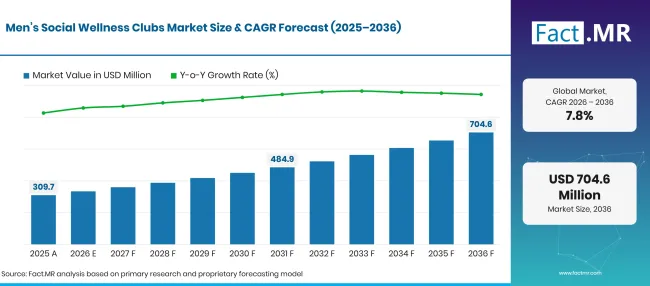
Mens Social Wellness Clubs Forecast Global | Source: Fact.MR
What are the defining numbers behind Men’s Social Wellness Clubs Market growth?
The 2026 to 2036 period will add USD 370.9 million in new value, led by preventive health formats, monthly memberships and hybrid pop-up clubs that reach working men.
- Demand Drivers in the Market
- Public health bodies now treat social isolation as a health risk. The World Health Organization Commission on Social Connection published its report on loneliness and social connection in June 2025, calling for social connection to be built into health policy.
- Chronic disease is pushing prevention up the agenda. WHO reports that noncommunicable diseases killed at least 43 million people in 2021, and 18 million of them died before age 70. Social fitness sessions give men a fixed time, a group and a coach, which helps turn intent into habit.
- Recovery rituals are spreading from elite sport into everyday routines. Sauna, cold plunge and red light sessions now feature in men’s clubs as a reason to visit between workouts.
- Peer support is becoming a normal part of men’s wellbeing. Facilitated circles and talk groups offer a low-pressure entry point for men who avoid clinical services. Clubs that host these groups weekly build loyalty that a gym floor alone rarely creates.
- Hybrid formats lower the cost of entering new cities. Pop-up events, outdoor sessions and online communities let operators test demand before signing a lease.
- Key Segments Analyzed
- By Men’s Club Wellness Offering: Preventive Health Access will hold 25.3% share in 2026, since health screens and coaching give members a clear reason to join and return.
- By Access / Commercial Model: Monthly Membership will account for 25.6% of 2026 value, as recurring billing matches the weekly rhythm of group sessions.
- By Operating Setting: Hybrid Pop-up / Digital will capture 31.4% in 2026, helped by low fixed costs and the ability to reach men in several locations at once.
- By Core Visitor Group: Working Professionals will represent 33.8% of 2026 demand, owing to their spending power and their need for wellness that fits around work.
- Analyst Opinion at Fact.MR
- Shambhu Nath Jha, Principal Consultant at Fact.MR, states, “Men will pay for wellness when it comes with people they want to see again, so the club that wins is the one that makes the second and tenth visit easy. Operators will need to join preventive health, recovery and peer conversation into one routine with a simple monthly price. Hybrid formats will let them prove demand in a neighbourhood before they invest in a permanent site.”
- Strategic Implications
- Club operators should build every membership around one anchor service, such as a quarterly health check, and use recovery and social sessions to raise visit frequency.
- Employers and benefit managers should test private club bookings for staff groups, since team-based sessions can reach men who skip traditional workplace health programmes.
- Venue owners and landlords should offer short-term and shared-space deals that let pop-up clubs run regular sessions without long leases.
- Investors should judge operators on member retention and session attendance, because steady repeat use is a better guide to value than headline sign-ups.
China will post the quickest expansion at 9.8%, with rising household leisure budgets giving clubs a ready audience. South Korea follows closely at 9.5%, where regular sport is already routine for most adults and group activity is part of social life. The United States, at 7.4%, is a larger and more mature base, so growth comes from adding recovery and peer formats to an established fitness culture. Germany will expand at 6.9%, drawing on a strong club tradition and a persistent gap in male life expectancy. Japan, at 6.1%, closes the range, as an older population steers demand toward active ageing programmes.
How does the Men’s Social Wellness Clubs Market break down by segment?
Preventive Health Access will lead Men’s Club Wellness Offering at 25.3%; Monthly Membership will head Access / Commercial Model at 25.6%; Hybrid Pop-up / Digital will top Operating Setting at 31.4%; Working Professionals will hold Core Visitor Group at 33.8% in 2026.
Which Men’s Club Wellness Offering leads?
Preventive Health Access holds 25.3% of 2026 sales.
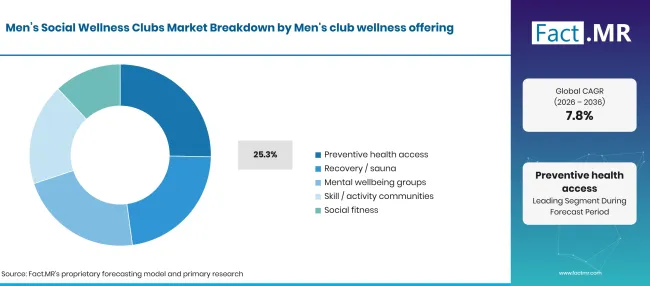
Mens Social Wellness Clubs Breakdown Mens Club Wellness Offering | Source: Fact.MR
| Men's Club Wellness Offering | Share (2026) |
|---|---|
| Preventive Health Access (Leading segment) | 25.3% |
| Other segments combined | 74.7%* |
| Total | 100.0% |
Source: Fact.MR analysis. Updated Nov 13, 2026
Many men delay visits to a doctor until a problem appears, so clubs that offer blood pressure checks, body composition scans and coaching on site meet a need clinics often miss. These services also give a measurable result that members can track from one quarter to the next, which supports renewals. Members who use dietary supplements often want guidance in the same setting. Recovery and sauna rooms, skill and activity communities, social fitness classes and mental wellbeing groups complete the offering. Each fills a different slot in the week, from a Saturday hike to a Tuesday talk circle.
What supports Monthly Membership within Access / Commercial Model?
Monthly Membership takes 25.6% of 2026 revenue.
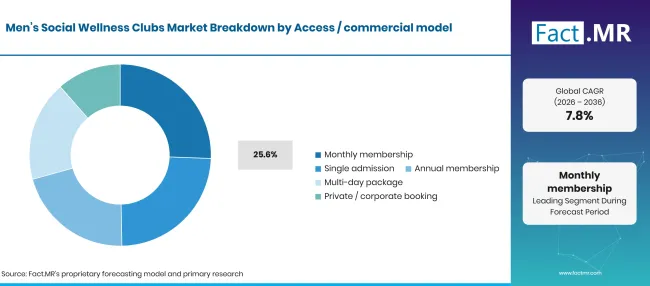
Mens Social Wellness Clubs Breakdown Access Commercial Model | Source: Fact.MR
| Access / Commercial Model | Share (2026) |
|---|---|
| Monthly Membership (Leading segment) | 25.6% |
| Other segments combined | 74.4%* |
| Total | 100.0% |
Source: Fact.MR analysis. Updated Nov 13, 2026
A monthly fee lowers the first commitment and still gives the operator predictable cash flow. Members can test the club through one cycle of sessions before deciding to stay, and the habit of a weekly group meeting tends to carry renewals. Single admission, annual membership, multi-day packages and private or corporate bookings serve other buyers. Employers use group bookings for team days, and some pair them with quit-smoking help such as nicotine replacement therapy.
How does Operating Setting shape demand?
Hybrid Pop-up / Digital captures 31.4% of 2026 value.
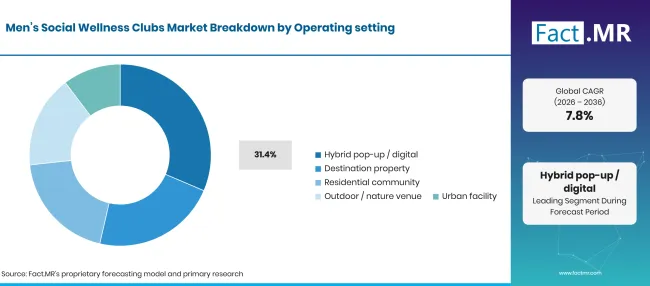
Mens Social Wellness Clubs Breakdown Operating Setting | Source: Fact.MR
| Operating Setting | Share (2026) |
|---|---|
| Hybrid Pop-up / Digital (Leading segment) | 31.4% |
| Other segments combined | 68.6%* |
| Total | 100.0% |
Source: Fact.MR analysis. Updated Nov 13, 2026
Temporary venues, rented halls and outdoor sites let operators run sessions where men already live and work. Programmes from the digital therapeutics field show how guided online sessions can support members between meetups. Outdoor and nature venues, residential communities, urban facilities and destination properties complete the setting mix. Destination properties host weekend retreats, which often draw men seeking better sleep alongside insomnia treatment.
What drives Working Professionals within Core Visitor Group?
Working Professionals account for 33.8% of 2026 spending.
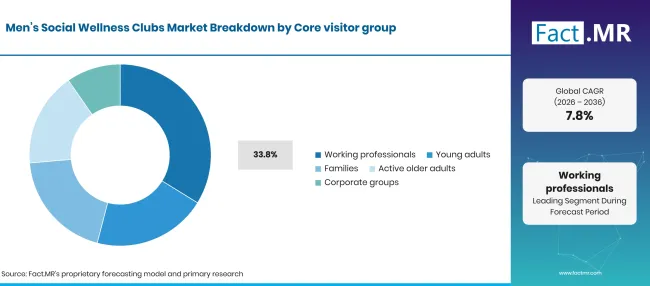
Mens Social Wellness Clubs Breakdown Core Visitor Group | Source: Fact.MR
| Core Visitor Group | Share (2026) |
|---|---|
| Working Professionals (Leading segment) | 33.8% |
| Other segments combined | 66.2%* |
| Total | 100.0% |
Source: Fact.MR analysis. Updated Nov 13, 2026
Long hours leave many men short of time for both exercise and friends, so a club that covers both in one evening is easy to justify. In the United States, men spent an average of 0.43 hours a day on sports, exercise and recreation in 2025, against 0.52 hours on socializing and communicating. Young adults, active older adults, corporate groups and families form the other visitor groups. Older men favour gentle fitness, health checks and recovery, while families attend open days and parent and child sessions.
What is accelerating Men’s Social Wellness Clubs Market adoption, and what is holding it back?
Growing public attention to loneliness and inactivity is pushing men toward clubs that mix health, recovery and conversation. Pop-up and digital models help operators reach new areas at low cost. On the other side, permanent recovery facilities are expensive to build, monthly fees strain budgets in price-sensitive markets, and keeping members engaged after the first few months is a constant challenge.
Drivers Impact Analysis
| DRIVER | (~) % IMPACT ON CAGR | GEOGRAPHIC RELEVANCE | IMPACT TIMELINE |
|---|---|---|---|
| Growing demand for preventive health access within men’s wellness programmes | +2.1% | Global | Short term (<=2 years) |
| Rising interest in recovery, sauna and physical wellbeing sessions | +1.8% | North America, Western Europe, East Asia | Medium term (2-4 years) |
| Wider participation in men’s peer groups and community social activities | +1.6% | North America, Western Europe, East Asia | Medium term (2-4 years) |
| Expansion of hybrid wellness formats and organized social fitness | +1.3% | Global | Long term (>=4 years) |
Source: Fact.MR analysis. Updated Nov 13, 2026
Opportunity Impact Analysis
| OPPORTUNITY | (~) % IMPACT ON CAGR | GEOGRAPHIC RELEVANCE | IMPACT TIMELINE |
|---|---|---|---|
| Integrated clubs that pair preventive health checks with recovery services | +1.4% | North America, Western Europe, East Asia | Medium term (2-4 years) |
| Membership programmes built around men’s peer support groups | +1.2% | Global | Medium term (2-4 years) |
| Pop-up and digital participation models for new cities | +1.0% | North America, East Asia, Western Europe | Short term (<=2 years) |
| Skill-based activity communities and social fitness clubs | +0.8% | Global | Long term (>=4 years) |
Source: Fact.MR analysis. Updated Nov 13, 2026
Restraints Impact Analysis
| RESTRAINT | (~) % IMPACT ON CAGR | GEOGRAPHIC RELEVANCE | IMPACT TIMELINE |
|---|---|---|---|
| High build and running costs for dedicated recovery facilities | -0.7% | Global | Short term (<=2 years) |
| Affordability limits on recurring fees and premium recovery sessions | -0.5% | Emerging markets | Medium term (2-4 years) |
| Member drop-off in community programmes after the first months | -0.3% | Global | Long term (>=4 years) |
Source: Fact.MR analysis. Updated Nov 13, 2026
Which countries are scaling the Men’s Social Wellness Clubs Market through 2036?
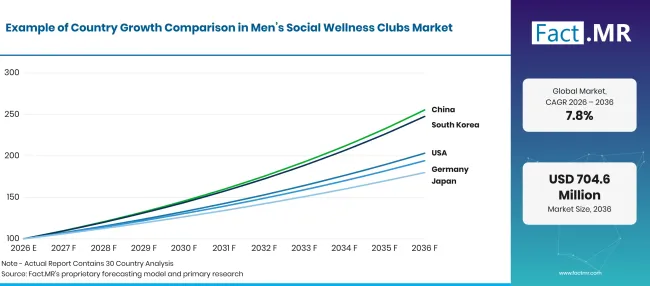
Mens Social Wellness Clubs Growth Index | Source: Fact.MR
| Country | CAGR (2026 to 2036) |
|---|---|
| China | 9.8% |
| South Korea | 9.5% |
| United States | 7.4% |
| Germany | 6.9% |
| Japan | 6.1% |
Source: Fact.MR analysis. Updated Nov 13, 2026
What supports China’s adoption?
9.8% CAGR, driven by growing household spending on leisure and recreation.
The National Bureau of Statistics reported per capita spending on education, culture and recreation of 2,647 yuan in the first three quarters of 2026, up 4.6% year on year. Rising leisure budgets give clubs room to sell paid pop-up sessions in large cities. Operators that add health checks and group recovery to these sites can attract urban men who already train but want a social circle around it.
How is South Korea developing demand?
9.5% CAGR, backed by high regular sport participation among men.
Korea’s Ministry of Culture, Sports and Tourism reported a regular sports participation rate of 62.9% in 2025, with men at 62.6%. Male life expectancy at birth reached 80.8 years in 2024, against 86.6 years for women [6]. The gap gives preventive health formats a clear message, and clubs that mix group sport with check-ups and peer talk fit well with existing habits.
What is supporting United States adoption?
7.4% CAGR, helped by a mature fitness culture adding recovery and peer formats.
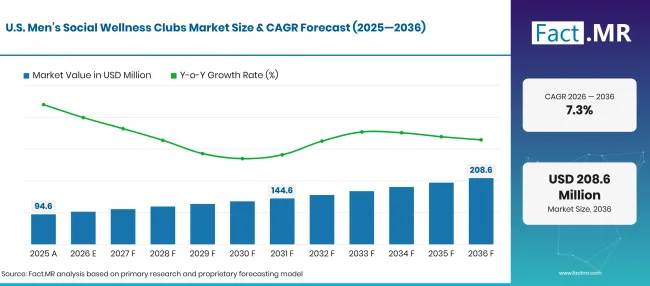
Mens Social Wellness Clubs Forecast Usa | Source: Fact.MR
The National Center for Health Statistics found that 52.3% of men met aerobic physical activity guidelines in 2024. Premium men’s clubs in the suburbs of New York now pair recovery suites with networking and podcasts, showing how operators can charge for community.
How is Germany scaling demand?
6.9% CAGR, reflecting a strong club culture and a persistent male health gap.
The Federal Statistical Office reported life expectancy at birth of 79.1 years for men in 2025, compared with 83.6 years for women. Germany’s long tradition of sports and leisure associations gives men’s clubs a familiar model to build on. Operators that add health checks, sauna culture and talk groups to this structure can appeal to men in their forties and fifties who want to close that gap.
How does Japan perform?
6.1% CAGR, as active ageing shapes what men look for in a club.
The Cabinet Office reported that people aged 65 and over accounted for 29.3% of Japan’s population as of October 2024. The Japan Sports Agency found that 55.0% of men aged 20 and over played sport at least once a week in its 2025 survey. Clubs that offer gentle fitness, bathing and conversation for retired men are well placed, though the shrinking younger population limits growth among working professionals.
Who leads the Men’s Social Wellness Clubs Market?
The field divides into three groups. Paid premium clubs such as Agora Social Club combine recovery suites, workshops and networking under one membership and compete on the quality of space and service. Activity networks such as Evryman and F3 Nation run outings, expeditions and free peer-led workouts, competing on community and frequency.
A third group of peer-support organizations, including ANDYSMANCLUB, The ManKind Project, UK Men’s Sheds Association and Men’s Circle India, offers talk groups, training weekends and workshop spaces that make conversation the main product. ANDYSMANCLUB launched its #MissionPossible campaign in May 2025 to encourage men to set personal challenges, and in October 2026 it announced a partnership with NIVEA MEN to link self-care with open conversation. Through 2036, the edge will go to groups that turn a first visit into a weekly habit and that can show members a real change in health.
Which companies are the key providers?
Key companies and organizations in the Men’s Social Wellness Clubs Market include Agora Social Club, Evryman, F3 Nation, ANDYSMANCLUB, The ManKind Project, UK Men’s Sheds Association and Men’s Circle India.
- Agora Social Club
- Evryman
- F3 Nation
- ANDYSMANCLUB
- The ManKind Project
- UK Men’s Sheds Association
- Men’s Circle India
Bibliography
- ANDYSMANCLUB. (2025, May 22). Mission Possible.
- ANDYSMANCLUB. (2026, October 12). Bringing Care and Conversation Together.
- Cabinet Office, Government of Japan. (2025). 令和7年版高齢社会白書(概要版)第1節 高齢化の状況.
- Japan Sports Agency. (2026, March 11). 令和7年度「スポーツの実施状況等に関する世論調査」の結果を公表します.
- Korea.net, Korean Culture and Information Service. (2025, December 4). Life expectancy hits record 83.7 years, women’s 3rd in OECD.
- Ministry of Culture, Sports and Tourism, Republic of Korea. (2026, January 20). [체육] 2025년 국민생활체육조사.
- National Bureau of Statistics of China. (2026, October 20). Households’ Income and Consumption Expenditure in the First Three Quarters of 2026.
- National Center for Health Statistics. (2026, April 7). Aerobic Physical Activity Among Adults Age 18 and Older: United States, 2024.
- Statistisches Bundesamt (Destatis). (2026, July 7). Lebenserwartung bei Geburt für Frauen und Männer im Jahr 2025 auf neue Höchstwerte gestiegen.
- U.S. Bureau of Labor Statistics. (2026, June 25). American Time Use Survey: 2025 Results.
- World Health Organization. (2025, June 30). From loneliness to social connection: charting a path to healthier societies. Report of the WHO Commission on Social Connection.
- World Health Organization. (2025, September 25). Noncommunicable diseases.
This Report Answers
- How much men’s social wellness club revenue will grow between 2026 and 2036, and what share of it comes from each offering.
- Why preventive health access, monthly plans and hybrid formats lead their categories, and what the other subsegments add.
- Where China and South Korea outpace the United States, Germany and Japan, and which official health and sport data explain the gaps.
- Which drivers, opportunities and restraints shift the growth rate, with an estimate of each one’s impact.
- How premium clubs, activity networks and peer-support groups compete for men’s time and loyalty.
- Which membership and booking models help operators keep members beyond the first few months.
What does the Men’s Social Wellness Clubs Market cover?
This market measures what men and employers pay to take part in clubs built around health, recovery and friendship. It counts memberships, single visits, packages and private bookings at both permanent sites and pop-up events.
Values are stated in USD million at the point of sale to the member or booking party. Free peer groups are profiled for their role in shaping demand, but only paid participation is counted in market value.
What is included in the scope?
Preventive health services delivered inside a club, such as screens, coaching and health talks, form part of the offer.
Recovery and sauna sessions are counted when sold as part of a men’s club visit, membership or retreat, in line with the wider spa services model.
Facilitated mental wellbeing groups, skill-based communities and social fitness sessions run by club operators are covered.
Corporate and private group bookings fall within this scope when they buy access to men’s club programmes.
What is excluded from the scope?
Conventional gyms and personal training without a social or peer element are left out.
Nutrition products, fitness equipment and wearable displays sold on their own are not counted.
Hospitals, clinics and home care services that offer only diagnosis or treatment remain outside.
Standalone fitness apps and employer wellness platforms with no link to a men’s club are excluded.
How Was the Analysis Built?
The analysis draws on 120+ sources, 35+ company portfolios, 25+ countries, and more than 20 industry interviews.
- Primary Research: Primary research includes discussions with manufacturers, service providers, technology developers, distributors, end users, and subject-matter experts. These conversations examine purchasing priorities, product adoption, operational challenges, approval requirements, competitive positioning, and the factors that influence wider market acceptance.
- Desk Research: Desk research covers government statistics, regulatory publications, company filings, trade data, technical studies, industry associations, standards, public policy, and other authoritative sources. Every source used in the analysis is documented in the bibliography.
- Market Sizing and Forecasting: Market estimates combine historical performance, demand indicators, pricing and volume trends, segment shares, company participation, country-level growth, adoption patterns, investment activity, and barriers to market expansion.
- Data Validation and Update Cycle: Findings are validated by comparing primary interviews with public data, company activity, regulatory changes, trade patterns, and industry developments. Regular updates review new product launches, capacity changes, partnerships, approvals, and shifts in commercial adoption.
Segmentation
What is the report’s scope and coverage?
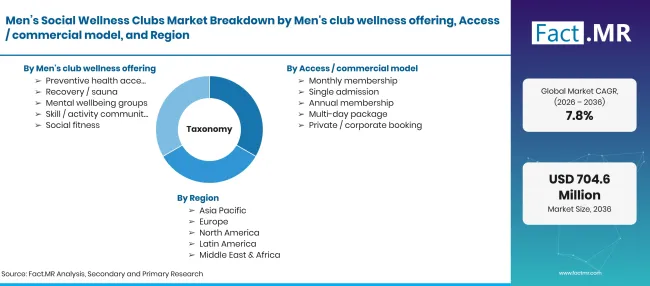
Mens Social Wellness Clubs Taxonomy | Source: Fact.MR
| Attribute | Details |
|---|---|
| Quantitative Units | USD million in 2026 to USD million by 2036 at CAGR |
| Market Definition | Membership, admission and booking revenue from clubs and organized communities that combine health, recovery, peer support and group activity for men. |
| Men’s Club Wellness Offering | Preventive Health Access; Recovery / Sauna; Mental Wellbeing Groups; Skill / Activity Communities; Social Fitness |
| Access / Commercial Model | Monthly Membership; Single Admission; Annual Membership; Multi-day Package; Private / Corporate Booking |
| Operating Setting | Hybrid Pop-up / Digital; Outdoor / Nature Venue; Residential Community; Urban Facility; Destination Property |
| Core Visitor Group | Working Professionals; Young Adults; Active Older Adults; Corporate Groups; Families |
| Regions Covered | North America; Latin America; Western Europe; Eastern Europe; East Asia; South Asia & Pacific; Middle East & Africa |
| Countries Covered | China; South Korea; United States; Germany; Japan |
| Companies Profiled | Agora Social Club; Evryman; F3 Nation; ANDYSMANCLUB; The ManKind Project; UK Men’s Sheds Association; Men’s Circle India |
| Forecast Period | 2026 to 2036 |
| Approach | Club revenue is built from membership and admission models, then split by offering, setting and visitor group and checked against country participation data. |
Source: Fact.MR analysis. Updated Nov 13, 2026
How is the market segmented?
-
By Men’s Club Wellness Offering
- Preventive Health Access
- Recovery / Sauna
- Mental Wellbeing Groups
- Skill / Activity Communities
- Social Fitness
-
By Access / Commercial Model
- Monthly Membership
- Single Admission
- Annual Membership
- Multi-day Package
- Private / Corporate Booking
-
By Operating Setting
- Hybrid Pop-up / Digital
- Outdoor / Nature Venue
- Residential Community
- Urban Facility
- Destination Property
-
By Core Visitor Group
- Working Professionals
- Young Adults
- Active Older Adults
- Corporate Groups
- Families
-
By Region
- North America
- Latin America
- Western Europe
- Eastern Europe
- East Asia
- South Asia & Pacific
- Middle East & Africa
Frequently Asked Questions
How large is the men’s social wellness clubs market in 2026?
What growth rate will the men’s social wellness clubs market record?
Which men’s club wellness offering leads?
Which access / commercial model leads?
Which operating setting leads?
Which core visitor group leads?
Which country will grow quickest?
Who are the main companies?
What holds the market back?
Who worked on this report


Preview the report firsthand - request a free sample
Free SampleGet the brochure for pricing and purchase details
Download PDF