- Base Value(2025): 420 Mn
- Estimated Value(2026): 470 Mn
- Forecast Value (2036): 1360 Mn
- CAGR (2026 - 2036): 11.2%
Bedside Delirium Monitoring Devices Market Size, Share and Forecast and Outlook By FACT.MR
In 2025, the bedside delirium monitoring devices market was valued at USD 420 million. Fact MR analysis indicates demand for bedside delirium monitoring devices is expected to reach USD 470 million in 2026 and USD 1,360 million by 2036. FMR estimates the market will expand at a CAGR of 11.2% across the forecast period.
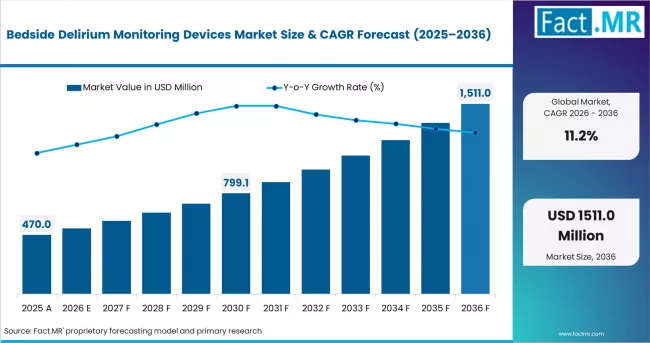
Bedside Delirium Monitoring Devices Market Market Value Analysis | Source: Fact.MR
Bedside Delirium Monitoring Devices Market
| Metric | Details |
|---|---|
| Industry Size (2026E) | USD 470 million |
| Industry Value (2036F) | USD 1,360 million |
| CAGR (2026 to 2036) | 11.2% |
Source: Fact.MR analysis. Updated Apr 24, 2026
Summary of Bedside Delirium Monitoring Devices Market
- Market Definition
- The bedside delirium monitoring devices market includes clinical monitoring technologies designed to detect, quantify, and continuously assess delirium symptoms in hospitalized patients through neurological signal acquisition, behavioral analytics, and predictive algorithms. These systems combine electroencephalography signals, sleep-wake cycle analysis, and machine learning models to support early identification of acute cognitive impairment across intensive care, post-operative recovery, and geriatric care environments.
- Demand Drivers
- Increasing clinical recognition of delirium as a measurable neurological parameter influencing patient recovery duration and mortality risk.
- Expansion of intensive care monitoring protocols incorporating continuous neurological observation alongside vital sign tracking.
- Rising adoption of artificial intelligence-enabled clinical decision support systems improving early identification of cognitive deterioration patterns.
- Growth in geriatric patient populations requiring structured monitoring approaches for post-surgical cognitive complications.
- Integration of neurological monitoring modules into multiparameter bedside monitoring systems improving clinical workflow efficiency.
- Increasing hospital investment in predictive patient monitoring technologies supporting early intervention strategies.
- Key Segments Analyzed
- End User: Hospitals account for 52.3% share reflecting concentration of neurological observation protocols across ICU and post-operative care settings.
- Technology: Electroencephalography monitoring holds 36.8% share supported by ability to detect abnormal brain activity patterns associated with delirium onset.
- Product Type: Multimodal neurological monitors and AI-based detection systems support continuous cognitive tracking across complex clinical environments.
- Geography: The United States demonstrates strong adoption supported by digital health integration, while the United Kingdom and Germany show growth aligned with standardized delirium screening protocols.
- Analyst Opinion at Fact MR
- Shambhu Nath Jha, Principal Consultant, Fact MR, states, "Bedside delirium monitoring technologies are transitioning neurological observation from episodic assessment toward continuous data-driven evaluation frameworks supporting predictive patient management. Hospitals increasingly incorporate EEG-derived cognitive indicators and algorithm-based behavioral analytics into multiparameter monitoring ecosystems designed to detect early neurological instability. Market expansion reflects integration of cognitive monitoring modules into digital health infrastructure aligned with patient safety protocols and ICU workflow optimization requirements through 2036."
- Strategic Implications
- Expand development of multimodal neurological monitoring platforms combining EEG signals, behavioral analytics, and physiological indicators.
- Improve interoperability between delirium monitoring devices and hospital electronic health record infrastructure.
- Strengthen validation of machine learning models supporting predictive identification of cognitive impairment risk patterns.
- Increase investment in wearable neurological monitoring technologies enabling extension of delirium observation beyond intensive care settings.
- Enhance clinical decision support integration enabling automated alert generation based on neurological signal deviation thresholds.
- Improve signal accuracy and artifact reduction supporting reliable cognitive assessment across critical care environments.
- Methodology
- Developed using primary interviews with neurologists, intensivists, medical device manufacturers, and hospital procurement stakeholders.
- Supported through review of clinical research literature, neurological monitoring technology documentation, and regulatory approval databases.
- Market estimation applied hybrid modeling combining bottom-up revenue analysis of neurological monitoring devices with top-down evaluation of ICU admission and geriatric care demand patterns.
- Data validated through triangulation using peer-reviewed clinical evidence, manufacturer disclosures, and expert consultation inputs.
- Periodic updates incorporate developments in EEG signal processing, AI-based clinical analytics, and hospital digitalization frameworks influencing adoption of continuous cognitive monitoring technologies.
The increase from USD 470 million in 2026 to USD 1,360 million in 2036 reflects strong 10-year growth, indicating structural expansion in continuous cognitive assessment tools within acute and long-term care settings. Adoption is supported by clinical emphasis on early delirium detection, while moderated by validation requirements, integration with monitoring systems, and reimbursement alignment across healthcare providers.
The USA records the fastest growth at 11.5%, supported by integration of continuous cognitive assessment tools in intensive care monitoring workflows. The United Kingdom follows at 11.4%, driven by increased adoption of digital neurological observation systems in hospital wards. Germany shows 11.1% growth, linked to incorporation of sensor-based delirium screening technologies in geriatric care protocols. France at 10.9% and Japan at 10.6% represent mature markets where demand is largely replacement-driven due to established clinical monitoring infrastructure. A structural constraint across mature markets is integration complexity with existing hospital IT systems, which slows rapid deployment of new monitoring platforms.
Segmental Analysis
Bedside Delirium Monitoring Devices Market Analysis by End User
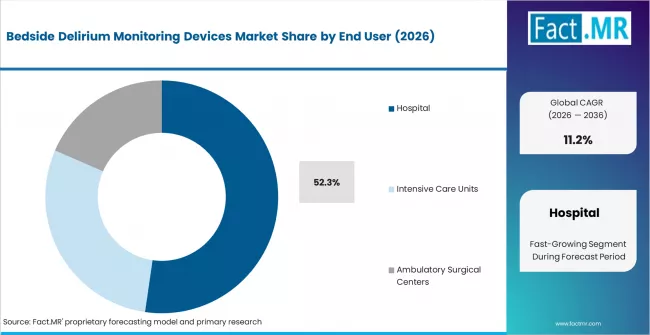
Bedside Delirium Monitoring Devices Market Analysis By End User | Source: Fact.MR
- Market Overview: Hospitals are projected to hold 52.3% share of the bedside delirium monitoring devices market in 2026. Adoption concentration reflects the need for continuous neurological observation in intensive care environments where delirium incidence remains associated with prolonged hospitalization and complex clinical conditions. Healthcare facilities prioritize monitoring technologies capable of supporting early identification of cognitive disturbances across critical care workflows.
- Demand Drivers:
- Critical Care Monitoring Needs: Hospitals manage patients exposed to sedation, mechanical ventilation, and post-surgical recovery conditions where delirium risk requires continuous neurological assessment.
- Clinical Workflow Integration: Monitoring systems are incorporated into bedside equipment frameworks supporting real-time observation of neurological indicators across intensive care and post-operative units.
- Patient Safety Protocols: Healthcare providers implement delirium monitoring devices to reduce complications associated with prolonged cognitive impairment and extended hospital stays.
Bedside Delirium Monitoring Devices Market Analysis by Technology
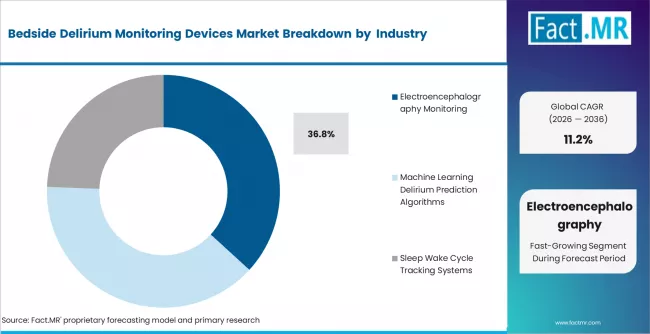
Bedside Delirium Monitoring Devices Market Analysis By Technology | Source: Fact.MR
- Market Overview: Electroencephalography monitoring is estimated to account for 36.8% share in 2026, supported by its ability to provide objective neurological activity measurement used in detection of abnormal brain function patterns associated with delirium onset. Technology adoption reflects demand for quantitative monitoring approaches supporting clinical decision-making processes.
- Demand Drivers:
- Neurological Signal Measurement: Electroencephalography monitoring technologies provide real-time assessment of brain wave activity used to detect cognitive irregularities in hospitalized patients.
- Objective Assessment Requirements: Clinicians utilize EEG-based monitoring systems to complement observational delirium screening tools used in intensive care environments.
- Device Integration Capability: EEG monitoring platforms are increasingly integrated with bedside monitoring systems supporting continuous neurological data acquisition across hospital care settings.
Key Dynamics
Bedside Delirium Monitoring Devices Market Drivers, Restraints, and Opportunities
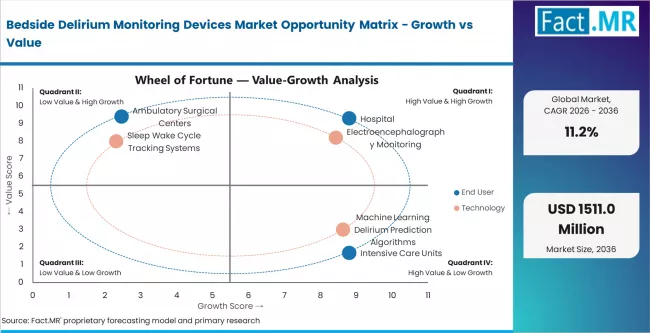
Bedside Delirium Monitoring Devices Market Opportunity Matrix Growth Vs Value | Source: Fact.MR
FMR analysts observe that the market reflects a developing neurological monitoring niche positioned within the broader patient monitoring device ecosystem. Market size exists because delirium remains underdiagnosed in acute care settings, despite strong clinical evidence linking delirium episodes to higher mortality, longer hospital stays, and increased care costs. Hospitals increasingly treat delirium as a measurable neurological parameter rather than a purely observational symptom, supporting investment in bedside cognitive monitoring tools integrated with multiparameter patient monitoring systems. Clinical studies indicate delirium affects a substantial proportion of hospitalized older adults and ICU patients, reinforcing the need for structured monitoring protocols.
Current market dynamics show declining reliance on manual nurse-led assessment scales such as CAM-ICU and ICDSC as digital cognitive monitoring tools incorporate EEG-derived biomarkers, motion tracking, and behavioral analytics. Sensor-enabled bedside systems command higher per-unit pricing due to algorithm validation and interoperability requirements with electronic health record platforms, while adoption expands gradually across intensive care units and geriatric care wards. Integration with broader neurological and multiparameter monitoring platforms supports clinical workflow efficiency as hospitals prioritize predictive patient monitoring capabilities.
- Clinical Protocol Formalization: Age-Friendly Health Systems initiatives and ICU delirium screening guidelines encourage structured cognitive monitoring adoption to reduce underdiagnosis rates and improve clinical outcomes.
- ICU Digitalization Trend: North America and Western Europe hospitals are integrating neurological monitoring modules into bedside multiparameter monitoring platforms to improve early detection of neurological deterioration.
- Sensor Analytics Integration: EEG-derived indices, behavioral tracking, and AI-based alert systems improve real-time detection sensitivity compared to periodic manual cognitive assessment workflows.
Regional Analysis
The bedside delirium monitoring devices market is assessed across North America, Europe, and Asia Pacific, segmented by country-level demand for cognitive monitoring systems, ICU delirium detection tools, neurological assessment devices, and AI-supported patient observation technologies. Geographic variation reflects hospital digitalization adoption, geriatric care demand, and clinical patient safety protocols. The full report offers market attractiveness analysis.
.webp "Top Country Growth Comparison Bedside Delirium Monitoring Devices Market Cagr (2026 2036)")
Top Country Growth Comparison Bedside Delirium Monitoring Devices Market Cagr (2026 2036) | Source: Fact.MR
CAGR Table
| Country | CAGR (2026–2036) |
|---|---|
| USA | 11.5% |
| UK | 11.4% |
| Germany | 11.1% |
| France | 10.9% |
| Japan | 10.6% |
Source: Fact.MR analysis. Updated Apr 24, 2026
Source: Fact MR analysis, based on proprietary forecasting model and primary research
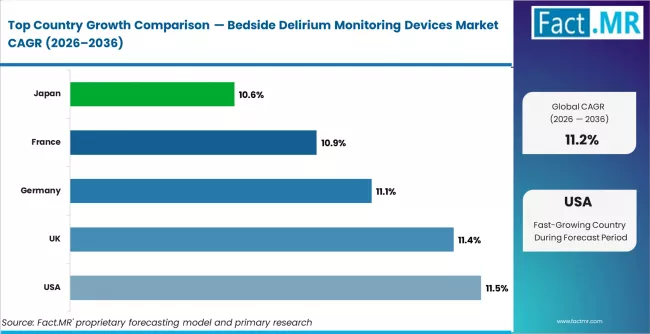
Bedside Delirium Monitoring Devices Market Cagr Analysis By Country | Source: Fact.MR
North America
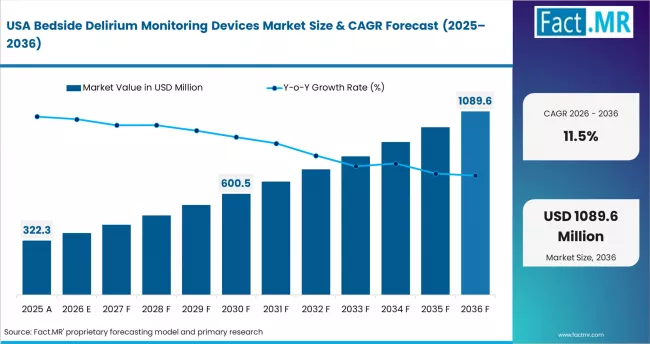
Bedside Delirium Monitoring Devices Market Country Value Analysis | Source: Fact.MR
North America functions as the clinical monitoring technology commercialization center supported by advanced ICU infrastructure and strong adoption of digital patient observation tools. GE HealthCare strengthens neurological monitoring capability. Philips Healthcare expands bedside cognitive assessment portfolio. Masimo Corporation supports continuous patient monitoring innovation.
- USA: The USA is projected to record 11.5% CAGR in bedside delirium monitoring devices through 2036. FDA digital health device guidance update (March 2023) supports AI-enabled patient monitoring system approvals. GE HealthCare expanded neurological monitoring technology development program (August 2023).
Europe
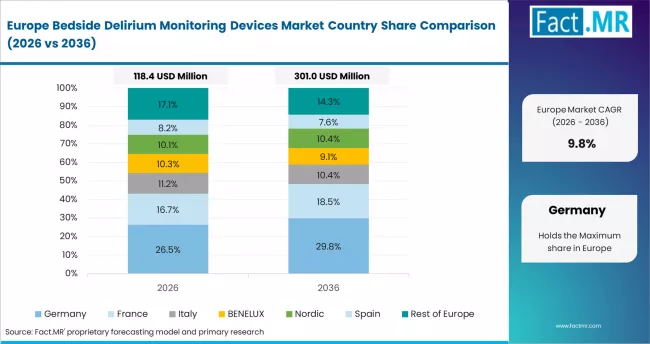
Bedside Delirium Monitoring Devices Market Europe Country Market Share Analysis, 2026 & 2036 | Source: Fact.MR
Europe operates as the patient safety compliance laboratory supported by structured clinical assessment protocols and adoption of standardized delirium screening practices across hospitals. Philips Healthcare strengthens clinical monitoring device portfolio depth. Draegerwerk AG expands ICU monitoring technology capability. Siemens Healthineers supports neurological assessment device innovation.
- UK: The UK is expected to observe 11.4% CAGR in bedside delirium monitoring devices through 2036. NHS patient safety strategy update (September 2023) promotes delirium screening protocol implementation. Philips Healthcare expanded cognitive monitoring solution deployment collaboration (May 2023).
- Germany: Germany is anticipated to expand at 11.1% CAGR in bedside delirium monitoring devices through 2036. EU Medical Device Regulation implementation (European Commission, ongoing) supports compliance-certified neurological monitoring device adoption. Draegerwerk AG expanded ICU monitoring technology research capability (April 2023).
- France: France is forecast to grow at 10.9% CAGR in bedside delirium monitoring devices through 2036. National digital health strategy update (Ministry of Solidarity and Health, February 2023) supports advanced patient monitoring integration. Siemens Healthineers expanded neurological monitoring device distribution capability (June 2023).
Asia Pacific
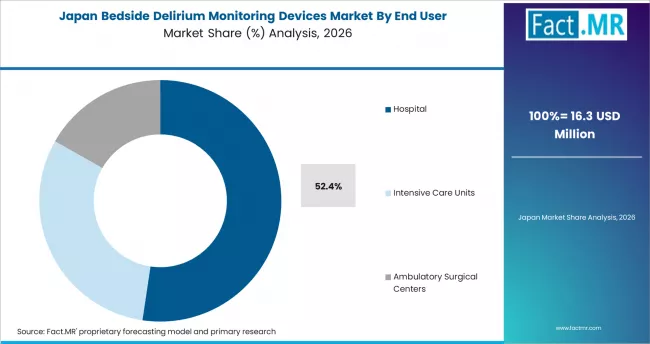
Bedside Delirium Monitoring Devices Market Japan Market Share Analysis By End User | Source: Fact.MR
Asia Pacific functions as the geriatric neurological monitoring expansion hub supported by increasing elderly population share and hospital investment in cognitive assessment technologies. Nihon Kohden Corporation strengthens neurological monitoring device expertise. Fujifilm Healthcare expands diagnostic monitoring capability. Omron Healthcare supports clinical monitoring innovation.
- Japan: Japan is projected to register 10.6% CAGR in bedside delirium monitoring devices through 2036. Medical DX promotion framework update (Ministry of Health, Labour and Welfare, January 2023) supports digital patient monitoring integration. Nihon Kohden Corporation expanded neurological monitoring technology development initiative (July 2023).
Fact MR's analysis of bedside delirium monitoring devices market in global regions consists of country-wise assessment that includes USA, UK, Germany, France, and Japan. Readers can find clinical monitoring technology adoption trends, patient safety protocol developments, hospital digitalization patterns, and competitive device innovation insights.
Competitive Landscape
What is the Competitive Structure of the Bedside Delirium Monitoring Devices Market?
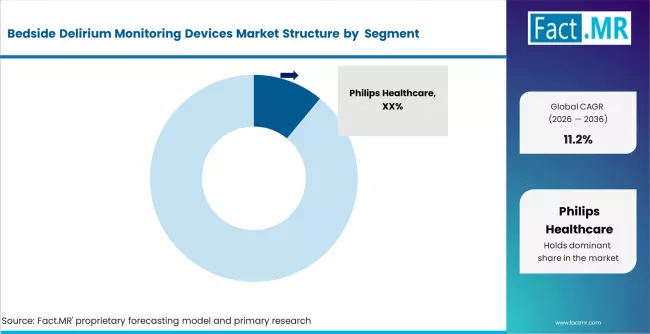
Bedside Delirium Monitoring Devices Market Analysis By Company | Source: Fact.MR
The Bedside Delirium Monitoring Devices Market demonstrates a moderately concentrated competitive structure, supported by medical technology companies with expertise in neurophysiological monitoring and patient surveillance systems. Leading companies including Philips Healthcare, GE HealthCare, Medtronic, Nihon Kohden, Masimo, Dräger, and Natus Medical collectively account for nearly 60–70% of market share, particularly in electroencephalography-based and multimodal bedside monitoring platforms used in intensive care environments. Competitive positioning is primarily determined by signal accuracy, real-time cognitive assessment capability, integration with patient monitoring systems, and compliance with hospital safety standards. High clinical validation requirements and complex algorithm development create entry barriers, limiting participation to companies with established neurological monitoring expertise and hospital distribution networks.
Structural advantages are observed among companies possessing installed bases of patient monitoring systems and established service networks across hospitals and critical care units. Philips Healthcare and GE HealthCare benefit from integrated monitoring ecosystems that enable interoperability between neurological monitoring modules and existing bedside equipment. Buyers typically manage supplier dependency through multi-vendor procurement frameworks and evaluation of device compatibility with hospital information systems. Procurement decisions often consider reliability of continuous monitoring performance, software interoperability, and compliance with clinical workflow requirements. Pricing power remains relatively balanced, though suppliers retain moderate leverage where validated monitoring algorithms and system integration capabilities create switching constraints for healthcare providers implementing continuous delirium assessment protocols.
Key Players of the Bedside Delirium Monitoring Devices Market
- Philips Healthcare
- GE HealthCare
- Medtronic
- Nihon Kohden
- Masimo
- Dräger
- Natus Medical
- Mindray
- Compumedics
- Advanced Brain Monitoring
Bibliographies
- [1] U.S. Food and Drug Administration. (2023, June 14). Content of premarket submissions for device software functions.
- [2] National Health Service England. (2023). Delirium screening tool and management plan.
- [3] European Commission. (ongoing). EU Medical Device Regulation implementation.
- [4] Ministry of Solidarity and Health (France). (2023, February). National digital health strategy update.
- [5] Ministry of Health, Labour and Welfare (Japan). (2023). Healthcare DX Promotion Roadmap.
- [6] GE HealthCare. (2023). Neurological monitoring technology development program expansion.
- [7] Philips Healthcare. (2019). Cognitive assessment platform IntelliSpace Cognition launch.
- [8] Dräger. (2023). ICU monitoring technology research capability expansion.
- [9] Siemens Healthineers. (2026, March 18). Brain health research portfolio expansion.
- [10] Nihon Kohden Corporation. (2026, January 29). Neurological monitoring portfolio expansion.
This Report Addresses
- Market size estimation and revenue forecasts from 2026 to 2036, supported by validated ICU admission benchmarks and adoption indicators for continuous neurological monitoring technologies.
- Growth opportunity mapping across EEG-based monitors, multimodal neurological monitoring platforms, wearable cognitive assessment devices, AI-based delirium detection systems, and integrated ICU monitoring architectures.
- Segment and regional revenue forecasts covering electroencephalography monitoring, sleep-wake cycle tracking systems, machine learning delirium prediction algorithms, and brain activity pattern analytics across hospital and intensive care applications.
- Competition strategy assessment including benchmarking of signal accuracy, algorithm validation capability, interoperability with electronic health record systems, and integration with multiparameter bedside monitoring platforms.
- Regulatory impact analysis covering medical device validation pathways, digital health software compliance frameworks, and clinical safety protocol standards influencing adoption of cognitive monitoring technologies.
- Market report delivery in PDF, Excel, PPT, and structured data formats designed for neurologists, ICU clinicians, biomedical engineers, digital health developers, and hospital procurement teams.
- Supply chain vulnerability assessments identifying concentration risks in neuro-sensor component manufacturing, EEG electrode production, embedded signal processing hardware, and clinical algorithm validation infrastructure supporting bedside cognitive monitoring systems.
Bedside Delirium Monitoring Devices Market Definition
The bedside delirium monitoring devices market includes medical technologies designed to detect, assess, and continuously monitor delirium in hospitalized patients, particularly in intensive care units. These systems use cognitive assessment tools, physiological sensors, or data analytics to identify changes in attention, awareness, and neurological status, enabling early clinical intervention and improved patient safety outcomes.
Bedside Delirium Monitoring Devices Market Inclusions
The report covers global and regional market size evaluation and forecast outlook across the defined study period. It includes segmentation by device type such as EEG-based monitors, clinical decision support platforms, and digital cognitive assessment tools. Applications include ICU care, post-operative monitoring, and geriatric care. Pricing structure, supply chain configuration, and technology adoption trends are analyzed.
Bedside Delirium Monitoring Devices Market Exclusions
The scope excludes general neurological monitoring equipment not intended for delirium detection, standard patient monitoring systems lacking delirium-specific analytics, and pharmaceutical treatments for cognitive disorders. Diagnostic imaging systems and psychiatric assessment software unrelated to bedside monitoring are not included, focusing strictly on devices designed for real-time delirium identification and tracking.
Bedside Delirium Monitoring Devices Market Research Methodology
- Primary Research: Interviews were conducted with critical care physicians, neurologists, medical device manufacturers, hospital procurement specialists, and clinical researchers involved in neuro-monitoring technologies.
- Desk Research: Scientific journals, clinical guidelines, regulatory databases, and company technical documentation were reviewed to identify validated delirium assessment technologies and emerging monitoring approaches.
- Market-Sizing and Forecasting: A hybrid model combining bottom-up analysis of device manufacturer revenues and top-down evaluation of ICU admission rates and neurological monitoring demand was applied to estimate market size and growth trajectory.
- Data Validation and Update Cycle: Data outputs were verified through triangulation of peer-reviewed literature, regulatory approvals, and expert consultation. Updates reflect evolving clinical protocols and advancements in continuous neurological monitoring technologies.
Segmentation
Report Scope
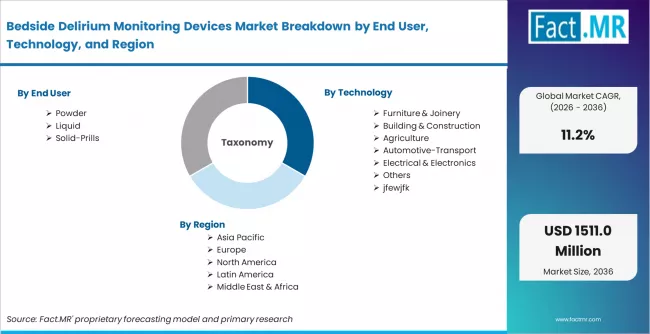
Bedside Delirium Monitoring Devices Market Breakdown By End User, Technology, And Region | Source: Fact.MR
| Metric | Value |
|---|---|
| Quantitative Units | USD 470 million (2026) to USD 1,360 million (2036), at a CAGR of 11.2% |
| Market Definition | The bedside delirium monitoring devices market includes neurological monitoring systems designed to detect cognitive impairment, altered brain activity patterns, and early indicators of delirium in clinical care environments. These devices combine neurophysiological monitoring, algorithm-based pattern recognition, and continuous patient observation tools to support clinical decision-making in intensive care and post-surgical recovery settings. |
| Product Type Segmentation | EEG-based bedside delirium monitors, Multimodal neurological monitors, AI-based delirium detection systems, Wearable cognitive monitoring devices, Integrated ICU monitoring systems |
| Technology Segmentation | Electroencephalography monitoring, Machine learning delirium prediction algorithms, Sleep-wake cycle tracking systems, Brain activity pattern monitoring |
| End User Segmentation | Hospitals, Intensive care units, Ambulatory surgical centers, Home care settings |
| Regions Covered | North America, Latin America, Europe, East Asia, South Asia, Oceania, Middle East and Africa |
| Countries Covered | United States, Canada, Mexico, Brazil, Argentina, Germany, France, United Kingdom, Italy, Spain, China, India, Japan, South Korea, Indonesia, Australia, and 40+ countries |
| Key Companies Profiled | Philips Healthcare, GE HealthCare, Medtronic, Nihon Kohden, Masimo, Dräger, Natus Medical, Mindray, Compumedics, Advanced Brain Monitoring |
| Forecast Period | 2026 to 2036 |
| Approach | Hybrid top-down and bottom-up market estimation validated through primary interviews with neurodiagnostic device manufacturers, intensive care specialists, hospital procurement teams, and digital health technology developers, supported by clinical adoption benchmarking, regulatory pathway analysis, and assessment of integration trends across neurological monitoring platforms |
Source: Fact.MR analysis. Updated Apr 24, 2026
Bedside Delirium Monitoring Devices Market Key Segments
-
Product Type:
- EEG Based Bedside Delirium Monitors
- Multimodal Neurological Monitors
- AI Based Delirium Detection Systems
- Wearable Cognitive Monitoring Devices
- Integrated ICU Monitoring Systems
-
Technology:
- Electroencephalography Monitoring
- Machine Learning Delirium Prediction Algorithms
- Sleep Wake Cycle Tracking Systems
- Brain Activity Pattern Monitoring
-
End User:
- Hospitals
- Intensive Care Units
- Ambulatory Surgical Centers
- Home Care Settings
-
Region:
- North America
- USA
- Canada
- Mexico
- Europe
- Germany
- UK
- France
- Italy
- Spain
- Nordic Countries
- BENELUX
- Rest of Europe
- Asia Pacific
- China
- Japan
- South Korea
- India
- Australia
- Rest of Asia Pacific
- Latin America
- Brazil
- Argentina
- Rest of Latin America
- Middle East and Africa
- Kingdom of Saudi Arabia
- United Arab Emirates
- South Africa
- Rest of Middle East and Africa
- Other Regions
- Oceania
- Central Asia
- Other Markets
- North America
Frequently Asked Questions
How large is the demand for Bedside Delirium Monitoring Devices in the global market in 2026?
What will be the market size of Bedside Delirium Monitoring Devices in the global market by 2036?
What is the expected demand growth for Bedside Delirium Monitoring Devices in the global market between 2026 and 2036?
Which End User is poised to lead global demand by 2026?
What is Driving Bedside Delirium Monitoring Device Demand in the United States?
What is the United States Growth Outlook in this Report?
What is Driving Bedside Delirium Monitoring Device Demand in Germany?
What is the Germany Growth Outlook in this Report?
What is Driving Bedside Delirium Monitoring Device Demand in the United Kingdom?
What is the United Kingdom Growth Outlook in this Report?
What is Driving Bedside Delirium Monitoring Device Demand in France?
What is the France Growth Outlook in this Report?
Does the Report Cover Japan in its Regional Analysis?
What is the Japan Growth Outlook in this Report?
Which Companies are Identified as Leading Participants in the Bedside Delirium Monitoring Devices Market?
What are Bedside Delirium Monitoring Devices and What are They Mainly Used For?
What does Bedside Delirium Monitoring Devices Market Mean in this Report?
What is Included in the Scope of this Bedside Delirium Monitoring Devices Market Report?
What is Excluded from the Scope of this Report?
What does Market Forecast Mean on this Page?
How is the Bedside Delirium Monitoring Devices Market Forecast Developed in this Report?
What does Data Validation Approach Mean in this Report?
Who worked on this report


Preview the report firsthand - request a free sample
Free SampleGet the brochure for pricing and purchase details
Download PDF