- Market Value (2025): USD 1.0 Bn
- Estimated Value (2026): USD 1.1 Bn
- Forecast Value (2036): USD 2.3 Bn
- CAGR (2026-2036): 7.7%
What is the Neurofibromatosis and Schwannomatosis Therapeutics Market forecast to be worth by 2036?
USD 1.1 billion in 2026 to USD 2.3 billion by 2036, at a 7.7% CAGR.
- The market entered 2026 at USD 1.1 billion, up from a USD 1.0 billion reference in 2025, following the 2025 FDA approval of mirdametinib (GOMEKLI), the second MEK inhibitor approved for NF1 plexiform neurofibromas and the first approved for both adults and children as young as two.
- Demand is projected to increase from USD 1.1 billion in 2026 to USD 2.3 billion by 2036.
- The market is forecast to record a 7.7% CAGR from 2026 to 2036 as dual MEK-pathway approvals, pediatric-to-adult label expansion, and NF2-specific pipeline development, including repurposed kinase inhibitors, continue to mature.
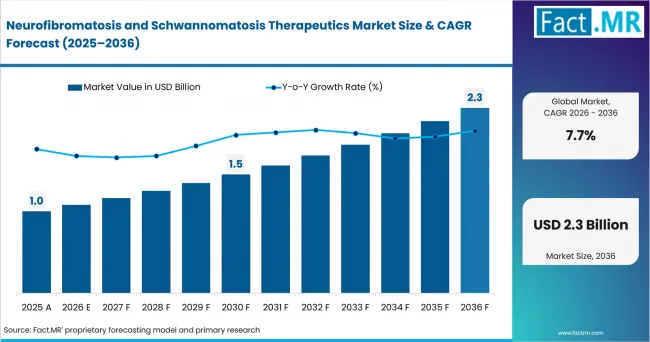
Neurofibromatosis And Schwannomatosis Therapeutics Market Value Analysis | Source: Fact.MR
What are the defining numbers behind Neurofibromatosis and Schwannomatosis Therapeutics Market growth?
USD 1.2 billion absolute opportunity is expected by 2036.
- Demand Drivers in the Market
- Two MEK inhibitors are now FDA-approved for NF1 plexiform neurofibromas: selumetinib (Koselugo), now available to adults across the U.S. and Europe, and mirdametinib (GOMEKLI), approved in 2025 as the first NF1 therapy for both adults and children as young as two; the pivotal NF106 Phase II trial of mirdametinib reported a 42% partial response rate with durable pain reduction.
- NF2-related schwannomatosis remains a disease with no approved targeted therapy, but the INTUITT-NF2 Phase 2 platform trial of repurposed multi-kinase inhibitor brigatinib, published in the New England Journal of Medicine, reported radiographic response in 23% of all tumors treated (meningiomas and non-vestibular schwannomas benefiting most) and hearing improvement in 35% of eligible ears, with no grade 4/5 treatment-related adverse events across 40 patients.
- A systematic review and meta-analysis of 16 studies covering more than 200 NF2-SWN patients found bevacizumab, the most extensively studied targeted agent for NF2-related vestibular schwannoma, achieved the highest efficacy of six drugs tested, with radiographic response in 38% and hearing improvement in 45% of patients.
- Key Segments Analyzed
- By Disease Type: Neurofibromatosis Type 1 (NF1) is expected to hold 38.3% share in 2026 due to its higher treatment demand and the growing use of targeted therapies for associated tumors.
- By Therapy Type: MEK Inhibitors are projected to account for 25.0% share in 2026, supported by their role in controlling abnormal cell signalling linked to NF1-related tumor growth.
- By Treatment Setting: First-Line Therapy is anticipated to capture 30.0% share in 2026 as targeted treatments are used earlier in care for eligible patients.
- By End User: Hospitals are estimated to represent 30.0% share in 2026 through their role in diagnosis, treatment planning, medicine administration, and long-term patient monitoring.
- Analyst Opinion at Fact.MR
- Shambhu Nath Jha, Senior Analyst at Fact.MR, states, that developers who treat NF1, NF2-related schwannomatosis, and other schwannomatosis as three separate commercial problems, rather than extensions of the same MEK-inhibitor playbook, will find the more defensible opportunities. NF2-related disease in particular still lacks an approved targeted option, which leaves an open competitive space that pain-management and surgical standards of care have not closed.
- Strategic Implications
- Design NF1, NF2-related schwannomatosis, and other schwannomatosis trials around their distinct underlying biology, neurofibromin loss in NF1 versus merlin loss in NF2, rather than assuming evidence from plexiform neurofibromas transfers to NF2-related tumors.
- Build long-term monitoring capacity alongside MEK-inhibitor and other targeted-therapy rollout, since that capacity, not drug supply, is what actually limits how many patients a centre can safely keep on chronic therapy.
- Pair tumor-volume response with pain, hearing, function, and quality-of-life measures in every trial; a shrinkage result alone does not confirm that outcomes patients actually care about have improved.
- Plan pricing and support programmes around lifelong treatment from the outset, since adherence tends to fall off exactly where monitoring infrastructure is thinnest, and these are lifelong conditions rather than fixed-duration ones.
Germany is projected to record the fastest pace at a 10.4% CAGR from 2026 to 2036, supported by its university-hospital base. Brazil is estimated to post a 9.6% CAGR through its large, diverse patient population. The USA is anticipated to advance at an 8.9% CAGR through its dense trial ecosystem. South Korea is forecast to record an 8.1% CAGR through chronic-adherence monitoring infrastructure. The U.K. is projected at 7.3%, while Japan is estimated to post the slowest pace at a 6.5% CAGR through multidisciplinary-care coordination requirements.
How does the Neurofibromatosis and Schwannomatosis Therapeutics Market break down by segment?
Neurofibromatosis Type 1 (NF1) is expected to lead Disease Type at 38.3%, and MEK Inhibitors are projected to lead Therapy Type at 25.0% share in 2026.
Why does Neurofibromatosis Type 1 (NF1) lead Disease Type?
Neurofibromatosis Type 1 (NF1) leads the Disease Type segment at 38.3% of 2026 demand.
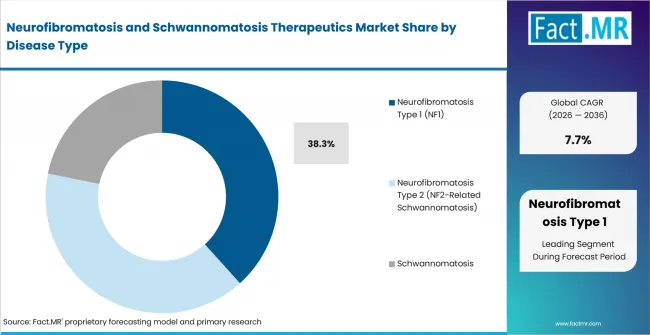
Neurofibromatosis And Schwannomatosis Therapeutics Market Analysis By Disease Type | Source: Fact.MR
The disease type categories are Neurofibromatosis Type 1 (NF1), Neurofibromatosis Type 2 (NF2-Related Schwannomatosis), and Schwannomatosis. NF1 leads because it is both the most common of the three disease groups, with an estimated global prevalence of roughly 1 in 2,700 to 3,500 individuals, and the only one with approved MEK inhibitors to build on, while NF2-related schwannomatosis, with an estimated prevalence near 1 in 50,000, and other schwannomatosis still depend mainly on surgery and symptom management.
Why does MEK Inhibitors lead Therapy Type?
MEK Inhibitors lead the Therapy Type segment at 25.0% of 2026 demand.
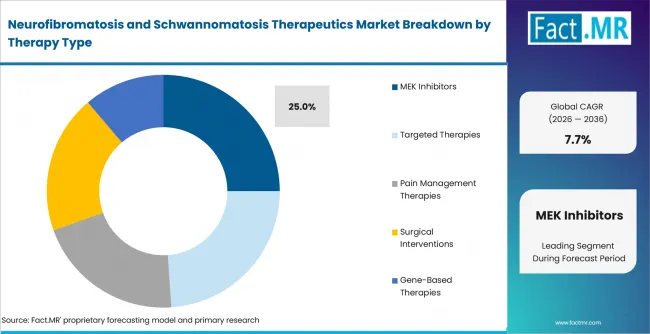
Neurofibromatosis And Schwannomatosis Therapeutics Market Analysis By Therapy Type | Source: Fact.MR
The therapy type categories are MEK Inhibitors, Targeted Therapies, Pain Management Therapies, Surgical Interventions, and Gene-Based Therapies. MEK inhibitors lead because they directly target the hyperactive RAS/MAPK signaling caused by neurofibromin loss in NF1, with selumetinib and mirdametinib both demonstrating measurable tumor-volume and pain reductions in controlled trials, though MEK inhibitors and other targeted therapies require ongoing toxicity monitoring that surgical intervention does not.
Why does First-Line Therapy lead Treatment Setting?
First-Line Therapy leads the Treatment Setting segment at 30.0% of 2026 demand.
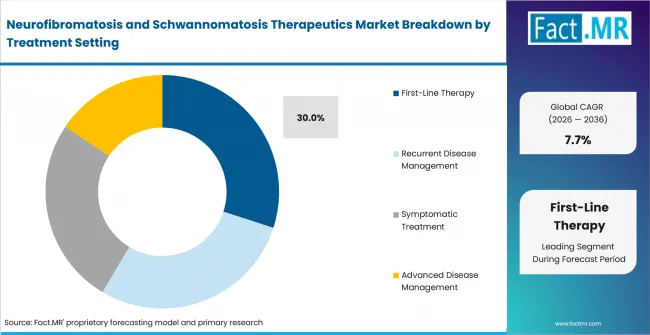
Neurofibromatosis And Schwannomatosis Therapeutics Market Analysis By Treatment Setting | Source: Fact.MR
The treatment setting categories are First-Line Therapy, Recurrent Disease Management, Symptomatic Treatment, and Advanced Disease Management. The central adoption barrier in this market, incomplete post-progression sequencing evidence, sits specifically at the boundary between first-line therapy and recurrent disease management, which is why that transition point carries more commercial weight than the first-line share alone suggests.
Why does Hospitals lead End User?
Hospitals lead the End User segment at 30.0% of 2026 demand.
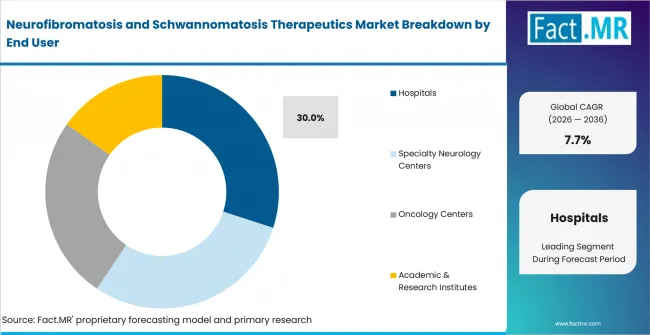
Neurofibromatosis And Schwannomatosis Therapeutics Market Analysis By End User | Source: Fact.MR
The end user categories are Hospitals, Specialty Neurology Centers, Oncology Centers, and Academic & Research Institutes. Hospitals currently hold only 30.0% of end-user demand despite carrying most chronic-monitoring responsibility; the Neurofibromatosis Clinical Trials Consortium, spanning institutions including Johns Hopkins, MGH, and NCI, illustrates how much of this market's evidence generation still runs through academic and specialty referral networks rather than hospitals alone.
What is accelerating Neurofibromatosis and Schwannomatosis Therapeutics Market adoption, and what is holding it back?
NF1, NF2-related schwannomatosis, and other schwannomatosis are already recognized as distinct diseases; the harder problem is building a separate, disease-appropriate evidence base for each rather than extending the NF1 MEK-inhibitor playbook by default. Funding follows centres and developers that can connect disease-specific evidence to the staff and monitoring infrastructure a chronic treatment requires.
Drivers Impact Analysis
| DRIVER | (~) % IMPACT ON CAGR | GEOGRAPHIC RELEVANCE | IMPACT TIMELINE |
|---|---|---|---|
| Dual MEK-pathway inhibitor approvals | +1.3% | USA and Germany | Short term (<= 2 years) |
| Pediatric-to-adult therapy expansion | +1.0% | USA and U.K. | Short term (<= 2 years) |
| Broadening MEK/mTOR/targeted/gene pipeline | +0.8% | Germany and USA | Medium term (2-4 years) |
| Harmonized surveillance and management guidance | +0.6% | Germany and U.K. | Medium term (2-4 years) |
| Standardized trial endpoints and registries | +0.5% | Brazil and global research networks | Long term (>= 4 years) |
Source: Fact.MR analysis. Updated Jul 21, 2026
- Dual MEK-pathway inhibitor approvals: FDA authorization of mirdametinib as a second MEK-pathway treatment alongside selumetinib expands competition around adult and pediatric NF1 plexiform neurofibromas.
- Pediatric-to-adult therapy expansion: Extending an established pediatric MEK inhibitor into adults enlarges the treatable population and raises long-term monitoring and sequencing questions.
- Broadening MEK/mTOR/targeted/gene pipeline: Active studies spanning MEK, mTOR, targeted, repurposed, and gene-directed approaches, including the INTUITT-NF2 brigatinib platform trial, give hospitals and academic centers a growing set of trial options.
Opportunity Impact Analysis
| OPPORTUNITY | (~) % IMPACT ON CAGR | GEOGRAPHIC RELEVANCE | IMPACT TIMELINE |
|---|---|---|---|
| NF2-related and other schwannomatosis-specific therapy development | +0.6% | Germany and Brazil | Medium term (2-4 years) |
| Gene-based therapy programmes | +0.5% | USA and Germany | Long term (>= 4 years) |
| Specialty neurology and oncology center expansion | +0.4% | South Korea and U.K. | Medium term (2-4 years) |
| AI-enabled drug discovery and repurposing partnerships | +0.3% | USA and global research networks | Long term (>= 4 years) |
Source: Fact.MR analysis. Updated Jul 21, 2026
- NF2-related and other schwannomatosis-specific therapy development: Because MEK inhibition has established its precedent mainly in NF1 plexiform neurofibromas, therapies tailored to NF2-related schwannomatosis, such as the repurposed kinase inhibitor brigatinib, represent the next open competitive space.
- Gene-based therapy programmes: Gene-Based Therapies remain a smaller slice of the Therapy Type segment today, leaving room for developers to convert early programmes into durable options.
- Specialty neurology and oncology center expansion: With Hospitals holding only 30.0% of End User demand, Specialty Neurology Centers and Oncology Centers have room to capture volume.
Restraints Impact Analysis
| RESTRAINT | (~) % IMPACT ON CAGR | GEOGRAPHIC RELEVANCE | IMPACT TIMELINE |
|---|---|---|---|
| Chronic-therapy adherence and long-term monitoring burden | -0.5% | South Korea and USA | Medium term (2-4 years) |
| Incomplete post-progression sequencing evidence | -0.4% | Global | Short term (<= 2 years) |
| Access and affordability constraints in mixed public-private systems | -0.3% | Brazil | Medium term (2-4 years) |
| Small, fragmented patient populations limiting trial and diagnostic scale | -0.3% | Japan and U.K. | Long term (>= 4 years) |
Source: Fact.MR analysis. Updated Jul 21, 2026
- Chronic-therapy adherence and long-term monitoring burden: NF1 and schwannomatosis therapies increasingly involve chronic treatment in children and adults with long exposure, straining patients and treatment centers.
- Incomplete post-progression sequencing evidence: The central adoption barrier is an incomplete pathway for long-term toxicity, resistance, surveillance, and treatment sequencing once a patient progresses beyond first-line MEK inhibition.
- Access and affordability constraints in mixed public-private systems: In markets with large, diverse patient populations and blended public-private delivery, affordability and regional capacity limit how quickly targeted therapies reach patients.
Which countries are scaling Neurofibromatosis and Schwannomatosis Therapeutics Market fastest?
A global growth rate represents the weighted average of all markets included in the analysis. Germany and Brazil remain above the 7.7% global figure, while South Korea, U.K. and Japan remain below it. The six countries presented are illustrative examples, and their comparison with the worldwide rate makes this difference visible.
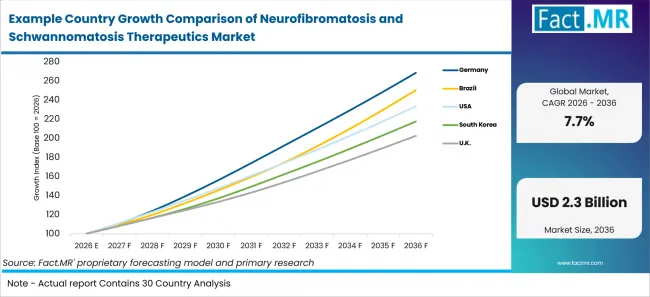
Example Country Growth Comparison Of Neurofibromatosis And Schwannomatosis Therapeutics Market | Source: Fact.MR
| COUNTRY | CAGR, 2026 to 2036 |
|---|---|
| Germany | 10.4% |
| Brazil | 9.6% |
| USA | 8.9% |
| South Korea | 8.1% |
| U.K. | 7.3% |
| Japan | 6.5% |
Source: Fact.MR analysis. Updated Jul 21, 2026
What shapes growth in Germany?
Germany: NF1-associated plexiform neurofibromas, NF2-related schwannomatosis, and other schwannomatosis as different diseases.
Germany is projected at 10.4% CAGR from 2026 to 2036, the fastest of the six countries tracked. Its university-hospital and laboratory base, aligned EU regulation, and specialist referral networks support parallel management of NF1, NF2-related schwannomatosis, and other schwannomatosis as genuinely different diseases, rather than a single uniform care pathway.
What shapes growth in Brazil?
Brazil: MEK inhibition, other targeted therapy, pain control, surgery, and gene-based development.
Brazil is projected at 9.6% CAGR from 2026 to 2036. A large, diverse patient population gives Brazil real scale, but its mixed public-private delivery system means affordability and regional specialist capacity, not the underlying science, will decide how quickly MEK inhibitors and other targeted therapies reach patients outside major centres.
What shapes growth in USA?
USA: tumor-volume response versus pain, hearing, function, appearance, and quality of life.
USA is projected at 8.9% CAGR from 2026 to 2036. Its dense concentration of clinical trials, specialised centres, and reimbursement experiments supports faster resolution of the tumor-volume-versus-quality-of-life question that increasingly shapes which candidates advance here.
What shapes growth in South Korea?
South Korea: chronic treatment in children and adults with long exposure and adherence requirements.
South Korea is projected at 8.1% CAGR from 2026 to 2036. Advanced digital infrastructure and high hospital concentration position South Korea well to track the long-term adherence and exposure data that chronic treatment in children and adults with NF1 and schwannomatosis requires.
What shapes growth in U.K.?
U.K.: first-line use, recurrent disease, symptomatic management, and advanced disease.
U.K. is projected at 7.3% CAGR from 2026 to 2036. Centralised NHS purchasing and genomic laboratory networks let the United Kingdom coordinate care consistently across first-line use, recurrent disease, symptomatic management, and advanced disease, rather than relying on individual hospitals to adopt independently.
What shapes growth in Japan?
Japan: multidisciplinary care involving neurology, oncology, surgery, audiology, pain, genetics, and rehabilitation.
Japan is projected at 6.5% CAGR from 2026 to 2036, the slowest of the six. Japan's specialist medicine and life-science base are strong, but coordinating the multidisciplinary care, neurology, oncology, surgery, audiology, pain, genetics, and rehabilitation, that NF1 and schwannomatosis patients need takes time to establish domestically before hospital pathways integrate a new treatment.
Who leads the Neurofibromatosis and Schwannomatosis Therapeutics Market?
This market is led by large pharmaceutical companies with approved MEK-inhibitor franchises, alongside biotechs pursuing earlier-stage targeted and gene-based approaches for NF2-related and other schwannomatosis. AstraZeneca markets selumetinib (Koselugo), the first FDA-approved NF1 therapy, while SpringWorks Therapeutics markets mirdametinib (GOMEKLI), approved in 2025 and identified through Children's Tumor Foundation-funded research before its transfer to SpringWorks. Pasithea Therapeutics is advancing PAS-004, an oral macrocyclic MEK1/2 inhibitor in ongoing clinical development for symptomatic plexiform neurofibromas, while Healx, Recursion Pharmaceuticals, NFlection Therapeutics, and Vivace Therapeutics represent earlier-stage targeted, repurposing, and gene-based development specifically aimed at the less-served NF2-related and other schwannomatosis populations.
Which companies are the key providers?
Seven developers with active neurofibromatosis or schwannomatosis programmes are tracked in this market, from companies with approved MEK-inhibitor products to smaller biotechs advancing earlier-stage targeted or gene-based candidates:
- AstraZeneca PLC
- SpringWorks Therapeutics, Inc.
- Pasithea Therapeutics Corp.
- Healx Ltd.
- Recursion Pharmaceuticals, Inc.
- NFlection Therapeutics, Inc.
- Vivace Therapeutics, Inc.
Bibliography
- Emerging Molecular Insights and Therapeutic Directions in Neurofibromatosis Type 1 and NF2-Related Schwannomatosis. International Journal of Molecular Sciences (MDPI), 2026.
- Children's Tumor Foundation. Our Impact: MEK inhibitor research and the INTUITT-NF2 platform trial.
- Weiss, B. D. et al. NF106: A Neurofibromatosis Clinical Trials Consortium Phase II Trial of the MEK Inhibitor Mirdametinib in Adolescents and Adults With NF1-Related Plexiform Neurofibromas. Journal of Clinical Oncology / PMC, 2021.
- Johns Hopkins Comprehensive Neurofibromatosis Center. Clinical Trials listing (MPNST, NF1, NF2).
- Plotkin, S. R. et al. Brigatinib in NF2-Related Schwannomatosis with Progressive Tumors. New England Journal of Medicine, 2024.
- Plotkin, S. R. & Blakeley, J. O. Expanding therapeutic options for people with NF2-related schwannomatosis: Encouraging results with brigatinib. Neuro-Oncology (Oxford Academic), 2024.
- NF2-Related Schwannomatosis (NF2): Molecular Insights and Therapeutic Avenues. PMC.
- A systematic review of targeted therapy for vestibular schwannoma in patients with NF2-related schwannomatosis. Neuro-Oncology Advances (PMC), 2023.
- Brigatinib causes tumor shrinkage in both NF2-deficient meningioma and schwannoma through inhibition of multiple tyrosine kinases but not ALK. PMC.
- U.S. Food and Drug Administration. FDA approves mirdametinib for neurofibromatosis type 1 symptomatic plexiform neurofibromas, 2025.
This Report Addresses
- The report provides strategic intelligence on the Neurofibromatosis and Schwannomatosis Therapeutics Market across Disease Type and Therapy Type choices that shape development decisions.
- Segment analysis covers Neurofibromatosis Type 1 (NF1) as the share leader within the 2026 market structure.
- Regional outlook evaluates Germany and Brazil alongside USA and South Korea, while U.K. and Japan complete the growth comparison.
- Competitive analysis profiles AstraZeneca and SpringWorks Therapeutics alongside Pasithea Therapeutics, followed by additional active providers.
- Use-case assessment covers the disease groups and treatment settings that shape adoption across the forecast period.
What does the Neurofibromatosis and Schwannomatosis Therapeutics Market cover?
Therapeutics for NF1-associated plexiform neurofibromas, NF2-related schwannomatosis, and other schwannomatosis are used across hospitals, specialty neurology centers, and academic research institutes.
The Neurofibromatosis and Schwannomatosis Therapeutics Market covers MEK inhibitors, other targeted therapies, pain management therapies, surgical interventions, and gene-based therapies across three genetically distinct tumor-predisposition syndromes: Neurofibromatosis Type 1, caused by NF1 gene variants affecting neurofibromin; NF2-related schwannomatosis, caused by NF2 gene variants affecting the merlin tumor suppressor; and other schwannomatosis. Coverage includes both FDA-approved MEK-inhibitor products and earlier-stage repurposed, targeted, and gene-based candidates.
The market differs from the broader neuro-oncology and rare-disease therapeutics sector because commercial value here comes specifically from therapies addressing the tumor-predisposition biology of these three syndromes, not general nervous-system tumor treatment. General neurosurgical oncology unrelated to NF1/NF2/schwannomatosis biology and broad-spectrum pain management not specific to these conditions remain outside the boundary.
What is included in the scope?
Included are the disease groups, therapy types, and treatment settings that define this rare-disease therapeutics category.
The scope includes Disease Type, Therapy Type, Treatment Setting, and End User, the recorded country growth estimates, the company set where available, recent non-commercial evidence on MEK-pathway and merlin-pathway biology, FDA approval and clinical-trial documentation, and long-term development considerations such as chronic-adherence and post-progression sequencing evidence.
What is excluded from the scope?
General neuro-oncology treatment and broad-spectrum pain management unrelated to NF1, NF2, or schwannomatosis biology remain outside the scope of this market.
Excluded are general neurosurgical oncology procedures and nervous-system tumor treatments not specific to NF1, NF2-related schwannomatosis, or other schwannomatosis biology, broad-spectrum pain management therapies without a disease-specific indication, and claims that cannot be tied to a current named academic, clinical, or regulatory source.
How Was the Analysis Built?
The analysis draws on peer-reviewed clinical-trial literature, FDA approval documentation, and nonprofit research-foundation reporting.
- Primary evidence base: peer-reviewed Phase II/III trial data for selumetinib, mirdametinib, and brigatinib from PMC, JCO, and NEJM, cross-checked against FDA approval notifications.
- Desk research: Children's Tumor Foundation research-impact reporting and Johns Hopkins Comprehensive Neurofibromatosis Center trial listings. Every source used is documented in the bibliography.
- Market sizing and forecasting: estimates combine segment taxonomy, country-level growth indicators, and disease-type prevalence mix across the 2025, 2026 and 2036 reference years.
- Data validation and update cycle: findings are validated by comparing primary academic literature with FDA regulatory updates and clinical-trial registry activity.
Segmentation
What is the report's scope and coverage?
| Attribute | Details |
|---|---|
| 2025 Market Size | USD 1.0 billion |
| 2026 Market Size | USD 1.1 billion |
| 2036 Market Size | USD 2.3 billion |
| Forecast CAGR | 7.7% |
| Forecast Period | 2026-2036 |
| Segmentation | Disease Type, Therapy Type, Treatment Setting, End User |
| Countries Analyzed | Germany, Brazil, USA, South Korea, U.K., Japan + 30 countries |
| Company Coverage | AstraZeneca PLC, SpringWorks Therapeutics, Inc., Pasithea Therapeutics Corp., Healx Ltd., Recursion Pharmaceuticals, Inc., NFlection Therapeutics, Inc., Vivace Therapeutics, Inc. |
Source: Fact.MR analysis. Updated Jul 21, 2026
How is the market segmented?
-
By Disease Type:
- Neurofibromatosis Type 1 (NF1) - 38.3% in 2026
- Neurofibromatosis Type 2 (NF2-Related Schwannomatosis)
- Schwannomatosis
-
By Therapy Type:
- MEK Inhibitors - 25.0% in 2026
- Targeted Therapies
- Pain Management Therapies
- Surgical Interventions
- Gene-Based Therapies
-
By Treatment Setting:
- First-Line Therapy - 30.0% in 2026
- Recurrent Disease Management
- Symptomatic Treatment
- Advanced Disease Management
-
By End User:
- Hospitals - 30.0% in 2026
- Specialty Neurology Centers
- Oncology Centers
- Academic & Research Institutes
-
By Region:
- North America
- Latin America
- Western Europe
- Eastern Europe
- East Asia
- South Asia and Pacific
- Middle East and Africa
Frequently Asked Questions
What exactly is included in the Neurofibromatosis and Schwannomatosis Therapeutics Market?
What is the 2026 market size and 2036 outlook?
Why does Neurofibromatosis Type 1 (NF1) lead Disease Type?
Why does MEK Inhibitors lead Therapy Type?
What is the central adoption barrier?
Why is Germany the fastest-growing country in this set?
How should evidence be shown to transfer beyond one treatment center?
Who worked on this report


Preview the report firsthand - request a free sample
Free SampleGet the brochure for pricing and purchase details
Download PDF