- Base Value(2025): 0.26 Bn
- Estimated Value(2026): 0.32 Bn
- Forecast Value (2036): 1.28 Bn
- CAGR (2026 - 2036): 15.0%
Structural Battery Pack Systems for Electric SUVs Market Size, Share and Forecast By Fact.MR
- In 2025, the structural battery pack systems for electric SUVs market was valued at USD 0.26 billion.
- Fact MR analysis indicates demand for structural battery pack systems for electric SUVs is expected to reach USD 0.32 billion in 2026 and USD 1.28 billion by 2036.
- FMR estimates the market will expand at a CAGR of 15.0% across the forecast period.
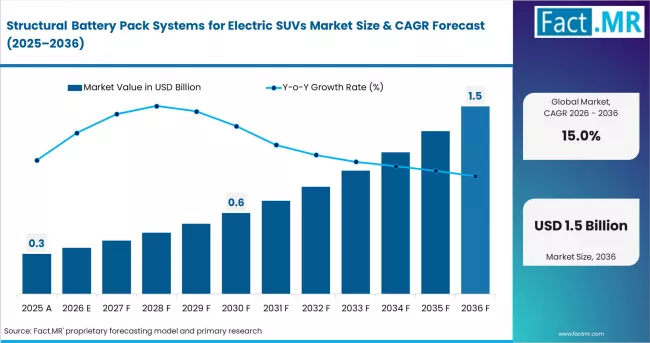
Structural Battery Pack Systems For Electric Suvs Market Market Value Analysis | Source: Fact.MR
Structural Battery Pack Systems for Electric SUVs Market
| Metric | Details |
|---|---|
| Industry Size (2026E) | USD 0.32 billion |
| Industry Value (2036F) | USD 1.28 billion |
| CAGR (2026 to 2036) | 15.0% |
Source: Fact.MR analysis. Updated May 8, 2026
Summary of Structural Battery Pack Systems for Electric SUVs Market
- Market Definition
- The structural battery pack systems for electric SUVs market refers to integrated battery architectures designed to function as both energy storage units and load-bearing structural components within electric sport utility vehicle platforms. These systems incorporate cell-to-pack and cell-to-chassis configurations that improve vehicle rigidity, reduce structural weight, and optimize packaging efficiency within electric SUV platforms.
- Demand Drivers
- Increasing demand for lightweight vehicle architecture supporting improved driving range and structural efficiency in electric SUVs.
- Rising adoption of cell-to-pack and cell-to-chassis battery configurations reducing redundant structural components.
- Expansion of electric SUV production requiring optimized chassis stiffness and improved weight distribution.
- Growing focus on improving vehicle crash performance through integrated structural battery housing design.
- Increasing use of high-strength composite materials supporting load-bearing battery enclosure capability.
- Key Segments Analyzed
- Battery Chemistry: Lithium-ion leads with 64.5% share supported by high energy density and structural integration compatibility.
- Vehicle Type: Mid-size electric SUVs account for 41.3% share supported by balanced vehicle size and battery capacity requirements.
- Component: Cell-to-pack structures and battery housing systems demonstrate strong adoption due to packaging efficiency advantages.
- Application: Structural floor battery packs show increased integration supported by improved center of gravity optimization.
- Geography: China and South Korea show strong growth supported by expansion of electric vehicle manufacturing ecosystems.
- Analyst Opinion at Fact MR
- Shambhu Nath Jha, Principal Consultant at Fact MR, states, "Structural battery integration represents a key engineering transition in electric SUV design as manufacturers seek to improve rigidity, reduce weight, and optimize energy efficiency. Suppliers capable of improving structural durability and compatibility with vehicle crash requirements will maintain strong positioning as EV platform architectures evolve."
- Strategic Implications
- Expand development of cell-to-chassis battery integration technologies supporting vehicle weight reduction.
- Improve structural durability performance supporting crash validation and mechanical stability requirements.
- Strengthen collaboration between battery manufacturers and EV platform engineers supporting integrated architecture development.
- Support modular structural battery design enabling scalability across multiple electric SUV platforms.
- Methodology
- Based on primary interviews with electric vehicle OEM engineers, battery system manufacturers, and structural design specialists.
- Supported by review of EV architecture studies, battery integration research, and supplier technical documentation.
- Market estimation uses hybrid modeling combining supplier revenue benchmarking with evaluation of electric SUV production trends.
- Data validation conducted using technical literature and expert consultation inputs.
The increase from USD 0.32 billion in 2026 to USD 1.28 billion in 2036 represents an absolute dollar opportunity of USD 0.96 billion, indicating structural scaling of battery pack integration within vehicle chassis architecture. Growth is supported by weight optimization and range efficiency targets, while constrained by crash validation costs, manufacturing redesign complexity, and material cost sensitivity across EV platforms.
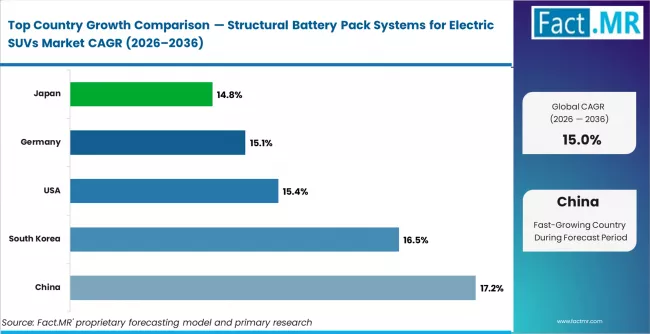
China records the fastest growth at 17.2%, supported by increasing integration of load-bearing battery architectures in electric sport utility vehicle platforms. South Korea follows at 16.5%, driven by development of high-strength structural cell packaging technologies for electric mobility applications. The USA shows 15.4% growth, linked to adoption of structural battery designs that optimize vehicle weight distribution and rigidity. Germany at 15.1% and Japan at 14.8% represent mature markets where demand is largely replacement-driven due to established electric vehicle engineering ecosystems. A structural constraint across mature markets is complex crash validation requirements, which extend product qualification timelines for structural battery integration systems.
Segmental Analysis
Structural Battery Pack Systems for Electric SUVs Market Analysis by Battery Chemistry
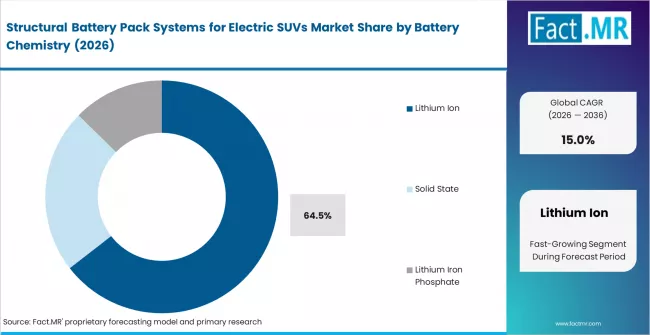
Structural Battery Pack Systems For Electric Suvs Market Analysis By Battery Chemistry | Source: Fact.MR
- Market Overview: Lithium-ion battery chemistry is projected to hold 64.5% share of the structural battery pack systems for electric SUVs market in 2026. Demand concentration reflects high energy density characteristics and structural integration capability enabling battery packs to function as load-bearing components within vehicle chassis architectures. Lithium-ion cell configurations support integration within structural enclosures designed to enhance vehicle rigidity and optimize space utilization across electric SUV platforms.
- Demand Drivers:
- Energy Density Requirements: Lithium-ion chemistry provides favorable gravimetric and volumetric energy capacity supporting extended driving range across electric SUV vehicle platforms.
- Structural Integration Capability: Battery pack architectures are engineered to contribute to chassis stiffness while maintaining protection of electrochemical cells within reinforced enclosure systems.
- Manufacturing Compatibility: Automotive manufacturers deploy lithium-ion battery modules compatible with established battery management systems used across electric vehicle production environments.
Structural Battery Pack Systems for Electric SUVs Market Analysis by Vehicle Type
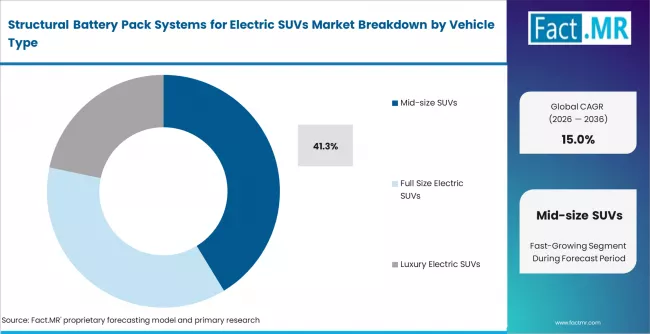
Structural Battery Pack Systems For Electric Suvs Market Analysis By Vehicle Type | Source: Fact.MR
- Market Overview: Mid-size SUVs are estimated to account for 41.3% share in 2026, supported by consumer demand for electric sport utility vehicles balancing interior space requirements and vehicle performance characteristics. Vehicle platform architecture accommodates structural battery pack integration within floor assemblies designed to optimize center of gravity and cabin space utilization.
- Demand Drivers:
- Vehicle Platform Adaptability: Mid-size SUV designs provide sufficient chassis volume to integrate structural battery packs without compromising passenger or cargo space requirements.
- Driving Range Considerations: Structural battery integration supports increased battery capacity within vehicle architecture designed to support extended driving distance performance targets.
- Production Scalability: Automotive manufacturers prioritize mid-size SUV platforms for electric vehicle expansion due to balanced cost structure and market demand characteristics.
Key Dynamics
Structural Battery Pack Systems for Electric SUVs Market Drivers, Restraints, and Opportunities
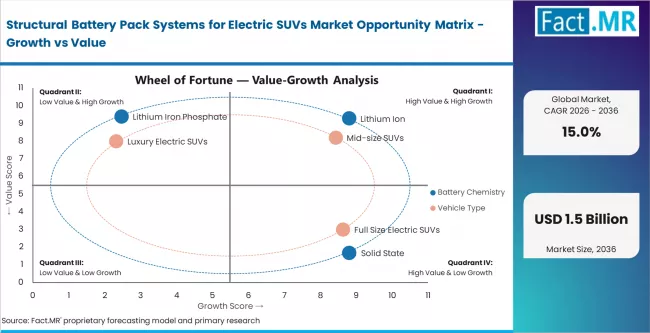
Structural Battery Pack Systems For Electric Suvs Market Opportunity Matrix Growth Vs Value | Source: Fact.MR
Fact MR analysis indicates the market reflects an emerging advanced vehicle architecture segment transitioning from modular battery enclosures toward load-bearing energy storage structures integrated into the chassis floor of electric SUVs. Market size exists because battery packs represent the heaviest component in electric vehicles, often accounting for a substantial share of vehicle mass and cost, creating engineering pressure to improve structural efficiency and range performance. Structural battery pack concepts such as cell-to-pack, cell-to-body, and cell-to-chassis architectures reduce redundant structural elements and improve stiffness while optimizing packaging space for larger SUV platforms.
Current dynamics show declining reliance on modular battery housings that increase weight and manufacturing complexity, while structural pack architectures command higher per-unit pricing due to advanced adhesives, thermal management systems, and crash-resistant housing materials. Structural integration improves torsional rigidity and reduces vehicle mass, enabling improved driving range despite relatively higher engineering and validation costs. Electric SUVs represent a key adoption segment because larger vehicle footprints allow integration of large-format battery packs designed to function as both energy storage and structural support elements.
- Cell-to-Chassis Transition: Structural battery architectures including cell-to-pack and cell-to-body eliminate intermediate modules, improving energy density and reducing system weight per vehicle platform.
- EV Platform Scaling: China, Europe, and North America electric SUV production growth supports adoption of integrated battery structures that improve driving range and vehicle stiffness in high-mass vehicle segments.
- Lightweight Engineering Shift: Structural battery composites combine load-bearing materials with energy storage capability, reducing redundant structural components and improving overall vehicle efficiency.
Regional Analysis
The structural battery pack systems for electric SUVs market is assessed across Asia Pacific, Europe, and North America, segmented by country-level demand for load-bearing battery enclosures, cell-to-pack architectures, integrated chassis battery systems, and lightweight structural energy storage solutions used in electric sport utility vehicles. Geographic variation reflects electric vehicle platform innovation, battery integration engineering capability, and automotive lightweighting strategies. The full report offers market attractiveness analysis.
.webp "Top Country Growth Comparison Structural Battery Pack Systems For Electric Suvs Market Cagr (2026 2036)")
Top Country Growth Comparison Structural Battery Pack Systems For Electric Suvs Market Cagr (2026 2036) | Source: Fact.MR
| Country | CAGR (2026–2036) |
|---|---|
| China | 17.2% |
| South Korea | 16.5% |
| USA | 15.4% |
| Germany | 15.1% |
| Japan | 14.8% |
Source: Fact.MR analysis. Updated May 8, 2026
Source: Fact MR analysis, based on proprietary forecasting model and primary research
Structural Battery Pack Systems For Electric Suvs Market Cagr Analysis By Country | Source: Fact.MR
Asia Pacific
Asia Pacific functions as the electric vehicle structural battery innovation hub supported by strong battery manufacturing capacity and increasing integration of cell-to-pack vehicle architectures. CATL strengthens structural battery engineering capability. LG Energy Solution expands integrated battery module portfolio depth. Panasonic Energy Co., Ltd. supports lightweight battery enclosure innovation.
- China: China is projected to record 17.2% CAGR in structural battery pack systems for electric SUVs through 2036. New Energy Vehicle Development Plan update (Ministry of Industry and Information Technology, January 2023) supports structural battery integration technologies. CATL expanded cell-to-pack battery production capability (June 2023).
- South Korea: South Korea is expected to observe 16.5% CAGR in structural battery pack systems for electric SUVs through 2036. K Battery Strategy update (Ministry of Trade, Industry and Energy, February 2023) supports advanced battery architecture development. LG Energy Solution expanded structural battery module research capability (May 2023).
- Japan: Japan is anticipated to expand at 14.8% CAGR in structural battery pack systems for electric SUVs through 2036. Green Growth Strategy update (Ministry of Economy, Trade and Industry, March 2023) supports next generation battery integration innovation. Panasonic Energy Co., Ltd. expanded structural battery enclosure engineering capability (April 2023).
North America
Structural Battery Pack Systems For Electric Suvs Market Country Value Analysis | Source: Fact.MR
North America operates as the electric SUV battery commercialization center supported by strong demand for high energy density vehicle platforms and integrated structural battery solutions. Tesla Inc. strengthens structural battery architecture capability. General Motors Company expands cell-to-pack platform development expertise. QuantumScape Corporation supports next generation battery structure innovation.
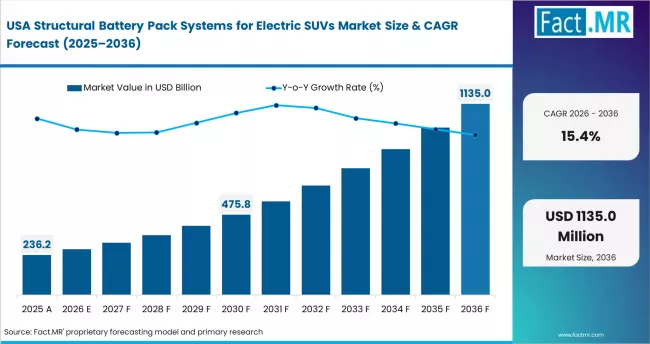
- USA: The USA is forecast to grow at 15.4% CAGR in structural battery pack systems for electric SUVs through 2036. Inflation Reduction Act battery manufacturing incentive update (U.S. Department of Energy, January 2023) supports structural battery technology investment. Tesla Inc. expanded structural battery pack production capability (August 2023).
Europe
Structural Battery Pack Systems For Electric Suvs Market Europe Country Market Share Analysis, 2026 & 2036 | Source: Fact.MR
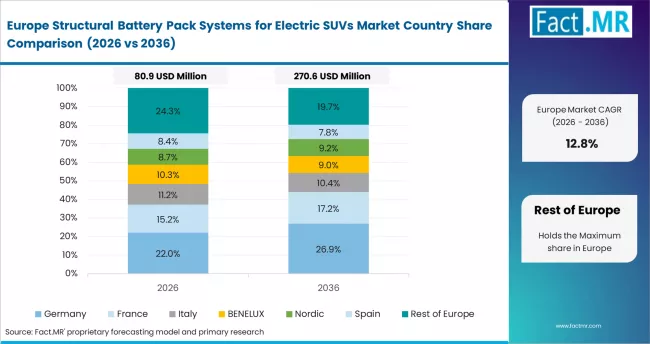
Europe functions as the electric vehicle engineering laboratory supported by strict vehicle efficiency targets and increasing adoption of lightweight structural battery integration technologies. BMW Group strengthens integrated battery chassis engineering capability. Volkswagen Group expands cell-to-pack platform portfolio depth. BASF SE supports battery material innovation.
- Germany: Germany is projected to register 15.1% CAGR in structural battery pack systems for electric SUVs through 2036. EU Battery Regulation update (European Commission, January 2023) supports advanced battery integration development. Volkswagen Group expanded structural battery platform engineering capability (July 2023).
Fact MR's analysis of structural battery pack systems for electric SUVs market in global regions consists of country-wise assessment that includes China, South Korea, USA, Germany, and Japan. Readers can find structural battery technology trends, electric vehicle platform developments, regulatory positioning frameworks, and competitive battery engineering innovation insights.
Competitive Landscape
What is the Competitive Structure of the Structural Battery Pack Systems for Electric SUVs Market?
Structural Battery Pack Systems For Electric Suvs Market Analysis By Company | Source: Fact.MR
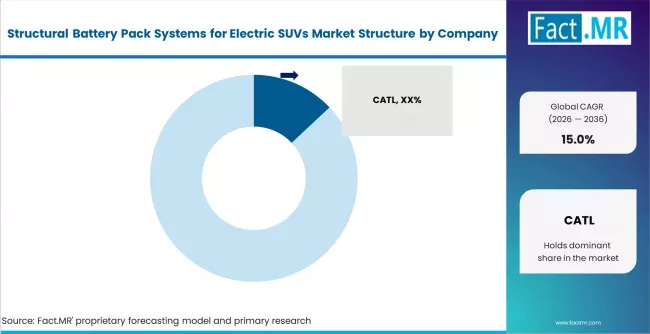
The Structural Battery Pack Systems for Electric SUVs Market demonstrates a moderately concentrated competitive structure, supported by global battery manufacturers and electric vehicle technology developers with expertise in cell-to-pack and structural integration engineering. Leading companies including CATL, BYD, LG Energy Solution, Panasonic, Samsung SDI, SK On, Northvolt, AESC, ProLogium, and Tesla collectively account for nearly 65–75% of global market share, particularly in high-strength battery architectures designed to function as load-bearing vehicle structures. Competitive positioning is primarily determined by energy density, structural rigidity, thermal stability, and crash performance compatibility with vehicle chassis design. High capital investment in cell chemistry optimization and pack integration technology creates entry barriers, reinforcing the presence of established battery manufacturers with advanced engineering capabilities.
Structural advantages are observed among companies possessing integrated battery cell production and pack assembly infrastructure supporting optimized mechanical performance and thermal management characteristics. CATL and BYD benefit from strong manufacturing scale and established partnerships with electric vehicle manufacturers developing platform-specific structural battery architectures. Buyers typically manage supplier dependency through long-term supply agreements and validation of battery safety performance across multiple suppliers. Procurement decisions often consider structural integrity, thermal runaway resistance, and compatibility with vehicle platform engineering requirements. Pricing power remains relatively balanced, though suppliers retain moderate leverage where proprietary cell-to-pack integration methods and validated safety performance create switching constraints for automotive manufacturers implementing structural battery designs.
Key Players of the Structural Battery Pack Systems for Electric SUVs Market
- CATL
- BYD
- LG Energy Solution
- Panasonic
- Samsung SDI
- Tesla
- SK On
- Northvolt
- AESC
- ProLogium
Structural Battery Pack Systems for Electric SUVs Market Key Segments
-
Component:
- Cell to Pack Structures
- Cell to Chassis Structures
- Battery Housing Structures
- Thermal Management Structures
- Battery Management System Integration
-
Battery Chemistry:
- Lithium Ion
- Solid State
- Lithium Iron Phosphate
- Nickel Manganese Cobalt
-
Vehicle Type:
- Mid Size Electric SUVs
- Full Size Electric SUVs
- Luxury Electric SUVs
-
Application:
- Structural Floor Battery Packs
- Structural Frame Battery Packs
- Integrated Crash Protection Battery Packs
- Lightweight Structural Battery Modules
-
Region:
- North America
- USA
- Canada
- Mexico
- Europe
- Germany
- UK
- France
- Italy
- Spain
- Nordic Countries
- BENELUX
- Rest of Europe
- Asia Pacific
- China
- Japan
- South Korea
- India
- Australia
- Rest of Asia Pacific
- Latin America
- Brazil
- Argentina
- Rest of Latin America
- Middle East and Africa
- Kingdom of Saudi Arabia
- United Arab Emirates
- South Africa
- Rest of Middle East and Africa
- Other Regions
- Oceania
- Central Asia
- Other Markets
- North America
Bibliographies
- [1] Ministry of Industry and Information Technology (MIIT), China. (2023). New Energy Vehicle (NEV) Policy and Emission Standards (2023 Update).
- [2] U.S. Department of the Treasury. (2023, November). Treasury Releases Proposed Guidance on Inflation Reduction Act Clean Vehicle Tax Credits.
- [3] European Commission. (2023, July). Regulation (EU) 2023/1542 on batteries and waste batteries.
- [4] Ministry of Trade, Industry and Energy (MOTIE), South Korea. (2025, November). K-Battery to Power Korea's Future Industries (K-Battery Strategy Update).
- [5] Ministry of Economy, Trade and Industry (METI), Japan. (2023, July). GX Promotion Strategy (Green Growth Strategy Update).
- [6] U.S. Department of Energy. (2023). 2023 Critical Materials Assessment (Battery Supply Chain).
- [7] TÜV Rheinland. (2023, August). EU New Battery Regulation (EU) 2023/1542.
- [8] Fraunhofer ISI. (2024). Benchmarking International Battery Policies (K-Battery Strategy).
This Report Addresses
- Market size estimation and revenue forecast for 2026 to 2036 supported by electric SUV production benchmarks and structural battery integration data.
- Growth opportunity evaluation across cell to pack, cell to chassis, battery housing, thermal management, and battery management integration structures.
- Segment level demand assessment covering lithium ion, solid state, lithium iron phosphate, and nickel manganese cobalt chemistries.
- Regional adoption analysis identifying demand trends across Asia Pacific, Europe, and North America electric vehicle platforms.
- Competitive benchmarking covering battery manufacturers specializing in structural pack engineering and chassis integrated energy storage architectures.
- Technology evaluation assessing rigidity performance, crash load distribution capability, lightweight structural design, and integration validation requirements.
- Supply chain assessment identifying concentration risks in battery cells, structural materials, bonding technologies, and qualification cycles.
- Deliverables including PDF report, Excel dataset, presentation slides, and forecast models supporting vehicle platform and battery architecture strategy.
Structural Battery Pack Systems for Electric SUVs Market Definition
The structural battery pack systems for electric SUVs market refers to integrated battery architectures designed to function as both energy storage units and load-bearing structural components within electric sport utility vehicles. These systems improve vehicle rigidity, reduce weight, and optimize space utilization by embedding battery cells directly into the chassis or body structure.
Structural Battery Pack Systems for Electric SUVs Marketnclusions
The report covers global and regional market size estimation and forecast outlook across the defined period. It includes segmentation by architecture type such as cell-to-pack, cell-to-body, and cell-to-chassis configurations, along with applications in electric SUVs and crossover vehicles. Analysis includes supply chain structure, component integration, manufacturing approaches, and cost optimization trends.
Structural Battery Pack Systems for Electric SUVs Market Exclusions
The scope excludes conventional battery packs that function only as energy storage without structural load-bearing capability. Battery cells, cathode materials, and battery management software sold independently of structural integration are not included. Hybrid vehicle battery modules and removable battery systems are excluded, focusing strictly on integrated structural battery pack systems used in electric SUV platforms.
Structural Battery Pack Systems for Electric SUVs MarketResearch Methodology
- Primary Research:Interviews were conducted with electric vehicle OEMs, battery pack manufacturers, structural composite developers, and automotive platform engineers involved in integrated EV architecture development.
- Desk Research:Technical journals, EV battery architecture studies, automotive engineering publications, and supplier product documentation were reviewed to assess structural integration trends and material design approaches.
- Market-Sizing and Forecasting:A hybrid model combining bottom-up analysis of battery system supplier revenues and top-down evaluation of electric SUV production volumes was applied to estimate market size and growth outlook.
- Data Validation and Update Cycle:Findings were validated using technical literature, supplier capability data, and expert consultation. Periodic updates reflect developments in cell-to-chassis engineering, lightweight composite materials, and evolving EV platform architectures.
Segmentation
Report Scope
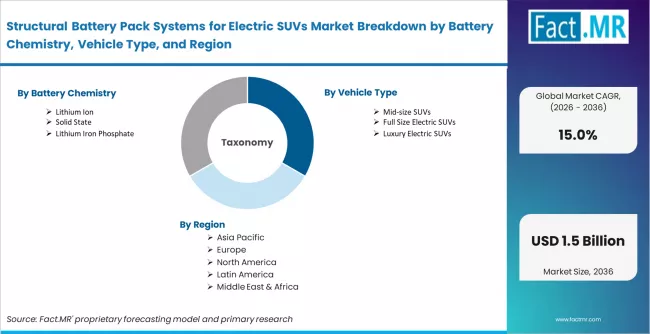
Structural Battery Pack Systems For Electric Suvs Market Breakdown By Battery Chemistry, Vehicle Type, And Region | Source: Fact.MR
| Metric | Value |
|---|---|
| Quantitative Units | USD 0.32 billion (2026) to USD 1.28 billion (2036), at a CAGR of 15.0% |
| Market Definition | The structural battery pack systems for electric SUVs market includes integrated battery architectures designed to function as load-bearing structural elements within vehicle chassis platforms. These systems combine energy storage capability with structural reinforcement to improve vehicle rigidity, reduce weight, optimize packaging efficiency, and enhance crash performance across electric sport utility vehicle platforms. |
| Component Segmentation | Cell-to-pack structures, Cell-to-chassis structures, Battery housing structures, Thermal management structures, Battery management system integration |
| Battery Chemistry Segmentation | Lithium-ion, Solid-state, Lithium iron phosphate, Nickel manganese cobalt |
| Vehicle Type Segmentation | Mid-size electric SUVs, Full-size electric SUVs, Luxury electric SUVs |
| Application Segmentation | Structural floor battery packs, Structural frame battery packs, Integrated crash protection battery packs, Lightweight structural battery modules |
| Regions Covered | North America, Latin America, Europe, East Asia, South Asia, Oceania, Middle East and Africa |
| Countries Covered | United States, Canada, Mexico, Brazil, Argentina, Germany, France, United Kingdom, Italy, Spain, China, India, Japan, South Korea, Indonesia, Australia, and 40+ countries |
| Key Companies Profiled | CATL, BYD, LG Energy Solution, Panasonic, Samsung SDI, Tesla, SK On, Northvolt, AESC, ProLogium |
| Forecast Period | 2026 to 2036 |
| Approach | Hybrid top-down and bottom-up market estimation validated through primary interviews with battery cell manufacturers, electric vehicle OEM engineers, structural design specialists, and battery system integrators, supported by electric vehicle production benchmarking, battery architecture technology assessment, and evaluation of adoption trends across structural energy storage integration platforms |
Source: Fact.MR analysis. Updated May 8, 2026
Frequently Asked Questions
How large is the demand for Structural Battery Pack Systems for Electric SUVs in the global market in 2026?
What will be the market size of Structural Battery Pack Systems for Electric SUVs in the global market by 2036?
What is the expected demand growth for Structural Battery Pack Systems for Electric SUVs in the global market between 2026 and 2036?
Which Battery Chemistry is poised to lead global demand by 2026?
What is Driving Structural Battery Pack System Demand in China?
What is the China Growth Outlook in this Report?
What is Driving Structural Battery Pack System Demand in South Korea?
What is the South Korea Growth Outlook in this Report?
What is Driving Structural Battery Pack System Demand in the United States?
What is the United States Growth Outlook in this Report?
What is Driving Structural Battery Pack System Demand in Germany?
What is the Germany Growth Outlook in this Report?
Does the Report Cover Japan in its Regional Analysis?
What is the Japan Growth Outlook in this Report?
Which Companies are Identified as Leading Participants in the Structural Battery Pack Systems for Electric SUVs Market?
What are Structural Battery Pack Systems for Electric SUVs and What are They Mainly Used For?
What does Structural Battery Pack Systems for Electric SUVs Market Mean in this Report?
What is Included in the Scope of this Structural Battery Pack Systems for Electric SUVs Market Report?
What is Excluded from the Scope of this Report?
What does Market Forecast Mean on this Page?
How is the Structural Battery Pack Systems for Electric SUVs Market Forecast Developed in this Report?
What does Data Validation Approach Mean in this Report?
Who worked on this report


Preview the report firsthand - request a free sample
Free SampleGet the brochure for pricing and purchase details
Download PDF