Non-Metal Antifreeze and Coolant Formulations Market
Non-Metal Antifreeze and Coolant Formulations Market Size and Share Forecast Outlook 2026 to 2036
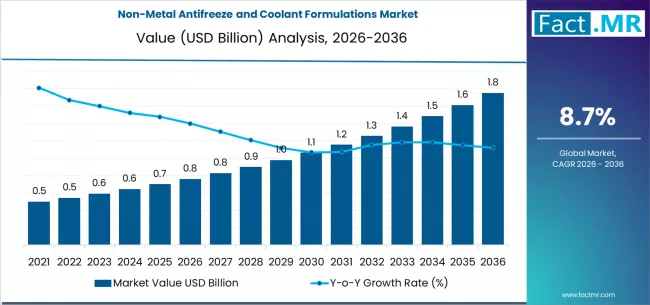
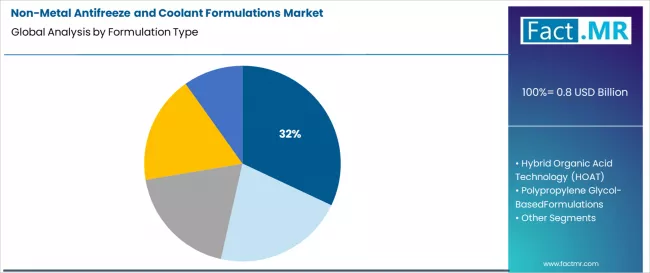
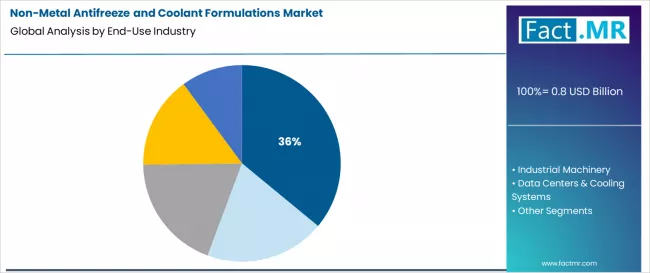
Non-metal antifreeze and coolant formulations market is projected to grow from USD 0.8 billion in 2026 to USD 1.8 billion by 2036, at a CAGR of 8.7%. Organic Acid Technology (OAT) will dominate with a 32.0% market share, while automotive & ev will lead the end-use industry segment with a 36.0% share.
Non-Metal Antifreeze and Coolant Formulations Market Forecast and Outlook 2026 to 2036
Expected to rise from USD 0.76 billion in 2026 to USD 1.75 billion by 2036, the market for non-metal antifreeze and coolant formulations is progressing at a CAGR of 8.7%. This growth signifies a pivotal shift in thermal management chemistry, moving away from traditional silicate and phosphate-based inhibitors toward advanced organic technologies that eliminate metal corrosion at the source. The evolution is driven by demands for longer service life, enhanced compatibility with modern engine materials, and a reduced environmental footprint across cooling applications.
Key Takeaways from the Non-Metal Antifreeze and Coolant Formulations Market
- Market Value for 2026: USD 0.76 Billion
- Market Value for 2036: USD 1.75 Billion
- Forecast CAGR (2026-2036): 8.7%
- Leading Formulation Type Share (2026): Organic Acid Technology (OAT) (32%)
- Leading End-Use Industry Share (2026): Automotive & EV (36%)
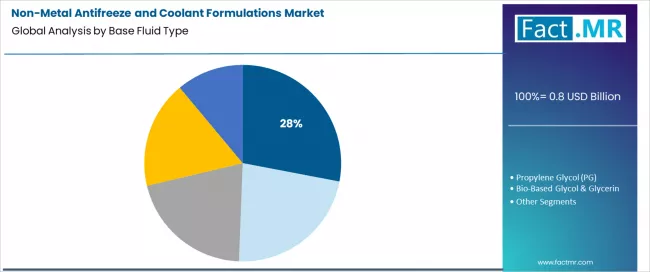
- Leading Base Fluid Type Share (2026): Ethylene Glycol (EG) (28%)
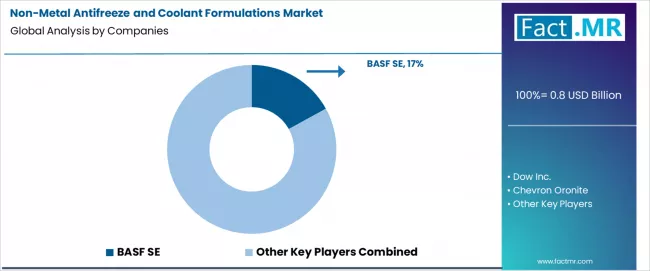
- Key Players in the Market: BASF SE, Dow Inc., Chevron Oronite, Shell Chemicals, TotalEnergies

Organic Acid Technology (OAT) formulations command the largest segment share at 32%, establishing the benchmark for extended-life, metal-free protection. The automotive and electric vehicle sector is the dominant end-user, driving 36% of demand, as thermal system complexity and longevity requirements intensify. Ethylene glycol remains the prevalent base fluid, holding a 28% share, due to its superior heat transfer properties, though its position is increasingly challenged by alternatives in specific niche applications.
Market expansion is closely linked to the global push for higher efficiency and durability in thermal systems. Non-metal formulations prevent scale and corrosion without depositing silicate gels, which is critical for protecting aluminum components prevalent in modern engines and cooling systems. The transition supports extended drain intervals, reduces maintenance downtime for industrial equipment, and aligns with sustainability goals by improving system longevity and enabling the use of less toxic base fluids.
Metric
| Metric | Value |
|---|---|
| Market Value (2026) | USD 0.76 Billion |
| Market Forecast Value (2036) | USD 1.75 Billion |
| Forecast CAGR (2026-2036) | 8.7% |
Category
| Category | Segments |
|---|---|
| Formulation Type | Organic Acid Technology (OAT), Hybrid Organic Acid Technology (HOAT), Polypropylene Glycol-Based Formulations, Bio-Based & Glycerin Coolants, Other Metal-Free Coolant Systems |
| End-Use Industry | Automotive & EV, Industrial Machinery, Data Centers & Cooling Systems, HVAC and Refrigeration, Marine & Aerospace |
| Base Fluid Type | Ethylene Glycol (EG), Propylene Glycol (PG), Bio-Based Glycol & Glycerin, Water-Blended Advanced Coolants, Other Specialty Metal-Free Fluids |
| Region | North America, Latin America, Western Europe, Eastern Europe, East Asia, South Asia & Pacific, MEA |
Segmental Analysis
By Formulation Type, Which Technology Defines Modern Long-Life Coolants?

Organic Acid Technology (OAT) leads with a 32% share. OAT coolants utilize carboxylic acids as corrosion inhibitors, forming a protective monolayer on metal surfaces without depositing abrasive or insulating scale. This chemistry enables significantly extended service intervals often exceeding 5 years or 200,000 kilometers in automotive applications. Its effectiveness across a wide temperature range and compatibility with aluminum, plastics, and elastomers make it the foundational technology for modern, low-maintenance cooling systems.
By End-Use Industry, Where are Performance Demands Most Stringent?

The automotive and electric vehicle industry is the primary consumer, accounting for 36% of the market. In internal combustion engines, the prevalence of aluminum blocks and heads necessitates superior corrosion protection. For electric vehicles, battery thermal management systems and power electronics cooling require precise viscosity, high dielectric strength, and exceptional material compatibility, driving demand for specialized non-metal polypropylene glycol and OAT formulations.
By Base Fluid Type, Which Fluid Balances Performance and Practicality?

Ethylene glycol remains the dominant base fluid, holding a 28% share. Its preference is rooted in an optimal blend of high boiling point, low freezing point, efficient heat transfer, and relatively low cost. While its toxicity drives interest in alternatives like propylene glycol for specific applications, EG’s performance efficiency in closed-loop systems, particularly where heat rejection is critical, secures its continued use in mainstream automotive and industrial contexts.
What are the Drivers, Restraints, and Key Trends of the Market?
The primary driver is the engineering shift toward lightweight aluminum and mixed-material cooling systems in automotive and industrial design, which are highly susceptible to galvanic and pitting corrosion. Manufacturer mandates for extended service intervals to reduce total cost of ownership create a direct need for more stable inhibitor packages. Global environmental regulations, such as REACH and GHS, also push formulators away from older, metal-based inhibitor chemistries toward safer organic alternatives.
A key market restraint is the higher raw material cost of advanced organic acid inhibitors compared to traditional inorganic salts. This cost premium can be a barrier in highly price-sensitive market segments. Compatibility remains a concern; certain OAT formulations may not be suitable for older engine designs with solder or specific seal materials, necessitating careful fluid selection. The performance limitations of some non-toxic base fluids, like propylene glycol’s lower heat transfer efficiency, also present engineering trade-offs.
Significant trends include the rapid development of bio-based and renewable base fluids, such as glycerin and bio-glycols, to improve the overall environmental profile. There is growing demand for application-specific formulations, including low-conductivity coolants for EV battery packs and fire-resistant fluids for data center immersion cooling. The trend toward predictive maintenance is also integrating smart sensor technology with coolant condition monitoring, where the stable chemistry of non-metal formulations provides more reliable fluid life data.
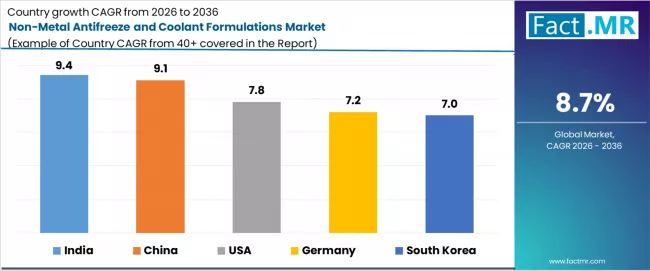
Analysis of the Non-Metal Antifreeze and Coolant Formulations Market by Key Countries

| Country | CAGR (2026-2036) |
|---|---|
| India | 9.40% |
| China | 9.10% |
| USA | 7.80% |
| Germany | 7.20% |
| South Korea | 7.00% |
How is India's Automotive Sector Transformation Influencing Demand?
India's leading CAGR of 9.40% is fueled by its burgeoning automotive manufacturing base and a rapid increase in vehicle ownership. The market is transitioning from conventional coolants to extended-life OAT products, driven by both consumer demand for lower maintenance and OEM specifications for modern engines. The parallel growth in data centers and industrial facilities further amplifies demand for reliable, non-corrosive cooling solutions suited to the local climate.
What Role does China's EV Leadership Play in Market Growth?
China's 9.10% growth is inextricably linked to its dominance in electric vehicle production. The specific thermal management needs of EV battery packs and power electronics require coolants with high dielectric strength and non-conductive properties, a niche where non-metal polypropylene glycol and specialized OAT formulations excel. National standards promoting advanced manufacturing and energy efficiency further accelerate the adoption of these high-performance fluids across industries.
Why Does the USA Represent a Mature yet Innovation-Driven Market?

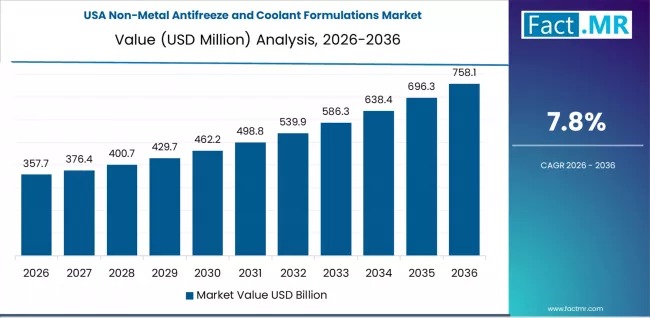
The USA's 7.80% CAGR reflects a mature automotive aftermarket and a strong industrial base. Growth is driven by the widespread OEM adoption of OAT/HOAT coolants as factory fill and the aftermarket's shift toward these extended-life products. The presence of major chemical companies and a stringent regulatory environment for worker safety and chemical reporting fosters continuous innovation in next-generation, environmentally considered non-metal formulations.
How Does Germany's Engineering Focus Shape Product Specifications?
Germany's 7.20% growth is characterized by its high-value engineering in premium automotive and industrial machinery. German OEMs specify coolants with extremely long service life and guaranteed material compatibility, favoring advanced HOAT and proprietary OAT blends. The emphasis on system efficiency and durability in sectors like high-performance manufacturing and renewable energy infrastructure creates a premium market for technically sophisticated, metal-free coolant systems.
What is Driving Adoption in South Korea's Technology-Intensive Economy?
South Korea's 7.00% growth is anchored in its world-leading electronics, semiconductor, and automotive sectors. The cooling demands of massive data centers, display manufacturing, and advanced automotive plants require ultra-pure, non-corrosive, and thermally stable fluids. This drives demand for high-purity polypropylene glycol formulations and specialized coolants for immersion cooling, making South Korea a critical market for cutting-edge, non-metal thermal management solutions.
Competitive Landscape of the Non-Metal Antifreeze and Coolant Formulations Market

The competitive landscape features global chemical conglomerates and specialized fluid manufacturers with deep expertise in organic chemistry and tribology. Competition is intense around proprietary inhibitor packages, the ability to formulate for specific OEM specifications, and securing global OEM factory-fill contracts. Success requires significant investment in R&D for new base fluids and inhibitor combinations, coupled with robust technical service to support fluid analysis and maintenance programs for large industrial clients.
Key Players in the Non-Metal Antifreeze and Coolant Formulations Market
- BASF SE
- Dow Inc.
- Chevron Oronite
- Shell Chemicals
- TotalEnergies
Scope of Report
| Items | Values |
|---|---|
| Quantitative Units | USD Billion |
| Formulation Type | OAT, HOAT, Polypropylene Glycol-Based, Bio-Based/Glycerin, Other Metal-Free Systems |
| End-Use Industry | Automotive & EV, Industrial Machinery, Data Centers, HVAC&R, Marine & Aerospace |
| Base Fluid Type | Ethylene Glycol, Propylene Glycol, Bio-Based/Glycerin, Water-Blended, Other Specialty Fluids |
| Key Countries | India, China, USA, Germany, South Korea |
| Key Companies | BASF SE, Dow Inc., Chevron Oronite, Shell Chemicals, TotalEnergies |
| Additional Analysis | Corrosion inhibition mechanisms of organic acids; compatibility testing with polymers and elastomers; lifecycle analysis of extended-drain coolants; impact of coolant chemistry on heat exchanger efficiency; regulatory landscape for glycols and inhibitors; emerging applications in immersion cooling and renewable energy storage. |
Market by Segments
-
Formulation Type :
- Organic Acid Technology (OAT)
- Hybrid Organic Acid Technology (HOAT)
- Polypropylene Glycol-Based Formulations
- Bio-Based & Glycerin Coolants
- Other Metal-Free Coolant Systems
-
End-Use Industry :
- Automotive & EV
- Industrial Machinery
- Data Centers & Cooling Systems
- HVAC and Refrigeration
- Marine & Aerospace
-
Base Fluid Type :
- Ethylene Glycol (EG)
- Propylene Glycol (PG)
- Bio-Based Glycol & Glycerin
- Water-Blended Advanced Coolants
- Other Specialty Metal-Free Fluids
-
Region :
-
North America
- USA
- Canada
-
Latin America
- Brazil
- Mexico
- Argentina
- Rest of Latin America
-
Western Europe
- Germany
- UK
- France
- Spain
- Italy
- BENELUX
- Rest of Western Europe
-
Eastern Europe
- Russia
- Poland
- Czech Republic
- Rest of Eastern Europe
-
East Asia
- China
- Japan
- South Korea
- Rest of East Asia
-
South Asia & Pacific
- India
- ASEAN
- Australia
- Rest of South Asia & Pacific
-
MEA
- Saudi Arabia
- UAE
- Turkiye
- Rest of MEA
-
Table of Content
- Executive Summary
- Global Market Outlook
- Demand to side Trends
- Supply to side Trends
- Technology Roadmap Analysis
- Analysis and Recommendations
- Market Overview
- Market Coverage / Taxonomy
- Market Definition / Scope / Limitations
- Market Background
- Market Dynamics
- Drivers
- Restraints
- Opportunity
- Trends
- Scenario Forecast
- Demand in Optimistic Scenario
- Demand in Likely Scenario
- Demand in Conservative Scenario
- Opportunity Map Analysis
- Product Life Cycle Analysis
- Supply Chain Analysis
- Investment Feasibility Matrix
- Value Chain Analysis
- PESTLE and Porter’s Analysis
- Regulatory Landscape
- Regional Parent Market Outlook
- Production and Consumption Statistics
- Import and Export Statistics
- Market Dynamics
- Global Market Analysis 2021 to 2025 and Forecast, 2026 to 2036
- Historical Market Size Value (USD Million) Analysis, 2021 to 2025
- Current and Future Market Size Value (USD Million) Projections, 2026 to 2036
- Y to o to Y Growth Trend Analysis
- Absolute $ Opportunity Analysis
- Global Market Pricing Analysis 2021 to 2025 and Forecast 2026 to 2036
- Global Market Analysis 2021 to 2025 and Forecast 2026 to 2036, By Formulation Type
- Introduction / Key Findings
- Historical Market Size Value (USD Million) Analysis By Formulation Type, 2021 to 2025
- Current and Future Market Size Value (USD Million) Analysis and Forecast By Formulation Type, 2026 to 2036
- Organic Acid Technology (OAT)
- Hybrid Organic Acid Technology (HOAT)
- Polypropylene Glycol-BasedFormulations
- Bio-Based & Glycerin Coolants
- Other Metal-Free Coolant Systems
- Organic Acid Technology (OAT)
- Y to o to Y Growth Trend Analysis By Formulation Type, 2021 to 2025
- Absolute $ Opportunity Analysis By Formulation Type, 2026 to 2036
- Global Market Analysis 2021 to 2025 and Forecast 2026 to 2036, By End-Use Industry
- Introduction / Key Findings
- Historical Market Size Value (USD Million) Analysis By End-Use Industry, 2021 to 2025
- Current and Future Market Size Value (USD Million) Analysis and Forecast By End-Use Industry, 2026 to 2036
- Automotive & EV
- Industrial Machinery
- Data Centers & Cooling Systems
- HVAC and Refrigeration
- Marine & Aerospace
- Automotive & EV
- Y to o to Y Growth Trend Analysis By End-Use Industry, 2021 to 2025
- Absolute $ Opportunity Analysis By End-Use Industry, 2026 to 2036
- Global Market Analysis 2021 to 2025 and Forecast 2026 to 2036, By Base Fluid Type
- Introduction / Key Findings
- Historical Market Size Value (USD Million) Analysis By Base Fluid Type, 2021 to 2025
- Current and Future Market Size Value (USD Million) Analysis and Forecast By Base Fluid Type, 2026 to 2036
- Ethylene Glycol (EG)
- Propylene Glycol (PG)
- Bio-Based Glycol & Glycerin
- Water-Blended Advanced Coolants
- Other Specialty Metal-Free Fluids
- Ethylene Glycol (EG)
- Y to o to Y Growth Trend Analysis By Base Fluid Type, 2021 to 2025
- Absolute $ Opportunity Analysis By Base Fluid Type, 2026 to 2036
- Global Market Analysis 2021 to 2025 and Forecast 2026 to 2036, By Region
- Introduction
- Historical Market Size Value (USD Million) Analysis By Region, 2021 to 2025
- Current Market Size Value (USD Million) Analysis and Forecast By Region, 2026 to 2036
- North America
- Latin America
- Western Europe
- Eastern Europe
- East Asia
- South Asia and Pacific
- Middle East & Africa
- Market Attractiveness Analysis By Region
- North America Market Analysis 2021 to 2025 and Forecast 2026 to 2036, By Country
- Historical Market Size Value (USD Million) Trend Analysis By Market Taxonomy, 2021 to 2025
- Market Size Value (USD Million) Forecast By Market Taxonomy, 2026 to 2036
- By Country
- USA
- Canada
- Mexico
- By Formulation Type
- By End-Use Industry
- By Base Fluid Type
- By Country
- Market Attractiveness Analysis
- By Country
- By Formulation Type
- By End-Use Industry
- By Base Fluid Type
- Key Takeaways
- Latin America Market Analysis 2021 to 2025 and Forecast 2026 to 2036, By Country
- Historical Market Size Value (USD Million) Trend Analysis By Market Taxonomy, 2021 to 2025
- Market Size Value (USD Million) Forecast By Market Taxonomy, 2026 to 2036
- By Country
- Brazil
- Chile
- Rest of Latin America
- By Formulation Type
- By End-Use Industry
- By Base Fluid Type
- By Country
- Market Attractiveness Analysis
- By Country
- By Formulation Type
- By End-Use Industry
- By Base Fluid Type
- Key Takeaways
- Western Europe Market Analysis 2021 to 2025 and Forecast 2026 to 2036, By Country
- Historical Market Size Value (USD Million) Trend Analysis By Market Taxonomy, 2021 to 2025
- Market Size Value (USD Million) Forecast By Market Taxonomy, 2026 to 2036
- By Country
- Germany
- UK
- Italy
- Spain
- France
- Nordic
- BENELUX
- Rest of Western Europe
- By Formulation Type
- By End-Use Industry
- By Base Fluid Type
- By Country
- Market Attractiveness Analysis
- By Country
- By Formulation Type
- By End-Use Industry
- By Base Fluid Type
- Key Takeaways
- Eastern Europe Market Analysis 2021 to 2025 and Forecast 2026 to 2036, By Country
- Historical Market Size Value (USD Million) Trend Analysis By Market Taxonomy, 2021 to 2025
- Market Size Value (USD Million) Forecast By Market Taxonomy, 2026 to 2036
- By Country
- Russia
- Poland
- Hungary
- Balkan & Baltic
- Rest of Eastern Europe
- By Formulation Type
- By End-Use Industry
- By Base Fluid Type
- By Country
- Market Attractiveness Analysis
- By Country
- By Formulation Type
- By End-Use Industry
- By Base Fluid Type
- Key Takeaways
- East Asia Market Analysis 2021 to 2025 and Forecast 2026 to 2036, By Country
- Historical Market Size Value (USD Million) Trend Analysis By Market Taxonomy, 2021 to 2025
- Market Size Value (USD Million) Forecast By Market Taxonomy, 2026 to 2036
- By Country
- China
- Japan
- South Korea
- By Formulation Type
- By End-Use Industry
- By Base Fluid Type
- By Country
- Market Attractiveness Analysis
- By Country
- By Formulation Type
- By End-Use Industry
- By Base Fluid Type
- Key Takeaways
- South Asia and Pacific Market Analysis 2021 to 2025 and Forecast 2026 to 2036, By Country
- Historical Market Size Value (USD Million) Trend Analysis By Market Taxonomy, 2021 to 2025
- Market Size Value (USD Million) Forecast By Market Taxonomy, 2026 to 2036
- By Country
- India
- ASEAN
- Australia & New Zealand
- Rest of South Asia and Pacific
- By Formulation Type
- By End-Use Industry
- By Base Fluid Type
- By Country
- Market Attractiveness Analysis
- By Country
- By Formulation Type
- By End-Use Industry
- By Base Fluid Type
- Key Takeaways
- Middle East & Africa Market Analysis 2021 to 2025 and Forecast 2026 to 2036, By Country
- Historical Market Size Value (USD Million) Trend Analysis By Market Taxonomy, 2021 to 2025
- Market Size Value (USD Million) Forecast By Market Taxonomy, 2026 to 2036
- By Country
- Kingdom of Saudi Arabia
- Other GCC Countries
- Turkiye
- South Africa
- Other African Union
- Rest of Middle East & Africa
- By Formulation Type
- By End-Use Industry
- By Base Fluid Type
- By Country
- Market Attractiveness Analysis
- By Country
- By Formulation Type
- By End-Use Industry
- By Base Fluid Type
- Key Takeaways
- Key Countries Market Analysis
- USA
- Pricing Analysis
- Market Share Analysis, 2025
- By Formulation Type
- By End-Use Industry
- By Base Fluid Type
- Canada
- Pricing Analysis
- Market Share Analysis, 2025
- By Formulation Type
- By End-Use Industry
- By Base Fluid Type
- Mexico
- Pricing Analysis
- Market Share Analysis, 2025
- By Formulation Type
- By End-Use Industry
- By Base Fluid Type
- Brazil
- Pricing Analysis
- Market Share Analysis, 2025
- By Formulation Type
- By End-Use Industry
- By Base Fluid Type
- Chile
- Pricing Analysis
- Market Share Analysis, 2025
- By Formulation Type
- By End-Use Industry
- By Base Fluid Type
- Germany
- Pricing Analysis
- Market Share Analysis, 2025
- By Formulation Type
- By End-Use Industry
- By Base Fluid Type
- UK
- Pricing Analysis
- Market Share Analysis, 2025
- By Formulation Type
- By End-Use Industry
- By Base Fluid Type
- Italy
- Pricing Analysis
- Market Share Analysis, 2025
- By Formulation Type
- By End-Use Industry
- By Base Fluid Type
- Spain
- Pricing Analysis
- Market Share Analysis, 2025
- By Formulation Type
- By End-Use Industry
- By Base Fluid Type
- France
- Pricing Analysis
- Market Share Analysis, 2025
- By Formulation Type
- By End-Use Industry
- By Base Fluid Type
- India
- Pricing Analysis
- Market Share Analysis, 2025
- By Formulation Type
- By End-Use Industry
- By Base Fluid Type
- ASEAN
- Pricing Analysis
- Market Share Analysis, 2025
- By Formulation Type
- By End-Use Industry
- By Base Fluid Type
- Australia & New Zealand
- Pricing Analysis
- Market Share Analysis, 2025
- By Formulation Type
- By End-Use Industry
- By Base Fluid Type
- China
- Pricing Analysis
- Market Share Analysis, 2025
- By Formulation Type
- By End-Use Industry
- By Base Fluid Type
- Japan
- Pricing Analysis
- Market Share Analysis, 2025
- By Formulation Type
- By End-Use Industry
- By Base Fluid Type
- South Korea
- Pricing Analysis
- Market Share Analysis, 2025
- By Formulation Type
- By End-Use Industry
- By Base Fluid Type
- Russia
- Pricing Analysis
- Market Share Analysis, 2025
- By Formulation Type
- By End-Use Industry
- By Base Fluid Type
- Poland
- Pricing Analysis
- Market Share Analysis, 2025
- By Formulation Type
- By End-Use Industry
- By Base Fluid Type
- Hungary
- Pricing Analysis
- Market Share Analysis, 2025
- By Formulation Type
- By End-Use Industry
- By Base Fluid Type
- Kingdom of Saudi Arabia
- Pricing Analysis
- Market Share Analysis, 2025
- By Formulation Type
- By End-Use Industry
- By Base Fluid Type
- Turkiye
- Pricing Analysis
- Market Share Analysis, 2025
- By Formulation Type
- By End-Use Industry
- By Base Fluid Type
- South Africa
- Pricing Analysis
- Market Share Analysis, 2025
- By Formulation Type
- By End-Use Industry
- By Base Fluid Type
- USA
- Market Structure Analysis
- Competition Dashboard
- Competition Benchmarking
- Market Share Analysis of Top Players
- By Regional
- By Formulation Type
- By End-Use Industry
- By Base Fluid Type
- Competition Analysis
- Competition Deep Dive
- BASF SE
- Overview
- Product Portfolio
- Profitability by Market Segments (Product/Age /Sales Channel/Region)
- Sales Footprint
- Strategy Overview
- Marketing Strategy
- Product Strategy
- Channel Strategy
- Dow Inc.
- Chevron Oronite
- Shell Chemicals
- TotalEnergies
- BASF SE
- Competition Deep Dive
- Assumptions & Acronyms Used
- Research Methodology
List Of Table
- Table 1: Global Market Value (USD Million) Forecast by Region, 2021 to 2036
- Table 2: Global Market Value (USD Million) Forecast by Formulation Type, 2021 to 2036
- Table 3: Global Market Value (USD Million) Forecast by End-Use Industry, 2021 to 2036
- Table 4: Global Market Value (USD Million) Forecast by Base Fluid Type, 2021 to 2036
- Table 5: North America Market Value (USD Million) Forecast by Country, 2021 to 2036
- Table 6: North America Market Value (USD Million) Forecast by Formulation Type, 2021 to 2036
- Table 7: North America Market Value (USD Million) Forecast by End-Use Industry, 2021 to 2036
- Table 8: North America Market Value (USD Million) Forecast by Base Fluid Type, 2021 to 2036
- Table 9: Latin America Market Value (USD Million) Forecast by Country, 2021 to 2036
- Table 10: Latin America Market Value (USD Million) Forecast by Formulation Type, 2021 to 2036
- Table 11: Latin America Market Value (USD Million) Forecast by End-Use Industry, 2021 to 2036
- Table 12: Latin America Market Value (USD Million) Forecast by Base Fluid Type, 2021 to 2036
- Table 13: Western Europe Market Value (USD Million) Forecast by Country, 2021 to 2036
- Table 14: Western Europe Market Value (USD Million) Forecast by Formulation Type, 2021 to 2036
- Table 15: Western Europe Market Value (USD Million) Forecast by End-Use Industry, 2021 to 2036
- Table 16: Western Europe Market Value (USD Million) Forecast by Base Fluid Type, 2021 to 2036
- Table 17: Eastern Europe Market Value (USD Million) Forecast by Country, 2021 to 2036
- Table 18: Eastern Europe Market Value (USD Million) Forecast by Formulation Type, 2021 to 2036
- Table 19: Eastern Europe Market Value (USD Million) Forecast by End-Use Industry, 2021 to 2036
- Table 20: Eastern Europe Market Value (USD Million) Forecast by Base Fluid Type, 2021 to 2036
- Table 21: East Asia Market Value (USD Million) Forecast by Country, 2021 to 2036
- Table 22: East Asia Market Value (USD Million) Forecast by Formulation Type, 2021 to 2036
- Table 23: East Asia Market Value (USD Million) Forecast by End-Use Industry, 2021 to 2036
- Table 24: East Asia Market Value (USD Million) Forecast by Base Fluid Type, 2021 to 2036
- Table 25: South Asia and Pacific Market Value (USD Million) Forecast by Country, 2021 to 2036
- Table 26: South Asia and Pacific Market Value (USD Million) Forecast by Formulation Type, 2021 to 2036
- Table 27: South Asia and Pacific Market Value (USD Million) Forecast by End-Use Industry, 2021 to 2036
- Table 28: South Asia and Pacific Market Value (USD Million) Forecast by Base Fluid Type, 2021 to 2036
- Table 29: Middle East & Africa Market Value (USD Million) Forecast by Country, 2021 to 2036
- Table 30: Middle East & Africa Market Value (USD Million) Forecast by Formulation Type, 2021 to 2036
- Table 31: Middle East & Africa Market Value (USD Million) Forecast by End-Use Industry, 2021 to 2036
- Table 32: Middle East & Africa Market Value (USD Million) Forecast by Base Fluid Type, 2021 to 2036
List Of Figures
- Figure 1: Global Market Pricing Analysis
- Figure 2: Global Market Value (USD Million) Forecast 2021 to 2036
- Figure 3: Global Market Value Share and BPS Analysis by Formulation Type, 2026 and 2036
- Figure 4: Global Market Y to o to Y Growth Comparison by Formulation Type, 2026 to 2036
- Figure 5: Global Market Attractiveness Analysis by Formulation Type
- Figure 6: Global Market Value Share and BPS Analysis by End-Use Industry, 2026 and 2036
- Figure 7: Global Market Y to o to Y Growth Comparison by End-Use Industry, 2026 to 2036
- Figure 8: Global Market Attractiveness Analysis by End-Use Industry
- Figure 9: Global Market Value Share and BPS Analysis by Base Fluid Type, 2026 and 2036
- Figure 10: Global Market Y to o to Y Growth Comparison by Base Fluid Type, 2026 to 2036
- Figure 11: Global Market Attractiveness Analysis by Base Fluid Type
- Figure 12: Global Market Value (USD Million) Share and BPS Analysis by Region, 2026 and 2036
- Figure 13: Global Market Y to o to Y Growth Comparison by Region, 2026 to 2036
- Figure 14: Global Market Attractiveness Analysis by Region
- Figure 15: North America Market Incremental Dollar Opportunity, 2026 to 2036
- Figure 16: Latin America Market Incremental Dollar Opportunity, 2026 to 2036
- Figure 17: Western Europe Market Incremental Dollar Opportunity, 2026 to 2036
- Figure 18: Eastern Europe Market Incremental Dollar Opportunity, 2026 to 2036
- Figure 19: East Asia Market Incremental Dollar Opportunity, 2026 to 2036
- Figure 20: South Asia and Pacific Market Incremental Dollar Opportunity, 2026 to 2036
- Figure 21: Middle East & Africa Market Incremental Dollar Opportunity, 2026 to 2036
- Figure 22: North America Market Value Share and BPS Analysis by Country, 2026 and 2036
- Figure 23: North America Market Value Share and BPS Analysis by Formulation Type, 2026 and 2036
- Figure 24: North America Market Y to o to Y Growth Comparison by Formulation Type, 2026 to 2036
- Figure 25: North America Market Attractiveness Analysis by Formulation Type
- Figure 26: North America Market Value Share and BPS Analysis by End-Use Industry, 2026 and 2036
- Figure 27: North America Market Y to o to Y Growth Comparison by End-Use Industry, 2026 to 2036
- Figure 28: North America Market Attractiveness Analysis by End-Use Industry
- Figure 29: North America Market Value Share and BPS Analysis by Base Fluid Type, 2026 and 2036
- Figure 30: North America Market Y to o to Y Growth Comparison by Base Fluid Type, 2026 to 2036
- Figure 31: North America Market Attractiveness Analysis by Base Fluid Type
- Figure 32: Latin America Market Value Share and BPS Analysis by Country, 2026 and 2036
- Figure 33: Latin America Market Value Share and BPS Analysis by Formulation Type, 2026 and 2036
- Figure 34: Latin America Market Y to o to Y Growth Comparison by Formulation Type, 2026 to 2036
- Figure 35: Latin America Market Attractiveness Analysis by Formulation Type
- Figure 36: Latin America Market Value Share and BPS Analysis by End-Use Industry, 2026 and 2036
- Figure 37: Latin America Market Y to o to Y Growth Comparison by End-Use Industry, 2026 to 2036
- Figure 38: Latin America Market Attractiveness Analysis by End-Use Industry
- Figure 39: Latin America Market Value Share and BPS Analysis by Base Fluid Type, 2026 and 2036
- Figure 40: Latin America Market Y to o to Y Growth Comparison by Base Fluid Type, 2026 to 2036
- Figure 41: Latin America Market Attractiveness Analysis by Base Fluid Type
- Figure 42: Western Europe Market Value Share and BPS Analysis by Country, 2026 and 2036
- Figure 43: Western Europe Market Value Share and BPS Analysis by Formulation Type, 2026 and 2036
- Figure 44: Western Europe Market Y to o to Y Growth Comparison by Formulation Type, 2026 to 2036
- Figure 45: Western Europe Market Attractiveness Analysis by Formulation Type
- Figure 46: Western Europe Market Value Share and BPS Analysis by End-Use Industry, 2026 and 2036
- Figure 47: Western Europe Market Y to o to Y Growth Comparison by End-Use Industry, 2026 to 2036
- Figure 48: Western Europe Market Attractiveness Analysis by End-Use Industry
- Figure 49: Western Europe Market Value Share and BPS Analysis by Base Fluid Type, 2026 and 2036
- Figure 50: Western Europe Market Y to o to Y Growth Comparison by Base Fluid Type, 2026 to 2036
- Figure 51: Western Europe Market Attractiveness Analysis by Base Fluid Type
- Figure 52: Eastern Europe Market Value Share and BPS Analysis by Country, 2026 and 2036
- Figure 53: Eastern Europe Market Value Share and BPS Analysis by Formulation Type, 2026 and 2036
- Figure 54: Eastern Europe Market Y to o to Y Growth Comparison by Formulation Type, 2026 to 2036
- Figure 55: Eastern Europe Market Attractiveness Analysis by Formulation Type
- Figure 56: Eastern Europe Market Value Share and BPS Analysis by End-Use Industry, 2026 and 2036
- Figure 57: Eastern Europe Market Y to o to Y Growth Comparison by End-Use Industry, 2026 to 2036
- Figure 58: Eastern Europe Market Attractiveness Analysis by End-Use Industry
- Figure 59: Eastern Europe Market Value Share and BPS Analysis by Base Fluid Type, 2026 and 2036
- Figure 60: Eastern Europe Market Y to o to Y Growth Comparison by Base Fluid Type, 2026 to 2036
- Figure 61: Eastern Europe Market Attractiveness Analysis by Base Fluid Type
- Figure 62: East Asia Market Value Share and BPS Analysis by Country, 2026 and 2036
- Figure 63: East Asia Market Value Share and BPS Analysis by Formulation Type, 2026 and 2036
- Figure 64: East Asia Market Y to o to Y Growth Comparison by Formulation Type, 2026 to 2036
- Figure 65: East Asia Market Attractiveness Analysis by Formulation Type
- Figure 66: East Asia Market Value Share and BPS Analysis by End-Use Industry, 2026 and 2036
- Figure 67: East Asia Market Y to o to Y Growth Comparison by End-Use Industry, 2026 to 2036
- Figure 68: East Asia Market Attractiveness Analysis by End-Use Industry
- Figure 69: East Asia Market Value Share and BPS Analysis by Base Fluid Type, 2026 and 2036
- Figure 70: East Asia Market Y to o to Y Growth Comparison by Base Fluid Type, 2026 to 2036
- Figure 71: East Asia Market Attractiveness Analysis by Base Fluid Type
- Figure 72: South Asia and Pacific Market Value Share and BPS Analysis by Country, 2026 and 2036
- Figure 73: South Asia and Pacific Market Value Share and BPS Analysis by Formulation Type, 2026 and 2036
- Figure 74: South Asia and Pacific Market Y to o to Y Growth Comparison by Formulation Type, 2026 to 2036
- Figure 75: South Asia and Pacific Market Attractiveness Analysis by Formulation Type
- Figure 76: South Asia and Pacific Market Value Share and BPS Analysis by End-Use Industry, 2026 and 2036
- Figure 77: South Asia and Pacific Market Y to o to Y Growth Comparison by End-Use Industry, 2026 to 2036
- Figure 78: South Asia and Pacific Market Attractiveness Analysis by End-Use Industry
- Figure 79: South Asia and Pacific Market Value Share and BPS Analysis by Base Fluid Type, 2026 and 2036
- Figure 80: South Asia and Pacific Market Y to o to Y Growth Comparison by Base Fluid Type, 2026 to 2036
- Figure 81: South Asia and Pacific Market Attractiveness Analysis by Base Fluid Type
- Figure 82: Middle East & Africa Market Value Share and BPS Analysis by Country, 2026 and 2036
- Figure 83: Middle East & Africa Market Value Share and BPS Analysis by Formulation Type, 2026 and 2036
- Figure 84: Middle East & Africa Market Y to o to Y Growth Comparison by Formulation Type, 2026 to 2036
- Figure 85: Middle East & Africa Market Attractiveness Analysis by Formulation Type
- Figure 86: Middle East & Africa Market Value Share and BPS Analysis by End-Use Industry, 2026 and 2036
- Figure 87: Middle East & Africa Market Y to o to Y Growth Comparison by End-Use Industry, 2026 to 2036
- Figure 88: Middle East & Africa Market Attractiveness Analysis by End-Use Industry
- Figure 89: Middle East & Africa Market Value Share and BPS Analysis by Base Fluid Type, 2026 and 2036
- Figure 90: Middle East & Africa Market Y to o to Y Growth Comparison by Base Fluid Type, 2026 to 2036
- Figure 91: Middle East & Africa Market Attractiveness Analysis by Base Fluid Type
- Figure 92: Global Market - Tier Structure Analysis
- Figure 93: Global Market - Company Share Analysis
- FAQs -
How big is the non-metal antifreeze and coolant formulations market in 2026?
The global non-metal antifreeze and coolant formulations market is estimated to be valued at USD 0.8 billion in 2026.
What will be the size of non-metal antifreeze and coolant formulations market in 2036?
The market size for the non-metal antifreeze and coolant formulations market is projected to reach USD 1.8 billion by 2036.
How much will be the non-metal antifreeze and coolant formulations market growth between 2026 and 2036?
The non-metal antifreeze and coolant formulations market is expected to grow at a 8.7% CAGR between 2026 and 2036.
What are the key product types in the non-metal antifreeze and coolant formulations market?
The key product types in non-metal antifreeze and coolant formulations market are organic acid technology (oat), hybrid organic acid technology (hoat), polypropylene glycol-basedformulations, bio-based & glycerin coolants and other metal-free coolant systems.
Which end-use industry segment to contribute significant share in the non-metal antifreeze and coolant formulations market in 2026?
In terms of end-use industry, automotive & ev segment to command 36.0% share in the non-metal antifreeze and coolant formulations market in 2026.