- Base Value (2025): 1.6 Bn
- Estimated Value(2026): 1.8 Bn
- Forecast Value (2036): 4.1 Bn
- CAGR (2026 - 2036): 8.4%
Global Cold Chain Antifreeze Glycols Market Forecast and Outlook 2026 to 2036
The global cold chain antifreeze glycols market is poised for robust growth, projected to expand from USD 1.84 billion in 2026 to USD 4.12 billion by 2036, advancing at an 8.4% CAGR. This expansion is fundamentally driven by the relentless global expansion of temperature-sensitive supply chains for pharmaceuticals, biologics, and high-value foods, coupled with increasingly stringent regulatory standards for product integrity. Cold Chain Antifreeze Glycols Market Market Value Analysis | Source: Fact.MR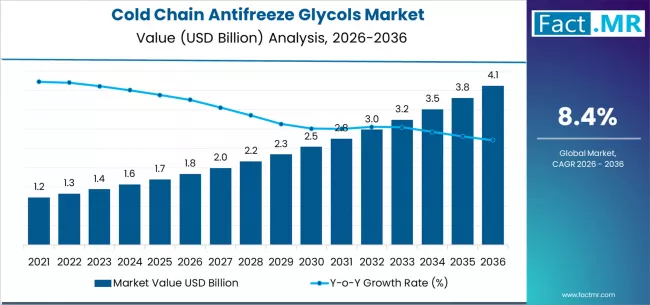
Summary of Cold Chain Antifreeze Glycols Market
- Market Snapshot
- Global cold chain antifreeze glycols market revenue stood at USD 1.84 billion in 2026 and is forecast to reach USD 4.12 billion by 2036.
- At an 8.4%CAGRfrom 2026 to 2036, this market is driven by relentless expansion of temperature-sensitive supply chains for pharmaceuticals, biologics, and high-value foods.
- Growth is underpinned by increasingly stringent regulatory standards for product integrity and cold chain validation across pharmaceutical and foodlogisticssectors.
- The market is evolving toward advanced glycol-based fluids with enhanced thermal stability, lower toxicity, and improved corrosion inhibition for modern compressor systems.
- Demand and Growth Drivers
- Exponential growth in global trade of temperature-sensitive pharmaceuticals including vaccines, biologics, and personalized medicines demands uncompromising cold chain integrity.
- Expansion of organized retail, online grocery delivery, and consumer demand for fresh, globally sourced food products furtheramplifiesglycol demand.
- Stricter food safety regulations andpharmacopeialstandards mandate validated cold chain processes, making high-performance antifreeze fluids a critical non-negotiablecomponent.
- Development of hybrid glycol formulations with enhanced biodegradability and lower aquatic toxicity is a key emerging trend addressing environmental concerns.
- Integration of glycol fluids withIoT-enabled monitoring systems tracking fluid condition, concentration, and contamination in real-time is enabling predictive maintenance.
- Product and Segment View
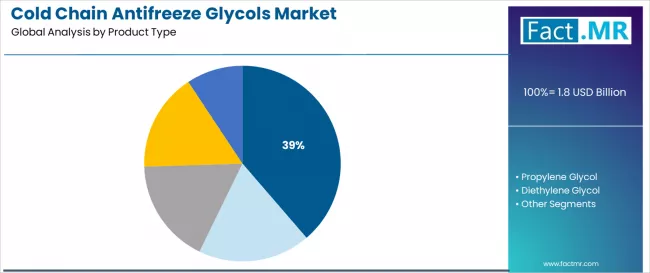
- MonoethyleneGlycol leads the Product Type segment with a 38.7% market share in 2026, valued for superior freeze protection, high heat transfer efficiency, and cost-effectiveness.
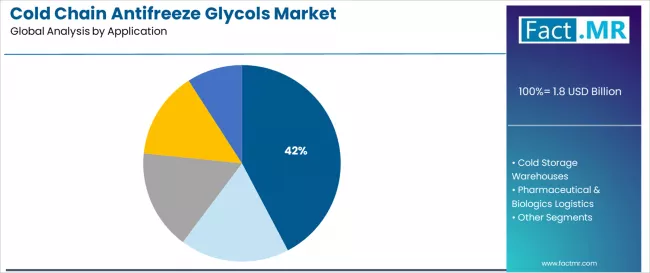
- Cold Chain Transport Refrigeration leads the Application segment with a 42.3% share in 2026, reflecting the vast and growing fleet of mobile refrigeration units globally.
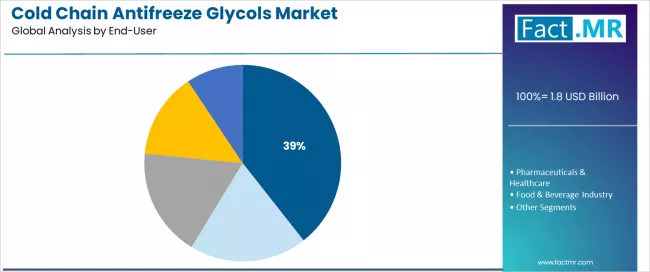
- Logistics & Transportation Providers lead the End-User segment with a 39% share in 2026, as volume anchor consumers of glycols for fleet maintenance and compliance.
- Additional segments include Propylene Glycol, Diethylene Glycol,TriethyleneGlycol, Cold Storage Warehouses, Pharmaceutical & Biologics Logistics, and Food & Beverage Cold Chain.
- Geography and Competitive Outlook
- India (10.00%CAGR), China (9.60%), USA (8.90%), Germany (8.20%), and Japan (7.70%) are the key growth countries across this market.
- South Asia & Pacific, East Asia, North America, and Western Europe are primary regional markets, supported by cold chain modernization, vaccine distribution, and pharmalogisticsgrowth.
- Market expansion is closely tied to cold chain infrastructure investment, government food safetyprogrammes, and biopharma sector growth in emerging economies.
- Key companies active in this market include BASF SE, Dow Inc., Shell Chemicals,INEOS, andClariantAG.
Cold Chain Antifreeze Glycols Market — At a Glance
| Attribute | Details |
| Market Value 2026 | USD 1.84 Billion |
| Market Value 2036 | USD 4.12 Billion |
| Absolute Dollar Opportunity 2026-2036 | USD2.28Billion |
| Total Growth 2026-2036 | 124% |
| CAGR2026-2036 | 8.4% |
| Growth Multiple | 2.2x |
| Key Demand Theme | Expansion of temperature-sensitive pharmaceutical and food supply chains demanding advanced, high-performance antifreeze glycol solutions |
| Leading Segment by Product Type (2026) | MonoethyleneGlycol |
| Product Type Segment Share (2026) | 38.7% |
| Leading Segment by Application (2026) | Cold Chain Transport Refrigeration |
| Application Segment Share (2026) | 42.3% |
| Leading Segment by End-User (2026) | Logistics& Transportation Providers |
| End-User Segment Share (2026) | 39% |
| Key Growth Regions | South Asia & Pacific, East Asia, North America, Western Europe |
| Country CAGRs | India 10.00%, China 9.60%, USA 8.90%, Germany 8.20%, Japan 7.70% |
| Top Companies | BASF SE, Dow Inc., Shell Chemicals,INEOS,ClariantAG |
| Segmentation by Product Type | MonoethyleneGlycol, Propylene Glycol, Diethylene Glycol,TriethyleneGlycol, Others |
| Segmentation by Application | Cold Chain Transport Refrigeration, Cold Storage Warehouses, Pharmaceutical & Biologics Logistics, Food & Beverage Cold Chain, Others |
| Segmentation by End-User | Logistics& Transportation Providers, Pharmaceuticals & Healthcare, Food & Beverage Industry, Retail & DistributionCenters, Others |
| Segmentation by Region | North America, Latin America, Western Europe, Eastern Europe, East Asia, South Asia & Pacific, MEA |
Source: Fact.MR analysis. Updated Apr 14, 2026
Monoethylene glycol leads product types with a 39% share, valued for its effective freeze-point depression, while cold chain transport refrigeration constitutes the primary application (42%). Logistics providers are the key end-user segment (39%), underscoring the critical role of refrigerated transportation in global trade. Market progression is centered on developing advanced glycol-based fluids with enhanced thermal stability, lower toxicity, and improved corrosion inhibition to meet the exacting demands of modern compressor systems and evolving environmental regulations. The convergence of digital monitoring and predictive maintenance within the cold chain is further refining glycol performance and management protocols. Growth is particularly strong in developing economies like India (10.00% CAGR) and China (9.60% CAGR), where cold chain infrastructure is rapidly modernizing to support vaccine distribution, perishable food exports, and burgeoning e-commerce grocery delivery.
Category
| Category | Segments |
|---|---|
| Product Type | Monoethylene Glycol, Propylene Glycol, Diethylene Glycol, Triethylene Glycol, Others |
| Application | Cold chain Transport Refrigeration, Cold Storage Warehouses, Pharmaceutical & Biologics Logistics, Food & Beverage Cold chain, Others |
| End-User | Logistics & Transportation Providers, Pharmaceuticals & Healthcare, Food & Beverage Industry, Retail & Distribution Centers, Others |
| Region | North America, Latin America, Western Europe, Eastern Europe, East Asia, South Asia & Pacific, MEA |
Source: Fact.MR analysis. Updated Apr 14, 2026
Segmental Analysis
By Product Type, Which Segment is the Industry Workhorse?
Cold Chain Antifreeze Glycols Market Analysis By Product Type | Source: Fact.MR
Monoethylene glycol holds a leading 39% market share, primarily due to its superior freeze protection, high heat transfer efficiency, and well-established cost-effectiveness. It is the predominant fluid in heavy-duty transport refrigeration units and large-scale cold storage facilities where operational cost and performance are paramount.
While toxicity concerns limit its use in some sensitive applications, its proven performance in demanding, closed-loop industrial systems ensures its continued dominance in the core logistics and bulk storage segments of the cold chain.
By Application, Where is Demand Most Concentrated?
Cold Chain Antifreeze Glycols Market Analysis By Application | Source: Fact.MR
Cold chain transport refrigeration is the dominant application, accounting for 42% of the market. This reflects the vast and growing fleet of road, rail, and sea containers that require reliable, mobile refrigeration.
The harsh operating conditions, frequent temperature cycling, and critical need for failure-free operation make the thermal and corrosion properties of the antifreeze fluid absolutely essential. This segment's growth is directly tied to the expansion of global trade in perishable goods and the increasing complexity of multi-modal logistics routes.
By End-User, Which Sector Drives Core Consumption?
Cold Chain Antifreeze Glycols Market Analysis By End User | Source: Fact.MR
Logistics & transportation providers constitute the leading end-user segment with a 39% share. These companies operate the physical assets that form the circulatory system of the cold chain.
Their demand for glycols is driven by the need to minimize downtime, reduce maintenance costs, and guarantee compliance with cargo safety regulations. They often procure glycols in bulk and require formulations that are compatible with a wide range of OEM equipment, making them the volume anchor of the market.
What are the Drivers, Restraints, and Key Trends of the Cold Chain Antifreeze Glycols Market?
The primary market driver is the exponential growth in global trade of temperature-sensitive pharmaceuticals, including vaccines, biologics, and personalized medicines, which demand uncompromising cold chain integrity.
The expansion of organized retail, online grocery delivery, and the consumer demand for fresh, globally sourced food products further amplifies demand. Stricter food safety regulations and pharmacopeial standards mandate validated cold chain processes, making high-performance antifreeze fluids a critical, non-negotiable component.
A significant market restraint is the environmental and toxicity profile of certain glycols, particularly MEG, which is classified as harmful and requires careful handling, disposal, and spill mitigation. This drives regulatory scrutiny and pushes some end-users toward higher-cost, less-toxic alternatives like propylene glycol.
Volatility in the prices of raw materials also impacts glycol pricing and market stability. The high capital cost of cold chain infrastructure itself can sometimes pace the adoption of new fluid technologies.
Key trends include the development of hybrid glycol formulations with enhanced biodegradability and lower aquatic toxicity. There is a growing integration of glycol fluids with IoT-enabled monitoring systems that track fluid condition, concentration, and contamination in real-time, enabling predictive maintenance.
The use of propylene glycol-based fluids is increasing in pharmaceutical and food-adjacent applications due to its generally recognized as safe status. Furthermore, manufacturers are offering customized fluid blends tailored to specific climatic zones and operational duty cycles.
Analysis of the Cold chain Antifreeze Glycols Market by Key Countries
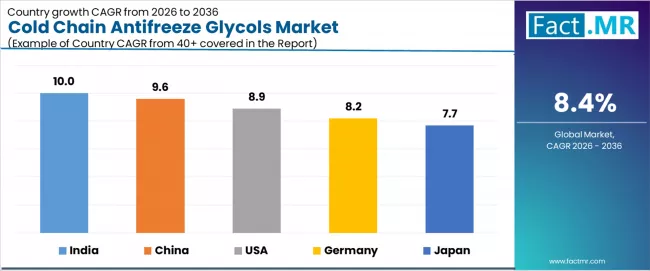
Cold Chain Antifreeze Glycols Market Cagr Analysis By Country | Source: Fact.MR
| Country | CAGR (2026-2036) |
|---|---|
| India | 10.00% |
| China | 9.60% |
| USA | 8.90% |
| Germany | 8.20% |
| Japan | 7.70% |
Source: Fact.MR analysis. Updated Apr 14, 2026
How is India's Infrastructure Modernization and Pharmaceutical Hub Status Driving Growth?
India's leading CAGR of 10.00% is fueled by massive public and private investment in modernizing its cold chain infrastructure, critical for its role as the pharmacy of the world and for reducing domestic food waste.
Government initiatives like the Integrated Cold Chain and Value Addition Scheme provide direct impetus. The expansion of vaccine manufacturing and the growth of organized food retail are creating sustained demand for reliable antifreeze solutions across a vast and climatically diverse geography.
What is the Impact of China's Domestic Consumption Boom and Export Leadership?
China's 9.60% growth is propelled by its soaring domestic consumption of perishable goods and its position as a leading global exporter of fresh produce and processed foods. The rapid scale-up of its logistics network, including vast numbers of new reefer containers and trucks, requires corresponding volumes of antifreeze fluids. Simultaneously, the growth of its domestic biopharma sector adds a layer of sophisticated demand for high-purity glycols used in GMP-compliant logistics.
Why Does the USA's Mature but Evolving Cold chain Network Sustain Demand?
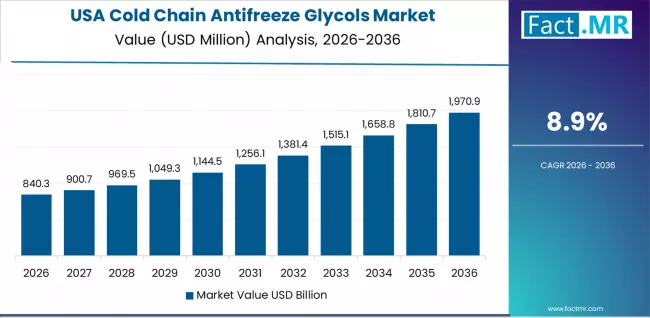
Cold Chain Antifreeze Glycols Market Country Value Analysis | Source: Fact.MR
The USA's 8.90% growth is anchored in its vast, technologically advanced cold chain network, which requires constant maintenance and fluid replenishment. The trend toward last-mile delivery of groceries and meals, along with stringent FDA oversight of pharmaceutical logistics, creates a steady demand for high-performance, reliable glycols. The market is characterized by a shift toward more environmentally acceptable fluids and the integration of fluids with fleet management software.
How is Germany's Central Logistics Role and Engineering Standards Influencing the Market?
Germany's 8.20% CAGR reflects its position as a central logistics hub for Europe and its high engineering standards for technical fluids. German equipment manufacturers and logistics operators demand glycols with extended service life, excellent materials compatibility, and comprehensive technical documentation. The market is driven by the need for efficiency and reliability in cross-continental transport, with a strong preference for premium, branded fluids from established chemical suppliers.
What Role does Japan's Advanced Pharmaceuticals and Precision Logistics Play?
Japan's 7.70% growth occurs within a market defined by advanced pharmaceutical manufacturing, precision logistics, and high consumer expectations for food quality. The cold chain is exceptionally critical and reliable.
Demand focuses on ultra-high-purity glycols for sensitive biologics transport and on formulations that ensure flawless performance in automated, high-density urban cold storage and distribution centers, where system failure is not an option.
Competitive Landscape of the Cold Chain Antifreeze Glycols Market
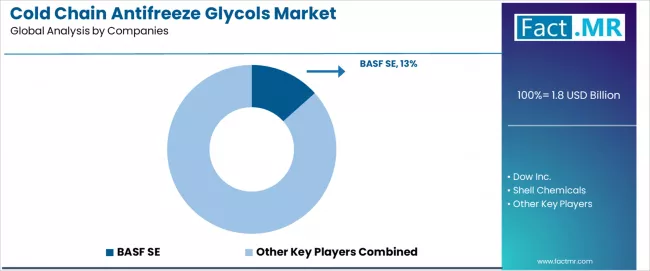
Cold Chain Antifreeze Glycols Market Analysis By Company | Source: Fact.MR
Large, integrated petrochemical and specialty chemical companies that produce the base glycols and formulate finished fluids dominate the competitive landscape. Competition is based on product quality and consistency, technical service and support, global supply chain reliability, and the ability to provide tailored formulations for specific OEM equipment.
Success is increasingly linked to providing comprehensive fluid analysis and maintenance programs, helping customers optimize fluid life and system performance, thereby transitioning from a product supplier to a solutions partner.
Key Players in the Cold chain Antifreeze Glycols Market
- BASF SE
- Dow Inc.
- Shell Chemicals
- INEOS
- Clariant AG
References
- Ashby, M. F., & Johnson, K. (2023). Materials and sustainable development. Butterworth-Heinemann.
- Baird, C., & Cann, M. (2024). Environmental chemistry. W. H. Freeman.
- Berk, Z. (2023). Food process engineering and technology. Academic Press.
- Fennema, O. R., & Tannenbaum, S. R. (2024). Food chemistry. CRC Press.
- Heldman, D. R., & Lund, D. B. (2023). Handbook of food engineering. CRC Press.
- Kessler, H. G. (2024). Food and bio process engineering. Springer.
- Mullan, W. M. A., & McDowell, D. (2023). Food and cold chain management: A handbook of technology and practice. Wiley-Blackwell.
- Rahman, M. S. (2024). Handbook of food preservation. CRC Press.
- Sun, D. W. (2023). Handbook of frozen food processing and packaging. CRC Press.
- Toledo, R. T., & Singh, R. K. (2024). Fundamentals of food process engineering. Springer.
Segmentation
Scope of Report
| Items | Values |
|---|---|
| Quantitative Units | USD Billion |
| Product Type | Monoethylene Glycol, Propylene Glycol, Diethylene Glycol, Triethylene Glycol, Others |
| Application | Cold chain Transport Refrigeration, Cold Storage Warehouses, Pharmaceutical & Biologics Logistics, Food & Beverage Cold chain, Others |
| End-User | Logistics & Transportation Providers, Pharmaceuticals & Healthcare, Food & Beverage Industry, Retail & Distribution Centers, Others |
| Key Countries | India, China, USA, Germany, Japan |
| Key Companies | BASF SE, Dow Inc., Shell Chemicals, INEOS, Clariant AG |
| Additional Analysis | Corrosion inhibition performance in mixed-metal systems; fluid longevity and degradation analysis under cyclic thermal loads; environmental and regulatory comparison of MEG vs. PG; impact of glycol concentration on system energy efficiency; cold chain integrity failure risk analysis related to fluid performance. |
Source: Fact.MR analysis. Updated Apr 14, 2026
Market by Segments
-
Product Type :
- Monoethylene Glycol
- Propylene Glycol
- Diethylene Glycol
- Triethylene Glycol
- Others
-
Application :
- Cold chain Transport Refrigeration
- Cold Storage Warehouses
- Pharmaceutical & Biologics Logistics
- Food & Beverage Cold Chain
- Others
-
End-User :
- Logistics & Transportation Providers
- Pharmaceuticals & Healthcare
- Food & Beverage Industry
- Retail & Distribution Centers
- Others
-
Region :
- North America
- USA
- Canada
- Latin America
- Brazil
- Mexico
- Argentina
- Rest of Latin America
- Western Europe
- Germany
- UK
- France
- Spain
- Italy
- BENELUX
- Rest of Western Europe
- Eastern Europe
- Russia
- Poland
- Czech Republic
- Rest of Eastern Europe
- East Asia
- China
- Japan
- South Korea
- Rest of East Asia
- South Asia & Pacific
- India
- ASEAN
- Australia
- Rest of South Asia & Pacific
- MEA
- Saudi Arabia
- UAE
- Turkiye
- Rest of MEA
- North America
Frequently Asked Questions
How big is the cold chain antifreeze glycols market in 2026?
What will be the size of cold chain antifreeze glycols market in 2036?
How much will be the cold chain antifreeze glycols market growth between 2026 and 2036?
What are the key product types in the cold chain antifreeze glycols market?
Which application segment to contribute significant share in the cold chain antifreeze glycols market in 2026?
Who worked on this report


Preview the report firsthand - request a free sample
Free SampleGet the brochure for pricing and purchase details
Download PDF