- Market Value (2025): USD 1.15 Bn
- Estimated Value (2026): USD 1.29 Bn
- Forecast Value (2036): USD 3.90 Bn
- CAGR (2026-2036): 11.7%
Thermal Imaging Driving Assistant System Market Forecast and Outlook 2026 to 2036
The thermal imaging driving assistant systems market is forecast to increase from USD 1.29 billion in 2026 to USD 3.90 billion by 2036. Demand for thermal imaging driving assistant systems is forecast to record a CAGR of 11.7% over the forecast period.
Vehicle engineers are examining thermal cameras for detecting people and animals after dark, when ordinary cameras can lose detail. Long-wave infrared systems read heat differences and give driver-assistance software another view of the road. The US FMVSS No. 127 establishes automatic emergency braking performance requirements for light vehicles, including pedestrian detection under nighttime conditions. Infrared cameras represent one sensing option that manufacturers may evaluate alongside visible-light cameras, radar and other technologies to meet these requirements.
Market Highlights: Thermal Imaging Driving Assistant System Market
- Sales of thermal imaging driving assistant systems stood at USD 1.15 billion in 2025
- Thermal Imaging Driving Assistant System Market Value (2026): USD 1.29 billion
- Thermal Imaging Driving Assistant System Market Forecast Value (2036): USD 3.90 billion
- Thermal Imaging Driving Assistant System Market Forecast CAGR (2026-2036): 11.7%
- Leading Vehicle Type: Passenger vehicles (62.4%)
- Key Market Participants: Teledyne FLIR, Magna International, AUMOVIO SE, ADASKY
- Key Growth Regions: Germany, United States, Japan, United Kingdom, Brazil
In April 2026, the National Highway Traffic Safety Administration estimated 1.10 road deaths per 100 million vehicle miles travelled in the United States during 2025. Road-safety pressure has not disappeared despite that improvement. A thermal camera may help a vehicle identify a pedestrian beyond the useful range of its headlamps, but vehicle manufacturers still need to prove that the complete braking system works in actual driving conditions.
Thermal Imaging Driving Assistant System Market
| Metric | Value |
|---|---|
| Estimated Value in (2026) | USD 1.29 billion |
| Forecast Value in (2036) | USD 3.90 billion |
| Forecast CAGR (2026 to 2036) | 11.7% |
Source: Fact.MR analysis. Updated Nov 23, 2026
Source: Fact.MR analysis.
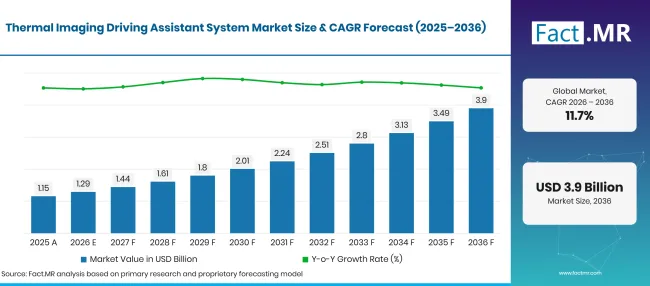
Thermal Imaging Driving Assistant System Market Forecast Global | Source: Fact.MR
Category
| Category | Segments |
|---|---|
| Vehicle Type | Passenger Vehicles, Commercial Vehicles |
| Application | Night Vision, Pedestrian Detection, Collision Avoidance, Others |
| Sales Channel | OEM, Aftermarket |
| Region | Germany; United States; Japan; United Kingdom; Brazil |
Source: Fact.MR analysis. Updated Nov 23, 2026
Segmental Analysis
Why do passenger vehicles lead vehicle-type demand in the Thermal Imaging Driving Assistant System Market?
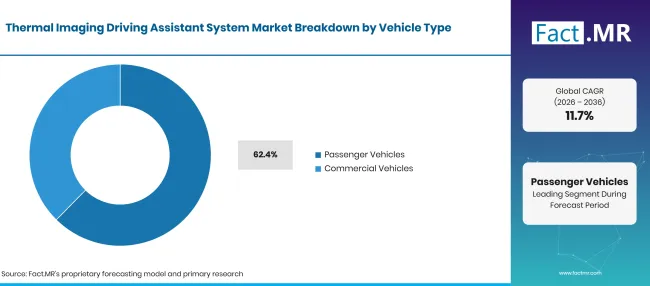
Thermal Imaging Driving Assistant System Market Breakdown Vehicle Type | Source: Fact.MR
Passenger vehicles account for 62.4% of thermal imaging driving assistant system revenue in 2026, generating USD 805 million, as automakers explore infrared sensing for pedestrian detection and night-time driving assistance. In 2024, the US National Highway Traffic Safety Administration finalized FMVSS No. 127, establishing automatic emergency braking performance requirements for passenger cars and light trucks, including pedestrian detection under daytime and nighttime test conditions. Manufacturers may evaluate thermal imaging alongside other sensing technologies when designing systems to meet these requirements.
Why does night vision lead application demand in the Thermal Imaging Driving Assistant System Market?
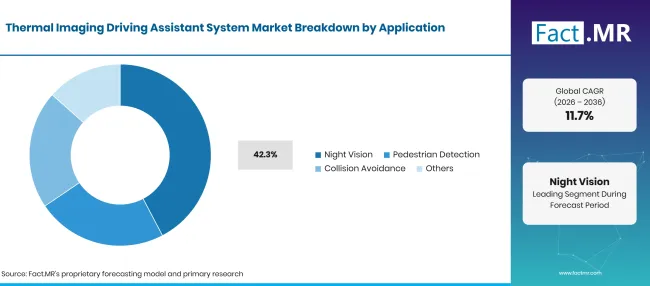
Thermal Imaging Driving Assistant System Market Breakdown Application | Source: Fact.MR
Night vision represents 42.3% of thermal imaging driving assistant system revenue in 2026, equivalent to USD 545 million, because infrared cameras detect temperature differences that help identify pedestrians, animals and obstacles beyond conventional headlight visibility. Teledyne FLIR's automotive thermal imaging portfolio supports night vision and pedestrian detection, including applications where visible-light cameras face challenging lighting conditions. Vehicle software processes thermal images to identify potential hazards and provide useful warnings.
Why do OEM channels lead sales in the Thermal Imaging Driving Assistant System Market?
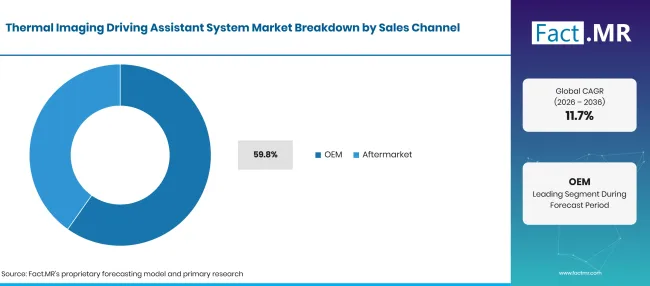
Thermal Imaging Driving Assistant System Market Breakdown Sales Channel | Source: Fact.MR
OEM channels contribute 59.8% of thermal imaging driving assistant system revenue in 2026, worth USD 770 million, because factory integration allows manufacturers to position infrared cameras and connect them with vehicle electronic control systems. Teledyne FLIR and Valeo have collaborated on automotive-qualified thermal imaging technology for driver assistance applications, reflecting the importance of supplier partnerships during vehicle development. Factory-installed systems undergo testing for environmental durability, warning accuracy and compatibility with existing safety functions.
Thermal Imaging Driving Assistant System Market-Drivers, Restraints & Trends
Drivers
Night-time pedestrian detection creates a specific reason to assess infrared sensing alongside ordinary cameras and radar. On 27 October 2026, the European Commission reported 19,350 road deaths across the EU in 2025.
Restraints
Thermal camera assemblies add hardware expense to vehicle safety systems, while the final application also requires image processing and difficult road testing. Low-cost cars have little room for a feature whose benefit is being evaluated across the planned sensor package. Infrared imagery can also become less distinct when the thermal contrast between a pedestrian and the background is weak.
Trend
Sensor Fusion with Radar and Cameras Thermal imagery supplies a different type of information from visible cameras and radar. Vehicle engineers may combine the signals to improve object recognition when light conditions change. The development challenge involves matching images and object tracks quickly enough for a braking decision. Developers also need to control false warnings, since unnecessary braking can undermine confidence in the complete assistance package.
Trend
Thermal for Autonomous Driving Automated driving systems depend on consistent road-user detection throughout their operating hours. Thermal sensing is being assessed as an additional way to observe pedestrians when visible light is poor. A vehicle operator cannot treat a thermal camera as a replacement for the wider sensing and control system. Investment is therefore more likely to follow tested use cases and clear reliability results than broad promises about autonomous driving.
Thermal Imaging Driving Assistant System Market by Analysis by Key Country
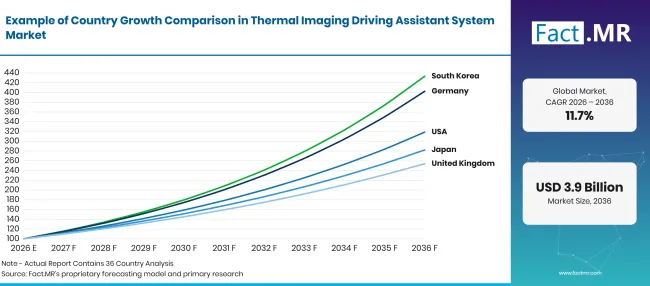
Thermal Imaging Driving Assistant System Market Growth Index | Source: Fact.MR
| Country | CAGR (2026-2036) |
|---|---|
| Germany | 14.9% |
| United States | 12.3% |
| Japan | 10.9% |
| United Kingdom | 9.8% |
| Brazil | 8.9% |
Source: Fact.MR analysis. Updated Nov 23, 2026
Source: Fact.MR analysis.
Why is Germany the fastest-growing market for thermal imaging driving assistant systems?
Germany is projected to record a 14.9% CAGR for thermal imaging driving assistant systems between 2026 and 2036.
Passenger-car manufacturers can assess thermal cameras within established vehicle electronics programs, where safe mounting and dependable pedestrian recognition are central design concerns. In July 2026, the Federal Statistical Office reported 2,832 road deaths in Germany during 2025. Germany's position in automotive engineering also creates opportunities for camera designers to work directly with software and vehicle integration teams.
How are AEB rules supporting sales in the United States?
US demand for thermal imaging driving assistant systems is projected to rise at a 12.3% CAGR between 2026 and 2036.
Federal pedestrian automatic emergency braking requirements create a clear reason for automakers to test sensing performance after dark. In April 2026, the National Highway Traffic Safety Administration estimated that 36,640 people died in US traffic crashes during 2025. Road-safety priorities keep investment focused on reliable obstacle detection across real driving conditions. Under FMVSS No. 127, manufacturers must demonstrate specified braking performance, so thermal-camera suppliers need evidence from full vehicle tests.
What is shaping demand in Japan?
Japanese automakers are assessing how additional sensing inputs can improve driver assistance on busy roads and after dark.
The thermal imaging driving assistant system market in Japan is forecast to rise at a 10.9% CAGR from 2026 to 2036. In January 2026, Japan's National Police Agency reported 2,547 traffic fatalities for 2025. Vehicle safety work therefore continues to include pedestrian awareness and dependable warnings in difficult light. Japanese electronic-component manufacturers have experience integrating camera information into vehicle control systems, which gives thermal-module developers an opportunity into design trials.
What is shaping demand in the United Kingdom?
Vehicle safety assessment in the United Kingdom and pedestrian protection are shaping interest in infrared driving assistance.
Demand for thermal imaging driving assistant systems is forecast to rise at a 9.8% CAGR between 2026 and 2036. In May 2026, the Department for Transport reported 19,972 pedestrian casualties in Great Britain during 2025 in its provisional results. Thermal cameras may provide an extra source of information for vehicles using visible cameras and radar.
Why is growth slower in Brazil?
Brazil is anticipated to record an 8.9% CAGR for thermal imaging driving assistant systems between 2026 and 2036.
The most practical early applications are likely to involve vehicles that regularly travel on poorly lit routes, where drivers may benefit from earlier awareness of people or animals ahead. In May 2026, Brazil's Ministry of Transport reported 37,150 national traffic deaths for 2024. That road-safety burden gives public authorities and vehicle manufacturers a reason to assess detection technologies suited to local travel conditions. Wider sales of thermal systems depend on affordability and the pace at which vehicle electronics are added to domestic models.
Competitive Landscape for Thermal Imaging Driving Assistant System Market
Thermal-imaging specialists compete mainly on sensor performance and component integration. Teledyne FLIR offers automotive-focused long-wave infrared camera technology, while vehicle-system companies evaluate how sensing can support safety functions. Vehicle purchasing teams compare detection capability under poor lighting and the effort needed to qualify hardware for vehicle use. A compact camera offers little commercial advantage if its software cannot identify pedestrians reliably or if the design makes vehicle assembly and servicing expensive.
Teledyne FLIR’s Tura camera is designed around ISO 26262 functional-safety requirements and gives vehicle teams an option for night-time road sensing. The product places attention on system qualification instead of night-view displays alone. Producers with tested detection software and a dependable hardware supply are better placed to enter long vehicle development programs. Actual orders still depend on each automaker’s performance targets and investment case.
Recent Developments
- In January 2026, Magna International expanded its collaboration with NVIDIA, introducing integration and validation services for the DRIVE Hyperion platform to support advanced driver assistance systems and autonomous vehicle deployment.
- In February 2025, Teledyne Technologies completed its approximately USD 710 million acquisition of selected Excelitas aerospace and defense electronics businesses, expanding its advanced optical systems and night-vision technology portfolio.
Key Players in Thermal Imaging Driving Assistant System Market
Key companies operating in the market include Teledyne FLIR, Magna International, AUMOVIO SE, ADASKY, Valeo SA, and LYNRED.
- Teledyne FLIR
- Magna International
- AUMOVIO SE
- ADASKY
- Valeo SA
- LYNRED
Bibliography
- National Highway Traffic Safety Administration. (2026, April 1). Trump’s Transportation Department announces record-low traffic deaths & fatality rates in 2025.
- European Commission. (2026, October 27). Road safety statistics for 2025 confirm drop in EU road deaths.
- Federal Statistical Office. (2026, July). Eight deaths and more than 1,000 injuries per day in road traffic accidents in 2025.
- Magna International. (2026, January 5). Magna to offer DRIVE Hyperion-compatible ECUs and Tier-1 integration services for NVIDIA DRIVE AV.
- National Police Agency. (2026, January 6). Road traffic fatalities in 2025. https://www.npa.go.jp/news/release/2026/20260106001jiko.html
- Department for Transport. (2026, May 28). Reported road casualties in Great Britain, provisional estimates: 2025.
- Ministry of Transport of Brazil. (2026, May 19). Ministério dos Transportes cria centro nacional para prevenir mortes no trânsito.
- Teledyne Technologies Incorporated. (2025, February 3). Teledyne completes acquisition of select aerospace and defense electronics businesses of Excelitas
- Teledyne FLIR OEM. (2026, January 5). Teledyne FLIR OEM debuts Tura automotive-qualified thermal camera at CES for AVs and ADAS.
- U.S. Department of Transportation. (2024, April 29). NHTSA finalizes key safety rule to reduce crashes and save lives.
Segmentation
Scope of Report
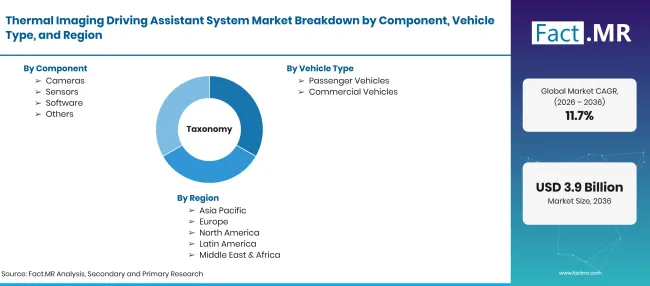
Factmr Thermal Imaging Driving Assistant System Market Taxonomy | Source: Fact.MR
| Items | Values |
|---|---|
| Quantitative Units (2026) | USD 1.29 Billion |
| Vehicle Type | Passenger Vehicles, Commercial Vehicles |
| Application | Night Vision, Pedestrian Detection, Collision Avoidance, Others |
| Sales Channel | OEM, Aftermarket |
| Regions Covered | North America, Latin America, Europe, East Asia, South Asia and Pacific, Middle East & Africa |
| Countries Covered | United States, Germany, Japan, United Kingdom, Brazil, and other countries |
| Key Companies Profiled | Teledyne FLIR, Magna International, AUMOVIO SE, ADASKY, Valeo SA, LYNRED |
| Additional Attributes | Dollar revenue in the Thermal Imaging Driving Assistant System Market is segmented by vehicle type (passenger vehicles, commercial vehicles), application (night vision, pedestrian detection, collision avoidance, others), sales channel (OEM, aftermarket) and region.] |
Source: Fact.MR analysis. Updated Nov 23, 2026
Thermal Imaging Driving Assistant System Market by Segments
-
Vehicle Type
- Passenger Vehicles
- Commercial Vehicles
-
Application
- Night Vision
- Pedestrian Detection
- Collision Avoidance
- Others
-
Sales Channel
- OEM
- Aftermarket
-
Region:
- North America
- United States
- Canada
- Mexico
- Europe
- Germany
- United Kingdom
- France
- Italy
- Spain
- Rest of Europe
- Asia Pacific
- China
- India
- Japan
- South Korea
- Australia
- Rest of Asia Pacific
- Latin America
- Brazil
- Mexico
- Argentina
- Rest of Latin America
- Middle East & Africa
- GCC Countries
- South Africa
- Rest of Middle East & Africa
- North America
Frequently Asked Questions
How big is the global Thermal Imaging Driving Assistant System Market in 2026?
What will be the size of the Thermal Imaging Driving Assistant System Market by 2036?
How fast will the Thermal Imaging Driving Assistant System Market grow during the forecast period?
Who worked on this report


Preview the report firsthand - request a free sample
Free SampleGet the brochure for pricing and purchase details
Download PDF