- Market Value (2025): USD 531.2 Mn
- Estimated Value (2026): USD 570.0 Mn
- Forecast Value (2036): USD 1153.1 Mn
- CAGR (2026-2036): 7.3%
Regenerative Braking Controllers Market Forecast and Outlook 2026 to 2036
The global regenerative braking controllers market was valued at USD 531.2 million in 2025 and reached USD 570.0 million in 2026. The market will reach USD 1153.1 million by 2036, expanding at a CAGR of 7.3% during the 2026 to 2036 assessment period.
Electric and hybrid vehicle makers are placing greater emphasis on regenerative braking controllers because smooth braking depends on balancing motor-based energy recovery with conventional friction brakes. Manufacturers are refining axle-specific controllers, blended braking units and software that works with brake-by-wire and inverter systems. In November 2026, Germany's KBA recorded 94,086 new battery-electric car registrations in October, up 79.5% year on year. Rising EV adoption is creating wider opportunities for regenerative braking controller manufacturers.
Key Takeaways from the Regenerative Braking Controllers Market
- Sales of regenerative braking controllers stood at USD 531.2 million in 2025
- Regenerative Braking Controllers Market Value (2026): USD 570.0 million
- Regenerative Braking Controllers Market Forecast Value (2036): USD 1153.1 million
- Regenerative Braking Controllers Market Forecast CAGR (2026-2036): 7.3%
- Leading Product Type: Axle-specific regenerative controller (31.1%)
- Key Market Participants: Bosch, AUMOVIO (spun off from Continental), ZF, Denso, Brembo, Hitachi Astemo
- Key Growth Regions: South Korea, United States, Germany, Japan, United Kingdom
In October 2026, The BRAKE Report noted that ZF had reached 10 million one-box brake control units and that three by-wire brake systems had started series production in the season. Demand for regenerative braking controllers is growing as brake-by-wire becomes the standard way to blend regenerative and friction braking. Suppliers of regenerative braking controllers are moving control software into central vehicle computers. Similar by-wire adoption is projected to drive sales of regenerative braking controllers across Asia, North America and Europe.
Regenerative Braking Controllers Market
| Metric | Value |
|---|---|
| Estimated Value in (2025) | USD 531.2 million |
| Estimated Value in (2026) | USD 570.0 million |
| Forecast Value in (2036) | USD 1153.1 million |
| Forecast CAGR (2026 to 2036) | 7.3% |
Source: Fact.MR analysis. Updated Nov 23, 2026
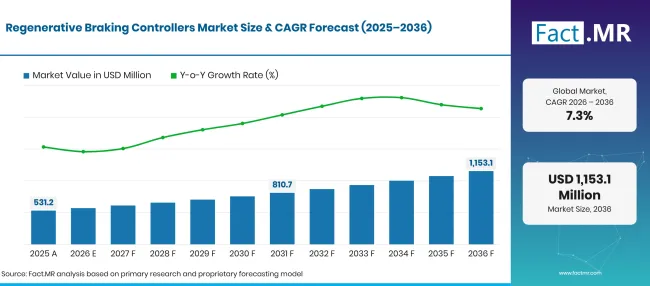
Regenerative Braking Controllers Forecast Global | Source: Fact.MR
Category
| Category | Segments |
|---|---|
| Product Type | Axle-specific regenerative controller, Brake-by-wire regen integration, Motor-inverter braking controller, Blended braking ECU, Battery regeneration control |
| Vehicle Platform | Passenger car, Marine vessel, Aircraft, Commercial vehicle, Specialty and other |
| Integration | Module, Subsystem, Component, OEM integrated, Aftermarket and retrofit |
| Control Type | Hybrid, Electronic, Mechanical, Electromechanical, Electrohydraulic |
| Region | South Korea; United States; Germany; Japan; United Kingdom |
Source: Fact.MR analysis. Updated Nov 23, 2026
Segmental Analysis
Why do axle-specific regenerative controllers lead product demand in the Regenerative Braking Controllers Market?
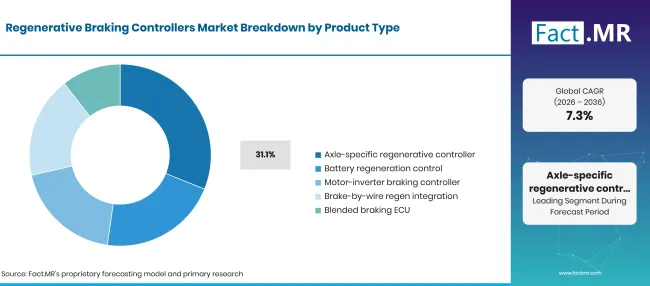
Regenerative Braking Controllers Breakdown Product Type | Source: Fact.MR
Axle-specific regenerative controllers hold a 31.1% market share in 2026, valued at USD 177.3 million, as separate front and rear motor control allows electric vehicles to recover braking energy without compromising wheel grip or vehicle stability. This configuration is particularly useful in dual-motor and all-wheel-drive vehicles. Other controller types are also gaining traction as automakers adopt simpler braking architectures for single-motor models. In 2026, UNECE updated braking provisions covering regenerative torque compensation and friction-brake continuity, reinforcing the need for precise axle-level control.
How are passenger cars leading platform demand in the Regenerative Braking Controllers Market?
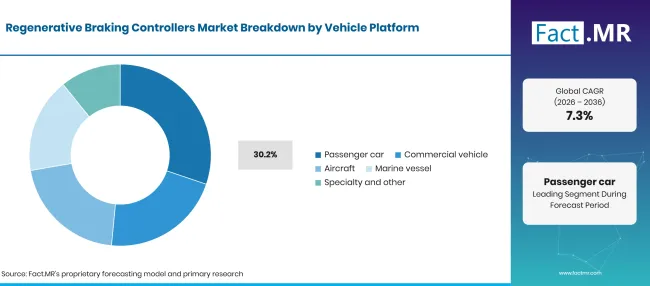
Regenerative Braking Controllers Breakdown Vehicle Platform | Source: Fact.MR
Passenger cars contribute 30.2% of market revenue in 2026, reaching USD 172.1 million, as electric and hybrid models account for a substantial portion of new vehicle programmes. Their high production volumes create a wider installation base for regenerative braking electronics. Commercial vehicles are also attracting interest as electric buses and delivery fleets adopt energy recovery to improve operating efficiency. Hyundai Motor reported 245,540 electrified vehicle sales in the third quarter of 2026, including hybrid, electric and plug-in hybrid models. This expanding passenger vehicle base continues to create opportunities for controller manufacturers.
Why does the module level lead integration demand in the Regenerative Braking Controllers Market?
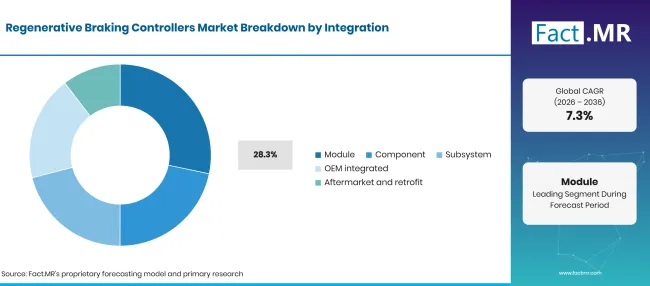
Regenerative Braking Controllers Breakdown Integration | Source: Fact.MR
Module-level integration commands a 28.3% market share in 2026, valued at USD 161.3 million, because automakers prefer consolidated brake control units that bring actuators, sensors and electronic controls into a single assembly. This reduces component complexity and simplifies vehicle integration. Component-level and system-level solutions are also gaining attention as manufacturers develop flexible architectures for different vehicle platforms. In July 2025, ZF described its Integrated Brake Control system as combining electro-hydraulic actuation with stability control and other driving safety functions, highlighting the shift towards consolidated braking hardware.
How is hybrid control leading demand in the Regenerative Braking Controllers Market?
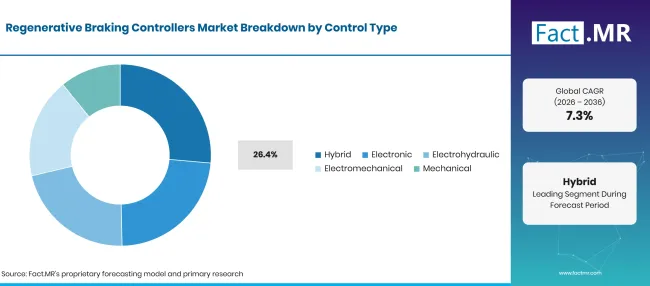
Regenerative Braking Controllers Breakdown Control Type | Source: Fact.MR
Hybrid control holds a 26.4% market share in 2026, valued at USD 150.5 million, as electric vehicles need seamless coordination between motor-based energy recovery and conventional friction braking. The ability to maintain braking performance when regenerative torque changes makes this configuration important for vehicle safety. Pure regenerative and other electronic control approaches are also gaining traction as EV architectures become more sophisticated. In 2026, UNECE braking provisions addressed compensation for changes in regenerative braking torque and continued braking performance, reinforcing the importance of reliable coordination between both braking systems.
Regenerative Braking Controllers Market-Drivers, Restraints & Trends
Drivers: Electrification of Vehicle Production:
The expansion of electric and hybrid vehicle production is creating a wider market for regenerative braking controllers because every electrified platform needs reliable coordination between energy recovery and conventional braking. As automakers increase EV manufacturing capacity, controller installations are rising alongside new vehicle programmes. Hyundai Mobis reported third-quarter 2026 operating profit of KRW 914.1 billion, up 17.2% year on year, supported partly by higher EV production and electronics sales.
Restraints: Margin Pressure and Uneven EV Growth:
Regenerative braking controller manufacturers face margin pressure from expensive automotive electronics, high development costs and uneven EV sales across regions. AUMOVIO reported a 12% decline in third-quarter 2026 adjusted sales to EUR 4.0 billion, highlighting the difficult conditions facing automotive suppliers. Such financial pressure can restrict investment in new braking technologies and delay customer programmes.
Trend: Brake-by-Wire Integration:
Automakers are moving towards brake-by-wire architectures because electronic braking gives them greater control over regenerative energy recovery without compromising braking response. In September 2026, AUMOVIO introduced its distributed brake system and secured its first series-production order from a Chinese automaker, with production scheduled for late 2027. Wider adoption of electronically controlled braking creates opportunities for regenerative braking controllers as EV platforms become more integrated.
Trend: Software-Defined Braking:
Braking systems are becoming more software-driven as automakers shift vehicle functions towards centralized computing and connected control architectures. In January 2026, ZF presented AI Road Sense at CES, highlighting how software can coordinate chassis functions in software-defined vehicles. This transition opens opportunities for regenerative braking controller manufacturers to develop software-compatible control architectures, improve energy recovery calibration and enable future vehicle updates.
Regenerative Braking Controllers Market by Analysis by Key Country
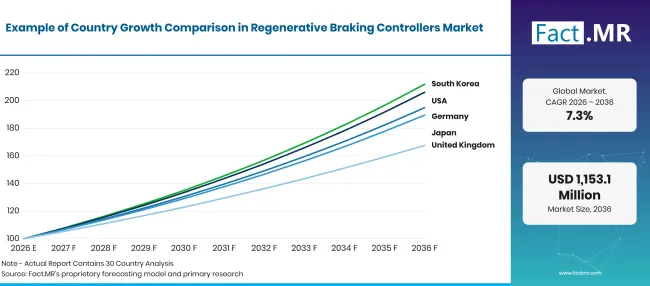
Regenerative Braking Controllers Growth Index | Source: Fact.MR
| Country | CAGR (2026-2036) |
|---|---|
| South Korea | 7.8% |
| United States | 7.5% |
| Germany | 6.9% |
| Japan | 6.6% |
| United Kingdom | 5.3% |
Source: Fact.MR analysis. Updated Nov 23, 2026
What is driving regenerative braking controllers demand in South Korea?
South Korea's regenerative braking controllers market will expand at a CAGR of 7.8% through 2036, supported by its strong automotive electronics industry and increasing production of electric and hybrid vehicles.
In May 2025, South Korea's Ministry of Trade, Industry and Energy reported that eco-friendly vehicles accounted for 52% of domestic automobile sales, surpassing conventional combustion-engine cars for the first time. Wider adoption of hybrid platforms and domestic EV manufacturing is creating additional opportunities for braking controller suppliers.
How are hybrids supporting regenerative braking controllers sales in the United States?
A CAGR of 7.5% through 2036 reflects the expanding use of electrified powertrains across American passenger vehicles and commercial fleets.
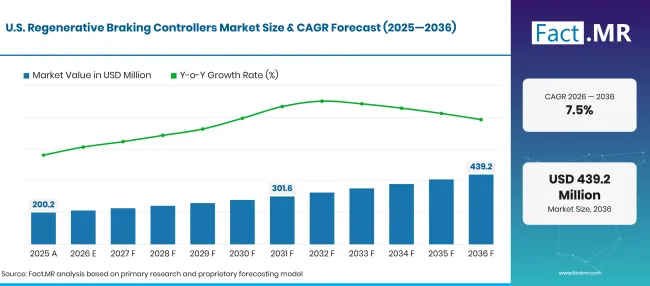
Regenerative Braking Controllers Forecast Usa | Source: Fact.MR
The US Department of Energy's Alternative Fuels Data Center recorded a 21% increase in registered electric vehicles between 2024 and 2025. Demand for energy-efficient vehicle systems, hybrid powertrains and advanced braking electronics is creating opportunities for regenerative braking controller manufacturers, particularly as automakers refine their electric vehicle platforms.
What is shaping regenerative braking controllers demand in Germany?
Germany's market is set to advance at a CAGR of 6.9% during 2026–2036, with domestic automotive engineering and electric vehicle production providing a strong foundation.
According to Germany's VDA, new registrations of battery-electric cars reached 545,100 units in 2025, increasing 43% year on year. The country's established premium vehicle manufacturing base, rising hybrid adoption and focus on electronic braking integration are creating further opportunities for regenerative braking controller suppliers.
How is hybrid leadership shaping regenerative braking controllers sales in Japan?
Japan will record a CAGR of 6.6% through 2036 as automakers continue incorporating energy recovery into hybrid and battery-electric vehicle platforms.
A May 2026 report from Japan's Ministry of Economy, Trade and Industry highlighted 2025 sales of 2.01 million hybrid vehicles, compared with 63,000 battery-electric vehicles. The extensive use of hybrid powertrains, fuel-efficiency priorities and continued automotive electronics innovation are keeping regenerative braking technologies relevant across the domestic vehicle industry.
Why is growth slower for regenerative braking controllers in the United Kingdom?
With a CAGR of 5.3% through 2036, the UK market is benefiting from the gradual electrification of passenger cars and commercial fleets.
Official Department for Transport statistics published in April 2026 showed that new zero-emission vehicle registrations increased 24% in 2025 to 528,000 units. Fleet electrification, stricter vehicle emission targets and wider availability of electric and plug-in hybrid models are creating opportunities for regenerative braking controller suppliers across the country.
Competitive Landscape for Regenerative Braking Controllers Market
Competition in the regenerative braking controllers market is led by global brake and chassis suppliers. Bosch competes with integrated power brake and stability control systems, AUMOVIO, the automotive business spun off from Continental, competes with one-box and distributed brake-by-wire systems, ZF competes with integrated brake control, Brembo competes with its Sensify by-wire system, and Denso and Hitachi Astemo compete with Japanese carmakers. Buyers select regenerative braking controllers on energy recovery, pedal feel, functional safety and cost.
From 2025 onward, competition shifted toward brake-by-wire and software integration. ZF passed 10 million one-box units, AUMOVIO won a first distributed by-wire order, Brembo started Sensify production, and electric registrations jumped in Germany in 2026. Suppliers that integrate regenerative control into by-wire platforms are best placed to grow.
Recent Developments
- On May 21, 2026, Bosch Limited announced a 50:50 joint venture with Brakes India and Wheels India to develop, manufacture and sell electronically controlled air systems for commercial vehicles.
- On June 15, 2026, Continental announced a strategic partnership with Renault Group to develop energy-efficient tyres for electric vehicles. The technology aims to reduce rolling resistance and improve driving range.
- On December 23, 2025, ZF agreed to sell its Advanced Driver Assistance Systems (ADAS) business to HARMAN for an enterprise value of EUR 1.5 billion. The deal will help ZF reduce financial liabilities and focus on its core automotive technology businesses.
- On November 16, 2026, DENSO announced a partnership with Toyota Tsusho to strengthen in-vehicle software development. DENSO plans to acquire a 20% stake in Toyota Tsusho Definex to expand software capabilities for software-defined vehicles.
- On June 17, 2026, Brembo signed a joint venture agreement with Ningbo SAFE Brakes Systems to manufacture motorcycle ABS systems in India. Brembo will hold a 60% stake in the new venture, with production planned at a facility in Chakan, Pune.
Key Players in Regenerative Braking Controllers Market
Key companies operating in the market include Bosch, AUMOVIO (spun off from Continental), ZF, Denso, Brembo, and Hitachi Astemo.
- Bosch
- AUMOVIO (spun off from Continental)
- ZF
- Denso
- Brembo
- Hitachi Astemo
Bibliography
- AUMOVIO SE. (2026, September 10). Smaller brake, greater performance: AUMOVIO unveils its new braking system and receives first series order.
- Alternative Fuels Data Center. (n.d.). Vehicle registration counts by state. U.S. Department of Energy.
- Department for Transport. (2026, April 29). Vehicle licensing statistics: 2025. GOV.UK.
- European Union. (2026, April 13). Commission Regulation (EU) 2026/502: UN Regulation No. 13-H, uniform provisions concerning the approval of passenger cars with regard to braking. Official Journal of the European Union.
- Hyundai Motor Company. (2026, October 29a). Hyundai Motor announces 2026 Q3 business results.
- Hyundai Motor Company. (2026, October 29b). Hyundai Motor reports Q3 and YTD 2026 global retail sales results.
- Ministry of Land, Infrastructure, Transport and Tourism. (2026). Next-generation vehicle adoption status [Government vehicle registration statistics, in Japanese].
- Ministry of Trade, Industry and Energy. (2025, June 17). Eco-friendly auto sales surpass conventional cars in May. Government of the Republic of Korea.
- ZF Friedrichshafen AG. (2025, July 10). Integrated Brake Control (IBC). ZF Press Center.
- ZF Friedrichshafen AG. (2026, January 5). AI Road Sense: Navigating the road ahead. ZF Press Center.
Segmentation
Scope of Report
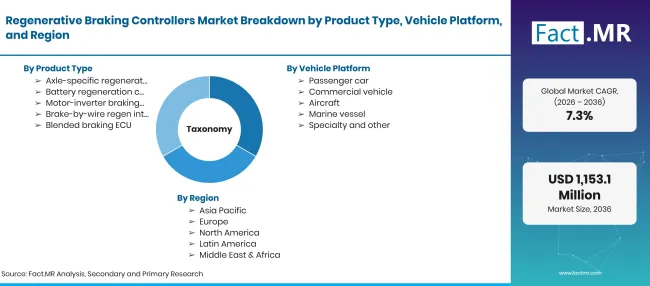
Regenerative Braking Controllers Taxonomy | Source: Fact.MR
| Items | Values |
|---|---|
| Quantitative Units (2026) | USD Million |
| Product Type | Axle-specific regenerative controller, Brake-by-wire regen integration, Motor-inverter braking controller, Blended braking ECU, Battery regeneration control |
| Vehicle Platform | Passenger car, Marine vessel, Aircraft, Commercial vehicle, Specialty and other |
| Integration | Module, Subsystem, Component, OEM integrated, Aftermarket and retrofit |
| Control Type | Hybrid, Electronic, Mechanical, Electromechanical, Electrohydraulic |
| Regions Covered | North America, Latin America, Europe, East Asia, South Asia and Pacific, Middle East & Africa |
| Countries Covered | South Korea, United States, Germany, Japan, United Kingdom, and other countries |
| Key Companies Profiled | Bosch, AUMOVIO (spun off from Continental), ZF, Denso, Brembo, Hitachi Astemo |
| Additional Attributes | Dollar revenue in the Regenerative Braking Controllers Market is segmented by product type (axle-specific controller, brake-by-wire regen integration, motor-inverter controller, blended braking ECU, battery regeneration control), vehicle platform, integration, control type and region. |
Source: Fact.MR analysis. Updated Nov 23, 2026
Source: Fact.MR analysis. Updated 18 Nov 2026
Regenerative Braking Controllers Market by Segments
-
Product Type
- Axle-specific regenerative controller
- Brake-by-wire regen integration
- Motor-inverter braking controller
- Blended braking ECU
- Battery regeneration control
-
Vehicle Platform
- Passenger car
- Marine vessel
- Aircraft
- Commercial vehicle
- Specialty and other
-
Integration
- Module
- Subsystem
- Component
- OEM integrated
- Aftermarket and retrofit
-
Control Type
- Hybrid
- Electronic
- Mechanical
- Electromechanical
- Electrohydraulic
-
Region
- North America
- United States
- Canada
- Mexico
- Europe
- Germany
- United Kingdom
- France
- Italy
- Spain
- Rest of Europe
- Asia Pacific
- China
- India
- Japan
- South Korea
- Australia
- Rest of Asia Pacific
- Latin America
- Brazil
- Mexico
- Argentina
- Rest of Latin America
- Middle East & Africa
- GCC Countries
- South Africa
- Rest of Middle East & Africa
- North America
Frequently Asked Questions
How big is the global Regenerative Braking Controllers Market in 2026?
What will be the size of the Regenerative Braking Controllers Market by 2036?
How fast will the Regenerative Braking Controllers Market grow during the forecast period?
Which product type segment holds the largest share of the Regenerative Braking Controllers Market?
Who worked on this report


Preview the report firsthand - request a free sample
Free SampleGet the brochure for pricing and purchase details
Download PDF