- Base Value(2025): 3.40 Bn
- Estimated Value(2026): 3.53 Bn
- Forecast Value (2036): 5.18 Bn
- CAGR (2026 - 2036): 3.9%
Oligomers Market Size, Market Forecast and Outlook By Fact.MR
The oligomers market was valued at USD 3.40 billion in 2025, projected to reach USD 3.53 billion in 2026, and is forecast to expand to USD 5.18 billion by 2036 at a 3.9% CAGR. is being driven by the UV/EB curing coatings and inks revolution, where acrylate oligomers enable instant-cure, zero-VOC coating and printing systems that are replacing solvent-borne formulations in industrial wood finishing, packaging printing, and electronics conformal coating applications.
The absolute dollar expansion between 2026 and 2036 amounts to approximately USD 1.65 billion. Growth reflects expanding adoption of UV/EB curing technology across industrial coatings, printing inks, and adhesive applications where instant cure, zero VOC, and energy efficiency provide compelling manufacturing advantages. Acrylic acid and specialty monomer feedstock pricing, photoinitiator availability, and the capital cost of UV lamp and LED curing equipment act as adoption variables.
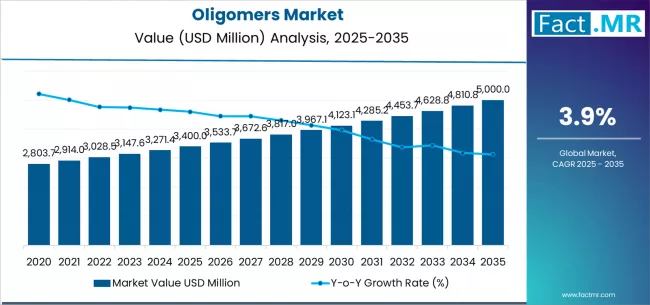
Oligomers Market Market Value Analysis | Source: Fact.MR
Oligomers Market Key Takeaways
| Metric | Details |
|---|---|
| Industry Size (2026) | USD 3.53 billion |
| Industry Value (2036) | USD 5.18 billion |
| CAGR (2026 to 2036) | 3.9% |
Source: Fact.MR analysis. Updated Mar 24, 2026
Industrial coating line engineers are converting from thermal-cure solvent-borne coatings to UV-curable acrylate oligomer systems that achieve full cure in 0.1 to 2 seconds under LED UV lamps. The elimination of solvent flash-off ovens reduces coating line length by 50% to 70% and energy consumption by 80%, creating compelling capital and operating cost advantages for new line installations.
All major regional markets reflect differentiated growth parameters. India sets the pace at 4.8% CAGR. China registers at 4.2% CAGR. USA registers at 3.8% CAGR. Germany registers at 3.6% CAGR. South Korea registers at 3.5% CAGR. France registers at 3.4% CAGR. Japan registers at 3.0% CAGR.
Summary of Oligomers Market
- Oligomers Market Definition
- Oligomers are low-molecular-weight polymers (typically 500 to 10,000 Da) that serve as the primary film-forming component in radiation-curable (UV/EB) coatings, inks, and adhesives. Major oligomer types include acrylate oligomers (urethane acrylate, epoxy acrylate, polyester acrylate), epoxy oligomers, and polyurethane oligomers.
- Demand Drivers in the Market
- UV LED curing adoption: The transition from mercury-arc UV lamps to LED UV curing systems (operating at 365 nm, 385 nm, or 395 nm) reduces energy consumption by 50% and eliminates mercury disposal requirements.
- Packaging ink conversion: Flexible packaging converters are converting from solvent-borne gravure inks to UV/EB-curable inks to eliminate solvent recovery costs and meet food contact compliance requirements.
- 3D printing resin demand: Stereolithography and digital light processing (DLP) 3D printers use acrylate oligomer-based photopolymer resins as the build material.
- Key Segments Analyzed in the Fact.MR Report
- Acrylate type: 45.0% share in 2026.
- Coatings application: 40.0% share in 2026.
- India: 4.8% compound growth through 2036.
- Analyst Opinion at Fact.MR
- Acrylate oligomers hold 45% share because they are the workhorse chemistry of the UV/EB curing industry, with urethane acrylates providing flexibility and abrasion resistance, epoxy acrylates delivering hardness and chemical resistance, and polyester acrylates offering adhesion and weatherability. Coatings hold 40% of application share. Industrial end-use holds 50% share. BASF, Allnex, and Arkema are the three largest acrylate oligomer producers globally, operating dedicated UV resin manufacturing facilities in Europe, North America, and Asia..
- Strategic Implications / Executive Takeaways
- Procurement teams must establish multi-year supply agreements with qualified producers to secure allocation ahead of anticipated demand increases.
- Product development resources should prioritize formulations that meet tightening regulatory specifications in key markets.
- Regional expansion strategies must account for divergent growth rates and regulatory environments across major consuming nations.
Why is the Oligomers Market Growing?
Market expansion is being supported by the increasing demand for high-performance chemical intermediates and the corresponding need for advanced oligomer systems in specialty polymer applications across global coatings, adhesives, and industrial manufacturing operations. Modern chemical manufacturers are increasingly focused on advanced oligomer technologies that can improve product performance, reduce processing costs, and enhance material properties while meeting stringent quality requirements. The proven efficacy of oligomer systems in various industrial applications makes them an essential component of comprehensive material science strategies and advanced manufacturing programs.
The growing emphasis on industrial technology advancement and high-performance material optimization is driving demand for ultra-efficient oligomer systems that meet stringent performance specifications and industrial requirements for specialized applications. Chemical manufacturers' preference for reliable, high-performance oligomer systems that can ensure consistent product quality is creating opportunities for innovative chemical technologies and customized industrial solutions. The rising influence of performance requirements and advanced manufacturing protocols is also contributing to increased adoption of premium-grade oligomer systems across different industrial applications and manufacturing systems requiring advanced polymer technology.
Opportunity Pathways - Oligomers Market
The oligomers market represents a specialized growth opportunity, expanding from USD 3,400.0 million in 2025 to USD 5,000.0 million by 2035 at a 3.9% CAGR. As manufacturers prioritize material performance, industrial compliance, and product quality in complex manufacturing processes, oligomer systems have evolved from a niche chemical technology to an essential component enabling product enhancement, performance optimization, and multi-stage manufacturing production across industrial operations and specialized chemical applications.
The convergence of industrial expansion, increasing oligomer adoption, specialized chemical organization growth, and performance requirements creates momentum in demand. High-efficiency formulations offering superior polymerization performance, cost-effective acrylate systems balancing performance with economics, and specialized epoxy variants for premium applications will capture market premiums, while geographic expansion into high-growth Asian manufacturing markets and emerging market penetration will drive volume leadership. Industrial emphasis on material quality and processing reliability provides structural support.
- Pathway A - Acrylate Dominance: Leading with 45.0% market share, acrylate applications drive primary demand through complex industrial workflows requiring comprehensive polymerization systems for specialized manufacturing. Advanced formulations enabling improved material performance, reduced processing costs, and enhanced product properties command premium pricing from manufacturers requiring stringent performance specifications and industrial compliance. Expected revenue pool: USD 1,530.0-2,250.0 million.
- Pathway B - Coatings Application Leadership: Dominating with 40.0% market share through an optimal balance of performance and cost-effectiveness, coatings serve most industrial applications while meeting material performance requirements. This application addresses both performance standards and economic considerations, making it the preferred choice for industrial and manufacturing operations seeking reliable material performance. Opportunity: USD 1,360.0-2,000.0 million.
- Pathway C - Asian Market Acceleration: India (4.8% CAGR) and China (4.2% CAGR) lead global growth through industrial infrastructure expansion, manufacturing capacity development, and domestic oligomer demand. Strategic partnerships with local manufacturers, industrial compliance expertise, and supply chain localization enable the expansion of oligomer technology in major industrial hubs. Geographic expansion upside: USD 680.0-1,000.0 million.
- Pathway D - Industrial End-Use Premium Segment: Industrial applications serve specialized requirements demanding exceptional performance specifications for critical manufacturing processes. Industrial formulations supporting complex processing requirements, specialized polymerization applications, and performance-sensitive processes command significant premiums from advanced manufacturing organizations and specialized chemical facilities. Revenue potential: USD 1,700.0-2,500.0 million.
- Pathway E - Advanced Processing & Technology Systems: Companies investing in sophisticated oligomer technologies, specialized polymerization systems, and automated manufacturing processes gain competitive advantages through consistent system performance and material quality reliability. Advanced capabilities enabling customized specifications and rapid deployment capture premium industrial partnerships. Technology premium: USD 340.0-500.0 million.
- Pathway F - Supply Chain Optimization & Reliability: Specialized distribution networks, strategic inventory management, and reliable supply chain systems create competitive differentiation in industrial markets requiring consistent oligomer availability. Companies offering guaranteed supply security, technical support, and industrial documentation gain preferred supplier status with compliance-focused manufacturers. Supply chain value: USD 272.0-400.0 million.
- Pathway G - Emerging Applications & Market Development: Beyond traditional acrylate oligomers, oligomer applications in specialty epoxy formulations, advanced polyurethane systems, and novel processing technologies represent growth opportunities. Companies developing new applications, supporting R&D initiatives, and expanding into adjacent industrial markets capture incremental demand while diversifying revenue streams. Emerging opportunity: USD 204.0-300.0 million.
Segmental Analysis
The market is segmented by type, application, end use, and region. By type, the market is divided into acrylate, epoxy, and polyurethane. Based on application, the market is categorized into coatings, adhesives, and inks. By end use, the market is divided into industrial, construction, and electronics. Regionally, the market is divided into Asia Pacific, North America, Europe, Latin America, Middle East & Africa.
By Type, Acrylate Segment Accounts for 45.0% Market Share
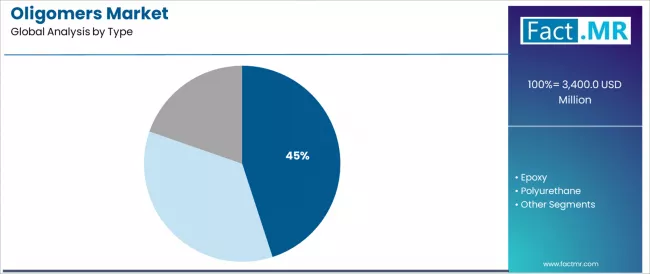
Oligomers Market Analysis By Type | Source: Fact.MR
The acrylate segment is projected to account for 45.0% of the oligomers market in 2025, reaffirming its position as the category's dominant type. Manufacturers increasingly recognize the optimal balance of performance and cost-effectiveness offered by acrylate for most industrial applications, particularly in polymerization processes and chemical manufacturing. This type addresses both performance requirements and economic considerations while providing reliable quality across diverse industrial applications.
This type forms the foundation of most industrial protocols for oligomer applications, as it represents the most widely accepted and commercially viable level of chemical processing technology in the industry. Quality control standards and extensive industrial testing continue to strengthen confidence in acrylate formulations among manufacturing and chemical processing providers.
With increasing recognition of the cost-performance optimization requirements in industrial operations, acrylate systems align with both operational efficiency and material quality goals, making them the central growth driver of comprehensive manufacturing enhancement strategies.
By Application, Coatings Segment Accounts for 40.0% Market Share
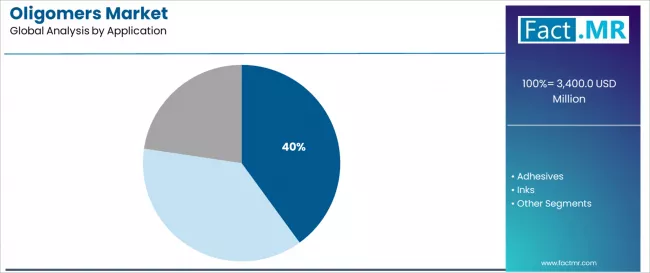
Oligomers Market Analysis By Application | Source: Fact.MR
Coatings are projected to represent 40.0% of oligomers demand in 2025, underscoring its role as the primary application segment driving market adoption and growth. Manufacturers recognize that coatings requirements, including complex formulation processes, specialized material needs, and multi-layer application systems, often require advanced oligomer systems that standard chemical technologies cannot adequately provide. Oligomer systems offer enhanced material performance and processing compliance in coatings manufacturing applications.
The segment is supported by the growing nature of coatings adoption, requiring sophisticated chemical systems, and the increasing recognition that advanced oligomer technologies can improve manufacturing performance and material outcomes. Additionally, manufacturers are increasingly adopting evidence-based industrial guidelines that recommend specific oligomer systems for optimal material performance. As understanding of coating complexity advances and industrial requirements become more stringent, oligomer systems will continue to play a crucial role in comprehensive manufacturing strategies within the coatings market.
By End Use, Industrial Segment Accounts for 50.0% Market Share
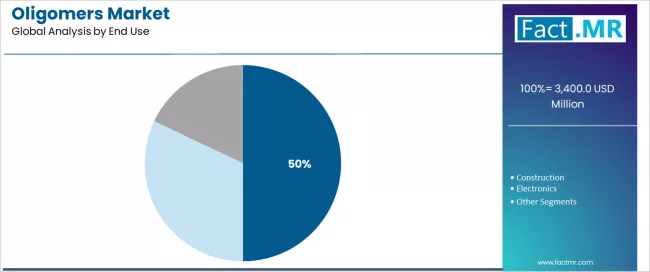
Oligomers Market Analysis By End Use | Source: Fact.MR
The industrial segment is projected to account for 50.0% of the oligomers market in 2025, establishing its position as the category's leading end use. Industrial manufacturers increasingly recognize the critical performance requirements offered by oligomers for complex manufacturing applications, particularly in chemical processing and material production systems. This end use addresses both performance demands and operational considerations while providing consistent quality across diverse industrial manufacturing applications.
Industrial applications form the foundation of most manufacturing protocols for oligomer utilization, representing the most essential and commercially significant level of chemical processing technology in modern industry. Quality control standards and comprehensive industrial validation continue to strengthen confidence in oligomer formulations among manufacturing and processing providers.
With increasing recognition of the performance optimization requirements in industrial operations, oligomer systems align with both operational efficiency and material quality objectives, making them the central growth driver of comprehensive industrial enhancement strategies.
What are the Drivers, Restraints, and Key Trends of the Oligomers Market?
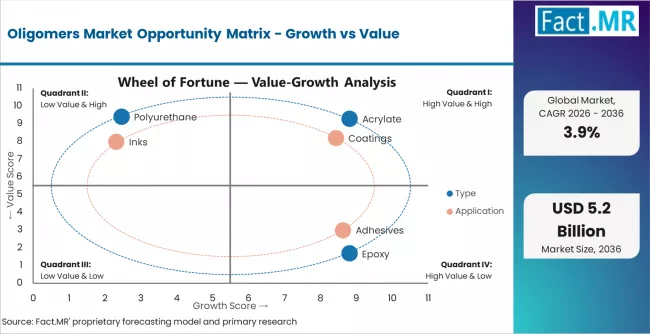
Oligomers Market Opportunity Matrix Growth Vs Value | Source: Fact.MR
The oligomers market is advancing steadily due to increasing recognition of advanced chemical technologies' importance and growing demand for high-efficiency polymerization systems across the industrial and manufacturing sectors.
However, the market faces challenges, including complex processing requirements, potential for performance variations during implementation and operation, and concerns about supply chain consistency for specialized chemical equipment. Innovation in oligomer technologies and customized industrial protocols continues to influence product development and market expansion patterns.
Expansion of Advanced Manufacturing Facilities and Chemical Technologies
The growing adoption of advanced manufacturing facilities is enabling the development of more sophisticated oligomer production and quality control systems that can meet stringent industrial requirements.
Specialized manufacturing facilities offer comprehensive chemical services, including advanced polymerization and processing capabilities that are particularly important for achieving high-efficiency requirements in industrial applications.
Advanced manufacturing channels provide access to premium services that can optimize material performance and reduce processing costs while maintaining cost-effectiveness for large-scale industrial operations.
Integration of Digital Processing Systems and Quality Management Systems
Modern manufacturing organizations are incorporating digital technologies such as real-time performance monitoring, automated processing systems, and supply chain integration to enhance oligomer production and distribution processes. These technologies improve system performance, enable continuous quality monitoring, and provide better coordination between suppliers and manufacturers throughout the production cycle. Advanced digital platforms also enable customized performance specifications and early identification of potential system deviations or supply disruptions, supporting reliable industrial production.
Analysis of the Oligomers Market by Key Country
.webp "Top Country Growth Comparison Oligomers Market Cagr (2026 2036)")
Top Country Growth Comparison Oligomers Market Cagr (2026 2036) | Source: Fact.MR
| Country | CAGR (2026-2036) |
|---|---|
| India | 4.8% |
| China | 4.2% |
| USA | 3.8% |
| Germany | 3.6% |
| South Korea | 3.5% |
| France | 3.4% |
| Japan | 3.0% |
Source: Fact.MR analysis. Updated Mar 24, 2026
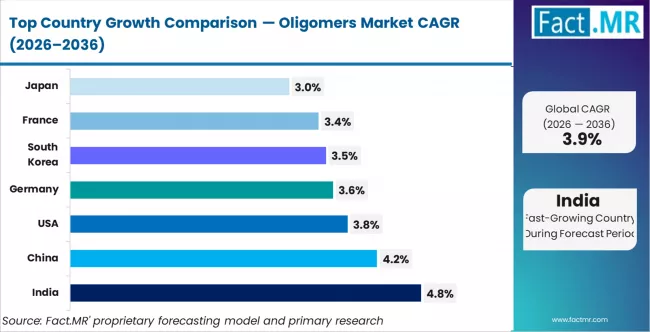
Oligomers Market Cagr Analysis By Country | Source: Fact.MR
The oligomers market is experiencing varied growth globally, with India leading at a 4.8% CAGR through 2036, driven by the expansion of manufacturing infrastructure development, increasing industrial processing capabilities, and growing domestic demand for high-efficiency oligomer systems.
China follows at 4.2%, supported by industrial expansion, growing recognition of advanced chemical technology importance, and expanding manufacturing capacity. USA records 3.8% growth, with a focus on developing the chemical technology and industrial processing industries.
Germany shows 3.6% growth, representing a mature market with established industrial patterns and chemical frameworks. South Korea demonstrates 3.5% growth with focus on advanced manufacturing adoption.
France demonstrates 3.4% growth, emphasizing industrial infrastructure expansion and systematic chemical approaches. Japan demonstrates 3.0% growth, emphasizing manufacturing infrastructure expansion and systematic industrial approaches.
India Demonstrates Growing Market Potential with Manufacturing Infrastructure Development
Revenue from oligomers in India is projected to exhibit robust growth with a CAGR of 4.8% through 2036, driven by ongoing industrial expansion and increasing recognition of high-efficiency oligomer systems as essential chemical components for complex manufacturing processes. The country's expanding manufacturing infrastructure and growing availability of specialized chemical processing capabilities are creating significant opportunities for oligomer adoption across both domestic and export-oriented industrial facilities. Major international and domestic chemical companies are establishing comprehensive production and distribution networks to serve the growing population of manufacturers and industrial facilities requiring high-performance oligomer systems across chemical and manufacturing applications throughout India's major industrial hubs.
The Indian government's strategic emphasis on chemical industry modernization and manufacturing advancement is driving substantial investments in specialized chemical processing capabilities. This policy support, combined with the country's large domestic manufacturing market and expanding industrial requirements, creates a favorable environment for the oligomers market development. Indian manufacturers are increasingly focusing on high-value chemical technologies to improve processing capabilities, with oligomer systems representing a key component in this industrial transformation.
- Government initiatives supporting industrial development and chemical modernization are driving demand for high-efficiency oligomer systems throughout major manufacturing and chemical centers, including Mumbai, Gujarat, and Chennai regions.
- Manufacturing capacity expansion and chemical processing system development are supporting appropriate utilization of oligomer systems among manufacturers and industrial facilities nationwide, with particular growth in specialty chemical operations and manufacturing enhancement services.
China Demonstrates Exceptional Market Potential with Industrial Growth
Revenue from oligomers in China is expanding at a CAGR of 4.2%, supported by increasing industrial accessibility, growing manufacturing awareness, and developing chemical market presence across the country's major industrial clusters. The country's large manufacturing sector and increasing recognition of advanced oligomer systems are driving demand for effective high-efficiency chemical solutions in both industrial processing and manufacturing applications. International chemical companies and domestic providers are establishing comprehensive distribution channels to serve the growing demand for quality oligomer systems while supporting the country's position as an emerging chemical technology market.
China's manufacturing sector continues to benefit from favorable industrial policies, expanding chemical capabilities, and cost-competitive manufacturing infrastructure development. The country's focus on becoming a global chemical technology hub is driving investments in specialized oligomer technology and industrial processing infrastructure. This development is particularly important for oligomer applications, as manufacturers seek reliable domestic sources for critical chemical technologies to reduce import dependency and improve supply chain security.
- Rising awareness about advanced chemical processing options and improving manufacturing capabilities are creating opportunities for specialized oligomer systems across industrial and manufacturing settings in major hubs like Beijing, Shanghai, and Guangzhou.
- Growing manufacturing infrastructure development and technology adoption are supporting increased access to high-efficiency oligomer systems among organizations requiring comprehensive chemical processing capabilities, particularly in industrial processing and manufacturing organizations.
USA Maintains Technology Leadership
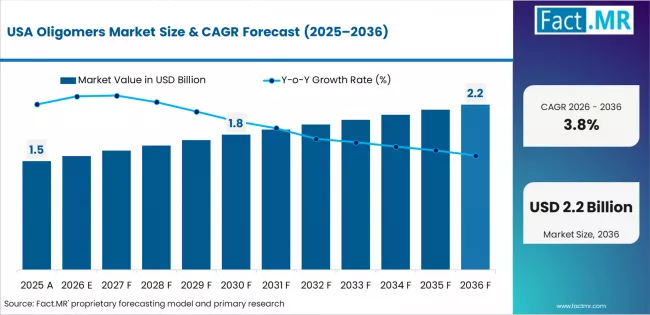
Oligomers Market Country Value Analysis | Source: Fact.MR
USA's advanced chemical technology market demonstrates sophisticated industrial processing deployment with documented oligomer effectiveness in manufacturing departments and industrial centers through integration with existing chemical systems and processing infrastructure. The country leverages industrial expertise in chemical technology and manufacturing systems integration to maintain a 3.8% CAGR through 2036. Industrial centers, including major metropolitan areas, showcase premium installations where oligomer systems integrate with comprehensive manufacturing information systems and processing platforms to optimize chemical accuracy and operational workflow effectiveness.
American manufacturers prioritize system reliability and industrial compliance in chemical development, creating demand for premium systems with advanced features, including quality validation and integration with US industrial standards. The market benefits from established chemical industry infrastructure and a willingness to invest in advanced oligomer technologies that provide long-term operational benefits and compliance with industrial regulations.
Germany Shows Strong Regional Leadership
Germany's market expansion benefits from diverse industrial demand, including manufacturing modernization in major industrial centers, chemical processing development programs, and government industrial programs that increasingly incorporate oligomer solutions for manufacturing enhancement applications. The country maintains a 3.6% CAGR through 2036, driven by rising industrial awareness and increasing adoption of chemical processing benefits, including superior manufacturing capabilities and reduced complexity.
Market dynamics focus on cost-effective oligomer solutions that balance advanced chemical features with affordability considerations important to German industrial operators. Growing manufacturing infrastructure creates demand for modern chemical processing systems in new industrial facilities and manufacturing equipment modernization projects.
Strategic Market Considerations:
- Manufacturing and industrial processing segments leading growth with focus on chemical enhancement and operational efficiency applications
- Regional industrial requirements are driving a diverse product portfolio from basic oligomer systems to advanced chemical processing platforms
- Import dependency challenges offset by potential local development partnerships with international chemical manufacturers
- Government industrial initiatives beginning to influence procurement standards and manufacturing requirements
South Korea Emphasizes Advanced Manufacturing
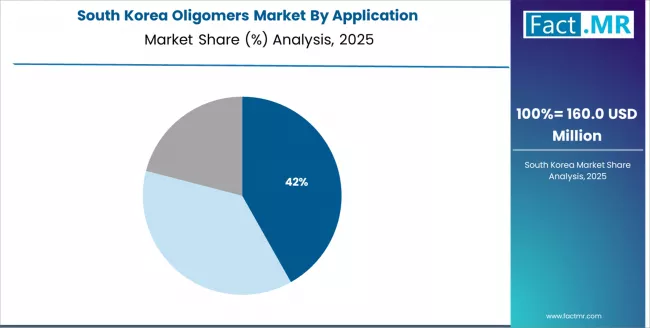
Oligomers Market South Korea Market Share Analysis By Application | Source: Fact.MR
South Korea demonstrates strong market development with a 3.5% CAGR through 2036, driven by advanced manufacturing infrastructure and industrial preference for technology-integrated oligomer systems. The country's sophisticated industrial ecosystem and high technology adoption rates are creating significant opportunities for oligomer adoption across both domestic and technology-driven manufacturing facilities. Major international and domestic chemical companies are establishing comprehensive production and distribution networks to serve the growing population of advanced manufacturers and industrial facilities requiring high-performance oligomer systems across specialized and manufacturing applications throughout South Korea's major industrial hubs.
The South Korean government's strategic emphasis on advanced manufacturing and industrial technology is driving substantial investments in specialized chemical processing capabilities. This policy support, combined with the country's technology-focused industrial base and expanding manufacturing requirements, creates a favorable environment for the oligomers market development. South Korean manufacturers are increasingly focusing on high-value industrial technologies to improve processing capabilities, with oligomer systems representing a key component in this manufacturing transformation.
- Government initiatives supporting advanced manufacturing development and technology modernization are driving demand for high-efficiency oligomer systems throughout major industrial and chemical centers, including Seoul, Busan, and Ulsan regions.
- Technology capacity expansion and advanced processing system development are supporting appropriate utilization of oligomer systems among manufacturers and industrial facilities nationwide, with particular growth in high-tech manufacturing operations and specialized industrial processing services.
Japan Emphasizes Precision and Quality Excellence
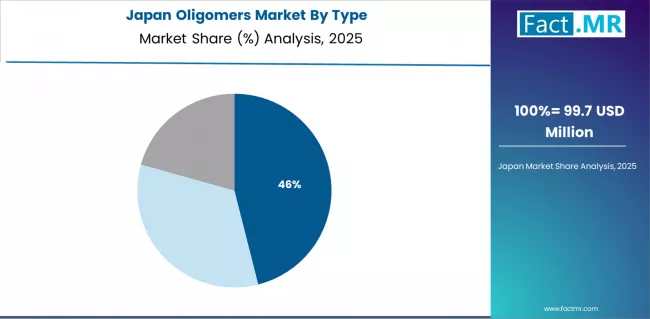
Oligomers Market Japan Market Share Analysis By Type | Source: Fact.MR
Japan demonstrates steady market development with a 3.0% CAGR through 2036, distinguished by manufacturers' preference for high-quality oligomer systems that integrate seamlessly with existing industrial equipment and provide reliable long-term operation in specialized chemical applications. The market prioritizes advanced features, including precision processing capabilities, quality validation, and integration with comprehensive manufacturing platforms that reflect Japanese industrial expectations for technological advancement and operational excellence.
Japanese manufacturers focus on system reliability and precision in chemical development, creating demand for premium systems with advanced features including automated quality monitoring and comprehensive technical support. The market benefits from established industrial research infrastructure and investment in chemical technology that provides long-term manufacturing benefits.
Strategic Market Indicators:
- Premium focus on precision systems with advanced processing capabilities and high-reliability features
- Integration requirements with existing manufacturing information systems and industrial management platforms
- Emphasis on oligomer reliability and long-term performance in industrial applications
France Shows Steady Industrial Growth
France demonstrates consistent market development with a 3.4% CAGR through 2036, characterized by industrial operators' emphasis on high-quality oligomer systems that complement existing chemical infrastructure and provide dependable performance in specialized manufacturing applications. The market prioritizes comprehensive features, including advanced processing protocols, quality assurance, and integration with established industrial platforms that align with French manufacturing standards for chemical excellence and operational reliability.
French manufacturers focus on system integration and chemical performance optimization, creating demand for sophisticated systems with comprehensive capabilities including automated processing control and extensive technical documentation. The market benefits from established chemical research infrastructure and strategic investment in industrial technology that delivers long-term competitive advantages.
Europe Market Split by Country
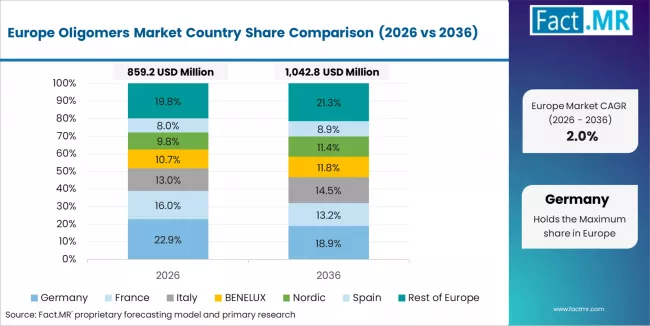
Oligomers Market Europe Country Market Share Analysis, 2026 & 2036 | Source: Fact.MR
The oligomers market in Europe is projected to grow significantly, with individual country performance varying across the region. Germany is expected to maintain its leadership position with a market value of USD 720.0 million in 2026, supported by its advanced manufacturing infrastructure, precision chemical processing capabilities, and strong industrial presence throughout major manufacturing regions.
UK follows with USD 500.0 million in 2026, driven by advanced industrial protocols, chemical innovation integration, and expanding specialty manufacturing networks serving both domestic and international markets. France holds USD 400.0 million in 2026, supported by manufacturing infrastructure expansion and growing adoption of high-efficiency oligomer systems. Italy commands USD 340.0 million in 2026, while Spain accounts for USD 280.0 million in 2026. The Rest of Europe region, including Nordic countries, Eastern Europe, and smaller Western European markets, holds USD 740.0 million in 2026, representing diverse market opportunities with established manufacturing and industrial processing capabilities.
Competitive Landscape of the Oligomers Market
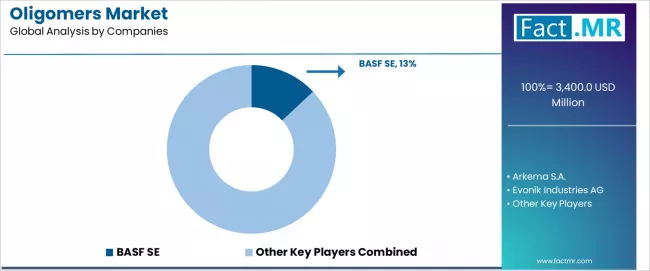
Oligomers Market Analysis By Company | Source: Fact.MR
The oligomers market is characterized by competition among established chemical companies, specialty polymer manufacturers, and industrial technology suppliers focused on delivering high-efficiency, consistent, and reliable oligomer systems. Companies are investing in chemical technology advancement, performance control enhancement, strategic partnerships, and customer technical support to deliver effective, efficient, and reliable oligomer solutions that meet stringent industrial and manufacturing requirements. Product optimization, performance validation protocols, and supply chain strategies are central to strengthening product portfolios and market presence.
BASF leads the market with comprehensive high-efficiency oligomer system offerings with a focus on performance consistency and chemical reliability for industrial applications, holding approximately 13.0% market share. Arkema provides specialized chemical systems with emphasis on industrial processing applications and comprehensive technical support services.
Evonik focuses on advanced oligomer technologies and customized industrial solutions for chemical systems serving global markets. Allnex delivers established manufacturing systems with strong performance control systems and customer service capabilities.
DSM operates with a focus on bringing innovative oligomer technologies to specialized industrial applications and emerging markets. Covestro provides comprehensive chemical system portfolios, including advanced oligomer services, across multiple industrial applications and manufacturing processes.
Dow specializes in customized chemical solutions and performance management systems for industrial systems with emphasis on manufacturing compliance. Toagosei provides reliable supply chain solutions and technical expertise to enhance market accessibility and customer access to essential oligomer systems.
Key Players in the Oligomers Market
- BASF SE
- Arkema S.A.
- Evonik Industries AG
- Allnex S.A.
- DSM N.V.
- Covestro AG
- Dow Inc.
- Toagosei Co., Ltd.
- Eternal Materials Co., Ltd.
- Jiangsu Sanmu Group Co., Ltd.
- Hitachi Chemical Co., Ltd.
- Cytec Industries Inc.
- Showa Denko K.K.
- Alberdingk Boley GmbH
- Momentive Performance Materials Inc.
Bibliography
- Allnex SA. (2024). UV/EB curable resins: Acrylate oligomer product portfolio. Allnex.
- BASF SE. (2024). Radiation curing resins: Laromer product range. BASF.
- Arkema SA. (2024). Sartomer: Specialty acrylate oligomers for UV/EB applications. Arkema.
- DSM-Firmenich. (2024). UV curing resins: Fibre optic and industrial coating grades. dsm-firmenich.
- Eternal Materials Co., Ltd. (2024). UV resins: Acrylate oligomer specifications. Eternal.
- RadTech International. (2024). UV/EB technology conference proceedings: Market trends. RadTech.
This bibliography is provided for reader reference. The full Fact.MR report contains the complete reference list with primary research documentation.
This Report Addresses
- Market sizing and quantitative forecast metrics detailing the precise expenditure dedicated to oligomers across major industrial sectors through 2036.
- Segmentation analysis mapping the adoption patterns of specific type categories and evaluating the technical and economic factors driving segment share distribution.
- Regional deployment intelligence comparing growth trajectories across Asia Pacific, North America, Europe, Latin America, and Middle East and Africa.
- Regulatory compliance assessment analyzing how evolving standards and policies affect product specifications and market access in key consuming regions.
- Competitive posture evaluation tracking the positioning of leading producers and the structural factors determining competitive advantage.
- Capital investment strategic guidance defining the procurement and capacity planning considerations for industry participants.
- Supply chain risk analysis identifying the specific feedstock, logistics, and regulatory variables that constrain market expansion.
- Custom data delivery formats encompassing interactive dashboards, raw Excel datasets, and PDF narrative reports.
Oligomers Market Definition
Oligomers are low-molecular-weight polymers (typically 500 to 10,000 Da) that serve as the primary film-forming component in radiation-curable (UV/EB) coatings, inks, and adhesives. Major oligomer types include acrylate oligomers (urethane acrylate, epoxy acrylate, polyester acrylate), epoxy oligomers, and polyurethane oligomers. When exposed to ultraviolet light or electron beam radiation in the presence of photoinitiators, acrylate oligomers undergo rapid free-radical polymerization to form crosslinked, solvent-free films with excellent hardness, adhesion, and chemical resistance.
Oligomers Market Inclusions
Market scope covers global and regional revenue for oligomers across acrylate, epoxy, and polyurethane types. Application segments include coatings, adhesives, and inks. End-use segments span industrial, construction, and electronics. The forecast period is 2026 to 2036.
Oligomers Market Exclusions
The scope excludes high-molecular-weight polymers (resins above 10,000 Da). Reactive diluent monomers (TPGDA, HDDA, TMPTA) sold separately from oligomers are excluded. UV/EB curing equipment and photoinitiators fall outside the boundary.
Oligomers Market Research Methodology
-
Primary Research: Analysts engaged with procurement specialists, process engineers, and supply chain directors across producing and consuming regions to map the specific decision criteria triggering purchasing and specification changes.
-
Desk Research: Data collection aggregated regulatory filings, trade body publications, standards body documentation, and company disclosures relevant to the product category.
-
Market-Sizing and Forecasting: Baseline values derive from a bottom-up aggregation of production volumes and trade flows, applying region-specific demand curves to project adoption velocity through 2036.
-
Data Validation and Update Cycle: Projections are tested against publicly reported industry expenditure guidance and cross-referenced with primary interview data to ensure internal consistency.
Segmentation
Scope of the Report
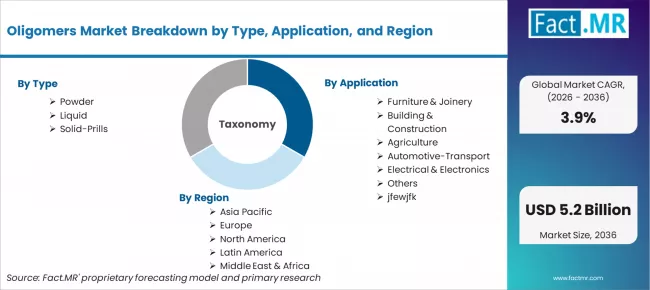
Oligomers Market Breakdown By Type, Application, And Region | Source: Fact.MR
| Metric | Value |
|---|---|
| Quantitative Units | USD 3.53 billion to USD 5.18 billion, at a CAGR of 3.9% |
| Market Definition | Oligomers are low-molecular-weight polymers (typically 500 to 10,000 Da) that serve as the primary film-forming component in radiation-curable (UV/EB) coatings, inks, and adhesives. Major oligomer types include acrylate oligomers (urethane acrylate, epoxy acrylate, polyester acrylate), epoxy oligomers, and polyurethane oligomers. |
| Type Segmentation | Acrylate, Epoxy, Polyurethane |
| Application Segmentation | Coatings, Adhesives, Inks |
| End Use Segmentation | Industrial, Construction, Electronics |
| Regions Covered | North America, Latin America, Europe, East Asia, South Asia, Oceania, Middle East & Africa |
| Countries Covered | India, China, USA, Germany, South Korea, France, Japan, and 40 plus countries |
| Key Companies Profiled | BASF SE, Arkema S.A., Evonik Industries AG, Allnex S.A., DSM N.V., Covestro AG, Dow Inc., Toagosei Co., Ltd., Eternal Materials Co., Ltd., Jiangsu Sanmu Group Co., Ltd., Hitachi Chemical Co., Ltd., Cytec Industries Inc., Showa Denko K.K., Alberdingk Boley GmbH, Momentive Performance Materials Inc. |
| Forecast Period | 2026 to 2036 |
| Approach | Hybrid top-down and bottom-up methodology reconciling production, trade, and consumption data with primary research validation. |
Source: Fact.MR analysis. Updated Mar 24, 2026
Oligomers Market by Segments
-
Type :
- Acrylate
- Epoxy
- Polyurethane
-
Application :
- Coatings
- Adhesives
- Inks
-
End Use :
- Industrial
- Construction
- Electronics
-
Region :
-
Asia Pacific
- China
- India
- Japan
- South Korea
- ASEAN
- Australia & New Zealand
- Rest of Asia Pacific
-
North America
- United States
- Canada
- Mexico
-
Europe
- Germany
- United Kingdom
- France
- Italy
- Spain
- Nordic
- BENELUX
- Rest of Europe
-
Latin America
- Brazil
- Argentina
- Chile
- Rest of Latin America
-
Middle East & Africa
- Kingdom of Saudi Arabia
- Other GCC Countries
- Turkey
- South Africa
- Other African Countries
- Rest of Middle East & Africa
-
Frequently Asked Questions
How large is the demand for Oligomers in the global market in 2026?
What will be the market size of Oligomers in the global market by 2036?
What is the expected demand growth for Oligomers in the global market between 2026 and 2036?
Which Type is poised to lead global sales by 2026?
How is the Application segment structured in this report?
What is the growth outlook for India in this report?
What is Oligomers and what is it mainly used for?
How does Fact.MR build and validate the Oligomers forecast?
Who worked on this report


Preview the report firsthand - request a free sample
Free SampleGet the brochure for pricing and purchase details
Download PDF