- Base Value(2025): 5.9 Bn
- Estimated Value(2026): 6.5 Bn
- Forecast Value (2036): 17.1 Bn
- CAGR (2026 - 2036): 10.2%
Omni-Channel Fulfillment and Inventory Orchestration Platforms Market Forecast and Outlook (2026 to 2036)
In 2025, the omni-channel fulfillment and inventory orchestration platforms market was valued at USD 5.9 billion. Based on Fact.MR analysis, demand for omni-channel fulfillment and inventory orchestration platforms is estimated to grow to USD 6.5 billion in 2026 and USD 17.1 billion by 2036. Fact.MR projects a CAGR of 10.2% during the forecast period.
.webp "Image (3)")
Image (3) | Source: Fact.MR
| Metric | Details |
|---|---|
| Industry Size (2026) | USD 6.5 billion |
| Industry Value (2036) | USD 17.1 billion |
| CAGR (2026 to 2036) | 10.2% |
Source: Fact.MR analysis. Updated May 7, 2026
Summary of Omni-Channel Fulfillment and Inventory Orchestration Platforms Market
- Market Definition
- The market includes platforms that orchestrate fulfillment decisions and inventory availability across stores, warehouses, digital channels, and returns networks to support more accurate, flexible omnichannel commerce.
- Demand Drivers
- Retailers need one inventory view across channels because digital demand is now too large to manage with disconnected stock signals.
- Store-based fulfillment, pickup, and returns require real-time decision logic rather than static routing rules. [2]
- Retailers are using AI and optimization more actively to improve inventory productivity and operational responsiveness.
- Key Segments Analyzed
- By Component, Software is expected to hold 72.6% share in 2026, supported by the core platform role of orchestration engines, inventory logic, and decision workflows.
- By Deployment, Cloud is projected to account for 68.9% share in 2026 because composable and continuously updated fulfillment orchestration is easier to scale in cloud environments.
- By Fulfillment Model, Distributed Order Management is likely to capture 29.8% share in 2026 due to its central role in node selection, inventory exposure, and exception handling.
- Analyst Opinion at Fact.MR
- Shambhu Nath Jha, Senior Analyst at Fact.MR, opines framed as an order management software category, though the stronger commercial reality is broader. Retailers do not buy these platforms only to move an order to the next node. They buy them because inventory truth, service promises, and margin protection now depend on orchestration quality. A platform that makes more order promises is not automatically better. The better platform is the one that makes promises the operation can actually keep.
- Strategic Implications
- Retailers need to treat inventory orchestration as a margin and service discipline, not just a commerce feature.
- Platform buyers should prioritize accurate available-to-sell logic and exception management before layering in more customer-facing promise options.
- Vendors that combine order orchestration, inventory visibility, and returns-aware decisioning are better positioned than suppliers focused on isolated workflows.
- Methodology
- Focus on decision-makers controlling omnichannel fulfillment design and inventory exposure.
- Uses official retail and vendor sources rather than generalized software-market estimates.
- Connects digital retail growth, fulfillment complexity, and platform adoption in inventory-intensive verticals.
- Cross-checks product positioning, case evidence, and current omnichannel trends in retail operations.
The market is projected to generate USD 10.6 billion in absolute opportunity between 2026 and 2036. Growth remains strong but structurally selective. Retailers no longer invest in these platforms only to add another online fulfillment option. They invest because fulfillment decisions now sit at the center of customer experience, margin protection, labor use, and inventory productivity.
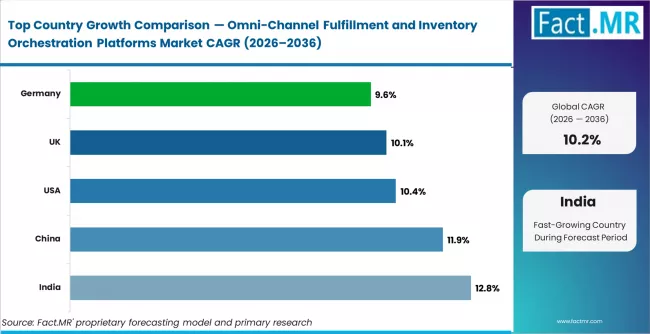
India leads with a projected CAGR of 12.8% through 2036, driven by rapid expansion of digital retail and increasing need for unified inventory visibility across multiple fulfillment nodes. China follows at 11.9%, supported by large-scale e-commerce ecosystems and growing demand for advanced order orchestration across complex retail networks. The United States records 10.4%, with growth anchored in mature omnichannel operations and continued investment in fulfillment optimization and inventory accuracy. The United Kingdom grows at 10.1%, driven by strong adoption of store-based fulfillment and evolving unified commerce strategies. Germany expands at 9.6%, supported by rising emphasis on coordinated fulfillment execution and cross-channel inventory control.
Segmental Analysis
Omni-Channel Fulfillment and Inventory Orchestration Platforms Market Analysis by Component
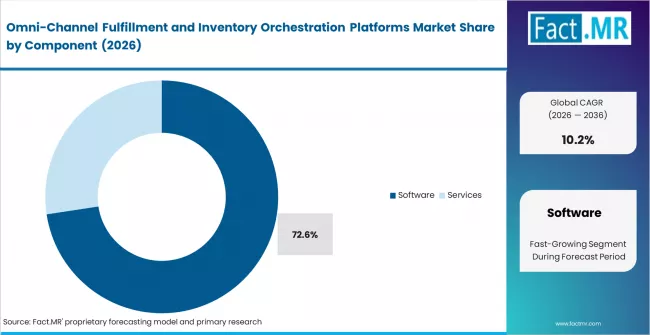
Omni Channel Fulfillment And Inventory Orchestration Platforms Market Analysis By Component | Source: Fact.MR
Software is expected to account for 72.6% share in 2026, as the core value in this market sits inside orchestration logic rather than in deployment labor alone. Retailers adopt these platforms to decide where inventory should be exposed, which node should fulfill an order, how substitutions should be handled, and when store stock should be reserved for digital demand instead of shelf availability. Manhattan’s OMS positioning centers on orchestrating orders across channels and optimizing fulfillment decisions, while Fluent Commerce emphasizes distributed order management and inventory availability as the heart of scalable omnichannel operations. That makes software the primary revenue and value anchor in this category, while services remain important for integration, migration, and process redesign. [3]
- Decision logic: Software captures the value because fulfillment-node selection and inventory truth depend on platform rules, data processing, and orchestration workflows.
- Scalability: Once implemented well, the platform can support more channels, nodes, and order types without the same linear rise in service effort.
- Reuse value: Retailers often gain more from reusable orchestration logic than from one-time implementation work alone.
Omni-Channel Fulfillment and Inventory Orchestration Platforms Market Analysis by Deployment
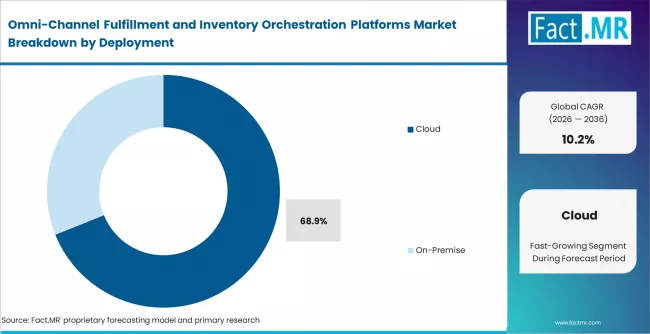
Omni Channel Fulfillment And Inventory Orchestration Platforms Market Analysis By Deployment | Source: Fact.MR
Cloud is projected to hold 68.9% share in 2026. This segment leads because omnichannel execution changes too quickly for retailers to remain dependent on slow upgrade cycles and rigid architecture. Store fulfillment, click-and-collect, returns decisioning, and new promise rules often need continuous adjustment. Manhattan’s broader unified commerce messaging and Fluent Commerce’s composable positioning both reflect the market’s move toward flexible deployment and ongoing improvement rather than infrequent system resets. Cloud deployment also aligns with the way retailers now evaluate platform modernization, especially when they want faster rollout across geographies, channels, and store networks.
- Release agility: Cloud deployment makes it easier to update fulfillment logic and inventory rules without waiting for long upgrade cycles.
- Rollout speed: Multi-region or multi-banner retailers can extend orchestration more quickly across estates when the platform is cloud-based.
- Composability: Retailers increasingly want modular commerce architecture, which strengthens cloud preference in modern deployments.
Omni-Channel Fulfillment and Inventory Orchestration Platforms Market Analysis by Fulfillment Model
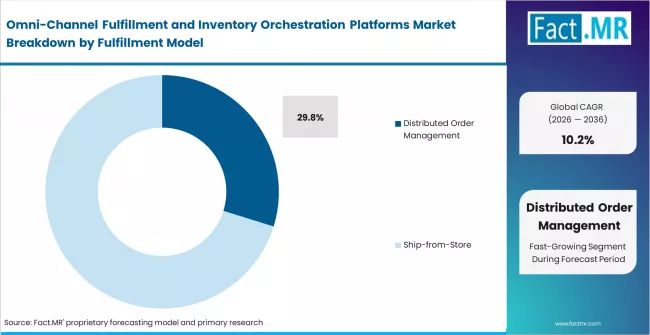
Omni Channel Fulfillment And Inventory Orchestration Platforms Market Analysis By Fulfillment Model | Source: Fact.MR
Distributed Order Management is likely to account for 29.8% share over the assessment period, as it sits at the center of omnichannel orchestration. A retailer can add more channels and nodes, though the operation still fails if it cannot decide where the order should go and whether the inventory is truly available. Distributed order management solves that coordination problem. IBM’s Sterling positioning and recent case-based messaging around reduced stock-out-related order cancellations underline how much performance depends on better orchestration rather than on more inventory alone. This is why DOM remains the functional core of the category even as adjacent use cases such as returns and click-and-collect continue to grow. [4]
- Node intelligence: DOM matters because retailers need rules that can choose between stores, warehouses, and other fulfillment points in real time.
- Promise integrity: Better orchestration reduces the gap between what the customer sees and what the operation can actually fulfill.
- Exception handling: The segment leads because disruptions, substitutions, and stock imbalances are now normal parts of retail fulfillment.
Drivers, Restraints, and Opportunities
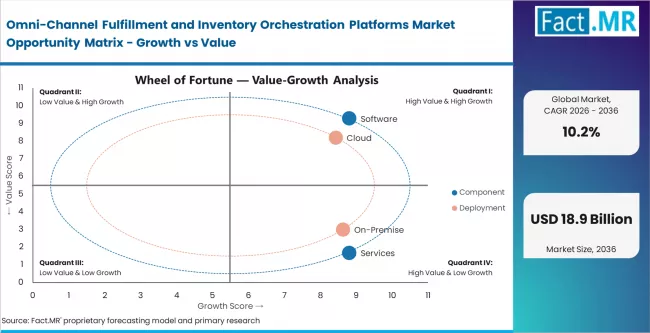
Omni Channel Fulfillment And Inventory Orchestration Platforms Market Opportunity Matrix Growth Vs Value | Source: Fact.MR
A key driver is the continued rise of digital retail and the operational burden that comes with it. U.S. e-commerce sales reached at significant rate, which reinforces how much customer demand now touches digital inventory and fulfillment workflows. Retailers can no longer treat e-commerce as a separate channel with its own isolated stock pool. They need platforms that can make inventory visible, allocate demand intelligently, and reduce fulfillment friction across stores and distribution centers. NRF’s 2025 commentary on AI and inventory optimization supports this direction, as does current vendor emphasis on unified commerce and orchestrated fulfillment.
The main restraint is not lack of interest. It is data and process inconsistency. Omnichannel orchestration depends on reliable stock records, store execution readiness, returns reintegration, and integration with legacy retail systems. Fluent Commerce has explicitly highlighted real-time inventory visibility as a challenge where legacy ERPs and commerce platforms were not built to support omnichannel scale. That means many retailers want the orchestration outcome before they have stabilized the inventory truth required to support it. [5]
Opportunities in the Omni-Channel Fulfillment and Inventory Orchestration Platforms Market
- Returns-aware orchestration: NRF’s 2025 returns landscape shows that online returns remain significant, creating room for platforms that fold returns into inventory and fulfillment decisions instead of treating them as downstream exceptions.
- Store fulfillment expansion: Retailers are still looking for ways to turn stores into more effective fulfillment nodes while controlling cost and service trade-offs.
- AI-guided orchestration: Blue Yonder and NRF both point to rising use of AI and adaptive decisioning in supply chain and retail operations, which supports stronger platform value in the next phase of market growth. [6]
Regional Analysis
Based on the regional analysis, the Omni-Channel Fulfillment and Inventory Orchestration Platforms Market is segmented into North America, Europe, Asia Pacific, Latin America, and Middle East & Africa across 40 plus countries.
.webp "Top Country Growth Comparison Omni Channel Fulfillment And Inventory Orchestration Platforms Market Cagr (2026 2036)")
Top Country Growth Comparison Omni Channel Fulfillment And Inventory Orchestration Platforms Market Cagr (2026 2036) | Source: Fact.MR
| Country | CAGR (2026 to 2036) |
|---|---|
| India | 12.8% |
| China | 11.9% |
| United States | 10.4% |
| United Kingdom | 10.1% |
| Germany | 9.6% |
Source: Fact.MR analysis. Updated May 7, 2026
Source: Fact.MR analysis, based on proprietary forecasting model and primary research.
Omni Channel Fulfillment And Inventory Orchestration Platforms Market Cagr Analysis By Country | Source: Fact.MR
North America Omni-Channel Fulfillment and Inventory Orchestration Platforms Market Analysis
Omni Channel Fulfillment And Inventory Orchestration Platforms Market Country Value Analysis | Source: Fact.MR
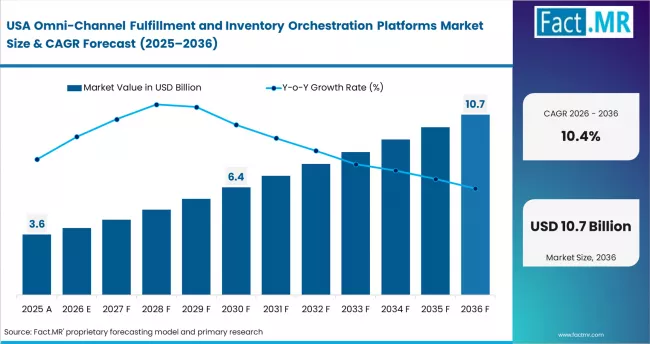
North America remains the largest revenue center in this market because digital retail penetration, store-network complexity, and platform modernization budgets are all relatively mature. The United States anchors regional demand through its scale in e-commerce and its high operational exposure to pickup, ship-from-store, and returns workflows. Census data shows the continued weight of digital retail in the U.S., while multiple platform vendors use North American retail examples to demonstrate orchestration value in real operations. This keeps the region central to current spending even as growth rates in Asia Pacific remain higher.
- United States: The U.S. market is projected to grow at 10.4% CAGR, supported by large-scale digital retail operations and increasing expectations around fulfillment speed and accuracy. Retailers rely on orchestration platforms to manage inventory across stores, warehouses, and last-mile nodes. As fulfillment complexity increases, platform performance directly impacts service levels and order success rates. Continued investment in unified commerce systems is expected to sustain demand.
Fact.MR’s North American analysis also includes Canada, where omnichannel modernization remains significant, though market scale is lower than in the United States.
Europe Omni-Channel Fulfillment and Inventory Orchestration Platforms Market Analysis
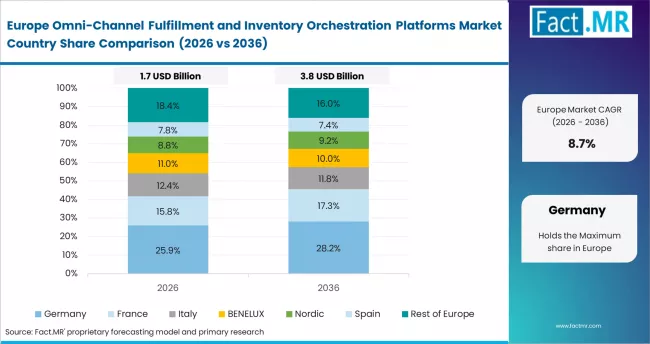
Omni Channel Fulfillment And Inventory Orchestration Platforms Market Europe Country Market Share Analysis, 2026 & 2036 | Source: Fact.MR
Europe remains an important modernization market because many retailers are balancing store-rich operating models with rising digital expectations and greater pressure on fulfillment efficiency. The United Kingdom and Germany lead regional demand in this study because both combine mature retail infrastructure with strong need for cross-channel inventory control. Store participation in fulfillment, returns reintegration, and unified commerce architecture all matter strongly in this region, which helps sustain demand for orchestration platforms rather than channel-specific solutions. Manhattan’s unified commerce research and vendor messaging around flexible omnichannel operations align well with this structure.
- United Kingdom: The UK is expected to advance at 10.1% CAGR, driven by ongoing refinement of store-based fulfillment and omnichannel service models. Retailers are investing in platforms that improve inventory accuracy and enable faster order processing across multiple channels.
- Germany: Germany is projected to grow at 9.6% CAGR, supported by its strong retail infrastructure and increasing focus on coordinated fulfillment execution. Businesses are prioritizing systems that improve stock accuracy and streamline operations across distribution nodes.
Fact.MR’s European view also covers France, Italy, Spain, and the Nordics, where omnichannel execution maturity varies, though the need for better inventory orchestration is increasingly shared.
Asia Pacific Omni-Channel Fulfillment and Inventory Orchestration Platforms Market Analysis
Asia Pacific is the fastest-growing region in this study because digital commerce expansion, retail modernization, and platform adoption are all rising from a lower base in several major markets. India and China stand out for different reasons. India gains from rapid digital-commerce scaling and increasing complexity in inventory exposure across modern retail channels. China benefits from digital retail maturity and a large installed base of merchants that need more coordinated fulfillment logic as channel boundaries blur. Australia also remains relevant because omnichannel retail operations are mature enough to value orchestration depth, even if the overall market is smaller than China or India. World Bank logistics benchmarking also remains relevant because fulfillment quality depends partly on broader logistics performance.
- India: Demand for omni-channel fulfillment and inventory orchestration platforms in India is projected to grow at 12.8% CAGR, reflecting rapid digital commerce scaling and increasing complexity in inventory management. Retailers are adopting orchestration platforms to maintain a single source of inventory truth across warehouses, stores, and third-party logistics providers. Growth is further supported by expanding e-commerce penetration and modernization of retail infrastructure.
- China: The China market is expected to expand at 11.9% CAGR, driven by its large digital retail ecosystem and advanced fulfillment networks. Retailers and platforms operate at significant scale, which increases the need for sophisticated orchestration systems to manage inventory and order flows efficiently. Demand is reinforced by high consumer expectations for fast delivery and seamless cross-channel experiences.
Fact.MR’s Asia Pacific analysis also includes Japan, South Korea, and Southeast Asia, where omnichannel retail maturity is uneven but increasingly dependent on more coordinated inventory and fulfillment platforms.
Competitive Aligners for Market Players
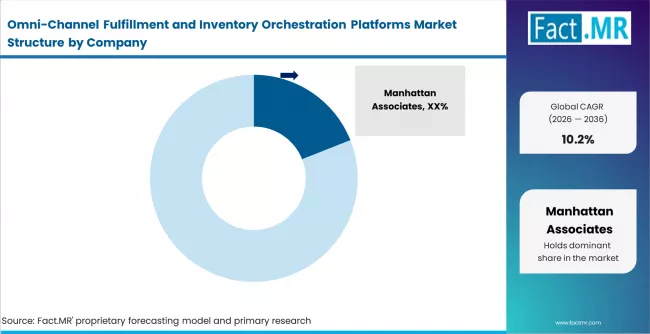
Omni Channel Fulfillment And Inventory Orchestration Platforms Market Analysis By Company | Source: Fact.MR
The market is moderately concentrated, though still competitive. Manhattan Associates, Blue Yonder, IBM, Fluent Commerce, Salesforce, Oracle, and SAP all remain visible in adjacent or direct parts of this category, while specialist providers continue to compete on composability, agility, and inventory-centric design. Competitive advantage is defined less by broad commerce messaging and more by whether the platform can maintain reliable inventory truth, support rule-rich order orchestration, and keep store fulfillment practical at scale. Manhattan’s OMS and unified commerce positioning, Blue Yonder’s orchestration and command-center emphasis, and Fluent Commerce’s focus on distributed order management and inventory availability all point to that same core battleground.
Buyers increasingly distinguish between platforms that simply connect channels and those that actually improve fulfillment outcomes. That difference matters because order orchestration now influences cancellation rates, labor use, customer promise accuracy, and inventory productivity. IBM’s case-based claim of reduced order cancellations and Manhattan’s current commerce benchmark framing both reinforce that the category is moving toward measurable operational performance, not just channel enablement.
Key Players in Omni-Channel Fulfillment and Inventory Orchestration Platforms Market
- Manhattan Associates
- Blue Yonder
- IBM
- Fluent Commerce
- Salesforce
- Oracle
- SAP
Bibliography
- [1] U.S. Census Bureau. Quarterly Retail E-Commerce Sales Report.
- [2] Manhattan Associates. 2025 Unified Commerce Benchmark for Specialty Retail.
- [3] Manhattan Associates. Redefining Unified Commerce in 2025.
- [4] IBM. How IBM Sterling Order Management is Transforming Retail Operations.
- [5] Fluent Commerce. Recently Updated documentation.
- [6] Blue Yonder. Supply Chain Command Center Solutions.
This Report Addresses
- Strategic outlook for omnichannel fulfillment and inventory orchestration platform demand.
- Forecast trajectory from USD 6.5 billion in 2026 to USD 17.1 billion by 2036.
- Why orchestration quality now shapes service promises, cancellation rates, and inventory productivity.
- Segment analysis by component, deployment, fulfillment model, enterprise size, and end use.
- Regional demand patterns across North America, Europe, Asia Pacific, and Latin America.
- Competitive positioning of current OMS and inventory orchestration platform providers.
- The role of returns, ship-from-store, and distributed order management in next-stage platform growth.
- Why the category is moving from channel enablement toward measurable operational performance.
Omni-Channel Fulfillment and Inventory Orchestration Platforms Market Definition
The market covers software platforms and related services used to manage distributed inventory visibility, fulfillment decisioning, and order orchestration across digital and physical retail channels. These platforms help retailers and brands decide where orders should be fulfilled, which inventory should be exposed to customers, how exceptions and substitutions should be handled, and how inventory should be balanced across stores, warehouses, and returns networks.
Omni-Channel Fulfillment and Inventory Orchestration Platforms Market Inclusions
Market scope includes distributed order management, order promising, inventory availability engines, omnichannel fulfillment execution, returns orchestration, store fulfillment coordination, click-and-collect enablement, ship-from-store orchestration, and the service layers required to configure, integrate, and optimize these capabilities. It covers cloud and on-premise platforms used by retailers, brands, and selected B2B sellers where omnichannel inventory and fulfillment complexity is commercially important.
Omni-Channel Fulfillment and Inventory Orchestration Platforms Market Exclusions
The scope excludes basic e-commerce storefront software that lacks fulfillment orchestration and distributed inventory control. It excludes warehouse management systems when they are sold without order orchestration and cross-channel inventory decisioning, and it excludes ERP inventory modules that do not support real-time omnichannel availability and fulfillment optimization. It also excludes parcel delivery software and last-mile tools that operate after fulfillment-node selection has already been made.
Omni-Channel Fulfillment and Inventory Orchestration Platforms Research Methodology
- Primary Research:Interviews with order management leaders, store-operations executives, digital-commerce heads, inventory-planning managers, omnichannel transformation leaders, and retail IT architects.
- Desk Research:Review of U.S. Census e-commerce sales data, NRF retail outlook material, current platform provider disclosures, order management solution descriptions, and public retail case studies from current vendors.
- Market-Sizing and Forecasting:Hybrid model based on omnichannel retail software exposure, digital fulfillment complexity by retail vertical, distributed order management penetration, and software-plus-services value capture across orchestration deployments.
- Data Validation and Update Cycle:Validation against current platform capabilities, public implementation examples, vendor revenue signals, and retail-operating pressures around inventory visibility and fulfillment flexibility. [1]
Segmentation
Scope of the Report
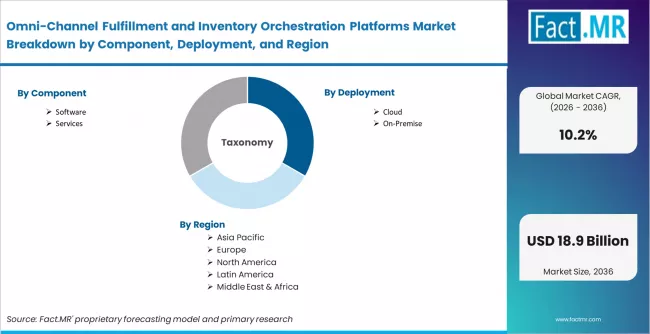
Omni Channel Fulfillment And Inventory Orchestration Platforms Market Breakdown By Component, Deployment, And Region | Source: Fact.MR
| Attribute | Details |
|---|---|
| Quantitative Units | USD 6.5 billion (2026) to USD 17.1 billion (2036), at a CAGR of 10.2% |
| Market Definition | Platforms and related services used to orchestrate inventory visibility, fulfillment-node decisions, order promising, and cross-channel execution across omnichannel retail environments |
| Component Segmentation | Software, Services |
| Deployment Segmentation | Cloud, On-Premise |
| Fulfillment Model Segmentation | Ship-from-Store, Click-and-Collect, Endless Aisle, Distributed Order Management, Returns Orchestration |
| Enterprise Size Segmentation | Large Enterprises, SMEs |
| End Use Segmentation | Apparel, Grocery, Electronics, General Merchandise, Beauty & Personal Care, Others |
| Regions Covered | North America, Europe, Asia Pacific, Latin America, Middle East & Africa |
| Countries Covered | India, China, United States, United Kingdom, Germany, Australia, Brazil, and 40+ countries |
| Key Companies Profiled | Manhattan Associates, Blue Yonder, IBM, Fluent Commerce, Salesforce, Oracle, SAP |
| Forecast Period | 2026 to 2036 |
| Approach | Hybrid sizing based on omnichannel retail complexity, distributed order management penetration, inventory-intensive vertical exposure, and current platform-value layering across software and services |
Source: Fact.MR analysis. Updated May 7, 2026
Frequently Asked Questions
How large is the omni-channel fulfillment and inventory orchestration platforms market in 2025?
What will the market size be in 2026?
What is the projected market size by 2036?
What is the expected CAGR from 2026 to 2036?
Which component segment is poised to lead the market?
Which deployment segment holds the largest share?
Which fulfillment model dominates the market?
Which end-use segment leads the market?
Which country shows the fastest growth?
What is driving demand in this market?
What is the key challenge in this market?
Who worked on this report


Preview the report firsthand - request a free sample
Free SampleGet the brochure for pricing and purchase details
Download PDF