- Market Value (2025):USD 0.4 Bn
- Estimated Value (2026):USD 0.5 Bn
- Forecast Value (2036):USD 2.8 Bn
- CAGR (2026-2036):18.8% CAGR
What is the operational twin dashboards market forecast to be worth by 2036?
USD 0.5 billion in 2026 to USD 2.8 billion by 2036, at 18.8% CAGR.
- The operational twin dashboards market crossed a valuation of USD 0.4 billion in 2025.
- Demand is expected to increase from USD 0.5 billion in 2026 to USD 2.8 billion by 2036.
- The market is forecast to record 18.8% CAGR from 2026 to 2036 as asset owners shift from static twin models to live operating screens.
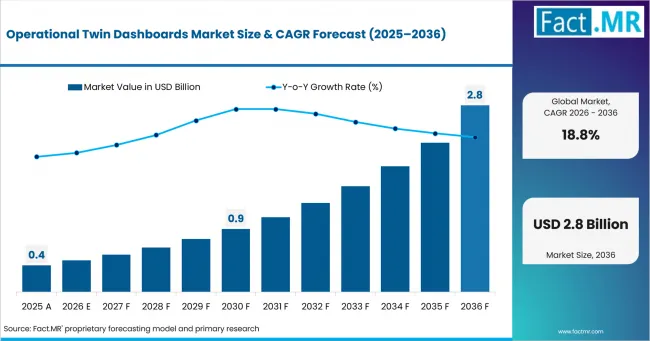
Operational Twin Dashboards Market Market Value Analysis | Source: Fact.MR
What are the defining numbers behind operational twin dashboards growth?
USD 2.3 billion absolute opportunity by 2036, led by India and China.
- Demand Drivers in the Market
- Operations managers need live twin views because equipment, building and line data are still split across several systems.
- Asset owners are moving dashboard spend toward condition views that connect maintenance actions with operating risk.
- Facilities teams require building twin dashboards as energy, comfort and asset-status checks move into one operating screen.
- Reliability teams are likely to specify anomaly dashboards when sensor feeds expose early failure signals.
- Key Segments Analyzed
- By Twin Object: Equipment twins are expected to hold 34.0% share in 2026 because machinery condition is the first operating problem buyers fund.
- By Dashboard Type: KPI dashboards account for 31.0% share in 2026 as operations teams need daily targets before adding deeper simulation views.
- By Deployment: SaaS is projected to hold 48.0% share in 2026 because multi-site buyers prefer faster rollout and common upgrades.
- By Data Feed: IoT sensors are expected to account for 38.0% share in 2026 as live asset data gives dashboards their operating value.
- By Buyer Type: Operations managers are likely to hold 33.0% share in 2026 because they own shift-level performance and downtime decisions.
- By Geography: India is projected to record 21.3% CAGR through 2036 as plant digitization expands from a lower dashboard base.
- Analyst Opinion at Fact.MR
- Shambhu Nath Jha, Senior Analyst at Fact.MR, states, “Operational twin dashboards become useful when they stop being model viewers and start answering the daily question on every site. Which asset is drifting? Which shift needs attention? Which work order should move first? Providers that connect live feeds with plain operating logic are expected to win more repeat deployments.”
- Strategic Implications
- Dashboard providers should package templates by asset type because equipment, building and line operators measure different problems.
- Cloud vendors need connector depth for supervisory control, maintenance and enterprise data because buyers do not want isolated screens.
- Asset owners should define operating decisions before buying dashboards because model accuracy alone does not improve daily work.
- System integrators can gain account access by linking dashboard alerts with work-order processes and role-based views.
The market covers dashboard software and configuration services that connect digital twins with operational data feeds. The National Institute of Standards and Technology states that digital twins can monitor status, detect anomalies and predict system behavior in manufacturing. This supports paid dashboard demand when plants need a shared interface for condition monitoring and work prioritization.
India is projected to record 21.3% CAGR through 2036 because electronics manufacturing and factory digitization are expanding from a smaller installed base. China is expected to expand at 20.8% CAGR as robotized production lines require operational views. South Korea is forecast at 19.8% CAGR due to dense automation assets and connected factory systems. The United States is expected to advance at 19.4% CAGR as manufacturing programs support twin-enabled operating models. Germany is projected to rise at 18.7% CAGR because automation density and factory software discipline support dashboard spending.
How does the operational twin dashboards market break down by segment?
Equipment twins lead at 34.0%; KPI dashboards lead at 31.0%.
Which twin object dominates?
Equipment twins hold 34.0% share in 2026.
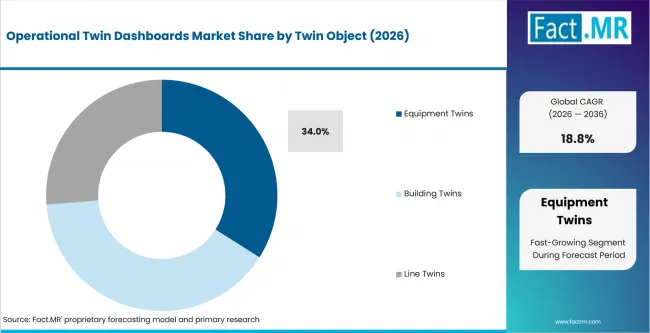
Operational Twin Dashboards Market Analysis By Twin Object | Source: Fact.MR
Equipment twins lead because machinery health, uptime and work-order priority are the first questions operations teams ask. That operator makes equipment dashboards easier to fund than broad site views.
Building twins follow because facilities teams need asset, occupancy and comfort views in the same operating screen. Utility network twins grow as grid and water operators move from map views toward condition views.
Which dashboard type dominates?
KPI dashboards account for 31.0% share in 2026.
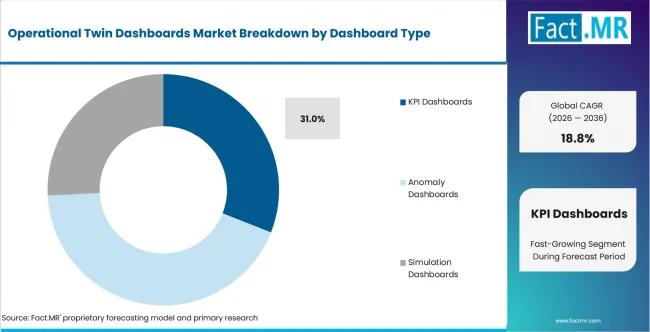
Operational Twin Dashboards Market Analysis By Dashboard Type | Source: Fact.MR
KPI dashboards lead because buyers first ask for uptime and energy status. Throughput and maintenance status usually come into the same operating view later. Anomaly dashboards follow once the data team can trust incoming feeds. Simulation dashboards remain important for planning, but daily buyers usually fund the operational view first.
Which deployment model dominates?
SaaS holds 48.0% share in 2026.
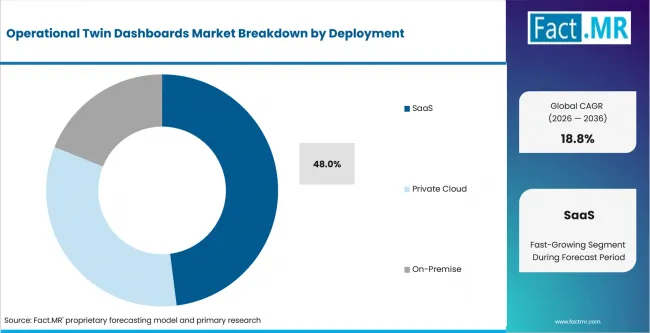
Operational Twin Dashboards Market Analysis By Deployment | Source: Fact.MR
SaaS leads because multi-site owners need common updates, user access control and repeatable templates. The Internet of Things layer also pushes dashboard teams toward hosted environments that can ingest device data from several facilities. Private cloud remains relevant for utilities and regulated industrial users.
Which data feed dominates?
IoT sensors lead with 38.0% share in 2026.
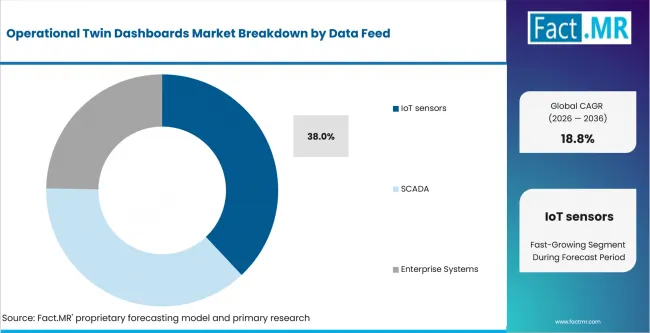
Operational Twin Dashboards Market Analysis By Data Feed | Source: Fact.MR
IoT sensors lead because a dashboard needs fresh operating signals before it can guide action. Supervisory control and data acquisition feeds remain important in process plants, but sensor-based feeds make dashboards useful for edge analytics and site-level alerts.
Which buyer type dominates?
Operations managers hold 33.0% share in 2026.
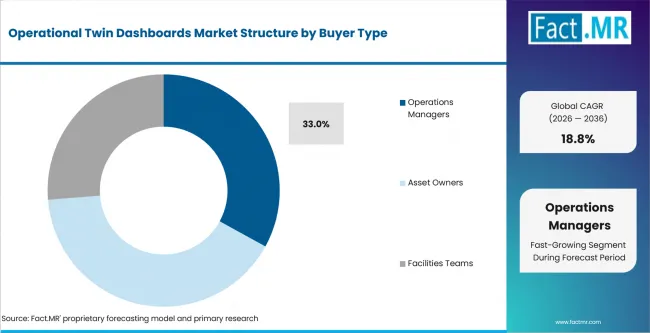
Operational Twin Dashboards Market Analysis By Buyer Type | Source: Fact.MR
Operations managers lead because they need answers during active shifts. Asset owners fund larger programs when dashboards show risk across facilities. Reliability teams become stronger buyers once dashboards link anomalies with maintenance history.
What is accelerating operational twin dashboard adoption, and what is holding it back?
Live asset feeds and multi-site operating views drive it, while disconnected asset data and unclear dashboard ownership restrain it.
Drivers Impact Analysis
| DRIVER | (~) % IMPACT ON CAGR | GEOGRAPHIC RELEVANCE | IMPACT TIMELINE |
|---|---|---|---|
| Live asset data entering twin views | +3.8% | United States and Germany | Short term (≤ 2 years) |
| Multi-site operations needing common screens | +3.2% | United States and India | Medium term (2–4 years) |
| Maintenance teams shifting to condition views | +2.9% | Global industrial markets | Medium term (2–4 years) |
| Cloud vendors packaging industrial connectors | +2.5% | North America and Europe | Short term (≤ 2 years) |
| Infrastructure owners testing twin data standards | +2.1% | United Kingdom and Japan | Long term (≥ 4 years) |
Source: Fact.MR analysis. Updated Jul 2, 2026
- Live asset signals: Operational twin dashboards become valuable when live feeds replace periodic reports. Microsoft made Azure IoT Operations generally available in November 2024. Buyers are expected to fund dashboards when the screen helps a shift leader decide what to inspect first.
- Multi-site view standardization: Large asset owners want the same operating view across plants, buildings and utility assets. This supports dashboards that connect industrial automation control systems with asset hierarchy and maintenance data. The driver is strongest where operations leaders compare site performance every week.
- Condition-based workflows: Reliability teams are shifting dashboard requirements from static KPI cards to condition-linked work queues. This creates direct pull for predictive maintenance views that explain asset drift before a failure stops production. Siemens AG expanded Industrial Copilot for maintenance in March 2025.
Opportunity Impact Analysis
| OPPORTUNITY | (~) % IMPACT ON CAGR | GEOGRAPHIC RELEVANCE | IMPACT TIMELINE |
|---|---|---|---|
| Packaged equipment twin dashboards | +3.5% | China and Germany | Short term (≤ 2 years) |
| Building portfolio views | +2.8% | United States and United Kingdom | Medium term (2–4 years) |
| Utility network twin screens | +2.4% | United Kingdom and Japan | Medium term (2–4 years) |
| Embedded OEM portals | +2.0% | United States and China | Long term (≥ 4 years) |
| Operational revalidation after process changes | +1.7% | Global | Long term (≥ 4 years) |
Source: Fact.MR analysis. Updated Jul 2, 2026
- Equipment dashboard packages:Equipment twin dashboards give vendors a repeatable way to sell into reliability budgets. The opportunity is close to operational predictive maintenance because buyers want screens that translate condition signals into action. Template depth is expected to matter more than visual design.
- Building portfolio views: Building owners need a dashboard layer that turns many facilities into one operating picture. Willow positions its platform around unified spatial, static and live building data. That supplier direction shows why asset owners compare portfolio visibility before they compare model features.
- Line change simulation: Manufacturing buyers can use dashboards to compare a live line with the planned twin before a process change. That makes digital twin commissioning cells commercially relevant for operators that need faster validation. The strongest use case appears where product mix changes often.
Restraints Impact Analysis
| RESTRAINT | (~) % IMPACT ON CAGR | GEOGRAPHIC RELEVANCE | IMPACT TIMELINE |
|---|---|---|---|
| Disconnected asset data | -2.6% | Global | Short term (≤ 2 years) |
| Dashboard ownership unclear | -2.1% | Multi-site enterprises | Short term (≤ 2 years) |
| High configuration cost | -1.9% | India and Brazil | Medium term (2–4 years) |
| Cybersecurity review delays | -1.7% | Utilities and regulated sites | Medium term (2–4 years) |
| Shortage of twin-literate operators | -1.4% | Global | Long term (≥ 4 years) |
Source: Fact.MR analysis. Updated Jul 2, 2026
- Disconnected data foundations: Operational dashboards fail when asset names, maintenance codes and sensor tags do not match. The United Kingdom Department for Transport highlighted digital twin data requirements in October 2025. Vendors are constrained when they must rebuild customer data foundations before showing value.
- Unclear dashboard ownership: Dashboard programs can stall when engineering owns the twin and operations owns daily decisions. This creates a handoff problem between model teams, maintenance teams and plant supervisors. Virtual commissioning projects face the same issue when simulation results must move into live operations.
- Configuration cost pressure: Smaller plants often need the dashboard but cannot fund long integration cycles. The risk is stronger when every site needs custom connectors and custom role views. Suppliers can reduce this restraint by selling asset templates and staged onboarding packages.
Which countries are scaling operational twin dashboards fastest?
India 21.3%, China 20.8%, South Korea 19.8%, USA 19.4%, Germany 18.7%, UK 18.2%, Japan 17.6%.
Based on regional analysis, the operational twin dashboards market is segmented into North America and Western Europe. It also covers East Asia, South Asia and Pacific. Latin America and Middle East and Africa complete the regional frame.
| Country | CAGR |
|---|---|
| India | 21.3% |
| China | 20.8% |
| South Korea | 19.8% |
| United States | 19.4% |
| Germany | 18.7% |
| United Kingdom | 18.2% |
| Japan | 17.6% |
Source: Fact.MR analysis. Updated Jul 2, 2026
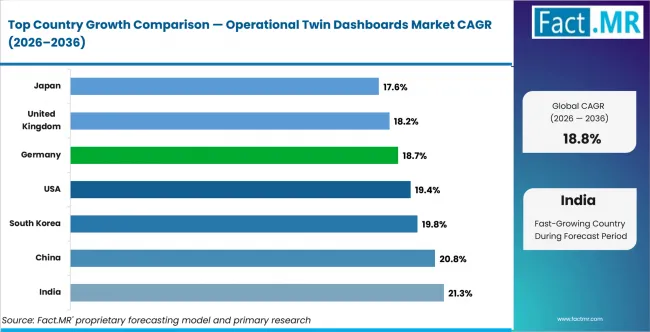
Operational Twin Dashboards Market Cagr Analysis By Country | Source: Fact.MR
What is powering India’s lead?
21.3% CAGR, supported by electronics manufacturing scale and lower dashboard penetration.
India’s factory operators are adding more electronics, automotive and industrial equipment capacity. The Press Information Bureau of India reported electronics production of Rs. 11.3 lakh crore for 2024 to 2025 in October 2025. India is projected to record a 21.3% CAGR through 2036, supported by new operating sites that need live production and maintenance views. Suppliers that offer lower-entry SaaS packages are expected to gain faster access here.
How is China scaling dashboard demand?
20.8% CAGR, driven by robotized production lines and industrial Internet spending.
China has the largest installed robotics base and a broad set of factory digitization programs. The International Federation of Robotics reported that China installed 295,000 industrial robots in 2024. China is expected to expand at 20.8% CAGR through 2036, supported by dense automation sites that need line and equipment visibility. Local integration depth is expected to shape supplier selection. Warehouse operators also use twin dashboards beside automated material handling equipment when throughput and equipment status need one view.
Why does South Korea remain a high-readiness market?
19.8% CAGR, backed by dense automation and electronics production discipline.
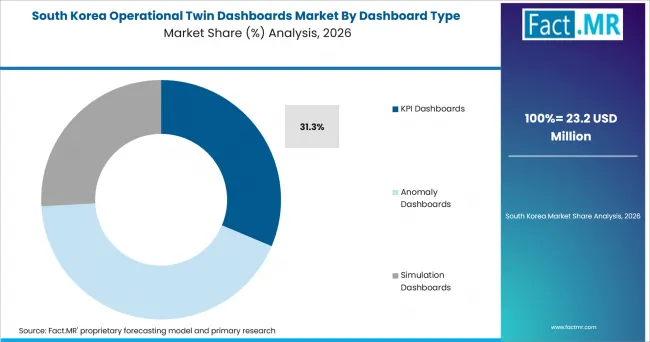
Operational Twin Dashboards Market South Korea Market Share Analysis By Dashboard Type | Source: Fact.MR
South Korea is a high-readiness market because factory assets are already heavily automated. The International Federation of Robotics reported 1,220 robots for every 10 thousand manufacturing employees in 2024. South Korea is forecast to grow at 19.8% CAGR through 2036, supported by buyers that already track automation performance closely. Suppliers need strong connector libraries and Korean implementation support.
What supports the United States outlook?
19.4% CAGR, supported by public manufacturing programs and cloud vendor depth.
United States buyers often start with cloud platforms and scale dashboards across sites. The National Institute of Standards and Technology announced a planned USD 70 million AI-focused Manufacturing USA institute in March 2024. The United States is expected to advance at 19.4% CAGR through 2036. Growth is supported by manufacturing programs that connect AI, asset data and operations. Account access is expected to favor vendors with enterprise security and integration depth.
What underpins Germany’s growth?
18.7% CAGR, backed by automation density and industrial software discipline.
German buyers are likely to specify operational dashboards through automation and maintenance teams. Germany is projected to rise at 18.7% CAGR through 2036, supported by factories that already use structured automation data. Suppliers gain when dashboard views support plant audits and maintenance governance.
Why is the United Kingdom an important dashboard market?
18.2% CAGR, supported by infrastructure digital twin guidance and asset-owner data discipline.
The United Kingdom has a policy-led route into operational twin dashboards through infrastructure and transport assets. The United Kingdom is forecast at 18.2% CAGR through 2036, supported by public infrastructure owners that need evidence before changing operations. Demand is expected to favor dashboards that explain asset condition in plain operating terms.
How does Japan’s market build from industrial discipline?
17.6% CAGR, driven by robotics experience and factory improvement culture.
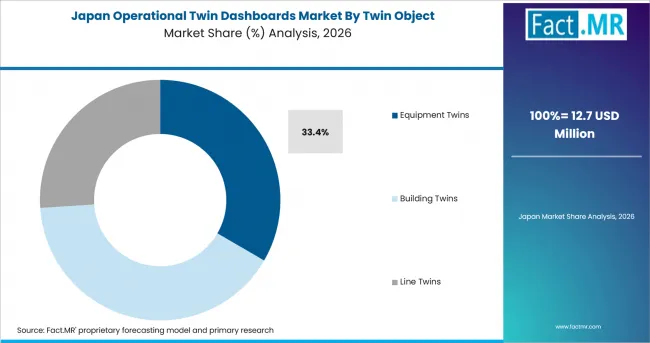
Operational Twin Dashboards Market Japan Market Share Analysis By Twin Object | Source: Fact.MR
Japanese buyers usually require careful validation before operational software becomes part of daily work. Japan is expected to post 17.6% CAGR through 2036. Growth is supported by factories that connect machine data, quality data, and process improvement workflows. Growth is lower than India and China because the installed industrial software base is already more structured.
Who leads the operational twin dashboards landscape?
Microsoft and AWS lead through cloud reach. IBM, Siemens AG and Schneider Electric add automation and enterprise asset software depth.
Operational twin dashboard competition is shaped by platform reach and connector depth. Microsoft and AWS compete through cloud data services. IBM and Siemens AG bring enterprise asset and automation software. Schneider Electric and Honeywell International Inc. add building and energy access.
Bentley Systems and Willow are important in buildings, infrastructure and asset portfolio use cases. Their value is strongest when a buyer wants a spatial asset view connected to live facility data. This overlaps with digital twin devices when physical assets and operating interfaces are sold as part of the same decision environment.
Providers that combine live feed ingestion, role-specific dashboard templates and maintenance workflow links are best placed through 2036. Smaller providers can win project work when they understand one asset class deeply. They are less likely to win enterprise-wide programs without cloud security, connector coverage and implementation partners.
Which companies are the key players?
Microsoft, Amazon Web Services and IBM lead the cloud and enterprise software layer. Siemens AG, Schneider Electric and Honeywell International Inc. bring industrial automation access. Bentley Systems and Willow support infrastructure and building twin workflows.
- Microsoft
- Amazon Web Services
- IBM
- Siemens AG
- Schneider Electric
- Honeywell International Inc.
- Bentley Systems
- Willow
Bibliography
- National Institute of Standards and Technology. (2024, April 15). Digital twins for advanced manufacturing.
- National Institute of Standards and Technology. (2024, March 12). NIST to launch competition for AI-focused Manufacturing USA Institute.
- International Federation of Robotics. (2025, September 25). World Robotics 2025 report: Industrial robots.
- International Federation of Robotics. (2026, April 8). Robot density surges in Europe, Asia, and Americas.
- Press Information Bureau, Government of India. (2025, October 11). India’s electronics leap.
- United Kingdom Department for Transport. (2025, October 30). Infrastructure digital twins: Data requirements.
- Ministry of Economy, Trade and Industry of Japan. (2025, August 6). Connected Industries.
- Microsoft Corporation. (2024, November 19). Microsoft Ignite 2024 Book of News.
- Siemens AG. (2025, March 24). Siemens expands Industrial Copilot with new generative AI-powered maintenance offering.
This Report Addresses
- Strategic intelligence on operational twin dashboards across twin object, dashboard type and buyer type.
- Segment analysis covering equipment twins, KPI dashboards, SaaS deployment, IoT sensor feeds and operations managers.
- Regional outlook covering India, China, South Korea, United States, Germany, United Kingdom and Japan.
- Competitive analysis of Microsoft, Amazon Web Services and IBM. It also covers Siemens AG, Schneider Electric and Honeywell International Inc. Bentley Systems and Willow complete the comparison.
- Dashboard assessment covering KPI dashboards, anomaly dashboards, simulation dashboards and maintenance views.
- Data feed assessment covering IoT sensors, SCADA, enterprise systems and maintenance systems.
- Primary interviews, provider checks, official source review and dashboard deployment validation support the forecast.
What does the operational twin dashboards market cover?
Live dashboard software for digital twins is used in plants and buildings.
The operational twin dashboards market covers software modules, configuration services and managed views that make twin data usable for daily operations. It includes dashboards for equipment twins and building twins. It also covers line twins, utility network twins and site twins. The scope differs from general digital twin engineering because the buying trigger is daily monitoring and decision support.
What is included in the scope?
Dashboard configuration, alert logic and live operational data integration.
The scope includes dashboard configuration and visualization layers. It covers alert logic, user access setup and integration with live operating data. KPI dashboards and anomaly dashboards are included. Simulation dashboards and maintenance views are also included. Deployment covers SaaS, private cloud and on-premise models. Embedded OEM portal deployment is included when the portal supports live operations.
What is excluded from the scope?
Stand-alone models, generic business intelligence projects and hardware-only sensor sales.
The scope excludes stand-alone CAD models, generic business intelligence projects and offline simulation work without live asset connection. It excludes digital twin creation services when the final deliverable is only a model. It also excludes hardware sensors unless they are sold as part of a dashboard implementation package.
How was the analysis built?
100+ sources across 40+ company portfolios. Coverage includes 25+ countries and 20+ interviews.
- Primary Research: Primary research includes interviews with plant reliability teams, facilities operators and digital twin architects. It also includes input from industrial software integrators and cloud implementation partners.
- Desk Research: Desk research reviews manufacturing digitization programs, robotics installation data and official digital twin policy sources. It also checks company portfolios for operational dashboard capabilities and service coverage.
- Market-Sizing and Forecasting: Forecasting uses the 2025 and 2026 market value anchors. The model reconciles those values against digital twin adoption, automation density and dashboard service intensity.
- Data Validation and Update Cycle: Forecasts are validated through supplier capability checks and country readiness reviews. Company launches and public digital twin programs are used to refresh market direction.
Segmentation
What is the report’s scope and coverage?
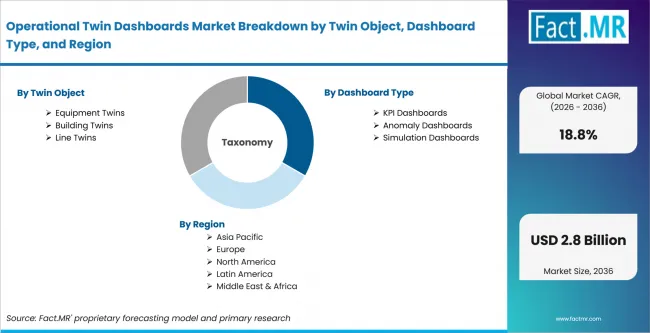
Operational Twin Dashboards Market Breakdown By Twin Object, Dashboard Type, And Region | Source: Fact.MR
| Attribute | Details |
|---|---|
| Quantitative Units | USD Billion in 2026 to USD Billion by 2036 at CAGR |
| Market Definition | Live dashboard software and configuration services that connect operational data with digital twins |
| Twin Object | Equipment twins, building twins, line twins, utility twins, site twins |
| Dashboard Type | KPI dashboards, anomaly dashboards, simulation dashboards, maintenance views |
| Deployment | SaaS, private cloud, on-premise, embedded OEM portal |
| Data Feed | IoT sensors, SCADA, enterprise systems, maintenance systems |
| Buyer Type | Operations managers, asset owners, facilities teams, reliability teams |
| Regions Covered | North America, Western Europe, East Asia, South Asia and Pacific, Latin America, Middle East and Africa |
| Countries Covered | India, China, South Korea, United States, Germany, United Kingdom, Japan |
| Key Companies Profiled | Microsoft, Amazon Web Services, IBM, Siemens AG, Schneider Electric, Honeywell International Inc., Bentley Systems and Willow |
| Forecast Period | 2026 to 2036 |
| Approach | Hybrid top-down and bottom-up approach using automation density, digital twin readiness and dashboard configuration intensity |
Source: Fact.MR analysis. Updated Jul 2, 2026
How is the market segmented?
-
By Twin Object:
- Equipment Twins
- Building Twins
- Line Twins
- Utility Twins
- Site Twins
-
By Dashboard Type:
- KPI Dashboards
- Anomaly Dashboards
- Simulation Dashboards
- Maintenance Views
-
By Deployment:
- SaaS
- Private Cloud
- On-Premise
- OEM Portal
-
By Data Feed:
- IoT Sensors
- SCADA
- Enterprise Systems
- Maintenance Systems
-
By Buyer Type:
- Operations Managers
- Asset Owners
- Facilities Teams
- Reliability Teams
-
By Region:
- North America
- United States
- Canada
- Mexico
- Latin America
- Brazil
- Argentina
- Rest of Latin America
- Europe
- Germany
- United Kingdom
- France
- Italy
- Spain
- Rest of Europe
- Asia Pacific
- China
- India
- Japan
- South Korea
- ASEAN
- Middle East & Africa
- GCC Countries
- South Africa
- UAE
- Rest of Middle East & Africa
- North America
Frequently Asked Questions
Which twin object leads the Operational Twin Dashboards Market?
Which country expands fastest in the Operational Twin Dashboards Market?
How does China perform in the Operational Twin Dashboards Market?
How does South Korea perform in the Operational Twin Dashboards Market?
How does the United States perform in the Operational Twin Dashboards Market?
How does Germany perform in the Operational Twin Dashboards Market?
What is the primary driver in the Operational Twin Dashboards Market?
What is the main restraint in the Operational Twin Dashboards Market?
Why are equipment twins important in this market?
Who worked on this report


Preview the report firsthand - request a free sample
Free SampleGet the brochure for pricing and purchase details
Download PDF