Digital Twin Modeling for Recycling Plant Operations Market
Digital Twin Modeling for Recycling Plant Operations Market Size and Share Forecast Outlook 2026 to 2036
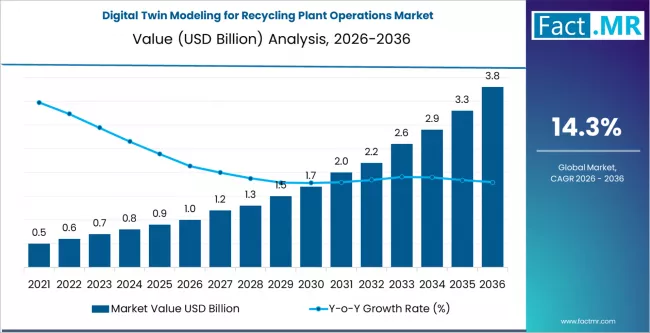
Digital twin modeling for recycling plant operations market is projected to grow from USD 1.0 billion in 2026 to USD 3.8 billion by 2036, at a CAGR of 14.3%. MRFs and plastics recycling plants will dominate with a 40.0% market share, while process and asset twins will lead the twin type segment with a 45.0% share.
Digital Twin Modeling for Recycling Plant Operations Market Forecast and Outlook 2026 to 2036
The digital twin modeling for recycling plant operations market is anticipated to reach USD 1 billion in 2026, growing to USD 3.8 billion by 2036, with a CAGR of 14%.
Key Takeaways from Digital Twin Modeling for Recycling Plant Operations Market
- Digital Twin Modeling for Recycling Plant Operations Market Value (2026): USD 1 billion
- Digital Twin Modeling for Recycling Plant Operations Market Forecast Value (2036): USD 3.8 billion
- Digital Twin Modeling for Recycling Plant Operations Market Forecast CAGR (2026-2036): 14%
- Leading Segment in Digital Twin Modeling for Recycling Plant Operations Market: Physics + AI hybrid twins (51%)
- Key Growth Region in Digital Twin Modeling for Recycling Plant Operations Market: Asia Pacific
- Key Players in Digital Twin Modeling for Recycling Plant Operations Market: Siemens Digital Industries, AspenTech, Huawei Cloud, Yokogawa, AVEVA, Ansys, SUPCON
Procurement priorities in this market are shaped by a growing emphasis on cost efficiency, system integration, and predictive maintenance. As buyers prioritize minimizing risk, vendor lock-in becomes a significant factor, leading to longer-term contracts and stability in supply chains.
The preference for proven, reliable solutions drives risk aversion, with procurement teams seeking out suppliers with established track records. High switching costs associated with changing systems or platforms further encourage buyer loyalty, reducing market fluidity. As technology evolves, the ability to scale and integrate new capabilities becomes crucial in procurement decisions. These factors collectively influence vendor relationships and market dynamics, requiring suppliers to offer long-term value and seamless integration to remain competitive.
Digital Twin Modeling for Recycling Plant Operations Market
| Metric | Value |
|---|---|
| Industry Sales Value (2026) | USD 1 billion |
| Industry Forecast Value (2036) | USD 3.8 billion |
| Industry Forecast CAGR (2026-2036) | 14% |
Category
| Category | Segments |
|---|---|
| End Use | MRFs and plastics recycling plants; Operational optimization; Large recycling parks; Precision operations; Emerging MRFs |
| Twin Type | Process and asset twins; Plant-wide twins; Line-level twins; Equipment twins; Others |
| Data Inputs | Sensor, throughput, quality data; Energy and downtime data; Vision and sorter data; Control and QC data; Others |
| Technology | Physics + AI hybrid twins; Cloud-native twins; Edge-connected twins; High-fidelity simulation; Others |
| Region | North America; Europe; Asia Pacific; Latin America; Middle East & Africa |
Segmental Analysis
What Is the Impact of Data Inputs on the Digital Twin Modeling for Recycling Plant Operations Market?
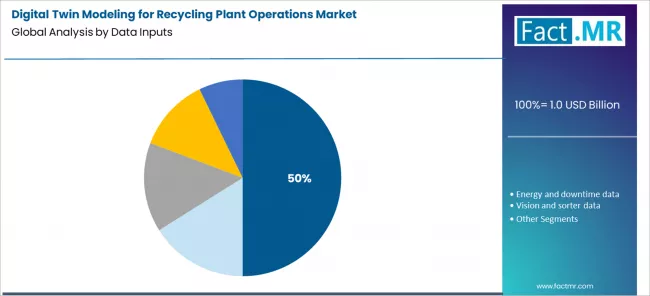
In the digital twin modeling for recycling plant operations market, data inputs play a crucial role in shaping the accuracy and functionality of digital twin models. Sensor, throughput, and quality data lead the market with a 50% share, as these data types are essential for creating real-time, dynamic representations of plant operations. By capturing key operational parameters, these data inputs enable better monitoring and optimization of recycling processes. As the industry continues to focus on enhancing operational efficiency and sustainability, the importance of accurate and comprehensive data inputs will continue to drive the adoption of digital twin technologies in recycling plants.
How Does Technology Influence the Digital Twin Modeling for Recycling Plant Operations Market?
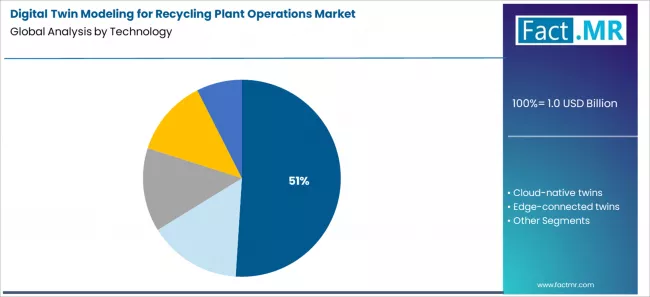
Technology is central to the effectiveness of digital twin modeling, with physics + AI hybrid twins leading the segment at a 51% share. This combination of physics-based models and artificial intelligence allows for the creation of highly accurate and adaptive digital twins, which can simulate plant operations and predict performance under various conditions. The integration of cloud-native twins, edge-connected twins, and high-fidelity simulation further enhances the capabilities of digital twins, enabling more sophisticated data processing, real-time insights, and predictive maintenance. As recycling plants strive for increased efficiency and reduced downtime, the continued development and deployment of advanced digital twin technologies will play a key role in improving plant operations.
What are the Principal Drivers, Constraints, and Evolving Dynamics of the Digital Twin Modeling for Recycling Plant Operations Market?
Interest in digital twin modeling for recycling plant operations has been shaped by efforts to improve throughput, reduce downtime, and enhance process visibility. Operators of material recovery and recycling facilities have evaluated virtual replicas of equipment and workflows to simulate performance under varying feedstock conditions. Access to real time sensor data from conveyors, sorters, and granulators has supported development of models that reflect plant behavior and guide operational adjustments.
Constraints include the cost of sensor networks and software platforms that support digital twin frameworks. Some facilities lack consistent data streams needed to develop accurate models. Integration with legacy control systems has presented challenges where data formats are incompatible. Work to standardize data capture and improve model fidelity is under way. Collaboration between equipment manufacturers, software developers, and recycling operators is guiding efforts to refine simulation tools and encourage broader adoption.
Analysis of the Digital Twin Modeling for Recycling Plant Operations Market by Key Country
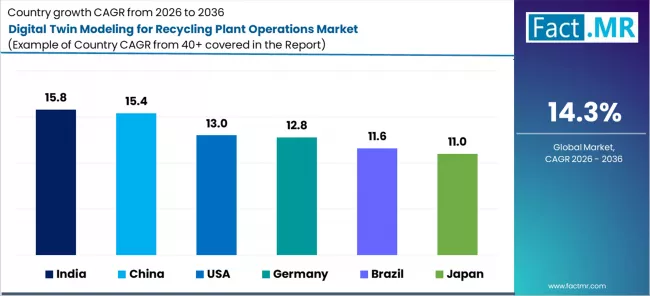
| Country | CAGR 2026 to 2036 |
|---|---|
| Germany | 12.8% |
| USA | 13% |
| China | 15.4% |
| Japan | 11% |
| India | 15.8% |
| Brazil | 11.6% |
The report covers an in-depth analysis of 40+ countries; top-performing countries are highlighted below.
What is the Growth Outlook for Digital Twin Modeling for Recycling Plant Operations in Germany?
Germany’s digital twin modeling for recycling plant operations market is expected to grow at a CAGR of 12.8% from 2026 to 2036. As Germany continues to push for greater efficiency and sustainability in its recycling operations, the demand for advanced technologies like digital twin modeling is increasing. These technologies enable real-time monitoring and optimization of recycling processes, improving operational efficiency and reducing costs. With Germany’s focus on sustainability and its advanced manufacturing infrastructure, the market for digital twin solutions in recycling plants is set to grow steadily.
How is the Demand for Digital Twin Modeling for Recycling Plant Operations Performing in the USA?
Demand for digital twin modeling for recycling plant operations in the USA is projected to grow at a CAGR of 13% from 2026 to 2036. The USA is increasingly adopting smart technologies in waste management and recycling to improve efficiency and reduce costs. Digital twin modeling offers significant advantages in terms of predictive maintenance, process optimization, and real-time monitoring, making it an essential tool for modern recycling plants. As the USA focuses on improving recycling infrastructure and reducing waste, the demand for digital twin modeling solutions is expected to rise steadily.
What is the Market Outlook for Digital Twin Modeling for Recycling Plant Operations in China?
China is expected to experience significant growth in the digital twin modeling for recycling plant operations market, with a projected CAGR of 15.4% from 2026 to 2036. China’s rapidly expanding recycling industry, driven by the need to manage increasing waste volumes, is driving the adoption of advanced technologies such as digital twin modeling. These systems enable better resource management, operational efficiency, and cost reduction, all of which are critical in China’s efforts to improve its recycling infrastructure. With strong government support for sustainability and green technologies, China’s market for digital twin solutions in recycling is set to grow substantially.
How Will Digital Twin Modeling for Recycling Plant Operations Evolve in Japan?
Digital twin modeling for recycling plant operations demand in Japan is forecast to grow at a CAGR of 11% from 2026 to 2036. Japan’s recycling industry is highly advanced, and integrating digital twin technology will further optimize operations. As the country continues to prioritize sustainability, the demand for technologies that enhance efficiency and reduce waste will continue to rise. While the growth rate is more moderate compared to other regions, the adoption of digital twin modeling will remain strong due to its ability to provide valuable insights into plant operations and improve overall performance.
What is the Growth Potential for Digital Twin Modeling for Recycling Plant Operations in India?
Digital twin modeling for recycling plant operations sales in India are set to grow at a robust CAGR of 15.8% from 2026 to 2036. India’s rapidly expanding waste management and recycling sectors are increasingly adopting digital solutions to optimize operations. With the country’s growing focus on improving recycling efficiency and sustainability, digital twin modeling offers a valuable tool for real-time monitoring, predictive analytics, and process optimization. The market in India will experience significant growth as government initiatives and industry demand for more efficient recycling technologies continue to rise.
What is the Market Expansion Outlook for Digital Twin Modeling for Recycling Plant Operations in Brazil?
The digital twin modeling for recycling plant operations industry in Brazil is projected to grow at a CAGR of 11.6% from 2026 to 2036. As Brazil’s recycling sector continues to evolve, the need for advanced technologies to optimize plant operations is increasing. Digital twin modeling can improve operational efficiency, reduce waste, and enable better resource management. With growing government support for sustainability and improvements in recycling infrastructure, Brazil’s market for digital twin solutions in recycling plants is expected to expand steadily over the coming years.
How is Competition Structured in the Digital Twin Modeling for Recycling Plant Operations Market?
Competition in the digital twin modeling market for recycling plant operations is defined by simulation fidelity, realtime integration, and scalability across diverse systems. Siemens Digital Industries and AVEVA compete with comprehensive industrial platforms that pair digital twin models with plant automation and asset management. Their systems support predictive maintenance and operational optimization through continuous data feedback.
AspenTech and Ansys emphasize advanced process simulation and multiphysics modeling that allow detailed representation of material flows and equipment behavior. Huawei Cloud offers scalable cloud infrastructure and analytics that support large data sets and crosssite deployments. Yokogawa and SUPCON focus on control system integration and closedloop feedback that ties twin models directly to operational parameters. Differentiation arises from model accuracy, ease of deployment with existing control systems, and the ability to forecast performance under variable feedstock conditions. Buyers evaluate providers based on technical support, documentation quality, and proven use cases in recycling environments.
Key Players in the Digital Twin Modeling for Recycling Plant Operations Market
- Siemens Digital Industries
- AspenTech
- Huawei Cloud
- Yokogawa
- AVEVA
- Ansys
- SUPCON
Scope of the Report
| Items | Values |
|---|---|
| Quantitative Units (2026) | USD Billion |
| End Use | MRFs and plastics recycling plants, Operational optimisation, Large recycling parks, Precision operations, Emerging MRFs |
| Twin Type | Process and asset twins, Plant-wide twins, Line-level twins, Equipment twins, Others |
| Data Inputs | Sensor, throughput, quality data, Energy and downtime data, Vision and sorter data, Control and QC data, Others |
| Technology | Physics + AI hybrid twins, Cloud-native twins, Edge-connected twins, High-fidelity simulation, Others |
| Regions Covered | North America, Europe, Asia Pacific, Latin America, Middle East & Africa |
| Countries Covered | United States, Canada, Mexico, Brazil, Germany, United Kingdom, France, Italy, Spain, China, Japan, South Korea, India, Australia & New Zealand |
| Key Companies Profiled | Siemens Digital Industries, AspenTech, Huawei Cloud, Yokogawa, AVEVA, Ansys, SUPCON |
| Additional Attributes | Dollar revenue by end-use, twin type, data inputs, and technology; regional demand trends, competitive landscape, technological advancements in digital twin modeling, and innovations in recycling plant operations |
Digital Twin Modeling for Recycling Plant Operations Market Key Segments
-
End Use :
- MRFs and plastics recycling plants
- Operational optimisation
- Large recycling parks
- Precision operations
- Emerging MRFs
-
Twin Type :
- Process and asset twins
- Plant-wide twins
- Line-level twins
- Equipment twins
- Others
-
Data Inputs :
- Sensor, throughput, quality data
- Energy and downtime data
- Vision and sorter data
- Control and QC data
- Others
-
Technology :
- Physics + AI hybrid twins
- Cloud-native twins
- Edge-connected twins
- High-fidelity simulation
- Others
-
Region :
- North America
- U.S.
- Canada
- Mexico
- Europe
- Germany
- UK
- France
- Italy
- Spain
- Nordic Countries
- BENELUX
- Rest of Europe
- Asia Pacific
- China
- Japan
- South Korea
- India
- Australia
- Rest of Asia Pacific
- Latin America
- Brazil
- Argentina
- Rest of Latin America
- Middle East and Africa
- Kingdom of Saudi Arabia
- United Arab Emirates
- South Africa
- Rest of Middle East and Africa
- Other Regions
- Oceania
- Central Asia
- Other Markets
- North America
Bibliographies
- International Energy Agency. (2023).Digitalisation and automation in industrial process optimisation. IEA Publications.
- Organisation for Economic Co-operation and Development. (2023).Digital technologies for circular economy infrastructure and waste management. OECD Publishing.
- World Economic Forum. (2023).Digital twins for industrial performance, resilience, and sustainability. World Economic Forum White Paper.
- Journal of Cleaner Production. (2023).Application of digital twin models for waste processing efficiency and emissions reduction.
- Computers & Chemical Engineering. (2024).Integrated digital twin frameworks for closed-loop process control in recycling plants.
Table of Content
- Executive Summary
- Global Market Outlook
- Demand to side Trends
- Supply to side Trends
- Technology Roadmap Analysis
- Analysis and Recommendations
- Market Overview
- Market Coverage / Taxonomy
- Market Definition / Scope / Limitations
- Market Background
- Market Dynamics
- Drivers
- Restraints
- Opportunity
- Trends
- Scenario Forecast
- Demand in Optimistic Scenario
- Demand in Likely Scenario
- Demand in Conservative Scenario
- Opportunity Map Analysis
- Product Life Cycle Analysis
- Supply Chain Analysis
- Investment Feasibility Matrix
- Value Chain Analysis
- PESTLE and Porter’s Analysis
- Regulatory Landscape
- Regional Parent Market Outlook
- Production and Consumption Statistics
- Import and Export Statistics
- Market Dynamics
- Global Market Analysis 2021 to 2025 and Forecast, 2026 to 2036
- Historical Market Size Value (USD Million) Analysis, 2021 to 2025
- Current and Future Market Size Value (USD Million) Projections, 2026 to 2036
- Y to o to Y Growth Trend Analysis
- Absolute $ Opportunity Analysis
- Global Market Pricing Analysis 2021 to 2025 and Forecast 2026 to 2036
- Global Market Analysis 2021 to 2025 and Forecast 2026 to 2036, By End Use
- Introduction / Key Findings
- Historical Market Size Value (USD Million) Analysis By End Use, 2021 to 2025
- Current and Future Market Size Value (USD Million) Analysis and Forecast By End Use, 2026 to 2036
- MRFs and plastics recycling plants
- Operational optimisation
- Large recycling parks
- Precision operations
- Emerging MRFs
- MRFs and plastics recycling plants
- Y to o to Y Growth Trend Analysis By End Use, 2021 to 2025
- Absolute $ Opportunity Analysis By End Use, 2026 to 2036
- Global Market Analysis 2021 to 2025 and Forecast 2026 to 2036, By Twin Type
- Introduction / Key Findings
- Historical Market Size Value (USD Million) Analysis By Twin Type, 2021 to 2025
- Current and Future Market Size Value (USD Million) Analysis and Forecast By Twin Type, 2026 to 2036
- Process and asset twins
- Plant-wide twins
- Line-level twins
- Equipment twins
- Others
- Process and asset twins
- Y to o to Y Growth Trend Analysis By Twin Type, 2021 to 2025
- Absolute $ Opportunity Analysis By Twin Type, 2026 to 2036
- Global Market Analysis 2021 to 2025 and Forecast 2026 to 2036, By Data Inputs
- Introduction / Key Findings
- Historical Market Size Value (USD Million) Analysis By Data Inputs, 2021 to 2025
- Current and Future Market Size Value (USD Million) Analysis and Forecast By Data Inputs, 2026 to 2036
- Sensor, throughput, quality data
- Energy and downtime data
- Vision and sorter data
- Control and QC data
- Others
- Sensor, throughput, quality data
- Y to o to Y Growth Trend Analysis By Data Inputs, 2021 to 2025
- Absolute $ Opportunity Analysis By Data Inputs, 2026 to 2036
- Global Market Analysis 2021 to 2025 and Forecast 2026 to 2036, By Technology
- Introduction / Key Findings
- Historical Market Size Value (USD Million) Analysis By Technology, 2021 to 2025
- Current and Future Market Size Value (USD Million) Analysis and Forecast By Technology, 2026 to 2036
- Physics + AI hybrid twins
- Cloud-native twins
- Edge-connected twins
- High-fidelity simulation
- Others
- Physics + AI hybrid twins
- Y to o to Y Growth Trend Analysis By Technology, 2021 to 2025
- Absolute $ Opportunity Analysis By Technology, 2026 to 2036
- Global Market Analysis 2021 to 2025 and Forecast 2026 to 2036, By Region
- Introduction
- Historical Market Size Value (USD Million) Analysis By Region, 2021 to 2025
- Current Market Size Value (USD Million) Analysis and Forecast By Region, 2026 to 2036
- North America
- Latin America
- Western Europe
- Eastern Europe
- East Asia
- South Asia and Pacific
- Middle East & Africa
- Market Attractiveness Analysis By Region
- North America Market Analysis 2021 to 2025 and Forecast 2026 to 2036, By Country
- Historical Market Size Value (USD Million) Trend Analysis By Market Taxonomy, 2021 to 2025
- Market Size Value (USD Million) Forecast By Market Taxonomy, 2026 to 2036
- By Country
- USA
- Canada
- Mexico
- By End Use
- By Twin Type
- By Data Inputs
- By Technology
- By Country
- Market Attractiveness Analysis
- By Country
- By End Use
- By Twin Type
- By Data Inputs
- By Technology
- Key Takeaways
- Latin America Market Analysis 2021 to 2025 and Forecast 2026 to 2036, By Country
- Historical Market Size Value (USD Million) Trend Analysis By Market Taxonomy, 2021 to 2025
- Market Size Value (USD Million) Forecast By Market Taxonomy, 2026 to 2036
- By Country
- Brazil
- Chile
- Rest of Latin America
- By End Use
- By Twin Type
- By Data Inputs
- By Technology
- By Country
- Market Attractiveness Analysis
- By Country
- By End Use
- By Twin Type
- By Data Inputs
- By Technology
- Key Takeaways
- Western Europe Market Analysis 2021 to 2025 and Forecast 2026 to 2036, By Country
- Historical Market Size Value (USD Million) Trend Analysis By Market Taxonomy, 2021 to 2025
- Market Size Value (USD Million) Forecast By Market Taxonomy, 2026 to 2036
- By Country
- Germany
- UK
- Italy
- Spain
- France
- Nordic
- BENELUX
- Rest of Western Europe
- By End Use
- By Twin Type
- By Data Inputs
- By Technology
- By Country
- Market Attractiveness Analysis
- By Country
- By End Use
- By Twin Type
- By Data Inputs
- By Technology
- Key Takeaways
- Eastern Europe Market Analysis 2021 to 2025 and Forecast 2026 to 2036, By Country
- Historical Market Size Value (USD Million) Trend Analysis By Market Taxonomy, 2021 to 2025
- Market Size Value (USD Million) Forecast By Market Taxonomy, 2026 to 2036
- By Country
- Russia
- Poland
- Hungary
- Balkan & Baltic
- Rest of Eastern Europe
- By End Use
- By Twin Type
- By Data Inputs
- By Technology
- By Country
- Market Attractiveness Analysis
- By Country
- By End Use
- By Twin Type
- By Data Inputs
- By Technology
- Key Takeaways
- East Asia Market Analysis 2021 to 2025 and Forecast 2026 to 2036, By Country
- Historical Market Size Value (USD Million) Trend Analysis By Market Taxonomy, 2021 to 2025
- Market Size Value (USD Million) Forecast By Market Taxonomy, 2026 to 2036
- By Country
- China
- Japan
- South Korea
- By End Use
- By Twin Type
- By Data Inputs
- By Technology
- By Country
- Market Attractiveness Analysis
- By Country
- By End Use
- By Twin Type
- By Data Inputs
- By Technology
- Key Takeaways
- South Asia and Pacific Market Analysis 2021 to 2025 and Forecast 2026 to 2036, By Country
- Historical Market Size Value (USD Million) Trend Analysis By Market Taxonomy, 2021 to 2025
- Market Size Value (USD Million) Forecast By Market Taxonomy, 2026 to 2036
- By Country
- India
- ASEAN
- Australia & New Zealand
- Rest of South Asia and Pacific
- By End Use
- By Twin Type
- By Data Inputs
- By Technology
- By Country
- Market Attractiveness Analysis
- By Country
- By End Use
- By Twin Type
- By Data Inputs
- By Technology
- Key Takeaways
- Middle East & Africa Market Analysis 2021 to 2025 and Forecast 2026 to 2036, By Country
- Historical Market Size Value (USD Million) Trend Analysis By Market Taxonomy, 2021 to 2025
- Market Size Value (USD Million) Forecast By Market Taxonomy, 2026 to 2036
- By Country
- Kingdom of Saudi Arabia
- Other GCC Countries
- Turkiye
- South Africa
- Other African Union
- Rest of Middle East & Africa
- By End Use
- By Twin Type
- By Data Inputs
- By Technology
- By Country
- Market Attractiveness Analysis
- By Country
- By End Use
- By Twin Type
- By Data Inputs
- By Technology
- Key Takeaways
- Key Countries Market Analysis
- USA
- Pricing Analysis
- Market Share Analysis, 2025
- By End Use
- By Twin Type
- By Data Inputs
- By Technology
- Canada
- Pricing Analysis
- Market Share Analysis, 2025
- By End Use
- By Twin Type
- By Data Inputs
- By Technology
- Mexico
- Pricing Analysis
- Market Share Analysis, 2025
- By End Use
- By Twin Type
- By Data Inputs
- By Technology
- Brazil
- Pricing Analysis
- Market Share Analysis, 2025
- By End Use
- By Twin Type
- By Data Inputs
- By Technology
- Chile
- Pricing Analysis
- Market Share Analysis, 2025
- By End Use
- By Twin Type
- By Data Inputs
- By Technology
- Germany
- Pricing Analysis
- Market Share Analysis, 2025
- By End Use
- By Twin Type
- By Data Inputs
- By Technology
- UK
- Pricing Analysis
- Market Share Analysis, 2025
- By End Use
- By Twin Type
- By Data Inputs
- By Technology
- Italy
- Pricing Analysis
- Market Share Analysis, 2025
- By End Use
- By Twin Type
- By Data Inputs
- By Technology
- Spain
- Pricing Analysis
- Market Share Analysis, 2025
- By End Use
- By Twin Type
- By Data Inputs
- By Technology
- France
- Pricing Analysis
- Market Share Analysis, 2025
- By End Use
- By Twin Type
- By Data Inputs
- By Technology
- India
- Pricing Analysis
- Market Share Analysis, 2025
- By End Use
- By Twin Type
- By Data Inputs
- By Technology
- ASEAN
- Pricing Analysis
- Market Share Analysis, 2025
- By End Use
- By Twin Type
- By Data Inputs
- By Technology
- Australia & New Zealand
- Pricing Analysis
- Market Share Analysis, 2025
- By End Use
- By Twin Type
- By Data Inputs
- By Technology
- China
- Pricing Analysis
- Market Share Analysis, 2025
- By End Use
- By Twin Type
- By Data Inputs
- By Technology
- Japan
- Pricing Analysis
- Market Share Analysis, 2025
- By End Use
- By Twin Type
- By Data Inputs
- By Technology
- South Korea
- Pricing Analysis
- Market Share Analysis, 2025
- By End Use
- By Twin Type
- By Data Inputs
- By Technology
- Russia
- Pricing Analysis
- Market Share Analysis, 2025
- By End Use
- By Twin Type
- By Data Inputs
- By Technology
- Poland
- Pricing Analysis
- Market Share Analysis, 2025
- By End Use
- By Twin Type
- By Data Inputs
- By Technology
- Hungary
- Pricing Analysis
- Market Share Analysis, 2025
- By End Use
- By Twin Type
- By Data Inputs
- By Technology
- Kingdom of Saudi Arabia
- Pricing Analysis
- Market Share Analysis, 2025
- By End Use
- By Twin Type
- By Data Inputs
- By Technology
- Turkiye
- Pricing Analysis
- Market Share Analysis, 2025
- By End Use
- By Twin Type
- By Data Inputs
- By Technology
- South Africa
- Pricing Analysis
- Market Share Analysis, 2025
- By End Use
- By Twin Type
- By Data Inputs
- By Technology
- USA
- Market Structure Analysis
- Competition Dashboard
- Competition Benchmarking
- Market Share Analysis of Top Players
- By Regional
- By End Use
- By Twin Type
- By Data Inputs
- By Technology
- Competition Analysis
- Competition Deep Dive
- Siemens Digital Industries
- Overview
- Product Portfolio
- Profitability by Market Segments (Product/Age /Sales Channel/Region)
- Sales Footprint
- Strategy Overview
- Marketing Strategy
- Product Strategy
- Channel Strategy
- AspenTech
- Huawei Cloud
- Yokogawa
- AVEVA
- Ansys
- SUPCON
- Siemens Digital Industries
- Competition Deep Dive
- Assumptions & Acronyms Used
- Research Methodology
List Of Table
- Table 1: Global Market Value (USD Million) Forecast by Region, 2021 to 2036
- Table 2: Global Market Value (USD Million) Forecast by End Use, 2021 to 2036
- Table 3: Global Market Value (USD Million) Forecast by Twin Type, 2021 to 2036
- Table 4: Global Market Value (USD Million) Forecast by Data Inputs, 2021 to 2036
- Table 5: Global Market Value (USD Million) Forecast by Technology, 2021 to 2036
- Table 6: North America Market Value (USD Million) Forecast by Country, 2021 to 2036
- Table 7: North America Market Value (USD Million) Forecast by End Use, 2021 to 2036
- Table 8: North America Market Value (USD Million) Forecast by Twin Type, 2021 to 2036
- Table 9: North America Market Value (USD Million) Forecast by Data Inputs, 2021 to 2036
- Table 10: North America Market Value (USD Million) Forecast by Technology, 2021 to 2036
- Table 11: Latin America Market Value (USD Million) Forecast by Country, 2021 to 2036
- Table 12: Latin America Market Value (USD Million) Forecast by End Use, 2021 to 2036
- Table 13: Latin America Market Value (USD Million) Forecast by Twin Type, 2021 to 2036
- Table 14: Latin America Market Value (USD Million) Forecast by Data Inputs, 2021 to 2036
- Table 15: Latin America Market Value (USD Million) Forecast by Technology, 2021 to 2036
- Table 16: Western Europe Market Value (USD Million) Forecast by Country, 2021 to 2036
- Table 17: Western Europe Market Value (USD Million) Forecast by End Use, 2021 to 2036
- Table 18: Western Europe Market Value (USD Million) Forecast by Twin Type, 2021 to 2036
- Table 19: Western Europe Market Value (USD Million) Forecast by Data Inputs, 2021 to 2036
- Table 20: Western Europe Market Value (USD Million) Forecast by Technology, 2021 to 2036
- Table 21: Eastern Europe Market Value (USD Million) Forecast by Country, 2021 to 2036
- Table 22: Eastern Europe Market Value (USD Million) Forecast by End Use, 2021 to 2036
- Table 23: Eastern Europe Market Value (USD Million) Forecast by Twin Type, 2021 to 2036
- Table 24: Eastern Europe Market Value (USD Million) Forecast by Data Inputs, 2021 to 2036
- Table 25: Eastern Europe Market Value (USD Million) Forecast by Technology, 2021 to 2036
- Table 26: East Asia Market Value (USD Million) Forecast by Country, 2021 to 2036
- Table 27: East Asia Market Value (USD Million) Forecast by End Use, 2021 to 2036
- Table 28: East Asia Market Value (USD Million) Forecast by Twin Type, 2021 to 2036
- Table 29: East Asia Market Value (USD Million) Forecast by Data Inputs, 2021 to 2036
- Table 30: East Asia Market Value (USD Million) Forecast by Technology, 2021 to 2036
- Table 31: South Asia and Pacific Market Value (USD Million) Forecast by Country, 2021 to 2036
- Table 32: South Asia and Pacific Market Value (USD Million) Forecast by End Use, 2021 to 2036
- Table 33: South Asia and Pacific Market Value (USD Million) Forecast by Twin Type, 2021 to 2036
- Table 34: South Asia and Pacific Market Value (USD Million) Forecast by Data Inputs, 2021 to 2036
- Table 35: South Asia and Pacific Market Value (USD Million) Forecast by Technology, 2021 to 2036
- Table 36: Middle East & Africa Market Value (USD Million) Forecast by Country, 2021 to 2036
- Table 37: Middle East & Africa Market Value (USD Million) Forecast by End Use, 2021 to 2036
- Table 38: Middle East & Africa Market Value (USD Million) Forecast by Twin Type, 2021 to 2036
- Table 39: Middle East & Africa Market Value (USD Million) Forecast by Data Inputs, 2021 to 2036
- Table 40: Middle East & Africa Market Value (USD Million) Forecast by Technology, 2021 to 2036
List Of Figures
- Figure 1: Global Market Pricing Analysis
- Figure 2: Global Market Value (USD Million) Forecast 2021 to 2036
- Figure 3: Global Market Value Share and BPS Analysis by End Use, 2026 and 2036
- Figure 4: Global Market Y to o to Y Growth Comparison by End Use, 2026 to 2036
- Figure 5: Global Market Attractiveness Analysis by End Use
- Figure 6: Global Market Value Share and BPS Analysis by Twin Type, 2026 and 2036
- Figure 7: Global Market Y to o to Y Growth Comparison by Twin Type, 2026 to 2036
- Figure 8: Global Market Attractiveness Analysis by Twin Type
- Figure 9: Global Market Value Share and BPS Analysis by Data Inputs, 2026 and 2036
- Figure 10: Global Market Y to o to Y Growth Comparison by Data Inputs, 2026 to 2036
- Figure 11: Global Market Attractiveness Analysis by Data Inputs
- Figure 12: Global Market Value Share and BPS Analysis by Technology, 2026 and 2036
- Figure 13: Global Market Y to o to Y Growth Comparison by Technology, 2026 to 2036
- Figure 14: Global Market Attractiveness Analysis by Technology
- Figure 15: Global Market Value (USD Million) Share and BPS Analysis by Region, 2026 and 2036
- Figure 16: Global Market Y to o to Y Growth Comparison by Region, 2026 to 2036
- Figure 17: Global Market Attractiveness Analysis by Region
- Figure 18: North America Market Incremental Dollar Opportunity, 2026 to 2036
- Figure 19: Latin America Market Incremental Dollar Opportunity, 2026 to 2036
- Figure 20: Western Europe Market Incremental Dollar Opportunity, 2026 to 2036
- Figure 21: Eastern Europe Market Incremental Dollar Opportunity, 2026 to 2036
- Figure 22: East Asia Market Incremental Dollar Opportunity, 2026 to 2036
- Figure 23: South Asia and Pacific Market Incremental Dollar Opportunity, 2026 to 2036
- Figure 24: Middle East & Africa Market Incremental Dollar Opportunity, 2026 to 2036
- Figure 25: North America Market Value Share and BPS Analysis by Country, 2026 and 2036
- Figure 26: North America Market Value Share and BPS Analysis by End Use, 2026 and 2036
- Figure 27: North America Market Y to o to Y Growth Comparison by End Use, 2026 to 2036
- Figure 28: North America Market Attractiveness Analysis by End Use
- Figure 29: North America Market Value Share and BPS Analysis by Twin Type, 2026 and 2036
- Figure 30: North America Market Y to o to Y Growth Comparison by Twin Type, 2026 to 2036
- Figure 31: North America Market Attractiveness Analysis by Twin Type
- Figure 32: North America Market Value Share and BPS Analysis by Data Inputs, 2026 and 2036
- Figure 33: North America Market Y to o to Y Growth Comparison by Data Inputs, 2026 to 2036
- Figure 34: North America Market Attractiveness Analysis by Data Inputs
- Figure 35: North America Market Value Share and BPS Analysis by Technology, 2026 and 2036
- Figure 36: North America Market Y to o to Y Growth Comparison by Technology, 2026 to 2036
- Figure 37: North America Market Attractiveness Analysis by Technology
- Figure 38: Latin America Market Value Share and BPS Analysis by Country, 2026 and 2036
- Figure 39: Latin America Market Value Share and BPS Analysis by End Use, 2026 and 2036
- Figure 40: Latin America Market Y to o to Y Growth Comparison by End Use, 2026 to 2036
- Figure 41: Latin America Market Attractiveness Analysis by End Use
- Figure 42: Latin America Market Value Share and BPS Analysis by Twin Type, 2026 and 2036
- Figure 43: Latin America Market Y to o to Y Growth Comparison by Twin Type, 2026 to 2036
- Figure 44: Latin America Market Attractiveness Analysis by Twin Type
- Figure 45: Latin America Market Value Share and BPS Analysis by Data Inputs, 2026 and 2036
- Figure 46: Latin America Market Y to o to Y Growth Comparison by Data Inputs, 2026 to 2036
- Figure 47: Latin America Market Attractiveness Analysis by Data Inputs
- Figure 48: Latin America Market Value Share and BPS Analysis by Technology, 2026 and 2036
- Figure 49: Latin America Market Y to o to Y Growth Comparison by Technology, 2026 to 2036
- Figure 50: Latin America Market Attractiveness Analysis by Technology
- Figure 51: Western Europe Market Value Share and BPS Analysis by Country, 2026 and 2036
- Figure 52: Western Europe Market Value Share and BPS Analysis by End Use, 2026 and 2036
- Figure 53: Western Europe Market Y to o to Y Growth Comparison by End Use, 2026 to 2036
- Figure 54: Western Europe Market Attractiveness Analysis by End Use
- Figure 55: Western Europe Market Value Share and BPS Analysis by Twin Type, 2026 and 2036
- Figure 56: Western Europe Market Y to o to Y Growth Comparison by Twin Type, 2026 to 2036
- Figure 57: Western Europe Market Attractiveness Analysis by Twin Type
- Figure 58: Western Europe Market Value Share and BPS Analysis by Data Inputs, 2026 and 2036
- Figure 59: Western Europe Market Y to o to Y Growth Comparison by Data Inputs, 2026 to 2036
- Figure 60: Western Europe Market Attractiveness Analysis by Data Inputs
- Figure 61: Western Europe Market Value Share and BPS Analysis by Technology, 2026 and 2036
- Figure 62: Western Europe Market Y to o to Y Growth Comparison by Technology, 2026 to 2036
- Figure 63: Western Europe Market Attractiveness Analysis by Technology
- Figure 64: Eastern Europe Market Value Share and BPS Analysis by Country, 2026 and 2036
- Figure 65: Eastern Europe Market Value Share and BPS Analysis by End Use, 2026 and 2036
- Figure 66: Eastern Europe Market Y to o to Y Growth Comparison by End Use, 2026 to 2036
- Figure 67: Eastern Europe Market Attractiveness Analysis by End Use
- Figure 68: Eastern Europe Market Value Share and BPS Analysis by Twin Type, 2026 and 2036
- Figure 69: Eastern Europe Market Y to o to Y Growth Comparison by Twin Type, 2026 to 2036
- Figure 70: Eastern Europe Market Attractiveness Analysis by Twin Type
- Figure 71: Eastern Europe Market Value Share and BPS Analysis by Data Inputs, 2026 and 2036
- Figure 72: Eastern Europe Market Y to o to Y Growth Comparison by Data Inputs, 2026 to 2036
- Figure 73: Eastern Europe Market Attractiveness Analysis by Data Inputs
- Figure 74: Eastern Europe Market Value Share and BPS Analysis by Technology, 2026 and 2036
- Figure 75: Eastern Europe Market Y to o to Y Growth Comparison by Technology, 2026 to 2036
- Figure 76: Eastern Europe Market Attractiveness Analysis by Technology
- Figure 77: East Asia Market Value Share and BPS Analysis by Country, 2026 and 2036
- Figure 78: East Asia Market Value Share and BPS Analysis by End Use, 2026 and 2036
- Figure 79: East Asia Market Y to o to Y Growth Comparison by End Use, 2026 to 2036
- Figure 80: East Asia Market Attractiveness Analysis by End Use
- Figure 81: East Asia Market Value Share and BPS Analysis by Twin Type, 2026 and 2036
- Figure 82: East Asia Market Y to o to Y Growth Comparison by Twin Type, 2026 to 2036
- Figure 83: East Asia Market Attractiveness Analysis by Twin Type
- Figure 84: East Asia Market Value Share and BPS Analysis by Data Inputs, 2026 and 2036
- Figure 85: East Asia Market Y to o to Y Growth Comparison by Data Inputs, 2026 to 2036
- Figure 86: East Asia Market Attractiveness Analysis by Data Inputs
- Figure 87: East Asia Market Value Share and BPS Analysis by Technology, 2026 and 2036
- Figure 88: East Asia Market Y to o to Y Growth Comparison by Technology, 2026 to 2036
- Figure 89: East Asia Market Attractiveness Analysis by Technology
- Figure 90: South Asia and Pacific Market Value Share and BPS Analysis by Country, 2026 and 2036
- Figure 91: South Asia and Pacific Market Value Share and BPS Analysis by End Use, 2026 and 2036
- Figure 92: South Asia and Pacific Market Y to o to Y Growth Comparison by End Use, 2026 to 2036
- Figure 93: South Asia and Pacific Market Attractiveness Analysis by End Use
- Figure 94: South Asia and Pacific Market Value Share and BPS Analysis by Twin Type, 2026 and 2036
- Figure 95: South Asia and Pacific Market Y to o to Y Growth Comparison by Twin Type, 2026 to 2036
- Figure 96: South Asia and Pacific Market Attractiveness Analysis by Twin Type
- Figure 97: South Asia and Pacific Market Value Share and BPS Analysis by Data Inputs, 2026 and 2036
- Figure 98: South Asia and Pacific Market Y to o to Y Growth Comparison by Data Inputs, 2026 to 2036
- Figure 99: South Asia and Pacific Market Attractiveness Analysis by Data Inputs
- Figure 100: South Asia and Pacific Market Value Share and BPS Analysis by Technology, 2026 and 2036
- Figure 101: South Asia and Pacific Market Y to o to Y Growth Comparison by Technology, 2026 to 2036
- Figure 102: South Asia and Pacific Market Attractiveness Analysis by Technology
- Figure 103: Middle East & Africa Market Value Share and BPS Analysis by Country, 2026 and 2036
- Figure 104: Middle East & Africa Market Value Share and BPS Analysis by End Use, 2026 and 2036
- Figure 105: Middle East & Africa Market Y to o to Y Growth Comparison by End Use, 2026 to 2036
- Figure 106: Middle East & Africa Market Attractiveness Analysis by End Use
- Figure 107: Middle East & Africa Market Value Share and BPS Analysis by Twin Type, 2026 and 2036
- Figure 108: Middle East & Africa Market Y to o to Y Growth Comparison by Twin Type, 2026 to 2036
- Figure 109: Middle East & Africa Market Attractiveness Analysis by Twin Type
- Figure 110: Middle East & Africa Market Value Share and BPS Analysis by Data Inputs, 2026 and 2036
- Figure 111: Middle East & Africa Market Y to o to Y Growth Comparison by Data Inputs, 2026 to 2036
- Figure 112: Middle East & Africa Market Attractiveness Analysis by Data Inputs
- Figure 113: Middle East & Africa Market Value Share and BPS Analysis by Technology, 2026 and 2036
- Figure 114: Middle East & Africa Market Y to o to Y Growth Comparison by Technology, 2026 to 2036
- Figure 115: Middle East & Africa Market Attractiveness Analysis by Technology
- Figure 116: Global Market - Tier Structure Analysis
- Figure 117: Global Market - Company Share Analysis
- FAQs -
How big is the digital twin modeling for recycling plant operations market in 2026?
The global digital twin modeling for recycling plant operations market is estimated to be valued at USD 1.0 billion in 2026.
What will be the size of digital twin modeling for recycling plant operations market in 2036?
The market size for the digital twin modeling for recycling plant operations market is projected to reach USD 3.8 billion by 2036.
How much will be the digital twin modeling for recycling plant operations market growth between 2026 and 2036?
The digital twin modeling for recycling plant operations market is expected to grow at a 14.3% CAGR between 2026 and 2036.
What are the key product types in the digital twin modeling for recycling plant operations market?
The key product types in digital twin modeling for recycling plant operations market are mrfs and plastics recycling plants, operational optimisation, large recycling parks, precision operations and emerging mrfs.
Which twin type segment to contribute significant share in the digital twin modeling for recycling plant operations market in 2026?
In terms of twin type, process and asset twins segment to command 45.0% share in the digital twin modeling for recycling plant operations market in 2026.