- Market Value (2025): USD 173.8 Mn
- Estimated Value (2026): USD 210.0 Mn
- Forecast Value (2036):USD 1878.9 Mn
- CAGR (2026-2036): 24.5%
What is the digital twin composer market forecast to be worth by 2036?
USD 210.0 million in 2026 to USD 1,878.9 million by 2036, at 24.5% CAGR.
- The digital twin composer market crossed a valuation of USD 173.8 million in 2025.
- Demand is expected to increase from USD 210.0 million in 2026 to USD 1,878.9 million by 2036.
- The market is forecast to record 24.5% CAGR during the forecast period as industrial teams shift from custom twin builds toward packaged model assembly workspaces.
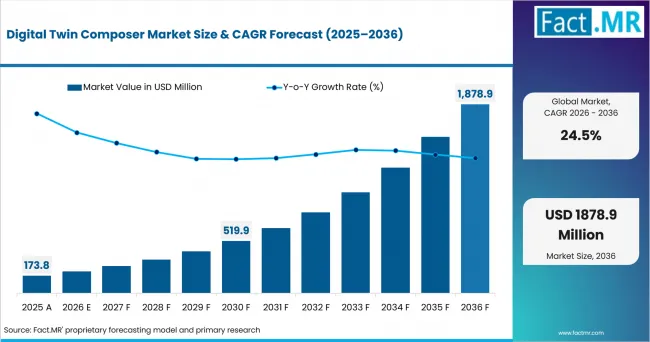
Digital Twin Composer Market Market Value Analysis | Source: Fact.MR
What are the defining numbers behind digital twin composer growth?
USD 1,668.9 million absolute dollar opportunity by 2036. India and China lead the country outlook.
- Demand Drivers in the Market
- Manufacturers need model assembly tools before factory data can support digital twin programs.
- Building owners need spatial twin views that connect geometry with operating systems.
- Plant IT teams need source-data mapping before analytics teams can use live equipment signals.
- System integrators need repeatable templates because custom twin builds are difficult to scale across sites.
- Key Segments Analyzed
- By Modeling Approach: 3D Scene Composition is expected to hold 34.0% share in 2026 because users need visual site context before simulation work begins.
- By User Type: Digital Twin Architects are likely to account for 31.0% share in 2026 because they connect engineering, IT and operations teams.
- By Deployment: Cloud SaaS is projected to hold 42.0% share in 2026 since teams prefer pilot access without heavy local infrastructure.
- By Data Integration: CAD and BIM Files are expected to hold 33.0% share in 2026 because geometry remains the first useful layer in twin creation.
- By End-use Industry: Manufacturing is forecast to hold 36.0% share in 2026 due to existing simulation and equipment-data use.
- By Geography: India is projected to record 27.8% CAGR through 2036 as lower-base adoption meets public manufacturing technology programs.
- Analyst Opinion at Fact.MR
- Shambhu Nath Jha, Senior Analyst at Fact.MR, states, “Digital twin composer tools are becoming the assembly layer for physical operations. Buyers are asking whether a plant engineer and an IT lead can build the same asset view without a long custom project. Providers that reduce file conversion and live data mapping work are likely to win the first scaled contracts.”
- Strategic Implications
- Platform vendors should make file conversion and asset hierarchy setup easier before adding more analytics features.
- Manufacturers need governance rules before composer projects expand across lines or facilities.
- Building owners should test whether 3D scenes connect with operating systems before procurement.
- System integrators need service packages that turn one pilot model into a repeatable site template.
Digital twin composer tools form the model assembly layer inside broader twin programs. The National Institute of Standards and Technology states that manufacturing twins connect sensors, Industrial Internet data and simulation work. This supports demand for workspaces that map assets before analytics or simulation teams use the model.
India is projected to record 27.8% CAGR through 2036 as manufacturing technology programs lower the entry barrier. China is expected to expand at 26.9% CAGR because software service revenue and factory automation are deepening. South Korea is forecast to grow at 26.1% CAGR as factory programs add twin-based workflows. The United States is expected to advance at 24.8% CAGR as platform vendors and manufacturing pilots support use. Germany is projected to rise at 24.4% CAGR because cloud use and industrial file control are both strong.
How does the digital twin composer market break down by segment?
3D Scene Composition leads at 34.0%; Cloud SaaS leads at 42.0%.
Which modeling approach dominates?
3D Scene Composition holds 34.0% share in 2026.
3D scene composition leads because users understand physical context faster through a visual workspace. Plant and building teams can place assets in a recognizable environment before they map data relationships. Siemens says Digital Twin Composer creates a virtual 3D model of a product, process or plant. This supports buyer interest in scene-first twin assembly.
Which user type dominates?
Digital Twin Architects account for 31.0% share in 2026.
Digital twin architects lead because they sit between engineering, IT and operations groups. Their work turns disconnected files and systems into a shared model structure. This role gains budget control because each twin project needs governance before it moves beyond a pilot.
Which deployment model dominates?
Cloud SaaS holds 42.0% share in 2026.
Cloud SaaS leads because teams want pilots that can begin without heavy local infrastructure. Eurostat reported that 52.74% of European Union enterprises used paid cloud computing services in 2025. This supports composer adoption because cloud access makes cross-functional review easier for distributed asset teams.
Which data integration route dominates?
CAD and BIM Files lead with 33.0% share in 2026.
Computer-aided design and building information modeling files lead because geometry enters twin workflows before live data becomes reliable. Bentley Systems says Infrastructure Cloud Connect can ingest data from over 50 distinct file formats. That signal shows why file breadth is becoming a commercial filter in composer software selection.
Which end use dominates?
Manufacturing holds 36.0% share in 2026.
Manufacturing leads because factories already use simulation, historians and equipment monitoring. The United States Department of Energy announced USD 33 million in July 2024 for manufacturing technology work. That funding direction supports tools that connect process models with live equipment data.
What is accelerating digital twin composer adoption, and what is holding it back?
Asset model assembly and cloud pilot access drive it while unclear model ownership and file conversion labor restrain it.
Drivers Impact Analysis
| DRIVER | (~) % IMPACT ON CAGR | GEOGRAPHIC RELEVANCE | IMPACT TIMELINE |
|---|---|---|---|
| Factory asset data mapping | +5.8% | United States, Germany, China | Short term (<= 2 years) |
| Cloud-first pilot deployment | +4.9% | Europe, India, South Korea | Short term (<= 2 years) |
| File reuse from CAD and BIM systems | +4.2% | Germany, United Kingdom, Japan | Medium term (2 to 4 years) |
| Operational data governance needs | +3.7% | North America, Europe, East Asia | Medium term (2 to 4 years) |
| Partner-led site templates | +3.1% | Global industrial markets | Long term (>= 4 years) |
Source: Fact.MR analysis. Updated Jul 2, 2026
- Factory asset mapping pressure
- Factory teams are connecting more equipment signals through Internet of Things systems. This creates pressure to organize asset names and operating context before analytics work starts.
- The International Federation of Robotics reported 4.664 million industrial robots in operational use during 2024. That equipment base increases the need for composer tools that connect machines, lines and plant models.
- Cloud pilot access
- Cloud procurement helps buyers test digital twin platforms before a full enterprise rollout. This makes composer functions useful as a starting layer for plants and buildings.
- The same procurement logic supports cloud-based composer tools because subscription access shortens the first pilot cycle. Vendors gain when they bundle model setup with secure data connectors.
- File reuse before simulation
- Manufacturers using digital twin commissioning cells need clean model assembly before virtual checks reach the plant floor. Composer software reduces rework by turning design files into usable operational context. This driver matters because buyers do not want a second project to rebuild information that already exists in engineering systems. Suppliers that read source files with fewer manual steps are likely to move faster from pilot to rollout.
Opportunity Impact Analysis
| OPPORTUNITY | (~) % IMPACT ON CAGR | GEOGRAPHIC RELEVANCE | IMPACT TIMELINE |
|---|---|---|---|
| Connector packages for CAD and BIM files | +5.5% | Europe, North America, Japan | Short term (<= 2 years) |
| Templates for mid-sized factories | +4.8% | India, South Korea, China | Medium term (2 to 4 years) |
| Infrastructure owner workspaces | +4.3% | United Kingdom, Germany, United States | Medium term (2 to 4 years) |
| Governed model libraries | +3.9% | Global enterprise users | Long term (>= 4 years) |
| Composer services around cloud twins | +3.4% | Global software partners | Long term (>= 4 years) |
Source: Fact.MR analysis. Updated Jul 2, 2026
- Connector packages
- Connector packages are attractive where building information modeling software already stores project geometry. Composer vendors can convert that data into asset models that operations teams can use. Specialized BIM extraction software also supports this route because it turns model content into structured inputs. This makes buildings and infrastructure a practical expansion field.
- Governed model libraries
- Governed model libraries can improve the value of IoT analytics tools because the data points already sit inside a known asset structure. Buyers are likely to pay more when the model remains usable after the first pilot. Plants that process data near edge computing nodes also need clear asset context. Composer tools can define where the edge feed belongs in the operating model.
Restraints Impact Analysis
| RESTRAINT | (~) % IMPACT ON CAGR | GEOGRAPHIC RELEVANCE | IMPACT TIMELINE |
|---|---|---|---|
| Unclear model ownership | -3.9% | Global | Short term (<= 2 years) |
| File conversion labor | -3.4% | Buildings, infrastructure, factories | Medium term (2 to 4 years) |
| Data access and switching review | -3.1% | Europe, multinational buyers | Medium term (2 to 4 years) |
| Shortage of twin architects | -2.7% | India, South Korea, Japan | Medium term (2 to 4 years) |
| Pilot-to-rollout budget gap | -2.2% | SME-heavy markets | Long term (>= 4 years) |
Source: Fact.MR analysis. Updated Jul 2, 2026
- Unclear model ownership
- Composer projects can stall when engineering, IT and operations teams disagree on model ownership. The tool can create the starting structure. The buyer still needs rules for asset names and access rights. Version updates also need ownership.
- Data access review
- The European Commission says the Data Act gives business users access to data from connected devices and helps users switch cloud providers. This improves openness over time but adds review work during procurement. Buyers may delay composer decisions until legal and IT teams agree on data-sharing terms.
- Pilot budget gap
- Some buyers fund a pilot under broad digital transformation programs but delay the rollout budget. Vendors can reduce this restraint by pricing model templates and connector libraries separately from full platform licenses. Service partners can also package digital twin as-a-service for buyers that cannot maintain a full twin team. This route helps smaller facilities test composer workflows before they commit to a larger platform.
Which countries are scaling digital twin composer adoption fastest?
India leads at 27.8% CAGR. China follows at 26.9% CAGR. South Korea holds 26.1% CAGR. The United States records 24.8% CAGR. Germany reaches 24.4% CAGR. The United Kingdom reaches 23.7% CAGR. Japan reaches 23.3% CAGR.
Based on regional analysis, the digital twin composer market is segmented into North America and Western Europe. It also covers East Asia and South Asia and Pacific. Latin America and Middle East and Africa are included.
| Country | CAGR |
|---|---|
| India | 27.8% |
| China | 26.9% |
| South Korea | 26.1% |
| United States | 24.8% |
| Germany | 24.4% |
| United Kingdom | 23.7% |
| Japan | 23.3% |
Source: Fact.MR analysis. Updated Jul 2, 2026
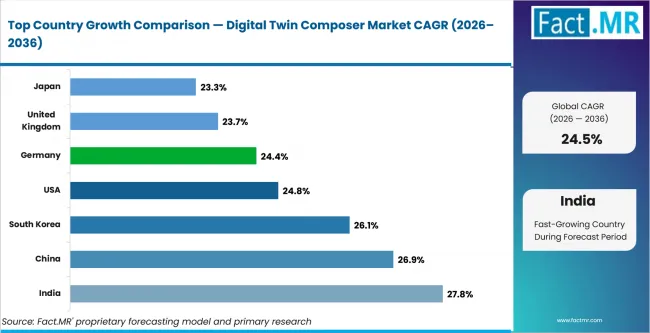
Digital Twin Composer Market Cagr Analysis By Country | Source: Fact.MR
What is powering India’s lead?
27.8% CAGR, supported by manufacturing technology programs and a lower starting base.
India is projected to record 27.8% CAGR through 2036 as manufacturing technology programs lower the entry barrier. The Central Manufacturing Technology Institute developed 15 MSME-oriented technologies in Digital Twin and Automation domains in 2025. That program signal helps local users test twin workflows before large platform purchases. Supplier success depends on templates that make pilots practical for mid-sized manufacturers.
How is China scaling adoption?
26.9% CAGR, driven by software services and factory automation.
China is expected to expand at 26.9% CAGR through 2036 as software services and factory automation deepen. The State Council of the People’s Republic of China reported that software sector revenue reached more than 15.48 trillion yuan in 2025. This gives composer suppliers a large channel for cloud and industrial software deployment. Local implementation partners are likely to matter because platform preferences differ by buyer.
Why is South Korea important?
26.1% CAGR, supported by twin-based factory programs.
South Korea is forecast to grow at 26.1% CAGR through 2036 as factory programs add twin-based workflows. The Ministry of SMEs and Startups said digital twin-based autonomous factories would be implemented in over 1,700 manufacturing SMEs. This creates demand for lighter composer tools with clear templates. Vendors that serve smaller manufacturers without long modeling projects should gain earlier access.
What supports the United States outlook?
24.8% CAGR, backed by platform vendors and manufacturing pilots.
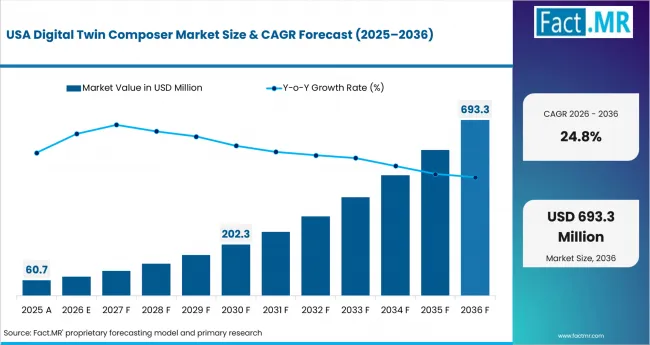
Digital Twin Composer Market Country Value Analysis | Source: Fact.MR
The United States is expected to advance at 24.8% CAGR through 2036 as platform vendors and manufacturing pilots support use. Buyers are likely to favor providers that connect composer workspaces with cybersecurity and plant data controls. Hyperscale cloud access gives the country a strong route to multi-site rollout.
Why does Germany remain an anchor market?
24.4% CAGR, owing to cloud use and industrial file control.
Germany is projected to rise at 24.4% CAGR through 2036 because cloud use and industrial file control are both strong. The Federal Statistical Office of Germany reported that 86% of large enterprises used cloud services in 2025. This makes Germany a buyer testbed for enterprise-grade composer governance. Plant buyers are likely to ask how a composer handles version control and access rights.
What shapes the United Kingdom opportunity?
23.7% CAGR, supported by manufacturing technology and infrastructure twin activity.
The United Kingdom is forecast at 23.7% CAGR through 2036 because manufacturing technology policy overlaps with infrastructure twin use. UK Research and Innovation lists a GBP 147 million budget for Made Smarter Innovation. Composer vendors can gain traction by aligning plant tools with building and infrastructure data workflows. Suppliers should show that design data can move into operations without repeated manual work.
How does Japan perform?
23.3% CAGR, backed by careful factory modernization.
Japan is expected to post 23.3% CAGR through 2036 as factory modernization and service-heavy implementation needs continue. The rate is below the global average because buyer validation cycles are longer. Japanese users are likely to prefer tested workflows over broad platform repositioning. Suppliers need local partner depth and clear links between model setup and shopfloor reliability.
Who leads the digital twin composer landscape?
Siemens leads through named composer tools. Microsoft and Amazon Web Services add twin graphs and cloud connector depth.
Digital twin composer software is used by industrial, building and infrastructure buyers that need a controlled model assembly layer before full twin deployment. Siemens has the clearest named product signal through Digital Twin Composer. Microsoft supports twin graph work through Azure Digital Twins. Amazon Web Services supports operational twins through AWS IoT TwinMaker.
Bentley Systems is strong in infrastructure because Infrastructure Cloud Connect addresses file ingestion and asset data unification. Dassault Systèmes competes through engineering model continuity across product and manufacturing workflows.
Schneider Electric adds power and facility system depth through electrical twin work with ETAP. Competition through 2036 is expected to depend on connector depth and governance design. Suppliers that reduce file conversion work and make model updates auditable are better placed than vendors that sell only visualization.
Which companies are the key players?
Key players include Microsoft Corporation and Amazon Web Services. The list also includes Siemens AG and Dassault Systèmes. Bentley Systems completes the group. Schneider Electric is also included.
- Microsoft Corporation
- Amazon Web Services
- Siemens AG
- Dassault Systèmes SE
- Bentley Systems Incorporated
- Schneider Electric SE
Bibliography
- International Federation of Robotics. (2025, September 25). World Robotics 2025 report: Industrial robots.
- National Institute of Standards and Technology. (2024, April 15). Digital Twins for Advanced Manufacturing.
- European Commission. (2025, December 15). Data Act explained.
- Siemens AG. (2026, January 6). Siemens unveils technologies to accelerate the industrial AI revolution at CES 2026.
- Eurostat. (2026, January 13). Cloud computing: Statistics on the use by enterprises.
- Bentley Systems Incorporated. (2025, October 15). Bentley Systems announces Bentley Infrastructure Cloud Connect.
- United States Department of Energy. (2024, July 18). $33 million in funding available to advance smart manufacturing technologies to help accelerate a clean energy economy.
- Press Information Bureau, Government of India. (2026, January 13). Year end review 2025: Ministry of Heavy Industries.
- State Council of the People’s Republic of China. (2026, January 31). China’s software industry revenues surge in 2025.
- Ministry of SMEs and Startups, Republic of Korea. (2025, January 10). Ministry of SMEs and Startups announces plan for 2025.
- Federal Statistical Office of Germany. (2026). Enterprises using cloud computing services by employment size class.
- UK Research and Innovation. (2026, March 20). Made Smarter Innovation.
This Report Addresses
- Strategic intelligence on digital twin composer software across modeling approach, user type and deployment model.
- Segment analysis covers 3D Scene Composition and Digital Twin Architects. It also covers Cloud SaaS and CAD and BIM Files and Manufacturing.
- Regional outlook covers India and China. It also covers South Korea, United States and Germany. United Kingdom and Japan complete the country view.
- Competitive analysis covers Microsoft and Amazon Web Services. It also covers Siemens, Dassault Systèmes and Bentley Systems. Schneider Electric completes the supplier view.
- Product assessment covers model composition and graph mapping. It also covers 3D scene assembly and data connector workspaces.
- Source review covers cloud adoption, manufacturing technology programs and official company product launches.
- Primary interviews, provider checks and official-source review support the forecast.
What does the digital twin composer market cover?
Software and related services that assemble asset twins, spatial scenes and live data relationships.
The digital twin composer market covers authoring environments that help users build or update digital twins for physical assets. It includes model hierarchy tools and 3D scene assembly. It also includes data connector mapping and deployment workspaces. The market differs from broader digital twin platforms because the focus is model composition and source-data setup.
What is included in the scope?
Model composition, data mapping and deployment-ready twin authoring.
The scope includes ontology-based model composition for industrial and built assets. It covers graph-based twin mapping for asset relationships. It includes 3D scene composition for plants and buildings. It also includes computer-aided design files, building information modeling files and historian data mapping. Cloud SaaS and enterprise platform modules are included when the product supports twin authoring.
What is excluded from the scope?
General simulation software and hardware-only sensing systems without twin composition functions.
The scope excludes generic computer-aided design tools that do not create operational twin structures. It excludes sensor hardware and industrial gateways sold without composer software. It excludes consulting-only transformation work without software-based twin authoring. It also excludes analytics dashboards that do not build or maintain asset models.
How was the analysis built?
100+ sources reviewed. 40+ company portfolios checked. 25+ countries screened. 20+ interviews used.
- Primary Research: Primary research includes interviews with plant technology leaders and facility software buyers. It includes input from digital twin architects and system integrators.
- Desk Research: Desk research reviews government manufacturing technology programs and official cloud adoption statistics. It also checks company product pages and release notes for twin authoring functions.
- Market-Sizing and Forecasting: Forecasting uses the 2025 and 2026 market value anchors. The model reconciles those values against software deployment intensity and manufacturing twin penetration.
- Data Validation and Update Cycle: Forecasts are validated through company participation checks and public program signals. Product launches and policy updates help confirm market direction.
Segmentation
What is the report’s scope and coverage?
| Attribute | Details |
|---|---|
| Quantitative Units | USD Million in 2026 to USD Million by 2036 at CAGR |
| Market Definition | Composer tools that build or update asset twins, 3D scenes and source-data relationships |
| Modeling Approach | Ontology-Based Models, Graph-Based Twins, 3D Scene Composition, Asset Hierarchy Mapping |
| User Type | Domain Engineers, Plant IT, Facility Managers, Digital Twin Architects |
| Deployment | Cloud SaaS, Enterprise Platform Module, On-Premise, Hybrid |
| Data Integration | IoT Data, CAD and BIM Files, Historian Data, Enterprise Systems |
| End-use Industry | Manufacturing, Buildings, Energy, Logistics, Connected Infrastructure |
| Regions Covered | North America, Western Europe, East Asia, South Asia and Pacific, Latin America, Middle East and Africa |
| Countries Covered | India, China, South Korea, United States, Germany, United Kingdom, Japan |
| Key Companies Profiled | Microsoft, Amazon Web Services, Siemens, Dassault Systèmes, Bentley Systems, Schneider Electric |
| Forecast Period | 2026 to 2036 |
| Approach | Hybrid top-down and bottom-up approach using supplied values, software deployment intensity, company product checks and public policy signals |
Source: Fact.MR analysis. Updated Jul 2, 2026
How is the market segmented?
-
By Modeling Approach:
- Ontology-Based Models
- Graph-Based Twins
- 3D Scene Composition
- Asset Hierarchy Mapping
-
By User Type:
- Domain Engineers
- Plant IT
- Facility Managers
- Digital Twin Architects
-
By Deployment:
- Cloud SaaS
- Enterprise Platform Module
- On-Premise
- Hybrid
- By Data Integration:
- IoT Data
- CAD and BIM Files
- Historian Data
- Enterprise Systems
-
By End-use Industry:
- Manufacturing
- Buildings
- Energy
- Logistics
- Connected Infrastructure
-
By Region:
- North America
- United States
- Canada
- Mexico
- Latin America
- Brazil
- Argentina
- Rest of Latin America
- Europe
- Germany
- United Kingdom
- France
- Italy
- Spain
- Rest of Europe
- Asia Pacific
- China
- India
- Japan
- South Korea
- ASEAN
- Middle East & Africa
- GCC Countries
- South Africa
- UAE
- Rest of Middle East & Africa
- North America
Frequently Asked Questions
Which modeling approach leads the Digital Twin Composer Market?
Which deployment model leads the Digital Twin Composer Market?
How does India perform in the Digital Twin Composer Market?
How does China perform in the Digital Twin Composer Market?
How does South Korea perform in the Digital Twin Composer Market?
What is the primary driver in the Digital Twin Composer Market?
What is the main restraint in the Digital Twin Composer Market?
Why are CAD and BIM files important in this market?
Who worked on this report


Preview the report firsthand - request a free sample
Free SampleGet the brochure for pricing and purchase details
Download PDF