- Market Value (2025): USD 200.1 Mn
- Estimated Value (2026): USD 219.7 Mn
- Forecast Value (2036): USD 560.6 Mn
- CAGR (2026-2036): 9.8%
What is the Optical Transceiver Modules Market forecast to be worth by 2036?
USD 219.7 million in 2026 to USD 560.6 million by 2036 at a 9.8% CAGR.
- Fact.MR estimates that the optical transceiver modules market was valued at USD 200.1 million in 2025.
- demand is projected to increase from USD 219.7 million in 2026 to USD 560.6 million by 2036.
- The forecast indicates a 9.8% CAGR from 2026 to 2036 as demand for high-bandwidth connectivity expands across data centers and communication networks.
| Year | Basis | Market Value (USD million) |
|---|---|---|
| 2025 | Actual | 200.1 |
| 2026 | Estimate | 219.7 |
| 2036 | Forecast | 560.6 |
| CAGR 2026 to 2036 | Forecast period | 9.8% |
Source: Fact.MR analysis. Updated Nov 11, 2026
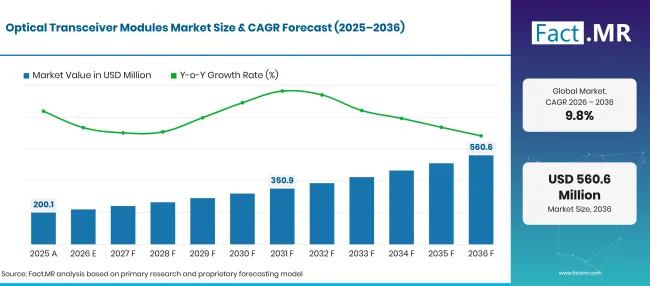
Optical Transceiver Modules Forecast Global | Source: Fact.MR
What are the defining numbers behind Optical Transceiver Modules Market growth?
USD 340.9 million in additional market value between 2026 and 2036.
- Demand Drivers in the Market
- AI infrastructure and hyperscale data center expansion has driven the growth of the market. Cloud service providers are expanding computing infrastructure to support artificial intelligence workloads. These facilities require high-speed optical interconnects to transfer large volumes of data between servers, switches, and storage systems. TrendForce projected the global AI optical transceiver market to reach USD 26 billion in 2026, compared with USD 16.5 billion in 2025.
- Increasing demand for high-capacity optical networking supports the market growth. Data center interconnect investments are encouraging the adoption of advanced optical transmission equipment. Dell'Oro Group reported that the optical transport equipment market expanded by 10% in 2025, with direct purchases of WDM equipment for data center interconnect applications increasing by nearly 40%.
- Transition toward higher transmission speeds has raised the demand for the optical transceiver modules. Manufacturers are developing 400G, 800G, and 1.6T modules to support growing bandwidth requirements. CIG Shanghai's 2025 annual report identifies 800G modules as an important product for AI data centers and notes that 1.6T modules have entered early commercial deployment.
- Telecommunications network upgrades create opportunities for optical-module suppliers. Telecom operators need higher-capacity optical connections to support 5G-Advanced deployments, metropolitan networks, and broadband infrastructure upgrades. This creates opportunities for manufacturers supplying modules across different transmission rates and network architectures.
- Key Segments Analyzed
- By Optical Transceiver Data Rate: 10–25G is projected to account for 29.7% of the market in 2026, reflecting demand across established networking infrastructure and communication applications.
- By Integration / Product Form: Discrete IC / die is the largest category in the segment table at 27.7% in 2026.
- By System Application: Data Center applications account for 24.4% of the market in 2026, reflecting demand for high-speed server and network connectivity.
- By Procurement Route: System Integrators lead with a 27.6% share in 2026, as organizations increasingly procure optical connectivity solutions through integrated infrastructure projects.
- Analyst Opinion at Fact.MR
- Shambhu Nath Jha, Principal Consultant at Fact.MR, states, “Optical transceiver manufacturers are likely to benefit from rising bandwidth requirements across data centers and communication networks. However, suppliers need to balance transmission speed with power efficiency, thermal performance, reliability, and compatibility to address the changing requirements of network operators and infrastructure developers.”
- Strategic Implications
- Optical module manufacturers should expand their high-speed product portfolios while maintaining compatibility with established networking equipment.
- Component suppliers need to strengthen their capabilities in photonic integration, laser technology, signal processing, and thermal management.
- Data center operators must evaluate transmission speed, power consumption, latency, and total deployment costs when selecting optical modules.
- System integrators can work with suppliers offering consistent product availability, interoperability, and technical support.
- Manufacturers targeting industrial and automotive applications should prioritize ruggedness, operating-temperature tolerance, and long-term reliability.
South Korea is projected to record an 11.8% CAGR through 2036, followed by China at 11.7%. Japan is estimated to advance at 11.3%, while Taiwan is forecast to register 10.9%. The USA is expected to record a 9.8% CAGR.
How does the Optical Transceiver Modules Market break down by segment?
Fact.MR finds that 10–25G leads Optical Transceiver Data Rate at 29.7%; Discrete IC / die leads Integration / Product Form at 27.7%; Data Center Leads System Application at 24.4%; and System Integrator leads Procurement Route at 27.6%.
Which Optical Transceiver Data Rate dominates?
10–25G is set to hold a 29.7% share in 2026.
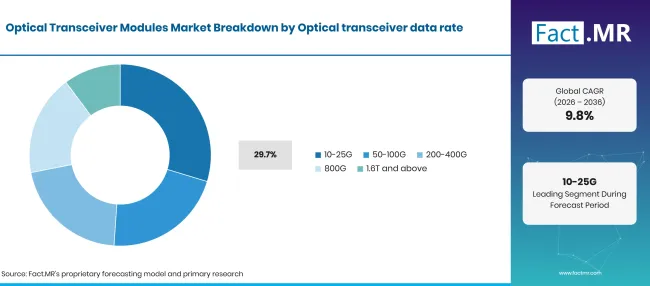
Optical Transceiver Modules Breakdown Optical Transceiver Data Rate | Source: Fact.MR
| Optical Transceiver Data Rate | Share (2026) |
|---|---|
| 10–25G (Leading segment) | 29.7% |
| Other segments combined | 70.3%* |
| Total | 100.0% |
Source: Fact.MR analysis. Updated Nov 11, 2026
The 10–25G category maintains a significant position because optical connectivity requirements extend beyond hyperscale computing environments. Enterprise networks, telecom access infrastructure, and established communication systems continue to require modules operating at comparatively moderate transmission speeds. These products can serve applications where network operators prioritize compatibility and deployment economics alongside bandwidth requirements. Higher-speed categories are gaining importance as data centers upgrade their infrastructure. The 200–400G, 800G, and 1.6T-and-above categories serve increasingly demanding connectivity requirements. Manufacturers need to maintain product availability across multiple speed categories to address different network architectures.
What leads the Integration / Product Form segment?
Discrete IC / die is shown as the leading category at 27.7% in the 2026 segment table.
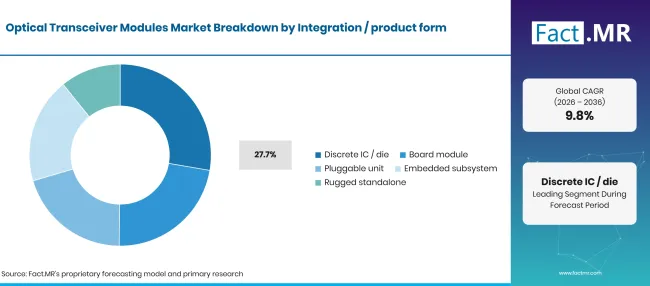
Optical Transceiver Modules Breakdown Integration Product Form | Source: Fact.MR
| Integration / Product Form | Share (2026) |
|---|---|
| Discrete IC / die (Leading segment) | 27.7% |
| Other segments combined | 72.3% * |
| Total | 100.0% |
Source: Fact.MR analysis. Updated Nov 11, 2026
Discrete IC and die products serve component-level integration requirements, while board modules and embedded subsystems are relevant to equipment manufacturers developing integrated communication platforms. Pluggable units also remain important because they allow network operators to replace or upgrade optical connectivity components without replacing entire systems. Rugged standalone modules address applications in which optical components must operate reliably under demanding environmental conditions. Industrial automation, transportation infrastructure, and specialized communication systems can require enhanced resistance to temperature variation, vibration, and other operating stresses. These requirements support demand for standalone products designed around application-specific reliability.
How does System Application shape demand?
Data Center applications are likely to account for a 24.4% share in 2026.
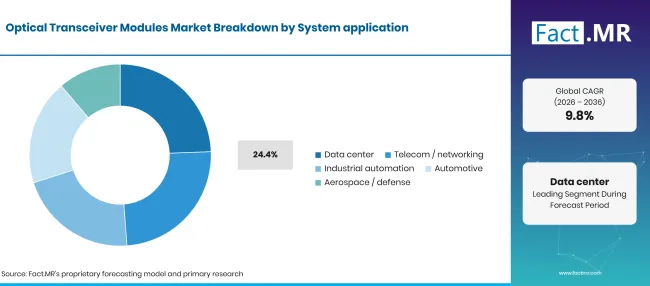
Optical Transceiver Modules Breakdown System Application | Source: Fact.MR
| System Application | Share (2026) |
|---|---|
| Data Center (Leading segment) | 24.4% |
| Other segments combined | 75.6%* |
| Total | 100.0% |
Source: Fact.MR analysis. Updated Nov 11, 2026
Data centers require optical transceivers to connect servers, switches, storage systems, and network infrastructure. Increasing AI workloads and cloud computing deployments are raising the need for higher bandwidth and lower-latency communication between computing resources. This creates opportunities for suppliers offering high-speed modules with improved power efficiency. Telecom and networking applications require optical modules for access, metropolitan, and backbone infrastructure. Industrial automation applications depend on reliable communication between connected equipment and control systems. Automotive applications are developing around increasingly connected vehicle architectures, while aerospace and defense systems require specialized optical connectivity products that meet stringent operational requirements.
How does Procurement Route shape market demand?
System Integrators are projected to account for a 27.6% share in 2026.
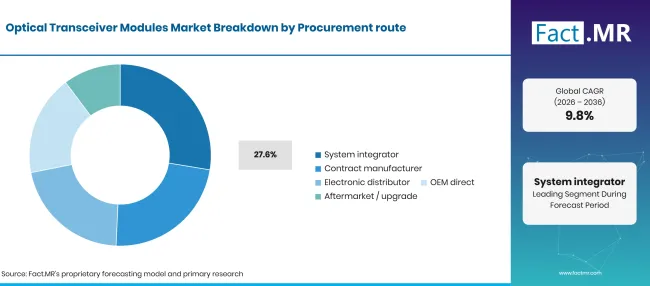
Optical Transceiver Modules Breakdown Procurement Route | Source: Fact.MR
| Procurement Route | Share (2026) |
|---|---|
| System Integrator (Leading segment) | 27.6% |
| Other segments combined | 72.4%* |
| Total | 100.0% |
Source: Fact.MR analysis. Updated Nov 11, 2026
System integrators play an important role in optical transceiver procurement because they coordinate equipment selection, network configuration, installation, and system compatibility. Large data center and telecommunications projects frequently require multiple interconnected components, making integrated procurement an attractive approach for infrastructure developers. Electronic distributors serve buyers requiring standardized products and established supply channels. Contract manufacturers procure components for equipment production, while OEM-direct purchasing allows original equipment manufacturers to work closely with optical module suppliers on product specifications and integration requirements. Aftermarket and upgrade procurement supports replacement and capacity expansion across installed networks.
What is accelerating Optical Transceiver Modules Market adoption, and what is holding it back?
AI data center expansion, higher network bandwidth requirements, and optical infrastructure upgrades support demand, while component shortages, power consumption, and technology transition costs can constrain adoption.
Drivers Impact Analysis
| DRIVER | (~) % IMPACT ON CAGR | GEOGRAPHIC RELEVANCE | IMPACT TIMELINE |
|---|---|---|---|
| AI data center infrastructure expansion | +1.2% | USA, China | Short term (≤ 2 years) |
| Higher-speed optical networking adoption | +0.9% | Global | Medium term (2–4 years) |
| Telecom network modernization | +0.7% | Asia, North America | Medium term (2–4 years) |
| Cloud computing infrastructure investment | +0.6% | USA, China, Japan | Short term (≤ 2 years) |
| Industrial and automotive connectivity | +0.4% | Global | Long term (≥ 4 years) |
Source: Fact.MR analysis. Updated Nov 11, 2026
Opportunity Impact Analysis
| OPPORTUNITY | (~) % IMPACT ON CAGR | GEOGRAPHIC RELEVANCE | IMPACT TIMELINE |
|---|---|---|---|
| Commercialization of 1.6T optical modules | +0.9% | USA, China, South Korea | Medium term (2–4 years) |
| Silicon photonics and advanced integration | +0.7% | USA, Taiwan, Japan | Long term (≥ 4 years) |
| High-reliability industrial optical modules | +0.5% | Germany, Japan, South Korea | Medium term (2–4 years) |
| Expansion of data center interconnect networks | +0.6% | Global | Short term (≤ 2 years) |
| Automotive optical connectivity development | +0.3% | USA, Japan, Germany | Long term (≥ 4 years) |
Source: Fact.MR analysis. Updated Nov 11, 2026
Restraints Impact Analysis
| RESTRAINT | (~) % IMPACT ON CAGR | GEOGRAPHIC RELEVANCE | IMPACT TIMELINE |
|---|---|---|---|
| Shortages of advanced optical components | -0.8% | Global | Short term (≤ 2 years) |
| High development and manufacturing costs | -0.6% | Global | Medium term (2–4 years) |
| Power consumption and thermal management requirements | -0.5% | Global | Medium term (2–4 years) |
| Interoperability and compatibility challenges | -0.4% | Global | Short term (≤ 2 years) |
| Rapid product obsolescence and upgrade requirements | -0.3% | Global | Long term (≥ 4 years) |
Source: Fact.MR analysis. Updated Nov 11, 2026
Which countries are scaling the Optical Transceiver Modules Market through 2036?
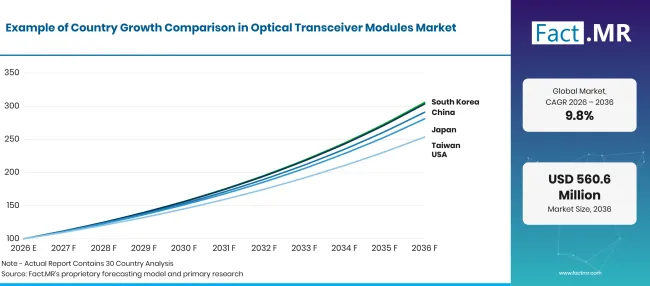
Optical Transceiver Modules Growth Index | Source: Fact.MR
| Country | CAGR (2026–2036) |
|---|---|
| South Korea | 11.8% |
| China | 11.7% |
| Japan | 11.3% |
| Taiwan | 10.9% |
| USA | 9.8% |
Source: Fact.MR analysis. Updated Nov 11, 2026
What supports South Korea's market growth?
11.8% CAGR, supported by semiconductor capabilities, advanced telecommunications infrastructure, and high-speed connectivity requirements.
South Korea's optical transceiver market is supported by its established semiconductor and electronics manufacturing ecosystem. Investment in advanced computing infrastructure and telecommunications networks creates demand for optical modules across multiple transmission speeds. Manufacturers can benefit from supplying high-performance modules for data centers and network equipment. Opportunities also exist in specialized optical connectivity for industrial and automotive applications.
What is Driving the China Market Over the Forecast Period?
11.7% CAGR, driven by domestic optical component manufacturing, data center investment, and telecommunications network expansion.
China benefits from a substantial electronics manufacturing base and an established optical communications supply chain. Domestic manufacturers are expanding their capabilities in high-speed optical modules to address growing requirements from cloud computing infrastructure and telecommunications operators. The development of AI computing facilities is creating opportunities for 800G and 1.6T products, while established networking infrastructure continues to support demand for lower-speed modules.
What supports Japan's adoption?
11.3% CAGR, shaped by advanced electronics manufacturing, precision engineering, and industrial connectivity requirements.
Japan's market is shaped by demand for reliable optical components across telecommunications, industrial automation, automotive electronics, and data center infrastructure. Its established electronics ecosystem provides opportunities for suppliers developing compact, energy-efficient, and high-reliability modules. Manufacturers can strengthen their market position through product engineering, optical component innovation, and compatibility with specialized network equipment.
Which Factors Drive the Growth of the Taiwan in the Market?
10.9% CAGR, led by semiconductor manufacturing expertise, electronics production, and growing demand for high-speed data transmission.
Taiwan's semiconductor and electronics manufacturing ecosystem supports the development and production of advanced optical communication components. Its role in the wider technology supply chain creates opportunities for optical transceiver manufacturers supplying data center equipment and network infrastructure providers. According to Taiwan’s Ministry of Finance, integrated circuit exports reached US$209.2 billion in 2025, increasing 26.7% year over year and accounting for 32.7% of total exports. The National Science and Technology Council reported that science park revenue increased 21.83% to NT$5.8 trillion in 2025, with integrated circuit industry revenue rising 26.8%. The Ministry of Economic Affairs has identified silicon photonic heterogeneous integration as a strategic development priority.
What supports United States adoption?
9.8% CAGR, backed by hyperscale data center expansion, cloud computing investments, and AI infrastructure development.
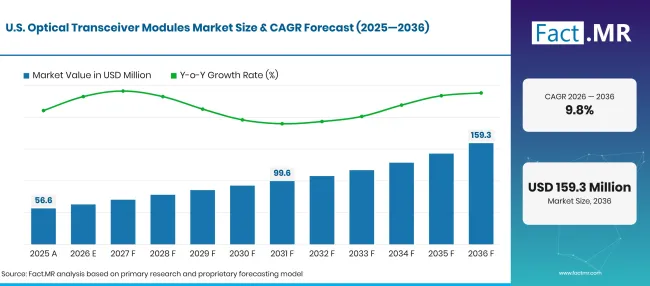
Optical Transceiver Modules Forecast Usa | Source: Fact.MR
The US market is supported by continued investments in hyperscale data centers and high-performance computing infrastructure. Cloud service providers require optical transceivers to connect servers, switches, and distributed computing resources. Demand for 400G and 800G modules, alongside the gradual introduction of 1.6T products, creates opportunities for manufacturers with advanced optical technologies. Suppliers also need to address power efficiency, thermal management, and supply reliability as data center operators expand network capacity.
Who leads the Optical Transceiver Modules Market?
Fact.MR identifies Coherent Corp., Lumentum Holdings Inc., Innolight Technology Corporation, Eoptolink Technology Inc., and Accelink Technologies Co., Ltd. as key companies in the optical transceiver modules market.
Coherent Corp. participates in optical communications through its optical components and transceiver portfolio. Its capabilities in photonics, lasers, and optical networking components support applications across data center and telecommunications infrastructure. Lumentum Holdings Inc. supplies optical and photonic products for cloud data center, telecommunications, and networking applications. Its optical communications portfolio includes technologies used in high-speed optical transmission.
Innolight Technology Corporation is a major supplier of high-speed optical transceiver modules. Its product portfolio includes 400G, 800G, and next-generation high-speed solutions designed for cloud computing and data center connectivity. Eoptolink Technology Inc. develops and manufactures optical transceiver products for data communications and telecommunications. Its portfolio spans different transmission rates and product configurations, including high-speed modules for data center networks.
Accelink Technologies Co., Ltd. participates in optical communication devices and module manufacturing. Its product activities cover optical transmission, access networks, and data communication applications.
Competitive positioning depends on transmission speed, product reliability, manufacturing scale, component availability, and customer qualification. Suppliers are also investing in advanced photonics, higher integration, and energy-efficient designs to address evolving data center and telecommunications requirements.
Which companies are the key providers?
Key companies include Coherent Corp.; Lumentum Holdings Inc.; Innolight Technology Corporation; Eoptolink Technology Inc.; and Accelink Technologies Co., Ltd.
- Coherent Corp.
- Lumentum Holdings Inc.
- Innolight Technology Corporation
- Eoptolink Technology Inc.
- Accelink Technologies Co., Ltd.
Bibliography
- CIG Shanghai Co., Ltd. (2026, April 2). 2025 Annual Report. Hong Kong Exchanges and Clearing Limited.
- Dell’Oro Group. (2026, February 18). Optical transport market grew to $16 billion in 2025, according to Dell’Oro Group.
- Ministry of Economic Affairs, Taiwan. (2026, March 25). Ministry of Economic Affairs Administrative Report.
- National Science and Technology Council, Taiwan. (2026, March 11). 科學園區2025年營收5.8兆元,成長21.83% [Science park revenue reached NT$5.8 trillion in 2025, up 21.83%].
- TrendForce. (2026, April 20). Global AI optical transceiver market to reach US$26 billion in 2026; component shortages identified as primary capacity expansion bottleneck.
This Report Answers
- The report describes the demand for optical transceiver modules across different transmission rates and networking applications.
- Segment analysis compares 10–25G, 50–100G, 200–400G, 800G, and 1.6T-and-above products.
- Integration analysis evaluates discrete components, board modules, pluggable units, embedded subsystems, and rugged standalone products.
- Application analysis examines data center, telecommunications, industrial automation, automotive, and aerospace and defense requirements.
- Country analysis discusses China, the USA, Taiwan, South Korea, and Japan alongside their market growth rates.
- The competitive overview profiles Coherent, Lumentum, Innolight, Eoptolink, and Accelink.
What does the Optical Transceiver Modules Market cover?
The market covers optical transceiver modules used to transmit and receive data through fiber-optic communication systems. These devices convert electrical signals into optical signals for transmission and convert incoming optical signals back into electrical signals for processing. Market coverage includes products across multiple transmission rates, integration formats, and application environments. Demand is influenced by data center expansion, telecommunications network upgrades, industrial connectivity, and the increasing need for high-bandwidth communication infrastructure.
What is included in the scope?
Included products comprise optical transceiver modules and associated module configurations used in data communication, telecommunications, industrial networking, automotive connectivity, and aerospace and defense communication systems.
The scope includes discrete IC / die products, board modules, pluggable units, embedded subsystems, and rugged standalone products across the specified transmission-rate categories.
The market also includes procurement through system integrators, contract manufacturers, electronic distributors, OEM-direct channels, and aftermarket or upgrade purchases. Product evaluation considers transmission speed, compatibility, signal quality, power consumption, integration requirements, and operational reliability.
What is excluded from the scope?
The analysis excludes standalone optical fibers, fiber-optic cables, passive optical components, and optical networking equipment sold independently of optical transceiver modules.
It also excludes general-purpose semiconductor components that are not specifically classified as optical transceiver products. Optical test equipment, installation services, network management software, and unrelated electronic communication devices are outside the defined market boundary.
How Was the Analysis Built?
The analysis draws on 120+ sources, 35+ company portfolios, 25+ countries, and more than 20 industry interviews.
- Primary Research: Primary research includes discussions with optical transceiver manufacturers, component suppliers, network equipment providers, system integrators, contract manufacturers, distributors, data center operators, telecommunications service providers, and subject-matter experts. These discussions examine procurement priorities, transmission requirements, product qualification, manufacturing capabilities, technology transitions, competitive positioning, and factors influencing wider market adoption.
- Desk Research: Desk research covers company annual reports, investor presentations, government publications, telecommunications industry statistics, semiconductor industry reports, technical studies, optical networking standards, industry associations, trade publications, and other authoritative sources. Every source used in the analysis is documented in the bibliography.
- Market Sizing and Forecasting: Market estimates combine historical performance, product pricing, shipment volumes, transmission-rate adoption, application demand, procurement patterns, company participation, regional investment, technology development, and barriers to market expansion.
- Data Validation and Update Cycle: Findings are validated by comparing primary interviews with company disclosures, product portfolios, industry developments, manufacturing investments, and technology adoption. Regular updates review new product launches, production capacity, customer qualification, strategic partnerships, and changes in optical networking requirements.
Segmentation
What is the report's scope and coverage?
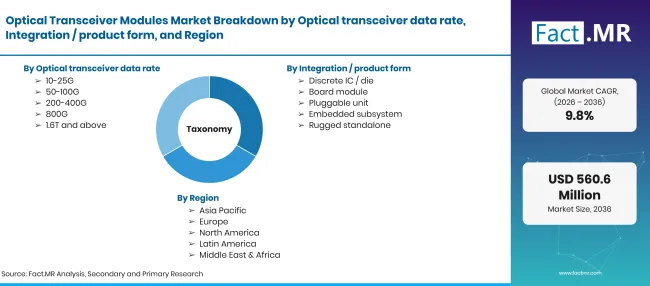
Optical Transceiver Modules Taxonomy | Source: Fact.MR
| Attribute | Details |
|---|---|
| Quantitative Units | USD million in 2026 to USD million by 2036, at CAGR |
| Market Definition | Optical transceiver modules are optoelectronic devices that convert electrical signals into optical signals and vice versa for data transmission across communication networks. |
| Optical Transceiver Data Rate | 10–25G; 50–100G; 200–400G; 800G; 1.6T and above |
| Integration / Product Form | Discrete IC / die; Board module; Pluggable unit; Embedded subsystem; Rugged standalone |
| System Application | Data center; Telecom / networking; Industrial automation; Automotive; Aerospace / defense |
| Procurement Route | System integrator; Contract manufacturer; Electronic distributor; OEM direct; Aftermarket / upgrade |
| Regions Covered | North America; Latin America; Western Europe; Eastern Europe; East Asia; South Asia & Pacific; Middle East & Africa |
| Countries Covered | China; USA; Taiwan; South Korea; Japan |
| Companies Profiled | Coherent Corp.; Lumentum Holdings Inc.; Innolight Technology Corporation; Eoptolink Technology Inc.; Accelink Technologies Co., Ltd. |
| Forecast Period | 2026 to 2036 |
| Approach | Market segmentation and scenario-based analysis supported by industry developments, company portfolios, technology adoption, and regional demand indicators |
Source: Fact.MR analysis. Updated Nov 11, 2026
How is the market segmented?
-
By Optical Transceiver Data Rate
- 10–25G
- 50–100G
- 200–400G
- 800G
- 1.6T and above
-
By Integration / Product Form
- Discrete IC / die
- Board module
- Pluggable unit
- Embedded subsystem
- Rugged standalone
-
By System Application
- Data center
- Telecom / networking
- Industrial automation
- Automotive
- Aerospace / defense
-
By Procurement Route
- System integrator
- Contract manufacturer
- Electronic distributor
- OEM direct
- Aftermarket / upgrade
-
By Region
- North America
- Latin America
- Western Europe
- Eastern Europe
- East Asia
- South Asia & Pacific
- Middle East & Africa
Frequently Asked Questions
How big is the Optical Transceiver Modules Market in 2026?
What is the CAGR from 2026 to 2036?
Which optical transceiver data rate has the largest share?
Which integration / product form leads the market?
Which system application accounts for the largest market share?
Which procurement route dominates the market?
Which country is expected to grow fastest?
Which companies are covered in the report?
Who worked on this report


Preview the report firsthand - request a free sample
Free SampleGet the brochure for pricing and purchase details
Download PDF