- Market Value (2025): USD 2.66 Bn
- Estimated Value (2026): USD 2.83 Bn
- Forecast Value (2036): USD 5.32 Bn
- CAGR (2026-2036): 6.5%
What is the RF Feeder System Market forecast to be worth by 2036?
USD 2.8 billion in 2026 to USD 5.3 billion by 2036 at a 6.5% CAGR.
- In 2025, the RF feeder system market was worth USD 2.66 billion, built on installed feeder lines across cell towers, broadcast transmitters and specialized wireless sites.
- Revenue will expand from USD 2.83 billion in 2026 to USD 5.32 billion by 2036 as operators add 5G sites and replace ageing coaxial runs on existing towers.
- A 6.5% CAGR reflects steady network densification, with indoor coverage systems and higher-band antennas adding new cable and connector content per site.
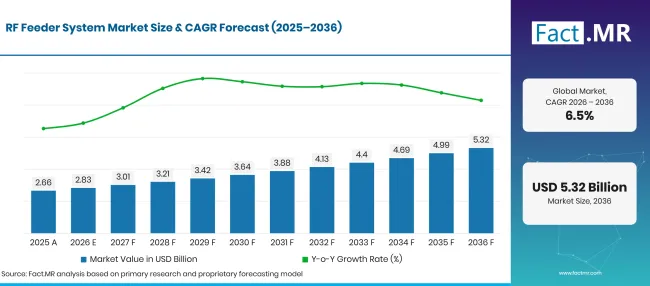
Rf Feeder System Market Forecast Global | Source: Fact.MR
| Year | Basis | Market Value (USD billion) |
|---|---|---|
| 2025 | Actual | 2.66 |
| 2026 | Estimate | 2.83 |
| 2036 | Forecast | 5.32 |
| CAGR 2026 to 2036 | Forecast period | 6.5% |
Source: Fact.MR analysis. Updated Nov 9, 2026
What are the defining numbers behind RF Feeder System Market growth?
The 2026 to 2036 period adds USD 2.5 billion in new value, concentrated in telecom operator networks and in feeder cable and connector purchases.
- Demand Drivers in the Market
- 5G coverage still has room to spread, which keeps new site construction active. The International Telecommunication Union reports that 5G networks covered 55% of the world’s population in 2025, against 84% in high-income countries and 4% in low-income countries [1]. Each newly covered area needs feeder cables, jumpers and connectors at every site.
- Traffic growth is pushing operators to add capacity on existing towers. ITU estimates mobile broadband traffic at 1.5 ZB in 2025, with mobile traffic growing about 19% a year since 2021 [2]. Extra carriers and antenna sectors on the same mast add jumper and connector content.
- Subscriber migration to 5G is lifting the share of sites that need new radio and antenna hardware. ITU data show 5G accounting for 36% of all mobile broadband subscriptions in 2025 [3]. Operators respond by refitting sites with multiband antennas and low-loss interconnects.
- Indoor and urban coverage projects are widening the product mix. Small cells, distributed antenna systems and radiating cables in tunnels, stadiums and offices create demand for thinner, flexible feeder lines and compact connectors.
- Broadcasting, aerospace and defense users keep a steady base of replacement orders. These buyers specify RF cables and connectors that hold frequency stability under vibration, heat and moisture, and they replace them on fixed maintenance cycles.
- Key Segments Analyzed
- By Component: Cables will hold 38.5% share in 2026, since every antenna and radio pair on a site needs a feeder or jumper run between them.
- By Application: Telecommunications will account for 42.3% of 2026 revenue, as 5G site additions and capacity upgrades generate the bulk of new feeder installations.
- By End-User: Telecom Operators will capture 44.9% of 2026 value, given that they own, upgrade and maintain the tower and rooftop sites where feeder systems are installed.
- Analyst Opinion at Fact.MR
- Shambhu Nath Jha, Principal Consultant at Fact.MR, states, “Feeder content per site will keep rising even as radios move closer to the antenna, because operators are adding bands, sectors and indoor layers to the same footprint. Suppliers that pair low-loss cable with connectors installers can fit quickly will win the refit contracts that now outnumber greenfield builds in mature networks. Emerging markets still extending 5G coverage will add the volume, while Europe and Japan will reward durability and passive intermodulation performance.”
- Strategic Implications
- Cable manufacturers should focus on low-attenuation designs, strong shielding and UV-resistant jackets, since outdoor feeder runs are judged on signal loss and service life.
- Connector suppliers should prioritize designs rated for higher frequencies and power levels that installers can terminate in the field without special tooling.
- Antenna and site-solution vendors should offer pre-matched cable, connector and antenna kits that cut installation time on crowded towers.
- Telecom operators and tower companies should standardize interfaces across network generations to reduce spares, simplify maintenance and protect signal quality during upgrades.
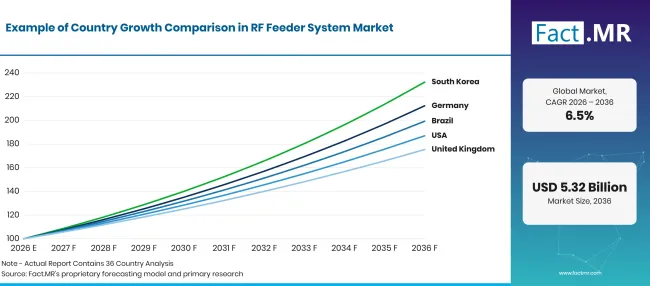
Germany leads the country set at 7.8%, where near-complete 5G area coverage is shifting spend toward capacity refits and rural infill. Brazil follows at 7.1%, 0.7 points behind, because its 5G rollout is still moving from state capitals into smaller municipalities. The United States, at 6.5%, trails Brazil by 0.6 points, with siting reform and small cell growth supporting steady upgrades in a large installed base. The United Kingdom records 5.8%, as standalone 5G work centers on upgrading existing masts. Japan closes the range at 5.1%, since population coverage is already close to universal and demand rests on replacement and densification.
How does the RF Feeder System Market break down by segment?
Cables will lead Component at 38.5%; Telecommunications will head Application at 42.3%; Telecom Operators will hold End-User at 44.9% in 2026.
Which Component leads?
Cables take 38.5% of 2026 sales.
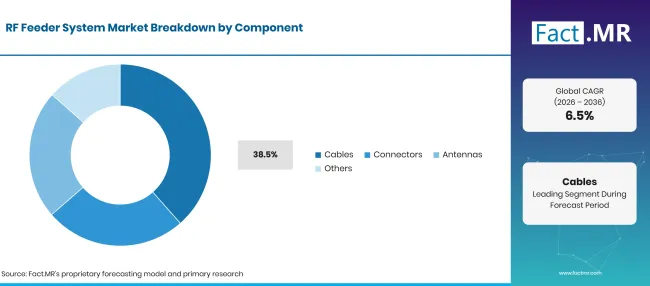
Rf Feeder System Market Breakdown Component | Source: Fact.MR
| Component | Share (2026) |
|---|---|
| Cables (Leading segment) | 38.5% |
| Other segments combined | 61.5%* |
| Total | 100.0% |
Source: Fact.MR analysis. Updated Nov 9, 2026
Every radio unit and antenna on a tower needs a transmission path, so feeder lines and jumpers are bought in volume on each new or refitted site. Signal loss, impedance stability and jacket durability decide which cable is specified, and operators replace weathered runs on planned cycles. Demand for low-loss wire and cable products with corrugated copper outer conductors stays firm on macro sites where long runs remain. Connectors, antennas and other components form the rest of the component mix. Connector demand rises with each extra band and sector, while multiband antennas absorb a growing share of site budgets during 5G refits. Higher power output from radios built around an RF power amplifier stage also raises the bar for connector heat handling and passive intermodulation performance.
What supports Telecommunications within Application?
Telecommunications accounts for 42.3% of 2026 revenue.
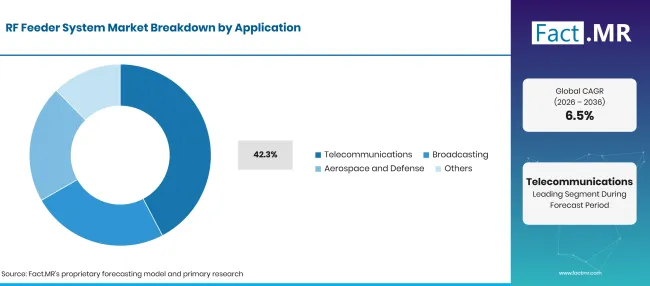
Rf Feeder System Market Breakdown Application | Source: Fact.MR
| Application | Share (2026) |
|---|---|
| Telecommunications (Leading segment) | 42.3% |
| Other segments combined | 57.7%* |
| Total | 100.0% |
Source: Fact.MR analysis. Updated Nov 9, 2026
Mobile network construction generates most of the new feeder installations, because each 5G site adds antenna ports and radio connections. The European Commission’s State of the Digital Decade 2025 report notes that the EU has progressed on basic 5G coverage but remains far from its goals for standalone 5G [4]. Closing that gap will require further site upgrades, and suppliers of 5G network equipment and passive interconnects will both benefit. Broadcasting relies on high-power coaxial lines for TV and radio transmitters, and it replaces them on long maintenance cycles. Aerospace and defense buyers order specialized RF cables and connectors for radar, satellite and tactical radio systems, including programs tied to radar antennas. Other applications include rail communications, public safety networks and private industrial networks.
How does End-User shape demand?
Telecom Operators represent 44.9% of 2026 value.
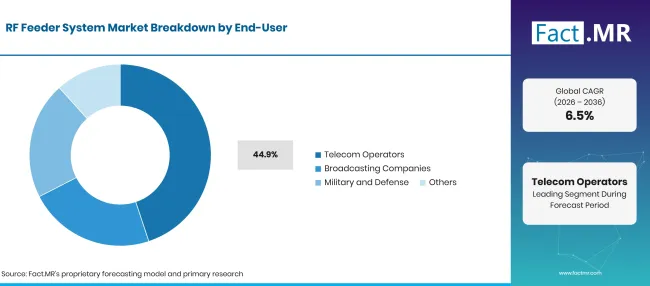
Rf Feeder System Market Breakdown End User | Source: Fact.MR
| End-User | Share (2026) |
|---|---|
| Telecom Operators (Leading segment) | 44.9% |
| Other segments combined | 55.1%* |
| Total | 100.0% |
Source: Fact.MR analysis. Updated Nov 9, 2026
Operators carry the capital budgets for coverage, capacity and site maintenance, so their purchase plans set the pace for feeder demand. They now favor matched component sets that lower installation time and reduce faults at crowded sites. Operators deploying 5G fixed wireless access also add capacity at existing towers, which brings fresh jumper and connector orders. Broadcasting companies buy rigid and semi-flexible transmission lines for transmitter sites. Military and defense organizations specify ruggedized assemblies that meet strict qualification standards, often for platforms that also use military antenna systems. Other end-users include tower companies, neutral host providers and enterprises running private networks.
What is accelerating RF Feeder System Market adoption, and what is holding it back?
Rising mobile traffic and continued 5G deployment are pushing operators to refit sites with new feeder lines, jumpers and connectors. Installation costs and the shift to remote radio units with fiber fronthaul limit long coaxial runs on new towers. Copper price swings squeeze supplier margins, and a shortage of skilled tower crews can delay projects.
Drivers Impact Analysis
| DRIVER | (~) % IMPACT ON CAGR | GEOGRAPHIC RELEVANCE | IMPACT TIMELINE |
|---|---|---|---|
| Expansion of 5G infrastructure and new base station deployment | +2.0% | Global | Medium term (2-4 years) |
| Rising mobile data traffic and capacity additions on existing sites | +1.6% | Global | Medium term (2-4 years) |
| Modernization of existing wireless and antenna infrastructure | +1.2% | North America, Western Europe, East Asia | Long term (>=4 years) |
| Network densification through small cells and distributed antenna systems | +1.0% | North America, East Asia, Western Europe | Medium term (2-4 years) |
| Reliable RF connectivity needs in broadcasting and defense | +0.7% | Global | Long term (>=4 years) |
Source: Fact.MR analysis. Updated Nov 9, 2026
Opportunity Impact Analysis
| OPPORTUNITY | (~) % IMPACT ON CAGR | GEOGRAPHIC RELEVANCE | IMPACT TIMELINE |
|---|---|---|---|
| Low-loss feeder cables for higher-band 5G sites | +0.5% | Global | Medium term (2-4 years) |
| 5G rollout in emerging telecommunications markets | +0.4% | South Asia & Pacific, Latin America, Middle East & Africa | Long term (>=4 years) |
| Multiband antennas with matched RF connectivity kits | +0.3% | North America, Western Europe, East Asia | Medium term (2-4 years) |
| Specialized RF assemblies for aerospace and defense platforms | +0.2% | North America, Western Europe, East Asia | Long term (>=4 years) |
Source: Fact.MR analysis. Updated Nov 9, 2026
Restraints Impact Analysis
| RESTRAINT | (~) % IMPACT ON CAGR | GEOGRAPHIC RELEVANCE | IMPACT TIMELINE |
|---|---|---|---|
| High installation and site modernization costs | -0.9% | Global | Short term (<=2 years) |
| Remote radio units and fiber fronthaul shortening coaxial runs | -0.7% | North America, Western Europe, East Asia | Medium term (2-4 years) |
| Signal loss, impedance matching and connector performance challenges | -0.4% | Global | Medium term (2-4 years) |
| Copper and raw material price swings | -0.3% | Global | Short term (<=2 years) |
Source: Fact.MR analysis. Updated Nov 9, 2026
Which countries are scaling the RF Feeder System Market through 2036?
Rf Feeder System Market Growth Index | Source: Fact.MR
| Country | CAGR (2026 to 2036) |
|---|---|
| Germany | 7.8% |
| Brazil | 7.1% |
| United States | 6.5% |
| United Kingdom | 5.8% |
| Japan | 5.1% |
Source: Fact.MR analysis. Updated Nov 9, 2026
What supports adoption in Germany?
7.8% CAGR, driven by capacity refits and rural 5G infill.
German operators have reached wide 5G area coverage and are now adding capacity and closing remaining gaps along roads, rail lines and rural districts. The Bundesnetzagentur reported in May 2025 that 5G was available on more than 93.85% of Germany’s area from at least one network operator [5]. Moving from coverage to capacity means more bands per site, which increases jumper and connector counts and favors low-loss feeder lines on shared masts.
How is Brazil developing demand?
7.1% CAGR, backed by 5G expansion into smaller municipalities.
Brazil’s 5G build is still spreading beyond large cities, which keeps new site construction active. The federal government reported in July 2025 that 5G had reached 1,507 municipalities, and that more than 1,000 cities had updated their municipal antenna laws by May 2025 [6]. Simpler local permitting shortens site approval times, and each new tower or rooftop installation needs a full feeder set from radio to antenna.
What is shaping the United States’ adoption?
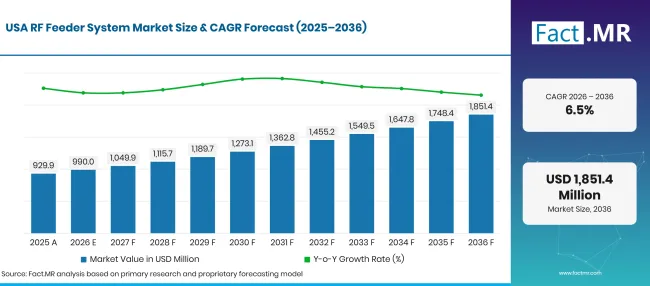
6.5% CAGR, helped by siting reform and small cell growth.
Rf Feeder System Market Forecast Usa | Source: Fact.MR
American operators are adding capacity in dense metros while upgrading a very large installed tower base. In a September 2025 rulemaking notice, the Federal Communications Commission noted that operational cell sites have grown 24% and small cells 110% since siting reforms took effect in 2018 [7]. Small cells and indoor systems need compact, flexible jumpers, while macro refits keep demand for larger feeder cables and weatherproof connectors.
What supports adoption in the United Kingdom?
5.8% CAGR, reflecting standalone 5G upgrades on existing masts.
UK operators are converting sites to standalone 5G and adding capacity to keep pace with traffic. Ofcom reported in November 2025 that 83% of the UK could access standalone 5G from at least one network, and that monthly mobile data use passed 1.2 billion GB, up 18% on the previous year [8]. These upgrades mostly take place on existing masts, so replacement cables, new jumpers and connector kits account for much of the spend.
How does Japan perform?
5.1% CAGR, as replacement and densification lead purchases.
Japan’s networks already reach almost the whole population, so demand comes from densification, higher-band capacity and replacement of older lines. The Ministry of Internal Affairs and Communications reported 5G population coverage of 98.4% at the end of fiscal year 2024, with 5G base stations installed in all 1,741 municipalities [9]. Indoor systems in stations, offices and venues add steady orders for thin feeder cables and compact connectors.
Who leads the RF Feeder System Market?
Competition splits into three groups. Full site-solution providers such as Amphenol, through its ANDREW brand, and RFS sell feeder cables, jumpers, connectors and antennas as one package, which lets operators source a whole site from one vendor.
ANDREW won two Small Cell Forum awards in June 2026 for its digital DAS and CleanBeam metaLens small cell technology [10]. RFS launched white RADIAFLEX radiating cables for in-building coverage in November 2026 [11]. A second group, including Rosenberger, HUBER+SUHNER and TE Connectivity, competes on precision connectors, cable assemblies and antennas, where passive intermodulation performance and fast installation decide orders. Radiall and Pasternack serve aerospace, defense and test buyers with specialized RF connectors and assemblies, and Radiall introduced Space SMPM connectors rated up to 40 GHz in July 2026 [12]. Through 2036, supplier choice will turn on matched component sets, field reliability and delivery speed for refit programs.
Which companies are the key providers?
Key companies in the RF Feeder System Market include Amphenol, RFS, Rosenberger, HUBER+SUHNER, TE Connectivity, Radiall and Pasternack.
- Amphenol
- RFS
- Rosenberger
- HUBER+SUHNER
- TE Connectivity
- Radiall
- Pasternack
Bibliography
- [1] International Telecommunication Union. (2025, October 15). More than half of the world’s population is covered by 5G.
- [2] International Telecommunication Union. (2025, October 15). Mobile broadband traffic is growing faster, but fixed networks still carry most of the Internet data.
- [3] International Telecommunication Union. (2025, October 15). 5G subscriptions already represent more than one-third of all mobile broadband subscriptions.
- [4] European Commission. (2025, June 16). State of the Digital Decade 2025 report.
- [5] Bundesnetzagentur. (2025, May 23). Mobile network measurement week across the country.
- [6] Agência Gov. (2025, July 2). Tecnologia 5G já chega a mais de 1.500 cidades e alcança 70% da população.
- [7] Federal Communications Commission. (2025, September 30). Build America: Eliminating Barriers to Wireless Deployments, Notice of Proposed Rulemaking.
- [8] Ofcom. (2025, November 19). Brits devour data at record levels as mobile networks race to improve 5G.
- [9] Ministry of Internal Affairs and Communications. (2025, September 19). 5G Development Status (As at the end of FY 2024).
- [10] ANDREW, an Amphenol company. (2026, June 4). ANDREW Honored for Innovation with Two SCF Mobile Network Awards.
- [11] Radio Frequency Systems. (2026, November 5). RFS Launches White RADIAFLEX Cables to Meet Demand for Discreet In-Building Solutions.
- [12] Radiall. (2026, July 13). Space SMPM & SMPM-Lock by Radiall.
This Report Answers
- How is spending divided between cables, connectors, antennas and other components, and why do cables lead?
- Which network projects make telecommunications the main application, and how do broadcasting and defense add to demand?
- What purchase patterns do telecom operators follow when refitting sites for 5G capacity?
- How will small cells, distributed antenna systems and fiber fronthaul change feeder content per site?
- Why does growth differ across Germany, Brazil, the United States, the United Kingdom and Japan?
- Which supplier groups compete for site-solution, connector and specialized RF contracts, and on what terms?
What does the RF Feeder System Market cover?
This study tracks the components that carry radio frequency signals between radio equipment and antennas. Feeder cables, jumpers, connectors, antennas and related transmission assemblies form the core product groups.
Revenue is measured at manufacturer selling value across telecommunications, broadcasting and aerospace and defense uses. End-user coverage spans telecom operators, broadcasting companies, military and defense organizations and other network owners.
What is included in the scope?
RF coaxial feeder cables, jumper assemblies and radiating cables used in wireless infrastructure.
RF connectors, adapters and field-installable connector kits used at base stations and indoor sites. Base station, small cell and DAS antennas sold as part of feeder system installations.Specialized RF cables and connectors for broadcast transmitters, radar, satellite and tactical radio systems.
What is excluded from the scope?
General-purpose fiber-optic cables and standalone optical networking equipment.
Electrical power cables and general electronic components not used in an RF transmission path. Radio units, baseband equipment and standalone wireless devices. Installation labor, telecom services, spectrum licensing and subscription revenue.
How Was the Analysis Built?
The analysis draws on 120+ sources, 35+ company portfolios, 25+ countries, and more than 20 industry interviews.
- Primary Research: Primary research includes discussions with manufacturers, service providers, technology developers, distributors, end users, and subject-matter experts. These conversations examine purchasing priorities, product adoption, operational challenges, approval requirements, competitive positioning, and the factors that influence wider market acceptance.
- Desk Research: Desk research covers government statistics, regulatory publications, company filings, trade data, technical studies, industry associations, standards, public policy, and other authoritative sources. Every source used in the analysis is documented in the bibliography.
- Market Sizing and Forecasting: Market estimates combine historical performance, demand indicators, pricing and volume trends, segment shares, company participation, country-level growth, adoption patterns, investment activity, and barriers to market expansion.
- Data Validation and Update Cycle: Findings are validated by comparing primary interviews with public data, company activity, regulatory changes, trade patterns, and industry developments. Regular updates review new product launches, capacity changes, partnerships, approvals, and shifts in commercial adoption.
Segmentation
What is the report’s scope and coverage?
Rf Feeder System Market Taxonomy | Source: Fact.MR
| Attribute | Details |
|---|---|
| Quantitative Units | USD billion |
| Market Definition | RF feeder systems are the cables, connectors, antennas and related transmission components that carry radio frequency signals between radio equipment and antennas in telecommunications, broadcasting, aerospace and defense networks. |
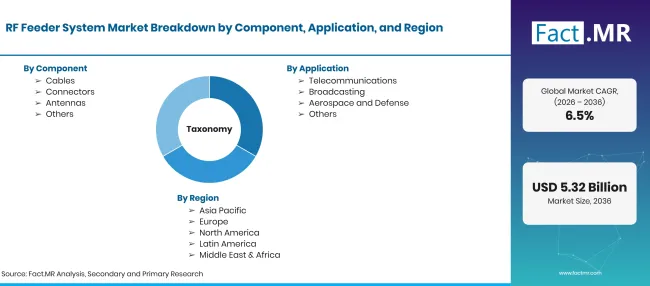
| Component | Cables; Connectors; Antennas; Others |
| Application | Telecommunications; Broadcasting; Aerospace and Defense; Others |
| End-User | Telecom Operators; Broadcasting Companies; Military and Defense; Others |
| Regions Covered | North America; Latin America; Western Europe; Eastern Europe; East Asia; South Asia & Pacific; Middle East & Africa |
| Countries Covered | Germany; Brazil; United States; United Kingdom; Japan |
| Companies Profiled | Amphenol; RFS; Rosenberger; HUBER+SUHNER; TE Connectivity; Radiall; Pasternack |
| Forecast Period | 2026 to 2036 |
| Approach | Site-level build combining base station additions, refit cycles, feeder and connector content per site, and application and end-user mix, checked against manufacturer portfolios. |
Source: Fact.MR analysis. Updated Nov 9, 2026
How is the market segmented?
-
By Component
- Cables
- Connectors
- Antennas
- Others
-
By Application
- Telecommunications
- Broadcasting
- Aerospace and Defense
- Others
-
By End-User
- Telecom Operators
- Broadcasting Companies
- Military and Defense
- Others
-
By Region
- North America
- Latin America
- Western Europe
- Eastern Europe
- East Asia
- South Asia & Pacific
- Middle East & Africa
Frequently Asked Questions
How large is the RF feeder system market in 2026?
What growth rate will the RF feeder system market record?
Which component leads?
Which application leads?
Which end-user leads?
Which country will grow quickest?
Who are the main companies?
What holds the market back?
Who worked on this report


Preview the report firsthand - request a free sample
Free SampleGet the brochure for pricing and purchase details
Download PDF