- Base Value(2025): 29.2 Bn
- Estimated Value(2026): 31.6 Bn
- Forecast Value (2036): 82.2 Bn
- CAGR (2026 - 2036): 8.3%
Optical Sensor Market Forecast and Outlook By Fact.MR
In 2025, the optical sensor market was valued at USD 29.2 billion. Based on Fact MR analysis, demand for optical sensors is estimated to grow to USD 31.6 billion in 2026 and USD 82.2 billion by 2036. FMR projects a CAGR of 8.3% during the forecast period.
The absolute dollar growth from 2026 to 2036 is USD 50.6 billion. This level of expansion reflects a significant structural increase in sensor deployment across electronics and industrial systems rather than simple incremental demand. Growth is supported by rising integration of optical sensing technologies in smartphones, automotive safety systems, factory automation equipment, and medical monitoring devices. Expanding adoption in imaging modules, proximity detection, and environmental sensing applications continues to reinforce market scale. At the same time, several structural factors influence growth stability, including semiconductor fabrication costs, supply chain exposure to specialized photonic components, and price pressure from high volume consumer electronics manufacturing.
India records the fastest expansion with a projected CAGR of 10.1%, supported by rapid growth in electronics manufacturing and increasing integration of optical sensing components in consumer devices. China follows with a CAGR of 9.8%, driven by strong domestic semiconductor production and large scale adoption across consumer electronics and industrial automation. The United States shows a CAGR of 9.3%, supported by demand from advanced automotive systems, defense electronics, and medical instrumentation. Japan is expected to expand at 8.9%, reflecting its established precision electronics and imaging component manufacturing base. Germany grows at 8.7%, supported by continued integration of optical sensing technologies in automotive safety and industrial automation equipment. Australia records the slowest growth at 8.5%, reflecting a smaller electronics manufacturing base. Mature technology markets such as the United States, Japan, and Germany generate a significant share of replacement demand as product cycles shorten and sensor upgrades occur within existing device ecosystems.
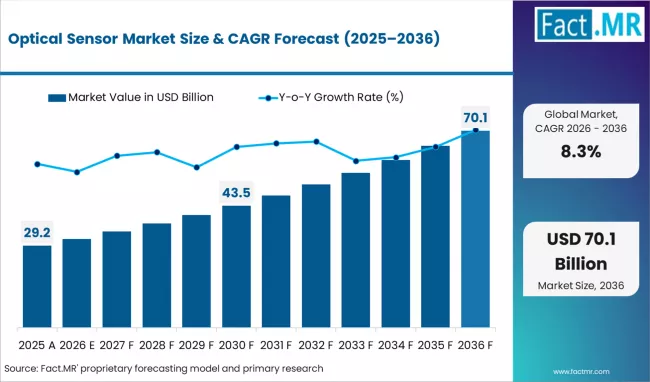
Optical Sensor Market Market Value Analysis | Source: Fact.MR
Optical Sensor Market
| Metric | Details |
|---|---|
| Industry Size (2026E) | USD 31.6 billion |
| Industry Value (2036F) | USD 82.2 billion |
| CAGR (2026 to 2036) | 8.3% |
Optical Sensor Market Definition
The Optical Sensor Market covers electronic sensing devices that detect light and convert it into electrical signals for measurement or control. These sensors operate using visible, infrared, or ultraviolet light to detect changes in intensity, position, motion, or presence. Optical sensors are widely used in consumer electronics, automotive systems, industrial automation, and safety monitoring applications. Common forms include image sensors, proximity sensors, ambient light sensors, and infrared sensors. Their primary function is to enable precise detection and monitoring of objects or environmental conditions using light-based technology in electronic and industrial systems.
Market Inclusions
This report covers global and regional market sizes for optical sensors along with forecast analysis for the study period. The market is segmented by product type such as image sensors, fiber optic sensors, position sensors, ambient light sensors, proximity sensors, and infrared sensors. Application segments include consumer electronics, automotive systems, industrial process control, military and defense, energy and utilities, and transportation systems. The study also examines pricing patterns, supply chain structures, and selected trade flow analysis across major producing and consuming regions.
Market Exclusions
The report excludes optical communication equipment such as fiber optic cables used for telecommunications networks. Laser systems used for industrial cutting, medical treatment, or research applications are not included. The scope also excludes complete imaging devices such as cameras, smartphones, and surveillance systems, focusing only on the sensing components. Optical measurement instruments designed solely for laboratory analysis or scientific experimentation are outside the defined market scope.
Research Methodology
- Primary Research: Interviews were conducted with sensor manufacturers, electronics component suppliers, system integrators, and procurement managers across multiple industries.
- Desk Research: Public information was collected from electronics industry publications, company reports, regulatory filings, and international trade statistics.
- Market-Sizing and Forecasting: A hybrid model combining bottom up company revenue analysis with top down demand assessment was used.
- Data Validation and Update Cycle: Findings were cross verified using multiple industry sources and expert inputs, with periodic updates conducted as new market data becomes available.
Summary of the Optical Sensor Market
- Market Definition
- The market comprises electronic sensing devices that detect light and convert optical signals into electrical outputs for monitoring, measurement, and control functions across consumer electronics, automotive systems, industrial automation, and defense applications.
- Demand Drivers
- Rising integration of optical sensing components in smartphones, wearable electronics, and smart home devices.
- Expansion of advanced driver assistance systems and automotive safety technologies that require optical sensing capabilities.
- Increasing adoption of optical sensors in industrial automation, machine vision systems, and process monitoring equipment.
- Growing deployment of sensing technologies in medical monitoring devices, environmental detection systems, and smart infrastructure.
- Key Segments Analyzed
- Application: Consumer electronics represents about 35% share due to extensive use in smartphones, tablets, and wearable devices.
- Type: Image sensors account for nearly 30% share supported by widespread adoption in cameras, automotive vision systems, and machine vision equipment.
- Industrial Application: Industrial process control and automation systems represent an expanding segment as factories integrate optical sensing technologies.
- Geography: India records the fastest growth rate, supported by rapid expansion in electronics manufacturing and semiconductor component demand.
- Analyst Opinion at Fact MR
- Shambhu Nath Jha, Principal Consultant, Fact MR, opines, "In this updated edition of the Optical Sensor Market report, industry participants will observe that market expansion is closely linked to semiconductor manufacturing capacity and the increasing number of sensing components integrated within electronic systems. Optical sensing technologies continue to expand across consumer electronics, automotive safety systems, and industrial automation platforms where non contact detection and high speed signal processing are required. Companies that maintain advanced semiconductor fabrication capabilities and invest in photonics research will retain competitive advantages within this evolving sensor ecosystem."
- Strategic Implications or Executive Takeaways
- Strengthen semiconductor fabrication capabilities to support high volume production of optical sensing components.
- Expand research and development activities in photonics, image sensing, and infrared detection technologies.
- Build partnerships with consumer electronics and automotive manufacturers to secure long term sensor supply agreements.
- Invest in integrated sensor modules combining imaging, proximity detection, and environmental sensing functions.
- Methodology
- Primary interviews conducted with semiconductor sensor manufacturers, electronics component suppliers, and system integrators.
- Desk research based on electronics industry publications, company reports, regulatory filings, and international trade statistics.
- Market sizing developed through a hybrid approach combining bottom up company revenue analysis and top down demand assessment.
- Findings validated through multiple industry data sources and expert consultations following Fact MR internal modeling standards.
Segmental Analysis
Optical Sensor Market Analysis by Application
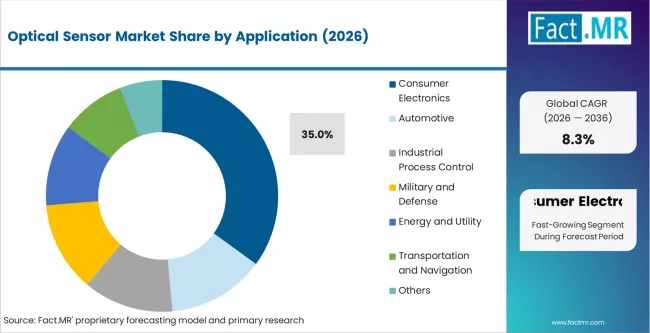
Optical Sensor Market Analysis By Application | Source: Fact.MR
- Market Overview: Consumer electronics are projected to account for about 35% share of the optical sensor market by 2026. Demand is supported by widespread integration of optical sensing components in smartphones, tablets, wearable devices, and smart home electronics. Optical sensors are deployed to enable functions such as facial recognition, ambient light detection, gesture recognition, and camera performance enhancement. Manufacturers of consumer electronics continue to integrate multiple sensor technologies within compact devices, which increases the average sensor count per product. High production volumes in mobile devices and wearable electronics maintain strong demand for optical sensors within this segment.
- Demand Drivers:
- Smartphone Sensor Integration: Smartphone manufacturers integrate multiple optical sensors including proximity sensors, ambient light sensors, and facial recognition modules to enhance device functionality and user interaction.
- Wearable Device Expansion: Smartwatches and fitness bands rely on optical sensors for features such as heart rate monitoring, motion detection, and environmental light adjustment.
- Smart Home Electronics: Optical sensors are incorporated into smart displays, security cameras, and home automation devices to support motion detection, imaging, and gesture based control.
Optical Sensor Market Analysis by Type
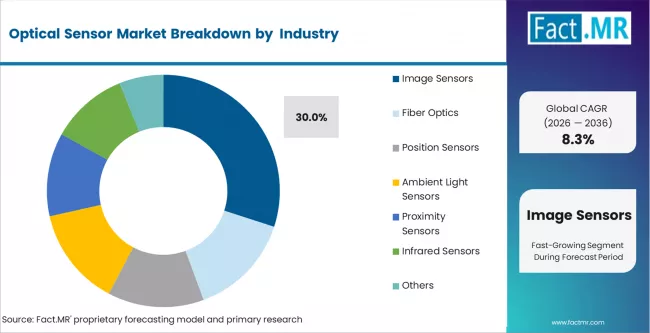
Optical Sensor Market Analysis By Type | Source: Fact.MR
- Market Overview: Image sensors are expected to represent around 30% share of the optical sensor market in 2026. These sensors convert light into electronic signals and are widely used in cameras, smartphones, automotive vision systems, and industrial inspection equipment. Demand for high resolution imaging and machine vision technologies has increased the adoption of CMOS and CCD image sensors across multiple industries. Improvements in sensor sensitivity, resolution capability, and low light performance have strengthened the use of image sensors in advanced imaging applications.
- Demand Drivers:
- Mobile Camera Demand: Smartphone manufacturers continuously upgrade camera systems, increasing the demand for high resolution image sensors capable of delivering enhanced photography and video capabilities.
- Automotive Vision Systems: Advanced driver assistance systems rely on image sensors for lane detection, object recognition, and parking assistance applications.
- Industrial Machine Vision: Manufacturing and inspection systems deploy image sensors in automated quality control processes to detect defects and ensure production accuracy.
Optical Sensor Market Drivers, Restraints, and Opportunities
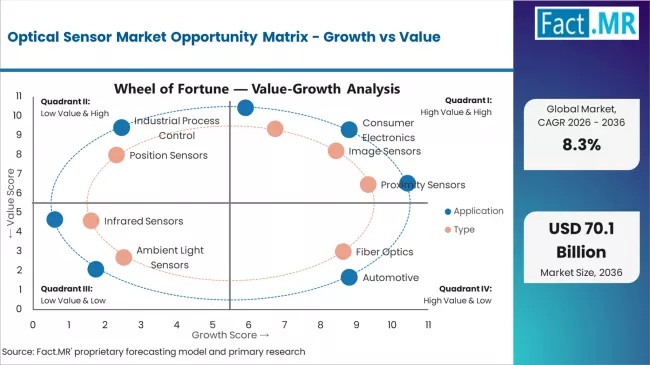
Optical Sensor Market Opportunity Matrix Growth Vs Value | Source: Fact.MR
Fact MR analysis indicates that the optical sensor market developed alongside the expansion of semiconductor manufacturing and industrial automation systems that require precise light detection. Early adoption occurred in industrial equipment, safety systems, and consumer electronics where optical sensors detected motion, proximity, and environmental conditions. The current market valuation reflects widespread integration of optical sensing components across smartphones, automotive electronics, factory automation equipment, and medical monitoring devices. Demand persists because optical sensors enable non-contact measurement and high-speed signal detection within electronic systems where physical sensors may limit accuracy.
A structural transition is occurring as conventional discrete optical sensors gradually give way to integrated sensing modules embedded within multifunction semiconductor platforms. Basic photodiodes and optical detectors remain common in industrial sensing applications where cost sensitivity limits adoption of complex sensor modules. Advanced optical sensors combining infrared detection, image sensing, and environmental monitoring capabilities command higher unit prices due to integrated signal processing and packaging technologies. Even with stable shipment volumes for commodity sensors, higher-value integrated optical sensing modules support overall market value expansion.
- Automotive Sensing Growth: Automotive electronics increasingly incorporate optical sensors for driver monitoring systems, adaptive lighting controls, and in-cabin gesture recognition technologies.
- Safety Certification Standards: International safety standards such as ISO 26262 functional safety requirements for automotive electronics influence the design and validation of optical sensing components.
- Asia Semiconductor Production: Semiconductor fabrication ecosystems in Taiwan, South Korea, and China support large-scale manufacturing of optical sensors used in consumer electronics and industrial automation equipment.
Regional Analysis
The market analysis covers key global regions, including North America, East Asia, South Asia, Europe, and Oceania. It is segmented geographically, with specific market dynamics for each region. The full report provides a detailed market attractiveness analysis.
.webp "Top Country Growth Comparison Optical Sensor Market Cagr (2026 2036)")
Top Country Growth Comparison Optical Sensor Market Cagr (2026 2036) | Source: Fact.MR
| Country | CAGR (2026-2036) |
|---|---|
| USA | 9.3% |
| China | 9.8% |
| Germany | 8.7% |
| Japan | 8.9% |
| India | 10.1% |
| Australia | 8.5% |
Source: Fact MR (FMR) analysis, based on proprietary forecasting model and primary research
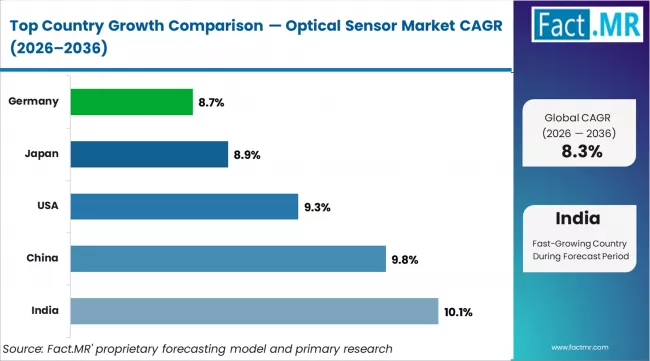
Optical Sensor Market Cagr Analysis By Country | Source: Fact.MR
North America
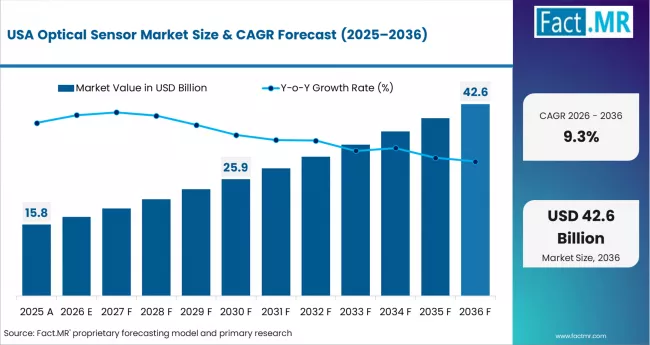
Optical Sensor Market Country Value Analysis | Source: Fact.MR
The USA represents a major market supported by demand from consumer electronics, industrial automation, and autonomous vehicle technologies. Key companies include Texas Instruments, Honeywell International Inc., and Analog Devices.
- USA: Demand for optical sensors in the U.S. is projected to rise at 9.3% CAGR through 2036. Growth is supported by expansion of semiconductor sensor manufacturing by Texas Instruments (05-2025) and increased deployment of sensing technologies in industrial automation systems by Honeywell International Inc. (08-2025).
East Asia
China and Japan represent major markets supported by consumer electronics production, automotive sensing technologies, and industrial robotics.
- China: Demand for optical sensors in China is projected to rise at 9.8% CAGR through 2036. Growth is supported by manufacturing expansion in semiconductor sensors (03-2025) and production investments by Huawei (08-2025).
- Japan: Demand for optical sensors in Japan is projected to rise at 8.9% CAGR through 2036. Growth is supported by robotics and automation initiatives promoted by the Ministry of Economy, Trade and Industry (04-2025) and sensor development programs by Sony Group Corporation (09-2025).
South Asia
India is a rapidly growing market supported by electronics manufacturing expansion, industrial automation adoption, and consumer electronics demand.
- India: Demand for optical sensors in India is projected to rise at 10.1% CAGR through 2036. Growth is supported by semiconductor manufacturing initiatives promoted by the Ministry of Electronics and Information Technology (05-2025) and expansion of sensor supply networks by Analog Devices (08-2025).
Europe
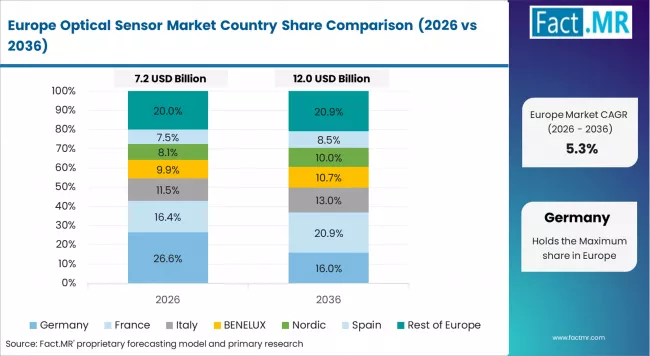
Optical Sensor Market Europe Country Market Share Analysis, 2026 & 2036 | Source: Fact.MR
Germany is a key market supported by industrial automation systems, automotive sensing technologies, and smart manufacturing.
- Germany: Demand for optical sensors in Germany is projected to rise at 8.7% CAGR through 2036. Growth is supported by Industry 4.0 initiatives promoted by the Federal Ministry for Economic Affairs (03-2025) and sensor technology development by Infineon Technologies (07-2025).
Oceania
Australia represents an important market supported by mining automation, industrial monitoring systems, and environmental sensing technologies.
- Australia: Demand for optical sensors in Australia is projected to rise at 8.5% CAGR through 2036. Growth is supported by mining automation programs (04-2025) and expansion of industrial sensing solutions by Honeywell International Inc. (08-2025).
Fact MR's analysis of the optical sensor market in North America, East Asia, South Asia, Europe, and Oceania consists of country-wise assessments that include the USA, China, Germany, Japan, India, and Australia. Readers can find detailed trends, regulatory updates, and company-specific investments shaping market growth in these countries.
Competitive Structure and Buyer Dynamics in the Optical Sensor Market
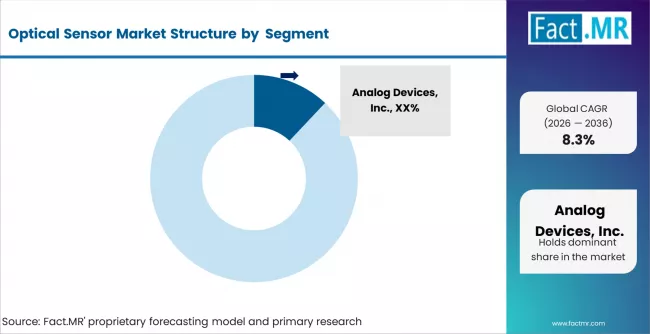
Optical Sensor Market Analysis By Company | Source: Fact.MR
The competitive structure of the Optical Sensor Market is moderately concentrated, with several global semiconductor and sensing technology companies holding a substantial share of industry revenue. Large multinational firms such as Analog Devices, Inc., STMicroelectronics N.V., Texas Instruments Incorporated, NXP Semiconductors N.V., ams-OSRAM AG, and Honeywell International Inc. maintain strong positions through extensive semiconductor manufacturing capabilities and global distribution networks. These companies supply optical sensors for consumer electronics, automotive systems, industrial automation, and healthcare devices. Specialized manufacturers including Hamamatsu Photonics K.K., ROHM Co., Ltd., Alphasense Ltd., and ABB Ltd. contribute to the market through application focused sensing solutions and precision photonics technologies. Competition is primarily determined by sensor accuracy, integration capability with electronic systems, power efficiency, and reliability across demanding operating environments. Product miniaturization, signal processing capability, and compatibility with semiconductor platforms also influence supplier selection across major application sectors.
Several companies hold structural advantages through advanced semiconductor fabrication infrastructure and strong research capabilities in photonics and sensing technologies. Firms such as Analog Devices, Inc., Texas Instruments Incorporated, and STMicroelectronics N.V. benefit from vertically integrated semiconductor production and established chip design ecosystems. Hamamatsu Photonics K.K. maintains expertise in photodetector and photonics technologies, supporting high precision sensing applications. Large industrial buyers and electronics manufacturers commonly adopt multi supplier procurement strategies to reduce dependence on a single semiconductor vendor. Automotive manufacturers and electronics producers frequently qualify multiple sensor suppliers during product design phases. This procurement approach moderates supplier pricing leverage and strengthens buyer negotiation power. Companies offering proprietary sensing technologies, strong intellectual property portfolios, and specialized application performance may retain moderate pricing influence within specific segments.
Key Players of the Optical Sensor Market
- Analog Devices, Inc.
- ABB Ltd.
- Hamamatsu Photonics K.K.
- STMicroelectronics N.V.
- Alphasense Ltd.
- Texas Instruments Incorporated
- NXP Semiconductors N.V.
- ams-OSRAM AG
- Honeywell International Inc.
- ROHM Co., Ltd.
Report Scope
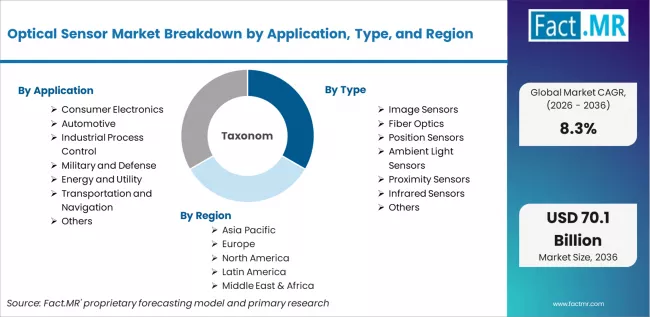
Optical Sensor Market Breakdown By Application, Type, And Region | Source: Fact.MR
| Metric | Value |
|---|---|
| Quantitative Units | USD 31.6 billion (2026) to USD 82.2 billion (2036), at a CAGR of 8.3% |
| Market Definition | The optical sensor market includes development, production, and deployment of sensors that detect and measure light or optical signals for monitoring, imaging, positioning, and automation across consumer, industrial, and defense applications. |
| Type Segmentation | Fiber Optics, Position Sensors, Image Sensors, Ambient Light Sensors, Proximity Sensors, Infrared Sensors, Others |
| Application Coverage | Consumer Electronics, Automotive, Industrial Process Control, Military & Defense, Energy & Utility, Transportation & Navigation, Others |
| Key Companies Profiled | Analog Devices, Inc., ABB Ltd., Hamamatsu Photonics K.K., STMicroelectronics N.V., Alphasense Ltd., Texas Instruments Incorporated, NXP Semiconductors N.V., ams-OSRAM AG, Honeywell International Inc., ROHM Co., Ltd. |
| Forecast Period | 2026 to 2036 |
| Approach | Hybrid top-down and bottom-up market modeling validated through interviews with sensor manufacturers and system integrators, supported by semiconductor shipment analysis, production benchmarking, and demand assessment across application industries. |
Bibliographies
- [1] U.S. Department of Energy. (2025). Semiconductor sensor manufacturing expansion.
- [2] Ministry of Electronics and Information Technology, India. (2025). Semiconductor manufacturing initiatives.
- [3] Federal Ministry for Economic Affairs, Germany. (2025). Industry 4.0 initiatives.
- [4] Ministry of Economy, Trade and Industry, Japan. (2025). Robotics and automation initiatives.
- [5] Texas Instruments. (2025). Semiconductor sensor manufacturing.
- [6] Honeywell International Inc. (2025). Industrial automation sensor deployment.
- [7] Huawei. (2025). Sensor production investments.
- [8] Sony Group Corporation. (2025). Sensor development programs.
- [9] Infineon Technologies. (2025). Sensor technology development.
This Report Addresses
- Market size estimation and revenue forecasts for the Optical Sensor Market from 2026 to 2036, supported by semiconductor production benchmarks and electronic component trade analysis.
- Growth opportunity mapping across image sensors, fiber optic sensors, ambient light sensors, proximity sensors, and infrared sensing technologies deployed across multiple electronics platforms.
- Segment and regional revenue forecasts covering consumer electronics, automotive systems, industrial process control, and defense electronics applications across major global manufacturing regions.
- Competition strategy assessment including technology integration models, semiconductor fabrication capabilities, and sensor module design benchmarking among leading industry participants.
- Regulatory and standards impact analysis covering functional safety requirements, industrial sensing certification frameworks, and electronics component compliance standards influencing optical sensor deployment.
- Market report delivery in PDF, Excel, PPT, and interactive dashboard formats designed to support technology planning, investment evaluation, and component sourcing strategies.
- Supply chain vulnerability assessments identifying semiconductor wafer fabrication dependencies, photonic component sourcing concentration, and regional manufacturing capacity risks affecting optical sensor production.
Segmentation
Optical Sensor Market Key Segments
-
Type :
- Fiber Optics
- Position Sensors
- Image Sensors
- Ambient Light Sensors
- Proximity Sensors
- Infrared Sensors
- Others
-
Application :
- Consumer Electronics
- Automotive
- Industrial Process Control
- Military and Defense
- Energy and Utility
- Transportation and Navigation
- Others
-
Region :
- North America
- USA
- Canada
- Mexico
- Europe
- Germany
- UK
- France
- Italy
- Spain
- Nordic Countries
- BENELUX
- Rest of Europe
- Asia Pacific
- China
- Japan
- South Korea
- India
- Australia
- Rest of Asia Pacific
- Latin America
- Brazil
- Argentina
- Rest of Latin America
- Middle East and Africa
- Kingdom of Saudi Arabia
- United Arab Emirates
- South Africa
- Rest of Middle East and Africa
- Other Regions
- Oceania
- Central Asia
- Other Markets
- North America
Frequently Asked Questions
How large is the demand for Optical Sensors in the global market in 2026?
What will be the market size of Optical Sensors in the global market by 2036?
What is the expected demand growth for Optical Sensors in the global market between 2026 and 2036?
Which Application Segment is poised to lead global demand by 2026?
Which Company is Identified as a Leading Participant in the Optical Sensor Market?
What is Driving Optical Sensor Demand in the United States?
What is the United States Growth Outlook in this Report?
Why is China an Important Market for Optical Sensors?
What is the China Growth Outlook in this Report?
Why is Germany Considered a Key Optical Sensor Market in Europe?
What is the Germany Growth Outlook in this Report?
What Factors Support Optical Sensor Demand in Japan?
What is the Japan Growth Outlook in this Report?
What Factors are Driving Optical Sensor Demand in India?
What is the India Growth Outlook in this Report?
Why is Australia Included in the Optical Sensor Market Outlook?
What is the Australia Growth Outlook in this Report?
What are Optical Sensors and What are They Mainly Used For?
What does Optical Sensor Market Mean in this Report?
What is Included in the Scope of this Optical Sensor Market Report?
What is Excluded from the Scope of this Report?
What does Market Forecast Mean on this Page?
How is the Optical Sensor Market Forecast Developed in this Report?
Who worked on this report


Preview the report firsthand - request a free sample
Free SampleGet the brochure for pricing and purchase details
Download PDF