- Market Value (2025): USD 134.6 Mn
- Estimated Value (2026): USD 150.1 Mn
- Forecast Value (2036): USD 445.0 Mn
- CAGR (2026-2036): 11.5%
What is the High-Frequency RF Filter Systems Market forecast to be worth by 2036?
USD 150.1 million in 2026 to USD 445.0 million by 2036, at a CAGR of 11.5%.
- As per Fact.MR analysis, the market crossed a valuation of USD 134.6 million in 2025.
- Demand is projected to rise from USD 150.1 million in 2026 to USD 445.0 million by 2036.
- The forecast records an 11.5% CAGR from 2026 to 2036 as demand grows for precise filtering across increasingly complex RF systems.
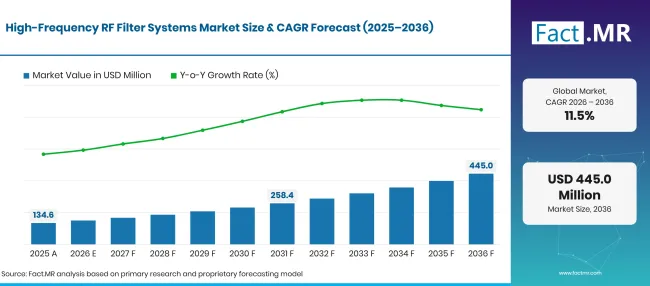
High Frequency Rf Filter Systems Forecast Global | Source: Fact.MR
| Year | Basis | Market Value (USD million) |
|---|---|---|
| 2025 | Actual | 134.6 |
| 2026 | Estimate | 150.1 |
| 2036 | Forecast | 445.0 |
| CAGR 2026 to 2036 | Forecast period | 11.5% |
Source: Fact.MR analysis. Updated Nov 10, 2026
What are the defining numbers behind High-Frequency RF Filter Systems Market growth?
USD 294.89 million in absolute opportunity is projected between 2026 and 2036.
- Demand Drivers in the Market
- Expansion of 5G and advanced wireless networks is increasing demand for high-frequency RF filter systems. India's Ministry of Communications reported that 5G base transceiver installations reached 562,971 by June 2026, with services available in 99.9% of districts [1]. The European Commission reported 96.8% household coverage for 5G networks, while coverage in the 3.4–3.8 GHz band reached 74.8% in 2026 [9].
- Growing Demand for Multi-Band Connectivity supports the market growth. Smartphones and wireless communication devices increasingly support multiple frequency bands and communication standards.
- Automotive electronics are expanding through connected vehicle functions and advanced driver-assistance systems. These applications require RF components that can operate reliably under demanding temperature and vibration conditions.
- Increasing Use of Radar and Defense Electronics has created lucrative opportunity for the growth of the market. Growing deployment of advanced radar systems and electronic warfare equipment is supporting demand for high-frequency RF filters that improve signal discrimination and electromagnetic compatibility.
- Key Segments Analyzed
- By RF Filter Architecture: LTCC leads with a 28.2% share in 2026, reflecting demand for compact ceramic-based filtering solutions.
- By Integration / Product Form: Pluggable units account for the largest share at 27.5% in 2026, supported by modular system integration requirements.
- By System Application: Automotive leads with a 24.0% share in 2026, reflecting the increasing use of RF connectivity and electronic systems in vehicles.
- By Procurement Route: Electronic distributors represent 27.7% share in 2026.
- Analyst Opinion at Fact.MR
- Shambhu Nath Jha, Principal Consultant at Fact.MR, states, “High-frequency RF filter systems are likely to gain importance as wireless platforms become more complex and require stronger control over signal interference. Suppliers need to demonstrate performance across operating frequencies and integration formats. Buyers are also likely to place greater emphasis on reliability and application-specific qualification when selecting RF filter solutions.”
- Strategic Implications
- Manufacturers must strengthen their product portfolios across ceramic, SAW, BAW and other RF filter architectures to address varying frequency ranges and performance requirements. Developing application-specific solutions can help suppliers serve automotive, telecommunications, aerospace and industrial applications while improving product differentiation and expanding their customer base.
- RF component suppliers should provide comprehensive technical specifications covering insertion loss, rejection performance, operating frequency and bandwidth capabilities. Transparent product documentation helps customers compare component performance, assess compatibility with system requirements and make informed procurement decisions while reducing technical uncertainties during product selection and integration.
- Automotive and aerospace suppliers need to demonstrate product reliability under demanding operating conditions, including temperature fluctuations, vibration and electromagnetic interference. Meeting applicable industry qualification requirements and maintaining consistent manufacturing standards can strengthen customer confidence, support long-term supply agreements and improve acceptance across safety-critical applications.
- Distributors and system integrators can provide technical assistance to customers through component selection, compatibility assessments and integration guidance during system design. Supporting customers with application-specific recommendations can simplify procurement decisions, reduce integration challenges and strengthen relationships with manufacturers and end users across different industries.
Taiwan is projected to record the highest country CAGR at 13.5% through 2036, followed by China at 13.3% and South Korea at 12.9%. The USA is expected to record 12.2% growth, while Japan is projected to advance at 10.6%.
How does the High-Frequency RF Filter Systems Market break down by segment?
Fact.MR identifies LTCC as the leading RF filter architecture with a 28.2% share in 2026. Pluggable units lead Integration / Product Form at 27.5%. Automotive accounts for the largest System Application share at 24.0%, while electronic distributors lead Procurement Route at 27.7%.
Which RF Filter Architecture dominates?
LTCC is set to hold the largest share at 28.2% in 2026.
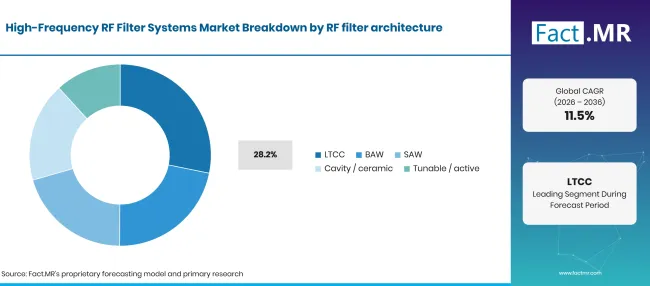
High Frequency Rf Filter Systems Breakdown Rf Filter Architecture | Source: Fact.MR
| RF filter architecture | Share (2026) |
|---|---|
| LTCC (Leading segment) | 28.2% |
| Other segments combined | 71.8%* |
| Total | 100.0% |
Source: Fact.MR analysis. Updated Nov 10, 2026
LTCC filters are used where compact dimensions and integration with other electronic components are important. Their multilayer ceramic construction supports compact RF circuit designs. BAW and SAW filters use acoustic-wave technologies to separate frequency bands. Cavity and ceramic filters serve applications that require specific filtering and power-handling characteristics. Tunable and active architectures can support systems that need more flexible frequency response.
Which Integration / Product Form leads?
Pluggable units are projected to account for 27.5% of the market in 2026.
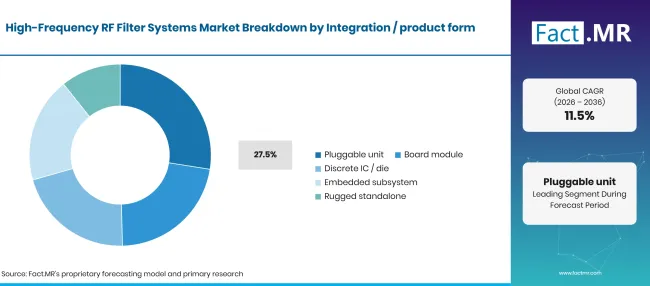
High Frequency Rf Filter Systems Breakdown Integration Product Form | Source: Fact.MR
| Integration / Product Form | Share (2026) |
|---|---|
| Pluggable unit (Leading segment) | 27.5% |
| Other segments combined | 72.5%* |
| Total | 100.0% |
Source: Fact.MR analysis. Updated Nov 10, 2026
Pluggable units offer a modular approach to RF system design. They can be installed or replaced without redesigning an entire board or subsystem. Board modules integrate filtering with other circuit elements and help reduce component count. Discrete ICs and dies give system designers greater control over component-level integration. Embedded subsystems and rugged standalone units serve designs with specific packaging and environmental requirements.
Which System Application accounts for the largest share?
Automotive is expected to account for 24.0% of the market in 2026.
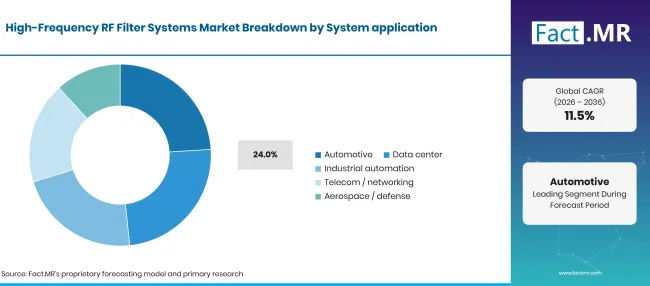
High Frequency Rf Filter Systems Breakdown System Application | Source: Fact.MR
| System Application | Share (2026) |
|---|---|
| Automotive (Leading segment) | 24.0% |
| Other segments combined | 76.0%* |
| Total | 100.0% |
Source: Fact.MR analysis. Updated Nov 10, 2026
Automotive systems use RF filters in connected vehicle platforms and wireless communication modules. Demand is also supported by vehicle connectivity and electronic control systems. Data centers use RF components in wireless infrastructure and networking equipment. Industrial automation requires reliable wireless communication across connected machinery and monitoring systems. Telecom and networking equipment uses filters to manage signal interference across frequency bands. Aerospace and defense applications require dependable filtering for communication and radar systems.
Which Procurement Route leads the market?
Electronic distributors are projected to account for 27.7% of the market in 2026.
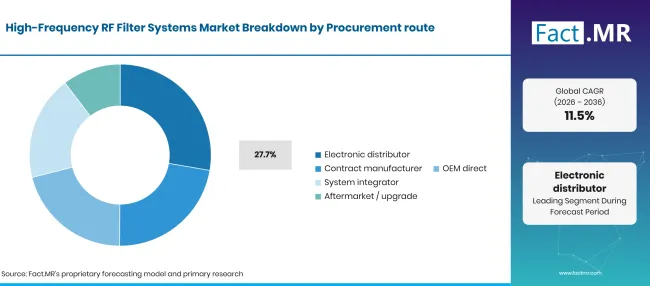
High Frequency Rf Filter Systems Breakdown Procurement Route | Source: Fact.MR
| Procurement Route | Share (2026) |
|---|---|
| Electronic distributor (Leading segment) | 27.7% |
| Other segments combined | 72.3%* |
| Total | 100.0% |
Source: Fact.MR analysis. Updated Nov 10, 2026
Electronic distributors support component sourcing across a broad customer base. Their role includes product availability and access to multiple manufacturers. System integrators represent a similar share because they procure components as part of complete RF systems. Contract manufacturers source filters for production programs, while OEMs may purchase directly when volumes and technical requirements justify direct supplier relationships. Aftermarket and upgrade demand comes from replacement and modernization requirements.
What is accelerating High-Frequency RF Filter Systems Market adoption, and what is holding it back?
Expansion of wireless connectivity and the need for reliable signal separation support demand. High design complexity and qualification requirements can slow adoption.
Drivers Impact Analysis
| DRIVER | (~) % IMPACT ON CAGR | GEOGRAPHIC RELEVANCE | IMPACT TIMELINE |
|---|---|---|---|
| Expansion of 5G and Wi-Fi infrastructure | +1.0% | Global | Medium term (2–4 years) |
| Higher RF complexity in connected vehicles | +0.8% | Asia, North America, Europe | Medium term (2–4 years) |
| Growth in data center and networking infrastructure | +0.7% | North America, Asia | Medium term (2–4 years) |
| Demand for compact integrated RF components | +0.6% | Global | Short term (≤ 2 years) |
| Aerospace and defense communication modernization | +0.4% | North America, Europe, Asia | Long term (≥ 4 years) |
Source: Fact.MR analysis. Updated Nov 10, 2026
Opportunity Impact Analysis
| OPPORTUNITY | (~) % IMPACT ON CAGR | GEOGRAPHIC RELEVANCE | IMPACT TIMELINE |
|---|---|---|---|
| Advanced BAW and high-frequency filter development | +0.8% | Global | Medium term (2–4 years) |
| Automotive-grade RF filter integration | +0.7% | Asia, North America, Europe | Medium term (2–4 years) |
| Compact modules for Wi-Fi 7 and next-generation networks | +0.6% | Global | Short term (≤ 2 years) |
| Custom RF filtering for data center systems | +0.5% | North America, Asia | Medium term (2–4 years) |
| Ruggedized filtering for aerospace and defense | +0.4% | North America, Europe | Long term (≥ 4 years) |
Source: Fact.MR analysis. Updated Nov 10, 2026
Restraints Impact Analysis
| RESTRAINT | (~) % IMPACT ON CAGR | GEOGRAPHIC RELEVANCE | IMPACT TIMELINE |
|---|---|---|---|
| High design and manufacturing complexity | -0.8% | Global | Short term (≤ 2 years) |
| Stringent performance and reliability requirements | -0.6% | Global | Medium term (2–4 years) |
| Qualification cycles in automotive and aerospace | -0.5% | Global | Medium term (2–4 years) |
| Dependence on specialized materials and fabrication | -0.4% | Global | Long term (≥ 4 years) |
Source: Fact.MR analysis. Updated Nov 10, 2026
Which countries are scaling the High-Frequency RF Filter Systems Market through 2036?
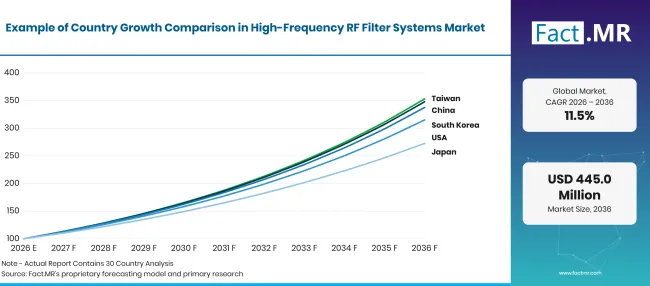
High Frequency Rf Filter Systems Growth Index | Source: Fact.MR
| Country | CAGR (2026–2036) |
|---|---|
| Taiwan | 13.5% |
| China | 13.3% |
| South Korea | 12.9% |
| USA | 12.2% |
| Japan | 10.6% |
Source: Fact.MR analysis. Updated Nov 10, 2026
What supports Taiwan's market growth?
13.5% CAGR, supported by its semiconductor manufacturing ecosystem and electronics supply chain.
Taiwan's semiconductor and electronics manufacturing base supports demand for advanced RF components. Local suppliers and contract manufacturers serve global communications and electronics companies. RF filter manufacturers can benefit from proximity to component assembly and system production. Demand will depend on continued investment in high-frequency communications and the ability to meet customer-specific performance requirements.
How is China developing the market?
13.3% CAGR, shaped by large-scale electronics production and wireless infrastructure development.
China has a broad electronics manufacturing base and continues to develop communication infrastructure. Demand for RF filtering can come from telecom equipment and connected devices as well as automotive electronics. Local production capabilities and supplier relationships can support adoption. Manufacturers need to address performance consistency and qualification requirements across different end markets.
What supports South Korea's market growth?
12.9% CAGR, drive by its electronics and semiconductor industries.
South Korea's established electronics sector provides a foundation for demand across mobile devices and communication equipment. RF filters are important in devices that operate across multiple frequency bands. Automotive electronics and industrial connectivity also provide application opportunities. Suppliers need to maintain miniaturization and performance as device designs become more integrated.
How is the USA expanding adoption?
12.2% CAGR, supported by investment in wireless infrastructure and advanced communication systems.
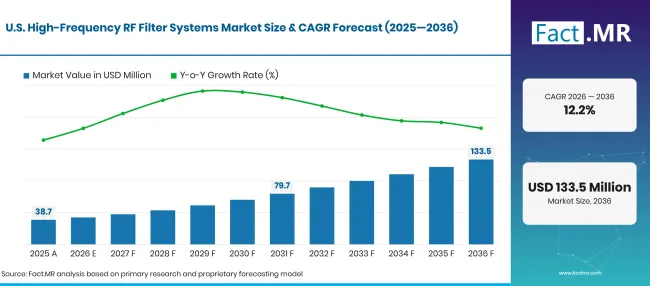
High Frequency Rf Filter Systems Forecast Usa | Source: Fact.MR
The U.S. market benefits from demand across data center infrastructure and telecom networks as well as aerospace and defense applications. Connected vehicles and industrial systems add further requirements for reliable RF components. Suppliers with advanced acoustic-wave technologies and integrated RF front-end solutions can address these applications. Qualification and supply-chain resilience remain important considerations for buyers.
What supports Japan's market growth?
10.6% CAGR, shaped by its electronic component manufacturing and automotive technology sectors.
Japan has an established base of electronic component manufacturers and automotive suppliers. Demand for RF filters is linked to connected vehicles and wireless equipment as well as industrial electronics. Japanese manufacturers can draw on expertise in ceramic materials and precision component production. Continued product development and integration capabilities will influence market growth.
Who leads the High-Frequency RF Filter Systems Market?
Fact.MR finds that Murata Manufacturing Co., Ltd., Broadcom Inc., TDK Corporation, TAIYO YUDEN CO., LTD. and Skyworks Solutions, Inc. (including the legacy Qorvo business) are profiled across the high-frequency RF filter systems value chain.
Murata Manufacturing Co., Ltd. supplies SAW filters and RF modules for wireless communication applications. Its portfolio addresses the need for higher-frequency operation and smaller components in communication devices [2]. Qorvo, Inc. has a broad portfolio of SAW and BAW filters and duplexers. Its product range includes BAW filters for Wi-Fi and 5G infrastructure [3]. Broadcom Inc. supplies FBAR filters and multiplexers. Its FBAR technology is a form of BAW filtering designed for low insertion loss and high rejection performance [4].
TDK Corporation offers LTCC-based RF filters and other high-frequency components. Its portfolio includes filters and modules for mobile devices and wireless equipment used in automotive and base-station applications [5]. Skyworks Solutions, Inc. has developed BAW filters and RF front-end modules for Wi-Fi 7 and other wireless applications. Its October 2025 product announcement described an expanded Wi-Fi 7 portfolio [6]. TAIYO YUDEN CO., LTD. supplies FBAR, SAW, and multilayer ceramic RF devices. Its portfolio includes filters and multiplexers for 5G and other wireless communication standards [7].
Skyworks completed its combination with Qorvo on October 5, 2026. Qorvo should not be presented as a separate independent company in a current November 2026 competitive landscape. Its RF filter portfolio is now part of the combined Skyworks business [8].
Which companies are the key providers?
The key company set includes Murata Manufacturing, Broadcom, TDK, TAIYO YUDEN, and Skyworks Solutions, which now includes the legacy Qorvo business.
- Murata Manufacturing Co., Ltd.
- Broadcom Inc.
- TDK Corporation
- TAIYO YUDEN CO., LTD.
- Skyworks Solutions, Inc. (including the legacy Qorvo business)
Bibliography
- [1] Ministry of Communications, Government of India. (2026, July 23). Steps taken to strengthen telecommunication and digital communication infrastructure. Press Information Bureau.
- [2] Murata Manufacturing Co., Ltd. (n.d.). High frequency devices and communications modules.
- [3] Qorvo. (n.d.). RF filters.
- [4] Broadcom Inc. (n.d.). FBAR devices.
- [5] TDK Corporation. (n.d.). Filters.
- [6] Skyworks Solutions, Inc. (2025, October 14). Skyworks introduces expanded Wi-Fi 7 portfolio with next-generation, high-efficiency and high-performance front-end modules and filters.
- [7] TAIYO YUDEN CO., LTD. (n.d.). RF devices.
- [8] Skyworks Solutions, Inc. (2026, October 5). Skyworks completes combination with Qorvo.
- [9] European Commission. (2026, June 17). Digital Decade 2026 – 5G Observatory Report.
This Report Answers
- The report examines the growth outlook for high-frequency RF filter systems from 2026 to 2036.
- Segment analysis compares RF filter architectures and integration formats using the 2026 shares.
- Application analysis covers automotive and data center systems as well as industrial automation, telecom, aerospace, and defense.
- Country analysis compares Taiwan, China, South Korea, the USA, and Japan using the country CAGRs.
- The competitive overview profiles major suppliers of acoustic-wave filters and ceramic RF components.
- Procurement analysis distinguishes distributor sourcing from contract manufacturing and direct OEM purchasing as well as system integration and aftermarket demand.
What does the High-Frequency RF Filter Systems Market cover?
The market covers high-frequency RF filters and filtering solutions used in electronic systems to select desired frequency bands and suppress unwanted signals. It includes LTCC and acoustic-wave technologies as well as cavity, ceramic, and tunable or active architectures. Product coverage includes discrete components and integrated formats such as pluggable units and board modules.
What is included in the scope?
Included products are RF filters and filtering systems sold for use in the specified application areas.
The scope covers the listed architectures and product forms when they perform RF signal filtering. It includes products supplied through electronic distributors and contract manufacturers as well as direct OEM and system integrator channels. Aftermarket and upgrade demand is included where it relates to replacement or modernization of covered RF filtering products.
What is excluded from the scope?
The analysis excludes standalone RF amplifiers and antennas that do not perform filtering functions.
General-purpose electronic components without an RF filtering function are outside the defined product boundary. Broad RF front-end modules should only be included to the extent that their filtering functionality is captured in the market estimate. Software-only signal processing and unrelated data center or telecom equipment are also excluded.
How Was the Analysis Built?
The analysis draws on 120+ sources, 35+ company portfolios, 25+ countries, and more than 20 industry interviews.
- Primary Research: Primary research includes discussions with manufacturers, service providers, technology developers, distributors, end users, and subject-matter experts. These conversations examine purchasing priorities, product adoption, operational challenges, approval requirements, competitive positioning, and the factors that influence wider market acceptance.
- Desk Research: Desk research covers government statistics, regulatory publications, company filings, trade data, technical studies, industry associations, standards, public policy, and other authoritative sources. Every source used in the analysis is documented in the bibliography.
- Market Sizing and Forecasting: Market estimates combine historical performance, demand indicators, pricing and volume trends, segment shares, company participation, country-level growth, adoption patterns, investment activity, and barriers to market expansion.
- Data Validation and Update Cycle: Findings are validated by comparing primary interviews with public data, company activity, regulatory changes, trade patterns, and industry developments. Regular updates review new product launches, capacity changes, partnerships, approvals, and shifts in commercial adoption.
Segmentation
What is the report's scope and coverage?
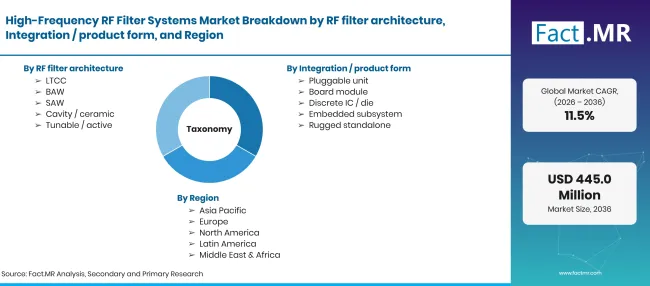
High Frequency Rf Filter Systems Taxonomy | Source: Fact.MR
| Attribute | Details |
|---|---|
| Quantitative Units | USD million: 2026 valuation, 2036 forecast and CAGR |
| Market Definition | High-frequency RF filter systems comprise passive and integrated electronic components designed to selectively transmit desired radio-frequency signals while attenuating unwanted frequencies, harmonics and interference across high-frequency communication bands. |
| RF Filter Architecture | LTCC; BAW; SAW; Cavity / ceramic; Tunable / active |
| Integration / Product Form | Pluggable unit; Board module; Discrete IC / die; Embedded subsystem; Rugged standalone |
| System Application | Automotive; Data center; Industrial automation; Telecom / networking; Aerospace / defense |
| Procurement Route | Electronic distributor; Contract manufacturer; OEM direct; System integrator; Aftermarket / upgrade |
| Countries Covered | Taiwan; China; South Korea; USA; Japan |
| Companies Profiled | Murata Manufacturing; Broadcom; TDK; TAIYO YUDEN; Skyworks Solutions, including legacy Qorvo |
| Forecast Period | 2026 to 2036 |
| Approach | Segment-based market assessment using the market estimates, country growth, and company product portfolio evidence |
Source: Fact.MR analysis. Updated Nov 10, 2026
How is the market segmented?
-
By RF Filter Architecture
- LTCC
- BAW
- SAW
- Cavity / ceramic
- Tunable / active
-
By Integration / Product Form
- Pluggable unit
- Board module
- Discrete IC / die
- Embedded subsystem
- Rugged standalone
-
By System Application
- Automotive
- Data center
- Industrial automation
- Telecom / networking
- Aerospace / defense
-
By Procurement Route
- Electronic distributor
- Contract manufacturer
- OEM direct
- System integrator
- Aftermarket / upgrade
-
By Region
- North America
- Latin America
- Western Europe
- Eastern Europe
- East Asia
- South Asia & Pacific
- Middle East & Africa
Frequently Asked Questions
How big is the High-Frequency RF Filter Systems Market in 2026?
What is the CAGR from 2026 to 2036?
Which RF filter architecture has the largest share?
Which integration / product form leads?
Which system application has the largest share?
Which procurement route leads the market?
Which country is projected to grow fastest?
Which companies are covered?
Who worked on this report


Preview the report firsthand - request a free sample
Free SampleGet the brochure for pricing and purchase details
Download PDF