- Market Value (2025): USD 6.36 Bn
- Estimated Value (2026): USD 6.64 Bn
- Forecast Value (2036): USD 10.3 Bn
- CAGR (2026-2036): 4.4%
What is the Organ Transplant Immunosuppressant Drugs Market forecast to be worth by 2036?
USD 6.6 billion in 2026 to USD 10.3 billion by 2036 at a CAGR of 4.4%.
- Fact.MR estimates that the Organ Transplant Immunosuppressant Drugs Market was valued at USD 6.36 billion in 2025.
- Revenue is projected to increase from USD 6.64 billion in 2026 to USD 10.3 billion by 2036 as demand for post-transplant immunosuppressive treatment continues.
- The Fact.MR forecast reports a 4.4% CAGR from 2026 to 2036, while the displayed rounded market values imply approximately 4.6%. The underlying unrounded forecast values should be used to reconcile this difference.
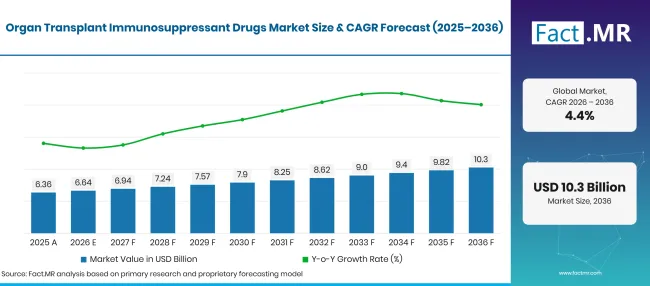
Factmr Organ Transplant Immunosuppressant Drugs Market Forecast Global | Source: Fact.MR
| Year | Basis | Market Value (USD billion) |
|---|---|---|
| 2025 | Actual | 6.2 |
| 2026 | Estimate | 6.6 |
| 2036 | Forecast | 10.3 |
| CAGR 2026 to 2036 | Forecast period | 4.4% |
Source: Fact.MR analysis. Updated Oct 21, 2026
What are the defining numbers behind Organ Transplant Immunosuppressant Drugs Market growth?
USD 3.7 billion in additional market value between 2026 and 2036
- Demand Drivers in the Market
- Long-term rejection prevention remains an important factor, as transplant recipients often require immunosuppressive treatment to reduce the risk of immune-mediated graft rejection.
- Continued transplant activity influences the population requiring post-transplant medication and follow-up. Germany’s national organ donation information service reported that 3,256 organs from deceased donors in Germany and the Eurotransplant network were transplanted in 2025, helping 3,150 patients [1]. This provides a 2026-published indicator of the transplant population requiring ongoing clinical care.
- Expansion of transplant infrastructure supports continued demand for immunosuppressive medicines. Brazil’s Ministry of Health maintains a national transplant system that monitors procedures, waiting lists and transplant activity, while public funding supports a substantial proportion of transplant care [2]. These services provide an important setting for ongoing treatment, although transplant activity alone does not determine market revenue.
- The development of transplant-related therapies also influences the treatment landscape. In April 2026, Veloxis Pharmaceuticals announced that its investigational maintenance immunosuppressive agent, pegrizeprument (VEL-101), received U.S. FDA Orphan Drug Designation for preventing heart transplant rejection, following an earlier designation for liver transplant rejection prevention [3]. This development highlights ongoing efforts to address unmet needs in solid-organ transplantation. However, pegrizeprument remains investigational, and the designation does not constitute marketing approval.
- Key Segments Analyzed
- By Drug Class: Calcineurin Inhibitors are projected to account for 38.5% of the market in 2026, reflecting their established role in many solid-organ transplant immunosuppression regimens.
- By Transplant Type: Kidney transplantation is projected to account for 49.4% of the market in 2026.
- By Distribution Channel: Retail Pharmacies are projected to account for 39.8% of the market in 2026.
- Analyst Opinion at Fact.MR
- The Organ Transplant Immunosuppressant Drugs Market continues to depend on the need for reliable, long-term prevention of graft rejection. Manufacturers that provide consistent drug supply, clinically appropriate formulations and support for adherence may be well positioned to serve transplant recipients. Future market development will also depend on patient outcomes, treatment tolerability, generic competition and access to specialist transplant care.
- Strategic Implications
- Drug manufacturers should prioritize reliable supply, product quality and formulations that support long-term treatment adherence.
- Transplant centers are advised to tailor immunosuppressive regimens to the transplanted organ, rejection risk, drug interactions and patient-specific safety considerations.
- Pharmacies and distributors must maintain dependable stock of prescribed medicines, given the importance of continuity in post-transplant treatment.
- Healthcare systems can strengthen medication counselling, therapeutic monitoring and follow-up to help patients manage adverse effects and reduce avoidable interruptions in treatment.
Japan is projected to record the highest country growth at 5.6% CAGR through 2036, followed by Brazil at 5.2%, the United Kingdom at 4.6%, Germany at 4.1% and the United States at 3.7%.
How does the Organ Transplant Immunosuppressant Drugs Market break down by segment?
Calcineurin Inhibitors are projected to lead Drug Class at 38.5%; Kidney will lead Transplant Type at 49.4%; and Retail Pharmacies will lead Distribution Channel at 39.8%.
Which Drug Class leads?
Calcineurin Inhibitors are projected to represent 38.5% of 2026 sales.
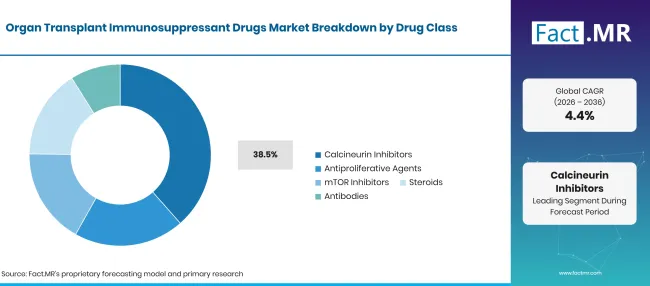
Factmr Organ Transplant Immunosuppressant Drugs Market Breakdown Drug Class | Source: Fact.MR
| Drug Class | Share (2026) |
| Calcineurin Inhibitors (Leading segment) | 38.5% |
| Other segments combined | 61.5%* |
| Total | 100.0% |
Source: Fact.MR analysis. Updated Oct 21, 2026
Calcineurin inhibitors such as tacrolimus and cyclosporine suppress immune activity involved in graft rejection and are used in many transplant regimens. Antiproliferative agents can be combined with other medicines to reduce immune-cell proliferation, while mTOR inhibitors and corticosteroids serve different roles depending on the treatment protocol. Antibody-based medicines may be used in selected induction or rejection-management settings. Treatment choices vary by organ, patient risk and clinical guidance.
Which Transplant Type leads?
Kidney transplantation is projected to represent 49.4% of the market in 2026.
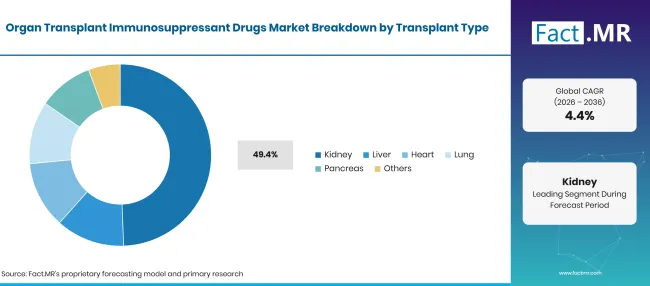
Factmr Organ Transplant Immunosuppressant Drugs Market Breakdown Transplant Type | Source: Fact.MR
| Transplant Type | Share (2026) |
| Kidney (Leading segment) | 49.4% |
| Other segments combined | 50.6%* |
| Total | 100.0% |
Source: Fact.MR analysis. Updated Oct 21, 2026
Kidney transplantation represents a substantial area of demand for immunosuppressive treatment because recipients typically require ongoing medication to reduce rejection risk. Liver, heart and lung transplants also require carefully managed immunosuppression, with regimens adjusted to organ function, rejection history and patient tolerance. Pancreas and combined-organ transplants can involve additional clinical considerations.
How does Distribution Channel shape demand?
Retail Pharmacies are projected to account for 39.8% of the market in 2026.
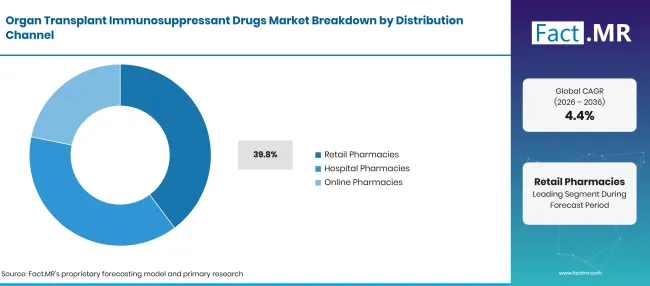
Factmr Organ Transplant Immunosuppressant Drugs Market Breakdown Distribution Channel | Source: Fact.MR
| Distribution Channel | Share (2026) |
| Retail Pharmacies (Leading segment) | 39.8% |
| Other segments combined | 60.2%* |
| Total | 100.0% |
Source: Fact.MR analysis. Updated Oct 21, 2026
Retail pharmacies can support prescription refills and ongoing access to maintenance medicines. Hospital pharmacies play a role in dispensing immunosuppressants around transplant procedures, treatment initiation and specialist follow-up. Online pharmacies may provide another access route where permitted by local regulation and appropriate prescription safeguards. The actual channel mix depends on national reimbursement systems, dispensing rules and transplant-center practices.
What is accelerating Organ Transplant Immunosuppressant Drugs Market adoption, and what is holding it back?
Rising transplant procedures and long-term rejection prevention support demand, while adverse effects, high treatment costs and medication adherence challenges constrain market growth.
Drivers Impact Analysis
| DRIVER | (~) % IMPACT ON CAGR | GEOGRAPHIC RELEVANCE | IMPACT TIMELINE |
|---|---|---|---|
| Continued growth in organ transplant procedures | +1.0% | Global | Medium term (2–4 years) |
| Long-term prevention of graft rejection | +0.9% | Global | Short term (≤ 2 years) |
| Expansion of transplant centers and clinical infrastructure | +0.7% | Americas, Europe, Asia | Medium term (2–4 years) |
| Improved access to immunosuppressive medicines | +0.5% | Global | Short term (≤ 2 years) |
| Development of more targeted immunosuppressive therapies | +0.4% | Global | Long term (≥ 4 years) |
Source: Fact.MR analysis. Updated Oct 21, 2026
Opportunity Impact Analysis
| OPPORTUNITY | (~) % IMPACT ON CAGR | GEOGRAPHIC RELEVANCE | IMPACT TIMELINE |
|---|---|---|---|
| Development of therapies with improved safety profiles | +0.8% | Global | Medium term (2–4 years) |
| Personalized immunosuppressive treatment regimens | +0.6% | Americas, Europe | Medium term (2–4 years) |
| Expansion of transplant services in emerging markets | +0.5% | Asia, Latin America | Long term (≥ 4 years) |
| Improved medication adherence and patient monitoring | +0.4% | Global | Short term (≤ 2 years) |
Source: Fact.MR analysis. Updated Oct 21, 2026
Restraints Impact Analysis
| RESTRAINT | (~) % IMPACT ON CAGR | GEOGRAPHIC RELEVANCE | IMPACT TIMELINE |
|---|---|---|---|
| High costs of long-term immunosuppressive treatment | -0.8% | Global | Short term (≤ 2 years) |
| Risk of infections and other adverse effects | -0.6% | Global | Medium term (2–4 years) |
| Medication interactions and complex treatment regimens | -0.5% | Global | Short term (≤ 2 years) |
| Unequal access to transplant care and specialist monitoring | -0.4% | Emerging markets | Medium term (2–4 years) |
Source: Fact.MR analysis. Updated Oct 21, 2026
Which countries are scaling the Organ Transplant Immunosuppressant Drugs Market through 2036?
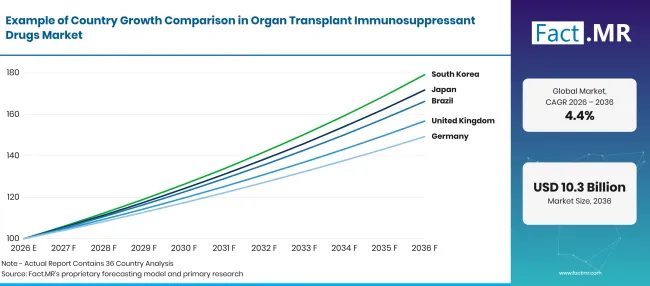
Factmr Organ Transplant Immunosuppressant Drugs Market Growth Index | Source: Fact.MR
| Country | CAGR (2026–2036) |
|---|---|
| Germany | 4.1% |
| Brazil | 5.2% |
| USA | 3.7% |
| UK | 4.6% |
| Japan | 5.6% |
Source: Fact.MR analysis. Updated Oct 21, 2026
What supports Germany’s adoption?
4.1% CAGR, supported by an established transplant network and continuing demand for post-transplant treatment.
Germany’s transplant system depends on coordination between donation organizations, transplant centers and specialist care teams. Germany’s Organ Transplant Immunosuppressant Drugs Market is supported by established transplant infrastructure, ongoing demand for medicines that prevent organ rejection, and the need for long-term patient monitoring. The main growth factors include transplant procedure volumes, access to specialized healthcare, reimbursement for essential medicines, and continued management of transplant recipients after surgery.
What is driving Brazil’s adoption?
5.2% CAGR, led by national transplant coordination and continued investment in transplant services.
Brazil’s Ministry of Health operates the Sistema Nacional de Transplantes, which coordinates organ donation, transplantation and waiting lists. According to the Ministry’s 2025 Integrated Management Report, Brazil performed 6,698 kidney transplants in 2025, compared with 6,325 in 2024, representing an increase of approximately 5.9%. The report also recorded 9,938 solid-organ transplants nationwide in 2025 and 44,558 people waiting for a kidney transplant. The Ministry’s kidney-transplant guidance, updated on May 18, 2026, emphasizes ongoing clinical monitoring, immunosuppressant-level testing and management of adverse effects following transplantation [4] [8].
What supports adoption in the United States?
3.7% CAGR, backed by a mature transplant network and established use of maintenance immunosuppressive medicines.
The United States maintains national transplant data through the Organ Procurement and Transplantation Network (OPTN), which tracks waiting lists, organ donation, matching and transplantation [5]. This infrastructure supports the coordination of transplant procedures and follow-up care.
How is the United Kingdom developing demand?
4.6% CAGR, shaped by national transplant services and ongoing post-transplant care.
The United Kingdom’s transplant system combines organ donation coordination, specialist transplant centers and follow-up care. NHS Blood and Transplant published its 2025–2026 annual report on July 14, 2026, covering its performance and activities during the financial year ending March 31, 2026 [6].
What supports Japan’s adoption?
5.6% CAGR, driven by transplant-care infrastructure and continuing demand for organ transplantation.
Japan’s Ministry of Health, Labour and Welfare published a report on organ transplantation activities on June 9, 2026. In an October 2026 public information article, the ministry reported that approximately 17,000 people were registered as awaiting transplantation as of June 30, 2026, while 636 people received transplants during 2025 [7].
Who leads the Organ Transplant Immunosuppressant Drugs Market?
Fact.MR identifies Novartis, Asahi Kasei Therapeutics Inc. (formerly Veloxis Pharmaceuticals), Eledon Pharmaceuticals, Lupin and Astellas Pharma as companies relevant to the competitive landscape. Their positions differ according to product approvals, commercial availability, development stage and therapeutic focus.
Novartis has a presence in transplant medicine and immunosuppressive therapies. Veloxis Pharmaceuticals, part of Asahi Kasei, is associated with Envarsus XR, an extended-release tacrolimus formulation used in kidney-transplant care. Astellas Pharma is an established participant in transplant immunosuppression, including tacrolimus-based treatment.
Lupin participates in the pharmaceutical market, including generic medicines, and its relevance should be assessed against its specific approved transplant-related products. Eledon Pharmaceuticals is developing investigational immunomodulatory therapies, including approaches targeting CD40 ligand. Investigational candidates should be distinguished from marketed medicines approved for routine organ-transplant immunosuppression.
Competitive positioning depends on regulatory status, clinical evidence, treatment indications, supply reliability, product formulations and access across healthcare systems. A company’s involvement in immunology research alone does not establish that it is a leading supplier of approved organ-transplant immunosuppressant drugs
Which companies are the key providers?
The companies for the competitive overview are:
- Novartis
- Asahi Kasei Therapeutics Inc. (formerly Veloxis Pharmaceuticals)
- Eledon Pharmaceuticals
- Lupin
- Astellas Pharma
Bibliography
- [1] Bundesinstitut für Öffentliche Gesundheit. (2026, January 15). Organspendezahlen 2025 auf höchstem Stand seit 2012 [Organ donation figures in 2025 at their highest level since 2012].
- [2] Ministério da Saúde. (n.d.). Sistema Nacional de Transplantes. Retrieved October 19, 2026, from https://www.gov.br/saude/pt-br/composicao/saes/snt
- [3] Veloxis Pharmaceuticals, Inc. (2026, April 22). Pegrizeprument granted orphan drug designation for prevention of organ rejection in heart transplant patients.
- [4] Ministério da Saúde. (2026, May 18). Cartilha – Transplante de rim: Orientações para profissionais da saúde.
- [5] Health Resources and Services Administration. (n.d.). Data reports. Organ Procurement and Transplantation Network. Retrieved October 19, 2026, from
- [6] NHS Blood and Transplant. (2026, July 14). NHS Blood and Transplant annual report and accounts: 2025 to 2026.
- [7] Ministry of Health, Labour and Welfare. (2026, October 1).[Considering organ transplantation].
- [8] Ministério da Saúde. (2026, March 25). Relatório de gestão integrado 2025.
This Report Answers
- The report describes market revenue across drug classes, transplant types and distribution channels.
- Segment analysis compares calcineurin inhibitors, antiproliferative agents, mTOR inhibitors, steroids and antibodies.
- Country analysis discusses Germany, Brazil, the United States, the United Kingdom and Japan alongside official transplant-related indicators.
- The competitive overview profiles the pharmaceutical companies, distinguishing commercial medicines from investigational therapies.
- Drivers, opportunities and restraints are assessed for their potential influence on market growth through 2036.
What does the Organ Transplant Immunosuppressant Drugs Market cover?
The market covers medicines used to suppress immune responses that could damage or reject a transplanted organ. These therapies are prescribed according to the type of transplant, rejection risk, patient health, clinical protocol and response to treatment.
The assessment includes calcineurin inhibitors, antiproliferative agents, mTOR inhibitors, steroids and eligible antibody-based therapies within the approved market definition. Demand depends on transplant activity, treatment duration, medicine pricing, access to specialist care and the need to manage adverse effects.
What is included in the scope?
The market includes immunosuppressive medicines used in kidney, liver, heart, lung, pancreas and other eligible organ-transplant settings.
It covers relevant products across the stated drug classes and distribution channels, including maintenance regimens and other approved transplant-related uses that fall within the market definition.
What is excluded from the scope?
Medicines used exclusively for unrelated autoimmune diseases, cancer treatment or other indications without a relevant organ-transplant use are excluded.
Transplant surgery, organ procurement, diagnostic equipment and hospital services are not included in the drug-market valuation.
Investigational medicines that have not received relevant marketing authorization should not be counted as established commercial products unless the approved market methodology explicitly includes pipeline valuation. Medicines for hematopoietic stem-cell transplantation and graft-versus-host disease should also be excluded unless specifically covered by the final definition.
How Was the Analysis Built?
The analysis draws on market estimates, company information, public statistical publications, regulatory information, and industry evidence to assess market developments and forecasts.
- Primary Research: Primary research includes discussions with manufacturers, service providers, technology developers, distributors, end users, and subject-matter experts. These conversations examine purchasing priorities, product adoption, operational challenges, approval requirements, competitive positioning, and the factors that influence wider market acceptance.
- Desk Research: Desk research covers government statistics, regulatory publications, company filings, trade data, technical studies, industry associations, standards, public policy, and other authoritative sources. Every source used in the analysis is documented in the bibliography.
- Market Sizing and Forecasting: Market estimates combine historical performance, demand indicators, pricing and volume trends, segment shares, company participation, country-level growth, adoption patterns, investment activity, and barriers to market expansion.
- Data Validation and Update Cycle: Findings are validated by comparing primary interviews with public data, company activity, regulatory changes, trade patterns, and industry developments. Regular updates review new product launches, capacity changes, partnerships, approvals, and shifts in commercial adoption.
Segmentation
What is the report’s scope and coverage?
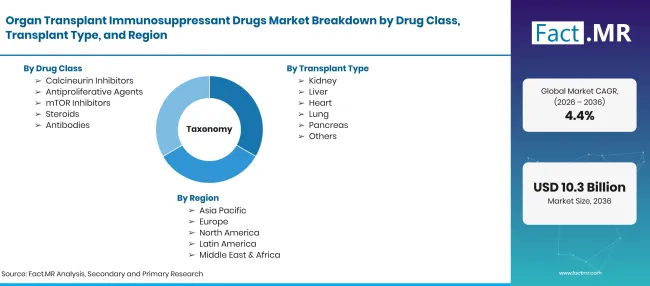
Factmr Organ Transplant Immunosuppressant Drugs Market Taxonomy | Source: Fact.MR
| Attribute | Details |
|---|---|
| Quantitative Units | USD billion: 2026 valuation, 2036 forecast and CAGR |
| Market Definition | The Organ Transplant Immunosuppressant Drugs Market covers medicines used to prevent or manage immune-mediated rejection following organ transplantation, subject to the defined drug and indication scope |
| Drug Class | Calcineurin Inhibitors; Antiproliferative Agents; mTOR Inhibitors; Steroids; Antibodies |
| Transplant Type | Kidney; Liver; Heart; Lung; Pancreas; Others |
| Distribution Channel | Retail Pharmacies; Hospital Pharmacies; Online Pharmacies |
| Regions Covered | North America; Latin America; Western Europe; Eastern Europe; East Asia; South Asia & Pacific; Middle East & Africa |
| Countries Covered | Germany; Brazil; United States; United Kingdom; Japan |
| Companies Profiled | Novartis; Asahi Kasei Therapeutics Inc. (formerly Veloxis Pharmaceuticals); Eledon Pharmaceuticals; Lupin; Astellas Pharma |
| Forecast Period | 2026 to 2036 |
| Approach | Market segmentation and scenario-based analysis informed by transplant activity, treatment adoption, medicine portfolios, regulatory information and country-level healthcare indicators |
Source: Fact.MR analysis. Updated Oct 21, 2026
How is the market segmented?
-
By Drug Class
- Calcineurin Inhibitors
- Antiproliferative Agents
- mTOR Inhibitors
- Steroids
- Antibodies
-
By Transplant Type
- Kidney
- Liver
- Heart
- Lung
- Pancreas
- Others
-
By Distribution Channel
- Retail Pharmacies
- Hospital Pharmacies
- Online Pharmacies
-
By Region
- North America
- Latin America
- Western Europe
- Eastern Europe
- East Asia
- South Asia & Pacific
- Middle East & Africa
Frequently Asked Questions
How big is the Organ Transplant Immunosuppressant Drugs Market in 2026?
What is the CAGR of the Organ Transplant Immunosuppressant Drugs Market from 2026 to 2036?
Which drug class leads the Organ Transplant Immunosuppressant Drugs Market?
Which transplant type leads the Organ Transplant Immunosuppressant Drugs Market?
Which distribution channel leads the Organ Transplant Immunosuppressant Drugs Market?
Which country will grow the most in the Organ Transplant Immunosuppressant Drugs Market?
Who are the main companies in the Organ Transplant Immunosuppressant Drugs Market?
Who worked on this report


Preview the report firsthand - request a free sample
Free SampleGet the brochure for pricing and purchase details
Download PDF