- Market Value (2025): USD 289.8 Mn
- Estimated Value (2026): USD 305.6 Mn
- Forecast Value (2036): USD 519.5 Mn
- CAGR (2026-2036): 5.4%
What is the Dental Laboratory Ovens Market forecast to be worth by 2036?
USD 305.6 million in 2026 to USD 519.5 million by 2036 at a 5.4% CAGR.
- The dental laboratory ovens market was valued at USD 289.8 million in 2025, with zirconia sintering and porcelain firing as the main workloads.
- By 2036 the market will reach USD 519.5 million, up from USD 305.6 million in 2026, as digital labs replace older muffle furnaces with programmable units.
- Annual growth will average 5.4% CAGR from 2026 to 2036, helped by faster sintering programs that free up lab capacity.
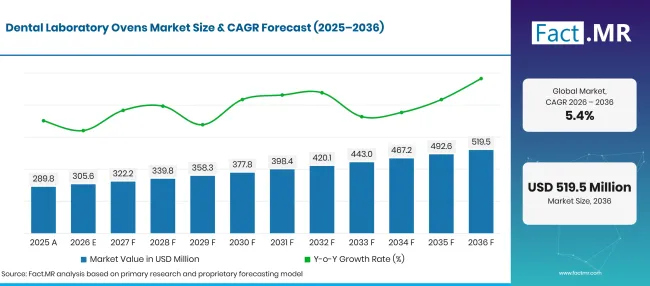
Dental Laboratory Ovens Market Forecast Global | Source: Fact.MR
| Year | Basis | Market Value (USD million) |
|---|---|---|
| 2025 | Actual | 289.8 |
| 2026 | Estimate | 305.6 |
| 2036 | Forecast | 519.5 |
| CAGR 2026 to 2036 | Forecast period | 5.4% |
Source: Fact.MR analysis. Updated Oct 30, 2026
What are the defining numbers behind Dental Laboratory Ovens Market growth?
The 2026 to 2036 period adds USD 213.9 million in new value, led by sintering furnaces for zirconia work.
- Demand Drivers in the Market
- Tooth loss creates steady prosthetic work for laboratories. The World Health Organization estimates that oral diseases affect nearly 3.7 billion people, and that about 23% of people aged 60 or older have lost all their teeth [1]. Each denture, crown or bridge made for these patients passes through at least one firing or sintering step.
- Monolithic zirconia keeps sintering ovens busy. In January 2025, VITA Zahnfabrik said its YZ Speed program can sinter restorations of up to 14 units in 50 minutes with VITA YZ MULTI TRANSLUCENT [2]. Shorter programs let a lab turn a bridge around on the day it is milled.
- Digital production is changing the lab bench. The U.S. Bureau of Labor Statistics notes that technicians now use computer programs and 3D printers to make dental appliances and restorations [3]. Milled and printed parts still need a furnace, which keeps ovens in the workflow even as hand layering declines.
- Labs are short of skilled hands, so they buy equipment that runs with less supervision. Ovens with stored programs, touch-screen control and remote start let one technician manage several firing cycles at once.
- Replacement purchases follow material changes. A furnace bought for metal-ceramic work often cannot reach the temperatures or vacuum levels that newer glass ceramics and high-translucency zirconia require.
- Key Segments Analyzed
- By Product Type: Sintering Ovens will hold 38.5% share in 2026, since nearly every milled zirconia crown and bridge must be densified in a furnace that reaches up to 1,650 degrees Celsius.
- By Application: Crown and Bridge will account for 41.3% share in 2026 owing to the volume of single-unit and multi-unit fixed restorations sent to labs.
- By End-User: Dental Laboratories will command 68.4% share in 2026, given that they run several furnaces in parallel to separate sintering, pressing and glaze firing.
- Analyst Opinion at Fact.MR
- Shambhu Nath Jha, Principal Consultant at Fact.MR, states, “Zirconia has moved the oven from the back of the lab to the center of production planning. Labs that once fired porcelain overnight now schedule several short sintering runs per shift, and they will pay for programs that cut cycle time without risking cracks. Suppliers that pair furnaces with validated material settings will win the replacement orders over the next ten years.”
- Strategic Implications
- Furnace makers should validate sintering and firing programs for each major zirconia and glass-ceramic brand, so labs can load a material and press start.
- Material suppliers should publish speed-sintering curves alongside their blanks, since buyers judge a new zirconia by how quickly it can leave the furnace.
- Laboratory owners should match chamber size to daily unit counts, given that an oversized sintering oven run half empty wastes power on every cycle.
- Distributors should build service teams for heating element and muffle replacement, because downtime on a single sintering unit can stall a lab’s entire output.
Japan heads the group at 6.6% CAGR, where an aging workforce of technicians pushes labs toward automated furnaces. Brazil follows at 6.0%, with clinic upgrades tied to new health regulations. The United Kingdom will grow at 5.1% as NHS treatment volumes recover. Germany posts 4.3% on a mature base of contract dental practices, and the United States completes the list at 3.9%, held back by a shrinking lab workforce.
How does the Dental Laboratory Ovens Market break down by segment?
Sintering Ovens will lead Product Type at 38.5%; Crown and Bridge will top Application at 41.3%; Dental Laboratories will head End-User at 68.4%.
Which Product Type leads?
Sintering Ovens capture 38.5% of 2026 revenue.
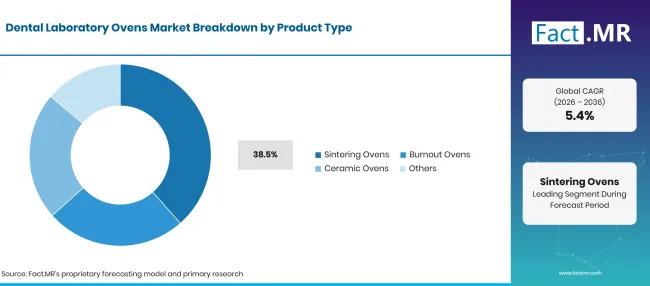
Dental Laboratory Ovens Market Breakdown Product Type | Source: Fact.MR
| Product Type | Share (2026) |
|---|---|
| Sintering Ovens (Leading segment) | 38.5% |
| Other segments combined | 61.5%* |
| Total | 100.0% |
Source: Fact.MR analysis. Updated Oct 30, 2026
Milled zirconia leaves the milling unit in a soft, chalky state and shrinks by about a fifth during densification, so no zirconia restoration can be delivered without a sintering cycle. Labs that mill in-house usually own two or more sintering units to keep pace with their dental 3D printing and milling lines. Vendors now compete on speed. VITA’s YZ Speed program, for example, handles bridges of up to 14 units in under an hour [2]. Ceramic ovens remain essential for glazing, staining and layering, while burnout ovens prepare molds for pressed ceramics and cast frameworks.
What supports Crown and Bridge within Application?
Crown and Bridge work holds 41.3% of 2026 demand.
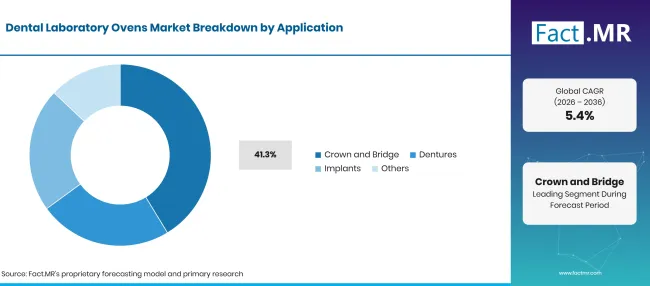
Dental Laboratory Ovens Market Breakdown Application | Source: Fact.MR
| Application | Share (2026) |
|---|---|
| Crown and Bridge (Leading segment) | 41.3% |
| Other segments combined | 58.7%* |
| Total | 100.0% |
Source: Fact.MR analysis. Updated Oct 30, 2026
Fixed restorations reach labs in greater numbers than any other case type, and each crown typically goes through sintering, then one or more glaze or stain firings. Growth in cosmetic dentistry adds veneers and anterior crowns that need precise color firing. Dentures use ovens mainly for burnout and, in some systems, for curing and polymerizing bases. Implant cases add zirconia frameworks and screw-retained bridges, which link oven demand to implant abutment systems and long-span sintering programs.
How does End-User shape demand?
Dental Laboratories represent 68.4% of 2026 sales.
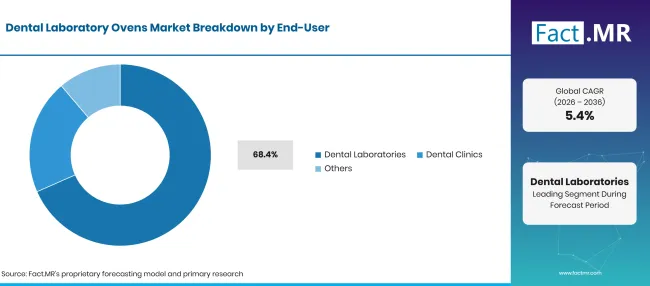
Dental Laboratory Ovens Market Breakdown End User | Source: Fact.MR
| End-User | Share (2026) |
|---|---|
| Dental Laboratories (Leading segment) | 68.4% |
| Other segments combined | 31.6%* |
| Total | 100.0% |
Source: Fact.MR analysis. Updated Oct 30, 2026
Commercial labs fire hundreds of units a week and need separate furnaces for each stage of production. Japan’s health ministry recorded 20,278 dental laboratories at the end of 2024 [4]. Many are small shops that replace one oven at a time. Dental clinics buy compact speed furnaces to finish chairside crowns in a single visit. Japan counted 66,378 dental clinics in October 2024, 440 fewer than a year earlier [5]. Teaching institutes and in-house hospital labs account for the remaining buyers, often under the broader dental services budget.
What is accelerating Dental Laboratory Ovens Market adoption, and what is holding it back?
Zirconia restorations, chairside workflows and shorter sintering programs will keep furnace orders moving through 2036. Purchase prices for vacuum and high-temperature units, power use and a thinning pool of trained technicians will slow replacement in smaller labs.
Drivers Impact Analysis
| DRIVER | (~) % IMPACT ON CAGR | GEOGRAPHIC RELEVANCE | IMPACT TIMELINE |
|---|---|---|---|
| Growing use of monolithic zirconia in crowns and bridges | +1.4% | Global | Short term (<= 2 years) |
| Digital milling and printing workflows in labs and clinics | +1.1% | North America, Western Europe, East Asia | Medium term (2-4 years) |
| Need for precise and repeatable ceramic firing | +0.8% | Global | Medium term (2-4 years) |
| Replacement of aging metal-ceramic furnaces | +0.5% | Western Europe, North America, East Asia | Long term (>= 4 years) |
Source: Fact.MR analysis. Updated Oct 30, 2026
Opportunity Impact Analysis
| OPPORTUNITY | (~) % IMPACT ON CAGR | GEOGRAPHIC RELEVANCE | IMPACT TIMELINE |
|---|---|---|---|
| Speed sintering programs for same-day restorations | +0.8% | Global | Short term (<= 2 years) |
| Furnaces linked to lab software and remote monitoring | +0.7% | Western Europe, North America, East Asia | Medium term (2-4 years) |
| Compact furnaces for small labs and clinics | +0.5% | Latin America, South Asia & Pacific, Eastern Europe | Medium term (2-4 years) |
| Energy-efficient heating elements and insulation | +0.4% | Western Europe, North America, East Asia | Long term (>= 4 years) |
Source: Fact.MR analysis. Updated Oct 30, 2026
Restraints Impact Analysis
| RESTRAINT | (~) % IMPACT ON CAGR | GEOGRAPHIC RELEVANCE | IMPACT TIMELINE |
|---|---|---|---|
| High purchase cost of vacuum and high-temperature furnaces | -0.7% | Global | Short term (<= 2 years) |
| Electricity cost of long sintering cycles | -0.4% | Global | Short term (<= 2 years) |
| Limited service networks for heating element and muffle repair | -0.3% | Latin America, Middle East & Africa, South Asia & Pacific | Medium term (2-4 years) |
| Shrinking technician workforce in mature markets | -0.2% | North America, East Asia | Long term (>= 4 years) |
Source: Fact.MR analysis. Updated Oct 30, 2026
Which countries are scaling the Dental Laboratory Ovens Market through 2036?
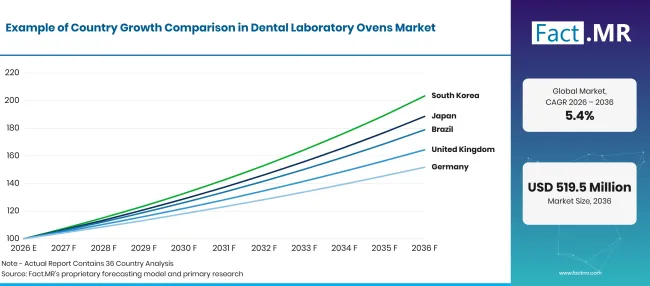
Dental Laboratory Ovens Market Growth Index | Source: Fact.MR
| Country | CAGR (2026 to 2036) |
|---|---|
| Japan | 6.6% |
| Brazil | 6.0% |
| United Kingdom | 5.1% |
| Germany | 4.3% |
| United States | 3.9% |
Source: Fact.MR analysis. Updated Oct 30, 2026
How does Japan perform?
6.6% CAGR, driven by labs automating production as the technician workforce ages.
Japan’s labs are losing staff faster than workloads fall. The Ministry of Health, Labour and Welfare counted 31,733 employed dental technicians at the end of 2024, down 3.7% from 2022 [4]. Labs respond by buying sintering and porcelain furnaces with stored programs that run unattended overnight. Strong domestic use of zirconia and ceramic crowns keeps firing volumes high.
What is supporting Brazil’s adoption?
6.0% CAGR, helped by clinic upgrades and new sanitary rules for dental services.
Brazil is pushing dental services to modernize their premises. The Federal Council of Dentistry reported in October 2026 that dental services must adapt to ANVISA resolution RDC No. 1,002/2025 by December 2026, and that many requirements call for structural changes and investment [6]. Clinics that refit their sites often add compact furnaces for in-office crowns, while regional prosthesis labs serve public dental programs.
How is the United Kingdom scaling demand?
5.1% CAGR, reflecting rising NHS treatment volumes.
NHS dental activity in England is recovering. NHS Business Services Authority data show 37.6 million courses of treatment in 2025/26, up 6.2% on 2024/25 [7]. Some 25,419 dentists delivered NHS activity that year [7]. More courses mean more crowns, bridges and dentures sent to commercial labs. Many UK labs run older porcelain furnaces that will need replacement for current glass ceramics.
What supports Germany’s adoption?
4.3% CAGR, backed by a mature base of contract dental practices.
Germany has a deep network of dental practices and master-led labs. The National Association of Statutory Health Insurance Dentists counted 43,166 contract dentists at the end of 2024, down 2.0% from 2023 [8]. Practices also employed 19,708 salaried dentists [8]. Destatis reported that employment in dental practices rose 1.0% in 2024 [9]. Domestic furnace makers serve these labs directly, which shortens service times.
What is supporting the United States’ adoption?
3.9% CAGR, as a smaller lab workforce slows new furnace installations.
The U.S. Bureau of Labor Statistics counted 34,400 dental laboratory technician jobs in 2025 and projects a 6% decline by 2035 [3]. Patient demand holds up, with 66.7% of adults having a dental exam or cleaning in 2025 [10]. Labs therefore consolidate work into fewer sites with larger sintering furnaces, while clinics add chairside speed units.
Who leads the Dental Laboratory Ovens Market?
Three groups shape competition. Material-led brands such as VITA Zahnfabrik, Ivoclar and Dentsply Sirona sell furnaces as part of a validated workflow, so a lab buying their zirconia or glass ceramic gets matching programs. Ivoclar’s Programat line covers ceramic, press and sintering units, and Dentsply Sirona offers inLab Profire for labs and CEREC SpeedFire for clinics.
Furnace specialists DEKEMA, MIHM-VOGT, Nabertherm and Dentalfarm compete on build quality and control software. DEKEMA launched its AUSTROMAT i G2 series with new Thor software in April 2025 [11], and VITA introduced the vPad LITE and PRO control units for its firing and sintering furnaces in August 2025 [12]. Lab-system suppliers Zirkonzahn and Whip Mix bundle Zirkonofen sintering units or Pro Series porcelain furnaces with milling, investment and press products. Validated speed programs and fast local service will decide which suppliers win replacement orders.
Which companies are the key providers?
Key companies include VITA Zahnfabrik; Ivoclar; Dentsply Sirona; DEKEMA; MIHM-VOGT; Nabertherm; Zirkonzahn; Whip Mix; and Dentalfarm.
- VITA Zahnfabrik H. Rauter GmbH & Co. KG
- Ivoclar
- Dentsply Sirona Inc.
- DEKEMA Dental-Keramiköfen GmbH
- MIHM-VOGT GmbH & Co. KG
- Nabertherm GmbH
- Zirkonzahn GmbH
- Whip Mix Corporation
- Dentalfarm Srl
Bibliography
- [1] World Health Organization. (2025, March 17). Oral health.
- [2] VITA Zahnfabrik. (2025, January 9). Premium zirconia: Perfect esthetics with Multi-Gradient Technology.
- [3] U.S. Bureau of Labor Statistics. (2026, August 27). Dental and Ophthalmic Laboratory Technicians and Medical Appliance Technicians: Occupational Outlook Handbook.
- [4] Ministry of Health, Labour and Welfare, Japan. (2025, July 29). [Summary of the 2024 Report on Public Health Administration and Services: Employed Medical Personnel].
- [5] Ministry of Health, Labour and Welfare, Japan. (2025, September 26). 令和6(2024)[Summary of the 2024 Survey of Medical Institutions and Hospital Report].
- [6] Conselho Federal de Odontologia. (2026, October 14). O Conselho Federal de Odontologia e o prazo de adequação à RDC nº 1.002/2025 da ANVISA [The Federal Council of Dentistry and the deadline to comply with ANVISA RDC No. 1,002/2025].
- [7] NHS Business Services Authority. (2026, August 27). Dental statistics: England 2025/26.
- [8] Kassenzahnärztliche Bundesvereinigung. (2025). Statistisches Jahrbuch 2025: An der vertragszahnärztlichen Versorgung teilnehmende Zahnärzte [Statistical Yearbook 2025: Dentists participating in statutory dental care].
- [9] Statistisches Bundesamt (Destatis). (2026, January 27). 1,7 % mehr Beschäftigte im Gesundheitswesen 2024 [1.7% more people employed in health care in 2024].
- [10] National Center for Health Statistics. (2026, June 12). FastStats: Oral and Dental Health.
- [11] DEKEMA Dental-Keramiköfen. (2025, April 1). DEKEMA presents the new series i G2.
- [12] VITA Zahnfabrik. (2025, August 28). VITA vPad LITE and PRO: New control units for efficient firing and sintering processes.
This Report Answers
- How large is oven revenue in 2026, and what value will the market add by 2036?
- Why do sintering units, crown and bridge work and commercial laboratories each hold the lead in their segment?
- Technician supply, clinic regulation and treatment volumes explain how Japan, Brazil, the United Kingdom, Germany and the United States differ.
- Which furnace makers sell validated material programs, and which compete on control software and build quality?
- Power cost, service access and purchase price are weighed against the gains from faster sintering cycles.
What does the Dental Laboratory Ovens Market cover?
Sintering, burnout and ceramic ovens used to produce dental restorations fall within this market, together with press furnaces and combination units grouped under Others. Both laboratory floor units and compact chairside furnaces are counted.
Demand is tracked across crowns and bridges, dentures and implant-supported work. Revenue is measured at the point of equipment sale to laboratories, clinics, teaching institutes and hospital labs.
What is included in the scope?
Vacuum porcelain furnaces, press furnaces, zirconia sintering furnaces and preheating units for investment molds are in scope. Control units, firing trays and muffles sold with a new oven count toward its value.
Ovens used to finish parts from dental prosthetics workflows are included, whether the restoration was milled, pressed or printed.
What is excluded from the scope?
Milling machines, scanners, 3D printers and design software are outside the valuation when bundled with a furnace. Zirconia blanks, ceramic ingots, glazes and other dental consumables are also left out.
Finished crowns, bridges and dentures are not counted. General-purpose industrial kilns and laboratory furnaces not designed for dental materials are excluded.
How Was the Analysis Built?
The analysis draws on 120+ sources, 35+ company portfolios, 25+ countries, and more than 20 industry interviews.
- Primary Research: Primary research includes discussions with manufacturers, service providers, technology developers, distributors, end users, and subject-matter experts. These conversations examine purchasing priorities, product adoption, operational challenges, approval requirements, competitive positioning, and the factors that influence wider market acceptance.
- Desk Research: Desk research covers government statistics, regulatory publications, company filings, trade data, technical studies, industry associations, standards, public policy, and other authoritative sources. Every source used in the analysis is documented in the bibliography.
- Market Sizing and Forecasting: Market estimates combine historical performance, demand indicators, pricing and volume trends, segment shares, company participation, country-level growth, adoption patterns, investment activity, and barriers to market expansion.
- Data Validation and Update Cycle: Findings are validated by comparing primary interviews with public data, company activity, regulatory changes, trade patterns, and industry developments. Regular updates review new product launches, capacity changes, partnerships, approvals, and shifts in commercial adoption.
Segmentation
What is the report’s scope and coverage?
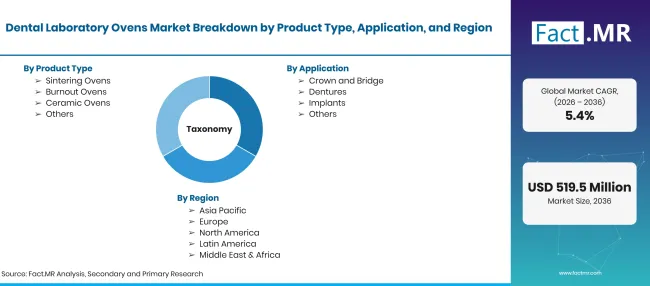
Dental Laboratory Ovens Market Taxonomy | Source: Fact.MR
| Attribute | Details |
|---|---|
| Quantitative Units | USD million |
| Market Definition | Furnaces and ovens used in dental laboratories and clinics to sinter, fire, press and burn out materials for dental restorations. Revenue is counted at the equipment level. |
| Product Type | Sintering Ovens; Burnout Ovens; Ceramic Ovens; Others |
| Application | Crown and Bridge; Dentures; Implants; Others |
| End-User | Dental Laboratories; Dental Clinics; Others |
| Regions Covered | North America; Latin America; Western Europe; Eastern Europe; East Asia; South Asia & Pacific; Middle East & Africa |
| Countries Covered | Japan; Brazil; United Kingdom; Germany; United States |
| Companies Profiled | VITA Zahnfabrik; Ivoclar; Dentsply Sirona; DEKEMA; MIHM-VOGT; Nabertherm; Zirkonzahn; Whip Mix; Dentalfarm |
| Forecast Period | 2026 to 2036 |
| Approach | Hybrid top-down and bottom-up approach using restoration volumes by type; furnace installed base and replacement cycles in labs and clinics; zirconia and glass-ceramic usage; and supplier portfolio review. |
Source: Fact.MR analysis. Updated Oct 30, 2026
How is the market segmented?
-
By Product Type
- Sintering Ovens
- Burnout Ovens
- Ceramic Ovens
- Others
-
By Application
- Crown and Bridge
- Dentures
- Implants
- Others
-
By End-User
- Dental Laboratories
- Dental Clinics
- Others
-
By Region
- North America
- Latin America
- Western Europe
- Eastern Europe
- East Asia
- South Asia & Pacific
- Middle East & Africa
Frequently Asked Questions
How big is the dental laboratory ovens market in 2026?
What is the CAGR of the dental laboratory ovens market from 2026 to 2036?
Which product type leads the dental laboratory ovens market?
Which application leads the dental laboratory ovens market?
Which end-user leads the dental laboratory ovens market?
Which country will grow the most in the dental laboratory ovens market?
Who are the main companies in the dental laboratory ovens market?
Who worked on this report


Preview the report firsthand - request a free sample
Free SampleGet the brochure for pricing and purchase details
Download PDF