- Market Value (2025): USD 141.2 Mn
- Estimated Value (2026): USD 161.8 Mn
- Forecast Value (2036): USD 633.3 Mn
- CAGR (2026-2036): 14.6%
How does the Magnetic-Guided Capsule Endoscopy Market break down by segment?
Fact.MR finds that Small Bowel Capsule Leads Product Type at 48.5%, Gastrointestinal Bleeding Leads Application at 35.7%, and Hospitals Lead End User at 52.8%.
Which Product Type dominates?
Small Bowel Capsule is set to hold a 48.5% share in 2026.
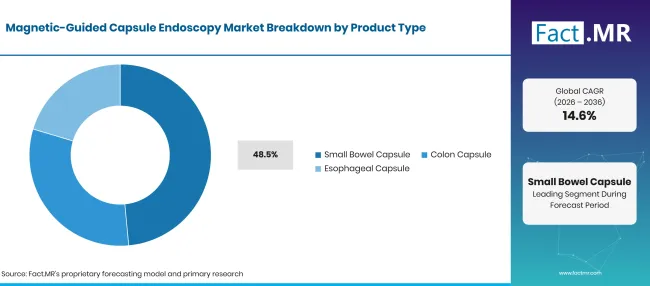
Magnetic Guided Capsule Endoscopy Market Breakdown Product Type | Source: Fact.MR
| Product Type | Share (2026) |
|---|---|
| Small Bowel Capsule (Leading segment) | 48.5% |
| Other segments combined | 51.5%* |
| Total | 100.0% |
Source: Fact.MR analysis. Updated Oct 30, 2026
Small bowel capsule examinations are used to investigate gastrointestinal conditions that may not be fully assessed through conventional upper endoscopy or colonoscopy. Magnetic guidance may help clinicians control capsule movement in suitable systems, but capabilities differ between small bowel capsules and magnetically controlled upper gastrointestinal devices. Product classification should therefore distinguish general capsule endoscopy from systems specifically designed for magnetic navigation.
What leads the Application segment?
Gastrointestinal Bleeding is set to represent a 35.7% share in 2026.
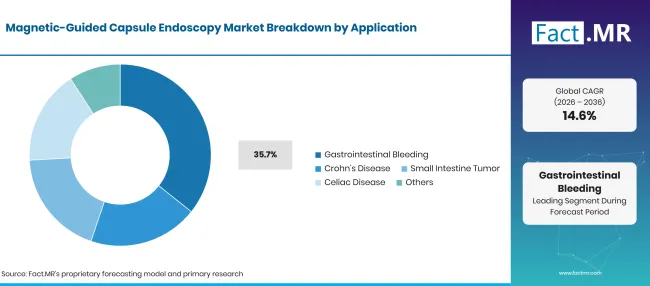
Magnetic Guided Capsule Endoscopy Market Breakdown Application | Source: Fact.MR
| Application | Share (2026) |
|---|---|
| Gastrointestinal Bleeding (Leading segment) | 35.7% |
| Other segments combined | 64.3%* |
| Total | 100.0% |
Source: Fact.MR analysis. Updated Oct 30, 2026
Gastrointestinal bleeding supports demand in the Magnetic-Guided Capsule Endoscopy Market because the technology helps clinicians examine the gastrointestinal tract for potential bleeding sources. Its minimally invasive approach can improve patient comfort while enabling physicians to visualize areas that may require further investigation. Growing demand for less invasive diagnostic procedures supports the use of magnetic-guided capsule endoscopy in selected gastrointestinal examinations.
How does End User shape demand?
Hospitals are likely to account for 52.8% of the market in 2026.
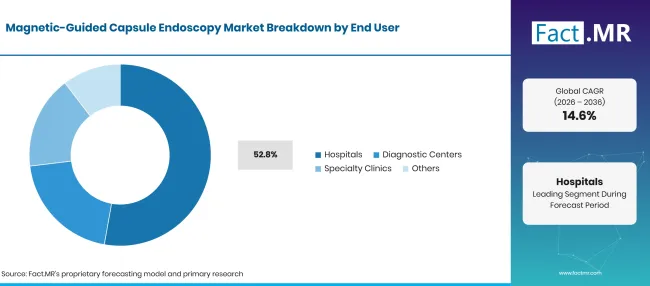
Magnetic Guided Capsule Endoscopy Market Breakdown End User | Source: Fact.MR
| End User | Share (2026) |
|---|---|
| Hospitals (Leading segment) | 52.8% |
| Other segments combined | 47.2%* |
| Total | 100.0% |
Source: Fact.MR analysis. Updated Oct 30, 2026
Hospitals can integrate capsule-based investigations into gastroenterology services, specialist referrals, and diagnostic pathways for patients with unexplained bleeding. Diagnostic centers may contribute through dedicated gastrointestinal testing services, while specialty clinics may use capsule examinations for selected patients. Equipment costs and reimbursement influence the choice of diagnostic setting.
What is accelerating Magnetic-Guided Capsule Endoscopy Market adoption, and what is holding it back?
Growing demand for minimally invasive gastrointestinal imaging and improvements in magnetic navigation create market opportunities. However, high device costs and the need for further clinical validation may limit adoption, while restrictions on use across certain diagnostic indications can affect wider implementation.
Drivers Impact Analysis
| DRIVER | (~) % IMPACT ON CAGR | GEOGRAPHIC RELEVANCE | IMPACT TIMELINE |
|---|---|---|---|
| Need to investigate unexplained gastrointestinal bleeding | +1.2% | Global | Short term (≤ 2 years) |
| Advances in magnetic navigation and robotic control | +1.0% | Europe, Asia, North America | Medium term (2–4 years) |
| Greater use of non-invasive gastrointestinal imaging | +0.8% | Global | Medium term (2–4 years) |
| Expansion of specialist gastroenterology services | +0.6% | Global | Medium term (2–4 years) |
| Improved image processing and capsule tracking | +0.5% | Global | Long term (≥ 4 years) |
Source: Fact.MR analysis. Updated Oct 30, 2026
Opportunity Impact Analysis
| OPPORTUNITY | (~) % IMPACT ON CAGR | GEOGRAPHIC RELEVANCE | IMPACT TIMELINE |
|---|---|---|---|
| Robotic assistance for controlled capsule movement | +1.0% | Europe, Asia | Medium term (2–4 years) |
| Clinical evidence for selected gastrointestinal indications | +0.8% | Global | Short term (≤ 2 years) |
| Integration with digital imaging and reporting workflows | +0.6% | Global | Medium term (2–4 years) |
| Expansion of specialist diagnostic access | +0.5% | Latin America, Asia | Long term (≥ 4 years) |
Source: Fact.MR analysis. Updated Oct 30, 2026
Restraints Impact Analysis
| RESTRAINT | (~) % IMPACT ON CAGR | GEOGRAPHIC RELEVANCE | IMPACT TIMELINE |
|---|---|---|---|
| High acquisition and operating costs | -0.9% | Global | Short term (≤ 2 years) |
| Differences in clinical evidence across device types | -0.7% | Global | Medium term (2–4 years) |
| Training and workflow integration requirements | -0.5% | Global | Medium term (2–4 years) |
| Limitations in indication-specific use and patient suitability | -0.5% | Global | Short term (≤ 2 years) |
Source: Fact.MR analysis. Updated Oct 30, 2026
Which countries are scaling the Magnetic-Guided Capsule Endoscopy Market through 2036?
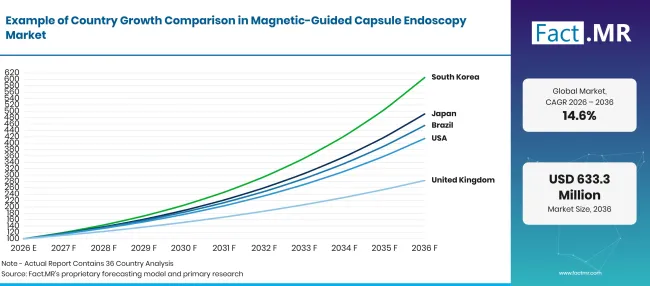
Magnetic Guided Capsule Endoscopy Market Growth Index | Source: Fact.MR
| Country | CAGR (2026–2036) |
|---|---|
| Germany | 10.6% |
| Brazil | 16.4% |
| USA | 15.3% |
| UK | 11.0% |
| Japan | 17.3% |
Source: Fact.MR analysis. Updated Oct 30, 2026
What supports Germany adoption?
10.6% CAGR, supported by potential demand from specialist gastrointestinal diagnostic services and technology-focused healthcare facilities.
Germany's opportunity depends on clinical acceptance of capsule-based gastrointestinal investigations, investment in diagnostic equipment, and the integration of new technologies into hospital workflows. Manufacturers need to demonstrate clinical utility, safety, and cost-effectiveness to support procurement decisions.
How is Brazil developing magnetic-guided capsule endoscopy adoption?
16.4% CAGR, reflecting potential expansion of specialist diagnostic services and access to less invasive gastrointestinal investigations.
Brazil's market development may depend on access to gastroenterologists, diagnostic infrastructure, equipment affordability, and reimbursement. Suppliers seeking wider adoption need to demonstrate that the technology can be deployed economically beyond highly specialized facilities.
What supports United States adoption?
15.3% CAGR, driven by the potential integration of advanced gastrointestinal imaging into specialist care.
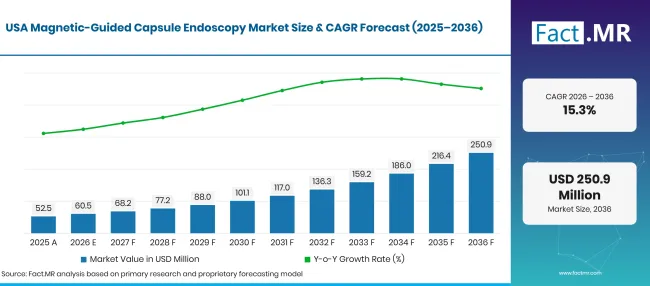
Magnetic Guided Capsule Endoscopy Market Forecast Usa | Source: Fact.MR
The United States benefits from an established medical-device and gastroenterology research ecosystem. Ongoing work in robotic and magnetically controlled endoscopy supports clinical evaluation of advanced imaging procedures, helping specialist care providers assess new technologies and broaden their potential use.
How is the United Kingdom building adoption?
11.0% CAGR, shaped by research into capsule-based diagnostics and potential use in specialist gastrointestinal pathways.
The United Kingdom increasing interest in capsule-based gastrointestinal diagnostics, supported by clinical research and specialist care pathways. Magnetic-guided capsule endoscopy can offer a less invasive imaging option, encouraging further evaluation across hospitals and gastroenterology services where suitable patients require detailed gastrointestinal assessment.
What supports Japan adoption?
17.3% CAGR, reflecting potential demand for advanced gastrointestinal imaging and ongoing capsule-endoscopy development.
Japan's opportunity depends on clinical evidence, regulatory review, specialist expertise, and the suitability of magnetically controlled systems for particular examinations. The PMDA's 2026 review summary for PillCam COLON 2 documents regulatory activity in the broader capsule-endoscopy category [5].
Who leads the Magnetic-Guided Capsule Endoscopy Market?
Fact.MR identifies IntroMedic Co. Ltd., and AnX Robotica Corporation among the companies. The broader list also includes Jinshan Science & Technology Group.
The competitive landscape spans capsule hardware, gastrointestinal imaging, magnetic navigation, and image-analysis software. However, the named companies do not all offer equivalent magnetic-guided capsule systems. Olympus and Fujifilm have broader endoscopy portfolios. Product-specific claims should be checked against the relevant manufacturer's documentation before publication.
The market's competitive dynamics depend on diagnostic performance, capsule navigation, image quality, clinical validation, system usability, and integration with hospital workflows. Providers that demonstrate a clear clinical role for magnetic guidance may be better positioned to support adoption, provided the technology meets applicable regulatory requirements.
Which companies are the key providers?
Key companies covered in the include IntroMedic Co. Ltd.; Jinshan Science & Technology Group; AnX Robotica Corporation.
- IntroMedic Co. Ltd.
- Jinshan Science & Technology Group
- AnX Robotica Corporation
Bibliography
- [1] Obstein, K. L., Landewee, C. A., Martin, J., Caló, S., Norton, J., Kow, J. W., Scaglioni, B., & Valdastri, P. (2026). The magnetic flexible endoscope: Phase 1 first-in-human clinical trial. The American Journal of Gastroenterology, 121(4), 871–880.
- [2] Tian, Y., Du, S., Liu, H., Yu, H., Bai, R., Su, H., Guo, X., He, Y., Song, Z., Chen, Y., Li, Q., Wang, J., Huang, W., & Rong, L. (2025). Prospective, multicenter, self-controlled clinical trial on the effectiveness and safety of a cable-transmission magnetically controlled capsule endoscopy system for the examination of upper GI diseases (with video). Gastrointestinal Endoscopy, 101(4), 804–817.e1.
- [3] Pharmaceuticals and Medical Devices Agency. (2026, May 19). Review summary: PillCam COLON 2 Capsule Endoscopy System.
- [4] University of Edinburgh. (2026, May 14). The use of robot assisted magnetically controlled capsule endoscopy in patients with iron deficiency anaemia (ClinicalTrials.gov Identifier NCT07197424). ClinicalTrials.gov.
- [5] Chen, W., Sui, J., Cao, X., Huang, J., Chen, F., Zhao, K., Li, Y., Liu, X., Yuan, Z., Zhang, J., Jiang, L., Xie, X., & Wang, C. (2026). A magnetically actuated robotic capsule endoscope for in-situ visualization and microneedle-mediated targeted drug delivery in gastrointestinal tract. Microsystems & Nanoengineering, 12, Article 42.
This Report Answers
- The report evaluates the projected growth of magnetic-guided capsule endoscopy from 2026 to 2036.
- Segment analysis compares Small Bowel Capsule, Gastrointestinal Bleeding, and Hospitals using their 2026 shares.
- Country analysis discusses Germany, Brazil, the USA, the UK, and Japan alongside relevant clinical and regulatory developments.
- The competitive overview companies associated with capsule endoscopy or the wider gastrointestinal imaging ecosystem.
- Technology analysis reviews magnetic navigation, robotic assistance, clinical validation, and image-processing developments.
What does the Magnetic-Guided Capsule Endoscopy Market cover?
The market covers capsule-based gastrointestinal diagnostic technologies, emphasizing devices that use magnetic fields to influence capsule movement or positioning. Relevant systems may support examination of the esophagus, stomach, small intestine, or colon, depending on the product's design and intended use.
The market's scope distinguishes magnetically guided systems from conventional capsule endoscopes that rely primarily on natural gastrointestinal movement. Imaging software and associated navigation components may be relevant where they form part of the diagnostic system. Clinical indications and device capabilities vary across manufacturers and products.
What is included in the scope?
Included products are capsule-endoscopy systems designed for gastrointestinal visualization, with magnetic navigation included where it is a defining feature of the system. The scope covers the specified product types, gastrointestinal applications, healthcare end users, and country markets. Associated imaging, tracking, and navigation technologies are considered where directly relevant to the diagnostic workflow.
What is excluded from the scope?
The analysis excludes conventional flexible endoscopes that do not form part of the defined capsule-based product category, unrelated diagnostic imaging equipment, and general robotic surgical systems without a relevant capsule-endoscopy application. Experimental prototypes are treated as research developments rather than established commercial products unless commercial availability is verified. General-purpose imaging software and unrelated medical-device revenues are also excluded.
How Was the Analysis Built?
The analysis draws on 120+ sources, 35+ company portfolios, 25+ countries, and more than 20 industry interviews.
- Primary Research: Primary research includes discussions with manufacturers, service providers, technology developers, distributors, end users, and subject-matter experts. These conversations examine purchasing priorities, product adoption, operational challenges, approval requirements, competitive positioning, and the factors that influence wider market acceptance.
- Desk Research: Desk research covers government statistics, regulatory publications, company filings, trade data, technical studies, industry associations, standards, public policy, and other authoritative sources. Every source used in the analysis is documented in the bibliography.
- Market Sizing and Forecasting: Market estimates combine historical performance, demand indicators, pricing and volume trends, segment shares, company participation, country-level growth, adoption patterns, investment activity, and barriers to market expansion.
- Data Validation and Update Cycle: Findings are validated by comparing primary interviews with public data, company activity, regulatory changes, trade patterns, and industry developments. Regular updates review new product launches, capacity changes, partnerships, approvals, and shifts in commercial adoption.
Segmentation
What is the Magnetic-Guided Capsule Endoscopy Market forecast to be worth by 2036?
USD 161.8 million in 2026 to USD 633.3 million by 2036 at a 14.6% CAGR.
- As per Fact.MR analysis, the magnetic-guided capsule endoscopy market was valued at USD 141.2 million in 2025.
- Demand will grow from USD 161.8 million in 2026 to USD 633.3 million by 2036.
- The forecast records a 14.6% CAGR from 2026 to 2036 as healthcare providers increasingly adopt advanced capsule-based diagnostic technologies.
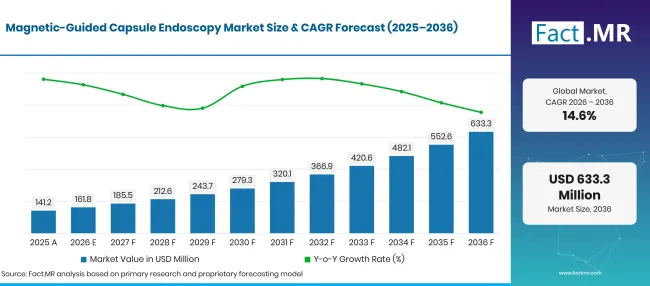
Magnetic Guided Capsule Endoscopy Market Forecast Global | Source: Fact.MR
| Year | Basis | Market Value (USD million) |
|---|---|---|
| 2025 | Actual | 141.2 |
| 2026 | Estimate | 161.8 |
| 2036 | Forecast | 633.3 |
| CAGR 2026 to 2036 | Forecast period | 14.6% |
Source: Fact.MR analysis. Updated Oct 30, 2026
What are the defining numbers behind Magnetic-Guided Capsule Endoscopy Market growth?
USD 471.5 million absolute opportunity between 2026 and 2036.
- Demand Drivers in the Market
- Growing demand for minimally invasive gastrointestinal diagnostics supports the growth of the market. Increasing preference for non-invasive diagnostic procedures supports the Magnetic-Guided Capsule Endoscopy Market. The technology allows clinicians to examine the stomach using a swallowable capsule, reducing discomfort associated with conventional endoscopic procedures.
- Advancements in magnetic navigation and imaging technology: Improvements in magnetic control systems and imaging capabilities support more systematic examination of the stomach. A 2024 multicenter clinical trial involving 180 participants reported 97.78% accuracy in detecting gastric focal lesions using a magnetically controlled capsule system [7].
- Rising focus on early gastrointestinal disease detection has driven the market growth. Greater emphasis on identifying gastrointestinal abnormalities at an early stage supports demand for advanced diagnostic technologies. Magnetic-guided capsule endoscopy offers an alternative approach for examining the stomach in suitable patients.
- Key Segments Analyzed
- By Product Type: Small Bowel Capsule leads with a 48.5% share in 2026.
- By Application: Gastrointestinal Bleeding leads with a 35.7% share in 2026.
- By End User: Hospitals account for 52.8% share in 2026, reflecting their role in specialist diagnostic services and hospital-based gastrointestinal investigations.
- Analyst Opinion at Fact.MR
- Shambhu Nath Jha, Principal Consultant at Fact.MR, states, “Magnetic-guided capsule endoscopy is positioned to attract interest where clinicians need non-invasive gastrointestinal imaging and greater control over capsule movement. Wider adoption will depend on clinical evidence, appropriate patient selection, workflow integration, and the economic case for healthcare providers.”
- Strategic Implications
- Manufacturers should provide clear clinical evidence on diagnostic performance, capsule navigation, safety, and intended use.
- Hospitals need to evaluate system costs alongside procedure requirements, staff training, maintenance, and patient suitability.
- Diagnostic centers must assess whether capsule-based examinations complement their existing endoscopy services and referral pathways.
- Technology developers can document the clinical advantages and limitations of magnetic navigation rather than assuming that every capsule procedure requires active magnetic control.
Germany is projected to record a 10.6% CAGR through 2036. Brazil is forecast to post a 16.4% CAGR, followed by the USA at 15.3%. The UK is estimated to advance at 11.0%, while Japan is forecast to record the fastest growth among the five listed countries at 17.3%.
What is the report's scope and coverage?
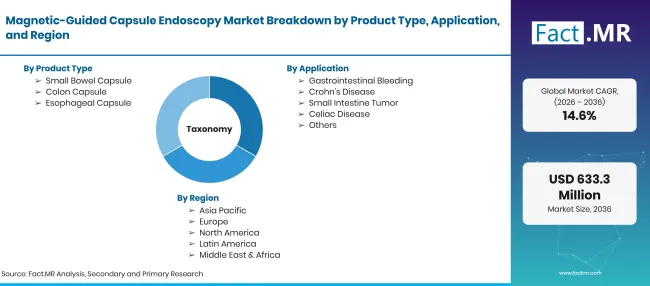
Magnetic Guided Capsule Endoscopy Market Taxonomy | Source: Fact.MR
| Attribute | Details |
|---|---|
| Quantitative Units | USD million in 2026 to USD billion by 2036 at CAGR |
| Market Definition | The Magnetic-Guided Capsule Endoscopy Market comprises swallowable capsule-based diagnostic systems that use magnetic navigation to guide capsule movement and capture images of the gastrointestinal tract. |
| Product Type | Small Bowel Capsule; Colon Capsule; Esophageal Capsule |
| Application | Gastrointestinal Bleeding; Crohn's Disease; Small Intestine Tumor; Celiac Disease; Others |
| End User | Hospitals; Diagnostic Centers; Specialty Clinics; Others |
| Regions Covered | North America; Latin America; Western Europe; Eastern Europe; East Asia; South Asia & Pacific; Middle East & Africa |
| Countries Covered | Germany; Brazil; USA; UK; Japan |
| Companies Profiled | IntroMedic Co. Ltd.; Jinshan Science & Technology Group; AnX Robotica Corporation |
| Forecast Period | 2026 to 2036 |
| Approach | Market segmentation and scenario-based analysis, informed by clinical studies, regulatory records, technology developments, and company documentation |
Source: Fact.MR analysis. Updated Oct 30, 2026
How is the market segmented?
-
By Product Type
- Small Bowel Capsule
- Colon Capsule
- Esophageal Capsule
-
By Application
- Gastrointestinal Bleeding
- Crohn's Disease
- Small Intestine Tumor
- Celiac Disease
- Others
-
By End User
- Hospitals
- Diagnostic Centers
- Specialty Clinics
- Others
-
By Region
- North America
- Latin America
- Western Europe
- Eastern Europe
- East Asia
- South Asia & Pacific
- Middle East & Africa
Frequently Asked Questions
How big is the Magnetic-Guided Capsule Endoscopy Market in 2026?
What is the CAGR from 2026 to 2036?
Which product type has the largest share?
Which application leads?
Which end user has the largest share?
Which country has the highest projected CAGR?
Which companies are covered?
Who worked on this report


Preview the report firsthand - request a free sample
Free SampleGet the brochure for pricing and purchase details
Download PDF