- Market Value (2025): USD 167.0 Mn
- Estimated Value (2026): USD 175.9 Mn
- Forecast Value (2036): USD 295.0 Mn
- CAGR (2026-2036): 5.3%
What is the Dental Elevator & Luxator Market forecast to be worth by 2036?
USD 175.9 million in 2026 to USD 295.0 million by 2036 at a 5.3% CAGR.
- The dental elevator and luxator market reached USD 167.0 million in 2025.
- According to Fact.MR analysis, revenue is projected to rise from USD 175.9 million in 2026 to USD 295.0 million in 2036.
- The market is forecast to record a 5.3% CAGR from 2026 to 2036 as dental clinics refresh extraction instrument sets.
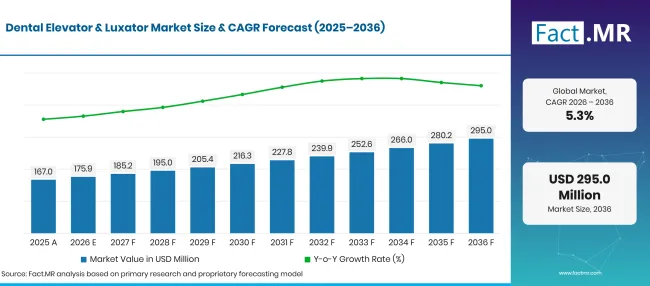
Dental Elevator And Luxator Market Forecast Global | Source: Fact.MR
| Year | Basis | Market Value (USD million) |
|---|---|---|
| 2025 | Actual | 167.0 |
| 2026 | Estimate | 175.9 |
| 2036 | Forecast | 295.0 |
| CAGR 2026 to 2036 | Forecast period | 5.3% |
Source: Fact.MR analysis. Updated Oct 30, 2026
What are the defining numbers behind Dental Elevator & Luxator Market growth?
The market is expected to add USD 119.1 million between 2026 and 2036.
- Demand Drivers in the Market
- Dental clinicians use elevators to gain initial tooth movement and create access for forceps. Straight designs suit familiar working angles, while curved patterns address harder-to-reach roots.
- Dental treatment activity gives suppliers an established customer base for reusable instrument replacements.
- Clinics choose reusable instruments carefully because working edges must remain reliable after repeated cleaning. A comfortable grip helps dentists control movement, while clear markings help chairside staff prepare the correct instruments for each procedure.
- Dental hospitals and teaching clinics need instruments for both routine extractions and more complex surgical procedures. Their sets often contain a wider variety of blade shapes than those used in a small general practice.
- Key Segments Analyzed
- By Product Type: Straight Elevators are projected to account for 38.2% of 2026 revenue as routine extraction trays use a familiar straight working profile.
- By Application: Tooth Extraction is forecast to represent 61.4% of 2026 sales since elevators and luxators are chiefly used to loosen teeth and roots ahead of removal.
- By End-User: Dental Clinics lead with 54.8% of 2026 spending as outpatient dentists maintain reusable instrument inventories.
- Analyst Opinion at Fact.MR
- Shambhu Nath Jha, Principal Consultant at Fact.MR, states, “Dentists judge extraction instruments by the control they provide at the working tip and how well they withstand repeated cleaning. Clinics often replace individual worn instruments rather than buying an entirely new tray.”
- Strategic Implications
- Instrument makers should specify tip geometry clearly so dentists can select a suitable elevator for the intended tooth and access angle. According to Fact.MR analysis, standardised hand-tool designs support comparisons with dental instrument handles used across clinical procedures.
- Dental distributors need dependable stock of familiar straight and curved patterns because a missing size can interrupt a planned extraction set.
- Clinic managers should check instrument condition at each cleaning cycle and remove tools with damaged working edges from service.
- Training institutions can arrange demonstration sets by tooth position so students learn the practical difference between elevation and periodontal ligament separation.
Germany is projected to record a 6.8% CAGR through 2036. Brazil follows at 6.2%, while the USA is anticipated to grow at 5.6%. The UK is forecast at 5.0%, and Japan at 4.4%. These rates describe different clinic purchasing conditions and replacement cycles.
How does the Dental Elevator & Luxator Market break down by segment?
Straight Elevators account for 38.2%; Tooth Extraction represents 61.4%; Dental Clinics account for 54.8% of projected 2026 revenue.
Which Product Type dominates?
Straight Elevators represent 38.2% of 2026 value.
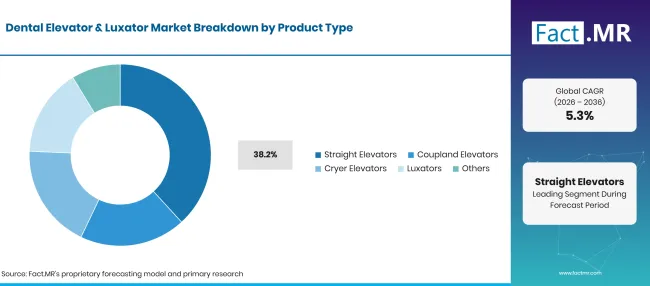
Dental Elevator And Luxator Market Breakdown Product Type | Source: Fact.MR
| Product Type | Share (2026) |
|---|---|
| Straight Elevators (Leading segment) | 38.2% |
| Other segments combined | 61.8% |
| Total | 100.0% |
Source: Fact.MR analysis. Updated Oct 30, 2026
Straight elevators remain a standard choice when a dentist needs a direct path to the tooth or remaining root. Their familiar profile suits routine trays and teaching sets. Coupland elevators provide a different blade form for specific access requirements, and Cryer elevators help engage roots from another angle. Luxators use narrow working tips to separate the periodontal ligament with controlled pressure. Directa lists straight and curved Luxator Periotome options in its product range [3].
Which Application accounts for most demand?
Tooth Extraction represents 61.4% of 2026 revenue.
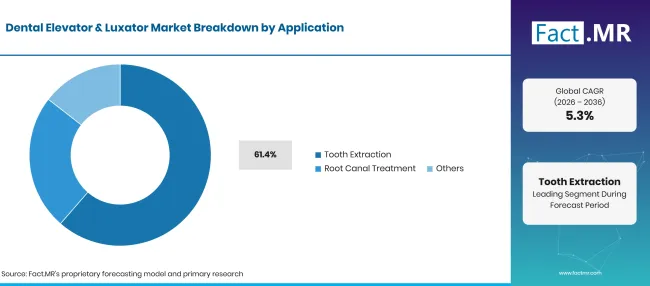
Dental Elevator And Luxator Market Breakdown Application | Source: Fact.MR
| Application | Share (2026) |
|---|---|
| Tooth Extraction (Leading segment) | 61.4% |
| Other segments combined | 38.6% |
| Total | 100.0% |
Source: Fact.MR analysis. Updated Oct 30, 2026
Tooth extraction uses an elevator or luxator to improve movement before the clinician proceeds to removal. Instruments must fit the space around a crown or retained root, so one handle style rarely covers every case. Root canal treatment is a separate clinical category and does not routinely require an elevator; instrument use is relevant where a tooth or root later needs removal. Other applications include related oral-surgical tasks where controlled root mobilisation is appropriate. Accurate case coding prevents treatment counts from being confused with sales of these tools.
Where are purchases concentrated by End-User?
Dental Clinics account for 54.8% of 2026 revenue.
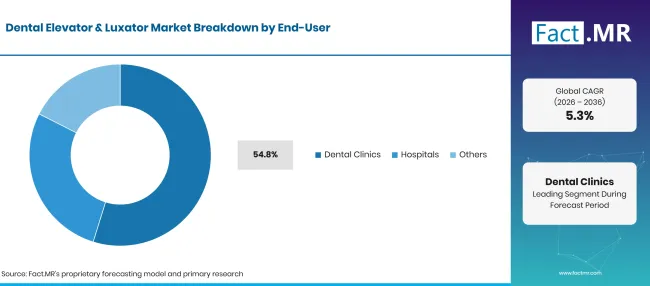
Dental Elevator And Luxator Market Breakdown End User | Source: Fact.MR
| End-User | Share (2026) |
|---|---|
| Dental Clinics (Leading segment) | 54.8% |
| Other segments combined | 45.2% |
| Total | 100.0% |
Source: Fact.MR analysis. Updated Oct 30, 2026
Dental clinics purchase instruments for routine chairside use and maintain several patterns for different extractions. Private clinics may buy individual replacements, while larger groups can standardise their selection across sites. Hospitals also use elevators in oral and maxillofacial surgery departments, where cases may require additional surgical exposure. Dental schools and other facilities form part of the remaining buyer base.
What is accelerating Dental Elevator & Luxator Market adoption, and what is holding it back?
Replacement of working extraction tools and the need for different blade patterns support purchases. Instrument handling, cleaning costs and clinic budgets influence how quickly practices refresh their sets.
Drivers Impact Analysis
| DRIVER | (~) % IMPACT ON CAGR | GEOGRAPHIC RELEVANCE | IMPACT TIMELINE |
|---|---|---|---|
| Routine replacement of worn extraction instruments | +1.0% | Global | Short term (<= 2 years) |
| Broader choice of blade and handle patterns | +0.8% | Global | Medium term (2–4 years) |
| Dental clinic equipment refresh | +0.7% | Europe, North America | Medium term (2–4 years) |
| Oral surgery and teaching requirements | +0.5% | Global | Long term (>= 4 years) |
| Distributor availability for common patterns | +0.4% | Global | Short term (<= 2 years) |
Source: Fact.MR analysis. Updated Oct 30, 2026
Opportunity Impact Analysis
| OPPORTUNITY | (~) % IMPACT ON CAGR | GEOGRAPHIC RELEVANCE | IMPACT TIMELINE |
|---|---|---|---|
| Clear instrument identification and set organisation | +0.8% | Global | Short term (<= 2 years) |
| Ergonomic handle selection | +0.6% | Europe, USA | Medium term (2–4 years) |
| Specialised narrow-tip extraction tools | +0.5% | Global | Medium term (2–4 years) |
| Clinic group standardisation | +0.4% | Global | Long term (>= 4 years) |
Source: Fact.MR analysis. Updated Oct 30, 2026
Restraints Impact Analysis
| RESTRAINT | (~) % IMPACT ON CAGR | GEOGRAPHIC RELEVANCE | IMPACT TIMELINE |
|---|---|---|---|
| Budget limits for reusable instruments | -0.8% | Global | Short term (<= 2 years) |
| Cleaning and maintenance workload | -0.6% | Global | Short term (<= 2 years) |
| Technique-dependent product choice | -0.5% | Global | Medium term (2–4 years) |
| Variation in distributor coverage | -0.4% | Brazil, Japan | Medium term (2–4 years) |
Source: Fact.MR analysis. Updated Oct 30, 2026
Which countries are scaling the Dental Elevator & Luxator Market through 2036?
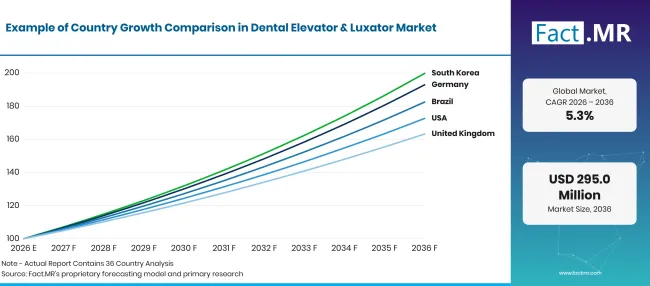
Dental Elevator And Luxator Market Growth Index | Source: Fact.MR
| Country | CAGR (2026 to 2036) |
|---|---|
| Germany | 6.8% |
| Brazil | 6.2% |
| USA | 5.6% |
| UK | 5.0% |
| Japan | 4.4% |
Source: Fact.MR analysis. Updated Oct 30, 2026
What supports dental instrument sales in Germany?
6.8% CAGR, reflecting an established network of dental practices.
German dental practices use reusable elevators in routine extraction trays and prefer familiar working edges that remain consistent after repeated sterilisation. In January 2026, Destatis reported that employment in dental practices rose 1.0% in 2024 [5]. That clinical workforce supports regular use of extraction instrument sets. In April 2026, Destatis published EUR 32.083 billion in expenditure at dentists’ offices for 2024 [4].
How does Brazil shape demand for extraction instruments?
6.2% CAGR, linked to dental practice access and instrument availability.
Brazilian general dental clinics use elevators for routine removal and require familiar straight and angled working profiles. A wider service network can expand the number of treatment settings using reusable extraction tools.
What supports dental elevator purchases in the USA?
5.6% CAGR, reflecting routine practice replenishment.
Dental clinics in the United States often replace individual extraction instruments when a working edge becomes worn. The American Dental Association reported 205,088 professionally active dentists in 2025 [2]. The breadth of this workforce provides a useful indicator of the clinical settings where reusable instruments are used.
How is the UK dental instrument market developing?
5.0% CAGR, supported by active dental service delivery.
British dental practices use elevators and luxators during tooth removal, with demand linked to clinical workloads and replacement of worn tools. NHS Business Services Authority reported 37.6 million NHS dental treatment courses in England during 2025/26 in its August 2026 release [1]. In the same release, NHSBSA recorded 25,419 dentists with NHS activity in England. Dentists value consistent instrument shapes that fit familiar chairside techniques.
How does Japan approach dental extraction instrument demand?
4.4% CAGR, reflecting established dental practice requirements.
Japanese dental clinicians select elevator patterns according to root access and the movement required during extraction. In December 2025, Japan’s Ministry of Health, Labour and Welfare published its 2024 dentist statistics and counted 100,266 dentists working in medical institutions [6]. This broad dental workforce represents the clinical setting for instrument use.
Who leads the Dental Elevator & Luxator Market?
Extraction instrument suppliers offer different combinations of standard elevators, narrow-tip luxators and specialty root instruments.
Hu-Friedy, Integra LifeSciences, A. Titan Instruments, MEDESY, Nordent Manufacturing, Karl Schumacher Dental, American Eagle Instruments, Bmed (Bontempi) and Helmut Zepf are included in the competitive review. Purchase decisions centre on instrument design and consistent stock availability rather than an assumed supplier market share. As per Fact.MR analysis, instrument choice is tied to clinical handling requirements and replacement timing.
Which companies are the key providers?
Key companies include Hu-Friedy Mfg. Co., LLC; Integra LifeSciences Corporation; A. Titan Instruments; MEDESY s.r.l.; Nordent Manufacturing; Karl Schumacher Dental; American Eagle Instruments, Inc.; Directa AB; Bmed S.r.l. (Bontempi); Helmut Zepf Medizintechnik GmbH.
- Hu-Friedy Mfg. Co., LLC
- Integra LifeSciences Corporation
- A. Titan Instruments
- MEDESY s.r.l.
- Nordent Manufacturing
- Karl Schumacher Dental
- American Eagle Instruments, Inc.
- Directa AB
- Bmed S.r.l. (Bontempi)
- Helmut Zepf Medizintechnik GmbH
Bibliography
- [1] NHS Business Services Authority. (2026, August 27). Dental statistics - England 2025/26
- [2] American Dental Association. (2025). The dentist workforce.
- [3] Directa Dental. (n.d.). Luxator® Periotome
- [4] Statistisches Bundesamt (Destatis). (2026, April 2). Health expenditure by health care providers
- [5] Statistisches Bundesamt (Destatis). (2026, January 27). 1,7 % mehr Beschäftigte im Gesundheitswesen 2024.
- [6] Ministry of Health, Labour and Welfare. (2025, December 23).[Overview of the 2024 statistics on physicians, dentists and pharmacists]
This Report Answers
- The study examines how straight elevators and other working profiles meet different tooth extraction needs.
- Application analysis separates direct tooth extraction use from other related dental procedures.
- End-user analysis compares routine dental clinic demand with hospital and institutional requirements.
- The country outlook reviews instrument replacement conditions in Germany, Brazil, the USA, the UK and Japan.
- Competitive coverage describes the companies supplying dental extraction tools and the practical factors behind equipment selection.
What does the Dental Elevator & Luxator Market cover?
The market covers reusable hand instruments designed to loosen teeth or mobilise retained roots during extraction. Revenue relates to elevators and luxators sold for use by qualified dental professionals. Differences in tip shape and handle design are part of the product mix.
What is included in the scope?
Straight, Coupland and Cryer elevator patterns are included alongside luxators and other extraction elevator designs.
Purchases by dental clinics and hospital dental departments are covered. Replacement tools and new instrument sets are counted within the same product boundary.
What is excluded from the scope?
Dental forceps, powered surgical systems and restorative instruments are outside this instrument-specific revenue boundary.
General dental consumables and implants are excluded. Root canal instruments that are not dental elevators or luxators are also outside the scope.
How Was the Analysis Built?
The analysis draws on 120+ sources, 35+ company portfolios, 25+ countries, and more than 20 industry interviews.
- Primary Research: Primary research includes discussions with manufacturers, service providers, technology developers, distributors, end users, and subject-matter experts. These conversations examine purchasing priorities, product adoption, operational challenges, approval requirements, competitive positioning, and the factors that influence wider market acceptance.
- Desk Research: Desk research covers government statistics, regulatory publications, company filings, trade data, technical studies, industry associations, standards, public policy, and other authoritative sources. Every source used in the analysis is documented in the bibliography.
- Market Sizing and Forecasting: Market estimates combine historical performance, demand indicators, pricing and volume trends, segment shares, company participation, country-level growth, adoption patterns, investment activity, and barriers to market expansion.
- Data Validation and Update Cycle: Findings are validated by comparing primary interviews with public data, company activity, regulatory changes, trade patterns, and industry developments. Regular updates review new product launches, capacity changes, partnerships, approvals, and shifts in commercial adoption.
Segmentation
What is the report’s scope and coverage?
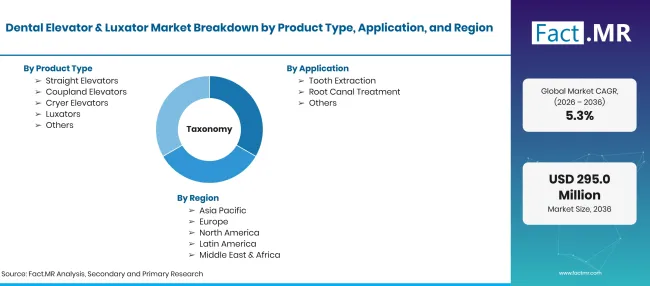
Dental Elevator And Luxator Market Taxonomy | Source: Fact.MR
| Attribute | Details |
|---|---|
| Quantitative Units | USD million |
| Market Definition | Reusable hand instruments used to loosen or elevate teeth and roots during dental procedures. |
| Product Type | Straight Elevators; Coupland Elevators; Cryer Elevators; Luxators; Others |
| Application | Tooth Extraction; Root Canal Treatment; Others |
| End-User | Dental Clinics; Hospitals; Others |
| Regions Covered | North America; Latin America; Western Europe; Eastern Europe; East Asia; South Asia & Pacific; Middle East & Africa |
| Countries Covered | Germany; Brazil; USA; UK; Japan |
| Companies Profiled | Hu-Friedy Mfg. Co., LLC; Integra LifeSciences Corporation; A. Titan Instruments; MEDESY s.r.l.; Nordent Manufacturing; Karl Schumacher Dental; American Eagle Instruments, Inc.; Directa AB; Bmed S.r.l. (Bontempi); Helmut Zepf Medizintechnik GmbH |
| Forecast Period | 2026 to 2036 |
| Approach | Analysis of segment and country forecasts, dental service activity and instrument supplier portfolios |
Source: Fact.MR analysis. Updated Oct 30, 2026
How is the market segmented?
-
By Product Type
- Straight Elevators
- Coupland Elevators
- Cryer Elevators
- Luxators
- Others
-
By Application
- Tooth Extraction
- Root Canal Treatment
- Others
-
By End-User
- Dental Clinics
- Hospitals
- Others
-
By Region
- North America
- Latin America
- Western Europe
- Eastern Europe
- East Asia
- South Asia & Pacific
- Middle East & Africa
Frequently Asked Questions
How big is the dental elevator and luxator market in 2026?
What is the CAGR from 2026 to 2036?
Which product type accounts for the largest share?
Which application accounts for the largest share?
Who are the main companies in this market?
Who worked on this report


Preview the report firsthand - request a free sample
Free SampleGet the brochure for pricing and purchase details
Download PDF