Osmometers Market Size, Share, Growth and Forecast (2026 - 2036)
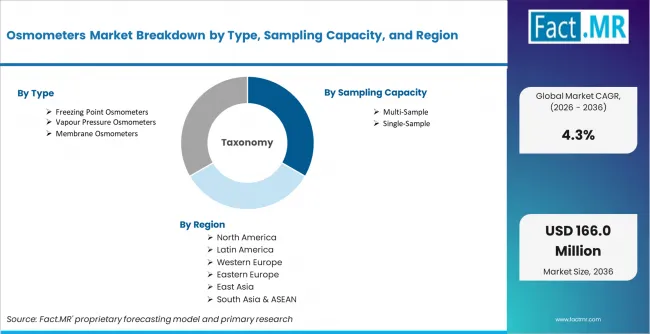
The Osmometers Market is segmented by Type (Freezing Point Osmometers, Vapour Pressure Osmometers, Membrane Osmometers), Sampling Capacity (Single-Sample, Multi-Sample), End Use (Hospitals, Laboratory and Diagnostics Centers, Healthcare Companies, Contract Research Organizations, Contract Manufacturing Organizations, Food and Feed Industries, Others), Product Type (Bench-Top Osmometers, Portable Osmometers, Automated Osmometers), Application (Clinical Diagnostics, Pharmaceutical and Biotechnology Testing, Food Quality Testing, Research Applications), and Region. Forecast for 2026 to 2036.
Fact.MR states the osmometers market is moving toward faster and more automated testing systems. Hospitals and pharmaceutical companies are replacing older single-sample instruments with automated multi-sample osmometers. Rising test volumes are increasing demand for faster processing and better accuracy.
Osmometers Market Forecast and Outlook By Fact.MR
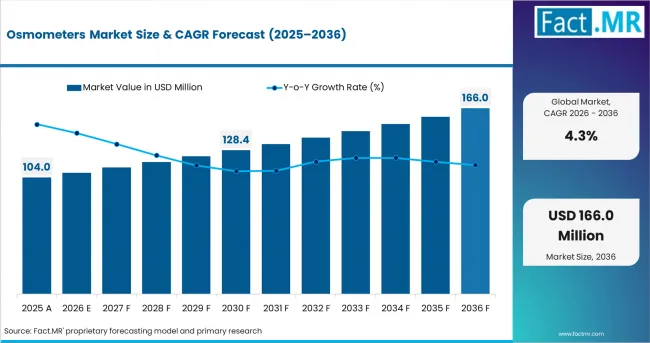
- In 2025, the osmometers market crossed a valuation of USD 104 million.
- Based on Fact.MR analysis, demand for osmometers is estimated to grow to USD 109 million in 2026 and USD 166 million by 2036.
- Fact.MR projects a CAGR of 4.3% during the forecast period.
| Metric | Value |
|---|---|
| Estimated Value in 2026 | USD 109 million |
| Forecast Value in 2036 | USD 166 million |
| Forecast CAGR (2026 to 2036) | 4.3% |
Summary of Osmometers Market
- Demand Drivers
- Hospital laboratories are increasing osmometer adoption as electrolyte disorder and renal function testing volumes rise in clinical care sites. Automated multi-sample systems are replacing older single-sample instruments at high-volume testing sites.
- Pharmaceutical quality control labs are using more osmolarity tests as injectable drug standards become stricter. Contract manufacturers are investing in bench-top and automated osmometers to batch release testing.
- Food and feed manufacturers are using osmometers to check product concentration and quality. Food safety regulation in China and India are increasing investment in food testing labs.
- Key Segments Analyzed
- By Type: Freezing Point Osmometers hold 54.8% share in 2026. Strong adoption in clinical diagnostics and pharmaceutical testing laboratories supports demand.
- By Sampling Capacity: Multi-Sample Osmometers account for 61.4% share in 2026. High-throughput laboratories prefer faster sample processing and improved workflow efficiency.
- By End Use: Laboratory and Diagnostics Centers hold 38.6% share in 2026. Rising osmolarity testing demand across clinical laboratories is increasing instrument adoption.
- By Product Type: Bench-Top Osmometers account for 47.2% share in 2026. Hospitals and pharmaceutical laboratories drives strong installation volumes.
- By Application: Clinical Diagnostics holds 42.9% share in 2026. Osmometers remain widely used in electrolyte imbalance and renal disorder testing.
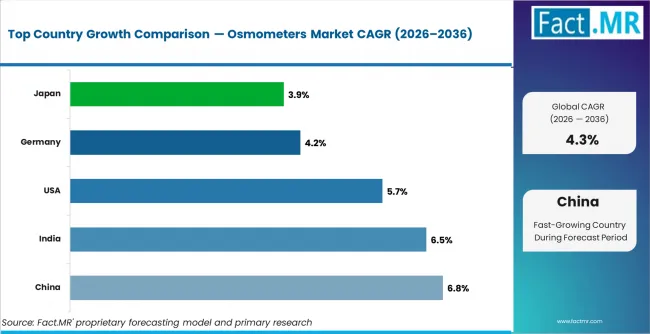
- By Geography: An expected 6.8% CAGR through 2036 positions China as the leading growth market. Hospital laboratory expansion and pharmaceutical quality testing investment accelerates demand.
- Analyst Opinion at Fact.MR
- Shambhu Nath Jha, Principal Consultant at Fact.MR, opines, CXOs will see steady replacement demand as hospital and pharmaceutical laboratories replace older single-sample osmometers. High-volume testing labs are shifting toward automated and multi-sample systems because they process tests faster and improve workflow.
- Strategic Implications
- Osmometer manufacturers should expand commercial presence in China and India where hospital labs buy more instruments. Rising pharmaceutical testing is creating long-term demand.
- Companies should focus more on automated and multi-sample osmometers. High-volume clinical laboratories and pharmaceutical manufacturers are steadily moving away from older single-sample instruments.
- Instrument suppliers should offer bundled reagent and service contracts. Hospitals and pharmaceutical labs prefer long-term support as testing volumes rise.
The market is set to add USD 57 million in new revenue by 2036. The market is growing steadily as labs replace old instruments and run more osmolality tests. Clinical and pharmaceutical quality labs are the main users. High calibration and reagent cost limits faster penetration at smaller diagnostic centers.
China leads at 6.8% CAGR by 2036 as hospital laboratory expansion and pharmaceutical quality testing investment increase osmometer demand. India follows at 6.5% CAGR driven by rising clinical diagnostics infrastructure and regulatory compliance pressure across pharmaceutical manufacturing. The United States is projected at 5.7% CAGR supported by high osmolarity test volumes across hospital networks and pharmaceutical biotechnology research. Germany is estimated at 4.2% CAGR as pharmaceutical production quality standards tighten across European manufacturing facilities. Japan is anticipated at 3.9% CAGR as clinical laboratory instrument replacement cycles progress across aging hospital laboratory infrastructure.
Segmental Analysis
Osmometers Market Analysis by Type
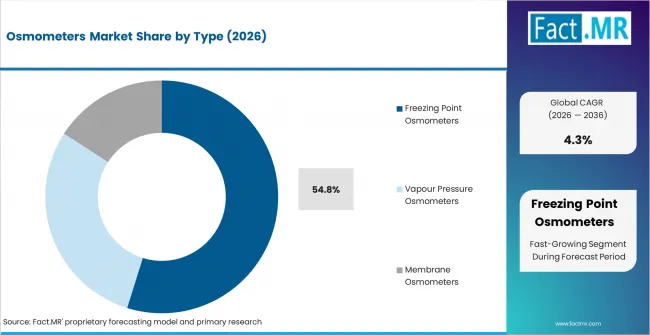
Freezing Point Osmometers are projected to hold 54.8% share in 2026 because hospitals and clinical laboratories prefer this method for high testing accuracy and compatibility with routine diagnostic workflows. The technology remains widely used across electrolyte and renal disorder testing.
- Strong Freezing Point Adoption: Clinical laboratories prefers freezing point osmometers for routine biological fluid testing. Established clinical reference standards support long-term demand.
- Vapor Pressure Expansion: Pharmaceutical laboratories are increasing use of vapour pressure osmometers for volatile and non-aqueous formulations. Specialized drug testing applications are supporting growth.
- Advanced Instruments Launches OsmoPRO MAX: Advanced Instruments introduced the OsmoPRO MAX automated osmometer for clinical laboratory use. The system automates sampling, testing, cleaning and data transfer to improve workflow efficiency and reduce manual errors. [1]
Osmometers Market Analysis by Sampling Capacity
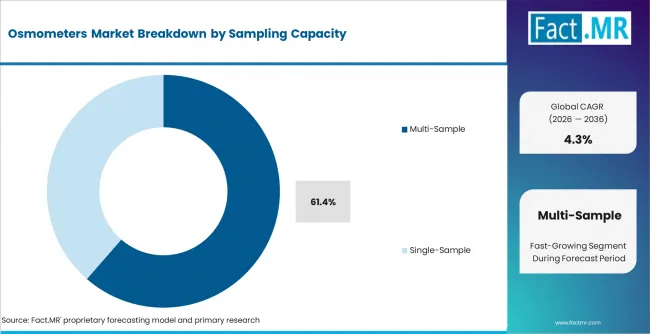
Multi-Sample Osmometers are expected to account for 61.4% share in 2026 because high-volume laboratories require faster sample handling and improved testing efficiency. Automated systems helps laboratories manage more tests with the same staff.
- High-Volume Laboratory Growth: Large hospital and pharmaceutical laboratories invests in multi-sample testing systems. Faster turnaround time is a major purchasing factor.
- Bruker to Acquire ELITechGroup for $942M: Bruker has signed a share purchase agreement to acquire ELITechGroup, a molecular diagnostics company, for about €870 million in cash. The acquisition strengthens Bruker’s in-vitro diagnostics portfolio and expands its capabilities in infectious disease and microbiology testing. [2]
- Workflow Standardization: Healthcare networks are standardizing multi-sample osmometer systems across affiliated laboratories. Process consistency and reporting accuracy supports this trend.
Osmometers Market Analysis by End Use
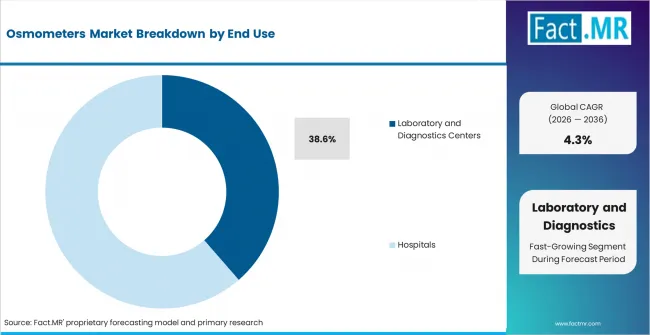
Laboratory and Diagnostics Centers are projected to hold 38.6% share in 2026 because these facilities handle the higher osmolality testing volumes in clinical and specialty diagnostics. Faster replacement cycles and automation upgrades supports market demand.
- Diagnostic Laboratory Expansion: Independent and hospital-affiliated laboratories increase investment in osmometer systems. Rising clinical testing demand is supporting instrument upgrades.
- Labcorp and Epic Expand Diagnostic Integration: Labcorp and Epic expanded their collaboration to integrate Labcorp’s full diagnostic test menu into Epic’s Aura platform.
Clinicians will be able to order tests and receive results directly within Epic workflows, improving efficiency and reducing integration complexity across hospitals. [3] - Pharmaceutical and CRO Demand: Contract research and manufacturing organizations are increasing osmometer adoption across formulation testing and quality control applications. Regulatory compliance pressure remains a key growth factor.
Osmometers Market Analysis by Product Type
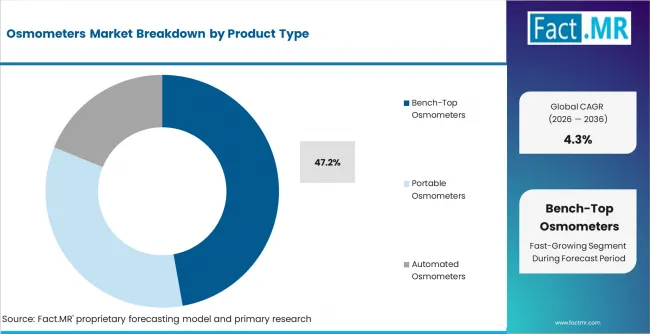
Bench-Top Osmometers are expected to hold 47.2% share in 2026 as hospitals and pharmaceutical laboratories prefer fixed systems for daily testing. These instruments helps labs maintain calibration control and steady workflow better than portable units.
- Bench-Top System Preference: High-volume laboratories favors bench-top osmometers for routine clinical testing and pharmaceutical market. Stable performance and calibration reliability support adoption.
- Portable Osmometer Growth: Portable systems are gaining traction across decentralized testing and food quality applications. Improved portability and testing accuracy are supporting market growth.
- Labcorp Expands New York Network with SOMOS Partnership: Labcorp has entered a multi-year agreement with SOMOS IPA to become the preferred laboratory provider across its physician network in New York. The partnership aims to improve access to affordable testing and integrate Labcorp services with community-based care and patient service centers. [4]
Osmometers Market Analysis by Application
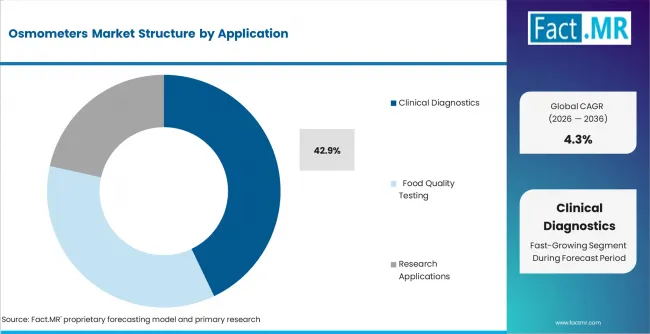
Clinical Diagnostics are projected to account for 42.9% share in 2026 because osmometers remain important tools for electrolyte imbalance and renal function testing in hospitals and diagnostic laboratories. Rising chronic disease cares are also increasing test demand.
- Renal Disorder Testing Growth: Hospitals are increasing osmolality testing across nephrology and electrolyte disorder diagnosis programs. Aging populations supports long-term clinical demand.
- Pharmaceutical Testing Expansion: Drug manufacturers are increasing osmolality testing during injectable formulation development and quality control procedures. Regulatory scrutiny is supporting higher testing frequency.
- Advanced Instruments to Merge with Nova Biomedical: Advanced Instruments has agreed to acquire and merge with Nova Biomedical in a $2.2 billion deal. The combined company will operate under the Nova Biomedical name and expand its analytical instruments and life sciences portfolio. [5]
Drivers, Restraints, and Opportunities

The osmometers market is growing steadily due to rising clinical testing demand and stricter pharmaceutical quality standards. Hospitals and diagnostic laboratories are increasing investment in automated testing systems to improve processing speed and workflow efficiency. Pharmaceutical manufacturers are also expanding osmometer usage across formulation development and quality control applications.
- Growing Clinical Testing Demand: Rising renal disorder and electrolyte imbalance testing volumes are increasing osmometer demand across hospitals and diagnostic laboratories. Aging populations are also supporting long-term testing growth.
- Automation Adoption: Clinical and pharmaceutical laboratories are replacing older single-sample instruments with multi-sample automated systems. Faster testing and lower manual work are increasing adoption.
- Pharmaceutical Quality Compliance: Stricter drug testing rules are increasing osmolality testing in sterile drug production and injectable formulation development. Quality control laboratories are installing more instruments to meet these requirements.
Regional Analysis
The osmometers market is assessed across North America, Europe, Asia Pacific, Latin America, and Middle East and Africa covering clinical laboratory infrastructure, pharmaceutical manufacturing activity, food testing regulation, and hospital instrument replacement cycles. The full report offers market attractiveness analysis by region and country.
.webp)
| Country | CAGR (2026 to 2036) |
|---|---|
| China | 6.8% |
| India | 6.5% |
| United States | 5.7% |
| Germany | 4.2% |
| Japan | 3.9% |
Source: Fact.MR (FACT.MR) analysis, based on proprietary forecasting model and primary research
Asia Pacific Osmometers Market Analysis
Asia Pacific is emerging as the fastest-growing osmometers market due to rapid hospital laboratory expansion and increasing pharmaceutical manufacturing activity across the region. Rising clinical diagnostics demand and stricter quality testing standards are encouraging higher adoption of automated osmometer systems in hospitals and pharmaceutical facilities.
- China: China is forecast to record 6.8% CAGR from 2026 to 2036 as healthcare infrastructure expands. County hospitals are increasing laboratory modernization activity and expanding routine osmolarity testing capacity. Pharmaceutical quality testing investment is also rising across domestic drug manufacturing facilities.
- India: India is anticipated to grow at 6.5% CAGR from 2026 to 2036 as pharmaceutical exports increase. Injectable drug manufacturers are increasing investment in osmolality testing systems to meet global regulatory quality standards. Clinical diagnostics infrastructure expansion is also supporting instrument adoption in hospitals and laboratories.
- Japan: Japan is expected to rise at 3.9% CAGR from 2026 to 2036 as older lab systems need replacement. Regional hospitals are gradually upgrading toward automated bench-top osmometers to improve workflow efficiency and testing accuracy. Pharmaceutical testing modernization is also supporting stable market demand.
FACT.MR’s Asia Pacific analysis covers China, India, Japan, South Korea, ASEAN, and Australia & New Zealand. Readers can find hospital laboratory instrument demand trends and pharmaceutical quality testing benchmarks across clinical and manufacturing applications.
North America Osmometers Market Analysis
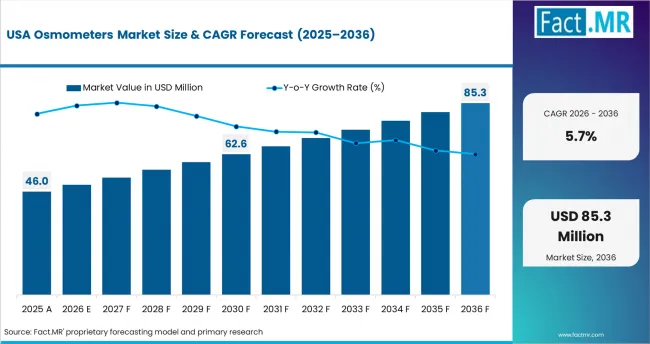
North America remains a high-value osmometers market supported by strong hospital laboratory networks and advanced pharmaceutical quality testing infrastructure. Healthcare providers across the region invests in automated laboratory systems to improve sample throughput and workflow efficiency.
- United States: High pharmaceutical quality testing activity is helping the United States maintain stable market expansion at 5.7% CAGR. Hospitals and pharmaceutical manufacturers are increasing osmometer installations to support rising clinical testing and injectable drug quality control requirements. Laboratory automation are supporting long-term demand.
FACT.MR’s North America analysis covers the United States, Canada, and Mexico. Readers can find pharmaceutical quality control trends and hospital laboratory instrument investment benchmarks across clinical diagnostic applications.
Europe Osmometers Market Analysis
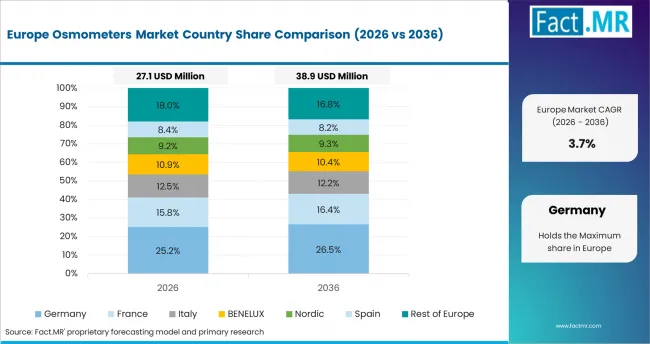
Europe represents a regulation-focused osmometers market comes from pharmaceutical quality standards and laboratory compliance requirements. Clinical laboratories and pharmaceutical manufacturers across the region are steadily modernizing testing infrastructure to improve workflow accuracy and regulatory compliance.
- Germany: Stricter pharmaceutical quality standards are supporting steady growth in Germany. The country is projected to record 4.2% CAGR from 2026 to 2036. Contract manufacturers and hospital laboratories are upgrading osmometer systems to improve testing precision and regulatory compliance. Laboratory automation investment is also increasing across pharmaceutical production facilities.
FACT.MR’s Europe analysis covers Germany, United Kingdom, France, Italy, Spain, BENELUX, Nordic Countries, and Rest of Europe. Readers can find EU IVDR compliance instrument demand trends and pharmaceutical quality control benchmarks across clinical and manufacturing markets.
Competitive Aligners for Market Players
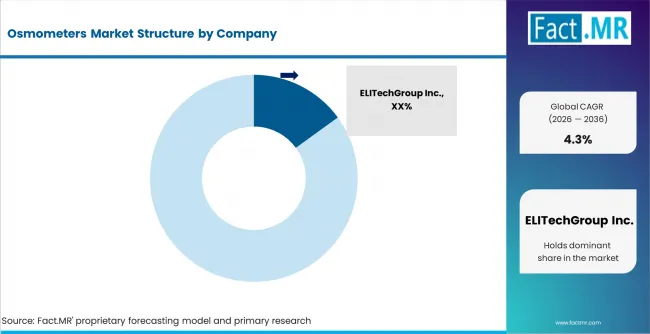
The osmometers market is becoming more competitive as hospitals and diagnostic laboratories invest in automated testing systems. Pharmaceutical manufacturers are also increasing installations for quality control. Companies are focusing on faster sample processing and stronger laboratory integration capabilities to improve long-term market positioning.
Multi-sample and automated osmometers are gaining demand because high-volume labs need quicker results and less manual work. Instrument makers with reliable calibration systems and steady reagent supply are gaining an edge with hospital and pharmaceutical clients.
Service support is also becoming an important competitive factor. Clinical labs prefer suppliers that offer maintenance contracts, training, and quick spare part support. Companies with wide service networks in China, India, and the United States can benefit from rising replacement demand. Pharmaceutical quality control is creating more growth opportunities. Drug manufacturers are testing injectable and sterile products more often. Suppliers with automated systems and better lab connectivity can build long-term revenue through reagent supply and service agreements.
Key Players Osmometers Market
- ELITechGroup Inc.
- Precision Systems Inc.
- ARKRAY Inc.
- Nova Biomedical
- ASTORI TECNICA
- KNAUER Wissenschaftliche Gerate GmbH
Bibliography
- Advanced Instruments. (2025). Advanced Instruments Releases the OsmoPRO® MAX Automated Osmometer.
- Bruker Corporation. (2024). Bruker announces share purchase agreement to acquire molecular diagnostics innovator ELITechGroup. Bruker Corporation.
- Labcorp. (2026). Labcorp and Epic expand collaboration to advance diagnostic integration across hospitals and health systems.
- Labcorp. (2026). Labcorp announces multi-year partnership with SOMOS IPA to expand access to high quality, affordable laboratory services for patients across New York State. Labcorp.
- Advanced Instruments. (2025). Advanced Instruments to acquire and merge with Nova Biomedical.
This Report Addresses
- Strategic intelligence covering osmometer demand across clinical diagnostics, pharmaceutical quality control, food testing, and research laboratory applications.
- Market forecast from USD 109 million in 2026 to USD 166 million by 2036 at 4.3% CAGR generating USD 57 million in absolute dollar opportunity during the forecast period.
- Growth opportunity analysis across China hospital laboratory expansion and US pharmaceutical osmolality testing compliance investment.
- Segment analysis across type, sampling capacity, end use, product type, and application with 2026 share benchmarks.
- Regional outlook covering Asia Pacific hospital laboratory instrument demand and North America pharmaceutical quality control investment trends.
- Competitive analysis of ELITechGroup Inc., Precision Systems Inc., ARKRAY Inc., and Nova Biomedical.
- Regulatory analysis covering EU IVDR instrument certification timelines, USP osmolality testing updates, and China hospital laboratory equipment standards.
- Report delivery in PDF and Excel formats supported by clinical test volume benchmarks, instrument placement data, and interviews with laboratory managers and pharmaceutical quality specialists.
Osmometers Market Definition
The osmometers market covers precision instruments used to measure the osmolality or osmolarity of biological fluids and chemical solutions. Clinical laboratories use osmometers to assess patient hydration status and detect electrolyte disorders across renal and critical care settings. Pharmaceutical manufacturers rely on osmometers for formulation quality control. Food and feed testing laboratories use these instruments to verify product concentration and shelf stability.
Osmometers Market Inclusions
The study covers global and regional forecasts from 2026 to 2036 across type, sampling capacity, end use, product type, and application. It includes freezing point, vapour pressure, and membrane osmometers across single-sample and multi-sample configurations used at hospitals, diagnostic centers, pharmaceutical facilities, and food testing laboratories.
Osmometers Market Exclusions
The study excludes refractometers and conductivity meters used as indirect osmolality estimation tools. It omits pathology instruments not designed for direct osmolality measurement. Osmometer consumables such as standards and cleaning solutions are excluded unless bundled as instrument system sales.
Osmometers Market Research Methodology
- Primary Research
- Primary research includes interviews with clinical laboratory managers, pharmaceutical quality control directors, and diagnostic instrument specialists. Hospital teams and research laboratory directors across the United States, Germany, and China were included.
- Desk Research
- Desk research uses public disclosures from ELITechGroup Inc., and KNAUER Wissenschaftliche Gerate GmbH. FDA laboratory instrument registrations and EU in-vitro diagnostic regulation updates from 2024 and 2025 were reviewed.
- Market-Sizing and Forecasting
- Market sizing applies a hybrid top-down and bottom-up model. Clinical osmolarity test volume data, pharmaceutical laboratory instrument placement benchmarks, and hospital activity form the core forecast inputs.
- Data Validation and Update Cycle
- Data validation uses instrument revenue disclosures and laboratory test volume benchmarks from 2024 and 2025 company filings. Findings are cross-checked with clinical laboratory managers and pharmaceutical quality control specialists.
Scope of the Report

| Attribute | Details |
|---|---|
| Quantitative Units | USD 109 million (2026) to USD 166 million (2036), at a CAGR of 4.3% |
| Market Definition | Precision laboratory instruments that measure osmolality or osmolarity of biological fluids and chemical solutions across clinical diagnostics, pharmaceutical quality control, and food testing applications globally. |
| Type Segmentation | Freezing Point Osmometers, Vapour Pressure Osmometers, Membrane Osmometers |
| Sampling Capacity Segmentation | Single-Sample, Multi-Sample |
| End Use Segmentation | Hospitals, Laboratory and Diagnostics Centers, Healthcare Companies, Contract Research Organizations, Contract Manufacturing Organizations, Food and Feed Industries, Others |
| Product Type Segmentation | Bench-Top Osmometers, Portable Osmometers, Automated Osmometers |
| Application Segmentation | Clinical Diagnostics, Pharmaceutical and Biotechnology Testing, Food Quality Testing, Research Applications |
| Regions Covered | North America, Europe, Asia Pacific, Latin America, Middle East and Africa |
| Countries Covered | United States, Germany, China, India, Japan, South Korea, and Rest of World |
| Key Companies Profiled | ELITechGroup Inc., Precision Systems Inc., ARKRAY Inc., Nova Biomedical, ASTORI TECNICA, KNAUER Wissenschaftliche Gerate GmbH |
| Forecast Period | 2026 to 2036 |
| Approach | Hybrid top-down and bottom-up model using clinical osmolarity test volume data, pharmaceutical laboratory instrument placement benchmarks, hospital activity disclosures, and primary interviews with laboratory managers and pharmaceutical quality directors. |
Osmometers Market by Segments
-
By Type
- Freezing Point (FP) Osmometers
- Vapour Pressure Osmometers
- Membrane Osmometers
-
By Sampling Capacity
- Single-Sample
- Multi-Sample
-
By End Use
- Hospitals
- Laboratory and Diagnostics Centers
- Healthcare Companies
- Contract Research Organizations
- Contract Manufacturing Organizations
- Food and Feed Industries
- Others
-
By Product Type
- Bench-Top Osmometers
- Portable Osmometers
- Automated Osmometers
-
By Application
- Clinical Diagnostics
- Pharmaceutical and Biotechnology Testing
- Food Quality Testing
- Research Applications
-
By Region
- North America
- United States
- Canada
- Mexico
- Latin America
- Brazil
- Argentina
- Rest of Latin America
- Western Europe
- Germany
- United Kingdom
- France
- Italy
- Spain
- Nordic Countries
- BENELUX
- Rest of Western Europe
- East Asia
- China
- Japan
- South Korea
- South Asia and Pacific
- India
- ASEAN
- Australia and New Zealand
- Rest of South Asia and Pacific
- Middle East and Africa
- Saudi Arabia
- UAE
- South Africa
- Rest of Middle East and Africa
- North America
- Frequently Asked Questions -
How large is the global osmometers market in 2025?
The global osmometers market was valued at USD 104 million in 2025 supported by rising clinical osmolarity testing demand.
What will the osmometers market size be in 2026?
Based on Fact.MR analysis, demand for osmometers is estimated to reach USD 109 million in 2026.
What is the projected osmometers market size by 2036?
The osmometers market is projected to reach USD 166 million by 2036 generating USD 62 million in absolute dollar opportunity over the forecast period.
What is the expected CAGR for the osmometers market from 2026 to 2036?
FACT.MR projects a CAGR of 4.3% for the osmometers market during the 2026 to 2036 forecast period.
Which osmometer type leads the market in 2026?
Freezing Point Osmometers lead with 54.8% share in 2026 due to high adoption across clinical diagnostics and pharmaceutical testing applications.
Which sampling capacity segment holds the largest share?
Multi-Sample Osmometers account for 61.4% share in 2026 as high-throughput laboratories prefer faster sample processing systems.
Which country shows the fastest growth in the osmometers market?
China leads at 6.8% CAGR through 2036 driven by hospital laboratory expansion and pharmaceutical quality testing investment.
Which end use segment generates the highest osmometer demand?
Laboratory and Diagnostics Centers hold 38.6% share in 2026 driven by rising osmolarity testing volumes across clinical settings.
Table of Content
- Executive Summary
- Global Market Outlook
- Demand to side Trends
- Supply to side Trends
- Technology Roadmap Analysis
- Analysis and Recommendations
- Market Overview
- Market Coverage / Taxonomy
- Market Definition / Scope / Limitations
- Research Methodology
- Chapter Orientation
- Analytical Lens and Working Hypotheses
- Market Structure, Signals, and Trend Drivers
- Benchmarking and Cross-market Comparability
- Market Sizing, Forecasting, and Opportunity Mapping
- Research Design and Evidence Framework
- Desk Research Programme (Secondary Evidence)
- Company Annual and Sustainability Reports
- Peer-reviewed Journals and Academic Literature
- Corporate Websites, Product Literature, and Technical Notes
- Earnings Decks and Investor Briefings
- Statutory Filings and Regulatory Disclosures
- Technical White Papers and Standards Notes
- Trade Journals, Industry Magazines, and Analyst Briefs
- Conference Proceedings, Webinars, and Seminar Materials
- Government Statistics Portals and Public Data Releases
- Press Releases and Reputable Media Coverage
- Specialist Newsletters and Curated Briefings
- Sector Databases and Reference Repositories
- Fact.MR Internal Proprietary Databases and Historical Market Datasets
- Subscription Datasets and Paid Sources
- Social Channels, Communities, and Digital Listening Inputs
- Additional Desk Sources
- Expert Input and Fieldwork (Primary Evidence)
- Primary Modes
- Qualitative Interviews and Expert Elicitation
- Quantitative Surveys and Structured Data Capture
- Blended Approach
- Why Primary Evidence is Used
- Field Techniques
- Interviews
- Surveys
- Focus Groups
- Observational and In-context Research
- Social and Community Interactions
- Stakeholder Universe Engaged
- C-suite Leaders
- Board Members
- Presidents and Vice Presidents
- R&D and Innovation Heads
- Technical Specialists
- Domain Subject-matter Experts
- Scientists
- Physicians and Other Healthcare Professionals
- Governance, Ethics, and Data Stewardship
- Research Ethics
- Data Integrity and Handling
- Primary Modes
- Tooling, Models, and Reference Databases
- Desk Research Programme (Secondary Evidence)
- Data Engineering and Model Build
- Data Acquisition and Ingestion
- Cleaning, Normalisation, and Verification
- Synthesis, Triangulation, and Analysis
- Quality Assurance and Audit Trail
- Market Background
- Market Dynamics
- Drivers
- Restraints
- Opportunity
- Trends
- Scenario Forecast
- Demand in Optimistic Scenario
- Demand in Likely Scenario
- Demand in Conservative Scenario
- Opportunity Map Analysis
- Product Life Cycle Analysis
- Supply Chain Analysis
- Investment Feasibility Matrix
- Value Chain Analysis
- PESTLE and Porter’s Analysis
- Regulatory Landscape
- Regional Parent Market Outlook
- Production and Consumption Statistics
- Import and Export Statistics
- Market Dynamics
- Global Market Analysis 2021 to 2025 and Forecast, 2026 to 2036
- Historical Market Size Value (USD Million) Analysis, 2021 to 2025
- Current and Future Market Size Value (USD Million) Projections, 2026 to 2036
- Y to o to Y Growth Trend Analysis
- Absolute $ Opportunity Analysis
- Global Market Pricing Analysis 2021 to 2025 and Forecast 2026 to 2036
- Global Market Analysis 2021 to 2025 and Forecast 2026 to 2036, By Type
- Introduction / Key Findings
- Historical Market Size Value (USD Million) Analysis By Type , 2021 to 2025
- Current and Future Market Size Value (USD Million) Analysis and Forecast By Type , 2026 to 2036
- Freezing Point Osmometers
- Vapour Pressure Osmometers
- Membrane Osmometers
- Freezing Point Osmometers
- Y to o to Y Growth Trend Analysis By Type , 2021 to 2025
- Absolute $ Opportunity Analysis By Type , 2026 to 2036
- Global Market Analysis 2021 to 2025 and Forecast 2026 to 2036, By Sampling Capacity
- Introduction / Key Findings
- Historical Market Size Value (USD Million) Analysis By Sampling Capacity, 2021 to 2025
- Current and Future Market Size Value (USD Million) Analysis and Forecast By Sampling Capacity, 2026 to 2036
- Multi-Sample
- Single-Sample
- Multi-Sample
- Y to o to Y Growth Trend Analysis By Sampling Capacity, 2021 to 2025
- Absolute $ Opportunity Analysis By Sampling Capacity, 2026 to 2036
- Global Market Analysis 2021 to 2025 and Forecast 2026 to 2036, By End Use
- Introduction / Key Findings
- Historical Market Size Value (USD Million) Analysis By End Use, 2021 to 2025
- Current and Future Market Size Value (USD Million) Analysis and Forecast By End Use, 2026 to 2036
- Laboratory and Diagnostics Centers
- Hospitals
- Laboratory and Diagnostics Centers
- Y to o to Y Growth Trend Analysis By End Use, 2021 to 2025
- Absolute $ Opportunity Analysis By End Use, 2026 to 2036
- Global Market Analysis 2021 to 2025 and Forecast 2026 to 2036, By Product Type
- Introduction / Key Findings
- Historical Market Size Value (USD Million) Analysis By Product Type, 2021 to 2025
- Current and Future Market Size Value (USD Million) Analysis and Forecast By Product Type, 2026 to 2036
- Bench-Top Osmometers
- Portable Osmometers
- Automated Osmometers
- Bench-Top Osmometers
- Y to o to Y Growth Trend Analysis By Product Type, 2021 to 2025
- Absolute $ Opportunity Analysis By Product Type, 2026 to 2036
- Global Market Analysis 2021 to 2025 and Forecast 2026 to 2036, By Application
- Introduction / Key Findings
- Historical Market Size Value (USD Million) Analysis By Application, 2021 to 2025
- Current and Future Market Size Value (USD Million) Analysis and Forecast By Application, 2026 to 2036
- Clinical Diagnostics
- Food Quality Testing
- Research Applications
- Clinical Diagnostics
- Y to o to Y Growth Trend Analysis By Application, 2021 to 2025
- Absolute $ Opportunity Analysis By Application, 2026 to 2036
- Global Market Analysis 2021 to 2025 and Forecast 2026 to 2036, By Region
- Introduction
- Historical Market Size Value (USD Million) Analysis By Region, 2021 to 2025
- Current Market Size Value (USD Million) Analysis and Forecast By Region, 2026 to 2036
- North America
- Latin America
- Western Europe
- Eastern Europe
- East Asia
- South Asia and Pacific
- Middle East & Africa
- Market Attractiveness Analysis By Region
- North America Market Analysis 2021 to 2025 and Forecast 2026 to 2036, By Country
- Historical Market Size Value (USD Million) Trend Analysis By Market Taxonomy, 2021 to 2025
- Market Size Value (USD Million) Forecast By Market Taxonomy, 2026 to 2036
- By Country
- USA
- Canada
- Mexico
- By Type
- By Sampling Capacity
- By End Use
- By Product Type
- By Application
- By Country
- Market Attractiveness Analysis
- By Country
- By Type
- By Sampling Capacity
- By End Use
- By Product Type
- By Application
- Key Takeaways
- Latin America Market Analysis 2021 to 2025 and Forecast 2026 to 2036, By Country
- Historical Market Size Value (USD Million) Trend Analysis By Market Taxonomy, 2021 to 2025
- Market Size Value (USD Million) Forecast By Market Taxonomy, 2026 to 2036
- By Country
- Brazil
- Chile
- Rest of Latin America
- By Type
- By Sampling Capacity
- By End Use
- By Product Type
- By Application
- By Country
- Market Attractiveness Analysis
- By Country
- By Type
- By Sampling Capacity
- By End Use
- By Product Type
- By Application
- Key Takeaways
- Western Europe Market Analysis 2021 to 2025 and Forecast 2026 to 2036, By Country
- Historical Market Size Value (USD Million) Trend Analysis By Market Taxonomy, 2021 to 2025
- Market Size Value (USD Million) Forecast By Market Taxonomy, 2026 to 2036
- By Country
- Germany
- UK
- Italy
- Spain
- France
- Nordic
- BENELUX
- Rest of Western Europe
- By Type
- By Sampling Capacity
- By End Use
- By Product Type
- By Application
- By Country
- Market Attractiveness Analysis
- By Country
- By Type
- By Sampling Capacity
- By End Use
- By Product Type
- By Application
- Key Takeaways
- Eastern Europe Market Analysis 2021 to 2025 and Forecast 2026 to 2036, By Country
- Historical Market Size Value (USD Million) Trend Analysis By Market Taxonomy, 2021 to 2025
- Market Size Value (USD Million) Forecast By Market Taxonomy, 2026 to 2036
- By Country
- Russia
- Poland
- Hungary
- Balkan & Baltic
- Rest of Eastern Europe
- By Type
- By Sampling Capacity
- By End Use
- By Product Type
- By Application
- By Country
- Market Attractiveness Analysis
- By Country
- By Type
- By Sampling Capacity
- By End Use
- By Product Type
- By Application
- Key Takeaways
- East Asia Market Analysis 2021 to 2025 and Forecast 2026 to 2036, By Country
- Historical Market Size Value (USD Million) Trend Analysis By Market Taxonomy, 2021 to 2025
- Market Size Value (USD Million) Forecast By Market Taxonomy, 2026 to 2036
- By Country
- China
- Japan
- South Korea
- By Type
- By Sampling Capacity
- By End Use
- By Product Type
- By Application
- By Country
- Market Attractiveness Analysis
- By Country
- By Type
- By Sampling Capacity
- By End Use
- By Product Type
- By Application
- Key Takeaways
- South Asia and Pacific Market Analysis 2021 to 2025 and Forecast 2026 to 2036, By Country
- Historical Market Size Value (USD Million) Trend Analysis By Market Taxonomy, 2021 to 2025
- Market Size Value (USD Million) Forecast By Market Taxonomy, 2026 to 2036
- By Country
- India
- ASEAN
- Australia & New Zealand
- Rest of South Asia and Pacific
- By Type
- By Sampling Capacity
- By End Use
- By Product Type
- By Application
- By Country
- Market Attractiveness Analysis
- By Country
- By Type
- By Sampling Capacity
- By End Use
- By Product Type
- By Application
- Key Takeaways
- Middle East & Africa Market Analysis 2021 to 2025 and Forecast 2026 to 2036, By Country
- Historical Market Size Value (USD Million) Trend Analysis By Market Taxonomy, 2021 to 2025
- Market Size Value (USD Million) Forecast By Market Taxonomy, 2026 to 2036
- By Country
- Kingdom of Saudi Arabia
- Other GCC Countries
- Turkiye
- South Africa
- Other African Union
- Rest of Middle East & Africa
- By Type
- By Sampling Capacity
- By End Use
- By Product Type
- By Application
- By Country
- Market Attractiveness Analysis
- By Country
- By Type
- By Sampling Capacity
- By End Use
- By Product Type
- By Application
- Key Takeaways
- Key Countries Market Analysis
- USA
- Pricing Analysis
- Market Share Analysis, 2025
- By Type
- By Sampling Capacity
- By End Use
- By Product Type
- By Application
- Canada
- Pricing Analysis
- Market Share Analysis, 2025
- By Type
- By Sampling Capacity
- By End Use
- By Product Type
- By Application
- Mexico
- Pricing Analysis
- Market Share Analysis, 2025
- By Type
- By Sampling Capacity
- By End Use
- By Product Type
- By Application
- Brazil
- Pricing Analysis
- Market Share Analysis, 2025
- By Type
- By Sampling Capacity
- By End Use
- By Product Type
- By Application
- Chile
- Pricing Analysis
- Market Share Analysis, 2025
- By Type
- By Sampling Capacity
- By End Use
- By Product Type
- By Application
- Germany
- Pricing Analysis
- Market Share Analysis, 2025
- By Type
- By Sampling Capacity
- By End Use
- By Product Type
- By Application
- UK
- Pricing Analysis
- Market Share Analysis, 2025
- By Type
- By Sampling Capacity
- By End Use
- By Product Type
- By Application
- Italy
- Pricing Analysis
- Market Share Analysis, 2025
- By Type
- By Sampling Capacity
- By End Use
- By Product Type
- By Application
- Spain
- Pricing Analysis
- Market Share Analysis, 2025
- By Type
- By Sampling Capacity
- By End Use
- By Product Type
- By Application
- France
- Pricing Analysis
- Market Share Analysis, 2025
- By Type
- By Sampling Capacity
- By End Use
- By Product Type
- By Application
- India
- Pricing Analysis
- Market Share Analysis, 2025
- By Type
- By Sampling Capacity
- By End Use
- By Product Type
- By Application
- ASEAN
- Pricing Analysis
- Market Share Analysis, 2025
- By Type
- By Sampling Capacity
- By End Use
- By Product Type
- By Application
- Australia & New Zealand
- Pricing Analysis
- Market Share Analysis, 2025
- By Type
- By Sampling Capacity
- By End Use
- By Product Type
- By Application
- China
- Pricing Analysis
- Market Share Analysis, 2025
- By Type
- By Sampling Capacity
- By End Use
- By Product Type
- By Application
- Japan
- Pricing Analysis
- Market Share Analysis, 2025
- By Type
- By Sampling Capacity
- By End Use
- By Product Type
- By Application
- South Korea
- Pricing Analysis
- Market Share Analysis, 2025
- By Type
- By Sampling Capacity
- By End Use
- By Product Type
- By Application
- Russia
- Pricing Analysis
- Market Share Analysis, 2025
- By Type
- By Sampling Capacity
- By End Use
- By Product Type
- By Application
- Poland
- Pricing Analysis
- Market Share Analysis, 2025
- By Type
- By Sampling Capacity
- By End Use
- By Product Type
- By Application
- Hungary
- Pricing Analysis
- Market Share Analysis, 2025
- By Type
- By Sampling Capacity
- By End Use
- By Product Type
- By Application
- Kingdom of Saudi Arabia
- Pricing Analysis
- Market Share Analysis, 2025
- By Type
- By Sampling Capacity
- By End Use
- By Product Type
- By Application
- Turkiye
- Pricing Analysis
- Market Share Analysis, 2025
- By Type
- By Sampling Capacity
- By End Use
- By Product Type
- By Application
- South Africa
- Pricing Analysis
- Market Share Analysis, 2025
- By Type
- By Sampling Capacity
- By End Use
- By Product Type
- By Application
- USA
- Market Structure Analysis
- Competition Dashboard
- Competition Benchmarking
- Market Share Analysis of Top Players
- By Regional
- By Type
- By Sampling Capacity
- By End Use
- By Product Type
- By Application
- Competition Analysis
- Competition Deep Dive
- ELITechGroup Inc.
- Overview
- Product Portfolio
- Profitability by Market Segments (Product/Age /Sales Channel/Region)
- Sales Footprint
- Strategy Overview
- Marketing Strategy
- Product Strategy
- Channel Strategy
- Precision Systems Inc.
- ARKRAY Inc.
- Nova Biomedical
- ASTORI TECNICA
- KNAUER Wissenschaftliche Gerate GmbH
- ELITechGroup Inc.
- Competition Deep Dive
- Assumptions & Acronyms Used
List Of Table
- Table 1: Global Market Value (USD Million) Forecast by Region, 2021 to 2036
- Table 2: Global Market Value (USD Million) Forecast by Type, 2021 to 2036
- Table 3: Global Market Value (USD Million) Forecast by Sampling Capacity, 2021 to 2036
- Table 4: Global Market Value (USD Million) Forecast by End Use, 2021 to 2036
- Table 5: Global Market Value (USD Million) Forecast by Product Type, 2021 to 2036
- Table 6: Global Market Value (USD Million) Forecast by Application, 2021 to 2036
- Table 7: North America Market Value (USD Million) Forecast by Country, 2021 to 2036
- Table 8: North America Market Value (USD Million) Forecast by Type, 2021 to 2036
- Table 9: North America Market Value (USD Million) Forecast by Sampling Capacity, 2021 to 2036
- Table 10: North America Market Value (USD Million) Forecast by End Use, 2021 to 2036
- Table 11: North America Market Value (USD Million) Forecast by Product Type, 2021 to 2036
- Table 12: North America Market Value (USD Million) Forecast by Application, 2021 to 2036
- Table 13: Latin America Market Value (USD Million) Forecast by Country, 2021 to 2036
- Table 14: Latin America Market Value (USD Million) Forecast by Type, 2021 to 2036
- Table 15: Latin America Market Value (USD Million) Forecast by Sampling Capacity, 2021 to 2036
- Table 16: Latin America Market Value (USD Million) Forecast by End Use, 2021 to 2036
- Table 17: Latin America Market Value (USD Million) Forecast by Product Type, 2021 to 2036
- Table 18: Latin America Market Value (USD Million) Forecast by Application, 2021 to 2036
- Table 19: Western Europe Market Value (USD Million) Forecast by Country, 2021 to 2036
- Table 20: Western Europe Market Value (USD Million) Forecast by Type, 2021 to 2036
- Table 21: Western Europe Market Value (USD Million) Forecast by Sampling Capacity, 2021 to 2036
- Table 22: Western Europe Market Value (USD Million) Forecast by End Use, 2021 to 2036
- Table 23: Western Europe Market Value (USD Million) Forecast by Product Type, 2021 to 2036
- Table 24: Western Europe Market Value (USD Million) Forecast by Application, 2021 to 2036
- Table 25: Eastern Europe Market Value (USD Million) Forecast by Country, 2021 to 2036
- Table 26: Eastern Europe Market Value (USD Million) Forecast by Type, 2021 to 2036
- Table 27: Eastern Europe Market Value (USD Million) Forecast by Sampling Capacity, 2021 to 2036
- Table 28: Eastern Europe Market Value (USD Million) Forecast by End Use, 2021 to 2036
- Table 29: Eastern Europe Market Value (USD Million) Forecast by Product Type, 2021 to 2036
- Table 30: Eastern Europe Market Value (USD Million) Forecast by Application, 2021 to 2036
- Table 31: East Asia Market Value (USD Million) Forecast by Country, 2021 to 2036
- Table 32: East Asia Market Value (USD Million) Forecast by Type, 2021 to 2036
- Table 33: East Asia Market Value (USD Million) Forecast by Sampling Capacity, 2021 to 2036
- Table 34: East Asia Market Value (USD Million) Forecast by End Use, 2021 to 2036
- Table 35: East Asia Market Value (USD Million) Forecast by Product Type, 2021 to 2036
- Table 36: East Asia Market Value (USD Million) Forecast by Application, 2021 to 2036
- Table 37: South Asia and Pacific Market Value (USD Million) Forecast by Country, 2021 to 2036
- Table 38: South Asia and Pacific Market Value (USD Million) Forecast by Type, 2021 to 2036
- Table 39: South Asia and Pacific Market Value (USD Million) Forecast by Sampling Capacity, 2021 to 2036
- Table 40: South Asia and Pacific Market Value (USD Million) Forecast by End Use, 2021 to 2036
- Table 41: South Asia and Pacific Market Value (USD Million) Forecast by Product Type, 2021 to 2036
- Table 42: South Asia and Pacific Market Value (USD Million) Forecast by Application, 2021 to 2036
- Table 43: Middle East & Africa Market Value (USD Million) Forecast by Country, 2021 to 2036
- Table 44: Middle East & Africa Market Value (USD Million) Forecast by Type, 2021 to 2036
- Table 45: Middle East & Africa Market Value (USD Million) Forecast by Sampling Capacity, 2021 to 2036
- Table 46: Middle East & Africa Market Value (USD Million) Forecast by End Use, 2021 to 2036
- Table 47: Middle East & Africa Market Value (USD Million) Forecast by Product Type, 2021 to 2036
- Table 48: Middle East & Africa Market Value (USD Million) Forecast by Application, 2021 to 2036
List Of Figures
- Figure 1: Global Market Pricing Analysis
- Figure 2: Global Market Value (USD Million) Forecast 2021-2036
- Figure 3: Global Market Value Share and BPS Analysis by Type, 2026 and 2036
- Figure 4: Global Market Y-o-Y Growth Comparison by Type, 2026 to 2036
- Figure 5: Global Market Attractiveness Analysis by Type
- Figure 6: Global Market Value Share and BPS Analysis by Sampling Capacity, 2026 and 2036
- Figure 7: Global Market Y-o-Y Growth Comparison by Sampling Capacity, 2026 to 2036
- Figure 8: Global Market Attractiveness Analysis by Sampling Capacity
- Figure 9: Global Market Value Share and BPS Analysis by End Use, 2026 and 2036
- Figure 10: Global Market Y-o-Y Growth Comparison by End Use, 2026 to 2036
- Figure 11: Global Market Attractiveness Analysis by End Use
- Figure 12: Global Market Value Share and BPS Analysis by Product Type, 2026 and 2036
- Figure 13: Global Market Y-o-Y Growth Comparison by Product Type, 2026 to 2036
- Figure 14: Global Market Attractiveness Analysis by Product Type
- Figure 15: Global Market Value Share and BPS Analysis by Application, 2026 and 2036
- Figure 16: Global Market Y-o-Y Growth Comparison by Application, 2026 to 2036
- Figure 17: Global Market Attractiveness Analysis by Application
- Figure 18: Global Market Value (USD Million) Share and BPS Analysis by Region, 2026 and 2036
- Figure 19: Global Market Y-o-Y Growth Comparison by Region, 2026 to 2036
- Figure 20: Global Market Attractiveness Analysis by Region
- Figure 21: North America Market Incremental Dollar Opportunity, 2026 to 2036
- Figure 22: Latin America Market Incremental Dollar Opportunity, 2026 to 2036
- Figure 23: Western Europe Market Incremental Dollar Opportunity, 2026 to 2036
- Figure 24: Eastern Europe Market Incremental Dollar Opportunity, 2026 to 2036
- Figure 25: East Asia Market Incremental Dollar Opportunity, 2026 to 2036
- Figure 26: South Asia and Pacific Market Incremental Dollar Opportunity, 2026 to 2036
- Figure 27: Middle East & Africa Market Incremental Dollar Opportunity, 2026 to 2036
- Figure 28: North America Market Value Share and BPS Analysis by Country, 2026 and 2036
- Figure 29: North America Market Value Share and BPS Analysis by Type, 2026 and 2036
- Figure 30: North America Market Y-o-Y Growth Comparison by Type, 2026 to 2036
- Figure 31: North America Market Attractiveness Analysis by Type
- Figure 32: North America Market Value Share and BPS Analysis by Sampling Capacity, 2026 and 2036
- Figure 33: North America Market Y-o-Y Growth Comparison by Sampling Capacity, 2026 to 2036
- Figure 34: North America Market Attractiveness Analysis by Sampling Capacity
- Figure 35: North America Market Value Share and BPS Analysis by End Use, 2026 and 2036
- Figure 36: North America Market Y-o-Y Growth Comparison by End Use, 2026 to 2036
- Figure 37: North America Market Attractiveness Analysis by End Use
- Figure 38: North America Market Value Share and BPS Analysis by Product Type, 2026 and 2036
- Figure 39: North America Market Y-o-Y Growth Comparison by Product Type, 2026 to 2036
- Figure 40: North America Market Attractiveness Analysis by Product Type
- Figure 41: North America Market Value Share and BPS Analysis by Application, 2026 and 2036
- Figure 42: North America Market Y-o-Y Growth Comparison by Application, 2026 to 2036
- Figure 43: North America Market Attractiveness Analysis by Application
- Figure 44: Latin America Market Value Share and BPS Analysis by Country, 2026 and 2036
- Figure 45: Latin America Market Value Share and BPS Analysis by Type, 2026 and 2036
- Figure 46: Latin America Market Y-o-Y Growth Comparison by Type, 2026 to 2036
- Figure 47: Latin America Market Attractiveness Analysis by Type
- Figure 48: Latin America Market Value Share and BPS Analysis by Sampling Capacity, 2026 and 2036
- Figure 49: Latin America Market Y-o-Y Growth Comparison by Sampling Capacity, 2026 to 2036
- Figure 50: Latin America Market Attractiveness Analysis by Sampling Capacity
- Figure 51: Latin America Market Value Share and BPS Analysis by End Use, 2026 and 2036
- Figure 52: Latin America Market Y-o-Y Growth Comparison by End Use, 2026 to 2036
- Figure 53: Latin America Market Attractiveness Analysis by End Use
- Figure 54: Latin America Market Value Share and BPS Analysis by Product Type, 2026 and 2036
- Figure 55: Latin America Market Y-o-Y Growth Comparison by Product Type, 2026 to 2036
- Figure 56: Latin America Market Attractiveness Analysis by Product Type
- Figure 57: Latin America Market Value Share and BPS Analysis by Application, 2026 and 2036
- Figure 58: Latin America Market Y-o-Y Growth Comparison by Application, 2026 to 2036
- Figure 59: Latin America Market Attractiveness Analysis by Application
- Figure 60: Western Europe Market Value Share and BPS Analysis by Country, 2026 and 2036
- Figure 61: Western Europe Market Value Share and BPS Analysis by Type, 2026 and 2036
- Figure 62: Western Europe Market Y-o-Y Growth Comparison by Type, 2026 to 2036
- Figure 63: Western Europe Market Attractiveness Analysis by Type
- Figure 64: Western Europe Market Value Share and BPS Analysis by Sampling Capacity, 2026 and 2036
- Figure 65: Western Europe Market Y-o-Y Growth Comparison by Sampling Capacity, 2026 to 2036
- Figure 66: Western Europe Market Attractiveness Analysis by Sampling Capacity
- Figure 67: Western Europe Market Value Share and BPS Analysis by End Use, 2026 and 2036
- Figure 68: Western Europe Market Y-o-Y Growth Comparison by End Use, 2026 to 2036
- Figure 69: Western Europe Market Attractiveness Analysis by End Use
- Figure 70: Western Europe Market Value Share and BPS Analysis by Product Type, 2026 and 2036
- Figure 71: Western Europe Market Y-o-Y Growth Comparison by Product Type, 2026 to 2036
- Figure 72: Western Europe Market Attractiveness Analysis by Product Type
- Figure 73: Western Europe Market Value Share and BPS Analysis by Application, 2026 and 2036
- Figure 74: Western Europe Market Y-o-Y Growth Comparison by Application, 2026 to 2036
- Figure 75: Western Europe Market Attractiveness Analysis by Application
- Figure 76: Eastern Europe Market Value Share and BPS Analysis by Country, 2026 and 2036
- Figure 77: Eastern Europe Market Value Share and BPS Analysis by Type, 2026 and 2036
- Figure 78: Eastern Europe Market Y-o-Y Growth Comparison by Type, 2026 to 2036
- Figure 79: Eastern Europe Market Attractiveness Analysis by Type
- Figure 80: Eastern Europe Market Value Share and BPS Analysis by Sampling Capacity, 2026 and 2036
- Figure 81: Eastern Europe Market Y-o-Y Growth Comparison by Sampling Capacity, 2026 to 2036
- Figure 82: Eastern Europe Market Attractiveness Analysis by Sampling Capacity
- Figure 83: Eastern Europe Market Value Share and BPS Analysis by End Use, 2026 and 2036
- Figure 84: Eastern Europe Market Y-o-Y Growth Comparison by End Use, 2026 to 2036
- Figure 85: Eastern Europe Market Attractiveness Analysis by End Use
- Figure 86: Eastern Europe Market Value Share and BPS Analysis by Product Type, 2026 and 2036
- Figure 87: Eastern Europe Market Y-o-Y Growth Comparison by Product Type, 2026 to 2036
- Figure 88: Eastern Europe Market Attractiveness Analysis by Product Type
- Figure 89: Eastern Europe Market Value Share and BPS Analysis by Application, 2026 and 2036
- Figure 90: Eastern Europe Market Y-o-Y Growth Comparison by Application, 2026 to 2036
- Figure 91: Eastern Europe Market Attractiveness Analysis by Application
- Figure 92: East Asia Market Value Share and BPS Analysis by Country, 2026 and 2036
- Figure 93: East Asia Market Value Share and BPS Analysis by Type, 2026 and 2036
- Figure 94: East Asia Market Y-o-Y Growth Comparison by Type, 2026 to 2036
- Figure 95: East Asia Market Attractiveness Analysis by Type
- Figure 96: East Asia Market Value Share and BPS Analysis by Sampling Capacity, 2026 and 2036
- Figure 97: East Asia Market Y-o-Y Growth Comparison by Sampling Capacity, 2026 to 2036
- Figure 98: East Asia Market Attractiveness Analysis by Sampling Capacity
- Figure 99: East Asia Market Value Share and BPS Analysis by End Use, 2026 and 2036
- Figure 100: East Asia Market Y-o-Y Growth Comparison by End Use, 2026 to 2036
- Figure 101: East Asia Market Attractiveness Analysis by End Use
- Figure 102: East Asia Market Value Share and BPS Analysis by Product Type, 2026 and 2036
- Figure 103: East Asia Market Y-o-Y Growth Comparison by Product Type, 2026 to 2036
- Figure 104: East Asia Market Attractiveness Analysis by Product Type
- Figure 105: East Asia Market Value Share and BPS Analysis by Application, 2026 and 2036
- Figure 106: East Asia Market Y-o-Y Growth Comparison by Application, 2026 to 2036
- Figure 107: East Asia Market Attractiveness Analysis by Application
- Figure 108: South Asia and Pacific Market Value Share and BPS Analysis by Country, 2026 and 2036
- Figure 109: South Asia and Pacific Market Value Share and BPS Analysis by Type, 2026 and 2036
- Figure 110: South Asia and Pacific Market Y-o-Y Growth Comparison by Type, 2026 to 2036
- Figure 111: South Asia and Pacific Market Attractiveness Analysis by Type
- Figure 112: South Asia and Pacific Market Value Share and BPS Analysis by Sampling Capacity, 2026 and 2036
- Figure 113: South Asia and Pacific Market Y-o-Y Growth Comparison by Sampling Capacity, 2026 to 2036
- Figure 114: South Asia and Pacific Market Attractiveness Analysis by Sampling Capacity
- Figure 115: South Asia and Pacific Market Value Share and BPS Analysis by End Use, 2026 and 2036
- Figure 116: South Asia and Pacific Market Y-o-Y Growth Comparison by End Use, 2026 to 2036
- Figure 117: South Asia and Pacific Market Attractiveness Analysis by End Use
- Figure 118: South Asia and Pacific Market Value Share and BPS Analysis by Product Type, 2026 and 2036
- Figure 119: South Asia and Pacific Market Y-o-Y Growth Comparison by Product Type, 2026 to 2036
- Figure 120: South Asia and Pacific Market Attractiveness Analysis by Product Type
- Figure 121: South Asia and Pacific Market Value Share and BPS Analysis by Application, 2026 and 2036
- Figure 122: South Asia and Pacific Market Y-o-Y Growth Comparison by Application, 2026 to 2036
- Figure 123: South Asia and Pacific Market Attractiveness Analysis by Application
- Figure 124: Middle East & Africa Market Value Share and BPS Analysis by Country, 2026 and 2036
- Figure 125: Middle East & Africa Market Value Share and BPS Analysis by Type, 2026 and 2036
- Figure 126: Middle East & Africa Market Y-o-Y Growth Comparison by Type, 2026 to 2036
- Figure 127: Middle East & Africa Market Attractiveness Analysis by Type
- Figure 128: Middle East & Africa Market Value Share and BPS Analysis by Sampling Capacity, 2026 and 2036
- Figure 129: Middle East & Africa Market Y-o-Y Growth Comparison by Sampling Capacity, 2026 to 2036
- Figure 130: Middle East & Africa Market Attractiveness Analysis by Sampling Capacity
- Figure 131: Middle East & Africa Market Value Share and BPS Analysis by End Use, 2026 and 2036
- Figure 132: Middle East & Africa Market Y-o-Y Growth Comparison by End Use, 2026 to 2036
- Figure 133: Middle East & Africa Market Attractiveness Analysis by End Use
- Figure 134: Middle East & Africa Market Value Share and BPS Analysis by Product Type, 2026 and 2036
- Figure 135: Middle East & Africa Market Y-o-Y Growth Comparison by Product Type, 2026 to 2036
- Figure 136: Middle East & Africa Market Attractiveness Analysis by Product Type
- Figure 137: Middle East & Africa Market Value Share and BPS Analysis by Application, 2026 and 2036
- Figure 138: Middle East & Africa Market Y-o-Y Growth Comparison by Application, 2026 to 2036
- Figure 139: Middle East & Africa Market Attractiveness Analysis by Application
- Figure 140: Global Market - Tier Structure Analysis
- Figure 141: Global Market - Company Share Analysis