- Market Value (2025): USD 4.0 Bn
- Estimated Value (2026): USD 4.6 Bn
- Forecast Value (2036): USD 17.9 Bn
- CAGR (2026-2036): 14.5%
What is the OT-IT Data Bridges Market forecast to be worth by 2036?
USD 4.6 billion in 2026 to USD 17.9 billion by 2036 at a 14.5% CAGR.
- The OT-IT Data Bridges Market reached USD 4.0 billion in 2025.
- Demand is projected to increase from USD 4.6 billion in 2026 to USD 17.9 billion by 2036.
- The market is forecast to record 14.5% CAGR from 2026 to 2036 as plants need governed routes from legacy controllers and historians into cloud analytics, AI workflows and enterprise decision systems.
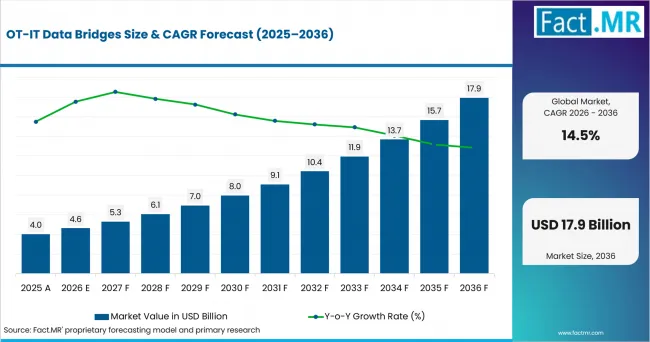
Ot It Data Bridges Value Analysis | Source: Fact.MR
What are the defining numbers behind OT-IT Data Bridges Market growth?
An absolute opportunity of USD 13.3 billion is expected between 2026 and 2036.
- Demand Drivers in the Market
- Modern OT estates are connected to enterprise and vendor services even when original designs assumed isolation. The UK NCSC issued definitive OT architecture guidance in September 2025 around this changed risk model.
- Factories need protocol normalization across long-lived equipment. PTC introduced Kepware Server in December 2025 as a unified Windows industrial connectivity platform supporting OPC UA and MQTT paths.
- Security programs are becoming sector-specific. Japan's METI released OT Security Guidelines for Semiconductor Device Factories in October 2025.
- Key Segments Analyzed
- Industrial edge gateways represent 31.0% of Bridge Type demand in 2026. Industrial edge gateways lead because they can terminate plant protocols, perform local buffering and expose governed northbound interfaces in one deployable appliance or software node.
- PLC and DCS account for 34.0% of the 2026 Source System mix. PLC and DCS systems contribute the largest share because they hold the live state of production and process assets.
- Cloud data platforms hold 32.0% of Destination demand in 2026. Cloud data platforms lead as manufacturers centralize cross-site analytics, model training and enterprise reporting.
- Firewall-segmented gateway accounts for 32.0% of Security Model demand in 2026. Firewall-segmented gateways lead because segmentation is a familiar, supportable control across most industrial estates.
- Analyst Opinion at Fact.MR
- Shambhu Nath Jha, Principal Consultant at Fact.MR, states, “An OT-IT bridge earns trust by limiting what crosses the boundary and by failing safely when a link or certificate breaks. Protocol count is useful, but context, buffering and security operations decide whether the deployment survives beyond a pilot. Vendors should prove how their product behaves during outages, upgrades and incident response.”
- Strategic Implications
- Connectivity vendors should publish supported protocol versions and migration paths. PTC's December 2025 release unified KEPServerEX and ThingWorx Kepware Server under the Kepware Server name, giving customers a clear lifecycle transition.
- Industrial software suppliers should connect edge collection with governed historian and cloud models. AVEVA positions CONNECT as an open cloud platform for industrial information, while Historian retains high-fidelity process and event history.
- MQTT specialists should package Sparkplug topic governance, certificates and store-and-forward behavior as operating controls. HiveMQ's industrial offering emphasizes MQTT Sparkplug interoperability across devices and applications.
Germany is projected at 17.3% CAGR through 2036 as interoperable manufacturing programs meet a large installed machine base. Architecture-led security upgrades support 15.9% in the UK, while France reaches 15.0% through controlled modernization in industry and infrastructure. The USA records 13.8% from a broad mixed-generation estate and Japan 12.9% under a cautious, sector-specific security approach.
How does the OT-IT Data Bridges Market break down by segment?
Industrial edge gateways, PLC and DCS, Cloud data platforms, and Firewall-segmented gateway
Which Bridge Type carries the largest share?
Industrial edge gateways: 31.0% share in 2026.
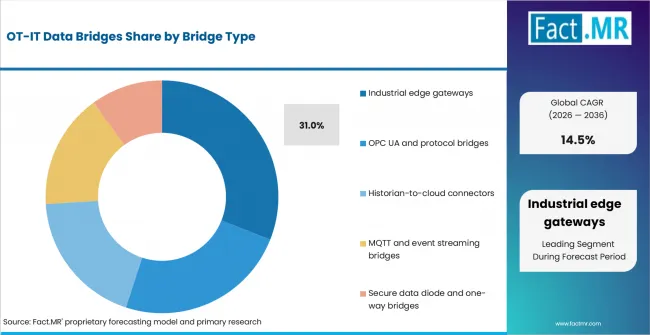
Ot It Data Bridges Analysis By Bridge Type | Source: Fact.MR
Industrial edge gateways lead because they can terminate plant protocols, perform local buffering and expose governed northbound interfaces in one deployable appliance or software node. That combination reduces custom integration at each machine cell.
Why do PLC and DCS sources lead?
PLC and DCS: 34.0% share in 2026.
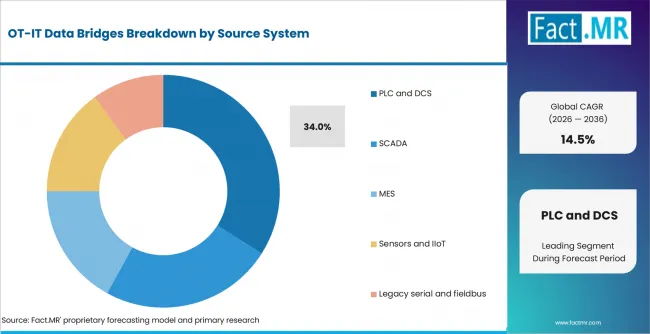
Ot It Data Bridges Analysis By Source System | Source: Fact.MR
PLC and DCS systems contribute the largest share because they hold the live state of production and process assets. Their deterministic operation and long service lives make non-invasive collection a central requirement for bridge design.
Which Destination leads bridge demand?
Firewall-segmented gateway: 32.0% share in 2026.
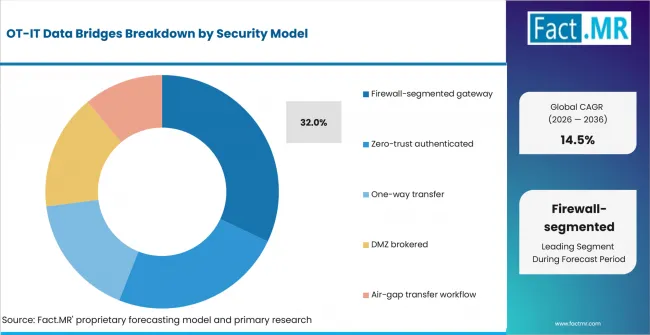
Ot It Data Bridges Analysis By Security Model | Source: Fact.MR
Cloud data platforms lead as manufacturers centralize cross-site analytics, model training and enterprise reporting. Gateways that compress, contextualize and queue events help plants use cloud services without making control dependent on a wide-area connection.
What keeps Firewall-segmented gateways in front?
Cloud data platforms: 32.0% share in 2026.
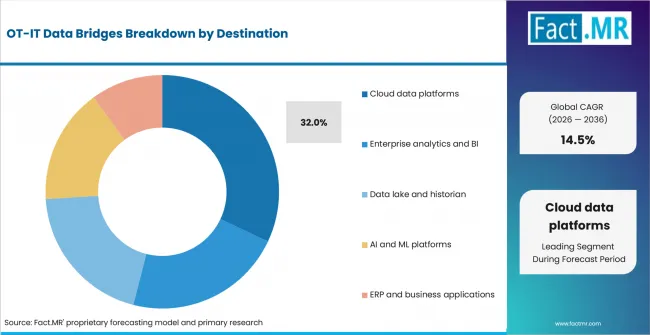
Ot It Data Bridges Analysis By Destination | Source: Fact.MR
Firewall-segmented gateways lead because segmentation is a familiar, supportable control across most industrial estates. It allows explicit ports and flows while accommodating two-way tasks such as certificate renewal or approved configuration exchange.
What is accelerating OT-IT Data Bridges Market adoption, and what is holding it back?
Adoption is accelerating as plants move maintenance, energy and production information into shared analytics. Growth is constrained by protocol sprawl, cybersecurity accountability and the risk that a poorly designed bridge can disturb a safety-critical control environment.
Drivers Impact Analysis
| DRIVER | (~) % IMPACT ON CAGR | GEOGRAPHIC RELEVANCE | IMPACT TIMELINE |
|---|---|---|---|
| Cloud analytics for plant information | +1.9% | USA, Germany, UK, France | Short term (<= 2 years) |
| Legacy protocol normalization | +1.4% | Global manufacturing | Medium term (2-4 years) |
| Formal OT network segmentation | +1.1% | Europe, USA, Japan | Medium term (2-4 years) |
| Industrial AI context pipelines | +0.8% | USA, Germany, Japan | Long term (>= 4 years) |
- Cloud analytics for plant information: Maintenance and operations teams need a controlled route for historian, alarm and equipment events to reach shared platforms.
- Legacy protocol normalization: Gateways turn vendor-specific tags and serial links into stable OPC UA or MQTT interfaces without replacing functioning controllers.
- Formal OT network segmentation: Architecture guidance converts unmanaged connections into budgeted DMZ, firewall, identity and monitoring projects.
Opportunity Impact Analysis
| OPPORTUNITY | (~) % IMPACT ON CAGR | GEOGRAPHIC RELEVANCE | IMPACT TIMELINE |
|---|---|---|---|
| One-way transfer for critical sites | +1.0% | Japan, France, USA | Short term (<= 2 years) |
| Managed gateway fleets across plants | +0.9% | North America, Europe | Medium term (2-4 years) |
| Contextualized event streams for AI | +0.7% | Germany, USA, UK | Long term (>= 4 years) |
- One-way transfer for critical sites: Data diodes and controlled export workflows can unlock analytics where two-way connectivity is not acceptable.
- Managed gateway fleets across plants: Central certificate, configuration and software lifecycle services create recurring value after the first integration.
- Contextualized event streams for AI: Vendors can move beyond raw tags by attaching asset hierarchy, units, quality and event meaning before information reaches a model.
Restraints Impact Analysis
| RESTRAINT | (~) % IMPACT ON CAGR | GEOGRAPHIC RELEVANCE | IMPACT TIMELINE |
|---|---|---|---|
| Protocol and tag inconsistency | -0.9% | Global | Short term (<= 2 years) |
| Cybersecurity ownership across OT and IT | -0.8% | Global | Medium term (2-4 years) |
| Production interruption risk | -0.6% | Process and regulated industries | Long term (>= 4 years) |
- Protocol and tag inconsistency: Two machines using the same driver can expose different names, units and update behavior, raising engineering effort.
- Cybersecurity ownership across OT and IT: Projects stall when no team owns certificates, patch windows, firewall rules and incident response for the bridge.
- Production interruption risk: Plants defer integration if testing cannot prove that gateway overload or network failure leaves control traffic unaffected.
Which countries are scaling the OT-IT Data Bridges Market through 2036?
- Germany treats interoperability as an industrial ecosystem issue, expanding bridge demand beyond individual plant dashboards.
- The UK creates a strong governance trigger by acknowledging cloud and remote-vendor connections in mainstream OT guidance.
- France favors use-case-led deployment, with each new information flow expected to pass infrastructure assurance review.
- The USA offers scale across many control vintages, rewarding broad drivers and integrator coverage.
- Japan prioritizes controlled transfer and lifecycle stability, which supports secure bridges but lengthens approval cycles.
Protocol age, plant criticality, cybersecurity governance and cloud policy produce different adoption paths by country. Coverage also extends to North America, Latin America, Western Europe, Eastern Europe, East Asia, South Asia & Pacific, Middle East & Africa.
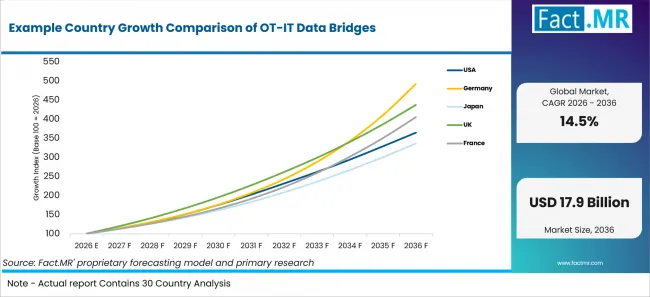
Example Country Growth Comparison Of Ot It Data Bridges | Source: Fact.MR
| Country | CAGR (2026-2036) |
|---|---|
| USA | 13.8% |
| Germany | 17.3% |
| Japan | 12.9% |
| UK | 15.9% |
| France | 15.0% |
What sustains the USA bridge market?
13.8% CAGR, supported by a broad installed base of mixed-generation control systems.
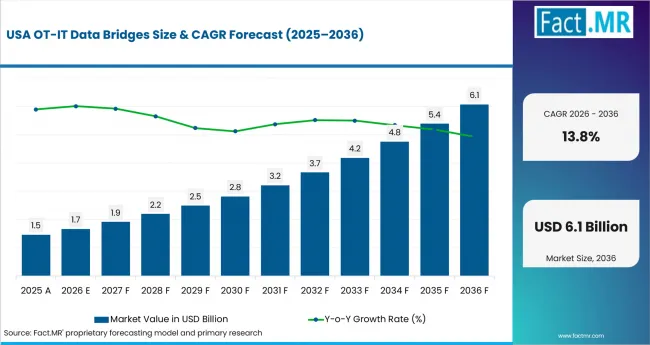
Ot It Data Bridges Country Value Analysis | Source: Fact.MR
U.S. plants often need to connect decades of PLC, DCS and historian investment with cloud analytics without disturbing validated control. NIST SP 800-82 Rev. 3 gives buyers a common framework for treating performance, reliability and safety alongside security. Projects therefore favor staged gateway deployments with protocol coverage, asset boundaries and rollback plans that operations teams can test during scheduled outages.
What is supporting Germany's 17.3% CAGR through 2036?
17.3% CAGR, driven by industrial digitalization and interoperable manufacturing programs.
Germany's manufacturing base creates a dense field of machine protocols and supplier-specific interfaces, so the bridge problem is both technical and organizational. Manufacturing-X and Industry 4.0 programs raise expectations for shared, governed operational information. Adoption is strongest where gateways preserve deterministic control locally while publishing normalized events to enterprise and partner workflows.
How does Japan approach OT-IT exchange?
12.9% CAGR, supported by factory modernization with a conservative security posture.
Japan is modernizing operational connectivity around established equipment that may remain in service for many years. METI issued OT Security Guidelines for Semiconductor Device Factories in October 2025, reinforcing sector-specific attention to cyber risk. One-way transfer, carefully brokered DMZ exchange and protocol translation gain traction where asset owners cannot accept direct cloud connectivity to production controllers.
What is moving the UK market forward?
15.9% CAGR, supported by explicit OT architecture guidance and remote-service needs.
The UK's NCSC stated in September 2025 that modern operational technology is no longer reliably air-gapped and increasingly connects with enterprise IT, cloud services and remote vendors. That reality turns informal point connections into an architecture program. Buyers need asset-aware gateways, authentication and monitored transfer paths that service teams can operate without weakening safety controls.
Where does France create demand?
15.0% CAGR, linked to industrial modernization and critical-infrastructure assurance.
France's market is influenced by industrial groups and infrastructure operators that require strong separation between control and business networks. Projects tend to begin with a defined use case, such as historian replication or maintenance analytics, and expand only after ANSSI-aligned security review. This favors modular bridges with clear protocol inventories and auditable flow control.
Who leads the OT-IT Data Bridges Market?
Kepware / PTC, Siemens, AVEVA (Schneider Electric), Rockwell Automation, HiveMQ and Litmus.
Kepware / PTC leads the bridge discussion through Kepware Server, a broad industrial connectivity platform for PLCs, devices and northbound OPC UA or MQTT exchange. Its installed driver base and integrator familiarity support brownfield projects.
Siemens participates through industrial edge, OPC UA, automation and data-space connectivity tied to its controller estate. The company is well positioned where buyers want supported paths from SIMATIC systems into plant and cloud applications.
AVEVA, a Schneider Electric company, combines historians, operations software and its CONNECT cloud platform. Rockwell Automation brings FactoryTalk and controller integration for plants standardizing around its automation architecture.
HiveMQ specializes in enterprise MQTT and Sparkplug messaging, while Litmus provides edge connectivity and industrial protocol normalization. These focused suppliers compete where customers want vendor-neutral event streams across heterogeneous equipment.
The market rewards protocol breadth only when it is paired with secure lifecycle operations. Certificate management, store-and-forward, observability and tested upgrade behavior create the durable differentiation.
Which companies are the key providers?
Key companies include Kepware / PTC; Siemens; AVEVA (Schneider Electric); Rockwell Automation; HiveMQ; Litmus.
- Kepware / PTC
- Siemens
- AVEVA (Schneider Electric)
- Rockwell Automation
- HiveMQ
- Litmus
Bibliography
- National Institute of Standards and Technology. (2023). Special Publication 800-82 Revision 3: Guide to Operational Technology Security.
- National Cyber Security Centre. (2025, September 29). Principles for operational technology architecture.
- Ministry of Economy, Trade and Industry, Japan. (2025, October 24). OT Security Guidelines for Semiconductor Device Factories.
- Ministry of Economy, Trade and Industry, Japan. (2025, November 25). Japan-U.S.-EU Industrial Control Systems Cybersecurity Week.
- PTC. (2025, December). Introducing Kepware Server.
- PTC. (2026). IoT Gateway for industrial information streaming.
- AVEVA. (2026). AVEVA Historian product overview.
- AVEVA. (2026). CONNECT industrial intelligence platform.
- HiveMQ. (2026). MQTT Sparkplug for industrial interoperability.
- Litmus. (2025, September 18). Industrial connectivity partnership supporting more than 250 protocols.
- Litmus. (2026). OPC Fusion for legacy OPC DA to OPC UA conversion.
This Report Answers
- The report explains how OT-IT data bridges demand is distributed across Bridge Type, Source System, Destination and Security Model.
- Segment analysis identifies the 2026 leaders and explains their purchase logic: Bridge Type: Industrial edge gateways at 31.0%; Source System: PLC and DCS at 34.0%; Destination: Cloud data platforms at 32.0%; Security Model: Firewall-segmented gateway at 32.0%.
- Country comparison traces the USA, Germany, Japan, UK and France against differences in protocol age, plant criticality, cybersecurity governance and cloud policy.
- Competitive analysis reviews current positions for Kepware / PTC, Siemens, AVEVA (Schneider Electric), Rockwell Automation, HiveMQ and Litmus.
- Application analysis tests cloud analytics for plant information against the limiting effect of protocol and tag inconsistency.
What does the OT-IT Data Bridges Market cover?
Hardware, software and managed connectivity layers that translate, buffer, contextualize and secure operational information exchanged between industrial control environments and enterprise or cloud systems.
What is included in the scope?
The scope includes industrial edge gateways, OPC UA and protocol bridges, historian-to-cloud connectors, MQTT or event-streaming bridges, and one-way transfer systems. Revenue includes embedded software and management functions bundled with the bridge.
Source coverage spans PLC, DCS, SCADA, MES, industrial sensors and legacy serial or fieldbus equipment. Destinations include cloud platforms, enterprise analytics, historians, AI environments and approved business applications.
What is excluded from the scope?
The scope excludes general routers, firewalls and cloud integration services without an industrial protocol or OT boundary function. PLC, DCS, SCADA and MES platform revenue is not counted on its own.
Manual file transfer, custom consulting without a reusable bridge component and sensor hardware are excluded. Safety-system control logic and direct remote operation services remain outside the market value.
How Was the Analysis Built?
The analysis draws on 120+ sources, 35+ company portfolios, 25+ countries, and more than 20 industry interviews.
- Primary Research: Interviews cover manufacturers, technology developers, integrators, channel partners, end users and subject-matter experts relevant to this market. Discussions test purchase triggers, specification tradeoffs, implementation barriers, supplier positioning and the conditions required for wider commercial adoption.
- Desk Research: Research covers government statistics, regulatory publications, standards, company announcements, technical studies, trade information and industry associations. Published claims used in the analysis are documented in the bibliography.
- Market Sizing and Forecasting: Sizing combines installed industrial endpoints, bridge attachment by control layer, software or appliance value, integration intensity and recurring management revenue. Forecasts test cloud migration, industrial AI, protocol retirement, cybersecurity policy and plant outage constraints across sectors and countries.
- Data Validation and Update Cycle: Findings are triangulated across interviews, public evidence, company activity, policy changes, trade patterns and implementation signals. Updates review product launches, capacity shifts, partnerships, approvals, procurement behavior and material changes in commercial adoption.
What is the report's scope and coverage?
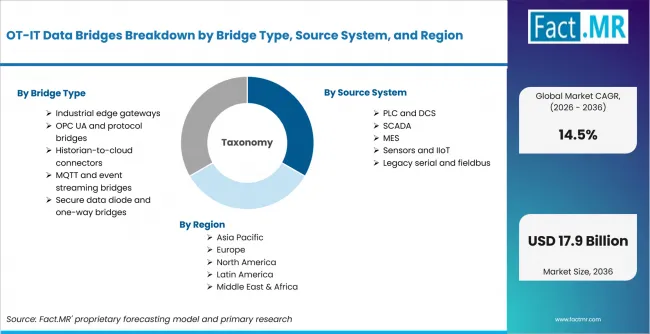
Ot It Data Bridges Breakdown By Bridge Type, Source System, And Region | Source: Fact.MR
| Attribute | Details |
|---|---|
| Quantitative Units | USD 4.6 billion in 2026 to USD 17.9 billion by 2036 at a 14.5% CAGR |
| Market Definition | Hardware, software and managed connectivity layers that translate, buffer, contextualize and secure operational information exchanged between industrial control environments and enterprise or cloud systems. |
| Bridge Type | Industrial edge gateways; OPC UA and protocol bridges; Historian-to-cloud connectors; MQTT and event streaming bridges; Secure data diode and one-way bridges |
| Source System | PLC and DCS; SCADA; MES; Sensors and IIoT; Legacy serial and fieldbus |
| Destination | Cloud data platforms; Enterprise analytics and BI; Data lake and historian; AI and ML platforms; ERP and business applications |
| Security Model | Firewall-segmented gateway; Zero-trust authenticated; One-way transfer; DMZ brokered; Air-gap transfer workflow |
| Regions Covered | North America; Latin America; Western Europe; Eastern Europe; East Asia; South Asia & Pacific; Middle East & Africa |
| Countries Covered | USA; Germany; Japan; UK; France |
| Key Companies | Kepware / PTC; Siemens; AVEVA (Schneider Electric); Rockwell Automation; HiveMQ; Litmus |
| Forecast Period | 2026 to 2036 |
| Approach | Sizing combines installed industrial endpoints, bridge attachment by control layer, software or appliance value, integration intensity and recurring management revenue. Forecasts test cloud migration, industrial AI, protocol retirement, cybersecurity policy and plant outage constraints across sectors and countries. |
How is the market segmented?
-
By Bridge Type
- Industrial edge gateways
- OPC UA and protocol bridges
- Historian-to-cloud connectors
- MQTT and event streaming bridges
- Secure data diode and one-way bridges
-
By Source System
- PLC and DCS
- SCADA
- MES
- Sensors and IIoT
- Legacy serial and fieldbus
-
By Destination
- Cloud data platforms
- Enterprise analytics and BI
- Data lake and historian
- AI and ML platforms
- ERP and business applications
-
By Security Model
- Firewall-segmented gateway
- Zero-trust authenticated
- One-way transfer
- DMZ brokered
- Air-gap transfer workflow
-
By Region
- North America
- Latin America
- Western Europe
- Eastern Europe
- East Asia
- South Asia & Pacific
- Middle East & Africa