- Market Value (2025): USD 17.0 Bn
- Estimated Value (2026): USD 18.6 Bn
- Forecast Value (2036): USD 46.9 Bn
- CAGR (2026-2036): 9.7%
What is the Data Center and AI Server Printed Circuit Board Market forecast to be worth by 2036?
USD 18.6 billion in 2026 to USD 46.9 billion by 2036 at 9.7% CAGR.
- The data center and AI server printed circuit board market reached USD 17.0 billion in 2025.
- Demand is projected to increase from USD 18.6 billion in 2026 to USD 46.9 billion by 2036.
- The market is forecast to record 9.7% CAGR from 2026 to 2036.
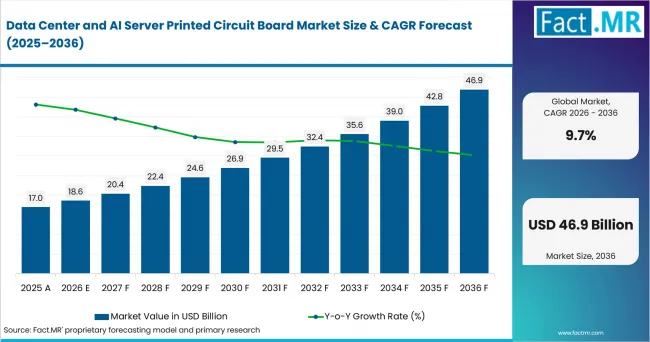
Data Center And Ai Server Printed Circuit Board Market Value Analysis | Source: Fact.MR
What are the defining numbers behind Data Center and AI Server Printed Circuit Board Market growth?
USD 28.2 billion absolute opportunity is projected by 2036.
- Demand Drivers in the Market
- AI training servers require dense routing between accelerators and memory. This raises the value of high-layer boards during qualification.
- Hyperscale data centers need stable boards for high-density AI racks. Procurement teams usually ask for repeatable signal-quality evidence before scale orders.
- Low-loss laminates help fast data movement across tight boards. This makes material choice central to server platform approval.
- PCB design software helps engineers check routing risk earlier. Better design review is expected to lower redesign work before volume release.
- Key Segments Analyzed
- By PCB Configuration: High-Density Interconnect (HDI) PCB is expected to hold 39.0% share in 2026 since AI server boards need compact routing density.
- By Server Platform: AI Training Servers is projected to account for 42.0% share in 2026 as training systems carry the heaviest board-performance burden.
- By Application Sector: Hyperscale Data Centers is anticipated to capture 44.0% share in 2026 where large cloud operators qualify boards at high volume.
- By Customer Group: Hyperscale Cloud Providers is estimated to represent 41.0% share in 2026 due to their direct role in AI infrastructure purchasing.
- By PCB Material Technology: Low-Loss High-Speed Laminate is forecast to hold 38.0% share in 2026 as faster data movement raises material requirements.
- Analyst Opinion at Fact.MR
- Shambhu Nath Jha, Principal Consultant at Fact.MR, states, “Data Center and AI Server Printed Circuit Board companies must explain board value by workload. Customers are expected to compare layer count and signal quality. Documentation is expected to shape repeat orders.”
- Strategic Implications
- Board manufacturers should organize sales material around AI training and networking workloads.
- Manufacturers are expected to protect margins by documenting laminate choice and signal-integrity testing.
- Channel partners should plan inventory around data center server rack design.
The USA leads at 10.6% CAGR through hyperscale cloud spending. Taiwan follows at 10.2% because PCB manufacturers are close to AI hardware supply. South Korea records 9.8% with electronics depth. Japan posts 9.3% through materials capability. Germany reaches 8.9% as customers expect documentation. Canada records 8.5% through cloud and research demand. Singapore reaches 8.1% through data center density.
How does the Data Center and AI Server Printed Circuit Board Market break down by segment?
High-Density Interconnect (HDI) PCB leads PCB Configuration at 39.0% share in 2026. AI Training Servers lead Server Platform at 42.0% share.
Which PCB Configuration dominates?
High-Density Interconnect (HDI) PCB is projected to account for 39.0% share in 2026.
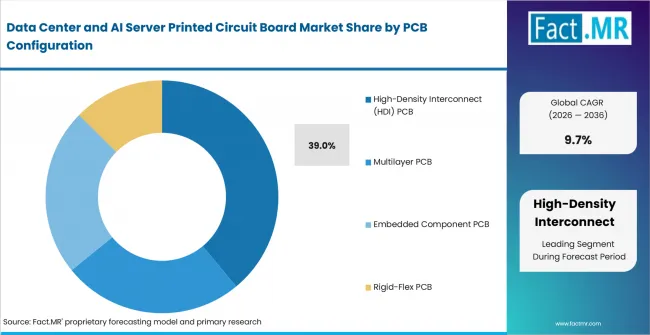
Data Center And Ai Server Printed Circuit Board Market Analysis By Pcb Configuration | Source: Fact.MR
HDI boards lead because they place more circuit routes into limited board space. Multilayer PCB remains useful for standard server boards. Embedded Component PCB and Rigid-Flex PCB serve designs that need special packaging.
What leads the Server Platform segment?
AI Training Servers is expected to hold 42.0% share in 2026.
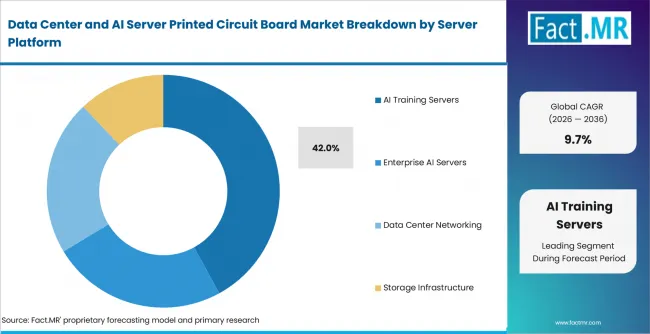
Data Center And Ai Server Printed Circuit Board Market Analysis By Server Platform | Source: Fact.MR
Training systems put the most pressure on boards since accelerators and memory must communicate at high speed. Enterprise AI Servers support private workloads. Data Center Networking and Storage Infrastructure add demand where traffic control matters.
How does Application Sector shape demand?
Hyperscale Data Centers are anticipated to capture 44.0% share in 2026.
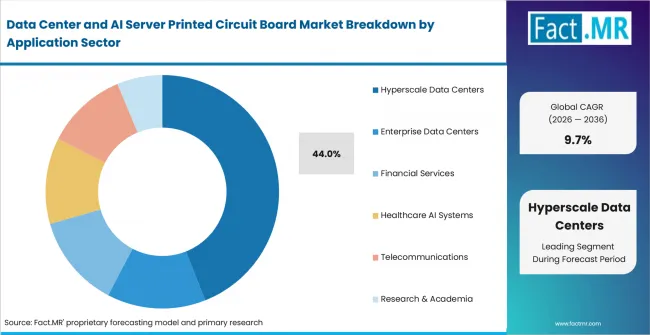
Data Center And Ai Server Printed Circuit Board Market Analysis By Application Sector | Source: Fact.MR
Large cloud platforms qualify boards for repeated server builds. Enterprise Data Centers create steadier replacement demand. Financial Services and Healthcare AI Systems need reliable boards for narrower workloads.
What supports Hyperscale Cloud Providers within Customer Group?
Hyperscale Cloud Providers are estimated to represent 41.0% share in 2026.
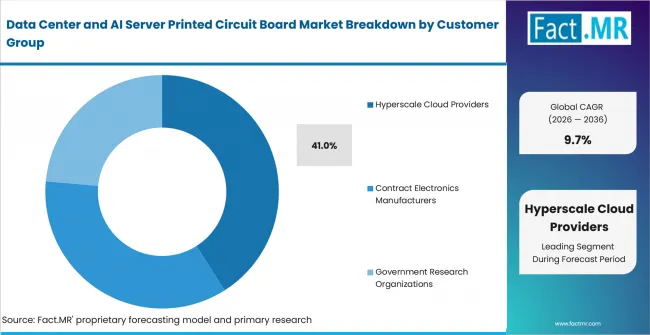
Data Center And Ai Server Printed Circuit Board Market Analysis By Customer Group | Source: Fact.MR
Hyperscale Cloud Providers lead because they set many server-platform requirements. Contract Electronics Manufacturers execute builds. Government Research Organizations use verified boards for computing clusters.
Why does Low-Loss High-Speed Laminate lead PCB Material Technology?
Low-Loss High-Speed Laminate is forecast to hold 38.0% share in 2026.
Data Center And Ai Server Printed Circuit Board Market Analysis By Pcb Configuration | Source: Fact.MR
Low-loss laminate leads because fast AI servers need clean signal movement across dense boards. Advanced FR-4 remains useful where cost matters. Embedded Copper Technology and Signal Integrity Optimization gain value as heat rises.
What is accelerating Data Center and AI Server Printed Circuit Board Market adoption, and what is holding it back?
Demand is expected to rise through AI server qualification and higher signal-speed requirements. Growth may be limited by laminate cost and advanced fabrication complexity.
Drivers Impact Analysis
| DRIVER | (~) % IMPACT ON CAGR | GEOGRAPHIC RELEVANCE | IMPACT TIMELINE |
|---|---|---|---|
| Adoption and integration | +1.6% | Global | Short term (<= 2 years) |
| Regulatory and compliance support | +1.4% | USA, Germany, UK | Short term (<= 2 years) |
| Channel and access expansion | +1.1% | Global | Medium term (2-4 years) |
| Clear specification and documentation | +0.9% | USA, UK, Canada | Medium term (2-4 years) |
| Cost and efficiency gains | +0.6% | Global | Long term (>= 4 years) |
Source: Fact.MR analysis. Updated Aug 6, 2026
- Adoption and integration: AI server programs are expected to raise demand when manufacturers join early design review.
- Regulatory and compliance support: Customers in controlled markets are expected to prefer traceable materials and manufacturing records.
- Clear specification and documentation: Procurement teams review laminate choice and reliability evidence faster when engineering information is easy to compare.
Opportunity Impact Analysis
| OPPORTUNITY | (~) % IMPACT ON CAGR | GEOGRAPHIC RELEVANCE | IMPACT TIMELINE |
|---|---|---|---|
| Emerging application expansion | +1.0% | Global | Medium term (2-4 years) |
| Premium and specialist positioning | +0.8% | USA, UK, Germany | Medium term (2-4 years) |
| Channel and partner expansion | +0.7% | Global | Long term (>= 4 years) |
| Standards and compliance alignment | +0.5% | USA, Canada, Singapore | Long term (>= 4 years) |
Source: Fact.MR analysis. Updated Aug 6, 2026
- Emerging application expansion: AI workloads beyond training are expected to open board demand in inference and storage systems.
- Premium and specialist positioning: Companies with low-loss materials and higher-layer capability are expected to gain stronger pricing support.
- Channel and partner expansion: Engineering partners are expected to reduce approval delays during platform refreshes.
Restraints Impact Analysis
| RESTRAINT | (~) % IMPACT ON CAGR | GEOGRAPHIC RELEVANCE | IMPACT TIMELINE |
|---|---|---|---|
| Rising material costs and high-layer board complexity | -1.1% | Global | Short term (<= 2 years) |
| Supply chain concentration and specialized fabrication needs | -0.9% | USA, UK, Germany | Short term (<= 2 years) |
| Design and verification complexity | -0.7% | Import-dependent markets | Medium term (2-4 years) |
| Supply chain and pricing pressure | -0.5% | Global | Long term (>= 4 years) |
Source: Fact.MR analysis. Updated Aug 6, 2026
- Rising material costs: Low-loss laminate and dense fabrication are expected to raise costs.
- Specialized fabrication needs: Advanced boards need controlled processes and skilled manufacturing.
- Design and verification complexity: More layers and tighter routing rules are expected to lengthen approval work.
Which countries are scaling the Data Center and AI Server Printed Circuit Board Market fastest?
- The country comparison spans 2.5 percentage points and forms three practical growth bands across the forecast period.
- The USA remains 0.4 percentage point above Taiwan through hyperscale cloud demand and electronics qualification.
- Taiwan remains 0.4 percentage point above South Korea because local PCB depth supports AI server supply chains.
- South Korea remains 0.5 percentage point above Japan through electronics manufacturing and server-component capability.
- Japan remains 0.4 percentage point above Germany with precision electronics and materials expertise.
- Germany remains 0.4 percentage point above Canada as industrial electronics customers require documentation.
- Canada remains 0.4 percentage point above Singapore even though Singapore keeps a compact electronics cluster.
Comparable CAGRs can create different entry conditions due to manufacturing depth and qualification timelines. Full report coverage includes North America; Latin America; Europe; East Asia; South Asia and Pacific; Middle East and Africa.
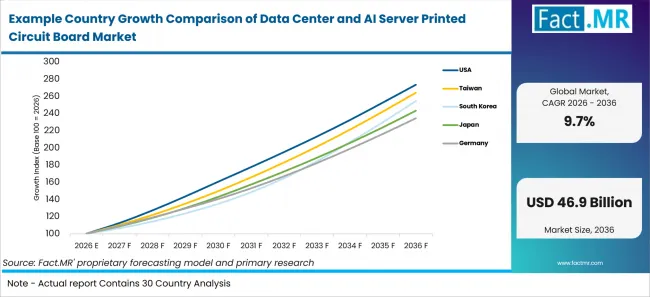
Example Country Growth Comparison Of Data Center And Ai Server Printed Circuit Board Market | Source: Fact.MR
| Country | CAGR (2026-2036) |
|---|---|
| USA | 10.6% |
| Taiwan | 10.2% |
| South Korea | 9.8% |
| Japan | 9.3% |
| Germany | 8.9% |
| Canada | 8.5% |
| Singapore | 8.1% |
Source: Fact.MR analysis. Updated Aug 6, 2026
What is driving USA's growth through 2036?
10.6% CAGR, supported by hyperscale demand and PCB qualification.
USA demand starts with large cloud customers that approve boards for repeated AI server builds. Local engineering review helps shorten qualification work when platform designs change.
What supports Taiwan adoption?
10.2% CAGR, backed by PCB depth and AI hardware supply chains.
Taiwan benefits from a deep electronics manufacturing base that understands HDI board production. Nearby board makers help AI hardware companies revise designs before higher-volume programs move forward.
How is South Korea developing demand?
9.8% CAGR, driven by electronics manufacturing and server components.
South Korea's electronics base gives customers access to experienced component and assembly partners. Quality records are expected to matter when customers compare repeat server-board orders.
How does Japan perform?
9.3% CAGR, led by materials expertise and precision electronics.
Japan's position is strongest where laminate knowledge and precision manufacturing decide qualification. Customers are expected to value long testing records before approving boards for advanced servers.
What is driving Germany's growth through 2036?
8.9% CAGR, supported by industrial electronics and compliance-led sourcing.
Germany's growth is shaped by customers that expect careful documentation for electronics procurement. Import dependence can lengthen lead times when high-speed boards need special materials.
What supports Canada's growth?
8.5% CAGR, supported by data centers and supply partnerships.
Canada's demand is expected to grow through cloud use and research computing needs. Cross-border supply channels help customers access advanced boards that are not widely fabricated locally.
What supports Singapore's growth?
8.1% CAGR, backed by data center density and electronics services.
Singapore is a compact electronics and data center hub where engineering support operates close to end users. High operating costs may still make customers strict about price and service evidence.
Who leads the Data Center and AI Server Printed Circuit Board Market?
Unimicron and TTM Technologies hold strong positions in advanced server-board supply, while Compeq and AT&S add HDI and high-layer manufacturing depth.
Meiko and Zhen Ding expand coverage across premium PCB and substrate applications. Shennan Circuits and Tripod Technology strengthen large-scale production capability. Ibiden contributes materials and packaging expertise, while Samsung Electro-Mechanics broadens the field through high-performance electronic components and advanced interconnect solutions for AI infrastructure and dense server platform requirements.
Which companies are the key providers?
Key companies include Unimicron Technology Corporation; TTM Technologies, Inc.; Compeq Manufacturing Co., Ltd.; AT&S Austria Technologie & Systemtechnik AG; Meiko Electronics Co., Ltd.; Zhen Ding Technology Holding Limited; Shennan Circuits Co., Ltd.; Tripod Technology Corporation; Ibiden Co., Ltd.; and Samsung Electro-Mechanics Co., Ltd.
- Unimicron Technology Corporation
- TTM Technologies, Inc.
- Compeq Manufacturing Co., Ltd.
- AT&S Austria Technologie & Systemtechnik AG
- Meiko Electronics Co., Ltd.
- Zhen Ding Technology Holding Limited
- Shennan Circuits Co., Ltd.
- Tripod Technology Corporation
- Ibiden Co., Ltd.
- Samsung Electro-Mechanics Co., Ltd.
Bibliography
- National Institute of Standards and Technology. (2025, January 6). Biden-Harris administration announces Arizona State University Research Park as planned site for third CHIPS for America R&D flagship facility. U.S. Department of Commerce.
- IPC International, Inc. (2025, February 6). New IPC white paper focuses on use of artificial intelligence in automated optical inspection in electronics manufacturing.
- International Energy Agency. (2025, April 10). Energy and AI.
- National Institute of Standards and Technology. (2025, September 10). The “soft side” of chips: NIST advances polymer science for semiconductor packaging.
This Report Answers
- The report provides strategic intelligence on the Data Center and AI Server Printed Circuit Board Market across PCB Configuration and Server Platform choices that shape AI hardware qualification.
- Segment analysis covers High-Density Interconnect (HDI) PCB and AI Training Servers as the share leaders within the 2026 market.
- Country outlook evaluates the USA and Taiwan alongside South Korea and Japan. Germany, Canada and Singapore complete the growth comparison across the profiled markets.
- Competitive analysis profiles the full named provider set across HDI, multilayer and high-speed board supply.
- Material assessment covers Low-Loss High-Speed Laminate and Advanced FR-4. Embedded Copper Technology and Signal Integrity Optimization complete the material view.
What does the Data Center and AI Server Printed Circuit Board Market cover?
Printed circuit boards are used inside servers and accelerator systems where stable electrical paths decide system performance.
The Data Center and AI Server Printed Circuit Board Market covers HDI and multilayer boards used in AI and data center server platforms. Embedded component and rigid-flex boards are included when they serve covered server designs. Coverage extends to AI training servers and enterprise AI servers. Networking and storage boards are included where board performance affects system approval.
What is included in the scope?
Data center and AI server printed circuit boards are assessed across configuration; platform; application; customer group; and material technology.
The scope includes boards used in AI training servers and enterprise AI servers. It covers boards used in data center networking and storage infrastructure. Hyperscale Data Centers and Enterprise Data Centers are included as application sectors. Financial Services and Healthcare.
What is excluded from the scope?
General electronics boards remain outside the scope unless they are sold for covered data center and AI server applications.
The scope excludes consumer electronics PCBs and unrelated automotive boards. General industrial PCBs are excluded unless demand depends on covered server or data center use. Commodity boards without AI server qualification are excluded. Standalone semiconductor packages and active components remain outside the scope unless they are discussed as part of the server-board ecosystem.
How Was the Analysis Built?
The analysis draws on 120+ sources, 35+ company portfolios, 25+ countries, and more than 20 industry interviews.
- Primary Research: Primary research includes discussions with manufacturers, service providers, technology developers, distributors, end users, procurement teams, and subject-matter experts. These conversations examine purchasing priorities, product adoption, operational challenges, approval requirements, competitive positioning, and the factors that influence wider market acceptance.
- Desk Research: Desk research covers government statistics, regulatory publications, company filings, trade data, technical studies, industry associations, standards, public policy, and other authoritative sources. Every source used in the analysis is documented in the bibliography.
- Market Sizing and Forecasting: Market estimates combine historical performance, demand indicators, pricing and volume trends, segment shares, company participation, country-level growth, adoption patterns, investment activity, and barriers to market expansion.
- Data Validation and Update Cycle: Findings are validated by comparing primary interviews with public data, company activity, regulatory changes, trade patterns, and industry developments. Regular updates review new product launches, capacity changes, partnerships, approvals, procurement trends, and shifts in commercial adoption.
Segmentation
What is the report's scope and coverage?
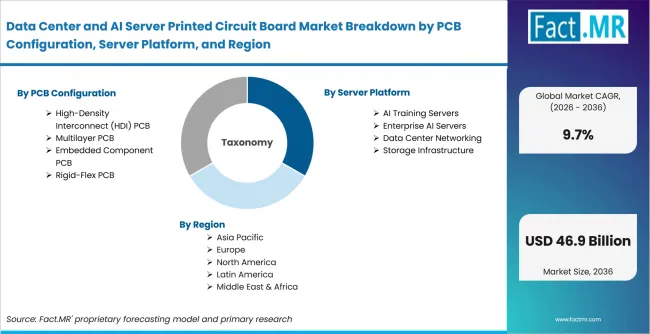
Data Center And Ai Server Printed Circuit Board Market Breakdown By Pcb Configuration, Server Platform, And Region | Source: Fact.MR
| Attribute | Details |
|---|---|
| Quantitative Units | USD billion |
| Market Definition | Printed circuit boards used inside data center and AI server systems where routing density, signal quality and laminate choice shape qualification. |
| PCB Configuration | High-Density Interconnect (HDI) PCB; Multilayer PCB; Embedded Component PCB; Rigid-Flex PCB |
| Server Platform | AI Training Servers; Enterprise AI Servers; Data Center Networking; Storage Infrastructure |
| Application Sector | Hyperscale Data Centers; Enterprise Data Centers; Financial Services; Healthcare AI Systems; Telecommunications; Research & Academia |
| Customer Group | Hyperscale Cloud Providers; Contract Electronics Manufacturers; Government Research Organizations |
| PCB Material Technology | Low-Loss High-Speed Laminate; Advanced FR-4; Embedded Copper Technology; Signal Integrity Optimization |
| Regions Covered | North America; Latin America; Europe; East Asia; South Asia and Pacific; Middle East and Africa |
| Countries Covered | USA; Taiwan; South Korea; Japan; Germany; Canada; Singapore |
| Key Companies Profiled | Unimicron Technology Corporation; TTM Technologies, Inc.; Compeq Manufacturing Co., Ltd.; AT&S Austria Technologie & Systemtechnik AG; Meiko Electronics Co., Ltd.; Zhen Ding Technology Holding Limited; Shennan Circuits Co., Ltd.; Tripod Technology Corporation; Ibiden Co., Ltd.; Samsung Electro-Mechanics Co., Ltd. |
| Forecast Period | 2026 to 2036 |
| Approach | Hybrid top-down and bottom-up approach using segment demand; country growth; pricing; material performance; server qualification; customer procurement checks; company portfolio review |
Source: Fact.MR analysis. Updated Aug 6, 2026
How is the market segmented?
-
By PCB Configuration:
- High-Density Interconnect (HDI) PCB
- Any-Layer HDI PCB
- Build-up HDI PCB
- Multilayer PCB
- 20+ Layer PCB
- Backplane PCB
- Embedded Component PCB
- Embedded Passive PCB
- Embedded Active PCB
- Rigid-Flex PCB
- High-Speed Flex PCB
- Shielded Flex PCB
- High-Density Interconnect (HDI) PCB
-
By Server Platform:
- AI Training Servers
- GPU Cluster Servers
- High-Performance Computing Servers
- Enterprise AI Servers
- Private AI Infrastructure
- Edge AI Servers
- Data Center Networking
- 800G Ethernet Switches
- InfiniBand Fabric
- Storage Infrastructure
- NVMe Storage Servers
- Distributed Storage Systems
- AI Training Servers
-
By Application Sector:
- Hyperscale Data Centers
- AI Infrastructure
- High-Performance Computing
- Enterprise Data Centers
- Financial Services
- Healthcare AI Systems
- Telecommunications
- Network Infrastructure
- Cloud Networking
- Research & Academia
- Supercomputing Centers
- Defense Computing
- Hyperscale Data Centers
-
By Customer Group:
- Hyperscale Cloud Providers
- Cloud Service Providers
- Server OEMs
- Original Design Manufacturers
- Enterprise IT Providers
- System Integrators
- Contract Electronics Manufacturers
- Network Equipment Vendors
- AI Hardware Integrators
- Government Research Organizations
- Public Research Institutions
- Defense Organizations
- Hyperscale Cloud Providers
-
By PCB Material Technology:
- Low-Loss High-Speed Laminate
- PTFE-based Material
- High Tg Laminate
- Advanced FR-4
- Low Dk Resin System
- Hybrid Laminate Stack-up
- Embedded Copper Technology
- Copper Coin Technology
- Thermal Via Technology
- Signal Integrity Optimization
- Laser Microvia Technology
- Backdrill Processing
- Low-Loss High-Speed Laminate
-
By Region:
- North America
- Latin America
- Europe
- East Asia
- South Asia and Pacific
- Middle East and Africa
Frequently Asked Questions
How big is the data center and AI server printed circuit board market in 2026?
What is the CAGR of the data center and AI server printed circuit board market from 2026 to 2036?
Which PCB configuration leads the data center and AI server printed circuit board market?
Which server platform leads the data center and AI server printed circuit board market?
Who are the leading companies in the data center and AI server printed circuit board market?
Who worked on this report


Preview the report firsthand - request a free sample
Free SampleGet the brochure for pricing and purchase details
Download PDF