- Market Value (2025): USD 1862.9 Mn
- Estimated Value (2026): USD 2302.5 Mn
- Forecast Value (2036): USD 19159.9 Mn
- CAGR (2026-2036): 23.6%
What is the Data Marketplace Platform Market forecast to be worth by 2036?
USD 2,302.5 million in 2026 to USD 19,159.9 million by 2036, at 23.6% CAGR.
- The data marketplace platform market crossed a valuation of USD 1,862.9 million in 2025 as enterprise data sourcing became more structured across cloud accounts.
- Demand is projected to increase from USD 2,302.5 million in 2026 to USD 19,159.9 million by 2036 across commercial and internal exchange programs.
- The market is forecast to record a 23.6% CAGR from 2026 to 2036 as data teams and business units expand governed data product access.
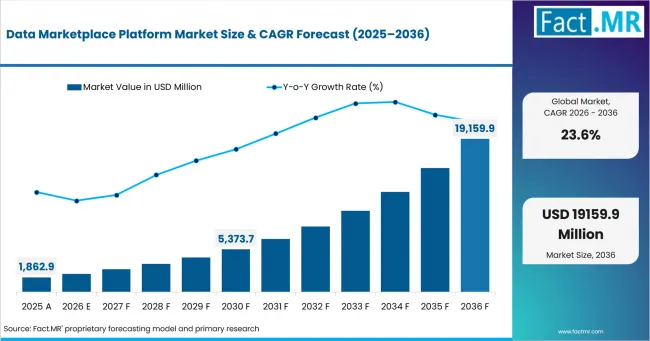
Data Marketplace Platform Market Market Value Analysis | Source: Fact.MR
What are the defining numbers behind Data Marketplace Platform Market growth?
USD 16,857.4 million absolute opportunity by 2036, led by platform and B2B data marketplace platforms with financial services accounts.
- Demand Drivers in the Market
- Enterprise data offices benefit from searchable product catalogs that streamline dataset discovery and minimize contract duplication across business units.
- Financial analytics teams require governed third-party datasets supported by transparent licensing terms before initiating model development activities.
- Data product owners need robust pricing and access-control capabilities to manage both internal cost-allocation programs and external data-monetization initiatives.
- Cloud platform teams favor direct delivery mechanisms that reduce unnecessary data movement between storage environments and analytics platforms.
- Key Segments Analyzed
- By Component: Platform is expected to hold 75.9% share in 2026 supported by enterprise preference for integrated discovery and transaction controls.
- By Type: B2B Data Marketplace Platforms are projected to account for at least 58.0% share in 2026 owing to recurring enterprise sourcing needs.
- By Revenue Model: Subscription is anticipated to capture at least 52.0% share in 2026 driven by predictable access budgets and repeat data use.
- By Enterprise Size: Large Enterprises are estimated to represent at least 57.0% share in 2026 attributable to broad data estates and formal governance teams.
- By End User: Financial Services is forecast to account for 18.5% share in 2026 shaped by alternative data use and regulated data controls.
- Analyst Opinion at Fact.MR
- Shambhu Nath Jha, Senior Analyst at Fact.MR, states: “The commercial bottleneck is proving rights and lineage before an enterprise workflow depends on a data product. Adoption is expected to favor platforms that combine discovery with contract controls and delivery into existing cloud estates. Providers should pair catalog depth with usage evidence and policy enforcement that remain auditable for data owners and governance teams.”
- Strategic Implications
- Chief data officers should define product ownership rules before opening an internal marketplace to prevent duplicated listings and unclear stewardship.
- Procurement teams should standardize license review fields so business users compare access rights before requesting security and legal approval.
- Data providers should package delivery methods alongside metadata because enterprise users increasingly expect direct activation inside governed analytics environments.
- Cloud architects should connect marketplace access with identity controls so approved products remain traceable after consumption expands across business units.
As data marketplaces evolve into platforms for AI consumption and enterprise decision-making, providers are expanding beyond traditional dataset distribution. In June 2025, Snowflake enhanced Snowflake Marketplace with agentic products and AI-ready data from news and research providers. The release also added semantic model sharing for structured data used across enterprise analytics and application development environments. The move reflects a wider shift from dataset discovery toward governed products that connect external information directly with analytics and application development.
China is expected to record a 26.9% CAGR through 2036 driven by digital economy scale and formal data circulation policy. Japan is projected to post a 24.9% CAGR supported by industrial interoperability programs and cross-border data guidance. The United Kingdom is anticipated to advance at a 22.5% CAGR owing to cloud adoption and public-sector data sharing programs. The United States is estimated to record a 21.4% CAGR attributable to deep data vendor networks and stronger privacy scrutiny. Germany is forecast to post an 18.4% CAGR shaped by industrial data spaces and enterprise governance requirements.
How does the Data Marketplace Platform Market break down by segment?
Platform leads at 75.9%, B2B Data Marketplace Platforms lead with at least 58.0%.
Which Component dominates?
Platform holds 75.9% share in 2026.
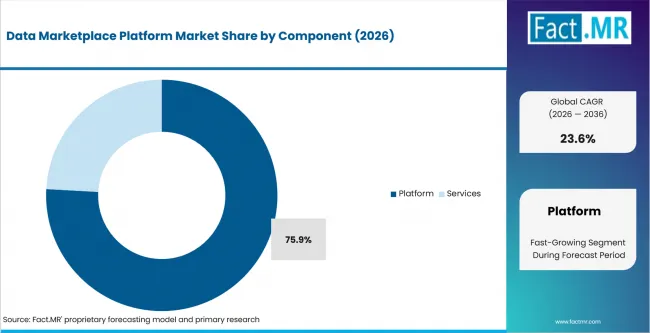
Data Marketplace Platform Market Analysis By Component | Source: Fact.MR
Platform is expected to hold 75.9% share in 2026 supported by demand for one environment that manages discovery and access approval. Services remain relevant when enterprises need operating models or provider onboarding support around a new marketplace. Integration work also connects identity systems and data catalogs with consumption environments that already manage approved enterprise use. In June 2026, Eurostat reported that 52.74% of EU enterprises used paid cloud computing services during 2025. That cloud base gives marketplace platforms a broad delivery layer for activated data products used across distributed analytics teams.
What leads the Type segment?
B2B Data Marketplace Platforms dominate with 58.0% share in 2026.
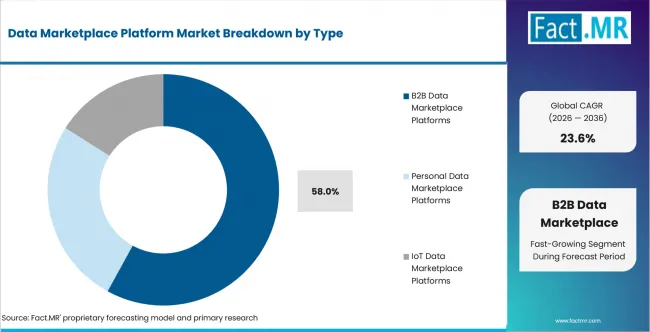
Data Marketplace Platform Market Analysis By Type | Source: Fact.MR
B2B Data Marketplace Platforms are projected to account for at least 58.0% share in 2026 owing to recurring enterprise sourcing and partner exchange needs. Personal Data Marketplace Platforms serve consent-based consumer data use cases that require stricter rights management. IoT Data Marketplace Platforms focus on machine data where access conditions and refresh frequency shape value. In June 2026, Eurostat reported that 39.85% of EU enterprises performed data analytics internally or through an external provider during 2025. That broad analytics base creates more enterprise demand for reusable datasets that arrive with clear ownership and access conditions.
How does Revenue Model shape demand?
Subscription garners around 52.0% share in 2026.
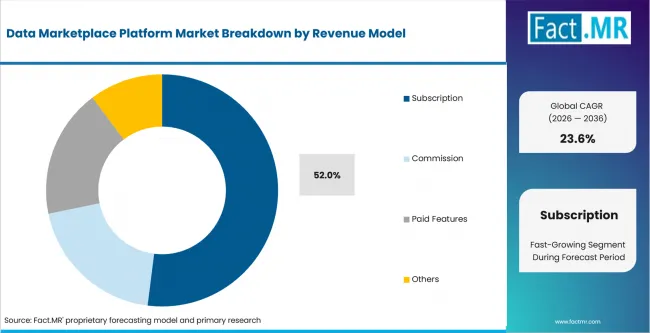
Data Marketplace Platform Market Analysis By Revenue Model | Source: Fact.MR
Subscription is anticipated to capture at least 52.0% share in 2026 driven by predictable spending and repeated access to refreshed data products. Commission models fit exchanges that collect fees from completed transactions between providers and enterprise accounts. Paid Features support premium search and workflow services inside platforms that maintain broader free discovery access. Snowflake stated in October 2025 that more than 12,000 businesses had chosen its platform by July 2025. A broad installed account base supports recurring commercial programs around marketplace procurement and partner solutions.
What supports Large Enterprises within Enterprise Size?
Large Enterprises records 57.0% share in 2026.
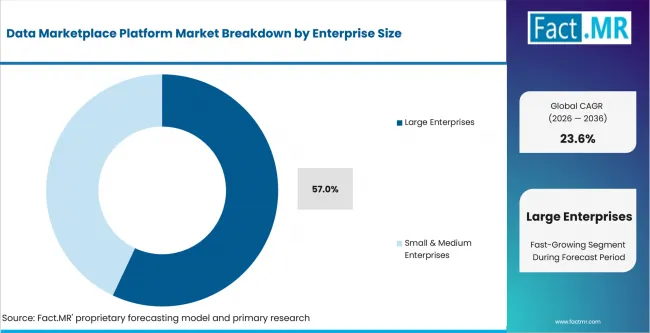
Data Marketplace Platform Market Analysis By Enterprise Size | Source: Fact.MR
Large Enterprises are estimated to represent at least 57.0% share in 2026 attributable to complex data estates and formal governance structures. Small and Medium Enterprises often enter through public marketplaces where procurement and delivery are simpler. Smaller accounts also favor narrow subscriptions that solve one analytics need without a full internal marketplace program. In June 2026, Eurostat reported that 55.03% of large EU enterprises used AI technologies during 2025. Large AI programs raise demand for governed data discovery and repeatable access approval before models and agents enter production workflows.
What leads demand across End User?
Financial Services leads with 18.5% share in 2026.
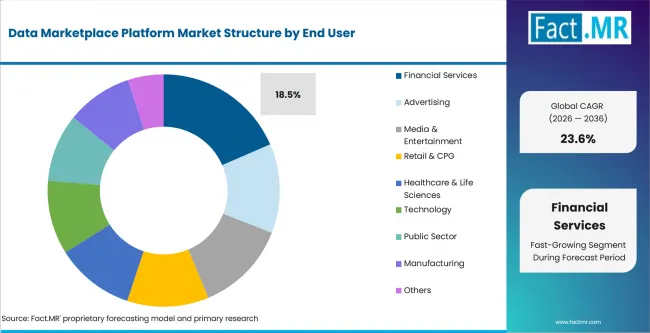
Data Marketplace Platform Market Analysis By End User | Source: Fact.MR
Financial Services is forecast to account for 18.5% share in 2026 shaped by alternative data sourcing and strict control over usage rights. Advertising teams use audience and commerce signals for campaign planning across media and retail channels. Healthcare accounts require clear privacy controls before external datasets enter research or analytics workflows involving sensitive information. Retail and manufacturing users combine internal operating records with external signals for planning across supply and customer functions. ENISA reported in October 2025 that its threat landscape analysis covered 4,875 incidents from July 2024 through June 2025. That exposure keeps traceability central when enterprises evaluate third-party datasets and internal redistribution rights across governed marketplace workflows.
What is accelerating Data Marketplace Platform Market adoption, and what is holding it back?
Governed data product reuse drives it, licensing and privacy complexity restrains it.
Drivers Impact Analysis
| DRIVER | (~) % IMPACT ON CAGR | GEOGRAPHIC RELEVANCE | IMPACT TIMELINE |
|---|---|---|---|
| Governed data product reuse across enterprise teams | +3.5% | Global enterprise accounts | Medium term (2-4 years) |
| Cloud-native delivery into analytics environments | +2.4% | North America and Europe | Medium term (2-4 years) |
| AI training and agent workflow data needs | +1.8% | United States and Asia Pacific | Short term (<= 2 years) |
| Regulatory support for structured data access | +1.1% | European Union and Japan | Medium term (2-4 years) |
| External data monetization by data owners | +0.8% | Global provider ecosystems | Long term (>= 4 years) |
Source: Fact.MR analysis. Updated Jul 7, 2026
- Governed data product reuse: Enterprises are turning internal datasets into named products with owners and access rules. Marketplace catalogs reduce repeated discovery work when teams need the same approved data across separate analytics or operational programs. In June 2026, Eurostat reported that 71% of EU SMEs reached at least basic digital intensity during 2025. Marketplace use is expected to expand as more firms organize digital assets for repeat discovery and controlled reuse.
- Cloud-native delivery: Marketplace value rises when approved data reaches the same cloud environment used for analytics and model development. Direct delivery reduces separate transfer work and keeps consumption tied to established identity controls across existing enterprise cloud environments. In June 2026, Eurostat reported that 13.76% of EU enterprises purchased cloud platforms for application development or deployment during 2025. Demand is projected to favor platforms that connect discovery with controlled activation across existing analytics and model development environments.
- AI workflow data needs: AI teams require more external and internal data products for grounding and evaluation. Marketplace workflows help teams find licensed content and documented usage rights before models or enterprise agents depend on those data products. In June 2026, Eurostat reported that 19.95% of EU enterprises used AI technologies during 2025. Data sourcing activity is anticipated to broaden as enterprise AI use expands beyond pilot teams.
- Structured data access policy: New rules are giving connected product users clearer rights to obtain and share generated data. The European Union Data Act started applying in September 2025 and clarified access conditions for connected device data. Providers are estimated to gain demand for tools that apply rights and contract terms at the product level.
- Data owner monetization: Companies are testing direct commercial routes for data assets that previously stayed inside operational systems. Marketplace platforms add packaging and pricing controls alongside provider discovery for data owners seeking structured commercial distribution routes. In February 2026, China reported 13.2% growth in software and information technology services revenue during 2025. Revenue programs are forecast to widen where data owners measure usage and control redistribution across enterprise customer accounts.
Opportunity Impact Analysis
| OPPORTUNITY | (~) % IMPACT ON CAGR | GEOGRAPHIC RELEVANCE | IMPACT TIMELINE |
|---|---|---|---|
| Internal marketplaces for governed enterprise data products | +2.0% | North America and Europe | Medium term (2-4 years) |
| Industrial data spaces and partner ecosystems | +1.7% | Germany and Japan | Long term (>= 4 years) |
| AI-ready content licensing and semantic products | +1.4% | United States and United Kingdom | Short term (<= 2 years) |
| Public-sector data discovery and exchange programs | +1.1% | United Kingdom and Asia Pacific | Medium term (2-4 years) |
Source: Fact.MR analysis. Updated Jul 7, 2026
- Internal data marketplaces: Large enterprises hold many datasets that remain difficult for other teams to discover or request. Internal marketplace programs create reusable listings around ownership and policy controls before business users request governed access. In April 2025, Dawex announced that TF1 Group selected its technology to create Hub TF1 for internal data access and exchange. Opportunity is expected to expand where organizations treat data discovery as shared infrastructure across business units.
- Industrial data spaces: Manufacturing and mobility ecosystems need controlled exchange across separate companies that cannot centralize all operating data. Marketplace platforms support policy rules and usage terms across those relationships while preserving control for separate participating organizations. Japan’s METI published trust guidance for industrial data sharing in March 2025 under the Ouranos Ecosystem work. Adoption is projected to advance where interoperability work connects technical exchange with commercial governance across long-term industrial ecosystem programs.
- AI-ready content licensing: Model builders increasingly need content that includes clear permissions and structured delivery paths. Marketplaces package licensing terms with data products that fit retrieval and agent workflows across enterprise model development. In September 2025, Microsoft announced Graph in Fabric and Maps in Fabric to support enterprise AI data readiness across connected and geospatial information. Opportunity is anticipated to concentrate where platforms connect usable data structures with clear purchase rights and governed delivery.
- Public data discovery: Government organizations hold valuable information across agencies that remains difficult to find or request consistently. Shared marketplaces provide one place for metadata and governed access workflows across separate departments inside complex organizations. In June 2026, the Government Digital Service reported that its data-maturity work with The National Archives had moved from discovery into an Alpha phase. Public-sector programs are estimated to provide practical models for discovery and controlled access across complex organizations.
Restraints Impact Analysis
| RESTRAINT | (~) % IMPACT ON CAGR | GEOGRAPHIC RELEVANCE | IMPACT TIMELINE |
|---|---|---|---|
| Licensing and usage-right complexity | -1.4% | Global | Medium term (2-4 years) |
| Privacy restrictions on sensitive personal data | -1.1% | United States and Europe | Short term (<= 2 years) |
| Data quality and lineage uncertainty | -0.8% | Global enterprise accounts | Medium term (2-4 years) |
| Integration cost across catalogs and cloud estates | -0.6% | Large enterprises | Long term (>= 4 years) |
Source: Fact.MR analysis. Updated Jul 7, 2026
- Licensing complexity: Data products often carry limits on geography and redistribution that vary across providers. Legal review slows procurement when terms are not expressed in comparable fields that procurement and governance teams assess consistently. Platforms are expected to face longer sales cycles when enterprise accounts cannot connect license rights with downstream user access and audit records.
- Privacy restrictions: Personal data exchange faces stricter limits where consent and sensitive location information are involved. In January 2025, the Federal Trade Commission finalized an order banning Mobilewalla from selling sensitive location data. Adoption is projected to remain selective for personal-data products that lack transparent collection records and clear use controls.
- Data quality uncertainty: A marketplace listing does not prove that a dataset is complete or suitable for a production model. Enterprise teams still need profiling and refresh history before approval because listing metadata alone does not prove operational suitability. Demand is anticipated to favor platforms that expose quality evidence and change records without forcing users to purchase a product before technical review.
- Integration cost: Marketplace tools must connect with identity systems and catalogs that already govern enterprise data estates. Large accounts often operate several clouds and regional controls that complicate one delivery pattern across business units and national jurisdictions. Adoption is estimated to slow where a marketplace becomes another isolated portal instead of a connected part of data operations.
Which countries are scaling Data Marketplace Platform Market fastest?
China 26.9%, Japan 24.9%, United Kingdom 22.5%, United States 21.4%, Germany 18.4%.
By region, data marketplace platform market is segmented into North America, Latin America, Europe, Asia Pacific, and the Middle East & Africa.
| COUNTRY | CAGR |
|---|---|
| China | 26.9% |
| Japan | 24.9% |
| United Kingdom | 22.5% |
| United States | 21.4% |
| Germany | 18.4% |
Source: Fact.MR analysis. Updated Jul 7, 2026
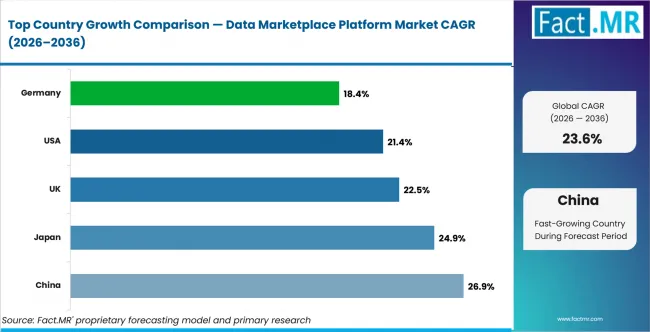
Data Marketplace Platform Market Cagr Analysis By Country | Source: Fact.MR
What is powering China's lead?
26.9% CAGR through 2036, driven by digital economy scale and formal data circulation policy.
China has a broad digital services base that creates large volumes of commercial and industrial data products. In December 2025, the National Bureau of Statistics reported that digital economy core industries represented 10.5% of 2024 GDP. The market is expected to record a 26.9% CAGR through 2036 as enterprise catalogs connect with domestic cloud and industry exchange programs.
How is Japan scaling Data Marketplace Platform demand?
24.9% CAGR through 2036, supported by industrial interoperability and cross-border data management.
Japan is building exchange rules around industrial ecosystems that need controlled data sharing across company boundaries. METI published a cross-border industrial data management manual in January 2025 to support international data sharing and utilization. The market is projected to post a 24.9% CAGR through 2036 as enterprise accounts connect interoperability work with commercial data governance.
What supports the United Kingdom outlook?
22.5% CAGR through 2036, owing to cloud adoption and public-sector data discovery programs.
The United Kingdom combines high cloud use with public-sector work on shared data discovery and governed access. In March 2025, the Office for National Statistics reported cloud use among 69% of UK firms during 2023. Demand is anticipated to advance at a 22.5% CAGR through 2036 as simpler access workflows support business users while governance teams retain approval visibility.
What underpins the United States growth path?
21.4% CAGR through 2036, attributable to deep data vendor networks and closer privacy review.
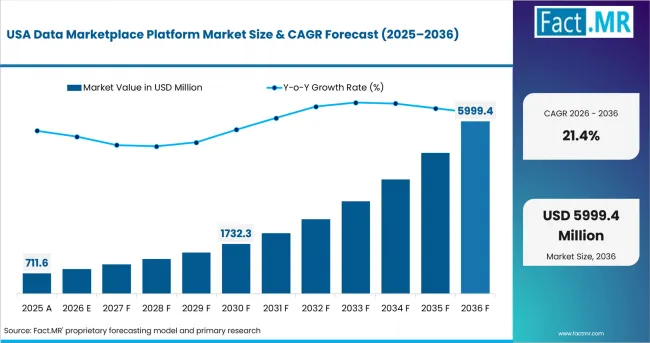
Data Marketplace Platform Market Country Value Analysis | Source: Fact.MR
The United States has a deep provider ecosystem across financial and consumer data that supports marketplace breadth. Market growth is estimated at a 21.4% CAGR through 2036 as privacy enforcement raises the value of visible rights controls and audit records. In January 2025, the Federal Trade Commission announced action against General Motors over alleged sharing of precise location and driving behavior data without consent.
How is Germany developing Data Marketplace Platform demand?
18.4% CAGR through 2036, shaped by industrial data spaces and enterprise governance requirements.
Germany enters the market through manufacturing data spaces and cross-company programs where trust rules are central. In June 2026, the International Data Spaces Association described Geo Data Space Germany as a shared sovereign foundation for cross-domain data exchange. Industry is forecast to post an 18.4% CAGR through 2036 as federated platforms connect contractual controls with technical policy enforcement.
Who leads the Data Marketplace Platform Market?
Snowflake and AWS lead direct marketplace coverage, while Microsoft and Oracle strengthen governed data discovery across cloud estates.
Companies in the market such as Snowflake combines marketplace distribution with live data sharing and AI-ready content products inside its Data Cloud environment. AWS operates Data Exchange alongside broader marketplace and analytics services that connect external datasets with cloud workloads. Nasdaq serves financial users through Data Link and direct commercial datasets used across investment research and professional analytics workflows. These providers compete on catalog breadth and procurement simplicity while integration depth shapes adoption across established cloud accounts.
Microsoft extends discovery and governance through Fabric and the OneLake catalog across enterprise analytics workflows. Oracle supports data discovery and sharing inside Autonomous AI Lakehouse and Data Studio tools for governed enterprise analytics programs. Dawex focuses on corporate data hubs and industry data spaces where policy and transaction rules require dedicated orchestration. Datarade operates a broad discovery exchange for external data products across many commercial categories and enterprise sourcing requirements. Competition through 2036 is expected to center on rights clarity and delivery into governed analytics environments.
Which companies are the key providers?
Snowflake, AWS, Microsoft, Oracle, Nasdaq, Dawex and Datarade.
- Snowflake
- Amazon Web Services (AWS)
- Microsoft
- Oracle
- Nasdaq
- Dawex
- Datarade
Bibliography
- European Commission. (2025, September 12). EU Data Act gives users control over data from connected devices. European Commission.
- European Union Agency for Cybersecurity. (2025, October 1). ENISA Threat Landscape 2025. ENISA.
- Eurostat. (2026, June). Digital economy and society statistics - enterprises. European Commission.
- Eurostat. (2026, June). Digitalisation in Europe – 2026 edition. European Commission.
- Federal Trade Commission. (2025, January 14). FTC finalizes order banning Mobilewalla from selling sensitive location data. Federal Trade Commission.
- Federal Trade Commission. (2025, January 16). FTC takes action against General Motors for sharing drivers’ precise location and driving behavior data without consent. Federal Trade Commission.
- Government Digital Service. (2026, June 4). Data maturity: the foundation for AI ready public sector data. Government of the United Kingdom.
- Ministry of Economy, Trade and Industry. (2025, January 27). Manual on Cross-Border Industrial Data Management compiled to promote companies’ international data sharing and utilization. Government of Japan.
- Ministry of Economy, Trade and Industry. (2025, March 28). Report compiled on trust required for promoting industrial data sharing in the Ouranos Ecosystem. Government of Japan.
- National Bureau of Statistics of China. (2025, December 31). Value added of China’s core industries of the digital economy takes up 10.5% of GDP in 2024. National Bureau of Statistics of China.
- National Bureau of Statistics of China. (2026, February 28). Statistical communiqué of the People’s Republic of China on the 2025 national economic and social development. National Bureau of Statistics of China.
- Office for National Statistics. (2025, March 24). Management practices and the adoption of technology and artificial intelligence in UK firms: 2023. Office for National Statistics.
- Snowflake. (2025, June 3). Snowflake Marketplace adds agentic products and AI-ready data from leading news, research and market data providers. Snowflake.
- Snowflake. (2025, October 14). The Snowflake Marketplace Capacity Drawdown Program: A Strategic Approach to Data and SaaS Spend. Snowflake.
- Dawex. (2025, April 23). The TF1 Group Enters into a Technological Partnership with Dawex to Accelerate Internal Data Exchange and the Development of New Services. Dawex.
- Microsoft. (2025, September 16). Microsoft leads shift beyond data unification to organization, delivering next-gen AI readiness with new Microsoft Fabric capabilities. Microsoft.
- International Data Spaces Association. (2026, June 18). Geo Data Space Germany: Building a sovereign geospatial foundation for cross-domain data spaces. International Data Spaces Association.
This Report Addresses
- The report provides strategic intelligence on Data Marketplace Platforms across Component and Type choices that shape enterprise data exchange programs.
- Segment analysis covers Platform and B2B Data Marketplace Platforms as the supplied share leaders within the 2026 market structure.
- Regional outlook evaluates China and Japan alongside the United Kingdom while the United States and Germany complete the country comparison.
- Competitive analysis profiles Snowflake and AWS alongside Microsoft and Oracle while Nasdaq and two specialist marketplace providers complete the company set.
- Component assessment covers Platform and Services offerings across data discovery and transaction workflows that require different deployment support.
- Type assessment covers Personal Data Marketplace Platforms and B2B Data Marketplace Platforms alongside IoT Data Marketplace Platforms for enterprise exchange needs.
- Revenue assessment covers Subscription and Commission alongside Paid Features and Other models that shape platform monetization and provider economics.
What does the Data Marketplace Platform Market cover?
Personal Data Marketplace Platforms, B2B Data Marketplace Platforms, and IoT Data Marketplace Platforms used for governed data discovery and exchange.
The Data Marketplace Platform Market covers software and related services that help organizations publish and discover data products under defined access terms. Platforms support paid transactions or internal exchange where ownership and usage rules still need structured control across organizational boundaries.
The market differs from general data catalogs because commercial or governed exchange workflows sit inside the core product boundary. Standalone storage and integration tools remain outside the scope unless they provide marketplace discovery and controlled data product access.
What is included in the scope?
Data Marketplace Platform systems used for external data sourcing and internal data product exchange across enterprise environments.
The scope includes Platform and Services offerings across Personal Data Marketplace Platforms and B2B Data Marketplace Platforms alongside IoT Data Marketplace Platforms. Subscription and Commission models are included alongside Paid Features and Other revenue structures that define marketplace monetization approaches. Coverage spans Large Enterprises and Small & Medium Enterprises across Financial Services and Advertising where external data sourcing is established. Media & Entertainment and Retail & CPG are also included where external data products support planning and measurement workflows. Adjacent data catalog solutions inform discovery workflows while Data as a Service offerings provide downstream delivery context. The scope also considers synthetic data governance services when governed dataset publication or exchange is part of the marketplace workflow.
What is excluded from the scope?
Standalone data catalogs and general cloud storage services are outside the scope.
The scope excludes pure metadata catalogs that do not support controlled exchange or marketplace access workflows. General cloud storage and data integration services are excluded unless marketplace discovery and data product transaction controls are part of the commercial offering. Consumer app stores are also outside the market boundary because their core role is application distribution instead of data exchange.
How was the analysis built?
120+ sources, 40+ company portfolios, 25+ countries, 20+ interviews.
- Primary Research:
- Primary research includes interviews with chief data officers and data product managers alongside procurement specialists involved in external dataset sourcing. It also covers platform administrators and data provider commercial teams that manage listing terms and enterprise onboarding.
- Desk Research:
- Desk research reviews official digital adoption statistics and data sharing rules alongside company product pages and technical documentation. Regulatory notices and provider announcements are evaluated to map market boundaries and active competitive capabilities.
- Market-Sizing and Forecasting:
- Forecasting uses enterprise cloud adoption and data product volumes alongside marketplace attachment rates and recurring access economics. Models also consider provider onboarding activity and internal marketplace deployment across large enterprise accounts with formal governance and procurement processes.
- Data Validation and Update Cycle:
- Forecasts are validated through provider checks and technical interviews that test assumptions on discovery activity and transaction workflows. Portfolio mapping and country policy review help confirm market direction while company developments support periodic forecast updates.
Segmentation
What is the report’s scope and coverage?
| Attribute | Details |
|---|---|
| Quantitative Units | USD Million in 2026 to USD Million by 2036 |
| Market Definition | Software and related services that enable organizations to publish; discover; license and exchange governed data products under defined access conditions |
| Component | Platform; Services; Integration Services |
| Type | B2B Data Marketplace Platforms; Personal Data Marketplace Platforms; IoT Data Marketplace Platforms |
| Revenue Model | Subscription; Commission; Paid Features; Other Revenue Models |
| Enterprise Size | Large Enterprises; Small and Medium Enterprises |
| End User | Financial Services; Advertising; Media & Entertainment; Retail & CPG; Other Enterprise Users |
| Regions Covered | North America; Europe; East Asia; South Asia and Pacific; Latin America; Middle East and Africa |
| Countries Covered | China; Japan; United Kingdom; United States; Germany |
| Key Companies Profiled | Snowflake; Amazon Web Services (AWS); Microsoft; Oracle; Nasdaq; Dawex; Datarade |
| Forecast Period | 2026 to 2036 |
| Approach | Hybrid top-down and bottom-up approach using enterprise cloud adoption; data product volumes; marketplace attachment rates; recurring access economics; provider onboarding; internal deployments and company validation |
Source: Fact.MR analysis. Updated Jul 7, 2026
How is the market segmented?
-
By Component:
- Platform
- Services
-
By Type:
- Personal Data Marketplace Platforms
- B2B Data Marketplace Platforms
- IoT Data Marketplace Platforms
-
By Revenue Model:
- Subscription
- Commission
- Paid Features
- Other Revenue Models
-
By Enterprise Size:
- Large Enterprises
- Small & Medium Enterprises
-
By End User:
- Financial Services
- Advertising
- Media & Entertainment
- Healthcare
- Retail & CPG
- Manufacturing
- Other End Users
-
Region:
- North America
- United States
- Canada
- Europe
- United Kingdom
- Germany
- France
- Netherlands
- Spain
- Asia Pacific
- China
- Japan
- South Korea
- Singapore
- India
- Australia
- Latin America
- Brazil
- Mexico
- Argentina
- Chile
- Middle East & Africa
- UAE
- Saudi Arabia
- South Africa
- North America
Frequently Asked Questions
Which Component leads the Data Marketplace Platform Market?
Which Type leads the Data Marketplace Platform Market?
Which Revenue Model leads the Data Marketplace Platform Market?
Which Enterprise Size leads the Data Marketplace Platform Market?
Which End User leads the Data Marketplace Platform Market?
Which country records the highest CAGR in the Data Marketplace Platform Market?
How does Japan perform in the Data Marketplace Platform Market?
How does the United Kingdom perform in the Data Marketplace Platform Market?
How does the United States perform in the Data Marketplace Platform Market?
How does Germany perform in the Data Marketplace Platform Market?
What is the primary driver in the Data Marketplace Platform Market?
What is the main restraint in the Data Marketplace Platform Market?
Why are B2B Data Marketplace Platforms important?
Why do Large Enterprises dominate demand?
Who worked on this report


Preview the report firsthand - request a free sample
Free SampleGet the brochure for pricing and purchase details
Download PDF