- Market Value (2025): USD 3.8 Bn
- Estimated Value (2026): USD 4.2 Bn
- Forecast Value (2036): USD 12.3 Bn
- CAGR (2026-2036): 11.3%
What is the Data Residency and Sovereignty Compliance Tools Market forecast to be worth by 2036?
USD 4.2 billion in 2026 to USD 12.3 billion by 2036 at 11.3% CAGR.
- The data residency and sovereignty compliance tools market reached USD 3.8 billion in 2025 as regulated cloud buyers placed more weight on data-location proof.
- Demand is projected to increase from USD 4.2 billion in 2026 to USD 12.3 billion by 2036.
- The market is forecast to record 11.3% CAGR from 2026 to 2036.
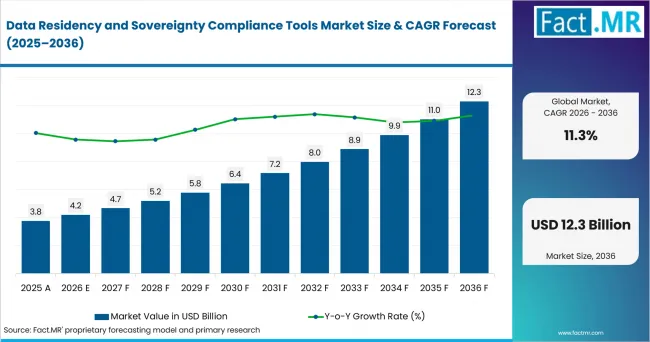
Data Residency And Sovereignty Compliance Tools Market Value Analysis | Source: Fact.MR
What are the defining numbers behind Data Residency and Sovereignty Compliance Tools Market growth?
USD 8.1 billion absolute opportunity is expected by 2036.
- Demand Drivers in the Market
- Enterprises need tools that show where regulated data is stored before cloud teams approve workload movement.
- Compliance teams use residency controls to reduce manual audit work and prove that policies are applied to each workload.
- Public-sector and regulated buyers need simple evidence trails before they trust cloud platforms with sensitive records.
- Security teams are expected to combine data-location checks with access rules because compliance reviews now cover both control areas.
- Key Segments Analyzed
- By Compliance Solution: Data Residency Management is expected to hold 41.0% share in 2026 because buyers first need clear visibility into where data resides.
- By Deployment Model: Cloud Workload Compliance is projected to account for 43.0% share in 2026 where cloud estates require policy checks before workload approval.
- By Application Area: BFSI is anticipated to capture 38.0% share in 2026 since banks need auditable handling of customer and transaction data.
- By End-user Organization: Large Enterprises are estimated to represent 42.0% share in 2026 due to multi-country operations and heavier audit exposure.
- By Compliance Technology: Policy Enforcement Engine is forecast to hold 37.0% share in 2026 as organizations need controls that act on approved rules automatically.
- Analyst Opinion at Fact.MR
- Shambhu Nath Jha, Principal Consultant at Fact.MR, states, “Data residency and sovereignty compliance tools must make location decisions easier for legal and cloud teams. Buyers are expected to reward providers that show how policies work inside daily operations.”
- Strategic Implications
- Cloud governance teams should define residency requirements before provider selection influences architecture decisions.
- Platform providers can support renewals by showing how policy enforcement reduces audit preparation time.
- Channel partners should separate basic compliance monitoring from tools that produce workload-level proof for regulated accounts.
The USA leads at 12.4% CAGR through cloud compliance depth and regulated enterprise demand. Germany follows at 11.9% CAGR due to stronger sovereignty-led procurement. Canada reaches 11.5% CAGR through public-sector and enterprise governance needs. Singapore records 11.0% CAGR through regional cloud control demand. The UK reaches 10.6% CAGR. Australia follows at 10.1% CAGR. Japan records 9.7% CAGR through cautious regulated-cloud adoption.
How does the Data Residency and Sovereignty Compliance Tools Market break down by segment?
Data Residency Management is expected to lead Compliance Solution at 41.0% share in 2026. Cloud Workload Compliance is projected to lead Deployment Model at 43.0% share in 2026.
Which compliance solution dominates?
Data residency management is projected to account for 41.0% share in 2026.
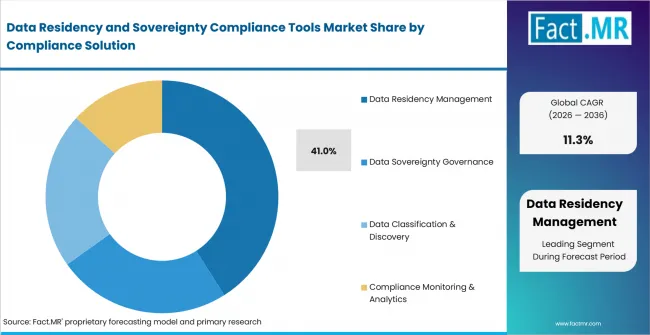
Data Residency And Sovereignty Compliance Tools Market Analysis By Compliance Solution | Source: Fact.MR
Its lead reflects the basic requirement to know where regulated data is stored before applying wider controls. This visibility helps compliance teams review cloud workloads, cross-border transfers and digital product passport workflows with clearer location evidence.
What leads the deployment model segment?
Cloud workload compliance is expected to hold 43.0% share in 2026.
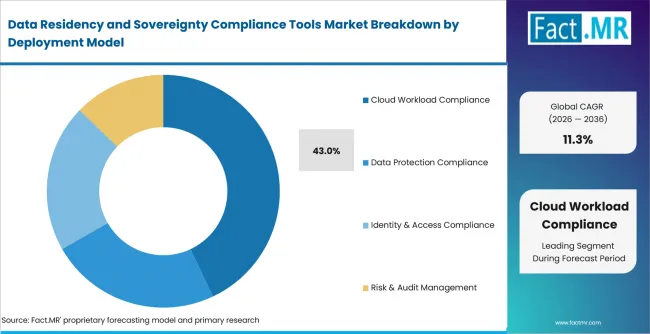
Data Residency And Sovereignty Compliance Tools Market Analysis By Deployment Model | Source: Fact.MR
Rapid changes across cloud environments give this model the strongest demand base. Organizations use compliance checks before workloads are moved, expanded or reconfigured. The same process supports closer control across public cloud management and multi-cloud operations.
How does application area shape demand?
BFSI is anticipated to lead with 38.0% share in 2026.
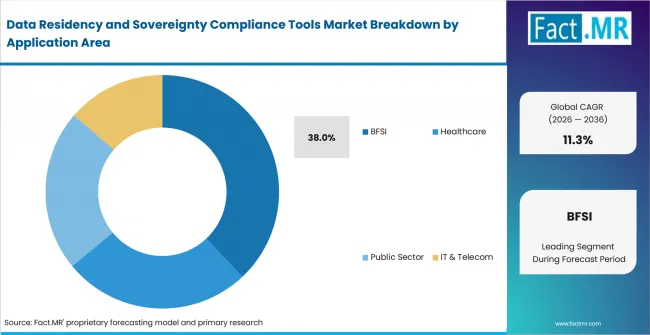
Data Residency And Sovereignty Compliance Tools Market Analysis By Application Area | Source: Fact.MR
Banks and insurers manage sensitive customer information across large and connected systems. Residency tools help trace how data moves during audits and regulatory reviews. This capability also supports digital identity services where location, access and record handling must remain visible.
What supports large enterprises within end-user organization?
Large enterprises are estimated to represent 42.0% share in 2026.
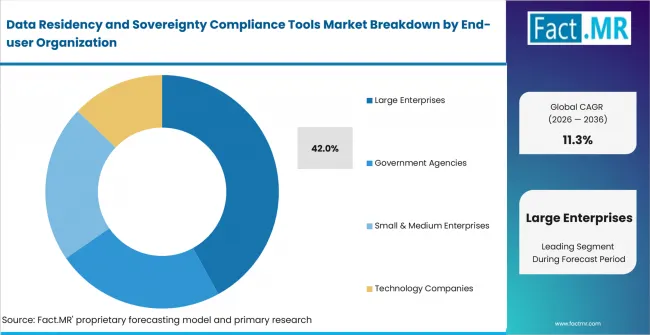
Data Residency And Sovereignty Compliance Tools Market Analysis By End User Organization | Source: Fact.MR
Operating across several countries and cloud environments creates more complex compliance responsibilities. Large organizations therefore rely on repeatable controls that reduce manual evidence collection. Centralized monitoring also helps business units follow common policies without rebuilding compliance processes separately.
What supports policy enforcement engine within compliance technology?
Policy enforcement engine is forecast to hold 37.0% share in 2026.
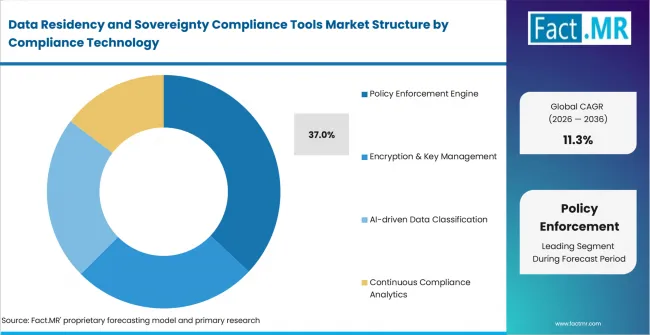
Data Residency And Sovereignty Compliance Tools Market Analysis By Compliance Technology | Source: Fact.MR
This technology leads by converting written data-location rules into active controls. It can block non-compliant movement, flag policy conflicts and guide workload placement. Automation becomes more valuable as data estates expand and manual review becomes harder to maintain.
What is accelerating Data Residency and Sovereignty Compliance Tools Market adoption, and what is holding it back?
Demand is expected to rise through regulated cloud use and stronger evidence requirements. Growth may be limited by integration cost and difficult policy mapping.
Drivers Impact Analysis
| DRIVER | (~) % IMPACT ON CAGR | GEOGRAPHIC RELEVANCE | IMPACT TIMELINE |
|---|---|---|---|
| Adoption and integration | +1.6% | Global | Short term (<= 2 years) |
| Regulatory and compliance support | +1.4% | USA; Germany; UK | Short term (<= 2 years) |
| Channel and access expansion | +1.1% | Global | Medium term (2-4 years) |
| Clear specification and documentation | +0.9% | USA; UK; Canada | Medium term (2-4 years) |
| Cost and efficiency gains | +0.6% | Global | Long term (>= 4 years) |
Source: Fact.MR analysis. Updated Aug 6, 2026
- Adoption and integration: Cloud teams are expected to require residency checks before workload approval becomes routine.
- Regulatory and compliance support: Data protection reviews are expected to raise demand for tools that translate policy into clear control steps.
- Channel and access expansion: Service partners are expected to help buyers deploy controls when internal compliance capacity is limited.
Opportunity Impact Analysis
| OPPORTUNITY | (~) % IMPACT ON CAGR | GEOGRAPHIC RELEVANCE | IMPACT TIMELINE |
|---|---|---|---|
| Emerging application expansion | +1.0% | Global | Medium term (2-4 years) |
| Premium and specialist positioning | +0.8% | USA; UK; Germany | Medium term (2-4 years) |
| Channel and partner expansion | +0.7% | Global | Long term (>= 4 years) |
| Standards and compliance alignment | +0.5% | USA; Canada; Singapore | Long term (>= 4 years) |
Source: Fact.MR analysis. Updated Aug 6, 2026
- Emerging application expansion: AI and analytics workloads are expected to create new review points for residency controls.
- Premium and specialist positioning: Providers with clear audit evidence are expected to gain attention from regulated accounts.
- Channel and partner expansion: Managed service partners are expected to widen access for buyers that lack internal compliance teams.
Restraints Impact Analysis
| RESTRAINT | (~) % IMPACT ON CAGR | GEOGRAPHIC RELEVANCE | IMPACT TIMELINE |
|---|---|---|---|
| Cost and complexity | -1.1% | Global | Short term (<= 2 years) |
| Specification and compliance checks | -0.9% | USA; UK; Germany | Short term (<= 2 years) |
| Substitution by lower-cost alternatives | -0.7% | Import-dependent markets | Medium term (2-4 years) |
| Supply chain and pricing pressure | -0.5% | Global | Long term (>= 4 years) |
Source: Fact.MR analysis. Updated Aug 6, 2026
- Cost and complexity: Buyers may delay projects when mapping rules across many cloud services takes too much internal effort.
- Specification and compliance checks: Procurement teams may slow approval when the tool cannot explain policy actions in plain language.
- Substitution by lower-cost alternatives: Some buyers may use basic reports when legal exposure is lower and audit cycles are lighter.
Which countries are scaling the Data Residency and Sovereignty Compliance Tools Market fastest?
- The country comparison spans 2.7 percentage points and forms a clear growth range across the forecast period.
- The USA remains 0.5 percentage point above Germany through cloud compliance depth and regulated enterprise demand.
- Germany remains 0.4 percentage point above Canada due to sovereignty-led procurement and provider localization needs.
- Canada remains 0.5 percentage point above Singapore through public-sector and enterprise governance requirements.
- Singapore remains 0.4 percentage point above the UK through regional cloud control demand.
- The UK remains 0.5 percentage point above Australia through compliance modernization in regulated enterprise accounts.
- Australia remains 0.4 percentage point above Japan because procurement teams are increasing attention to data-location proof.
Comparable CAGRs can create different entry conditions due to provider depth and local cloud maturity. Full report coverage includes North America; Latin America; Europe; East Asia; South Asia and Pacific; Middle East and Africa.
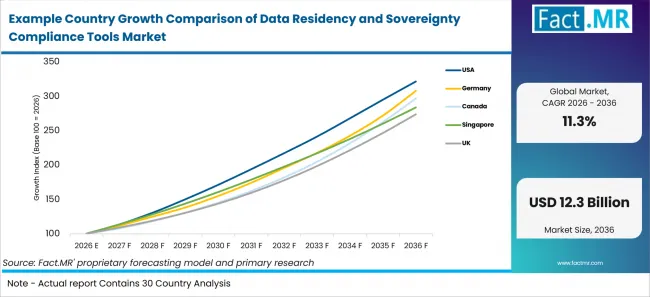
Example Country Growth Comparison Of Data Residency And Sovereignty Compliance Tools Market | Source: Fact.MR
Country CAGR (2026-2036)
| Country | CAGR (2026-2036) |
|---|---|
| USA | 12.4% |
| Germany | 11.9% |
| Canada | 11.5% |
| Singapore | 11.0% |
| UK | 10.6% |
| Australia | 10.1% |
| Japan | 9.7% |
Source: Fact.MR analysis. Updated Aug 6, 2026
What supports USA adoption?
12.4% CAGR, supported by cloud compliance depth and regulated enterprise demand.
The USA’s growth reflects a large enterprise base where legal and cloud teams must agree before sensitive workloads move. Vendors that make audit review easier are likely to hold an advantage with financial and public-sector accounts.
How is Germany scaling demand?
11.9% CAGR, driven by sovereignty-led procurement and provider localization needs.
Germany’s growth is shaped by strong attention to operational control and local accountability. Providers are expected to gain trust when they explain data location and policy enforcement in simple customer materials.
What is driving Canada’s growth from 2026 to 2036?
11.5% CAGR, backed by public-sector and enterprise governance requirements.
In Canada, demand is expected to grow through public and regulated organizations that need clearer data handling evidence. Suppliers that reduce manual evidence collection can support wider use across enterprise cloud programs.
How is Singapore developing demand?
11.0% CAGR, supported by regional cloud control demand.
Singapore’s growth reflects its role as a regional hub for finance and managed services. Organizations using cross-border cloud operations need tools that explain where data is stored and who can access it.
How does the UK perform?
10.6% CAGR, led by compliance modernization in regulated enterprise accounts.
The UK continues to offer demand where banks and public agencies modernize cloud governance. Buyers are expected to prefer tools that make residency checks part of daily cloud operations.
What supports Australia’s growth?
10.1% CAGR, backed by procurement focus on data-location evidence.
Australia’s demand is supported by organizations that need practical control over where regulated information is stored. Security and compliance teams are expected to ask vendors for plain evidence before approval.
How is Japan building demand?
9.7% CAGR, supported by enterprise security modernization and careful data handling.
Japan develops demand through cautious cloud programs where documentation quality matters before deployment. Adoption may move more slowly when teams need extra review before changing established workflows.
Who leads the Data Residency and Sovereignty Compliance Tools Market?
Microsoft and IBM show broad relevance because sovereign cloud controls are part of their enterprise portfolios. Oracle, AWS and Google add breadth. SAP and Cloudflare extend the field through governance and data-localization capabilities.
Competition is expected to depend on evidence quality and ease of use. Providers that connect policy enforcement with NIS2 compliance services and CDN security are likely to receive stronger consideration. Personal data vault services also show why buyers want control over where sensitive data is held.
Which companies are the key providers?
Key companies include Microsoft Corporation; IBM Corporation; Oracle Corporation; Amazon Web Services, Inc.; Google LLC; SAP SE; Cisco Systems, Inc.; Palo Alto Networks, Inc.; Thales Group; Cloudflare, Inc.
- Microsoft Corporation
- IBM Corporation
- Oracle Corporation
- Amazon Web Services, Inc.
- Google LLC
- SAP SE
- Cisco Systems, Inc.
- Palo Alto Networks, Inc.
- Thales Group
- Cloudflare, Inc.
Bibliography
- Amazon Web Services. (2026, January 14). Opening the AWS European Sovereign Cloud.
- Cloudflare. (2026). Data Localization Suite. Cloudflare Docs.
- Directorate-General for Communication. (2024, January 11). Data Act enters into force: what it means for you. European Commission.
- Gallot, H. (2025, May 21). Advancing sovereignty, choice, and security in the cloud for our customers. Google Cloud.
- IBM. (2026, May 5). IBM Sovereign Core creates AI-ready sovereign environments with verifiable control.
This Report Answers
- The report provides intelligence on the Data Residency and Sovereignty Compliance Tools Market across Compliance Solution and Deployment Model choices.
- Segment analysis covers Data Residency Management and Cloud Workload Compliance as the share leaders within the 2026 market.
- Country outlook evaluates the USA; Germany; Canada; Singapore; the UK; Australia; and Japan.
- Competitive analysis profiles Microsoft and IBM alongside Oracle and Amazon Web Services. Google and SAP complete the provider set with Cisco; Palo Alto Networks; Thales; and Cloudflare.
- Compliance technology assessment covers Policy Enforcement Engine and Encryption & Key Management. AI-driven Data Classification and Continuous Compliance Analytics complete the view.
What does the Data Residency and Sovereignty Compliance Tools Market cover?
Data residency and sovereignty compliance tools help organizations locate regulated data and apply rules that control where it is stored or processed.
The market covers software and cloud controls used for residency management, data sovereignty governance and compliance monitoring. It also includes data classification and policy enforcement. Encryption and continuous compliance analytics are included when they support audit evidence.
What is included in the scope?
Data residency and sovereignty compliance tools are used across large enterprises and government agencies. Small and medium enterprises and technology companies are also included.
The scope includes Compliance Solution and Deployment Model alongside Application Area, End-user Organization and Compliance Technology. Coverage spans BFSI and healthcare. Public sector and IT & telecom are included. Identity and access compliance, risk review and audit management follow the same control-use rule.
What is excluded from the scope?
General storage platforms and broad cloud management tools remain outside the scope when they do not provide residency or sovereignty compliance functions.
The scope excludes consulting-only services when no software or cloud-control component is provided. It also excludes data centers and access platforms when the product does not produce residency evidence.
How Was the Analysis Built?
The analysis draws on 120+ sources, 35+ company portfolios, 25+ countries, and more than 20 industry interviews.
- Primary Research: Primary research includes discussions with manufacturers, service providers, technology developers, distributors, end users, procurement teams, and subject-matter experts. These conversations examine purchasing priorities, product adoption, operational challenges, approval requirements, competitive positioning, and the factors that influence wider market acceptance.
- Desk Research: Desk research covers government statistics, regulatory publications, company filings, trade data, technical studies, industry associations, standards, public policy, and other authoritative sources. Every source used in the analysis is documented in the bibliography.
- Market Sizing and Forecasting: Market estimates combine historical performance, demand indicators, pricing and volume trends, segment shares, company participation, country-level growth, adoption patterns, investment activity, and barriers to market expansion.
- Data Validation and Update Cycle: Findings are validated by comparing primary interviews with public data, company activity, regulatory changes, trade patterns, and industry developments. Regular updates review new product launches, capacity changes, partnerships, approvals, procurement trends, and shifts in commercial adoption.
Segmentation
What is the report's scope and coverage?
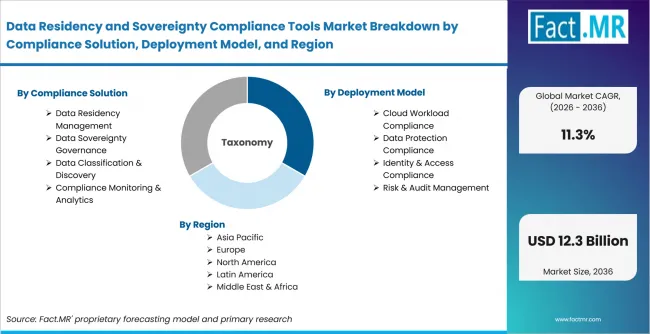
Data Residency And Sovereignty Compliance Tools Market Breakdown By Compliance Solution, Deployment Model, And Region | Source: Fact.MR
| Attribute | Details |
|---|---|
| Quantitative Units | USD billion |
| Market Definition | Software and cloud controls that identify regulated data locations and produce residency evidence for audits |
| Compliance Solution | Data Residency Management; Data Sovereignty Governance; Data Classification & Discovery; Compliance Monitoring & Analytics |
| Deployment Model | Cloud Workload Compliance; Data Protection Compliance; Identity & Access Compliance; Risk & Audit Management |
| Application Area | BFSI; Healthcare; Public Sector; IT & Telecom |
| End-user Organization | Large Enterprises; Government Agencies; Small & Medium Enterprises; Technology Companies |
| Compliance Technology | Policy Enforcement Engine; Encryption & Key Management; AI-driven Data Classification; Continuous Compliance Analytics |
| Regions Covered | North America; Latin America; Europe; East Asia; South Asia and Pacific; Middle East and Africa |
| Countries Covered | USA; Germany; Canada; Singapore; UK; Australia; Japan |
| Key Companies Profiled | Microsoft Corporation; IBM Corporation; Oracle Corporation; Amazon Web Services, Inc.; Google LLC; SAP SE; Cisco Systems, Inc.; Palo Alto Networks, Inc.; Thales Group; Cloudflare, Inc. |
| Forecast Period | 2026 to 2036 |
| Approach | Hybrid top-down and bottom-up approach using regulated enterprise demand; cloud workload movement; compliance technology adoption; segment share; country growth; provider portfolio review; pricing assessment |
Source: Fact.MR analysis. Updated Aug 6, 2026
How is the market segmented?
-
By Compliance Solution:
- Data Residency Management
- Data Localization Controls
- Cross-border Data Governance
- Data Sovereignty Governance
- Regulatory Policy Management
- Audit & Compliance Reporting
- Data Classification & Discovery
- Sensitive Data Discovery
- Data Inventory Management
- Compliance Monitoring & Analytics
- Real-time Compliance Dashboard
- Regulatory Reporting
- Data Residency Management
-
By Deployment Model:
- Cloud Workload Compliance
- Multi-cloud Workloads
- Hybrid Cloud
- Data Protection Compliance
- GDPR Compliance
- National Privacy Compliance
- Identity & Access Compliance
- Privileged Access Governance
- Identity Federation
- Risk & Audit Management
- Internal Risk Assessment
- Third-party Risk Monitoring
- Cloud Workload Compliance
-
By Application Area:
- BFSI
- Banking
- Insurance
- Healthcare
- Hospitals
- Healthcare Providers
- Public Sector
- Defense
- Public Administration
- IT & Telecom
- Telecommunications
- IT Services
- BFSI
-
By End-user Organization:
- Large Enterprises
- Global Enterprises
- Multinational Organizations
- Government Agencies
- Public Sector Organizations
- Regulated Industries
- Small & Medium Enterprises
- Regulatory Authorities
- Cloud Service Providers
- Technology Companies
- Digital Service Providers
- Managed Service Providers
- Large Enterprises
-
By Compliance Technology:
- Policy Enforcement Engine
- Automated Policy Engine
- Real-time Compliance Monitoring
- Encryption & Key Management
- Customer-managed Encryption Keys
- Bring Your Own Key (BYOK)
- AI-driven Data Classification
- Automated Data Discovery
- Metadata Classification
- Continuous Compliance Analytics
- Automated Risk Assessment
- Compliance Intelligence
- Policy Enforcement Engine
-
By Region:
- North America
- Latin America
- Europe
- East Asia
- South Asia and Oceania
- Middle East and Africa
Frequently Asked Questions
How big is the data residency and sovereignty compliance tools market in 2026?
What is the CAGR of the data residency and sovereignty compliance tools market from 2026 to 2036?
Which compliance solution leads the data residency and sovereignty compliance tools market?
Which deployment model leads the data residency and sovereignty compliance tools market?
Who are the leading companies in the data residency and sovereignty compliance tools market?
Who worked on this report


Preview the report firsthand - request a free sample
Free SampleGet the brochure for pricing and purchase details
Download PDF