- Market Value (2025): USD 455.5 Mn
- Estimated Value (2026): USD 490.1 Mn
- Forecast Value (2036): USD 1020.6 Mn
- CAGR (2026-2036): 7.6%
What is the Packaged Sour Cream Substitutes Market forecast to be worth by 2036?
USD 490.1 million in 2026 to USD 1,020.6 million by 2036 at a 7.6% CAGR.
- As per Fact.MR analysis, the Packaged Sour Cream Substitutes Market was valued at USD 455.5 million in 2025.
- Demand will grow from USD 490.1 million in 2026 to USD 1,020.6 million by 2036.
- The forecast records a 7.6% CAGR from 2026 to 2036 as consumers seek more plant-based food alternatives.
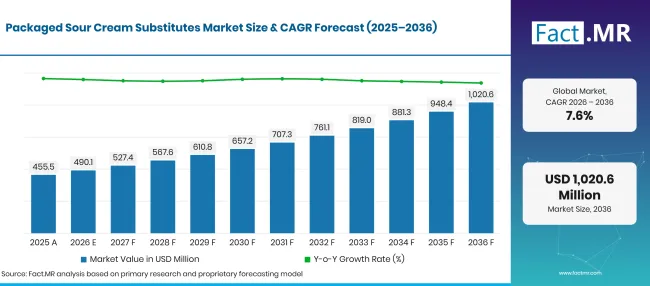
Factmr Packaged Sour Cream Substitutes Market Forecast Global | Source: Fact.MR
| Year | Basis | Market Value (USD million) |
|---|---|---|
| 2025 | Actual | 455.5 |
| 2026 | Estimate | 490.1 |
| 2036 | Forecast | 1,020.6 |
| CAGR 2026 to 2036 | Forecast period | 7.6% |
Source: Fact.MR analysis. Updated Oct 19, 2026
What are the defining numbers behind Packaged Sour Cream Substitutes Market growth?
USD 530.5 million absolute opportunity between 2026 and 2036.
- Demand Drivers in the Market
- Growing consumer demand for plant-based alternatives have driven the growth of the market.
- Consumers increasingly evaluate ingredient lists and dietary suitability when selecting dairy alternatives. Manufacturers of packaged sour cream substitutes can respond by offering products with transparent ingredient declarations, clearly identified allergens, and formulations tailored to specific dietary preferences.
- Restaurants, cafés, catering businesses, and commercial kitchens create opportunities for packaged sour cream substitutes used in dips, sauces, toppings, and prepared meals.
- Key Segments Analyzed
- By Product Type: Plant-Based Substitutes account for 58.3% share in 2026, reflecting the importance of non-dairy alternatives in the packaged sour cream substitute’s category.
- By Application: Cooking represents 35.6% share in 2026, supported by the use of sour cream substitutes in savory dishes, meal preparation, and recipes that require a creamy ingredient.
- By Sales Channel: Supermarkets/Hypermarkets lead with a 48.9% share, highlighting the role of established grocery retail networks in product distribution.
- By End-User: Households account for 62.7% share in 2026, making consumer-oriented packaged products a key focus for manufacturers.
- Analyst Opinion at Fact.MR
- Shambhu Nath Jha, Principal Consultant at Fact.MR, states, “The packaged sour cream substitutes market is positioned for growth as consumers seek alternatives that offer familiar creaminess, tanginess, and versatility in everyday recipes. Products from companies such as Kite Hill, Follow Your Heart, and Forager Project illustrate how manufacturers are developing alternatives for cooking, baking, and other food applications. Product performance, ingredient transparency, and consumer acceptance will remain important considerations as the category expands.”
- Strategic Implications
- Manufacturers need to prioritize taste, texture, and consistency to help packaged sour cream substitutes perform effectively in both hot and cold recipes.
- Product developers should evaluate plant-based and dairy-based formulations to serve consumers with different dietary preferences and product requirements.
- Retailers are encouraged to focus on strengthening product visibility across supermarkets, hypermarkets, and online stores to improve consumer awareness and purchasing convenience.
- Brands must communicate ingredient composition, allergen information, and appropriate product uses clearly on packaging.
- Food service suppliers should focus on formulation consistency and practical pack sizes to support commercial kitchens, restaurants, and other professional food operations.
Germany is projected to register a 7.3% CAGR through 2036. Brazil is expected to record a 5.4% CAGR, followed by the USA at 6.2%. The UK is forecast to advance at 7.7%, while Japan is projected to grow at 6.6%. These country-level growth rates indicate varied expansion prospects across the five markets. Local dietary preferences, retail access, product availability, and familiarity with plant-based alternatives will influence market development.
How does the Packaged Sour Cream Substitutes Market break down by segment?
Fact.MR finds that Plant-Based Substitutes leads Product Type at 58.3%; Cooking leads Application at 35.6%; Supermarkets/Hypermarkets leads Sales Channel at 48.9%; Households leads End-User at 62.7%
Which Product Type dominates?
Plant-Based Substitutes hold 58.3% share in 2026.
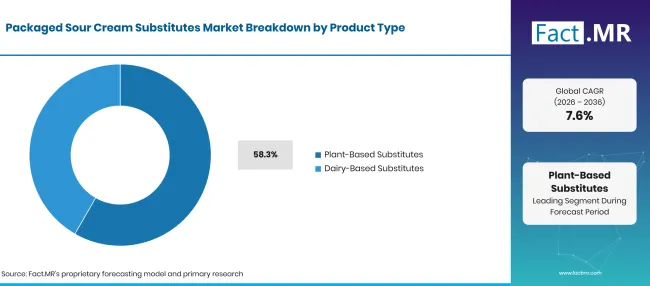
Factmr Packaged Sour Cream Substitutes Market Breakdown Product Type | Source: Fact.MR
| Product Type | Share (2026) |
|---|---|
| Plant-Based Substitutes (Leading segment) | 58.3% |
| Other segments combined | 41.7%* |
| Total | 100.0% |
Source: Fact.MR analysis. Updated Oct 19, 2026
Plant-based substitutes hold the leading share of the packaged sour cream substitutes market, supported by demand for dairy-free alternatives and plant-derived ingredients. Dairy-based substitutes remain relevant for consumers seeking alternatives within the traditional dairy category. Companies such as Kite Hill, Follow Your Heart, and Forager Project participate in the plant-based alternatives space.
What leads the Application segment?
Cooking represents 35.6% share in 2026.
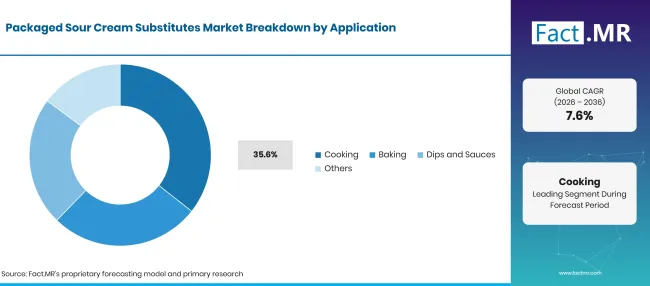
Factmr Packaged Sour Cream Substitutes Market Breakdown Application | Source: Fact.MR
| Application | Share (2026) |
|---|---|
| Cooking (Leading segment) | 35.6% |
| Other segments combined | 64.4%* |
| Total | 100.0% |
Source: Fact.MR analysis. Updated Oct 19, 2026
Cooking accounts for the stated application share as packaged sour cream substitutes can be used to add creaminess, texture, and flavor to everyday meals. Baking applications depend on the product's moisture content, consistency, and performance when heated. Dips and sauces provide additional opportunities for use in snacks, dressings, and prepared foods, while other applications serve varied household and food preparation needs.
How does Sales Channel shape demand?
Supermarkets/Hypermarkets account for 48.9% share in 2026.
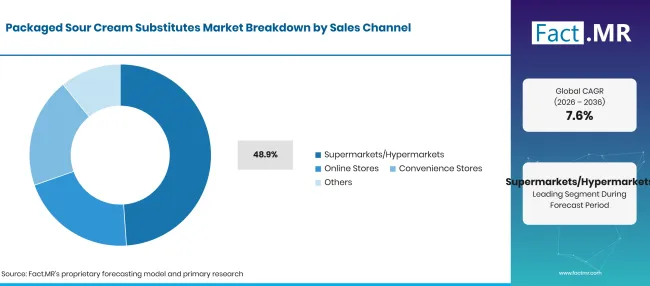
Factmr Packaged Sour Cream Substitutes Market Breakdown Sales Channel | Source: Fact.MR
| Sales Channel | Share (2026) |
|---|---|
| Supermarkets/Hypermarkets (Leading segment) | 48.9% |
| Other segments combined | 51.1%* |
| Total | 100.0% |
Source: Fact.MR analysis. Updated Oct 19, 2026
Supermarkets/hypermarkets represent the leading sales channel because they provide consumers with access to packaged sour cream substitutes alongside other refrigerated and plant-based products. Online stores offer convenience, product discovery, and home delivery, while convenience stores serve consumers seeking quick purchases. Other sales channels contribute to market access through different retail formats.
Which End-User dominates?
Households lead with 62.7% share in 2026.
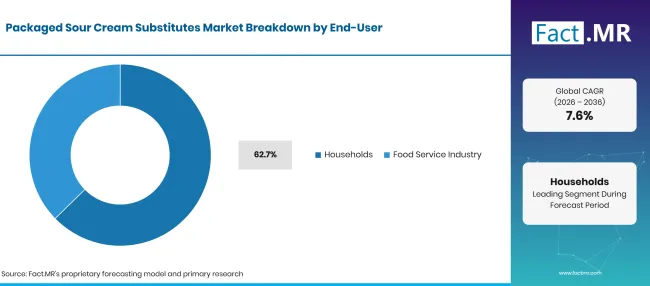
Factmr Packaged Sour Cream Substitutes Market Breakdown End User | Source: Fact.MR
| End-User | Share (2026) |
| Households (Leading segment) | 62.7% |
| Other segments combined | 37.3%* |
| Total | 100.0% |
Source: Fact.MR analysis. Updated Oct 19, 2026
Households represent the leading end-user share as consumers purchase packaged sour cream substitutes for cooking and baking as well as for dips and everyday meal preparation. Demand is influenced by dietary preferences, convenience, and the availability of plant-based and dairy-based options. The food service industry also represents an important end-user segment, with restaurants, caterers, and commercial kitchens using sour cream substitutes in recipes and prepared dishes.
What is accelerating Packaged Sour Cream Substitutes Market adoption, and what is holding it back?
Growing demand for plant-based alternatives boosts the adoption of the Packaged Sour Cream Substitutes Market, but high product prices and limited consumer awareness may slow market growth.
Drivers Impact Analysis
| DRIVER | (~) % IMPACT ON CAGR | GEOGRAPHIC RELEVANCE | IMPACT TIMELINE |
|---|---|---|---|
| Growing demand for plant-based alternatives | +1.0% | North America, Europe | Medium term (2–4 years) |
| Increasing adoption of dairy-free diets | +0.9% | Global | Short term (≤ 2 years) |
| Expanding use in cooking, baking, dips and sauces | +0.7% | Global | Medium term (2–4 years) |
| Wider availability through supermarkets and online stores | +0.5% | Global | Short term (≤ 2 years) |
| Rising innovation in plant-based formulations | +0.4% | North America, Europe | Long term (≥ 4 years) |
Source: Fact.MR analysis. Updated Oct 19, 2026
Opportunity Impact Analysis
| OPPORTUNITY | (~) % IMPACT ON CAGR | GEOGRAPHIC RELEVANCE | IMPACT TIMELINE |
|---|---|---|---|
| Improved taste and texture of plant-based substitutes | +0.8% | Global | Medium term (2–4 years) |
| Expansion of dairy-free product portfolios | +0.6% | North America, Europe | Medium term (2–4 years) |
| Growing online retail penetration | +0.5% | Americas, Asia | Long term (≥ 4 years) |
| Clearer labelling of plant-based ingredients | +0.4% | Global | Short term (≤ 2 years) |
Source: Fact.MR analysis. Updated Oct 19, 2026
Restraints Impact Analysis
| RESTRAINT | (~) % IMPACT ON CAGR | GEOGRAPHIC RELEVANCE | IMPACT TIMELINE |
|---|---|---|---|
| Higher prices compared with conventional sour cream | -0.8% | Global | Short term (≤ 2 years) |
| Limited consumer awareness and product familiarity | -0.6% | Global | Medium term (2–4 years) |
| Taste and texture differences from conventional sour cream | -0.5% | Global | Short term (≤ 2 years) |
| Limited retail availability in some markets | -0.4% | Emerging markets | Medium term (2–4 years) |
Source: Fact.MR analysis. Updated Oct 19, 2026
Which countries are scaling the Packaged Sour Cream Substitutes Market through 2036?
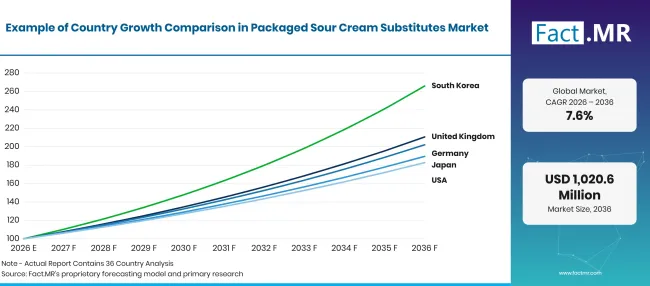
Factmr Packaged Sour Cream Substitutes Market Growth Index | Source: Fact.MR
| Country | CAGR (2026-2036) |
|---|---|
| Germany | 7.3% |
| Brazil | 5.4% |
| USA | 6.2% |
| UK | 7.7% |
| Japan | 6.6% |
Source: Fact.MR analysis. Updated Oct 19, 2026
What supports Germany adoption?
7.3% CAGR, supported by demand for plant-based alternatives and growing interest in dairy-free foods.
Germany’s packaged sour cream substitutes market may benefit from consumer interest in plant-based diets and wider availability of dairy-free products. Product innovation in taste, texture, and ingredient composition can help manufacturers appeal to consumers seeking alternatives to conventional sour cream. In June 2026, GFI Europe reported that Germany’s plant-based food market generated €1.71 billion in retail sales in 2025, with sales value increasing by 3.1% and sales volume rising by 6.2% compared with 2024. This growth across plant-based categories, including cream alternatives, provides context for the expansion of dairy-free products in Germany [3].
How is Brazil developing packaged sour cream substitutes adoption?
5.4% CAGR, driven by expanding interest in dairy-free options and diverse food applications.
Brazil’s market may benefit from the use of sour cream substitutes in cooking, dips, and sauces. Greater retail availability and consumer awareness of plant-based products could support adoption, while affordable pricing and familiar flavors may help manufacturers reach a wider customer base.
What supports United States adoption?
6.2% CAGR, led by established plant-based food demand and expanding dairy alternative choices.
The U.S. market may benefit from consumer interest in flexitarian diets and the availability of plant-based alternatives across multiple food categories. The Plant Based Foods Association reported that plant-based foods generated USD 7.9 billion in U.S. retail sales in 2025, with 60% of households purchasing plant-based foods that year. These broader category indicators provide context for potential growth in packaged sour cream substitutes [2].
How is the United Kingdom building adoption?
7.7% CAGR, shaped by growing interest in plant-based dairy and demand for convenient food alternatives.
UK adoption may benefit from wider retail availability and continued product development in plant-based dairy. The UK government's 2025 assessment noted that the availability and use of plant-based drinks had increased in recent years, while these products remained less widely consumed than cow's milk. Manufacturers of packaged sour cream substitutes can build on consumer familiarity with dairy alternatives by improving taste, texture, and product accessibility [1].
What supports Japan adoption?
6.6% CAGR, backed by interest in plant-based dairy and growing attention to health and nutrition.
Japan’s packaged sour cream substitutes market may benefit from established soy-based foods and growing interest in plant-derived ingredients. Continued product innovation and wider retail availability can help manufacturers introduce dairy-free alternatives for cooking, baking, dips, and sauces. Improving taste, texture, and affordability may further encourage consumers to try packaged sour cream substitutes.
Who leads the Packaged Sour Cream Substitutes Market?
Fact.MR finds that Kite Hill, Follow Your Heart, Forager Project, WayFare Foods, and Tofutti Brands are profiled across the nutrient value chain.
Kite Hill and Forager Project are relevant to the plant-based dairy alternatives market. Follow Your Heart and Tofutti Brands offer dairy-free food products, while WayFare Foods participates in the plant-based alternatives segment. Product offerings should be checked for the specific sour cream substitute and its ingredients before treating two portfolios as directly comparable. In February 2026, Treeline Cheese announced an expansion into Whole Foods Market, with its cashew sour cream being introduced in selected regional stores beginning in March. UNFI was identified as the distribution partner for the expansion. This demonstrates how retail distribution partnerships can increase the availability of plant-based sour cream alternatives [4].
Commercial competition depends on product quality, taste, texture, pricing, and retail availability. Manufacturers need consistent formulations that deliver a creamy texture and suitable performance in cooking and baking. Retailers need reliable product supply and clear ingredient labeling. Consumers need convenient access to affordable alternatives that meet their dietary preferences and expectations for flavor and consistency.
Which companies are the key providers?
Key companies include Kite Hill; Follow Your Heart; Forager Project; WayFare Foods and Tofutti Brands.
- Kite Hill
- Follow Your Heart
- Forager Project
- WayFare Foods
- Tofutti Brands
Bibliography
- [1] Office for Health Improvement and Disparities. (2025, July 16). SACN and COT assessment of the health benefits and risks of consuming plant-based drinks: Summary. GOV.UK.
- [2] Plant Based Foods Association. (2026, June 3). Plant-based foods are a staple in American households—Regional data highlights growing opportunity.
- [3] The Good Food Institute Europe. (2026, June 9). Germany remains Europe’s leading market for plant-based foods with 3.1% growth in sales value.
- [4] Treeline Cheese. (2026, February 6). Treeline Cheese expands assortment at Whole Foods Market [Press release]. NOSH.
This Report Answers
- The report describes how packaged sour cream substitutes are used across the specified applications.
- Segment analysis compares the specified product categories and their 2026 shares.
- Country analysis discusses Germany, Brazil, USA, UK, and Japan alongside their respective market growth rates.
- The competitive overview profiles Kite Hill, Follow Your Heart, Forager Project, WayFare Foods, and Tofutti Brands.
What does the Packaged Sour Cream Substitutes Market cover?
The market covers packaged plant-based and dairy-based alternatives designed to replace conventional sour cream. It tracks product use in cooking, baking, dips and sauces, and other food applications. Product coverage follows the specified categories, while distribution coverage separates supermarkets and hypermarkets, online stores, convenience stores, and other sales channels. Consumer purchasing decisions depend on taste, texture, ingredients, price, and suitability for intended food preparation.
What is included in the scope?
Included products comprise packaged plant-based and dairy-based sour cream substitutes sold for household and food service use.
The market value boundary covers products distributed through supermarkets and hypermarkets, online stores, convenience stores, and other stated retail channels. The segmentation also covers cooking, baking, dips and sauces, and other applications, alongside household and food service industry end-users.
What is excluded from the scope?
The analysis excludes conventional sour cream products sold without being positioned as substitutes.
Other plant-based dairy alternatives, such as standalone plant-based milk, yogurt, and cheese, are excluded unless specifically marketed as sour cream substitutes. Industrial food ingredients not sold as packaged sour cream substitutes are outside the defined product category. Sales of food preparation equipment and unrelated dairy-free products are also excluded.
How Was the Analysis Built?
The analysis draws on 120+ sources, 35+ company portfolios, 25+ countries, and more than 20 industry interviews.
- Primary Research: Primary research includes discussions with manufacturers, service providers, technology developers, distributors, end users, and subject-matter experts. These conversations examine purchasing priorities, product adoption, operational challenges, approval requirements, competitive positioning, and the factors that influence wider market acceptance.
- Desk Research: Desk research covers government statistics, regulatory publications, company filings, trade data, technical studies, industry associations, standards, public policy, and other authoritative sources. Every source used in the analysis is documented in the bibliography.
- Market Sizing and Forecasting: Market estimates combine historical performance, demand indicators, pricing and volume trends, segment shares, company participation, country-level growth, adoption patterns, investment activity, and barriers to market expansion.
- Data Validation and Update Cycle: Findings are validated by comparing primary interviews with public data, company activity, regulatory changes, trade patterns, and industry developments. Regular updates review new product launches, capacity changes, partnerships, approvals, and shifts in commercial adoption.
Segmentation
What is the report’s scope and coverage?
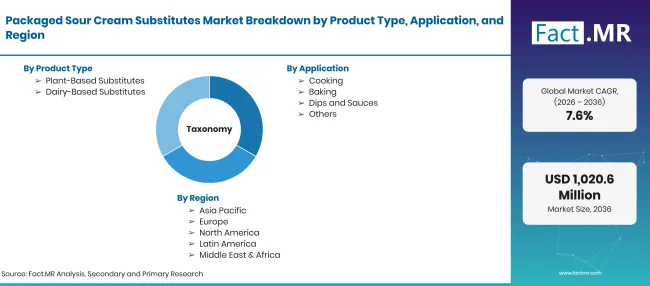
Factmr Packaged Sour Cream Substitutes Market Taxonomy | Source: Fact.MR
| Attribute | Details |
|---|---|
| Quantitative Units | USD million: 2026 valuation, 2036 forecast and CAGR |
| Market Definition | Packaged dairy-based and plant-based sour cream alternatives formulated to replicate the taste, texture, and functionality of conventional sour cream. |
| Product Type | Plant-Based Substitutes; Dairy-Based Substitutes |
| Application | Cooking; Baking; Dips and Sauces; Others |
| Sales Channel | Supermarkets/Hypermarkets; Online Stores; Convenience Stores; Other Methods |
| End-User | Households; Food Service Industry |
| Regions Covered | North America; Latin America; Western Europe; Eastern Europe; East Asia; South Asia & Pacific; Middle East & Africa |
| Countries Covered | Germany; Brazil; USA; UK; Japan |
| Companies Profiled | Kite Hill; Follow Your Heart; Forager Project; WayFare Foods and Tofutti Brands |
| Forecast Period | 2026 to 2036 |
| Approach | Market segmentation and scenario-based analysis supported by official agricultural statistics |
Source: Fact.MR analysis. Updated Oct 19, 2026
How is the market segmented?
-
By Product Type
- Plant-Based Substitutes
- Dairy-Based Substitutes
-
By Application
- Cooking
- Baking
- Dips and Sauces
- Others
-
By Sales Channel
- Supermarkets/Hypermarkets
- Online Stores
- Convenience Stores
- Other
-
By End-User
- Households
- Food Service Industry
-
By Region
- North America
- Latin America
- Western Europe
- Eastern Europe
- East Asia
- South Asia & Pacific
- Middle East & Africa
Frequently Asked Questions
How big is the packaged sour cream substitutes market in 2026?
What is the CAGR from 2026 to 2036?
Which product type has the largest stated share?
Which Application leads?
Which companies are covered?
Who worked on this report


Preview the report firsthand - request a free sample
Free SampleGet the brochure for pricing and purchase details
Download PDF